

The notion that open international markets make societies better off has been increasingly contested in recent years in many advanced economies. Central to these discussions of the merits of trade liberalization is a widespread popular perception that globalization has generated greater wealth for a small group of individuals and firms but has made most citizens worse off. These perceptions are in line with recent research in international trade that has found that the benefits of trade liberalization are indeed highly concentrated in the hands of a few “superstar” exporting firms. These studies show that firm-level differences in size and productivity can account for their divergent export performance, which in turn explains why trade liberalization can unevenly reallocate profits across firms.Footnote 1 Thus critics of globalization in the political arena and the recent literature both depict trade liberalization as a policy choice that concentrates wealth in the hands of the few, at the expense of the many.Footnote 2
At the same time, there are significant differences in the extent to which protectionist sentiments increase and affect the political debate across countries. While in some countries popular concerns over the welfare effects of trade liberalization are widespread and have generated marked protectionist responses from elected representatives, in other countries the opposition to trade liberalization has been much less intense. This observation underscores the importance of assessing whether, and eventually how, domestic institutional factors influence the distribution of the welfare effects of trade liberalization in different societies. The comparative political economy literature has long noted that different domestic institutional setups can affect the distributive consequences and politics of trade in systematic ways.Footnote 3
This paper contributes to the expanding literature on firm heterogeneity and trade politics by incorporating domestic institutional differences into the analysis of the competitive dynamics generated by trade liberalization. We build on Melitz's model of international trade regarding the determinants of the effect of trade liberalization on firms’ performance, and on Iversen and Soskice's model regarding institutional differences between liberal market economies (LMEs) and coordinated market economies (CMEs).Footnote 4 The joint effect of coordination in wage bargaining (which tends to equalize wages within sectors) and state-subsidized vocational training (which creates a large supply of highly skilled workers) in CMEs leads to wage compression—that is, the difference between wages in high- versus low-productivity firms is smaller in CMEs than in LMEs. When trade liberalization kicks in, an implication of CMEs’ commitment to wage compression is upward wage rigidity, even in the case of an expansion of labor demand due to increasing exports. Lower wages imply lower production costs, which help keep unproductive firms more competitive in CMEs than in LMEs. In turn, this generates a reallocation of revenue from the least to the most productive firms, which is weaker in CMEs than in LMEs.
We test our argument using the Amadeus firm-level data set on European Union (EU) countries, which includes information on more than 800,000 manufacturing firms between 2003 and 2016.Footnote 5 Since Amadeus does not include the entire universe of EU firms, we pay particular attention to ensuring that sampling issues do not affect our empirical strategy. To measure the occurrence of trade liberalization, we rely on de jure tariff cuts implemented by the EU with trade partners in all preferential trade agreements (PTAs) signed after 1995. Our identification strategy boils down to a triple difference-in-differences estimation in which the distributional effect of firms’ productivity and tariff cuts varies across labor market institutions. Importantly for our purposes, both LMEs and CMEs face the same preferential tariffs, which helps mitigate concerns about the endogeneity of tariff cuts. Since countries differ with respect to labor market institutions and several other characteristics, we control for a large number of potential confounders—including compensation policies, welfare, access to credit, innovation, and migration flows—in interaction with productivity and tariff cuts to identify the effect of wage-bargaining systems.
We find that, for productive firms, gains from trade are 20 percent larger in countries with LMEs (e.g., the United Kingdom) than they are in CMEs (e.g., Germany). Moreover, we show evidence of the mechanisms highlighted in our theory: both an institutionalized wage ceiling and subsidized vocational training reduce the reallocation effect from the least to the most productive firms after trade liberalization; wages increase significantly more in LMEs than in CMEs as a result of trade liberalization; and employment in the liberalized industries increases more in CMEs than LMEs after trade liberalization due to the oversupply of skilled workers.
We complement our firm-level analysis with suggestive individual-level evidence using European Social Survey (ESS) data and a novel geographical measure of trade liberalization weighted on the share of workers in unproductive firms, which we geolocated at the level of EU regions. By exploiting the heterogeneous impact of trade liberalization across European regions, we show that preferential liberalization generates a weaker demand for redistribution in CMEs compared to LMEs, given that the gains from trade are more uniform in the presence of wage rigidity. Importantly, this effect is driven by less-educated individuals, who are the likely losers from trade openness in developed economies. In line with the firm-level analysis, we show that our results hold even when we account for other characteristics—for example, the size of the welfare system—that correlate with labor market institutions.
Our paper contributes to several lines of research. First, a number of empirical articles have documented selection and market share reallocation effects from trade liberalization.Footnote 6 Recent studies have pointed out that a few large productive firms enjoy the lion's share of the benefits from trade liberalization at the expense of smaller, less productive firms.Footnote 7 We show that domestic institutions affect gains from trade, and that labor market frictions make the benefits from trade liberalization more uniform across firms.
Second, the paper adds to a large literature explaining support for globalization in general, and trade liberalization in particular.Footnote 8 Recent studies have found that trade shocks enhance support for economic nationalism and populism among the losers of globalization.Footnote 9 Our firm-level analysis explains the economic micro-foundations of how these policy preferences are formed by identifying the heterogeneous effects of trade liberalization among firms operating in different types of labor markets.
Third, our paper speaks to the large and important literature on embedded liberalism. Starting with seminal works highlighting the connection between trade openness and government spending for redistributive policies, a flurry of political economy research has investigated the micro-level foundations of this relationship over the years.Footnote 10 The key insight of this stream of research is that compensating the losers of globalization helps increase support for global market integration.Footnote 11 Our findings indicate that domestic institutions, and labor market institutions in particular, complement compensation policies designed to mitigate the backlash against globalization in developed democracies.
Finally, we contribute to the “varieties of capitalism” literatureFootnote 12 by demonstrating how differences in labor market arrangements affect the distributive consequences of trade liberalization. While many prior studies in this literature have noted the significance of various domestic institutional arrangements through which firms coordinate their operations, our study is the first to apply these insights to a firm-level analysis of the distributive consequences of trade liberalization and to explore cross-country variations in individual-level responses to trade liberalization.
Theory
Our theory examines the dynamics linking trade liberalization, productivity, wages, and labor market institutions. Our argument builds on two established strands of scholarship. The first is the recent wave of studies highlighting the relevance of firms as the unit of analysis in explanations of trade policy.Footnote 13 These studies highlight how firm-level characteristics can account for their heterogeneity in export performance, why trade liberalization can unevenly reallocate profits across firms, and the growing relevance of firm-level lobbying over trade policy.Footnote 14
Second, we build on the varieties of capitalism literature, for which the presence (or absence) of strategic coordination mechanisms between firms and employees explains most differences between advanced capitalist countries, including their comparative advantage and trade profiles.Footnote 15 This literature is based on the conceptual distinction between LMEs, in which “firms coordinate their activities primarily via hierarchies and competitive market arrangements,” and CMEs, where firms “depend more heavily on non-market relationships to coordinate their endeavors with other actors and to construct their core competencies.”Footnote 16 These varieties are characterized by different institutional complementarities; we focus here on cross-country differences in (1) wage bargaining institutions and (2) skill formation and training.
Assumptions
Building on these two streams of research, we make three assumptions. First, only the most productive firms are exporters. Based on the seminal work of Melitz,Footnote 17 research has shown that firm-level differences in size and productivity can account for heterogeneity in export performance.Footnote 18 Exporters face trade costs, including the fixed costs of distribution and servicing, as well as variable costs such as transport, insurance, fees, and tariffs. Only the most productive firms can afford to sustain the fixed and variable costs associated with accessing foreign markets and still profit from trade.Footnote 19
Our second assumption is that CMEs rely on coordinated wage bargaining while LMEs do not. In CMEs, coordinated wage bargaining institutions (e.g., trade unions, employer associations, and government agencies) can strike and enforce wage deals for all firms operating in a sector.Footnote 20 This implies that wages and wage caps are imposed on entire industries in CMEs, whereas workers bargain for wages in a decentralized manner at the plant level in LMEs.Footnote 21
Our third assumption is that CMEs ensure a large supply of highly skilled workers due to the presence of publicly subsidized vocational training systems supervised by employer associations and trade unions. Such systems are largely missing in LMEs.Footnote 22
Armed with these assumptions, we first describe differences in the labor market between CMEs and LMEs. We then introduce trade liberalization, explaining how gains from trade differ in the two types of economies.
The Labor Market in CMEs and LMEs
Iversen and Soskice argue that CMEs have higher wage compression than LMEs as a result of the combined effect of coordinated wage bargaining and state-subsidized training of a skilled workforce.Footnote 23 Wage compression means that there is a relatively small gap between wages paid by productive firms to skilled workers and wages paid by unproductive firms to unskilled workers. Unlike Iversen and Soskice, who focus on difference between sectors (traded versus nontraded), we are interested in differences between firms in the same sector. We posit that wage compression is different between CMEs and LMEs in the same sector populated by firms with heterogeneous productivity, heterogeneous workers’ skills, and therefore heterogeneous wages. It is well documented that manufacturing—the traded sector par excellence—includes firms with different levels of productivity in every economy.Footnote 24
Two mechanisms yield these differences between LMEs and CMEs. First, institutions that coordinate wage bargaining tend to equalize wages within sectors, and to produce deals at the industry level that grant moderate (and in any case predictable) wage increases.Footnote 25 The second mechanism is that state-subsidized vocational training provides a large supply of highly skilled workers to highly productive firms to contain shop-floor pressure against wage increases.Footnote 26
The effects of these two institutions go in the same direction. Both wage coordination and vocational training compress the wages of highly skilled workers employed in productive firms, and simultaneously generate upward pressure on the wages of less skilled workers employed in less productive firms.Footnote 27 Since these institutions are typical of CMEs but not of LMEs (by assumption), differences in wages between productive and unproductive firms in CMEs are less pronounced than in LMEs. This means that the wages of workers in the most productive CMEs should be relatively lower than those of workers employed in firms with similar levels of productivity in LMEs. At the same time, the wages of workers in less productive firms should be relatively higher in CMEs than in LMEs.
One implication of this wage compression is that CMEs have greater wage rigidity than LMEs.Footnote 28 On the one hand, wage compression is assured by wage coordination, which entails well-defined wage setting negotiated by trade unions and business associations. Wages are not permitted to move above or below these levels, at least in the short term. By creating upward wage rigidity, caps on skilled workers’ wages help exporters maintain their competitiveness abroad. On the other hand, subsidized vocational training reduces the cost of acquiring skills, which in turn creates upward rigidity due to an oversupply of skilled workers and downward rigidity due to a shortage of unskilled workers (assuming a constant pool of labor). In sum, upward rigidity reduces the cost of labor for exporters, which is the main goal of wage compression.Footnote 29
The dynamics are quite different in LMEs, where the two mechanisms we described (wage coordination and vocational training) are absent, so wages are more dispersed. Without any form of coordination, wages are free to move in response to market forces. Thus, if some firms need more skilled workers, say, their wages go up, increasing wage dispersion. Moreover, in the absence of publicly subsidized vocational training, the pool of skilled workers is more limited in LMEs than in CMEs. So accommodating any shortage of skilled workers and committing to specific wage settings is more difficult in the former than in the latter, especially in the short term. In other words, wages are flexible in LMEs for two main reasons: there is no commitment to wage compression, and labor dynamics are determined almost entirely by market forces rather than institutions.
The Effect of Trade Liberalization in CMEs and LMEs
In this section we use Melitz's work to explore how CMEs and LMEs respond differently to trade liberalization because of their different labor market institutions.Footnote 30 The Melitz model describes an economy in which firm survival, firm profitability, and firms’ decisions to export all depend on a single firm characteristic: productivity. Remember that, by assumption, exporting firms are more productive than those that serve only the domestic market. More specifically, the Melitz model identifies two productivity cutoffs in every economy: a domestic market productivity cutoff, φ(d), and a foreign market productivity cutoff, φ(x), with φ(d) < φ(x) due to the variable and fixed costs of trade discussed earlier. Firms with a level of productivity higher than φd but lower than φ(x) serve only the domestic market. Those with productivity higher than φ(x) serve both the domestic and foreign markets. Firms with productivity less than φ(d) do not survive in the market and exit. The higher these cutoffs, the fewer firms that are able to survive and to export; thus the remaining firms have higher revenues and profits.
When export tariffs decrease, the variable costs of trade go down as well. This implies that φ′(x) < φ(x), where φ′(x) is the productivity cutoff for exporting after trade liberalization. This has two effects. First, new firms, which were below the foreign market productivity cutoff before trade liberalization, are now able to access foreign markets because the productivity cutoff is lower (i.e., the extensive margins of trade increase). Second, firms that were already exporting before trade liberalization increase their sales in foreign markets because lower tariffs allow them to charge more competitive prices (the intensive margins of trade increase).
The entry of new firms into foreign markets and the increase of sales by firms that were already exporting raise the general demand for inputs, particularly labor. In turn, this greater demand for labor pushes wages up (and thus raises the cost of labor for firms). Only the most productive firms, which sell large amounts of goods in both domestic and foreign markets, can afford to recoup these rising costs of labor and to keep prices low. Less productive firms are unable to sustain the increasing costs without charging higher prices, which in turn leads them to reduce their sales to the advantage of more productive firms (reallocation effect) or, at the extreme, to exit the market (selection effect). Thus, through the labor market channel, a reduction in export tariffs leads to a higher domestic market productivity cutoff, that is, φ(d) < φ′(d), with φ′(d) serving as the domestic market productivity cutoff after trade liberalization. The greater the increase in wages, the higher φ′(d) is and the larger the distributional consequences of trade liberalization across firms are.Footnote 31
While this effect is at play in both CMEs and LMEs, we expect that they diverge in the extent to which wages are able to rise after trade liberalization due to the differences in their labor market rigidities discussed before.
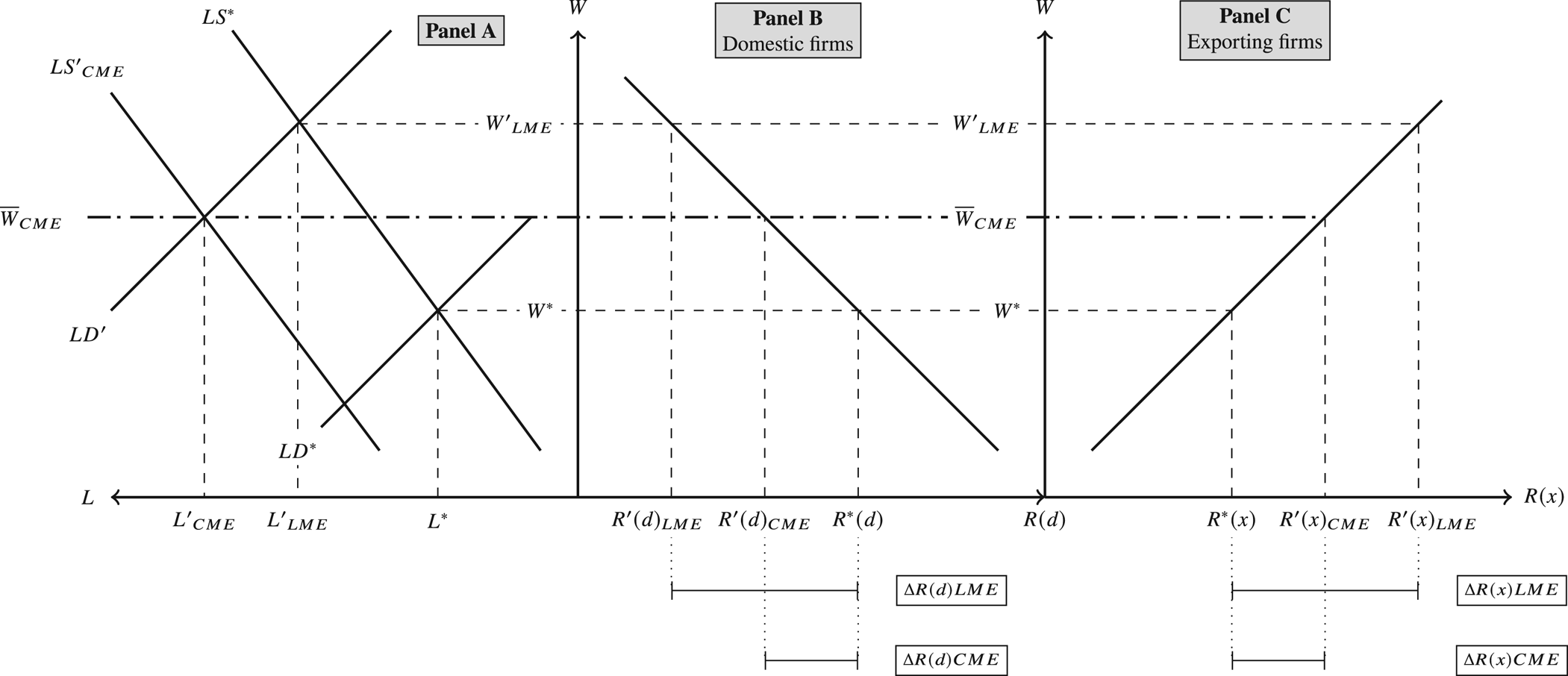
Figure 1 illustrates this argument. A reduction in the variable costs of trade reduces the foreign market productivity cutoff, increasing the number of exports and the total sales in foreign markets.Footnote 32 This increase raises the demand for labor, which shifts to the left, creating an upward pressure on wages (Panel A). At this point, CMEs and LMEs diverge. In LMEs, wages are free to move and labor market frictions are minimal; wages thus rise to the level W′. In CMEs, wages are capped at  ${\bar W}$ due to the presence of wage coordination and collective bargaining among all firms operating in a given industry. Moreover, government-subsidized vocational training generates a surplus of skilled workers, which allows the labor supply to expand, shift to the left, and (partially) offset the wage increase generated by the growing labor demand.Footnote 33 This combination of institutional devices embedded in the labor market helps adjust the expansion of labor demand and keep wages at the negotiated level
 ${\bar W}$, with
 ${\bar W} < {W}^{\prime}$. In sum, wages increase less in CMEs than in LMEs after trade liberalization.Footnote 34
Effect of trade liberalization in CMEs and LMEs: domestic versus exporting firms

Note that more workers are employed in CMEs than in LMEs after trade liberalization  $( {L}^{\prime}_{CME} > {L}^{\prime}_{LME}) $. These workers are disproportionally employed in exporting firms, which experience an expansion of economic activities due to a reduction in the variable costs of trade. This result is consistent with Iversen and Soskice, who argue that the traded sector is larger in CMEs than in LMEs because of wage compression.Footnote 35
These differences in how the labor market adjusts to a rise in demand has important distributional consequences for firms. Figure 1 illustrates that the relationship between wages and revenues is negative for unproductive firms (Panel B) and positive for productive firms (Panel C); the slope is a function of firm productivity. Melitz finds that these relationships hold in equilibrium, that is, after the economy adjusts to trade liberalization.Footnote 36 Since we assume that a firm's ability to export is a function of its productivity, for simplicity's sake, Panel B can be considered to represent the impact of trade liberalization on the average firm that serves the domestic market only. Panel C represents the impact of trade liberalization on the average exporting firm.Footnote 37
What happens to the revenues of domestic firms given the differences in wage increases between CMEs and LMEs? As illustrated in Panel B, we expect a negative relationship between wages and revenues in domestic firms. These firms suffer from wage increases “imposed” by productive exporters. They have to raise their wages to retain employees and to avoid job poaching, but to remain profitable they must also raise prices, which ultimately reduces their revenues. Although this happens in both CMEs and LMEs, our model predicts that the loss of revenue for domestic firms is lower in the former, since the increase in wages is smaller for them.Footnote 38 This is represented by the difference between R*(d) and R′(d), which is smaller in CMEs than in LMEs.
For exporting firms, the situation is the opposite (Panel C): their greater demand for labor drives wage increases. When they expand their workforce, exporting firms increase their sales in both the domestic market (at the expense of less productive firms) and foreign markets, which is why they have a positive relationship between wages and revenues. Again, our model suggests that the consequences of a wage increase are different in LMEs and CMEs. In LMEs, where wages can be raised freely, domestic firms experience a substantive reduction in their sales or are forced to exit the market altogether; thus few productive exporters experience a large increase in their revenues after trade liberalization. In CMEs, this dynamic is mitigated by domestic institutions that limit wage increases. As a result, the increase in revenues for exporters is smaller in CMEs than in LMEs.
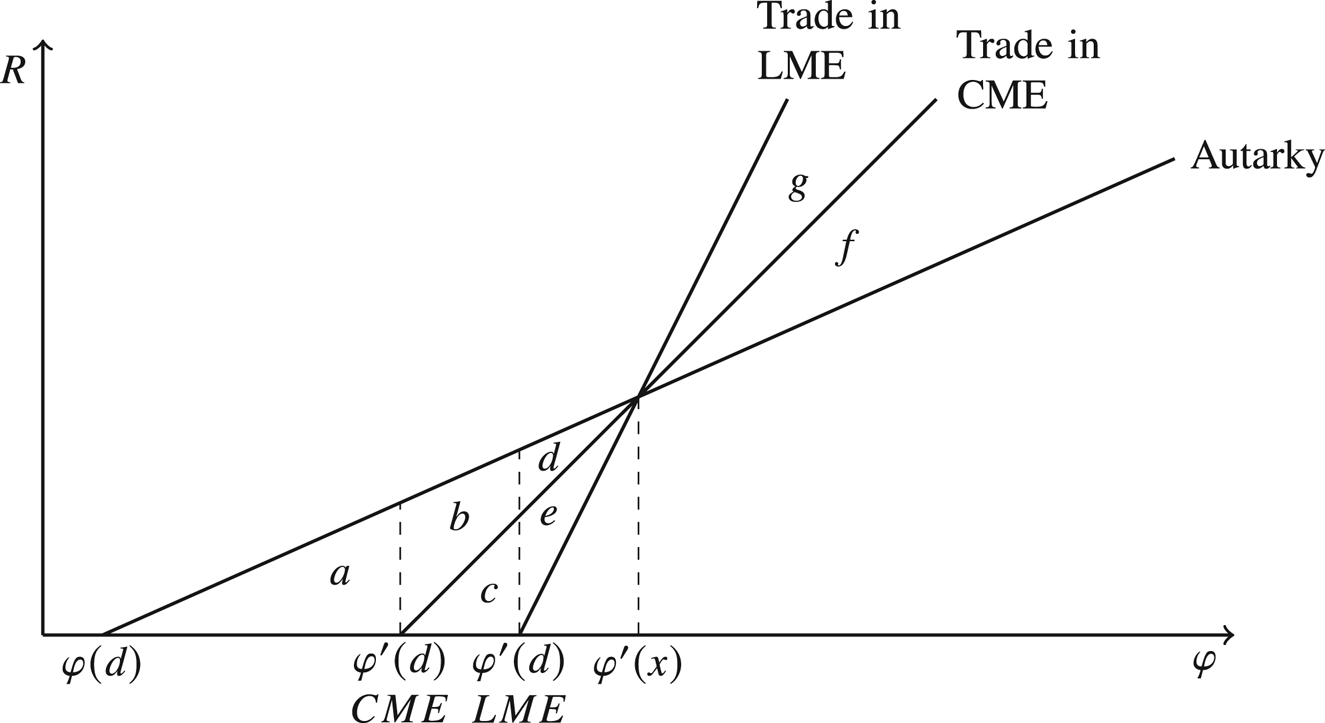
Building on Melitz,Footnote 39 Figure 2 summarizes the differences in selection and reallocation effects between CMEs and LMEs. Remember from Figure 1 that, since wages are more rigid in CMEs than in LMEs, they increase less in the former than in the latter due to trade liberalization, which mitigates the distributional consequences of tariff reductions. Figure 2 shows that, after trade liberalization, the domestic market productivity cutoff increases more in LMEs than in CMEs. Moreover, the slope of trade liberalization is steeper in LMEs than in CMEs, meaning that shifts in the productivity cutoff to the right generate larger revenue increases for exporters in LMEs than in CMEs. This is because the greater increase in the cost of labor experienced by LMEs compared to CMEs reduces the number of unproductive firms more in LMEs than CMEs. Thus, for the same productivity cutoff, there are fewer firms in LMEs than in CMEs; for the surviving firms, revenues are higher in LMEs than in CMEs.Footnote 40
Selection and reallocation effect in CMEs and LMEs

This setup affects both the selection and reallocation effects. The selection effect is weaker in CMEs than in LMEs, since the domestic market cutoff productivity after trade liberalization is lower in CMEs than in LMEs (φ′(d)CME < φ′(d)LME). The selection effect affects all firms placed in a in CMEs, and all firms placed in a+b+c in LMEs. Thus, there are more surviving firms in CMEs than in LMEs after trade liberalization. The reallocation effect is weaker in CMEs than in LMEs. In CMEs, firms placed in d survive trade liberalization, but experience losses, that is, their revenue after trade liberalization shrinks compared to their revenue under autarky.Footnote 41 In LMEs, firms placed in d+e experience losses from trade, that is, their revenue after trade liberalization is lower than under autarky. Therefore, for the same level of productivity, losers from trade liberalization that remain in the market experience larger reductions in revenue in LMEs than they do in CMEs.
On the contrary, firms placed in f experience gains from trade in CMEs, that is, their revenue after trade liberalization increases compared to their revenue under autarky. In LMEs, all firms placed in f+g experience gains from trade. Thus, for the same level of productivity cutoff, winners score higher revenue in LMEs compared to CMEs after trade liberalization (all firms placed in g). Combining these two effects, Figure 2 shows that the distributional consequences of trade liberalization are more severe in LMEs than in CMEs.Footnote 42
In sum, we derive the following key empirical implication: the reallocation effect between low- and high-productivity firms should be significantly greater in LMEs than in CMEs. In other words, we expect that while revenues increase more for productive than for unproductive firms after trade liberalization, this effect is more pronounced in LMEs than in CMEs.
Data
We test our argument using a reduced-form approach. In this section we describe our sample and main variables.
Sample
We test the empirical implications of our argument on a large number of firms from EU countries from 2003 to 2014. Firm-level data come from the Amadeus database provided commercially by the Bureau van Dijk. Data gathering was performed following best practices in terms of downloading methodology and cleaning procedures.Footnote 43 Our baseline sample includes more than 800,000 manufacturing firms operating in the (up to) twenty-eight EU countries. To analyze the distributional consequences of trade liberalization, our unit of observation is the firm-industry-country-year.
The key advantage of using this database is that it includes firms from all EU countries. This gives us the variation in labor institutions we need to test our argument. Moreover, it includes several firm-level characteristics, which is crucial for building our measure of productivity and other important controls. Furthermore, the database includes many firms of different sizes and levels of productivity, which operate in many industries at the NAICS four-digit level. This heterogeneity allows us to exploit variation across firms and across tariff cuts.
The Amadeus database also has three shortcomings. First, there are significant changes in its coverage over time and across countries.Footnote 44 Second, the data set does not include the universe of firms in each EU country. It overrepresents large, productive firms at the expense of small, unproductive firms. Third, the database does not systematically collect longitudinal firm-level data. Because the sample does not include the entire universe of firms, a firm f may be present in 2006 but not in 2007, either because it exited the market or because it was not surveyed. Hence, our data are repeated cross sections.Footnote 45 We return to these points later.
Dependent Variable
Our dependent variable is the logarithm of the revenue of firm f in industry i in country c in year t. We use this variable to proxy for the gains from trade, which allows us to quantify the distributional consequences of trade liberalization. According to Melitz, revenue increases proportionally with firm productivity after tariffs are reduced (this is known as the reallocation effect).Footnote 46 Other proxies capture the distributional consequences of trade liberalization. An obvious candidate would be firm exit, which captures the selection effect (i.e., productive firms should exit less frequently than unproductive firms after trade liberalization). However, our repeated cross-sectional data are not suitable for measuring firm exit. Another option would be to rely on profit rather than revenue. However, we opt for revenue because its coverage is substantively better in our data.
Independent Variables
We use the interaction between three independent variables to test our argument. First, to measure firm productivity we use a standard measure of total factor productivity (tfpr) using the Solow residuals. We calculate tfpr for each firm-year by regressing the firm-level log of revenue on firm-level physical assets, employment, year, four-digit industry, and country fixed effects. The residuals of this regression, which might also be negative, are our time-varying measures of firm productivity. We rescaled this variable so that it has only positive values.
The second independent variable is a measure of trade liberalization, which we constructed by creating an original data set of the preferential tariff (PRF) concessions made by EU partner countries in all PTAs signed between 1995 and 2014. For all PTAs, we extracted tariff schedules, each of which contains around 5,000 tariff lines at a highly disaggregated level. All PTAs contain at least two tariff schedules, one for the EU with its trade partner, and one for its trade partner with the EU. Our data are at the Harmonized Commodity Description and Coding System (HS) six-digit level. To merge the tariff data with the Amadeus database, we use available crosswalks from HS six-digit to NAICS four-digit.
The data were compiled from two sources. We gathered tariff data for the year before the PTA's entry into force from the World Integrated Trade Solution (WITS) data set, which relies on data reported by customs administrations. We then added information on tariff concessions from the officially negotiated tariff schedules listed in the appendices of the PTAs. Our tariff data have significantly better coverage than that of the WITS, as documented by Baccini, Dür, and Elsig.Footnote 47 Moreover, our tariffs are de jure and not applied, which should mitigate endogeneity concerns. We treat de jure tariffs as instruments for applied tariffs in reduced form. Moreover, all EU countries face the same tariffs. Thus, the endogeneity of tariff cuts would be an issue for us if and only if PRF cuts are affected by the preferences of large productive firms in LMEs (e.g., Estonia or the UK), which anticipate gains from trade, more than by the preferences of large productive firms in CMEs (such as Belgium or Germany).
Our data include PRFs from the entry into force of a PTA until the end of the implementation period, since not all tariffs go to zero in the year of ratification. In other words, we capture the phasing-out period for each product at the six-digit level. Importantly, we collected data for the average tariff (most-favored nation, MFN) that existed before the entry into force of each PTA's agreement. That allows us to capture the tariff cut (i.e., MFN – PRF) implemented by EU trade partners in each six-digit product for each year. In line with Melitz and our argument, we rely on export tariff cuts since they raise real wages by increasing exporters’ demand for labor. We label this variable Δτ.Footnote 48
The third independent variable, cme, measures the degree to which wages are coordinated within an economy. This variable comes from the ICTWSS databaseFootnote 49 and is based on Kenworthy's index of coordination in wage bargaining.Footnote 50 This variable measures “the degree of intentional harmonization observed in the wage-setting process”Footnote 51—that is, the extent to which the rest of the economic actors follow the wage settings determined by the major players (peak-level union and employer confederations, unions, and employer associations of influential sectors, such as metal manufacturing).
The variable is ordinal, ranging from 1 (“fragmented wage bargaining, confined largely to individual firms or plants”) to 5 (“maximum or minimum wage rates/increases based on centralized bargaining,”); it captures the level of actual market competition between firms on salaries. In countries scoring 1 (e.g., the UK), each firm can freely increase salaries to attract workers. The more a country has a wage-setting dynamic that limits this tendency (formally or informally), the more we expect the relocation effect to be constrained. For instance, Germany scores 4 in this variable, implying that “wage norms are based on centralized bargaining by peak associations with or without government involvement.”Footnote 52 Since our argument implies a dichotomous distinction between CMEs and LMEs, our cme dummy takes a value of 0 if Visser's original variable scores 1 and a value of 1 if Visser's variable scores between 2 and 5, which all imply some degree of wage coordination.
We include two additional variables from the ICTWSS database to test the mechanism. The first variable, wage cap, captures the mechanism related to the presence of a wage cap  ${\bar W}$: it scores 1 if a country negotiates agreements that contain a norm or ceiling regarding maximum wage rises. The second variable, subsidies for vt, is coded 1 if a country negotiates agreements containing concessions regarding employment policies that include subsidies for vocational training. This variable captures the second mechanism, related to a surplus of skilled workers, which allows the labor supply to expand to keep wages low.
The key independent variable of interest is the triple interaction between firm productivity, tariff cuts, and coordinated wages. To test our mechanisms, we also interact tfpr and Δτ with wage cap and subsidies for vt. As is customary, we also include the double interaction terms and each variable alone in our model specification, unless these terms are absorbed by the fixed effects. The correlation between the three terms of the interaction is always very low (ρ ≈ 0).
Empirical Strategy
We use a triple difference-in-differences approach to identification. We compare the evolution of (the log of) revenue across industries and firms according to the degree of trade liberalization and firm productivity in countries with different labor market institutions. Firm productivity varies across firms, but not over time. In other words, firms enter the data set with a given level of productivity, which is assumed to be exogenous and constant.Footnote 53 Note that the distribution of firm productivity is remarkably similar across different labor market institutions (Figures B2 and B3 in the online appendix).Footnote 54
Tariff cuts vary across industries and over time, but not across countries, since all EU countries face the same PRFs. Δτ distinguishes between treated industries (which face tariff cuts at some point) and control industries (which never face tariff cuts). In our setting, the intensity of the treatment varies, since industries face different degrees of trade liberalization. Δτ also captures the difference between pre- and post-treatment effects, since tariff cuts vary over time. In our setting, the treatment (i.e., tariff cuts) occurs at different times for each industry; the same industry may experience several treatments (i.e., several tariff cuts) over time. The over-time variation comes almost exclusively from Δτ in our estimates.
Furthermore, we let the variable cme vary across countries and over time. While there is no provision that forces EU countries to change their labor market regulations in PTAs, and while these labor market institutions are sticky and hard to change, we concede that they may be affected by globalization, though the empirical evidence is not conclusive.Footnote 55 Relatively few countries changed labor market institutions during our time span. This third component of the triple interaction term gives us different slopes of the combining effect of tfpr and Δτ on firm revenue across labor market institutions.
More formally, we estimate this baseline model:
 $$\displaylines{Revenue_{\,fict} = \beta _0 + \beta _1{\rm \sc TFPR}_{\,fic} + \beta _2\Delta \tau _{it} + \beta _3{\rm \sc TFPR}_{\,fic} \times \Delta \tau _{it} + \beta _4{\rm \sc TFPR}_{\,fic} \times {\rm \sc CME}_{ct} \cr \qquad \qquad+ \beta _5\Delta \tau _{it} \times {\rm \sc CME}_{ct} + \beta _6{\rm \sc TFPR}_{\,fic} \times \Delta \tau _{it} \times {\rm \sc CME}_{ct} + {\bf X}_{{\bf fict}}{\bf {\gamma }^{\prime}} + {\bf W}_{{\bf ict}}{\boldsymbol {\eta }^{\prime}} \cr \!\!\!\! \hskip-12pc+ {\it \delta }_{{\it ct}} + {\it \delta }_{\it i} + \epsilon_{{\it fict}}, \;}. $$
where revenue is the dependent variable, and tfpr, Δτ, cme, and their interactions are the main independent variables. β 0, β 1,  $\ldots {\mkern 1mu} \beta _6$, γ, and η are the coefficients. The key coefficient of interest is β 6, which we expect to be negative. δ ct and δ i are country-year and industry fixed effects, respectively. Year fixed effects capture and control for overall trends in firms’ revenue. Country-year fixed effects net out time-variant differences across countries, whereas industry fixed effects net out time-invariant differences across industries. Since we include δ ct, we are unable to estimate the coefficient of cme, which is absorbed by the fixed effects. ɛ fict accounts for all residual determinants of the dependent variable.
The matrix Xfict includes standard firm-level controls. We control for firm size (logged number of employees) as well as firm age (number of years it has operated in the market) and firm age squared. The matrix Wict includes industry-level controls—MFN tariffs, (log of) labor–capital ratio, and market concentration, measured using the Herfindahl-Hirschman index of revenue.Footnote 56
We run ordinary least squares (OLS) regressions with standard errors clustered at the country-year level. Because our data set includes more than 800,000 private and public firms for a period of over ten years, we have more than four million observations in our baseline models. Note that the Amadeus database reports only the main industry in which firms operate—that is, each firm appears in the data only once in each year.
There are three main concerns about our identification strategy. First, since the Amadeus database changes firms’ coverage over time and across countries, we need to make sure that our estimates are not purely an artifact of sampling issues. To address this concern, we use Kalemli-Ozcan and colleagues' data on how much of Eurostat's employment data is covered in the Amadeus data on the manufacturing sectors in EU countries.Footnote 57 We correlate these data with our variable cme for total employment and employment broken down by firm size. The Amadeus coverage has a low correlation with labor market institutions, which implies that bias in a firm's coverage is not driving the results of the triple difference-in-differences estimation. We also run some of the models with weights from Kalemli-Ozcan and co-authors' data.Footnote 58
Second, industries that are implementing trade liberalization may have been on a different trend than those facing no tariff cuts. Support for the parallel-trend assumption comes from the fact that our results are robust to the inclusion of industry-specific time trends.Footnote 59
The third and most important threat to the identification strategy comes from variables that are correlated with cme, since CMEs and LMEs differ in several ways in addition to their labor markets. Indeed, country-level characteristics may be responsible for the differential effect of firms’ productivity and tariff cuts on revenue. For instance, if countries adopting the euro are correlated with CMEs, the monetary mechanism could be mediating the effect of firm productivity and tariff cuts on firm performance. To address this concern, we identify a large number of country-level variables and interact them with tfpr and Δτ. We then include them with our key triple interaction terms in our models. If the results remain unchanged, we can safely rule out the possibility that these confounders invalidate our identification strategy.
We identify the following confounders: innovation, corruption, electoral system, migration, level of unemployment, and access to credit. We also include other variables that capture the market structure and could act as additional confounders: social welfare expenditure, government expenditure, size of the service sector, fiscal capacity, foreign direct investment outflows (and inflows), and Eurozone membership. In theory, any of these variables could mediate the effect of trade liberalization and firm productivity on firm performance.Footnote 60 Before interacting these variables with tfpr and Δτ, we begin by noting that their correlation with cme is generally quite small (Table C1 in the online supplement). Then, we include each of these (potential) confounders on the right-hand side of our main model and, as a very conservative test, all triple interaction terms at the same time. While we do our best to include all the potential confounders, we acknowledge that we cannot completely rule out the possibility of omitted observables and unobservables. In short, given our research design, our identification strategy requires stronger assumptions than it would require in an experimental setting.
Results
Main Findings
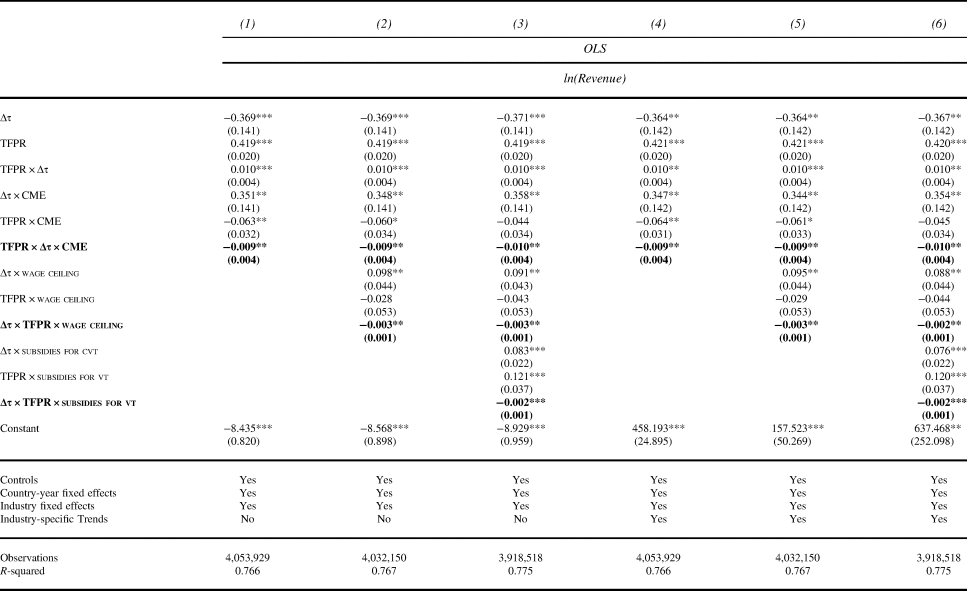
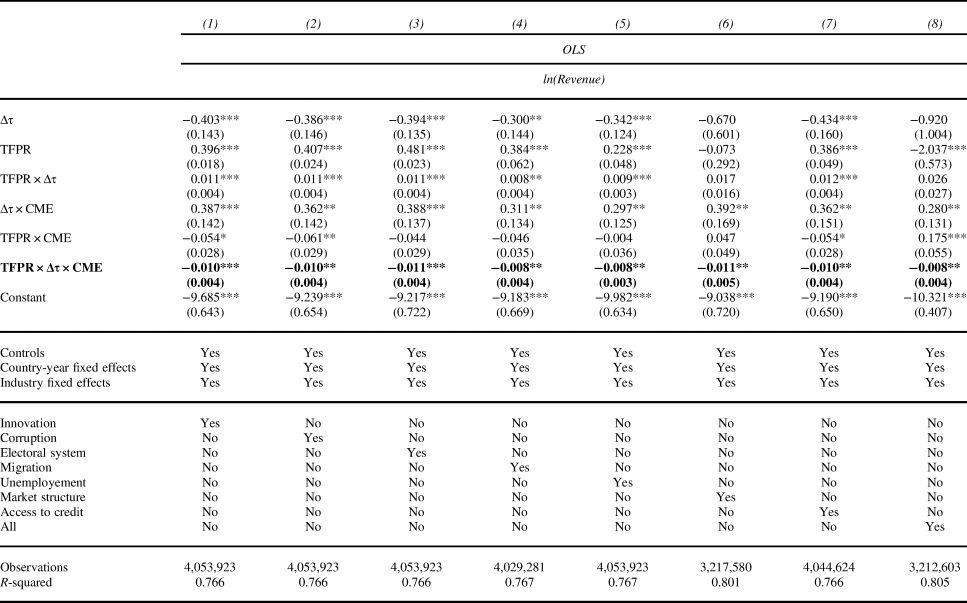
Table 1 reports our main results. Model 1 includes the triple interaction term among tfpr, Δτ, and cme; the coefficient is negative and significant, as expected. This implies that the reallocation effect is weaker in CMEs than in LMEs. That is, productive firms increase their revenue less in CMEs than in LMEs as a result of preferential liberalization. Models 2 and 3 report the mechanisms related to the two institutions highlighted in our theory: wage ceiling and subsidized vocational training. The triple interaction terms among tfpr, Δτ, and wage ceiling and among tfpr, Δτ, and subsidized vt are both negative and significant, in line with our theory. These findings imply that in the case of trade liberalization, the reallocation effect is weaker when these two institutions are in place. Note that the triple interaction term among tfpr, Δτ, and cme remains negative and significant in Models 2 and 3.
Reallocation effect in CMEs and LMEs

Notes: OLS with standard errors clustered at the country-year level in parentheses. The unit of observation is firm-industry (four-digit NAICS)-country-year. The outcome variable in all models is the log of revenue. Sources: Amadeus data set (Bureau van Dijk 2017) and Visser Reference Visser2016. *p < .10; **p < .05; ***p < .01.
Models 4 to 6 show the same model specifications as in models 1 to 3, but they also include industry-specific trends. The results are virtually the same, and the coefficients of interest are similar across different model specifications. Importantly, the coefficient of the double interaction term between tfpr and Δτ remains positive and significant in each model specification, adding plausibility to the results.
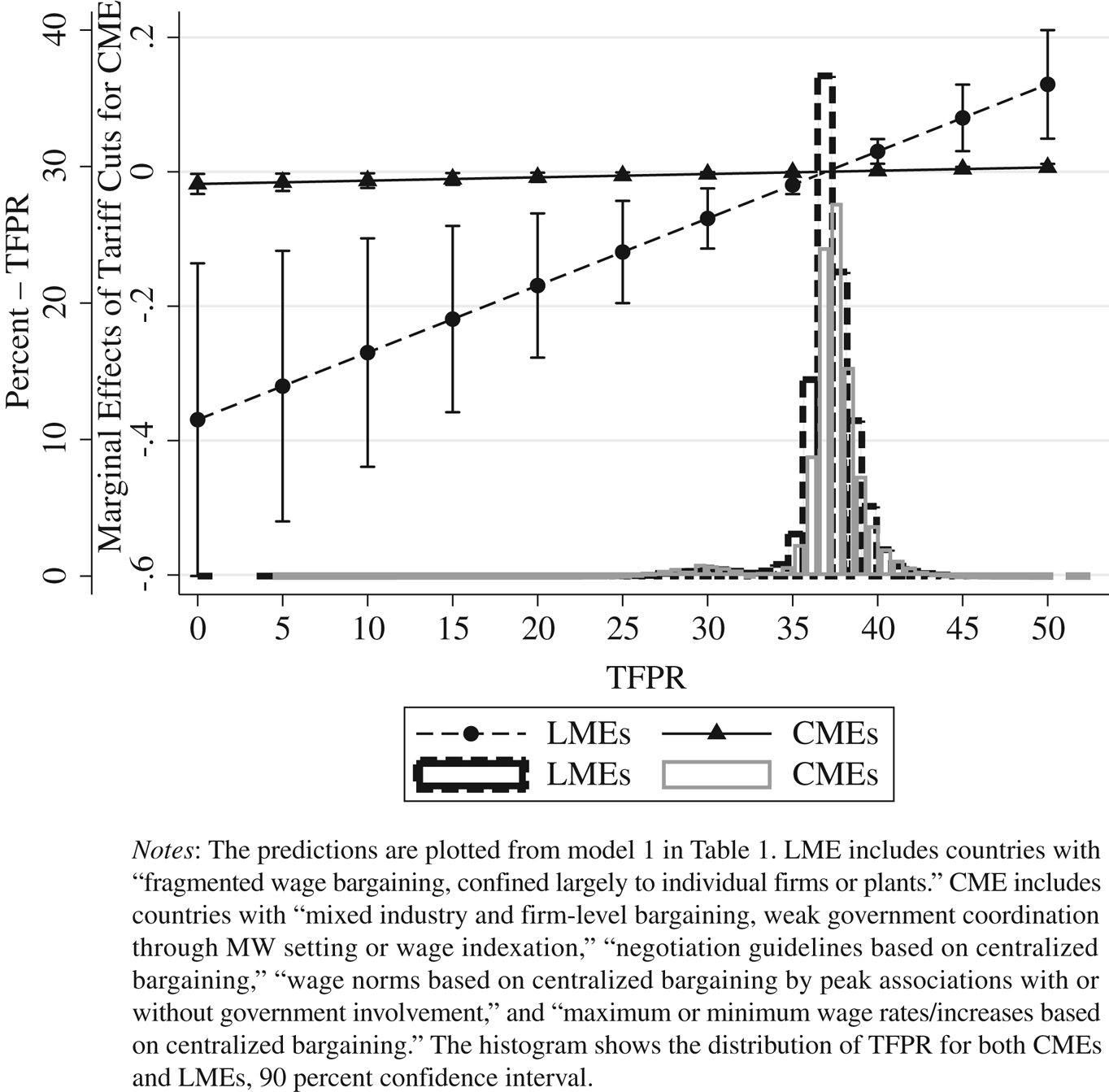
Figure 3 illustrates the effect of the triple interaction term, reporting the marginal effect of tariff cuts for different levels of firm productivity across CMEs and LMEs. The marginal effect is significantly more elastic for LMEs than for CMEs. In other words, the increase in revenue is significantly larger for productive firms in LMEs than for those in CMEs as a result of preferential trade liberalization. Concretely, the elasticity of the marginal effect is 20 percent larger in LMEs than in CMEs. Moreover, Figure 3 shows the distribution of the moderator, tfpr, distinguishing between CMEs and LMEs. There is no concern regarding a lack of common support for the moderator, since the distribution of firms is similar for both CMEs and LMEs and they both have firms for each value of tfpr. This is not surprising, given our very large number of observations.
Effect of tariff cuts on firm revenue for different levels of firm productivity in CMEs and LMEs

While we have provided evidence that labor market institutions mediate the distributional consequences of trade liberalization, concerns may remain that country-level characteristics other than wage coordination are responsible for this mediating effect. Given the nature of the triple difference-in-differences analysis, these confounders are a threat to our identification strategy if and only if they correlate with cme and they affect firm performance differentially in industries facing tariff cuts and based on firm productivity. To sharpen our identification strategy, we include the triple interaction term of tfpr, Δτ, and a large number of country-level (potential) confounders together with our key triple interaction term, tfpr × Δτ × cme.
Table 2 displays the results of these tests. Model 1 includes the triple interaction term with innovation. Model 2 includes the triple interaction term with corruption.Footnote 61 Models 3 to 5 include the triple interaction term with, respectively, a dummy capturing a proportional-representation electoral system, share of migrants, and level of unemployment. Model 6 includes triple interaction terms with country-level variables capturing the market structure: social welfare expenditure, size of the service sector, fiscal capacity, foreign direct investment outflows (and inflows), and the membership of the Eurozone. Model 7 includes interaction terms with variables capturing firms’ ease of access to credit. Model 8 includes all of these triple interaction terms. Our main coefficient of interest remains negative and statistically significant. Importantly, its magnitude remains the same across model specifications. In sum, there is no evidence that these confounding factors are driving our results. That said, it is fundamentally very difficult to isolate the effect of CMEs from other country-level characteristics (observable and unobservable), which correlate with labor market institutions.
Identification test

Other Mechanisms
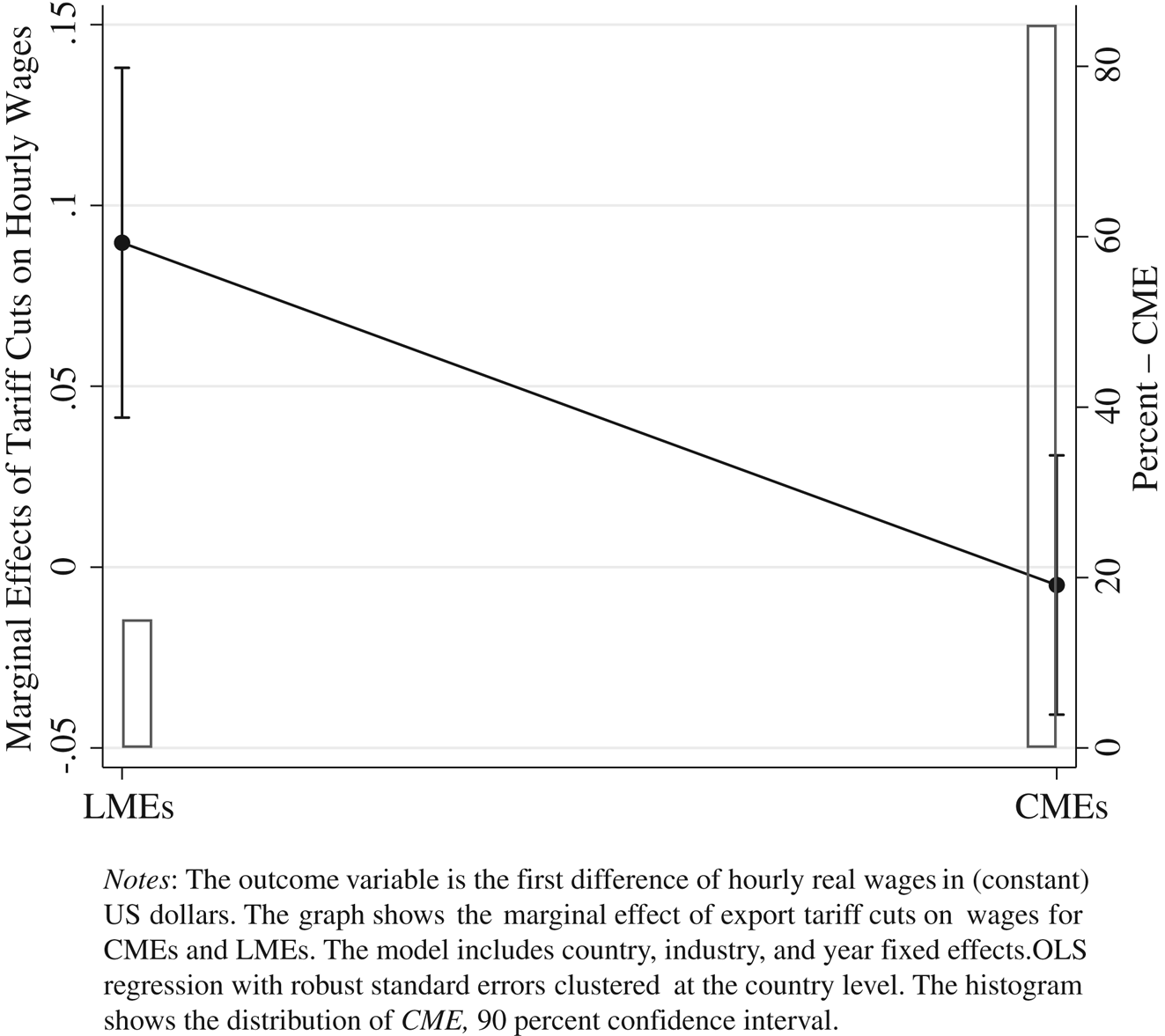
We also explore two other mechanisms at play, as highlighted in our theory. First, we show that wages increase differentially across labor institutions as a result of trade liberalization. In particular, we use real wage data, collected by the ILO, for all EU countries between 2002 and 2008.Footnote 62 Importantly for us, the ILO wage data vary across industries.Footnote 63 We run a model with the first differences of wages as the outcome variable and the interaction between Δτ and cme as key independent variable. We also include country, industry, and year fixed effects. Figure 4 shows the effect of the interaction term graphically, which supports the argument that in the case of tariff cuts wages are stickier in CMEs than in LMEs. In fact, after trade liberalization, hourly wages increase by about 10 percent in LMEs, whereas they remain unchanged in CMEs.Footnote 64 This finding validates the claims we make with respect to the y-axis in Panel A of Figure 1: in the case of an increase in labor demand triggered by trade liberalization, wages are more rigid in CMEs than in LMEs.Footnote 65
Effect of tariff cuts on wages in CMEs and LMEs

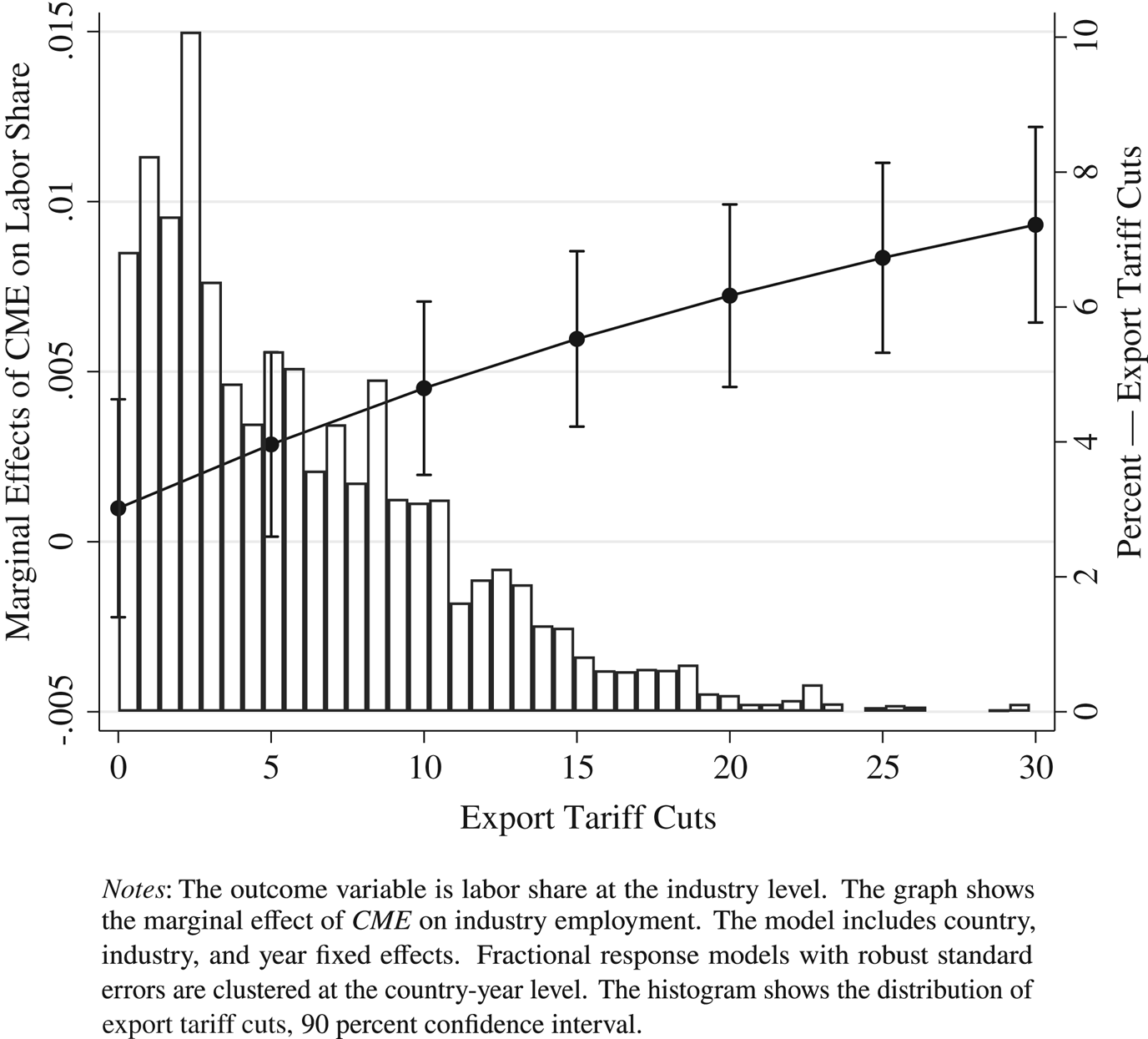
Second, we show that employment in industries facing tariff cuts increases more in CMEs than in LMEs. In particular, we regress labor share at the industry level on the interaction between Δτ and cme. We also include country, year, and industry fixed effects. Moreover, we control for market concentration, capital/labor ratio, and MFN tariffs, as well as their interaction with cme.Footnote 66 Figure 5 shows that CMEs employ a higher share of workers than LMEs in those industries that face tariff cuts, a result in line with Iversen and Soskice.Footnote 67 This finding validates the claim made with respect to the x-axis in Panel A of Figure 1: The supply of skilled labor increases more in CMEs than in LMEs to accommodate the increase in labor demand and to contain the upward pressure on wages after trade liberalization.Footnote 68
Effect of tariff cuts on employment at the industry level in CMEs and LMEs

Robustness Checks
We corroborate our main findings with tests tackling other identification issues. In particular, we show that our results hold if we endogenize tariff reduction and if we account for other potential confounders—labor flexibility and automation. Moreover, we explore the effect of other types of tariff cuts (import and input tariffs) on the reallocation effect among firms in different labor markets (see Appendix E for details).
Moreover, we implement a battery of robustness checks to test the sensitivity of our findings to issues related to diagnostics of the interaction term, choice of sample, and model specification. Details of these tests and the corresponding results are reported in Appendix F.
Gains from Trade and Attitudes to Redistribution
So far we have shown that gains from trade are more uniformly distributed among firms in CMEs than they are in LMEs, and that labor market frictions help unproductive firms weather trade liberalization. In short, after trade liberalization the same unproductive firm is better off in a CME than in an LME, since CMEs have labor market institutions that tame the uneven distributional effects of globalization. In addition to this firm-level analysis, we offer suggestive evidence in support of our argument by testing the effect of preferential trade liberalization on individual attitudes to redistribution. This part of the analysis builds on seminal contributions claiming that government compensation policies help mitigate the winner-takes-all effect of trade openness.Footnote 69
A core assumption in this political economy literature is that economic interests are key sources of individual-level preferences regarding redistribution. Insurance models of redistribution imply that citizens’ preferences for redistribution are a function of their exposure to labor market risks, especially as reflected in actual or threatened unemployment and their related actual or potential income losses.Footnote 70
These models’ underlying logic suggests an additional empirically observable implication of our argument. To the extent that trade liberalization generates a greater reallocation effect in LMEs than in CMEs—that is, a greater number of unproductive firms either lose market share or exit the market altogether—after trade liberalization, actual or potential income losses for individuals in unproductive firms should be greater in LMEs than in CMEs. Extending the logic of insurance models of redistribution to our argument allows us to derive the additional expectation that trade liberalization should trigger individual-level support for redistribution more in LMEs than in CMEs, especially among workers in unproductive firms. In short, labor institutions complement compensation policies in reducing individuals’ concerns about inequality generated by globalization.Footnote 71
Model
We use ESS data covering several EU countries with six waves from 2004 to 2014 to test the effect of preferential liberalization on individual attitudes to redistribution.Footnote 72 Importantly for us, these data report the geographic location of each respondent at the level of NUTS-2 regions. An important limitation of our analysis is that we lack data on personal exposure to trade liberalization; our data are only on regional exposure. In other words, we cannot tell whether a given individual has been directly affected by trade liberalization. But it is reasonable to assume that the negative consequences of trade liberalization (firms losing revenue, workers losing their jobs) have aggregate consequences. Thus, we assume that people living in a certain area are either directly or indirectly affected, or at least aware of others who are affected.
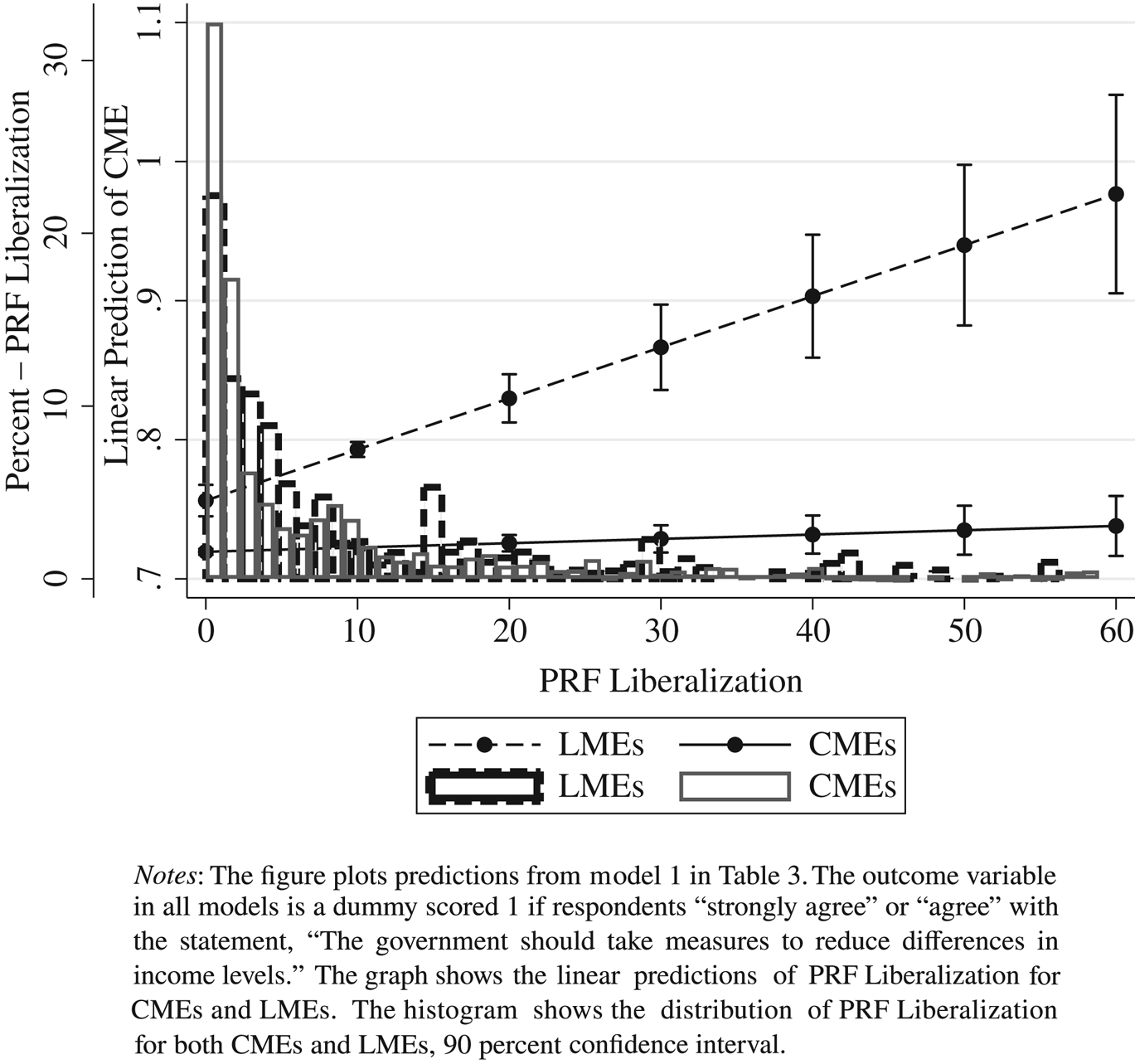
Following previous studies,Footnote 73 we use respondents’ level of agreement with the following statement to capture preferences regarding redistribution: “The government should take measures to reduce differences in income levels.”Footnote 74 Figure H1 in the online appendix shows the geographical distribution of this variable.
Our main independent variable measures the magnitude of trade liberalization in a specific industry i weighted by the share of manufacturing of industry i in a NUTS-2 region r. To build our independent variable, we geocoded all the firms used in the previous analysis at the level of a NUTS-2 region.Footnote 75 This Bartik variable is similar to the ones used by Colantone and Stanig.Footnote 76 More formally, this variable is built as
 $${\rm \sc PRF}\;{\rm \sc LIBERALIZATION}_{rct} = \mathop \sum \limits_j \displaystyle{{L_{rjf}} \over {L_r}}\times \Delta \tau _{cjt}, \;$$
where r indexes NUTS-2 regions, c countries, j industries, f firms, and t years.
Δτ jt is the yearly change in PRF cuts in country c and industry j. To back out the region-specific trade shock, we take the weighted sum of the change in tariff cuts per worker across industries, where the weights capture each industry's relative importance in a given region. Specifically, the weights are defined as the ratio of the number of workers in region r and industry j to the total number of workers in the region.
The important difference from previous studies is in the index f. We are interested in the share of employees in region r and industry j working in unproductive firms, who we expect to lose from trade liberalization proportionally more than very productive firms. Thus, the numerator of  $\displaystyle{{{L_{rjf}} \over {L_r}}}$ is the share of workers in firms belonging to the lowest tenth of the productivity distribution. The underlying logic is this. Larger preferential liberalization shocks are attributed to regions with larger shares of workers in unproductive firms, who should lose disproportionally more from tariff cuts than those employed in more productive firms.Footnote 77
The unit of analysis is respondent-NUTS-2 region-country-ESS wave. Since ESS waves are every other year, we take the biyearly sum of equation (2). Armed with these dependent and independent variables, we estimate the baseline model:
 $$\eqalign{Redistribution_{\,prcw} & = \gamma _0 + \gamma _1{\rm \sc PRF\;LIBERALIZATION}_{r( p) cw} \cr & + \gamma _2 {\rm \sc PRF\;LIBERALIZATION}_{r( p) cw} \times {\rm \sc CME}_{cw} \cr & + {\bf X}_{{\bf prcw}} + {\bf X}_{{\bf prcw}} \times {\rm \sc CME}^{\prime}_{cw}\eta \cr & + {\bf X}_{{\bf prcw}} \times {\rm \sc PRF\;LIBERALIZATION}{^\prime}_{r( p) cw}\zeta \cr & + {\bf Z}_{{\bf cw}} \times {\rm \sc PRF\;LIBERALIZATION}{^\prime}_{r( p) cw}{\theta} + \delta _{cw} + \delta _i + {\epsilon}_{\,prcw}, \;} $$
where p indexes people responding to the ESS, r NUTS-2 regions, c countries, and w waves. The function r(p) maps respondent p to her NUTS2 region r. γ 0, γ 1, γ 2, η, and θ are the coefficients. The key coefficient of interest is γ 2, which we expect to be negative.
Moreover, δ cw and δ i are country-wave and industry (in which respondents are employed) fixed effects, respectively. Country-wave fixed effects capture and control for time-varying country-level characteristics. Industry fixed effects net out time-invariant differences across the industries in which respondents are employed. ɛ prcw accounts for all residual determinants of the dependent variable. Since cmecw varies across countries and over time, we are unable to estimate its coefficient, which gets absorbed by country-wave fixed effects.
Furthermore, the matrix Xprcw includes standard individual-level variables. First and most importantly, the literature's key finding is that individuals who invest in acquiring specific skills, a feature often associated with CMEs, tend to be more supportive of redistribution.Footnote 78 Thus, following Alt and Iversen, we control for a variable that captures skill specificity.Footnote 79 Second, we control for education, gender, and ideology. Each of these controls is interacted with cme and prf liberalization.
In addition, the matrix Zcw includes all the potential confounders of CMEs described in the previous analysis in interaction with prf liberalization. Since these confounders vary only across countries and over time, we are unable to estimate their coefficient alone because it gets absorbed by country-wave fixed effects.Footnote 80
We employ a difference-in-differences empirical strategy in which the treatment (prf liberalization) varies in intensity across regions and over time and is interacted with labor market institutions. We run OLS regressions with robust standard errors clustered at the country level.Footnote 81 We have about 20,000 respondents per wave, for a total of approximately 120,000 observations. All regressions are run with population-size weights.
Results
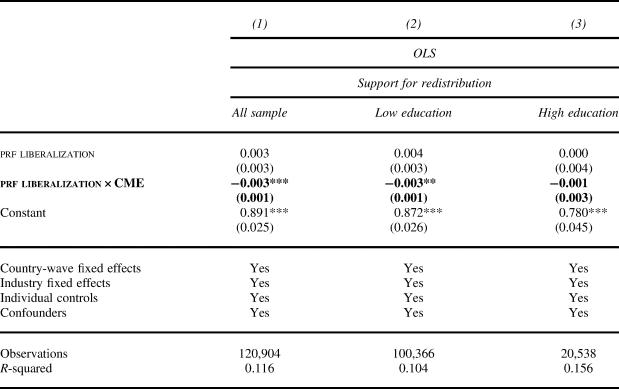
Table 3 reports the main results. In model 1, which includes the entire sample, the coefficient of the interaction between the instrument in equation (2) and cme is negative and significant, as expected. In a nutshell, we observe that the demand for redistribution in CMEs is weaker than in LMEs in the cases of preferential liberalization that affect a large share of workers in unproductive firms. The coefficient of the instrument of PRF liberalization alone is positive and significant, which indicates that trade liberalization increases support for redistribution regardless of labor institutions.
Support for redistribution

Notes: OLS, with robust standard errors clustered by country in parentheses. The unit of observation is respondent-region-country-wave. The outcome variable in all models is a dummy scoring 1 if respondents answer “strongly agree” or “agree” with the statement, “The government should take measures to reduce differences in income levels.” Low Education is respondents with no college degree; High Education is respondents with a college degree. Sources: Amadeus data set (Bureau van Dijk 2017), Visser Reference Visser2016, and European Social Survey, 2018. * p < .10; ** p < .05; *** p < .01.
Models 2 and 3 show the effect of heterogeneity based on education. The key finding is that after trade liberalization, support for redistribution is stronger in LMEs than in CMEs, especially among individuals with less education (no college degree). In short, these effects are more pronounced among low-skilled individuals, who are more likely to work in unproductive firms and for whom the income gap with high-skilled workers increases after trade liberalization. While the inference is ecological (because we cannot directly observe whether the respondents work in productive or unproductive firms), these results are consistent with our firm-level analysis and our argument about the differential effect of trade liberalization between labor markets.
Effect of tariff cuts on support for redistribution in CMEs and LMEs

To better interpret the results, model 1 plots the effect of the interaction term—that is, the linear predictions of cmes for different values of prf liberalization. The main findings are twofold. First, support for redistribution is always lower in CMEs than in LMEs, with or without trade liberalization. This result is in line with the fact that there is wage compression and thus less wage inequality in CMEs.Footnote 82 Second, while trade liberalization does not affect attitudes to redistribution in CMEs, as evidenced by the flat line, it increases support for redistribution by about 20 percent in LMEs. This is the key finding of the individual-level analysis.Footnote 83
In summary, while only suggestive, our individual-level analysis supports the firm-level results. The distributional consequences of trade liberalization are less severe when wages are more rigid, reducing upward pressure on wages, especially among high-skilled workers. In turn, demand for redistribution is weaker in CMEs than in LMEs.
Conclusion
In this paper we explore the distributional consequences of trade liberalization across different types of labor market institutions. The main findings are twofold. In the firm-level analysis, we show that the reallocation effect is weaker in CMEs than in LMEs. That is, the revenue of productive firms increases proportionally less in CMEs than in LMEs. This effect is driven by smaller wage increases in CMEs compared to LMEs due to upward wage rigidity, which we documented in our analysis. In the individual-level analysis, we find suggestive evidence that the demand for redistribution is weaker in CMEs compared to LMEs due to the impact of trade liberalization on unproductive firms.
Our analysis has three important and timely policy implications. First, our findings indicate that some labor market institutions mitigate the winner-takes-all effect of trade liberalization, producing more uniform gains from trade. While trade liberalization is akin to increasing the market power of a few large corporations,Footnote 84 some countries are less prone than others to producing “superstars,” given the presence of labor market frictions. This is a positive consequence of labor market frictions, which have often been blamed for high unemployment and sluggish economic growth. In other words, upward wage rigidity helps compensate the losers from globalization.
Second, our findings suggest that large and competitive firms should be in favor of removing labor market coordination mechanisms that constrain their ability to reap the full potential of trade liberalization. For instance, the domestic politics of Germany's labor market policies during the so-called Hartz reforms of 2003 to 2005 support this view.Footnote 85 Although many traditional mechanisms of labor market coordination remain in place, Germany's labor market policy has undergone substantial liberalization, in line with the preferences and demands for more liberal labor market policies vocally advocated by Germany's employers’ associations through the oft-cited public relations campaign, the New Social Market Initiative.Footnote 86 These dynamics suggest that labor market coordination mechanisms that are typical in CMEs may become the target of firms that view labor frictions as constraints on growth potential.
Finally, our paper warns that weakening labor market coordination would have important implications for inequality for both firms and workers. Indeed, our results show that coordinated labor market institutions mediate the effect of trade liberalization on people's concerns about differences in income levels. Some have argued that the current backlash against globalization in developed countries is partly triggered by extensive job losses in manufacturing due to competition from emerging economies.Footnote 87 Our findings thus indicate that trade openness does not affect all countries in the same way. In particular, we document that variation in labor institutions leads to discrepancies in concerns about inequality once trade liberalization kicks in.
Data Availability Statement
Replication data for this article may be found at <https://doi.org/10.7910/DVN/SIEH2Y>.
Supplementary Material
Supplementary material for this article is available at <https://doi.org/10.1017/S0020818321000138>.
Acknowledgments
We thank two referees and the editors for excellent comments on our paper. We also thank Francesco Amodio, Andy Baker, Paolo Barbieri, David Bearce, Matthieu Chemin, Dirk De Biévre, Andreas Dür, Rob Franzese, Jeff Frieden, Igor Guardiancich, Bob Hancké, Amit Khandelwal, and Stephanie Rickard. We also thank the participants at the 2018 ECPR and IPES conferences, seminars at the University of Boulder, Colorado, the University of Austin, Texas, the University of California, Davis, McGill University, and the Anti-Globalization Backlash workshop in Florence for comments and suggestions. Jan Oledan provided excellent research assistance.
Funding
Leo Baccini acknowledges the support of the Fonds de Recherche du Québec-Société et Culture (grant agreement 2017-NP-198967) and the support of the Robert Schuman Centre for Advanced Studies at the EUI, where he was a Jean Monnet fellow in the 2019-20 academic year. Aydin B. Yildirim acknowledges the support of the EU Horizon 2020 research program under Marie Skłodowska-Curie grant agreement PROSPER No. 842868. The usual disclaimers apply.