Introduction
Over the past two decades, enormous progress has been made in advancing the synthesis and fundamental understanding of inorganic nanoparticles (NPs). Reference Kovalenko, Manna, Cabot, Hens, Talapin, Kagan, Klimov, Rogach, Reiss, Milliron, Guyot-Sionnnest, Konstantatos, Parak, Hyeon, Korgel, Murray and Heiss1–Reference Xia, Xia, Wang and Xie9 The immense scientific interest in isolated or individual NPs derives from the dramatically different electronic, optical, magnetic, or catalytic properties they exhibit compared to their bulk forms. These properties can be further tuned through simple adjustments of their size and shape, Reference Olson, Dominguez-Medina, Hoggard, Wang, Chang and Link10–Reference Kolhatkar, Jamison, Litvinov, Willson and Lee13 making NPs attractive as novel building blocks for the construction of new materials.
Several factors, however, have contributed to the slow adaptation of NPs to technologically relevant materials and nanodevices. Most notably, individual NPs are commonly prepared as colloidal solutions or powders that have high surface reactivity. This enhancement in reactivity can be beneficial, for example, for antioxidants (e.g., cerium oxide) Reference Xu and Qu14 or heterogeneous catalysts (e.g., gold). Reference Schauermann, Nilius, Shaikhutdinov and Freund15,Reference Gross, Liu, Toste and Somorjai16 Alternatively, this high reactivity is also one of their greatest drawbacks, leading to environmental (e.g., susceptibility to agglomeration) and mechanical instability that presents significant challenges to their use in real applications. Reference Huber17 In addition, the solution and powder forms can be difficult to interface with existing device constructs.
To bridge the gap between NPs being simply scientifically intriguing and materials that can make a true technological impact, researchers have explored embedding NPs into various matrices. Numerous reports and several recent reviews have detailed the mixing or formation of NPs within polymeric materials as a means to create composites that have the additive value of the individual components. Reference Balazs, Emrick and Russell18–Reference Sarkar and Alexandridis25 For example, many early reports of NP composites centered on using inorganic NPs (e.g., metal oxides, nanocarbons) as fillers to reinforce the mechanical strength of bulk polymeric materials. Reference Hassanabadi and Rodrigue26–Reference Mark, Boudenne, Ibos, Candau and Thomas28 Other reports illustrated the use of polymers to control stability and interparticle spacing in NP dispersions. Reference Balazs, Emrick and Russell18,Reference Sarkar and Alexandridis25,Reference Kao, Bai, Chuang, Jiang, Ercius and Xu29,Reference Kumar and Jouault30
More recently, efforts have shifted toward creating composites that display an enhancement or amplification of the properties of the individual components (synergism) or multifunctionality. Most intriguing is the possibility of combining two materials so that new physical properties not observed in the individual components emerge through control over NP arrangement, distribution, and/or proximity. Another area of recent investigation is the use of stimuli-responsive polymeric matrices to actively control the internal packing arrangement of the encapsulated NPs to yield dynamic NP–polymer composites. Reference Wang, Xu, Kuang, Xu and Kotov31,Reference Zhang, Han and Yang32 In this review, selected examples of recent studies directed at the creation of NP–polymer composites are presented.
NPs have been successfully encapsulated in a wide variety of host materials, ranging from inorganic materials (e.g., ceramics, glasses) Reference Baia, Baia, Kiefer, Popp and Simon33–Reference Heck, Napp, Simonato, Möllmer, Lange, Reichardt, Staudt, Alves and Feldmann35 to biologically derived materials (e.g., DNA). Reference Saha, Agasti, Kim, Li and Rotello36,Reference Auyeung, Li, Senesi, Schmucker, Pals, de la Cruz and Mirkin37 Encapsulation in inorganic matrices can significantly improve the mechanical durability and environmental stability of NPs. Incorporation in biological materials imparts biocompatibility and can yield dynamic materials. Polymers can, in principle, be engineered to simultaneously exhibit durability, biocompatibility, and dynamics, but they also offer additional characteristics that can aid in addressing opportunities for synergism, emergent properties, and multifunctionality in materials. Polymers are processable, flexible, lightweight, and compatible with many existing device architectures. Many polymers also have co-compatibility with the solvents of NP sols, which can aid incorporation and composite formation. Polymers can also be structured, containing segregated regions offering the possibility for spatial organization and combining more than one type of NP into a single matrix. In addition, polymers can be responsive to a variety of external stimuli (temperature, pH, light, composition [solvent condition], applied force, and electric and magnetic fields), offering the possibility of actively controlling the NP assembly and resulting in tunable functionality of the bulk material. Given the degree of control and the potential for enhancement afforded by the use of polymers to structure NPs while simultaneously regulating their properties, significant opportunities exist for exploring nanoparticle–polymer composites.
Solution-phase construction of NP–polymer composites
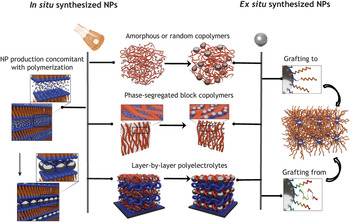
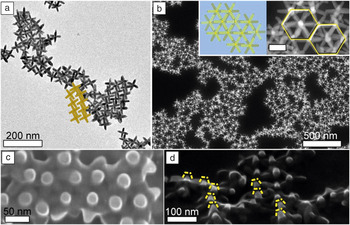
In addition to the physicochemical properties of the polymer, the way NPs are introduced into it can critically affect the performance of the composite. The mode of NP incorporation can broadly be divided into methods that either incorporate preformed NPs (ex situ synthesized, Figure 1 , right) or involve in situ synthesis of the particles (Figure 1, left). Both ex situ and in situ approaches can be achieved through a variety of synthetic means, each having distinct advantages and drawbacks. The simplest approach for composite formation involves doping or blending preformed (ex situ synthesized) NPs within a polymer. Reference Jeon and Baek20,Reference Ingrosso, Panniello, Comparelli, Curri and Striccoli23,Reference Li, Lin, Toprak, Kim and Muhammed38 This approach has been used for doping NPs into glassy amorphous (unstructured)/random copolymers Reference Arciniegas, Kim, De Graaf, Brescia, Marras, Miszta, Dijkstra, van Roij and Manna39,Reference Jiao and Akcora40 and layer-by-layer polyelectrolyte films, Reference Yang, Chueh, Li, Yip, Yin, Chen, Chen and Jen41–Reference Wang, Angelatos and Caruso45 as well as the selective decoration of phase-segregated block copolymers. Reference Sarkar and Alexandridis25,Reference Bockstaller, Mickiewicz and Thomas46,Reference Kao, Bai, Chuang, Jiang, Ercius and Xu47 The introduction of ex situ synthesized NPs allows for fine control over NP morphology (size and shape). Blending or doping of NPs into a matrix often suffers from limits on the particle number density or loading level. Presynthesized NPs also carry a ligand set that might not be compatible with the polymer and therefore might lead to deleterious particle aggregation or macroscopic phase segregation. Reference Williams, Hoppe, Zucchi, Romeo, Dell’Erba, Gomez, Puig and Leonardi48 Ligand exchange can be used to minimize this problem, although the stability of NP shape can often be compromised in the process. However, in systems where ligand exchange is viable, this process can offer an added degree of control over NP spatial distribution and surface chemistry (e.g., hydrophilicity), allowing for the location of particle intercalation to be directed within a structured polymer. More often than not, however, the addition of presynthesized NPs to a polymer matrix results in a lack of sufficient control over their assembly within the polymer. For example, ex situ synthesized octapod-shaped CdSe@CdS NPs (CdSe core and CdS pods), a synthetically complex morphology, doped into a poly(methyl methacrylate) matrix produced only partially embedded particles with locally ordered two-dimensional networks ( Figure 2 ). Reference Arciniegas, Kim, De Graaf, Brescia, Marras, Miszta, Dijkstra, van Roij and Manna39
Common synthetic approaches for the preparation of nanoparticle (NP)–polymer composites.

(a) Transmission electron microscope image of ex situ synthesized CdSe@CdS octapods. (b) High-angle annular dark-field scanning transmission electron microscope image showing the short-ranged ballerina network of octapods formed from drop-casting poly(methyl methacrylate) (1 wt%)–octapod solutions. Inset: Locally ordered hexagonal-like structure (scale bar = 50 nm). (c) Top-view scanning electron microscope (SEM) image of the sample in (b). (d) A 45°-tilt SEM image in which a single protruding pod from each of the embedded octapods is visible (framed in yellow dashed lines). Reproduced with permission from Reference 39. © American Chemical Society.

An alternative approach for directing the localization of ex situ synthesized NPs involves introducing specific chemical functional groups into the polymer to enhance noncovalent interactions or to promote covalent coupling for site-directed localization. Reference Luo, Hickey and Park49–Reference Grabowski, Koerner, Meth, Dang, Hui, Matyjaszewski, Bockstaller, Durstock and Vaia52 This procedure is often referred to as “grafting to” and has also proven useful for controlling particle agglomeration. Reference Gao, Rozin and Tao53 A more elaborate procedure for assembling ex situ synthesized NPs involves grafting either a polymer or a monomer (which can subsequently be polymerized) to the NPs, which can then create the supporting matrix. Reference Gao, Rozin and Tao53,Reference Jayaraman54 Although more synthetically demanding, the advantages of this strategy lie in achieving an isolated dispersion of NPs within a matrix and in covalent fixation of NPs within the matrix. Reference Paniagua, Kim, Henry, Kumar, Perry and Marder55 This “grafting from” route, which was recently reviewed, Reference Kumar and Jouault30 can produce homogeneous, unstructured collections of NPs within the polymer matrix.
In situ NP formation is carried out through the addition of an appropriate metal-ion precursor to the polymer. To date, this route has suffered from poor control of the NP morphology. The approach, however, allows for more control over particle number density within the matrix. Production of NPs within a polymer also affords more intimate NP–matrix interactions, lessening the tendency for undesirable aggregate formation. Furthermore, tightly coupled interactions between the components can also lead to changes in polymer properties, which might or might not be wanted (see text later). This method can also be used for effective control over the spatial organization of NPs within a structured polymer, and can be used for the formation of heterostructured composites containing more than one NP type.
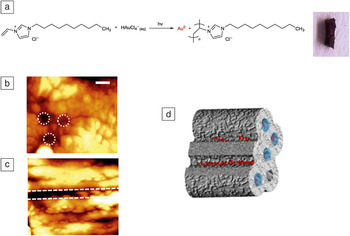
More recently, synthetic schemes have demonstrated the utility of in situ NP production concomitant with polymerization. In addition to having all the benefits of particle production within a formed polymer, this approach has the greatest potential for reducing the number of synthesis steps, thereby facilitating composite construction. Batra et a1. Reference Batra, Seifert, Varela, Liu and Firestone56 reported one example of the single-step formation of a gold NP–polymer composite. The composite was prepared through the assembly of the monomer vinyl decylimidazolium chloride [C10VIm+][Cl–] in water that also contained the gold ion precursor (AuCl4 –). The formed two-dimensional hexagonally ordered mesophase was then photoirradiated with UV light to initiate both the free-radical polymerization and cross-linking of the vinyl ionic-liquid monomer and to photoreduce the Au3+ ions to produce Au0 nanoparticles (Au NPs). The facile one-step reaction yielded a highly structured hexagonally perforated lamellar Au NP composite with the particles confined within the aqueous pores ( Figure 3 ).
(a) Synthesis of a gold–poly[C10VIm+][Cl–] composite prepared by photoirradiation of a two-dimensional hexagonal mesophase of the ionic liquid monomer vinyl decylimidazolium chloride ([C10VIm+][Cl–]) dispersed in 17 wt% water containing 0.17 μmol of Au3+. (b) Internal composite structure revealed by atomic force microscopy (AFM) carried out on a sample that was pre-swollen in ethanol and then contracted by air drying. The AFM topographic image, collected in a region of high stress, reveals pores (dark regions, highlighted with dashed white lines) in the hexagonally perforated lamellar structure. (c) Cross-sectional image showing alternating polymer layers (highlighted with dashed white lines) with incomplete filling of Au nanoparticles (NPs) and hydrophilic channels (highlighted with dashed lines). Feature sizes (pore diameter and channel cross section) are distorted by tip–sample and tip–contamination convolution, as well as imaging on a high-stress region of the composite. (d) Schematic illustration of the composite structure based on AFM, transmission electron microscopy, and small-angle x-ray scattering studies (Au NPs, red; polymer, gray; water, blue). Adapted from Reference 96 with permission from The Royal Society of Chemistry.

NP-mediated polymer properties
Just as the polymer matrix can be used to promote synergistic or emergent properties for a collection of encapsulated NPs, the presence of NPs can also induce an enhancement or emergence of new properties for the polymer. The mechanical properties of simple NP–polymer blends can be largely understood as simple mixtures of the constituent properties, with perhaps an added interaction of the polymer with the NP surface. Reference Fu, Feng, Lauke and Mai57 Although such mixtures are technologically important, they do not lead to new properties that are not exhibited by the constituent materials. The properties of a polymer can be dramatically altered by the presence of NPs, but this requires intimate mixing between the NP inclusions and the polymer.
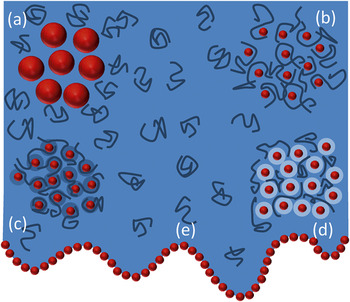
For the sake of simplicity, two limiting mixing conditions can be considered: particles that are larger or smaller than the dimensions of the polymer. Under conditions where the NPs are larger ( Figure 4a), the particles experience strong depletion forces similar to those in colloidal solutions, which can lead to agglomeration and phase separation. The polymer, meanwhile, in close association with these particles, has its molecular dimensions reduced, leading to a loss of entropy. Reference Nakatani, Chen, Schmidt, Gordon and Han58,Reference Mackay, Tuteja, Duxbury, Hawker, Van Horn, Guan, Chen and Krishnan59 Both of these effects favor agglomeration and phase separation, so there must be a significant enthalpic component to the interaction to achieve thermodynamically favorable mixing. Although stable mixtures are generally considered favorable, even a thermodynamic drive to phase separate can generate new, useful behaviors. For example, NPs with an entropically driven preference to phase separate from a polymer matrix can be used to push nanoparticles into cracks in a manner that could be used as a self-healing material. Reference Gupta, Zhang, Emerick, Balazas and Russell60
Effects of nanoparticles (NPs) on the structure of polymer matrixes. (a) NPs larger than the matrix polymer experience depletion forces pushing the particles together. (b) NPs smaller than the matrix polymer can lead to expanded polymer chain dimensions as the chains wrap around the particles. (c) NPs with strong favorable interactions with the polymer can lead to lower free volume near the particle surfaces. (d) NPs with unfavorable interactions can lead to higher free volume near the particle surfaces. (e) NPs can act as surfactants, stabilizing high-surface-area structures.

On the other hand, for NPs that are smaller than the polymer molecules with which they are mixed (Figure 4b), depletion forces are less of a concern, but the molecular dimensions of the polymer are still influenced. In this case, polymer molecules can envelop the particles, leading to an expansion in the molecular dimensions. Although one normally associates larger-volume molecules with higher entropy, in this case, the increase in size is due to excluded volume, so the entropy change is once again negative. Conveniently, this arrangement with the particles enveloped by the polymer can provide a sufficient increase in enthalpy, relative to phase-separated particles, because of enhanced molecular contacts with the flexible polymer compared to an inflexible nanoparticle. Reference Mackay, Tuteja, Duxbury, Hawker, Van Horn, Guan, Chen and Krishnan59 Although good mixing is a requirement for many applications, there are also interesting property changes caused by the entropic effects of inclusion of small nanoparticles, including the fact that the inclusion of small nanoparticles can slow the diffusion of polymer molecules dramatically, in contrast to the more modest effects of larger particles. Reference Gam, Meth, Zane, Chi, Wood, Winey, Clarke and Composto61
It has long been known that free volume in polymeric systems is a critical parameter that has important influence over a range of properties. Reference Fox and Flory62 One practical application of changes in polymer free volume in the presence of NPs is in the area of diffusion of small molecules through polymers, for which the barrier properties of polymer nanocomposite films have been of great interest in recent years. Among the most studied nanocomposite barrier systems are intercalated polymer–clay nanocomposites, which were shown to have dramatically lowered gas diffusion compared to the pure polymer. Reference Giannelis63 Early explanations attempted to attribute this difference to a tortuosity argument that longer diffusion lengths resulted from a lack of transport through the clay platelets. Reference Bharadwaj64 Current explanations, however, emphasize the dramatic effect of decreased free volume caused by the very strong favorable interactions between the polymer matrix and the clay. Reference Chen, Jia, Xu, Cao and Fan65 That is, the particles not only are barriers to diffusion, but also synergistically enhance the barrier properties of the polymer matrix by decreasing the free volume of the polymer (Figure 4c). These nanocomposites have yielded much lighter and more effective barriers to gas transport that have enormous technological applications.
A surprising more recent result was that the addition of nonporous silica NPs can dramatically increase the diffusion of gases in a polymer. Reference Merkel, Freeman, Spontak, He, Pinnau, Meakin and Hill66 As the silica itself cannot be responsible for this enhanced diffusion, the cause is the change in the properties of the polymer at the silica interface. In the absence of favorable interactions with this high-surface-area material, the polymer displays an increased free volume (Figure 4d). This increase in free volume allows for enhanced diffusion of small molecules that can be made selective for molecules of various sizes. Reference Janes and Durning67 This is perhaps more counterintuitive than the previous example, as the addition of a nonporous material that would itself be a significant barrier to small-molecule diffusion yields a nanocomposite with dramatically enhanced diffusion of these molecules.
Barrier properties are not the only emergent property of polymer nanocomposites mediated by free volume. Free volumes of polymer nanocomposites can also be manipulated to alter other properties such as the glass transition of glassy polymers, Reference Utracki68 the compressibility of polymer glasses and melts, Reference Utracki68 and the viscosity of polymer melts. Reference Kalathi, Grest and Kumar69 The addition of rigid nanoparticles can lead to lowered glass transition temperatures, increased compressibility, and decreased viscosity; here, the observed changes in the inherent polymer properties can be classified as synergistic and not simple combinations of constituent properties. It is also worth noting that, as in the case of transport properties, all of these properties can be increased as well as decreased by judicious choice of the nanoparticle inclusion.
Nanoparticles can also be added to mixtures of immiscible polymers, where they can migrate to the interfaces between the polymers. The NPs behave like surfactants, lowering the energy and stabilizing the interface (see Figure 4e). If more NPs are added than could normally be accommodated by the interfaces in a system, the NPs can increase the interfacial surface area between the immiscible polymers. This has been shown to be particularly useful for stabilizing bicontinuous phases in microphase-separated diblock copolymers Reference Kim, Fredrickson, Hawker and Kramer70 and immiscible homopolymer blends. Reference Gam, Corlu, Chung, Ohno, Hore and Composto71 The surfactant-like behavior of NPs in polymers have even been shown to stabilize polymer–air interfaces. Reference Maillard, Kumar, Rungta, Benicewicz and Prud’homme72 In these cases, the emergent property is the production of a novel structure that is not otherwise observed. These kinds of self-assembled architectures have great potential applications in micro- and nanosystems. Reference Price, Hur, Fredrickson, Frischneckt and Huber73
Polymer-mediated NP properties
Early work exploring NP–polymer composite formation focused on approaches that simply served to stabilize a collection of NPs to yield a practical material for device applications. Reference Shenhar, Norsten and Rotello74 These composites were formed by the simple dispersion of NPs within a conventional (unstructured) polymer, resulting in a material that merely exhibited the additive attributes of an NP and polymer, with little or no beneficial synergy between the two components. In other words, the polymer merely served to stabilize the particles and preserve their individual properties. Careful selection of the NP and polymer, however, can allow the NPs to enhance or add functionality to the functional polymer without compromising its inherent properties.
Metal oxides, which exhibit higher melting points, larger refractive indices, and greater mechanical strengths than many organic polymers, have been doped within polymers as a means to impart these characteristics to the composite material. Reference Kao, Thorkelsson, Bai, Rancatore and Xu75 The mechanical reinforcement of polymers through the incorporation of NPs is the most commonly studied composite formulation. As such, many reviews have focused on the use of NPs in mechanical reinforcement. Reference Sprenger76,Reference Srivastava, Schaefer, Yang, Tu and Archer77 Beyond mechanically reinforcing NPs, work has amply shown other benefits of combining NPs with polymers. For example, the in situ synthesis of <5 nm silver NPs within chitosan yielded an unstructured composite that was optimized for heterogeneous catalysis. The small silver NPs bound to the polymer matrix exhibited high catalytic activity and efficiency (turnover frequency). Although the NPs were tightly adhered to the polymer, the association did not inhibit access to the NP surface atoms. Reference Murugadoss and Chattopadhyay78 In addition to metal NPs, there are numerous examples of nanocarbons and quantum dots displaying increased chemical and photostability upon composite formation. Reference Habisreutinger, Leijtens, Eperon, Stranks, Nicholas and Snaith79–Reference Mosconi, Mazzier, Silvestrini, Privitera, Marega, Franco and Moretto82 As the field of nanoscience matures, however, there is increasing interest in moving beyond simple NP dispersions in polymers toward controlled ensembles that yield greater performance and new phenomena, and that display multiple functions simultaneously.
NP–polymer synergism
Whereas doping unstructured polymers with NPs will tend to lead to stochastic mixtures of nanoparticle ensembles, ordered supporting architectures can be used to control the degree of NP dispersion or aggregation within the polymer, thereby producing synergy between components. This synergy can manifest itself as an enhancement of a characteristic, such as amplification of a single NP property, or multifunctionality can be produced by combining the multiple components within the polymer matrix (heterostructures). Examples of synergistic effects include the inclusion of metal NPs into organic photovoltaics (OPVs), in which the effects of the plasmonic NP near-field absorption and scattering can act to enhance the light-harvesting ability of the OPV. Reference Chuang and Chen83,Reference Yang, Lin, Qing, Zhong, Ou, Hu, Chen, Zhou and Chen84 The plasmonic NP offers a simple and synergistic solution to the paradoxical tradeoff between quantum and absorption efficiencies in the polymer by virtue of the local electromagnetic field that forms around these nanoparticles under resonant incident irradiation. Reference Yen, Hayden, Dreaden, Szymanski and El-Sayed85
Recently, Choi et al. demonstrated the use of plasmonic, SiO2-coated silver nanospheres in increasing the power conversion efficiency of a bulk-heterojunction OPV by inserting NPs between the hole-transport and active layers of poly(3,4-ethylenedioxythiophene):poly(styrene sulfonic acid) polymer blend in the device. Reference Choi, Lee, Ko, Jung, Park, Yoo, Park, Jeong, Park and Kim86 Counterproductive electron transfer between the polymer and the NP surface was inhibited by the SiO2 shell, whereas enhancement is attributed to the effect of the plasmonic silver core on the behavior of charge carriers and light in the device. Beyond synergistic optical and electronic properties, the doping of CoFe2O4 NPs in poly(vinylidene fluoride) was shown to enhance the dielectric permittivity and ferroelectricity of the polymer. Reference Martins, Costa, Botelho, Lanceros-Mendez, Barandiaran and Gutierrez87 The enhancement was attributed to space-charge polarization at the interface between the two phases, which develops into a microcapacitor structure. Reference Vasundhara, Mandal and Tyagi88
The polymer matrix can also be used to control the orientation of anisotropic (rod-shaped) NPs to produce composites exhibiting synergistic properties, a topic that was recently reviewed. Reference Hore and Composto89 Examples of such composites include the mechanical alignment (through stretching) of gold nanorods in poly(vinyl alcohol) to yield a polarizing optical filter. Reference Perez, Rodriguez-Gonzalez, Mulaney and Liz-Marzan90 The efficiency of photovoltaic materials has also been improved by vertically aligning TiO2 rods within poly(3-hexylthiophene)-block-poly(ethylene oxide) copolymers, which served to improve carrier efficiency. Reference Lin, Wei, Qian, Yao and Watkins91 Beyond rod-shaped NPs, recent work demonstrated the matrix-assisted edge–edge and face–face assembly of Ag NPs into one-dimensional strings, and the generation of plasmonic hot spots. Reference Gao, Arya and Tao92
In the field of energy storage, Chen et al. demonstrated that ultrafine sulfur NPs encapsulated within the conducting polymer, poly(3,4,–ethylenedioxythiophene) (PEDOT) synergistically functioned to increase performance as a cathode material in a Li/S battery, showing a high initial discharge capacity of up to 1117 mAh g–1 and a stable capacity of 930 mAh g–1 over more than 50 cycles. Reference Chen, Dong, Ge, Wang, Wu, Lu and Chen93 The sulfur NP–PEDOT core–shell composite was prepared from oxidative polymerization of an EDOT monomer in the presence of ex situ synthesized sulfur NPs coated with FeCl3 (i.e., the polymer was grown from the NP surface). Reference Chen, Dong, Ge, Wang, Wu, Lu and Chen93 The sulfur NPs in contact with the conducting polymer synergistically enhanced electrical conduction and Li+ diffusion. In addition, the polymer also served to prevent dissolution of the lithium polysulfide intermediates into the electrolyte and inhibit aggregation of the particles.
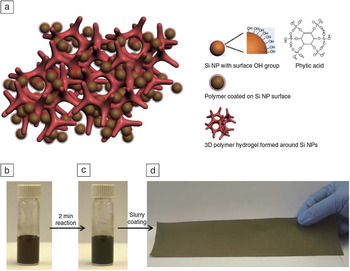
In another example, high-performance anodes for Li-ion batteries exploited the hierarchical structure of an in situ prepared electrically conductive polymer hydrogel, polyaniline, encapsulating ex situ synthesized silicon NPs to produce an extremely stable (to electrochemical cycling) high-capacity composite (see Figure 5 ). Reference Wang, Xiang, Liu, Wang, Luo, Chen and Shen94 The enhanced properties were attributed to the conformal coating of a structured polyaniline network formed around the silicon NPs, which yielded a composite composed of a continuous, electrically conductive polymeric network with closely associated silicon NPs, yet sufficient void space to allow for volume expansion of the NPs during cycling. Reference Wang, Xiang, Liu, Wang, Luo, Chen and Shen94
(a) Schematic illustration of three-dimensional porous silicon nanoparticle (Si NP)/conductive polymer hydrogel composite electrode. Each Si NP is encapsulated within a conductive polymer (polyaniline) surface coating and is further connected to the highly porous hydrogel framework. Si NPs were conformally coated with a polymer layer through interactions between surface–OH groups and the phosphonic acid groups in the cross-linker phytic acid molecules (right panel). (b–c) Photographs of the key steps used for electrode fabrication. (d) The viscous gel bladed onto a copper-foil current collector and dried. Reprinted with permission from Reference 94. Macmillan Publishers Ltd: Nature.

In addition to enhancing properties, the polymer can promote the assembly of several constituents, serving as a multifunctional platform. One notable area that has benefited from polymers as multifunctional platforms is photodynamic therapy. Photodynamic therapy employs up-converting phosphors such as rare-earth NPs (NaYF4:Yb3+, Er3+) to treat various diseases, including cancer. Up-conversion is a nonlinear optical process in which sequential absorption of two or more photons leads to the emission of light of a shorter wavelength than that used in excitation. Upon photoirradiation, the NPs up-convert near-infrared light to red light that is then used by a co-integrated photosensitizer to generate reactive oxygen species that promote the oxidative destruction of cellular targets. Reference Chatterjee, Fong and Zhang95
NP–polymer emergent properties
Structured polymers can also be used to control the arrangement and proximity of NPs, leading to new collective (macroscopic) properties. Particles separated by large distances are noninteracting, and their physical properties are based solely on the individual characteristics of the nanoparticles. As NPs are brought together, they exhibit more collective behavior as a result of particle–particle interactions, leading to emergent properties distinct from those of the individual NPs.
The key to achieving composites with emergent properties is developing polymers that are composed of embedded structures over multiple-length scales that serve to organize NPs into higher-order architectures in a controllable way. Several reports have demonstrated emergent properties through scaffold-assisted assembly of NPs within a polymer. For example, optimization of the Au NP number density within aqueous columns of a hexagonally perforated, lamellar structured polymerized ionic liquid (Figure 3) resulted in a percolated network of collimated Au NPs, thereby generating an electronically conductive polyelectrolyte (Figure 3) Reference Lee, Cummins, Willing and Firestone96 that was further shown to function as a biocompatible electrode that promoted the direct electron transfer to recessed redox centers in a biocatalytic enzyme. Reference Lee, Ringstrand, Stone and Firestone97
Studies have also demonstrated the assembly of fluorescence emitters (such as quantum dots) into composites that allowed the fluorescence parameters to be varied over a wide range and generated materials with implications ranging from sensing Reference Yang, Shen, Tan and Xia98 to light-emitting diodes. Reference Cosgun, Fu, Jiang, Li, Song, Song and Zeng80,Reference Shirasaki, Supran, Bawendi and Bulović99 Both emergent optical properties and multifunctionality were recently exhibited by a carbon-nanotube- (CNT-) embedded thermoplastic block copolymer system. Reference Oh and Islam100 Hard, aliphatic blocks (4,4′-methylene diphenyl diisocyanate or 1,4-butanediol) were found to segregate into amorphous or crystalline domains within a network of soft segments (poly[tetramethylene ether]glycol). Following hydrogel assembly, CNTs were embedded in the matrix. CNTs were found to increase the strength and toughness, impart electrical conductivity, reduce the polymer thermal motion, suppress the polymer glass transition, and extend the mechanical integrity of the composite well above the decomposition point of the undoped polymer. However, the composite also exhibited emergent behavior in the form of a strain-dependent optical response, with increasing fluorescence as a function of stress.
Dynamic NP–polymer composites
Whereas effort has been directed at using the polymer as a passive scaffold to spatially arrange the embedded NPs to promote synergistic or emergent composite properties, the next frontier will be active, dynamic modulation of the particle-packing arrangement for functional modulation. Reference Wang, Xu, Kuang, Xu and Kotov31,Reference Zhang, Han and Yang32 The possibility of reversibly modulating the aggregation state or segregation of NPs within a polymer opens new possibilities for the design of switchable materials. The simplest approaches have exploited stimuli-driven expansion and contraction of polymer chains to yield “breathing”-type modulation of a broad distribution of NP ensemble aggregates, thereby generating subtle changes in their optical properties. Numerous examples of NPs contained within isotropic assemblies of block copolymer micelles (polymersomes) have shown reversible assembly and disassembly in response to a variety of stimuli (temperature, pH, light). Reference Zhang, Liu, Yao and Yang101,Reference Tokarev and Minko102
Thermoreversible hydrogen-bonding interactions between polymer-grafted Au NPs embedded within a random copolymer matrix containing complementary ligands was shown to effectively aggregate and de-aggregate the particles, giving rise to a 20-nm shift in the plasmon resonance of the Au NPs. Reference Heo, Miesch, Emerick and Hayward103 Reversible redistribution of CdSe NPs within phase-segregated block domains has also been driven by temperature. Specifically, the QDs migrated from the poly(4-vinylpyridine) block to the poly(styrene-b-4-vinylpyridine) interface as a result of temperature-driven changes in polymer conformation. Reference Zhao, Thorkelsson, Mastronianni, Schilling, Luther, Rancatore, Matsunaga, Jinnnai, Wu, Poulsen, Frechet, Alivisatos and Xu104
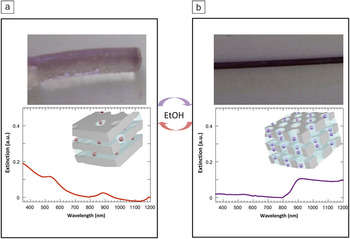
Stimuli-responsive nano- and mesostructured polymers offer additional opportunities for modulation of the packing arrangement of inorganic NPs. Reference Stuart, Huck, Genzer, Muller, Ober, Stamm, Sukhorukov, Szleifer, Tsukruk, Urban, Winnik, Zauscher, Luzinov and Minko105 For example, solvent-induced swelling of a hexagonally perforated, lamellar structured polyelectrolyte (poly[ionic liquid]) shifted the plasmon resonance of embedded Au NPs from the infrared to the visible range ( Figure 6 ). Reference Batra, Seifert, Varela, Liu and Firestone56
Photographs of gold nanoparticle–poly[C10VIm+][Cl–] composites in the (a) ethanol-swollen and (b) dried, contracted states. Corresponding optical spectra show the reversible switching in the optical properties that arises from the polymer-mediated changes in nanoparticle packing within the hexagonally perforated lamellar structure (insets). Adapted from Reference 56.

Conclusions and outlook
Work exploring how to combine individual NPs in polymer matrices contributes to our understanding of the fundamental principles that govern the integrated properties and behaviors of the formed composites. The complex interplay of properties of composites that are intimately mixed at the nanoscale can lead to useful and unexpected behaviors that are not present in either component. Although the properties and systems discussed here are necessarily incomplete, they were selected to illustrate the possibilities for the rapidly changing field of nanocomposites. It is anticipated that, from these basic studies, we can ultimately capitalize on the potential of inorganic nanoparticles for the creation of composite materials that will have an enduring impact on technological innovation.
Acknowledgments
M.A.F. and S.C.H. acknowledge support from the US Department of Energy, Center for Integrated Nanotechnologies, at Los Alamos National Laboratory (Contract DE-AC52-06NA25396). D.L.H. acknowledges support from the US Department of Energy, Center for Integrated Nanotechnologies, at Sandia National Laboratory. Sandia National Laboratories is a multiprogram laboratory managed and operated by Sandia Corporation, a wholly owned subsidiary of Lockheed Martin Corporation, for the US Department of Energy’s National Nuclear Security Administration under Contract DE-AC04-94AL85000.