Introduction
Huntington's disease (HD) is an autosomal-dominant neurological disorder caused by a cytosine-adenine-guanine (CAG) expansion in the Huntingtin gene (Walker, Reference Walker2007). The onset of the disease can be at any age but usually occurs in mid-life, with larger CAG repeat numbers associated with younger onset, and the first signs typically involuntary movements, psychiatric symptoms and cognitive decline (Walker, Reference Walker2007). Clinical definition HD diagnosis requires the presence of motor signs, however subtle cognitive and psychiatric symptoms often occur up to 15 years prior to diagnosis (Duff et al., Reference Duff, Paulsen, Beglinger, Langbehn, Wang and Stout2010; Martinez-Horta et al., Reference Martinez-Horta, Perez-Perez, van Duijn, Fernandez-Bobadilla, Carceller, Pagonabarraga and Kulisevsky2016; Paulsen & Long, Reference Paulsen and Long2014; Stout et al., Reference Stout, Paulsen, Queller, Solomon, Whitlock, Campbell and Aylward2011). All people with HD experience progressive cognitive decline, although the onset and progression of cognitive impairment is highly variable (Papoutsi, Labuschagne, Tabrizi, & Stout, Reference Papoutsi, Labuschagne, Tabrizi and Stout2014). Cognitive decline contributes to functional disability, reducing patients' ability to drive, work and live independently (Ross, Pantelyat, Kogan, & Brandt, Reference Ross, Pantelyat, Kogan and Brandt2014; Tabrizi et al., Reference Tabrizi, Scahill, Owen, Durr, Leavitt and Roos2013). Therefore, the ability to identify those most at risk of early and rapid cognitive decline would be beneficial in triggering early interventions aimed at supporting patients and their families to cope with cognitive change. Apathy, a loss of motivation and reduction in voluntary, goal-directed behaviour, is a common early sign of HD which may be a harbinger of cognitive impairment. Apathy is very common in HD. For example, Martinez-Horta et al. found clinically significant apathy in 23% of premanifest HD participants, who were on average more than a decade prior to diagnosis, and 62% in the early manifest HD group (Reference Martinez-Horta, Perez-Perez, van Duijn, Fernandez-Bobadilla, Carceller, Pagonabarraga and Kulisevsky2016). This is in comparison with a prevalence of 36% in Parkinson's disease (Garcia-Ramos, Villanueva, del Val, & Matias-Guiu, Reference Garcia-Ramos, Villanueva, del Val and Matias-Guiu2010) and 49% in Alzheimer's disease (Nobis & Husain, Reference Nobis and Husain2018).
Apathy predicts longitudinal cognitive decline in other neurodegenerative diseases. For example in Parkinson's disease (Dujardin, Sockeel, Delliaux, Destee, & Defebvre, Reference Dujardin, Sockeel, Delliaux, Destee and Defebvre2009) and Alzheimer's disease (Starkstein, Jorge, Mizrahi, & Robinson, Reference Starkstein, Jorge, Mizrahi and Robinson2006), participants who were more apathetic at baseline were more likely to show cognitive decline over 1–4 years than participants who were non-apathetic at baseline. Similarly, a longitudinal study of people with mild cognitive impairment revealed that those with apathy were more likely to develop Alzheimer's disease than those without apathy (Richard et al., Reference Richard, Schmand, Eikelenboom, Yang, Ligthart and Moll van Charante2012; Robert et al., Reference Robert, Berr, Volteau, Bertogliati-Fileau, Benoit, Guerin and PréAL Study Group2008). Why might this be? Levy and Dubois (Reference Levy and Dubois2006) proposed three prefrontal-subcortical circuits important for initiation, cognition/planning and emotional-affective/motivation aspects of apathy, and argued the disruption of any of these circuits could cause manifestations of apathy. Consistent with this proposal, two recent studies have found a relationship between apathy and structural brain changes within these circuits in early HD. In one study, the presence of apathy was associated with smaller thalamus volumes in premanifest and early HD participants from the TRACK-HD study (Baake et al., Reference Baake, Coppen, van Duijn, Dumas, van den Bogaard and Scahill2018). Additionally, an MRI-PET study found that in a sample of 40 patients with early-stage HD, higher apathy severity was associated with lower grey matter volume in subcortical regions, temporal lobes and anterior cingulate cortex, as well as lower brain glucose metabolism in the prefrontal cortex, temporal lobes, insula and precuneus (Martinez-Horta et al., Reference Martinez-Horta, Perez-Perez, Sampedro, Pagonabarraga, Horta-Barba, Carceller-Sindreu and Kulisevsky2018). These areas make up a complex cortico-subcortical network critical for reward- and emotion-processing. Importantly, lower grey matter volume and reduced metabolism in these regions were also associated with poorer cognitive task performance. Given degeneration occurs in parts of this cortico-subcortical reward-processing network years before the detection of cognitive impairment (Papoutsi et al., Reference Papoutsi, Labuschagne, Tabrizi and Stout2014), apathy may be an early sign of disruption to the brain's reward- and emotion-processing circuitry, which, with disease progression, eventually manifests in cognitive impairment (Palminteri et al., Reference Palminteri, Justo, Jauffret, Pavlicek, Dauta, Delmaire and Pessiglione2012).
Evidence from at least three previous studies suggests that apathy and cognitive impairment are associated with HD. For example, two cross-sectional studies have found that people with diagnosed HD classified as apathetic are more likely to have a cognitive impairment, compared to those classified as non-apathetic (Baudic et al., Reference Baudic, Maison, Dolbeau, Boissé, Bartolomeo, Dalla Barba and Bachoud-Lévi2006; Sousa et al., Reference Sousa, Moreira, Jesus-Ribeiro, Marques, Cunha, Canario and Januario2018). Additionally, Reedeker et al., assessed apathy and cognition over 2 years in a mixed premanifest and motor-manifest HD sample, and reported that slower processing speed at baseline predicted persistent apathy (Reference Reedeker, Bouwens, van Duijn, Giltay, Roos and van der Mast2011). Apathy as a predictor of subsequent cognitive decline has not been examined in premanifest or manifest HD, however, in early HD, one study found that apathy predicted subsequent functional decline over 36 months (Tabrizi et al., Reference Tabrizi, Scahill, Owen, Durr, Leavitt and Roos2013). Given the relationship between cognition and everyday function in HD, apathy may also predict subsequent cognitive decline in HD. In the current study, we examined severity of apathy symptoms as a predictor of cognitive decline over 2 years in premanifest and early HD, independent of age, motor or depression symptoms.
Method
Participants
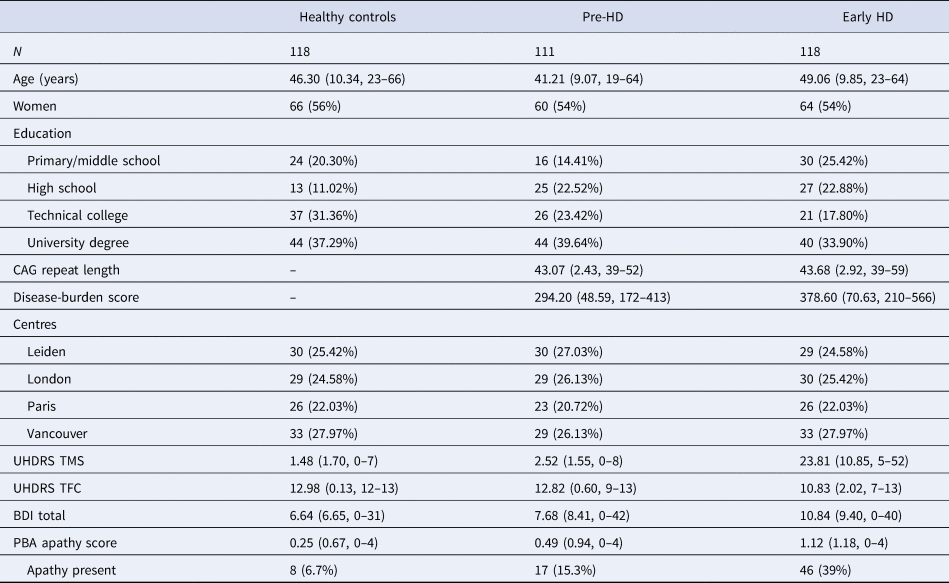
Our data analyses included 118 premanifest gene carriers, 111 early HD and 118 healthy control participants from the TRACK-HD study who completed baseline and 24-month visits. Full details of the TRACK-HD study have been reported elsewhere (Stout et al., Reference Stout, Jones, Labuschagne, O'Regan, Say, Dumas and Frost2012; Tabrizi et al., Reference Tabrizi, Langbehn, Leavitt, Roos, Durr, Craufurd and Stout2009). Briefly, participants were enrolled at four sites, London (UK), Paris (France), Leiden (Netherlands) and Vancouver (Canada). At baseline participants were aged between 18–65 years and had no history of major neurological disease (other than HD), major psychiatric disorder or severe head injury. Premanifest participants had a baseline total motor score (TMS) of 5 or lower on the United Huntington's Disease Rating Scale (UHDRS; Huntington Study Group, 1996). Early HD participants had a baseline UHDRS total functional capacity (TFC) score of between 7 and 13, indicating minimal to moderate clinical impairment (Shoulson & Fahn, Reference Shoulson and Fahn1979). Control participants were age- and gender-matched to the combined premanifest and early HD groups at baseline. Participant characteristics are presented in Table 1. The study was approved by local ethics committees and participants gave written informed consent.
Baseline participant characteristics

Data are mean (s.d., range) or number (%). Disease-burden score is calculated as age × (CAG-35.5). UHDRS TMS – UHDRS Total Motor Score: Possible scores range from 0–124; UHDRS TFC – UHDRS Total Functional Capacity: Possible scores range from 0–13; BDI Total – Beck Depression Inventory Total Score; PBA Apathy Score – Problem Behaviour Assessment Apathy Severity Score: Possible scores range from 0–4. Apathy Present: Proportion of participants above cut-off for clinical apathy ⩾2.
Assessment of apathy
Apathy symptom severity at baseline was measured using severity rating from the lack of initiative (apathy) item from the Short Problem Behaviours Assessment for Huntington's disease (PBA-s; Callaghan et al. Reference Callaghan, Stopford, Arran, Boisse, Coleman, Santos and Craufurd2015; Orth et al. Reference Orth, Handley, Schwenke, Dunnett, Craufurd and Ho2010). The PBA-s is a semi-structured interview conducted by a clinician-rater with the participant and an informant, and was designed to obtain information about current behaviour. The short version has 11 items, each measuring a different behavioural problem, such as apathy, depression or irritability. Each behaviour is rated for both severity and frequency on a 5-point scale, ranging from 0 (absent) to 4 (severe). The measure has good inter-rater reliability (Callaghan et al., Reference Callaghan, Stopford, Arran, Boisse, Coleman, Santos and Craufurd2015). Because of concerns regarding the validity of the frequency rating (McNally, Rickards, Horton, & Craufurd, Reference McNally, Rickards, Horton and Craufurd2015), we used the severity rating from the apathy item as the measure of baseline apathy. Baseline apathy scores, along with the proportion of participants rated in the clinical range (severity score ⩾2) within each group, are shown in Table 1.
Cognitive assessment
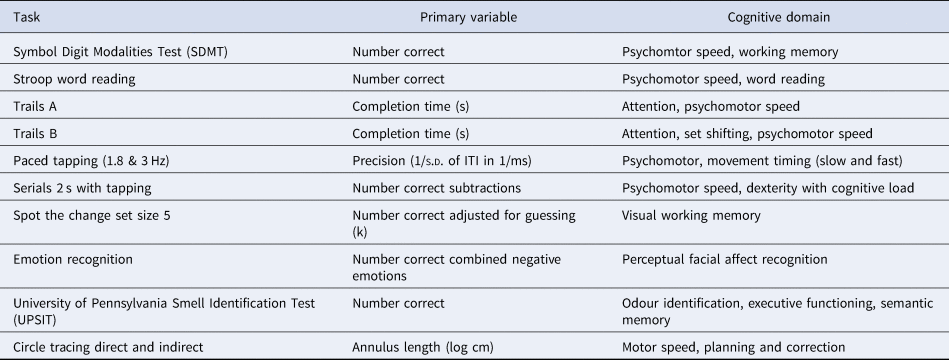
Cognitive function was assessed by deriving a composite based on 12 primary cognitive outcome variables from nine cognitive tasks, as proposed by Stout et al. (Reference Stout, Jones, Labuschagne, O'Regan, Say, Dumas and Frost2012) (see Table 2 for a description of each outcome measure). These cognitive tasks were originally selected as part of the TRACK-HD battery to be the most sensitive to cognitive change in pre-HD (Tabrizi et al., Reference Tabrizi, Langbehn, Leavitt, Roos, Durr, Craufurd and Stout2009) and included tests of psychomotor speed, attention, working memory, planning, set-shifting, emotion recognition and odour identification. Odour identification was included in the cognitive composite as there is a wealth of evidence that higher order olfactory tasks are strongly associated with executive functioning and semantic memory abilities in both healthy populations (Hedner, Larsson, Arnold, Zucco, & Hummel, Reference Hedner, Larsson, Arnold, Zucco and Hummel2010; Larsson, Finkel, & Pedersen, Reference Larsson, Finkel and Pedersen2000; Schab, Reference Schab1991) and HD (Delmaire et al., Reference Delmaire, Dumas, Sharman, van den Bogaard, Valabregue, Jauffret and Lehéricy2013; Nordin, Paulsen, & Murphy, Reference Nordin, Paulsen and Murphy1995). Cognition was assessed annually throughout the TRACK-HD study, and for this study, we included participants' baseline and 24-month cognitive results. We defined change in cognition as a change in performance from baseline (Visit 1) to 24 months (Visit 3).
Tasks contributing to cognitive composite

Assessment of depression
Severity of depression symptoms at baseline was measured using the total score of the Beck Depression Inventory II (BDI-II; Beck, Steer, and Brown, Reference Beck, Steer and Brown1996), a commonly used 21 item self-report measure. Each item is scored from 0 to 3, with higher scores indicating higher severity of symptoms. The maximum total score is 63.
Statistical analyses
In order to create the cognitive composite, for each participant, we first standardised the task scores of component cognitive measures by using the baseline data combined across the premanifest HD, early HD and control groups as the population. The average of the 12 standardised scores at baseline and at 24 months was then calculated, and difference between these values created the change in cognitive composite, where a positive value represented an improvement over 24 months, whereas a negative value represented a decline over 24 months. Because 36% of early diagnosed HD subjects were missing data from one or more cognitive tests at one of the visits, we used multiple imputation (MI; Rubin, Reference Rubin1987) to simulate a range of plausible values for missing scores. Imputation was done separately for the premanifest group, the early HD group and the control group. For the MI model, we used 12 cognitive variables contributing to the composite, as well as BDI and PBA-Apathy, age, gender and education. Twenty sets of data were imputed per group. Final model estimates and hypothesis tests were derived by applying Rubin's procedures to the analyses of each imputed data set (Carpenter & Kenward, Reference Carpenter and Kenward2013; Rubin, Reference Rubin1987). All statistical analyses were performed using SAS/STAT® software, version 14.1 (SAS Institute Inc, 2015).
Pearson correlations were used to assess the association between PBA-Apathy severity score and BDI-II depression score, UHDRS motor score and age for each group at baseline. We used statistical modelling to assess the impact of apathy and other measures at baseline on the subsequent longitudinal change in the cognitive composite score. We used least squares regression with the longitudinal cognitive score change as the outcome. Depending on the model, the predictors were chosen from among the baseline values of age, UHDRS motor score (square root transformed), BDI-II depression score and PBA-apathy severity.
Results
Cognitive change over 24 months by group
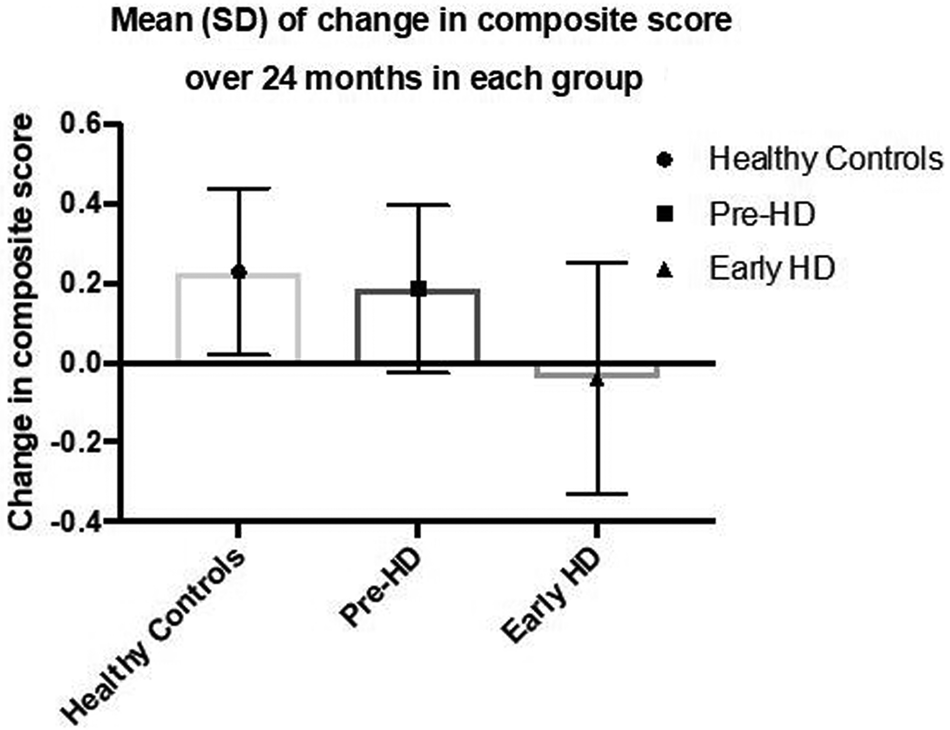
Figure 1 shows the mean change in cognitive composite score over 24 months for each group, where the control and premanifest groups show positive mean change scores, reflecting improved task performance due to practice effects (Stout et al., Reference Stout, Jones, Labuschagne, O'Regan, Say, Dumas and Frost2012), and the early HD group shows a negative mean change score indicating more marked cognitive decline occurred the 24 month interval. The early HD group showed significantly more cognitive decline than the control group, based on the multiple imputation data (t = −7.82, p = <0.001). The premanifest group showed an intermediate level of cognitive change, that was not significantly different from the control group (t = −1.57, p = 0.12).
Mean (standard deviation) of change in cognitive composite score over 24 months for each group, based on the multiple imputation data.

Bivariate correlations between apathy and age, total motor score and depression
Pearson correlations revealed that at baseline, a higher apathy score was associated with a higher depression score for controls (r = 0.53, p < 0.001), premanifest participants (r = .63, p < 0.001) and early HD participants (r = 0.45, p < 0.001). A higher apathy score also related to a higher UHDRS TMS for early diagnosed HD participants (r = 43, p < 0.001), but not premanifest participants (r = 0.07, p = 0.49) or controls (r = 0.05, p = 0.60). There was no significant association between apathy and age for any group (all ps <0.21).
Assessing apathy as a predictor of cognitive change over 24 months
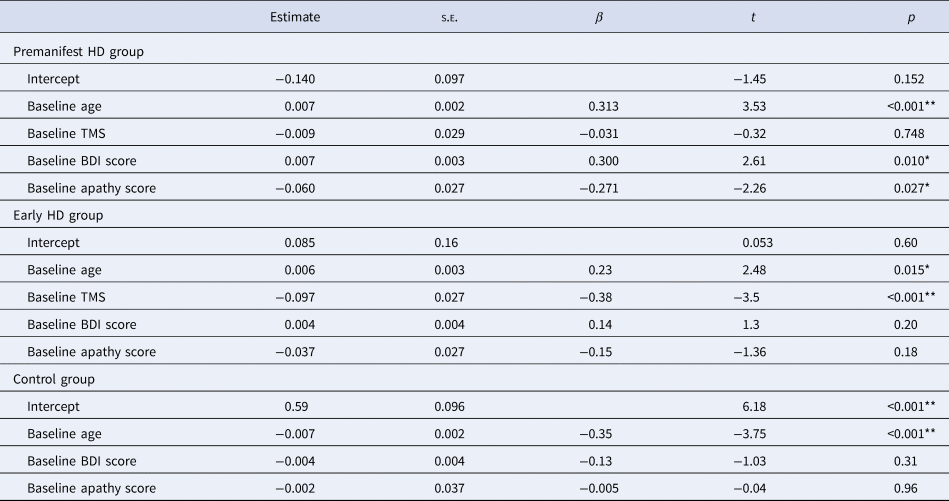
In the premanifest group, we initially entered only baseline age and apathy scores into the model, and found that older age predicted slower cognitive decline (β = 0.29, p = 0.002) but apathy was not a significant predictor (β = −0.09, p = 0.37). We then added self-reported depression to the model, and found that then apathy emerged as a significant predictor, with more apathy at baseline predicting faster cognitive decline (β = −0.27, p = 0.028). Baseline age and depression scores were also independent predictors in the model (age: β = 0.31, p < 0.001; depression: β = 0.30, p = 0.01), with older age and higher levels of self-reported depression predicting slower cognitive decline. Finally, the motor score was not a significant predictor of cognitive decline when it was added to the model, however apathy, age and depression remained as significant predictors. The final model is shown in Table 3, and accounted for 16.1% of the variance in cognitive decline.
Final multiple regression model of cognitive composite change for each group

TMS, UHDRS Total Motor Score (Square Root Transformed); BDI, Beck Depression Inventory; Apathy Score, Problem Behaviours Assessment Apathy Severity Score.
*p < 0.05, **p < 0.01.
In the early HD group, with only baseline age and apathy scores entered into the model, more baseline apathy predicted faster cognitive decline (β = −0.24, p = 0.01), whereas age was a not a significant predictor (β = 0.16, p = 0.14). Once the motor score was added to the model, however, apathy was no longer a significant predictor (β = −0.09, p = 0.40). Instead, in contrast to the premanifest group, for the early HD group more severe motor signs did predict faster cognitive decline (β = −0.37, p = 0.001), and younger age also predicted faster cognitive decline (β = 0.22, p = 02). Self-reported depression was not a significant predictor when added to the model, and the overall variability accounted for by the model was largely unchanged. The final model, in Table 3, accounts for 19.6% of the variance in cognitive decline.
Finally, in the control group, with baseline age and apathy scores entered into the model as predictors of cognitive decline over 2 years, age emerged as a significant predictor of cognitive decline, but in contrast to the HD groups (for whom older age predicted slower cognitive decline), older age at baseline predicted faster cognitive decline (β = −0.35, p < 0.001). Apathy was not associated with cognitive decline in healthy controls (β = −0.07, p = 0.49). Self-reported depression added to the model was also not a significant predictor; age remained the only significant predictor cognitive decline (see Table 3). The final model, which had age as its only significant predictor, accounted for 12.9% of the variance in cognitive decline.
Discussion
In this study, we found that in a premanifest HD sample, more severe apathy symptoms at baseline predicted more rapid subsequent cognitive decline over 24 months. This relationship emerged after controlling for age and depression symptoms. These findings suggest that in the context of the highly variable onset and course of cognitive decline in HD, the detection of apathy may point to an elevated risk of cognitive decline. Our findings extend previous cross-sectional studies that have documented the association between apathy and poorer cognition in HD (Baudic et al., Reference Baudic, Maison, Dolbeau, Boissé, Bartolomeo, Dalla Barba and Bachoud-Lévi2006; Reedeker et al., Reference Reedeker, Bouwens, van Duijn, Giltay, Roos and van der Mast2011), demonstrating that prospectively, using longitudinal data, the presence of apathy symptoms is predictive of cognitive decline. Our finding in HD is also consistent with previous studies in Parkinson's disease (Dujardin et al., Reference Dujardin, Sockeel, Delliaux, Destee and Defebvre2009) and Alzheimer's disease (Starkstein et al., Reference Starkstein, Jorge, Mizrahi and Robinson2006), which indicated that apathy was linked to faster cognitive decline over 1–4 years. In the current study, the premanifest group did not show evidence of significant cognitive decline over 24 months, consistent with previous studies of cognitive decline in premanifest HD, which have demonstrated subtle declines in this population, which generally require very large samples and a longer follow up to detect significant decline (Paulsen, Smith, Long, the Predict HD Investigators & Coordinators of the Huntington Study Group, Reference Paulsen, Smith and Long2013). Nevertheless, the emergence of a relationship between apathy symptoms and cognitive decline in this group indicates that apathy can predict even subtle cognitive decline, that may then accelerate as the disease progresses. Given the presence of apathy is associated with frontal-striatal damage (Levy & Dubois, Reference Levy and Dubois2006), and the TRACK-HD cognitive battery was chosen to be most sensitive to fronto-striatal degeneration (Stout et al., Reference Stout, Jones, Labuschagne, O'Regan, Say, Dumas and Frost2012), it is perhaps not surprising that we found a relationship between apathy and decline on these cognitive tasks. Recent research has identified cognitive deficits in HD associated with extra-striatal brain regions (Stout, Glikmann-Johnston, & Andrews, Reference Stout, Glikmann-Johnston and Andrews2016), and therefore future research should examine whether apathy is predictive of decline in all cognitive domains in HD, or whether it is specific only to cognitive domains affected by frontal-striatal degeneration.
Our finding that the relationship between apathy and cognitive decline only emerged after controlling for depression requires some consideration in light of the well-established relationship between depression and reduced cognitive performance across healthy and many clinical populations, including HD (Knight & Baune, Reference Knight and Baune2018; Pirogovsky-Turk et al., Reference Pirogovsky-Turk, Moore, Filoteo, Litvan, Song, Lessig and Schiehser2017; Smith, Mills, Epping, Westervelt, & Paulsen, Reference Smith, Mills, Epping, Westervelt and Paulsen2012). In contrast, we found that higher self-reported depression at baseline was associated with less subsequent cognitive decline in our final model. We believe this suggests that in participants with depression symptoms at baseline, some of their cognitive impairment may have been attributable to depression, and cognitive function may have improved secondary to effective treatment or spontaneous remission of depression over the study period. Another possibility is that participants with intact cognition at baseline were more self-aware of their depression symptoms, and also experienced slower cognitive decline. Supporting this hypothesis, previous research has demonstrated a relationship between cognition and awareness of neuropsychiatric symptoms (Andrews et al., Reference Andrews, Craufurd, Durr, Leavitt, Roos and Tabrizi2018), and shown that cognitive decline accelerates with disease progression in HD (Paulsen et al., Reference Paulsen, Smith and Long2013). Further research is needed to elucidate the relationship between depression and cognitive decline in HD gene-positive people.
The contrast between our findings in premanifest HD, in which motor signs appeared to have no effect on the apathy's prediction of more rapid cognitive impairment, and our findings in early manifest HD, in which more severe motor signs, but not apathy symptoms, predicted subsequent faster cognitive decline, indicates that after motor onset, motor signs are a better predictor of cognitive decline than apathy. Previous research, and our current findings, have demonstrated that cognitive decline is more marked in early HD compared to premanifest HD (Stout et al., Reference Stout, Jones, Labuschagne, O'Regan, Say, Dumas and Frost2012), and that motor and cognitive progression often co-occur (Dorsey et al., Reference Dorsey, Beck, Darwin, Nichols, Brocht, Biglan and Shoulson2013; Tabrizi et al., Reference Tabrizi, Scahill, Owen, Durr, Leavitt and Roos2013). Additionally, most cognitive tasks include a significant motor component; therefore motor impairments also often have a direct impact on cognitive performance (Hart et al., Reference Hart, Dumas, Schoonderbeek, Wolthuis, van Zwet and Roos2014; Ross et al., Reference Ross, Pantelyat, Kogan and Brandt2014). Hence, part of the predictive value of motor impairments on longitudinal cognitive decline might partially reflect the rate of motor progression over time. Because this project was a secondary analysis of data from the TRACK-HD study, our selection of cognitive tasks was limited to those available for analysis. To minimise the influence of motor impairments on measures of cognitive decline, future studies should consider the use of cognitive tasks requiring a minimal motor response, such as orally administered versions of common cognitive tasks such as the Symbol Digit Modalities Test.
Motor signs, compared to apathy, may also better predict cognitive decline due to lower levels of measurement error. As a behavioural syndrome, apathy is a challenging construct to measure. The assessment used in the current study, the PBA-s, although scored by a professional rater, is somewhat subjective and relies on a very small sample of behaviours. As such its reliability is somewhat limited. In contrast, the measurement of motor signs may be less noisy. Another consideration is that in our regression model for the early HD group, apathy was a significant predictor of cognitive decline before the inclusion of motor signs in the model. This suggests that there is a substantial overlap in variance between apathy and motor signs in early HD, and therefore even with improved measurement, apathy may not be a significant independent predictor of cognitive decline in early HD. Regardless, in early HD, motor symptoms better predict the rate of cognitive decline than symptoms of apathy.
In both premanifest and early HD participants, age was also a significant predictor of cognitive decline, where younger age at baseline was associated with more rapid cognitive decline. This is likely due to the relationship between CAG expansion, age and the timing and severity of disease onset. Specifically, people with larger CAG expansions tend to have a younger and more severe onset of symptoms in HD, including cognitive symptoms (Penney, Vonsattel, MacDonald, Gusella, & Myers, Reference Penney, Vonsattel, MacDonald, Gusella and Myers1997; Walker, Reference Walker2007). In contrast, in healthy controls, older age was a significant predictor of faster cognitive decline, in line with the long-established effect of age on cognition (Verhaeghen & Salthouse, Reference Verhaeghen and Salthouse1997).
This study had several strengths, including the large samples of premanifest and early HD participants, and the use of a prospective longitudinal design. With regard to limitations, although the PBA-s apathy measure is well validated, it comprises only a single item. Apathy is increasingly recognised as a multi-dimensional construct (Levy & Dubois, Reference Levy and Dubois2006), and new measures assess the cognitive, behavioural and emotional subtypes of the syndrome (Radakovic & Abrahams, Reference Radakovic and Abrahams2014). It is possible that a particular subtype of apathy (e.g. cognitive) is a better predictor of cognitive decline in HD, or that different subtypes of apathy may have differential effects on cognition. For example, behavioural apathy may be associated with reduced motivation to perform on a cognitive task, and cognitive apathy may be associated with poorer cognitive capacity in the context of intact motivation. Future studies using more comprehensive measures of apathy will likely further enhance our understanding of apathy as a predictor of cognitive decline, particularly in early HD.
In conclusion, we found that after controlling for age and depression, higher levels of apathy predicted more rapid cognitive decline in people with premanifest HD. In contrast, after clinical diagnosis of HD, which is triggered by the unequivocal presence of motor signs of HD, motor symptom severity, rather than apathy, is the best predictor of cognitive decline. Clinically, apathy in premanifest HD is a harbinger of relatively rapid cognitive decline, whereas in people with the clinical diagnosis of HD, motor signs are the harbinger of cognitive decline.
Financial support
TRACK-HD was supported by CHDI/High Q Foundation Inc, a not for profit organisation dedicated to finding treatments for Huntington's disease. CHDI provided funding to University College London (UCL), and UCL provided funding to Monash University. STJ was global Principal Investigator for the TRACK-HD study, and JCS was Principal Investigator for the Monash University component of TRACK-HD. Dr. Andrews was supported by a fellowship from the Huntington's Disease Society of America.
Conflicts of interest
None.
Ethical standards
The authors assert that all procedures contributing to this work comply with the ethical standards of the relevant national and institutional committees on human experimentation and with the Helsinki Declaration of 1975, as revised in 2008.