Nitrate concentrations in water have increased in many agricultural areas during the past 10 years, mainly because of the use of the fertilizers as part of intensive agricultural production, one of the underlying reasons for artificial eutrophication. The development of an environmentally friendly and efficient technology to remove nitrate from contaminated water is becoming essential.
The need to ameliorate the toxicity of nitrates has created new technologies for nitrate removal from water (Canter, Reference Canter1996), including physicochemical processes such as electrodialysis or reverse osmosis and biological processes using microorganisms to reduce nitrates into gaseous nitrogen. However, these processes are relatively expensive because of the equipment required, the production of large volumes of effluents and/or the long treatment times (Wan et al., Reference Wan, Liu, Liu, Qu, Li and Zhang2012). The adsorption method is good for the rapid, selective recovery of elements with markedly low concentrations. However, few adsorbents have been reported to facilitate the removal of nitrate ions from solutions that also contain large concentrations of chloride, sulfate or carbonate ions, because most of the adsorbents show low selectivity towards nitrate ions compared to other anions (Bhatnagar & Sillanpää, Reference Bhatnagar and Sillanpää2011; Lazaratou et al., Reference Lazaratou, Vayenas and Papoulis2020).
Layered double hydroxides (LDHs) are layered minerals that have attracted much attention in recent years (Cavani et al., Reference Cavani, Trifirò and Vaccari1991). The LDHs comprise positively charged layers with at least two different metal cations and negatively charged exchangeable interlayer anions. The general structural formula of LDHs can be expressed as [M 2+1–xM 3+x(OH)2]x +(An –)x /n·mH2O, where M 2+ are divalent cations with similar ionic radii to Mg2+, M 3+ are trivalent cations with similar ionic radii to Al3+, x is the M 2+/(M 2+ + M 3+) ratio and An – is the exchangeable interlayer anion of valence n. Furthermore, ternary, quaternary or multivariate LDHs can be synthesized when a variety of metals is introduced into the layer to improve properties such as adsorption, catalysis and so on (Wang & O'Hare, Reference Wang and O'Hare2012; Sun et al., Reference Sun, Lin, Zheng, Wang, Zhang, Xu and Hou2013; Gao et al., Reference Gao, Li, Zhan, Zhao, Xiao and Wei2014; Yang et al., Reference Yang, Gao and Wang2014; Kühl et al., Reference Kühl, Schumann, Kasatkin, Hävecker, Schlögl and Behrens2015). The properties of LDHs, namely their low cost, two-dimensional structure, large specific surface area, positive surface charge and large anion-exchange capacity, make them appropriate for a wide range of applications such as slow-release fertilizers (Gillman et al., Reference Gillman, Nobel and Raven2008), catalysts (Brito et al., Reference Brito, Borges, Garin and Hernandez2009; Zhou et al., Reference Zhou, Beltramini, Lin, Xu, Lu and Tanksale2011; Lv et al., Reference Lv, Yang, Fan, Zhao, Chen, Lu and Li2015), nanosheets (Mao et al., Reference Mao, Zhou, Tong, Yu and Lin2017) and flame retardants (Shi et al., Reference Shi, Li, Wang, Li, Evans and Duan2005), along with applications in the biomedical sector (Ren et al., Reference Ren, He, Evans, Duan and Ma2001; Wang & Zhang, Reference Wang and Zhang2012; Wang et al., Reference Wang, Zhang, Bao, Wu and Wan2012; Li et al., Reference Li, Li, Wang, Wang, Cader and Lu2013) and in polymer nanocomposite synthesis (Costa et al., Reference Costa, Leuteritz, Wagenknecht, Jehnichen, Häußler and Heinrich2008). Moreover, researchers are interested in using inexpensive precursors such as wastes and by-products instead of chemical salts for preparing a variety of target products, such as LDH materials. Such LDH products can be synthesized from iron-making slag (Wajima et al., Reference Wajima, Oya, Shibayama, Sugawara and Munakata2011, Reference Wajima, Oya, Shibayama and Munakata2012; Kuwahara et al., Reference Kuwahara, Tamagawa, Fujitani and Yamashita2016; Wang et al., Reference Wang, Chen, Shang, Hou and Li2016), aluminium dross (Murayama et al., Reference Murayama, Maekawa, Ushiro and Miyoshi2012), aluminium saline slag (Sntamaría et al., Reference Santamaria, Lopez-Aizpun, Garcia-Padial, Vicente, Korili and Gil2020), red mud (Hu et al., Reference Hu, Zhang, Lv, Tong, Xin and Meng2017), asbestos-containing waste (Li, Reference Li2019), biomass combustion ash (Suhara & Wajima, Reference Suhara and Wajima2018), waste serpentine tailing (Zhu et al., Reference Zhou, Li, Hao, Qian and Zhou2016), eggshell waste (Foruzin et al., Reference Foruzin, Rezvani and Habibi2020) and bittern (Wajima, Reference Wajima2015).
Extensive previous work on nitrate removal using LDHs has been done by many authors (Socías-Viciana et al., Reference Socias-Viciana, Urena-Amate, Gonzáles-Prades, Garcia-Cortés and López-Teruel2008; Terry, Reference Terry2009; Islam & Patel, Reference Islam and Patel2010, Reference Islam and Patel2011; Wan et al., Reference Wan, Liu, Liu, Qu, Li and Zhang2012; Ivánová et al., Reference Ivánová, Albert and Kavuličová2018). Among the LDH products, Fe-layered double hydroxide (Fe-LDH) has been reported to have selective nitrate removal ability (Tezuka et al., Reference Tezuka, Chitrakar, Sonoda, Ooi and Tomida2004), and there are many studies on efficient nitrate removal using Mg-Fe-LDH (Sasai et al., Reference Sasai, Norimatsu and Matsumoto2012; Yang et al., Reference Yang, Zhang, Xu, Zhang, Niu and Zhou2015; Xue et al., Reference Xue, Gao, Wan, Fang, Wang and Li2016; Tong et al., Reference Tong, Yang, Xu, Li and Niu2017; Kamimoto et al., Reference Kamimoto, Okamoto, Hagio, Yong-Jun, Deevanhxay and Ichino2019; Santos et al., Reference Santos, Silva, Lins, Duarte, Ide and Meili2020). In our previous study, a Ca-Mg-Fe-LDH with nitrate-removal ability was synthesized from bittern with the addition of FeCl3 (Wajima, Reference Suhara and Wajima2018). Bittern is a by-product of the salt-refinement process, and it contains several ions (Mg2+, Ca2+, K+ and Na+) in greater concentrations than in seawater. This is especially the case for Mg and Ca ions, which are the most abundant cation species in bittern. Japan is an island nation which promotes the use of marine resources. Bittern is an important resource for application in various fields, and a novel LDH product synthesized from bittern may be used in new applications. LLimited information is available on the synthesis of Fe-LDH from bittern and its nitrate-removal ability.
There have been previous studies of nitrate removal using uncalcined LDH (Islam & Patel, Reference Islam and Patel2009) and calcined LDH (Hosni & Srasra, Reference Hosni and Srasra2007; Socias-Viciana et al., Reference Socias-Viciana, Urena-Amate, Gonzáles-Prades, Garcia-Cortés and López-Teruel2008; Tong et al., Reference Tong, Yang, Xu, Li and Niu2017) from model water. The hydrotalcite structure becomes disordered after thermal decomposition at 450–500°C, creating highly active mixed-metal oxides. The calcined products exhibited greater oxyanion adsorption efficiency than their uncalcined counterparts due to their significant thermal stability, increased specific surface area and porosity and fewer carbonate anions in the interlayer. The various mechanisms of anion adsorption of the calcined LDH in comparison with the uncalcined LDH are related to the reconstruction capability of the original laminar structure (known as the memory effect) via rehydration and the incorporation of various anions in the interlayers from aqueous solutions (Goh et al., Reference Goh, Lim and Dong2008). Calcined LDHs are not suitable for repeated use because regeneration of the calcined LDH necessitates calcination at a high temperature, which increases total costs. The present study focused, therefore, on uncalcined LDH as a reusable adsorbent for nitrate removal via the ion-exchange reaction.
In this study, we attempted to prepare an LDH adsorbent from bittern with good nitrate-removal performance. The product including Fe-LDH was prepared from bittern via the addition of an inexpensive agent (FeCl3), and the nitrate-removal performance of the product was examined in various aqueous solutions. Synthesis of Fe-LDH from bittern by-products, control of the nitrate removal of the LDH product from bittern and the properties of the LDH regarding nitrate removal were analysed.
Experimental
Bittern and seawater
Commercial bittern was used to synthesize Fe-LDH, and seawater collected from the surface layer of Imari Bay, Saga Prefecture, Japan, was treated for the selective removal of nitrate. Table 1 lists the chemical compositions of the bittern and the seawater. The concentrations of the main elements in bittern were greater than those in seawater, except for SO42–. The concentrations of Mg2+ and Ca2+ in bittern were 5432 and 1385 mmol L–1, respectively. The seawater used in the experiment demonstrated the typical chemical composition of seawater. The pH values of bittern and the seawater were 5.4 and 7.8, respectively.
Chemical composition (mmol L–1) of bittern and the seawater.

Synthesis of Fe-LDH
The synthesis procedure of Fe-LDH from bittern is as follows (Fig. 1): FeCl3·6H2O (Wako) was added to 100 mL of bittern and stirred at room temperature (15–20°C) to prepare a mixed solution of (Mg2+ + Ca2+)/Fe3+ (molar ratio of 3). A total of 100 mL of 1 mol L–1 NaCl solution was stirred at 20–80°C and the mixed solution was dropped into the NaCl solution at a rate of 4 mL min–1. During stirring, the pH of the NaCl solution was maintained at 8.5–12.5 with 4 M NaOH. Additionally, N2 gas was bubbled into the solution to inhibit the dissolution of carbon dioxide from the atmosphere. After 6 h of stirring, the precipitates were filtered, washed with distilled water and then dried at 60°C to obtain the product. The weights of the product were measured with an electric scale; furthermore, the mineralogical phases in the products were identified using X-ray diffraction (XRD; Miniflex600, Rigaku) with Cu-Kα radiation (30 kV, 15 mA) in the 2θ range of 5–55° with a scanning step of 0.02o and a speed of 5° min–1 and with a receiving Soller slit of 5°. The chemical composition of the product was determined by dissolving 50 mg of the LDH in 10 mL of 0.1 M HNO3 solution, and determination of the Mg2+, Ca2+ and Fe3+ contents was achieving using atomic absorption spectrometry (AAS; AAnalyst 2000, PerkinElmer).
Synthesis procedure of the Fe-LDH.

Nitrate removal
To facilitate nitrate adsorption by the Fe-LDH, 50 mg of the product was added to a test tube containing 40 mL of 1 mmol L–1 NaNO3 solution. The mixture was shaken for 30 min and subsequently centrifuged. The NO3– content in the supernatant was measured using the Cu–Cd reduction–N-(1-naphthyl)-ethylenediamine absorption method to calculate the NO3– removal rate (R) with Equation 1:

where C 0 and C are the initial and final concentrations of NO3– in the supernatant, respectively.
The nitrate removal reactions of the product were determined as follows: 500 mg of the product was added to 500 mL of 1 mmol L–1 NaNO3 solution and the slurry was stirred with a magnetic stirrer for 6 h at 10–80°C. The pH of the solution was recorded during stirring with a pH meter (C-73, As One); aliquots of 4 mL were separated and filtered with a 20 μm membrane filter. The concentrations of NO3– were measured using the Cu–Cd reduction–N-(1-naphthyl)-ethylenediamine absorption method. The concentrations of Mg2+, Ca2+ and Fe3+ eluted from the Fe-LDH into the solution were used to determine the elution amount (E) using Equation 2:

where C is the concentration of the ions, V is the volume (L) and w is the mass of the sample (g).
In addition, the nitrate-removal capacity of the Fe-LDH from the salty solution was determined using a seawater sample that was diluted by 0 to 10,000-fold. Thereafter, NaNO3 powder was added to obtain an NO3– concentration of 0.1 mmol L–1. The Fe-LDH (50 mg) was added to 40 mL of these solutions in 50 mL test tubes and the mixtures were shaken for 3 h using a reciprocal shaker. Then, the solid phase was separated via centrifugation, and the nitrate concentration of the supernatant was determined using the Cu–Cd reduction–N-(1-naphthyl)-ethylenediamine absorption method to calculate the nitrate-removal rate (R).
Furthermore, the effects of the coexisting anions on the nitrate-removal reactions of the product were determined as follows: 0.5 g of the product was added to 500 mL of 1 mmol L–1 NaNO3 solution with 1 mmol L–1 NaCl, NaNO2, Na2SO4, Na2CO3, NaBr and NaF, and the slurry was stirred magnetically for 6 h at room temperature. During stirring, the pH of the solution was measured with a pH meter; aliquots of 4 mL were separated, and a 20 μm membrane filter was used to obtain the filtrate. The nitrate concentration in the filtrate was measured using the Cu–Cd reduction–N-(1-naphthyl)-ethylenediamine absorption method.
To construct the nitrate adsorption isotherm, 50 mg of the product was added to 40 mL of 0.02–1.00 mmol L–1 NaNO3 solution in test tubes and shaken for 20 min. The suspensions were then centrifuged and the nitrate content in the supernatant was measured using the Cu–Cd reduction–N-(1-naphthyl)-ethylenediamine absorption method to calculate the adsorption amount (qe) with Equation 3:

To study the stability of nitrate ions on the Fe-LDH, adsorption and desorption cycles of nitrate ions were performed using 1 mM NaNO3 as the absorbate and 5 mM NaCl as the eluent. The Fe-LDH (0.1 g) was added to 40 mL of 1 mM NaNO3 solution in a 50 mL centrifuge tube, shaken for 10 min to adsorb nitrate ions and centrifuged to collect the supernatant. Then, 40 mL of 5 mM NaCl solution was added and the mixture was shaken for 10 min to desorb nitrate ions from the Fe-LDH, and this was then centrifuged. After removal of the supernatant, 40 mL of 1 mM NaNO3 solution was added to the test tube again to adsorb the nitrate ions. This adsorption–desorption step was repeated ten times. The nitrate concentration in the supernatant was measured using the Cu–Cd reduction–N-(1-naphthyl)-ethylenediamine absorption method as per Equations 2 and 3.
Results and discussion
Preparation of Fe-LDH for nitrate removal
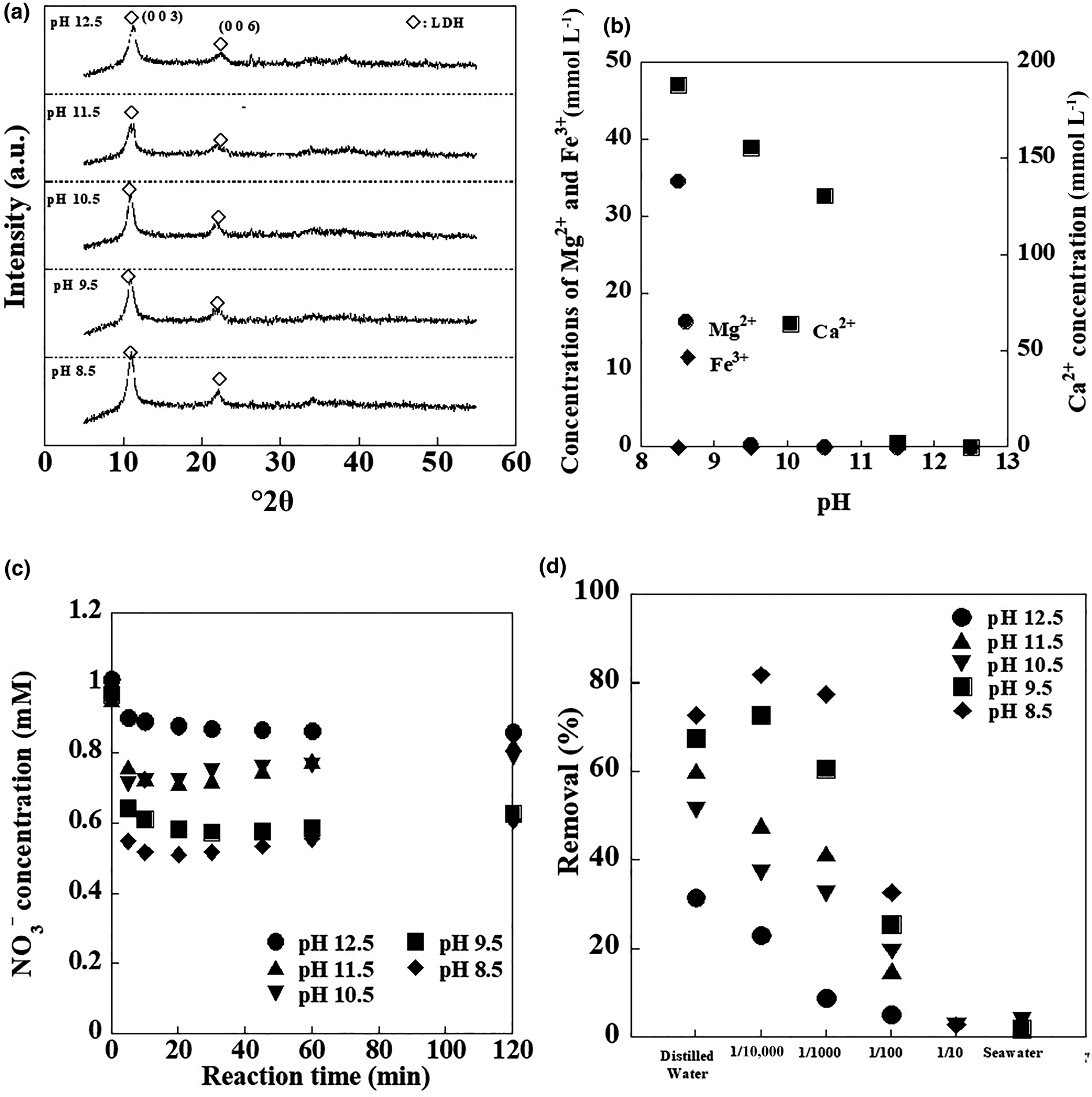
Figure 2a shows the XRD traces of the LDH synthesized in solutions with various pH values. The XRD traces of the products synthesized at pH 8.5–12.5 have symmetric peaks characteristic of hydrotalcite-like compounds (Ma et al., Reference Ma, Chen, Zhang and Zhao2017). The intensity of the 003 and 006 basal reflections decreased with a decrease in the pH of the synthesis solution, indicating a relatively well-formed crystalline Mg-LDH (Lv et al., Reference Lv, Ma, Xin, Wang, Xu and Liu2012).
(a) XRD traces of the products synthesized at pH 8.5–12.5. (b) Concentrations of Mg2+, Ca2+ and Fe3+ in the solution after synthesis at pH 8.5–12.5. (c) NO3– concentration in the solution using the LDH product synthesized at pH 8.5–12.5. (d) NO3– removal in the saline solution using the LDH product synthesized at pH 8.5–12.5.

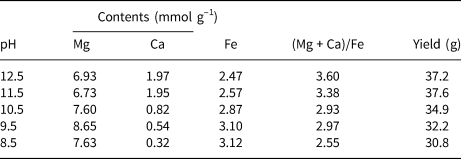
The chemical compositions of the products synthesized in the solution at various pH values are listed in Table 2. A reduction in the pH value of the synthesis solution increased the Mg and Fe contents and decreased the Ca content; consequently, the (Mg + Ca)/Fe molar ratio and the yield of the LDH decreased. Thus, it is considered that Mg-Fe-LDH was synthesized at a lower pH, whereas Mg-Ca-Fe-LDH was synthesized at a higher pH.
Chemical composition of the Fe-LDH products synthesized from solution at various pH values.

The concentrations of Mg2+, Ca2+ and Fe3+ in the synthesis solution are shown in Fig. 2b. By decreasing the pH of the synthesis solution, the Ca concentration increased after synthesis. Although the concentration of Mg was zero at pH 9.5–12.5, it was 35 mmol L–1 at pH 8.5. Moreover, the Fe content in the solution was zero regardless of the pH value, indicating that Fe was present entirely in the solid product after synthesis. Thus, the composition and yield of the products depended on the solubility of Ca in the synthesis solution at various pH values.
The concentration of NO3– in the liquid after adsorption on LDH synthesized at pH 8.5–12.5 and 20°C decreased within 10 min, remaining almost constant thereafter (Fig. 2c). The products synthesized at a lower pH removed greater amounts of NO3– from the solution, and the NO3– concentration after 10 min of using the products synthesized at pH 8.5–9.5 yielded the lowest NO3– concentration of ~0.6 mmol L–1. The solution pH was 10 and the elution of Mg2+, Ca2+ and Fe3+ was <0.4 mmol g–1 after 20 min of reaction, regardless of the type of LDH. It is suggested that the crystal structure of the LDH synthesized at a greater pH might be partly destroyed by the increasing Ca2+ entering the brucite-like sheet, which decreased the nitrate-removal ability.
The nitrate removal from saline water by the LDH products is shown in Fig. 2d. The nitrate removal rate of products synthesized at pH 10.5–12.5 from seawater gradually decreased to 3% with increasing salinity. The nitrate removal rate of the LDH products synthesized at pH 8.5–9.5 was 60–80% in distilled water, 1/10,000 seawater and 1/1000 seawater (freshwater environment), which is greater than those of the products at pH 10.5–12.5 owing to the greater nitrate-removal ability of Mg-Fe-LDH compared to Ca-Mg-Fe-LDH from saline water. Hence, the LDH synthesized at pH 8.5–9.5 exhibited greater removal ability for NO3– than those synthesized at pH > 10.5.
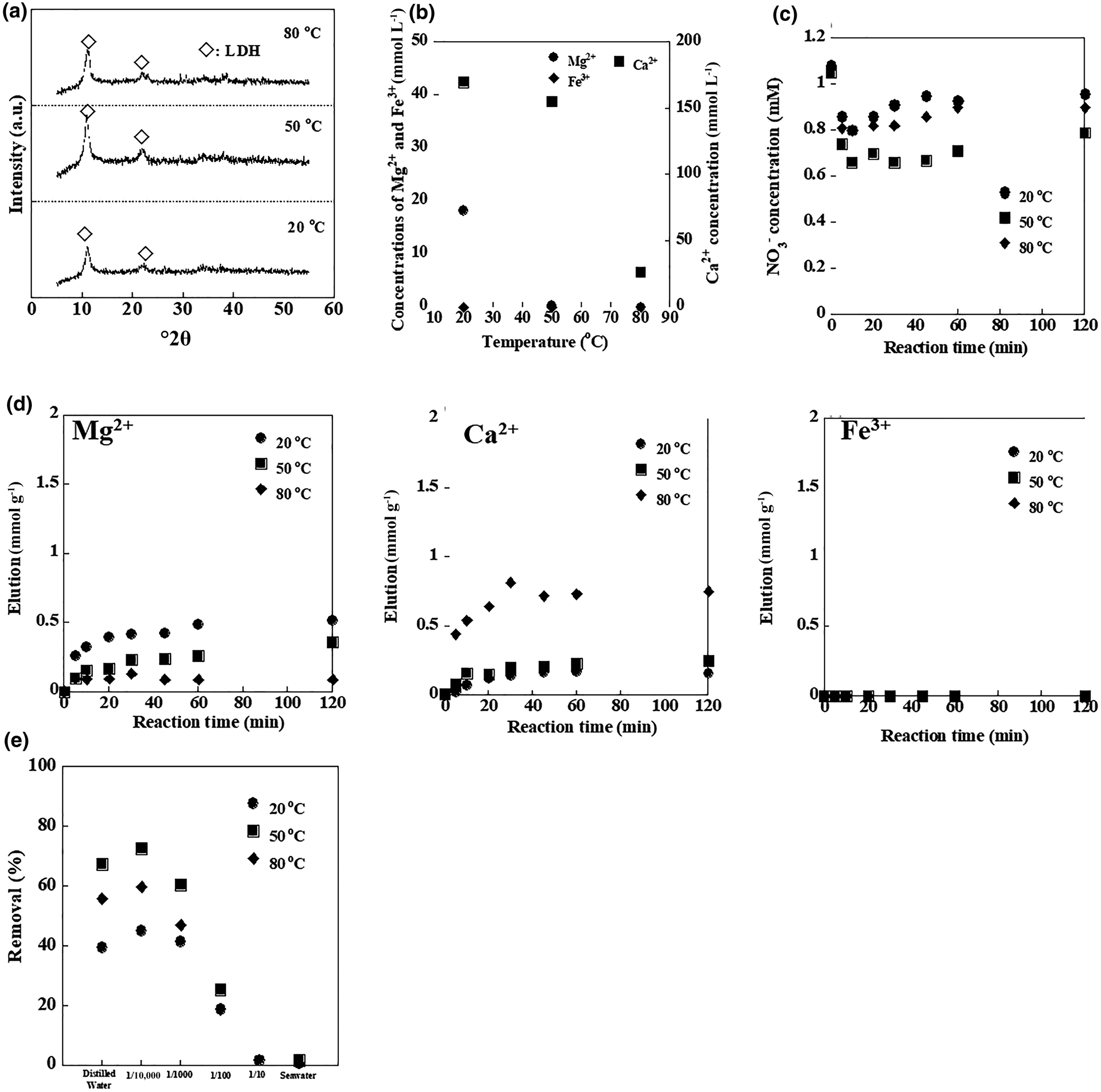
Figure 3a shows the XRD traces of the LDH synthesized at various temperatures and pH 9.5. The products contain hydrotalcite-like phases, and the crystal structure of the LDH synthesized at 80°C was partly destroyed by the incorporation of Ca2+ ions in the brucite-like sheet, which decreased the intensity of the 003 and 006 basal reflections. The product synthesized at 50°C showed the most intense LDH peaks.
(a) XRD traces of the LDH products synthesized at 20–80°C. (b) Concentrations of Mg2+, Ca2+ and Fe3+ in the solution after synthesis at 20–80°C. (c) NO3– concentration in the solution using the product synthesized at 20–80°C. (d) Elution of Mg2+, Ca2+ and Fe3+ in the NO3– solution from the LDH product synthesized at 20–80°C. (e) NO3– removal in the saline solution using the LDH product synthesized at 20–80°C.

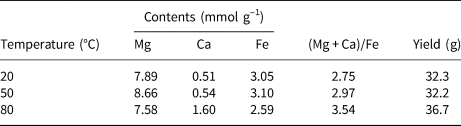
The chemical compositions of the LDH end products synthesized at various temperatures are shown in Table 3. The Mg content of the product synthesized at 50°C was greater than that at 20°C, whereas the Ca and Fe contents were almost the same, resulting in a greater (Mg + Ca)/Fe molar ratio of the product synthesized at 50°C. Moreover, the yield of the product at 50°C was almost identical to that at 20°C. In addition, the product synthesized at 80°C contained more Mg and Ca but less Fe than those synthesized at 20°C and 50°C, thus resulting in a greater (Mg + Ca)/Fe molar ratio of the product at 80°C. Therefore, the yield of the products was greater at 80°C than at 20°C or 50°C.
Chemical composition of the LDH products synthesized from solution at various temperatures.

The concentrations of Mg2+, Ca2+ and Fe3+ in the solution after synthesis are shown in Fig. 3b. Regardless of the synthesis temperature, the solution was Fe-free, indicating that Fe was hosted in the solid product after synthesis. The concentrations of Mg and Ca were 20 and 170 mmol L–1, respectively, in the solution after synthesis at 20°C. With increasing synthesis temperature, the concentration of Ca remained almost constant, and the concentration of Mg reduced to zero in the solution at 50°C. At 80°C, the solution was free of Mg, and the Ca content decreased to 30 mmol L–1. These results were in good agreement with the composition of the solids (Table 3).
The NO3– concentration in the solution after adsorption on the LDH products synthesized at 20–80°C is shown in Fig. 3c and the elution of Mg2+, Ca2+ and Fe3+ from the LDH products into the NO3– solution is shown in Fig. 3d. The NO3– concentration in solution decreased within 10 min, remaining almost constant thereafter. The LDH product synthesized at 50°C removed a greater amount of NO3– from the solution, and the corresponding NO3– concentration after the 10 min treatment was minimal (~0.6 mmol L–1). The NO3– concentration using the products at 20°C and 80°C was lower within the first 10 min but gradually increased at longer durations. The elution of Fe3+ from the products into the solution was negligible regardless of the synthesis temperature. The elution of Mg2+ and Ca2+ increased within 20 min of treatment and remained almost constant thereafter; the elution of Mg2+ from the LDH product synthesized at 20°C was greater than that of Ca2+ from the LDH product synthesized at 80°C. The increase in NO3– concentration in the solution after 10 min of treatment with products synthesized at 20°C and 80°C was due to the destruction of the LDH structure owing to the lower crystal order of the products synthesized at 20°C and 80°C compared to their counterparts synthesized at 50°C. After 20 min of reaction, the pH of the solution was alkaline (pH 10), regardless of the LDH products.
The removal of NO3– from saline water is shown in Fig. 3e. The nitrate removal rate of each LDH product remained almost constant upon increase of salinity of the solution to 1/1000 seawater and gradually decreased to 3% in seawater. The nitrate-removal rate of the LDH product synthesized at 50°C is 60–80% in distilled water, 1/10,000 seawater and 1/1000 seawater (freshwater environment), which is greater than that of the LDH product synthesized at 20°C (40%) and 80°C (50–60%); however, the removal rate decreased to 3% in seawater owing to the large amount of Mg-Fe-LDH in the solids. These results further confirmed that the LDH product synthesized at 50°C exhibited a greater removal ability for NO3– than the products synthesized at 20°C and 80°C.
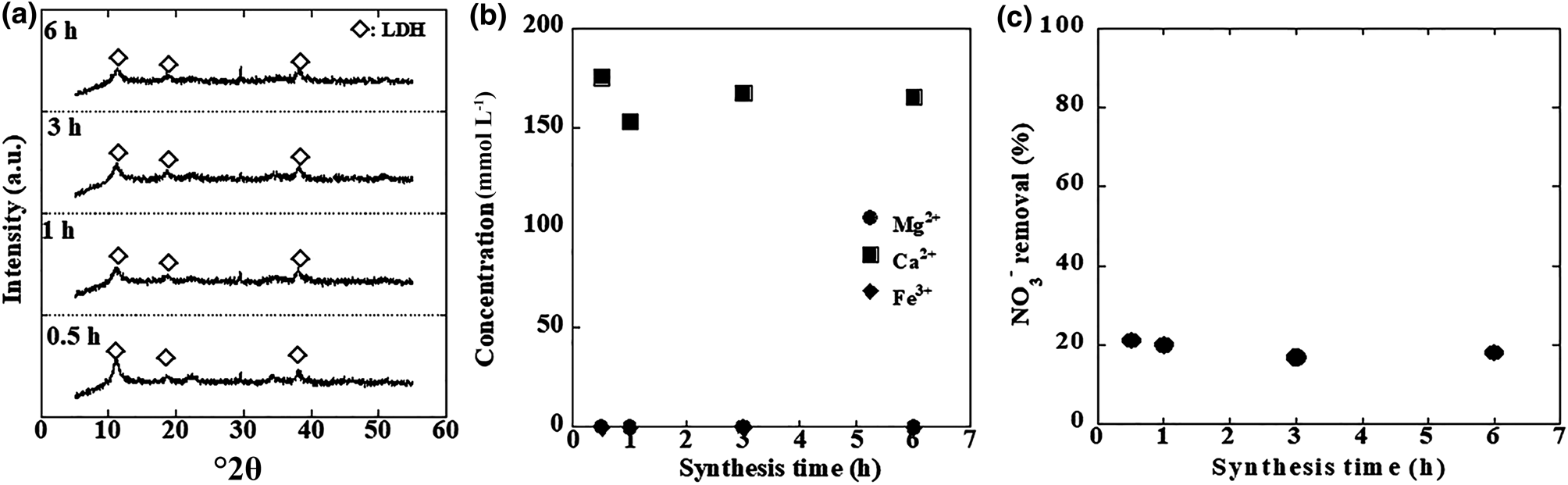
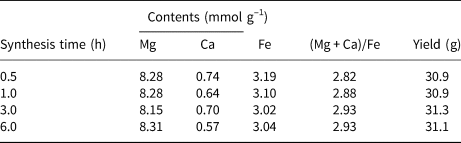
Figure 4a shows the XRD traces of the LDH products synthesized in the solution for various times at pH 9.5 and 50°C, and the respective chemical compositions are shown in Table 4. The products contained hydrotalcite-like phases after 0.5 h of synthesis, and the chemical compositions and yields of the products were almost the same as in the remaining synthesis experiments. The concentrations of Mg2+, Ca2+ and Fe3+ in the solution after synthesis are shown in Fig. 4b. Regardless of the synthesis period, the amounts of Ca2+ and Fe3+ in the solution were zero, and that of Mg was almost constant. Nitrate removal from the solution using the LDH products synthesized for 0–6 h is shown in Fig. 4c. Regardless of the synthesis period, the NO3– -removal capacities of the products were almost the same; thus, most NO3– was removed after a synthesis time of 0.5 h. Hence, the Fe-LDH product that was most effective for nitrate removal was synthesized in a solution with pH 9.5 at 50°C after 0.5 h.
(a) XRD traces of the LDH products synthesized for 0–6 h. (b) Concentrations of Mg2+, Ca2+ and Fe3+ in the solution after synthesis for 0–6 h. (c) NO3– removal from the solution using the LDH product synthesized for 0–6 h.

Chemical composition of the LDH products synthesized from solution at various reaction times.

Nitrate-removal ability
Figure 5 depicts nitrate removal from solution with various initial nitrate concentrations using the Fe-LDH product synthesized at pH 9.5 and 50°C for 0.5 h. The nitrate-removal rate decreased from 60% to 30% upon increasing the initial NO3– concentration from 0.05 to 1.0 mmol L–1.
Removal of NO3– from the solution with various initial NO3– concentrations.

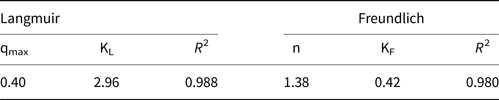
The isotherm of NO3– removal using the Fe-LDH product is shown in Fig. 6. The adsorption of NO3– increased with increasing equilibrium concentration. The adsorption isotherms were fitted with the Langmuir and Freundlich isotherm models. The linear forms of the Langmuir and Freundlich models are given by Equations 4 and 5, respectively.


where q e is the amount of nitrate adsorbed at equilibrium (mmol g–1) and qmax (mmol g–1) and KL (L mmol–1) are Langmuir constants related to the maximum adsorption capacity corresponding to complete coverage of the available sorption sites and a measure of adsorption energy (equilibrium adsorption constant), respectively. KF and n are the Freundlich constants.
Adsorption isotherm of NO3– on the Fe-LDH product.

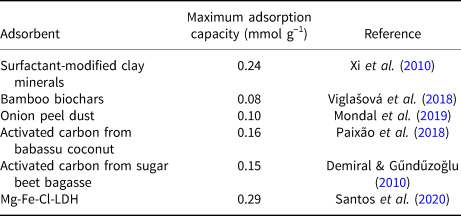
The Langmuir and Freundlich constants and regression coefficients for NO3– removal are listed in Table 5. The coefficients of determination (R 2) indicate a better fit for the Langmuir model than the Freundlich model; the maximum adsorption capacity of the LDH product for NO3– calculated from the Langmuir model was 0.40 mmol g–1. The adsorption capacity of the LDH product was greater than those of other adsorbents reported in previous studies (Table 6).
Langmuir and Freundlich parameters used to fit the NO3– adsorption isotherm.

Comparison of adsorption capacities of the LDH products for NO3– removal with previous work.

The NO3– concentrations in the solution during reaction with various coexisting anions are shown in Fig. 7. Regardless of the presence of anionic species, the NO3– concentrations in the solution decreased after 10 min of contact with the product, increasing gradually thereafter. The decrease of NO3– concentration in the solution containing monovalent anions was greater than that in solution with divalent anions because anions of greater valence are preferred over monovalent anions. For monovalent anions, the order of nitrate removal was F– > Cl– > NO2– > Br–, because the greater ionic size (spherical diameter of F–: 0.13 nm; Cl–: 0.18 nm; Br–: 0.20 nm; ellipsoids of NO3–: 0.29 nm × 0.15 nm; NO2–: 0.30 nm × 0.14 nm) affected the nitrate–ion exchange more. For divalent anions, the nitrate removal with SO42– was preferred to that with CO32–, which is similar to the results obtained using the biochar/Mg–Fe composite for nitrate removal, with the interfering effects of competing anions on nitrate adsorption following the order of HCO3– > SO42– (Xue et al., Reference Xue, Gao, Wan, Fang, Wang and Li2016). The presence of carbonate reduced the nitrate adsorption on LDH. For example, the selectivity order for anion adsorption on Mg-Al-LDH exhibits the following magnitude relation of anion exchange reaction: carbonate > phosphate > sulfate > fluoride > chloride > bromide > nitrate (Miyata, Reference Miyata1983). The presence of competitive anions reduced the nitrate adsorption on Zn-Al-Cl-LDH as follows: carbonate > phosphate > chloride > sulfate (Islam & Patel, Reference Islam and Patel2010). In this study, carbonate ions affected the adsorption of nitrate on LDH. Hence, carbonate contamination is an important limitation of nitrate adsorption on LDH. Therefore, it is necessary to remove carbonate anions by degassing with pressure reduction, ultrasound, etc., before water treatment with LDH.
NO3– concentration in the solution during reaction with various coexisting anions after the addition of LDH products.

The XRD traces of the LDH products after nitrate removal with various coexisting anions in the solution are shown in Fig. 8. The peaks of LDH were not affected by the coexisting anion species, indicating that the product removed NO3– from the solution through anion exchange without chemical precipitation of anions.
XRD traces of the LDH products after the nitrate-removal test in solution with coexisting anions.

The NO3– concentrations in the solutions during the adsorption at various temperatures are shown in Fig. 9. The LDH products decreased rapidly the NO3– concentrations of solutions within 10 min, but the nitrate concentrations increased gradually over longer durations. The rate of nitrate removal from solutions decreased with decreasing temperature of solutions, indicating that the nitrate removal was an exothermic reaction. By contrast, nitrate removal using calcined Mg-Fe-LDH was an endothermic reaction (Yang et al., Reference Yang, Zhang, Xu, Zhang, Niu and Zhou2015), the opposite of the anion-exchange reaction of nitrate using uncalcined Mg-Fe-LDH.
NO3– concentration in the solution during reaction at various temperatures after the addition of LDH products.

The XRD traces of the LDH products at various temperatures after nitrate removal are shown in Fig. 10. The peaks of LDH remained unchanged after nitrate removal at all temperatures, indicating that the product removed NO3– from the solution through ion exchange without affecting the LDH structure.
XRD traces of the LDH products after nitrate removal at various temperatures.

Figure 11 shows the adsorption capacity of the LDH products for nitrate ions after several adsorption/desorption cycles using 1 mM NaNO3 and 5 mM NaCl solution. The amount adsorbed decreased from 0.28 to 0.09 mmol g–1, remaining virtually constant at 0.09 mmol g–1 after six cycles. The amount desorbed increased from 0.14 to 0.18 mmol g–1 in the first three cycles, then decreased to 0.09 mmol g–1, and finally remained almost constant at 0.09 mmol g–1 after six cycles. The percentage of nitrate desorption after adsorption was ~50% in the first cycle, exceeding 100% up to six cycles, and then being ~100%. The LDH product exhibited a constant capacity for nitrate-ion exchange after seven cycles when almost the same amount of nitrate ions were adsorbed and desorbed, thereby attaining equilibrium between exchangeable Cl– in LDH and NO3– in the solution. Hence, the LDH product may be used repeatedly to remove nitrate ions with NaCl solution as the eluent.
Adsorption capacity of the LDH product for nitrate ions after repeated adsorption cycles. Adsorption was performed with 1 mM NaNO3 solution and desorption was performed with 5 mM NaCl solution.

Conclusions
An Fe-LDH was synthesized from bittern with the addition of FeCl3 for the removal of nitrate ions. The Fe-LDH product had the greatest nitrate-removal ability at synthesis conditions of pH 8.5–9.5, temperature 50°C and synthesis time 0.5 h. The LDH product removed nitrate ions from a highly saline solution, and the order of interference of anion species for nitrate removal was CO32– > SO42– > Br– > NO2– > Cl– > F–. The solution pH and nitrate removal were greater with increasing solution temperature because of the ion exchange between Cl– in Fe-LDH and NO3– in the solution. The product adsorbed and then desorbed nitrate ions in several cycles using NaCl solution. This work has demonstrated potential applications of the LDH product as a green absorbent for nitrate removal from water and as a soil amendment for the reduction of soil nitrate.
Financial support
This work was supported by the Salt Science Research Foundation, No. 1625.