I. INTRODUCTION
The selective oxidation of cyclohexane has a significant industrial impact because it produces a series of useful functionalized chemicals, including cyclohexanone (C6H10O) and cyclohexanol (C6H11OH), which are key intermediates in the production caprolactam (a monomer in the manufacture of nylon-6) and adipic acid (a building block for a number of polyamide fibers; e.g., nylon-66 and polyurethane resins).Reference Liu, Li, Wei, Dong, Wang, Slawin, Li, Dong and Morris1–Reference Xia, Cormier and Chen3 However, the cyclohexane oxidation process is a relatively difficult one, since the desired products, i.e., cyclohexanol and cyclohexanone, are intermediates in a sequence of reactions, and over oxidation easily results in a series of undesired by-products. The traditional process conditions for the cyclohexane oxidation were generally controlled at 413–433 K under the oxygen pressure of 1–2 MPa to prevent the formation of excessive by-products (e.g., diacids, ester, etc.) from the over oxidation of cyclohexane. However, even under such harsh conditions, the conversion of cyclohexane was usually kept at as low as 4%, and the selectivity toward cyclohexanone and cyclohexanol was near 70–85%.Reference Hereijgers and Weckhuysen4 Therefore, there is great interest in designing new heterogeneous catalysts to meet the demands for both substantially high conversion of cyclohexane and high selectivity to target products under mild reaction conditions, which continues to be a great challenge.Reference Hereijgers and Weckhuysen4–Reference Gu, Huang, Elangovan, Li, Zhao, Toshio, Yamazaki and Shi6
Transition metal catalysts are known for their redox properties and for their capacity to catalyze the oxidation of hydrocarbons.Reference Conley, Tenn, Young, Ganesh, Meier, Ziatdinov, Mironov, Oxgaard, Gonzales, Goddard and Periana7–Reference Zhao, Song and Chou10 In the last two decades, considerable efforts, applied as well as fundamental research have been spent on the activation and functionalization of hydrocarbons catalyzed by transition metal catalysts, including cyclohexane oxidation that represented a typical example of this kind of reactions.Reference Gu, Huang, Elangovan, Li, Zhao, Toshio, Yamazaki and Shi6,Reference Silva, Mourao and Rocha11–Reference Lemos, CarvalhoDa-Silva, Mussi, Santos, da Silva, de Carvalho, Reboucas and Idemori14 In addition, compared with common catalysts such as Beta-zeollites,Reference Ohno, Taniya, Tsuruya, Ichihashi and Nishiyama15 CNBF,Reference Wang, Zhang, Wang, Antonietti and Li16 CNTs,Reference Yu, Peng, Tan, Hu, Wang, Yang and Zheng5 etc., supported transition metal oxide catalysts could remarkably promote the decomposition of H2O2 and the formation of hydroxyl radicals OH· with much higher reactivity than that of oxygen to facilitate the oxidation of cyclohexane at a relatively lower temperature and increase the selectivity of the target products, which have been widely used for the selective oxidation of cyclohexane.Reference Zhou, Chen, Cui, Hua, Chen, Zhu, Song, Gong and Shi12 Among the various supported transition metal oxide catalysts, supported chromium-based catalysts have shown promise for the cyclohexane oxidation reaction due to their low cost and high intrinsic activity in the reversible multi-electron redox transformation.Reference Wu, He, Fu, Liu, Wang, Gong, Deng, Wu, Zou, Yu and Yin13,Reference Adam, Retnam and Iqbal17 Under the same chromium content, the catalytic activity of supported chromium-based catalysts is related to the nature of surface chromium, whose speciation is strongly dependent on the nature of oxide support and the method of preparation. Moreover, supported chromium-based catalysts are often susceptible to solvolysis by polar molecules such as water, diols, and acids present in the oxidation mixtures resulting in extensive leaching of active species metal ions under the reaction conditions. So, for the selective oxidation of cyclohexane that requires long-lasting exposure of supported chromium-based catalysts to water from the decomposition of H2O2 during the reaction, it is very important to select desired support and preparation method to enhance the interaction between chromium active species and support against the chromium leaching, which remains a great challenge that severely hinders the practical applications of supported chromium-based catalysts in the catalytic reactions containing water.
Ordered mesoporous alumina (OMA) with highly uniform channels, large surface area, narrow pore-size distribution, and tunable pore sizes should possess much more excellent properties as catalyst supports used in various reactions. A series of OMA materials have been successfully synthesized through the sol–gel processReference Yuan, Yin, Luo, Sun, Zhang, Duan, Liu and Yan18–Reference Cai, Yu, Anand, Vinu and Jaroniec20 or by utilizing the nanocasting method.Reference Liu, Wang, Wang and Zhang21,Reference Wu, Li, Peng, Webley and Zhao22 Among different proposed processes, evaporation-induced self-assembly (EISA) pathway proposed by Yuan et al.Reference Yuan, Yin, Luo, Sun, Zhang, Duan, Liu and Yan18 seems to be the simplest and the fastest to get highly ordered and thermally stable mesoporous alumina and alumina-supported metal oxides. In this method, self-assembled micelle structure is induced by increasing the micelle concentration through evaporation of solvent. Unidimensionally OMA or alumina-supported metal oxides are formed by removing cylindrical micelle assembly through thermal decomposition of micelle. According to the previous studies,Reference Li, Shi, Li, Zhang and Yan23–Reference Bang, Han, Seo, Youn, Song and Song25 the OMA supports with high surface area can remarkably increase the dispersity of active metal particles and effectively prevent their aggregation by the so-called confinement effect during high temperature calcination and catalytic reaction. In other words, activity and stability of the catalysts can be improved by finely dispersing active metal throughout the mesoporous alumina supports. Therefore, developing an ordered mesoporous chromium–alumina catalyst for radicals-involved oxidation of cyclohexane would be of great interest.
In this study, the highly OMCA catalysts were prepared via an EISA pathway associated with thermal treatment. For comparison, a chromium catalyst supported on OMA support was prepared by an impregnation method. The prepared catalysts were applied to the selective oxidation of cyclohexane. The effect of preparation method of chromium–alumina catalysts on their physicochemical properties and catalytic activity and stability in the selective oxidation of cyclohexane was investigated.
II. EXPERIMENTAL SECTION
A. Chemicals
Triblock copolymer F127 (Mw = 12,600, EO106PO70EO106) was purchased from Aldrich and Sigma-Aldrich (St. Louis, MO). Aluminum isopropoxide, chromium nitrate nonahydrate, citric acid (CA), hydrochloric acid (HCl), and anhydrous ethanol were obtained from Tianjin Chemical Reagent Co. (Tianjin, P.R. China). In addition, cyclohexane, H2O2 (35%, w/w), and acetonitrile were obtained from Beijing Reagent Co. (Beijing, P.R. China). All of the chemicals were of analytical grade and used as received without further purification.
B. Synthesis for ordered mesoporous chromium–alumina catalysts
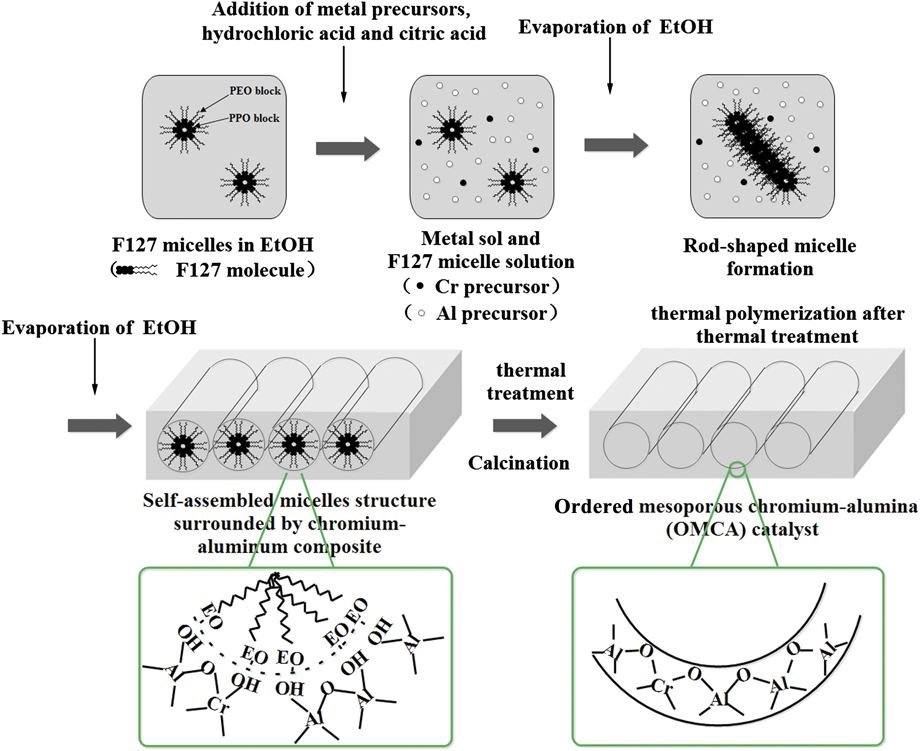
The OMCA catalysts were prepared by a single-step EISA method associated with thermal treatment, according to a similar method reported in the literature.Reference Wang, Pan, Guo, He, Niu and Li26 Fig. 1 shows the schematic procedure for the preparation of OMCA catalysts. A typical synthesis is described as follows: 3.2 g of F127 was dissolved in 20 mL anhydrous ethanol solution containing 0.4 g of citric acid and 1.6 g of 37 wt% hydrochloric acid. Then, 3.26 g of aluminum isopropoxide and a required amount of chromic nitrate (0.32 and 0.64 g, respectively) were slowly added into the above solution, simultaneously. After being vigorously stirred at 32 °C for 24 h, the resultant mixture was transferred to a dish and underwent solvent evaporation at 45 °C for 48 h and thermal treatment at 100 °C for 24 h, respectively. The final products were calcined at 550 °C for 5 h to remove the template and named as OMCA(x), where x stands for the molar ratio of Al/Cr.
Schematic procedures for the preparation of ordered mesoporous chromium–alumina catalysts.

For comparison, the OMA support was prepared by an EISA method without adding the chromium precursor, according to the similar method described above. A chromium catalyst supported on OMA was prepared by an incipient wetness impregnation (IWI) method. 1.0 g of OMA was added into 16 mL anhydrous ethanol solution dissolved in 0.784 g of chromic nitrate. The resultant mixture was treated by ultrasound for 1 h at 45 °C and then dried at 100 °C for 12 h. The final sample was calcined at 550 °C for 5 h at a heating rate of 1 °C/min. According to the molar ratio of Al/Cr, the prepared catalyst was named as Cr/OMA(10).
C. Catalysis studies
The selective oxidation of cyclohexane was conducted in a 50 mL thermostated glass vessel reactor under stirring conditions. In a typical catalytic reaction, 0.1 g of prepared catalyst, 10.0 mL of acetonitrile, 2.0 mL of cyclohexane, and 2.0 mL H2O2 were taken in the reactor. The reaction mixture was refluxed under constant stirring at 80 °C for 4 h. 0.1 g of benzyl chloride was used as the internal standard. The collected products were then identified and analyzed by gas chromatography (GC, Agilent, 7890-F, Santa Clara, CA) with a Rtx-1 capillary column equipped using a flame ionization detector. After each cyclohexane oxidation run, the catalyst was cooled to room temperature, separated by centrifugation from the product solution, washed with acetonitrile several times, dried at 100 °C, and calcined at 550 °C in air for 6 h for complete removal of organics and unreacted cyclohexane molecules, and reused for the next run under the same conditions. Herein, the conversion of cyclohexane was calculated by making the standard curve of products, considering the volatility of the cyclohexane.
D. Characterization
Powder X-ray diffraction (XRD) patterns were obtained on a Shimadzu XRD-6000 diffractometer (Shimadzu, Kyoto, Japan) using Ni-filtered Cu Kα (0.154 nm) radiation. Transmission electron microscopy (TEM) experiments were performed on a JEOL 2010 microscope (JEOL Ltd., Tokyo, Japan) operated at 200 kV. Samples were dispersed in ethanol by moderate sonication. Then, a carbon-coated Cu TEM grid was dipped in the sample suspension and dried under vacuum at 80 °C before analysis. Nitrogen adsorption–desorption isotherms were measured on a Quantachrome analyzer (Quantachrome, Boynton Beach, FL) at −196 °C. Before measurements, the samples were degassed at 180 °C in vacuum for 10 h. The Brunauer-Emmett-Teller (BET) method was used to calculate the specific surface areas. The pore volume and pore size distribution were derived from the adsorption branches of the isotherms using the Barrett-Joyner-Halenda (BJH) method. The total pore volume, V p, was calculated from the amount of nitrogen adsorbed at a relative pressure of 0.99. The UV-vis spectra of prepared catalysts were collected on a Varian Cary 300 UV-vis spectrophotometer (Varian Inc., Palo Alto, CA) coupled with a diffuse reflectance accessory. 27Al MAS NMR spectra were recorded on a Bruker AVANCEIII 6000Hz instrument (Bruker Optik GmbH, Ettlingen, Germany) operated at frequency 156.37 MHz, pulse width 3.98 µs, pulse delay 4 s, acquisition time 0.014 s, and spinning rate 8 kHz for 3072 scans. Hydrogen temperature-programmed reduced (H2-TPR) measurements for catalysts OMCA(x) and Cr/OMA(10) were performed in a quart fixed-bed microreactor. Before the H2-TPR measurements, 30 mg of samples was pretreated at 650 °C for 1 h in flowing He (30 mL/min) to remove any moisture and other impurites adsorbed in the samples. After cooling to 200 °C, the sample was exposed to a flow (30 mL/min) of 5% H2–He and heated at a rate of 10 °C/min to 800 °C, and the hydrogen consumption was measured using a thermal conductivity detector (TCD).
III. RESULTS AND DISCUSSION
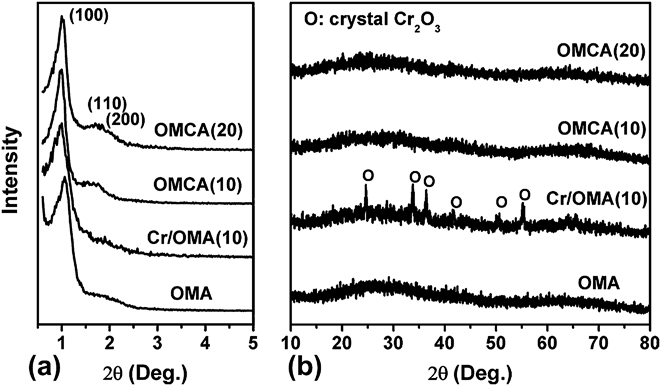
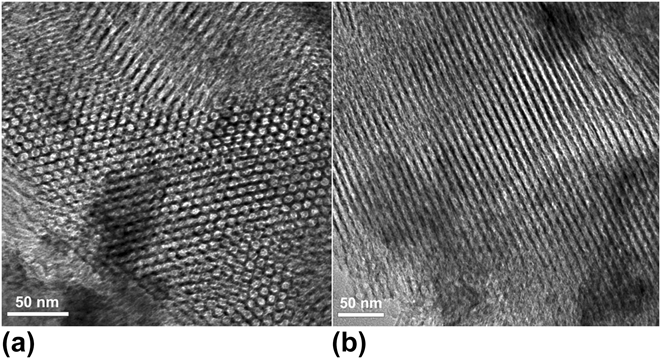
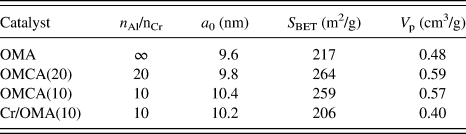
The powder XRD patterns of the support (OMA) and catalysts (Cr/OMA(10) and OMCA(x), synthesized with IWI and EISA methods, respectively) are shown in Fig. 2. It is well known that the diffraction patterns at small angles provide information about the possible organization of mesoporous.Reference Rashidi, Kharat, Rashidi, Lima, Lara and Valente27 As can be seen in Fig. 2(a), similar to OMA, the small-angle XRD patterns of both OMCA(10) and OMCA(20) showed two well-resolved Bragg peaks, which, according to the TEM observation of the well-ordered hexagonal arrays along [100] and [110] orientations with uniform pore size and wall thickness, respectively (Fig. 3), can be indexed as the (100), (110), and (200) reflections associated with a highly ordered two-dimensional hexagonal mesostructure (space group p6mm). Noteworthily, compared with the XRD pattern of OMA, OMCA(10) and OMCA(20) exhibited relatively stronger intensity of (110) and (200) peaks and narrower full width at half-maximum (FWHM) as judged from the (100) diffraction peak in their XRD patterns, suggesting that the multivalent Cr species from the hydrolysis of Cr precursor can participate in and promote the cooperative self-assembly between F127 and aluminum species to construct a uniform framework in which oligomers of chromium and aluminum species cross-link together to form the Cr–O–Al bonding during the thermal and calcination treatment (Fig. 1), leading to a remarkably increased mesostructural ordering of alumina. In addition, it is interesting to note that with the increase in the molar ratio of Al/Cr from 10 to ∞ (OMA, prepared without adding Cr precursor), the first diffraction peaks of OMCA(10), OMCA(20), and OMA were shifted toward higher angles [Fig. 2(a)], suggesting that the unit cell (a 0) parameter was decreased. From the intense (100) peak, the unit cell parameters of 9.6, 9.8, and 10.4 nm can be calculated for OMA, OMA(20), and OMA(10), respectively (Table I). This observation can be attributed to the incorporation of Cr with larger molar radius than that of aluminum into the alumina framework and the formation of Cr–O bond with higher length than that of Al–O bond during the preparation of catalysts OMCA(10) and OMCA(20). On the other hand, different from OMA support and OMCA(x), Cr/OMA(10) synthesized using IWI method only exhibited a broader (100) diffraction peak around approximately 2θ = 1.0° in its small-angle XRD pattern, indicating that the original mesoporous structure of OMA support was destroyed partly by the addition of Cr precursor during the impregnation process. In addition, although with the same loading amount of chromium oxide as that of OMCA(10), weak diffraction peaks at 2θ = 24.5, 33.6, 36.2, and 54.8° attributable to the hexagonal phase of Cr2O3 (JCPDS NO.:84-1616) were observed in the wide-angle XRD pattern of Cr/OMA(10), indicating that chromium species were poorly dispersed and there was a small amount of crystalline Cr2O3 existing in mesopores of OMA support or on the surface of OMA particles, whereas the majority of the chromium species in Cr/OMA(10) were still amorphous [Fig. 2(b)]. However, different from Cr/OMA(10), the wide-angle XRD patterns of OMCA(10) and OMCA(20) confirmed that similar to OMA support, the mesoporous walls of OMCA(10) and OMCA(20) were still in the amorphous phase without appearing any crystalline phase diffraction peak from alumina or chromic oxide [Fig. 2(b)], indicating that it is difficult for the highly homogeneously dispersed Cr species among alumina matrix to diffuse and be sintered during calcination process at high temperature to form the crystalline Cr2O3, in which Cr(III) buried as subsurface species is not accessible, thus catalytically inactive.Reference Puurunen and Weckhuysen28
Small-angle (a) and wide-angle (b) XRD patterns of calcined materials prepared with different methods.

TEM images of OMCA(10) (a) and OMCA(20) (b) view from (100) and (110) directions, respectively.

The physicochemical properties of calcined materials prepared with different methods.a

a a 0, Unit cell parameter; S BET, specific surface area; V p, pore volume.
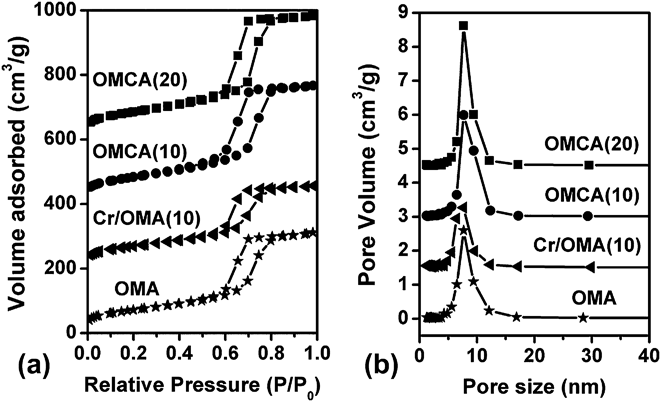
Figure 4 shows the N2 adsorption–desorption isotherms and corresponding pore size distribution curves of support (OMA) and catalysts (Cr/OMA(10), OMCA(10), and OMCA(20)), and the detailed textural properties are listed in Table I. From Fig. 4(a), it can be clearly seen that all the samples showed a typical IV-type isotherm, indicating the well-developed mesoporous structure. Compared with OMA, OMCA(10) and OMCA(20) displayed a steeper capillary condensation step occurred at a relative pressure (P/P 0) ranging from 0.60 to 0.80 [Fig. 4(a)], characteristic of ordered mesoporous materials with more uniform cylindrical mesopores. For catalysts OMCA(20) and OMCA(10), the surface areas and pore volumes were 264 and 259 m2/g, 0.59 and 0.57 cm3/g, respectively, which were remarkably higher than those of OMA support (Table I). The dimension and uniformity of mesopores in different samples are directly reflected by the pore size distribution curves. From Fig. 4(b), it can be clearly seen that OMCA(20) possessed the narrowest pore size distribution among all of the samples, indicating that the incorporation of a required amount of Cr (n Al/n Cr = 20) can effectively increase the mesoporous uniform of alumina materials, which was consistent with the effect of the incorporation of Cr on the mesostructural ordering of alumina [Fig. 2(a)]. However, the isotherm of Cr/OMA(10) showed a less steep capillary condensation step and the desorption branch rapidly decreased at a low relative pressure (P/P 0 ≈ 0.60), representing a large H2-type hysteresis loop and corresponding to a relatively broader pore size distribution curve [Fig. 4(b)]. This indicates that cage-like mesopores or constricted mesopores with a smaller pore diameter are mainly formed in the Cr/OMA(10) catalyst,Reference Cai, Yu, Anand, Vinu and Jaroniec20 which should be attributed to the formation of crystalline Cr2O3 particles in the mesopores of OMA support and causing the significant blockage of mesopores during the impregnation step. As a result, Cr/OMA(10) has lesser textural properties such as specific surface area and pore volume as compared with OMA support (as shown in Table I).
N2 sorption isotherms (a) and the corresponding pore size distribution curves (b) of calcined materials prepared with different methods. For clarity, in (a), the isotherms of Cr/OMA(10), OMCA(10), and OMCA(20) are offset along the Y-axis by 200, 400, and 600 cm3/g, respectively. In (b), the pore size distributions for Cr/OMA(10), OMCA(10), and OMCA(20) are offset by 1.5, 3, and 4.5 cm3/g, respectively.

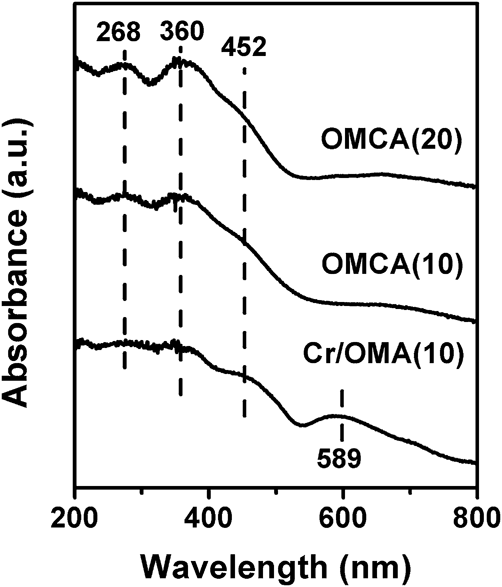
The diffuse reflectance UV-vis spectra for Cr/OMA(10), OMCA(10), and OMCA(20) have been used to verify whether chromium species are incorporated into alumina framework of OMA support or its corresponding oxide is formed on the surface of OMA particles. As shown in Fig. 5, the spectra of OMCA(10) and OMCA(20) showed three UV-vis absorption bands at 268, 360, and 452 nm, which could be assigned to charge transfer from O2− to Cr6+ of tetrahedrally coordinated Cr-oxide moieties highly homogeneously dispersed in alumina framework.Reference Weckhuysen, Verberckmoes, Buttiens and Schoonheydt29 The two intense absorption bands at 268 and 360 nm were attributable to 1A1→1T2 transition of tetrahedral Cr-oxide, and the weak shoulder at 452 nm was due to the symmetry-forbidden nature of the 1A1→1T1 transition of tetrahedral Cr-oxide.Reference Zhang, Zhao, Dai, He and Au30 In addition, the band at 452 nm may also originate from dichromate/polychromate.Reference Weckhuysen, Verberckmoes, Baets and Schoonheydt31 It is interesting to note that OMCA(10) exhibited the lesser intensity of absorption bands at 268 and 360 nm than those of OMCA(20), indicating that with the further increase of chromium incorporated, the relative content of tetrahedrally coordinated Cr-oxide species dispersed in alumina matrix decreases slightly, corresponding to the formation of dichromate/polychromate with more content. It is worth noting that only a very small amount of dichromate/polychromate species were observed for catalysts OMCA(x) as compared with Cr/OMA(10), indicating that chromium species were well isolated in the case of the former. In addition, different from OMCA(x), Cr/OMA(10) showed an addition strong absorption band at 589 nm assigned to d–d transition (A2g→T2g) typical of octahedrally coordinated Cr3+ in Cr2O3 clusters,Reference Rossi, Casaletto, Ferraris, Cimino and Minelli32 indicating that there was the presence of a large amount of octahedral Cr3+ (of crystalline Cr2O3) in Cr/OMA(10).
UV-vis spectra for catalysts Cr/OMA(10) and OMCA(x) prepared with different methods.

The highly homogeneously dispersions of Cr species in the alumina framework of OMCA(10) and OMCA(20) could be further effectively validated by the TEM-EDX analysis (Fig. 3). A chromium signal can be clearly observed in the energy dispersive X-ray analysis (EDX) spectra of OMCA(10) and OMCA(20) (not shown), which confirmed that a large amount of Cr is present in such two samples. When the different probe spots were selected, similar n Al/n Cr ratios were observed, which were near 11.8 and 19.3 for OMCA(10) and OMCA(20), respectively, indicating that almost all Cr species added in the initial reaction mixture have been eventually introduced into the final catalysts with a result of the homogeneous distribution of Cr and Al at atomic level.
On the basis of the above observations, we propose that the formation of highly ordered mesoporous OMCA(x) catalysts undergoes a triconstituent cooperative co-assembly process of inorganic multivalent chromium species from the hydrolysis of chromic nitrate, aluminum oligomers hydrolyzed from aluminum isopropoxide, and amphiphilic triblock copolymer F127. The final nanocomposites have a highly ordered mesostructure and uniform framework, in which oligomers of both chromium and aluminum species cross-link together and Cr and Al species are highly homogeneously distributed at the atomic level (Fig. 1).
First, the surfactant molecules, Pluronic F127 in the presence of ethanol containing a required amount of citric acid and hydrochloric acid self-assembled to form sphere-like micelles in which hydrophobic polypropylene oxide remains in the core surrounded by hydrophilic polyethylene oxide (PEO) in the corona. After the addition of chromium and aluminum precursors, the hydroxyl group (–OH) of chromium and aluminum from the hydrolysis of chromic nitrate and aluminum isopropoxide, respectively, can interact with the hydrophilic PEO of the surfactant molecules through hydrogen bonding, which will promote the cooperative co-assembly between F127 and aluminum/chromium species to construct an ordered mesostructure during the evaporation of solvent process. The concentration of hydroxyl group (–OH) of chromium and aluminum play important roles in the mesophase formation, and increasing the hydroxyl group (–OH) concentration of chromium and aluminum can significantly enhance the hydrogen-bonding interaction to further increase the mesostructural ordering of final materials. Hydrocarboxylic acids (such as citric acid) are good coordination agents for aluminum and chromium ions via monodentate or bridging bidentate modes.Reference Yuan, Yin, Luo, Sun, Zhang, Duan, Liu and Yan18 Zhang et al.Reference Liu, Wang, Wang and Zhang33 have proposed that hydro-carboxylic acids can act as a structure-directing agent in the formation of mesoporous γ-alumina via coordination between the hydrocarboxylic acid and aluminum sites of aluminum oxohydroxide particulates. In our case, citric acid can behave as a ligand and bond with aluminum and chromium atoms of aluminum and chromium alkoxides in a bidentate or bridging fashion. The complexation interaction between citric acid and alumina/chromium species can effectively slow down the hydrolysis–condensation reaction of aluminum and chromium alkoxides in the solution. As a result, the addition of a required amount of citric acid in the cooperative self-assembly process can produce more Al–OH and Cr–OH groups on the inorganic mesoporous walls and thus enhance the hydrogen bonding interaction between F127 and aluminum/chromium species. During further thermal treatment process at 100 °C, the composite mesostructure, i.e., ordered arrays of cylindrical micelles embedded within alumina and chromia matrices, experiences further wall condensation and framework shrinkage with the support from the surfactant micelles within the mesoporous channels against the collapse of mesostructure. Meanwhile, Al–OH and Cr–OH groups within mesoporous walls undergo the dehydroxylation and cross-link together to form Al–O–Cr and Al–O–Al bonds. In addition, the cross-link degree can be significantly enhanced during the followed calcination process at high temperature to remove the template micelles.
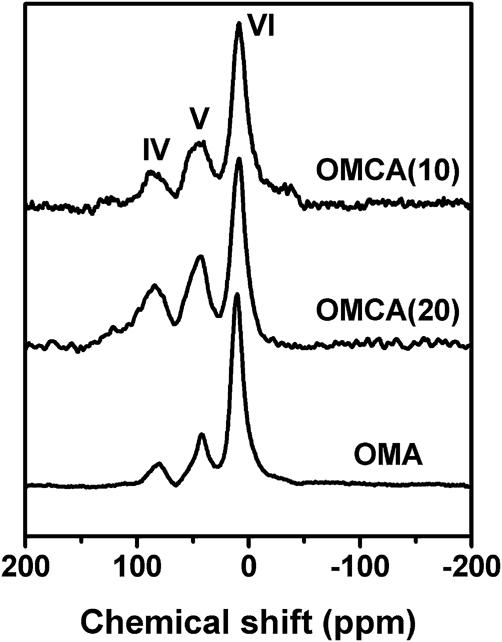
To underpin our proposed mechanism, the 27Al MAS NMR spectra were used to provide direct evidence of alumina cross-linking of mesostructured materials synthesized by our method. Figure 6 displays the 27Al MAS NMR spectra of OMA, OMCA(20), and OMCA(10) calcined at 550 °C. It can be seen that such three samples showed three resonance signals at 81, 43, and 11 ppm, respectively. These bands are assigned to the central transition of the Al3+ ion in tetrahedral (AlO4), pentahedral (AlO5), and octahedral (AlO6) coordination, respectively.Reference Yuan, Yin, Luo, Sun, Zhang, Duan, Liu and Yan18 The presence of a high concentration of pentahedrally coordinated aluminum is a direct consequence of the high quantity of defects induced by the large surface area of the network.Reference Chupas and Grey34 It is noteworthy that compared with OMA, OMCA(20) displayed a progressive increase in the intensity of AlO4 and AlO5, corresponding to more amount of framework aluminum species from the cross-linkage between chromium and aluminum species and the formation of Al–O–Cr bond within mesoporous walls. After deconvolution, the ratio of AlO6/(AlO4 + AlO5) calculated was 0.69, which was much lower than that (1.73) of OMA prepared without the incorporation of chromium. However, further increasing chromium content may affect the cooperative co-assembly between F127 and citric acid coordinated aluminum/chromium species, leading to a remarkably deduction in the intensity of AlO4 and AlO5 in the spectrum observed for OMCA(10). The ratio of AlO6/(AlO4 + AlO5) after deconvolution was calculated to be 1.49 for OMCA(10). The reason could be due to increasing incorporated chromium content, the added adjacent hydroxyl groups of chromium experience dehydroxylation, diffusion, and sinter to form dichromate or polychromate during the high temperature calcination treatment process (Fig. 5). As a result, a large amount of chromium species escape from the mesoporous framework, leading to a remarkable increase in the octahedrally coordinated non-framework aluminum.
27Al MAS NMR spectra of OMA and catalysts OMCA(x).

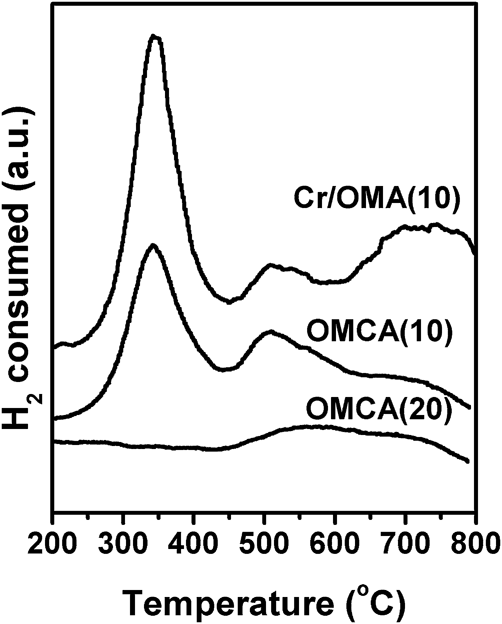
The interaction between chromium species and support in the Cr/OMA(10) and OMCA(x) catalysts was examined by H2-TPR measurements to further confirm the chromium species having been incorporated into the mesoporous alumina framework in catalysts OMCA(x) prepared by the improved EISA method. Figure 7 shows the H2-TPR profiles of Cr/OMA(10) and OMCA(x) catalysts pre-thermally treated at 650 °C for 1 h. Under equal experimental conditions, no reduction band was observed over the OMA support and only one reduction band centered at 680 °C was recorded over the pure alpha Cr2O3 (not shown here). As shown in Fig. 7, catalysts Cr/OMA(10) showed three strong reduction bands centered at 345, 509, and 700 °C, respectively. The reduction band appearing at 345 °C was due to the reduction of highly dispersed chromia species,Reference Shee and Sayari35 while the reduction band appearing at 509 °C according to the reduction of Cr6+→Cr3+ reaction,Reference Zhang, Zhao, Dai, He and Au30 respectively. In addition, another broad reduction band centered at approximately 700 °C was attributed to the reduction of crystalline Cr2O3 existing in mesopores of OMA support or on the surface of OMA particles [as shown in Fig. 2(b)]. It is noteworthy that different from catalyst Cr/OMA(10), catalysts OMCA(x) showed a relatively poorer reducibility, corresponding to a relatively stronger interaction between chromium and alumina support. Taking catalyst OMCA(20) for example, there were two weak and broad reduction bands centered at 560 and 720 °C, which were remarkably higher than those of dispersed chromia species. Considering the characteristic results from XRD, N2 adsorption, TEM, UV-vis, and 27Al MAS NMR, we attribute such two weak reduction bands to the reduction of highly homogeneously dispersed Cr-oxide moieties cross-linked with alumina through Al–O–Cr bond in the mesoporous framework. Similar to catalyst OMCA(20), catalyst OMCA(10) also displayed a weak shoulder appearing at 560 °C and a weak reduction band centered at 720 °C, respectively, indicating a large amount of chromium species having been incorporated into the alumina mesoporous framework through Al–O–Cr bond. In addition, the extra two obvious reduction peaks at 345 and 509 °C in the H2-TPR profile of OMCA(10) demonstrated the existing of highly dispersed dichromate or polychromate formed from further increased chromium species escaping from the mesoporous framework (Fig. 5).
H2-TPR profiles of catalysts Cr/OMA(10), OMCA(10), and OMCA(20).

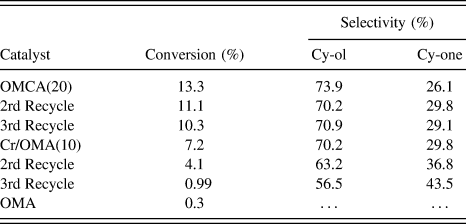
The selective oxidation of cyclohexane to cyclohexanol and cyclohexanone has been carried out to investigate the catalytic properties of catalyst OMCA(20) with lower loading amount of chromium species than those of Cr/OMA(10) and OMCA(10), and the catalyst Cr/OMA(10) and support OMA for comparison. Table II summarizes the results of cyclohexane oxidation over different catalysts. It can be seen that although containing half chromium content compared with Cr/OMA(10), OMCA(20) showed much higher catalytic activity for the chosen reaction, with cyclohexanol (Cy-ol) and cyclohexanone (Cy-one) as the major and minor products, respectively. After calculation through GC analysis, the conversion of cyclohexane and the selectivity for Cy-ol and Cy-one in the first cyclohexane oxidation run were 13.3, 73.9, and 26.1 %, respectively. It is to be noted here that the reaction performed over chromium-free OMA support did not show any significant activity, indicating that the presence of chromium ions in the alumina framework influences the activity greatly. The high conversion and selectivity of catalyst OMCA(20) could be explained on the basis of coordination environment and oxidation states of Cr species in the alumina matrix. Under the reaction conditions, the hexavalent chromium in a tetrahedral environment present in the mesoporous framework (Fig. 5) may interact with the oxidant (hydrogen peroxide) to form a catalytically active peroxo complex. Subsequently, the substrate molecules react with this active intermediate species to give the final products. However, for catalyst Cr/OMA(10), the majority of chromium species exist in the form of poorly dispersed crystalline Cr2O3 [Fig. 1(b) and Fig. 5], in which trivalent chromium ions as subsurface species is inaccessible and catalytically inactive for the oxidation reaction of cyclohexane, corresponding to a relatively lower conversion of cyclohexane (Table II). In addition, from Table II, it can also be seen that for the recycled catalyst Cr/OMA(10), a considerable decrease in activity was noticed, and with increasing recycling times, the activity decreased greatly. When catalyst Cr/OMA(10) is reused for the third run, the conversion of cyclohexane was only 0.99 %, which could be owing to the serious leaching of active (non-framework) chromium species caused by the solvolysis by polar water molecule from the decomposition of oxidant H2O2 during the reaction process. The inductively coupled plasma (ICP) analysis was carried out to determine the retained content of chromium species in the reused catalyst Cr/OMA(10) after the first cycle, the molar ratio of aluminum to chromium was high as 47.8. In contrast, over catalyst OMCA(20), the activity remains nearly the same in the subsequent cycles. The TEM-EDX analysis was carried out to determine the retained content of chromium species in the reused catalyst OMCA(20) after the third cycle, similar molar ratios of aluminum to chromium were observed, which were 22.5, 19.2, and 21.4, respectively, when three different probe spots were selected, indicating that the strong interaction between aluminum and chromium species within mesoporous framework (Fig. 7) can effectively inhibit the leaching of active chromium species, which is very important for the practical applications of supported chromium-based catalysts in the catalytic reaction containing water.
Oxidation of cyclohexane over chromium-containing mesoporous materials.

IV. CONCLUSIONS
The highly OMCA(x) catalysts with high surface area and uniformly distributed mesopores have been successfully synthesized via an EISA pathway associated with thermal treatment to promote the cooperative co-assembly between F127 and aluminum/chromium species. Using such a method, almost all chromium species have been highly homogeneously incorporated into alumina mesoporous framework in the form of tetrahedrally coordinated hexavalent Cr-oxide moieties. For the selective oxidation of cyclohexane, the catalyst OMCA(20) exhibits much higher activity than that of Cr/OMA(10) synthesized via a traditional IWI method, i.e., a conversion of >13% with a combined cyclohexanol and cyclohexanone selectivity of nearly 100%. More importantly, the strong interaction between aluminum and chromium species in mesoporous framework can effectively inhibit the leaching of active chromium species, corresponding to higher catalytic stability than that of Cr/OMA(10). Our achievements provide new contributions to synthesize the potential mesoporous alumina-based catalytic materials with highly ordered mesostructure and high catalytic activity, which may further extend the catalytic application for the oxidation of bulkier molecules.
ACKNOWLEDGMENT
This work was financially supported by the National Natural Science Foundation of China (51172154), the China Postdoctoral Science Foundation (2012M510783), the Shanxi Province Science Foundation for Youths (2012021006-2 and 2013021008-3), and the Science and Technology Project of Shanxi Province (20130313001-3).