Introduction
Central line-associated blood stream infection (CLABSI) is a preventable hospital-acquired infection (HAI), associated with increased morbidity, mortality, and hospital costs. 1–Reference Ziegler, Pellegrini and Safdar3 Pediatric patients with underlying malignancies and hematological disorders, especially those undergoing hematopoietic transplant or cellular therapy (TCT) are at an increased risk of developing CLABSI due to their prolonged need for central venous catheters (CVC), increased healthcare exposure, complexity of care, impaired skin and mucosal barriers, and immunocompromised status. Reference Ardura, Bibart and Mayer2,Reference Hoffman, Wong Quiles, Crumby and Adderson4 The incidence of CLABSI in TCT patients has been estimated to range between 2.0 and 2.5 per 1,000 central line days (CLD) and to result in significant morbidity requiring intensive care unit admission in 17%, CVC removal in 22%, and up to 6% mortality rate. Reference Ardura, Bibart and Mayer2,Reference Bavare, Foster, Wollam and Campbell5,Reference Dandoy, Kelley and Gaur6 Significant efforts over the past decade, including evidence-based interventions like hand hygiene, implementation of central line insertion and maintenance bundles, and education and reporting have helped decrease the incidence of CLABSI. Reference Bell and O’Grady7–Reference O’Grady, Alexander and Burns9 However, healthcare disparities particularly in minoritized populations continue to contribute to preventable harm despite these efforts. Increased rates of adverse events, including serious safety events or harm due to medical care such as dosing error or allergic reactions to medication, have been reported among hospitalized children whose families speak a language other than English. Reference Khan, Yin and Brach10,Reference Lion, Rafton and Shafii11 There is a growing need for improved data collection, targeted interventions to provide equitable care, and systemic changes to identify and mitigate these disparities. Reference Lyren, Haines and Fanta12,Reference McGrath, Bettinger and Stimpson13
The few studies that evaluated disparities in rates of healthcare-associated infections, such as CLABSI, have focused on hospitalized children of minoritized racial, ethnic, and language groups. The role of language barriers in CLABSI risk has not been well-explored, especially in pediatric TCT populations. This study aimed to evaluate the risk for CLABSI in hospitalized pediatric TCT patients with limited English proficiency (LEP) at St. Jude Children’s Research Hospital (SJCRH). We hypothesized that patients with LEP would have higher rates of CLABSI highlighting the need for modifying current preventative interventions and developing new targeted strategies to bridge this gap.
Methods
Study design
This is a single-center retrospective cohort study of TCT patients hospitalized between January 1st, 2021, and June 30th, 2024, on the transplant and cellular therapy unit at SJCRH. This study was approved by SJCRH institutional review board as non-human subject research.
Study population
SJCRH is a referral pediatric (age 0–25 years) center specialized in management of children with cancer and other catastrophic diseases of childhood including hematological malignancies, solid tumors, brain tumors, bone marrow failure syndromes, sickle cell disease, and some primary immunodeficiency conditions. Patients are referred to SJCRH from local (21%), national (70%), or international (9%) locations. Majority of national and international patients are referred for cancer treatment protocols for high-risk malignancy such as relapsed/refractory leukemia or acute myeloblastic leukemia followed by TCT or for disease-specific clinical expertise. On the other hand, all local patients with eligible catastrophic diseases are accepted to SJCRH, with majority having sickle cell disease. Due to their complicated and prolonged treatment courses, most of our patients have long-term CVC and therefore have increased risk of developing CLABSI. Patients undergoing TCT such as hematopoietic transplant, chimeric antigen receptor T cell (CAR-T) or gene therapy and those requiring hospitalization for post-TCT complications are admitted to a dedicated 18-bed inpatient transplant unit.
Interpreter services are provided for staff communication with patients with LEP through several modalities including telephone, video, and in-person interpreters. It is the policy at our center that a certified medical interpreter be included in all healthcare conversations with patients and families with LEP. Majority of our patients with LEP are Spanish speaking. In-person certified interpreters for Spanish are available at all hours but with intermittent availability for French and Arabic languages. Phone and video interpreting are available at all hours for most languages through third-party vendors. The use of ad hoc interpreters, such as bilingual employees or patient family members, is not allowed.
Our CLABSI prevention practices include four bundles; CVC insertion bundle, CVC maintenance care bundle, oral care bundle that includes teeth brushing, mouth rinse, and lip care, and an environmental care bundle that includes daily bathing, clothes change, and linen change. While hospitalized, all CVC maintenance care is performed by nursing staff. Patients’ caregivers are not allowed to provide CVC care while inpatient. Oral care and environmental care practices are provided or impacted by patients’ and families’ participation or cooperation. Compliance with these care practices requires communication about their importance to prevent infections.
Data collection
Data abstracted from the electronic health records (EHR) included patient demographics, preferred language, underlying primary diagnosis, length of hospitalization on transplant unit, types and dates of cellular therapy, type of CVCs, and inpatient CLD in the transplant unit. Patients were classified as having LEP if their or their caregivers’ preferred language listed in the EHR was a language other than English. Ethnicity might have an influence on CLABSI risk due to variation in cultural practices among our patients. However, ethnicity data was not included in the analysis due to inconsistent and inaccurate documentation. Data about CLABSI events were generated from the hospital infection prevention and control surveillance database.
Study outcomes
The primary outcome of the study was the occurrence of CLABSI events. The infection prevention and control team routinely reviews positive blood cultures for surveillance purposes and classifies them as HAI CLABSI based on the Centers for Disease Control and Prevention’s National Healthcare Safety Network (NHSN) definitions. 14 CLABSI is a laboratory-confirmed bloodstream infection (LCBI) where an eligible bloodstream infection organism is identified, and a CVC is present on the date of LCBI or the day before per NHSN definitions. The CLABSI events were reviewed for further classification as mucosal barrier injury LCBI (MBI-LCBI) or non-MBI CLABSI. Any CLABSI that occurs at least 15 days after a previous CLABSI in a patient is considered a subsequent CLABSI event. Abstracted CLABSI-related data included the type of CVC and absolute neutrophil count (ANC) on the day of the event and specification of the organisms identified from blood cultures. CLABSI rates were calculated as events per 1,000 inpatient CLD and were compared between patients with LEP and those proficient in English.
Statistical analysis
Demographic and clinical data for the cohort and the CLABSI events were summarized using descriptive statistics. The identified organisms of the CLABSI events were classified as gram-positive bacteria, gram-negative bacteria, fungi, or polymicrobial. Polymicrobial CLABSI was defined as that caused by any combination of gram-negative, gram-positive, or fungi. Polymicrobial CLABSI does not consider co-infections within the same class (e.g. different gram-negative organisms in the same infection). Wilcoxon rank sum test was used to compare continuous variables of two groups. Pearson’s Chi-squared test or Fisher’s exact test was used to compare categorical variables of two groups. Cox proportional hazard regression analysis was used to assess the risk of development of CLABSI over time by clinical factors. Risk factors with a P-value < .2 on univariate analysis or deemed clinically meaningful were included in the multivariable regression model. Variables that were found to be colinear were removed from the model based on the Akaike Information Criterion (AIC) of the model’s goodness-of-fit test. Multivariate Cox proportional hazards regression was used to evaluate independent risk factors of CLABSI outcome over time, adjusting for potential confounders. The outcome evaluated by the Cox proportional hazards regression was the inpatient first CLABSI event per patient. A 2-sided P-value < .05 was considered statistically significant. Statistical analyses were performed using SAS software, version 9.4 (SAS Institute, Cary, NC) and the R 4.5.2 (R Founding for Statistical Computing, Vienna, Austria) ‘stats’ and ‘survival’ packages.
Results
A total of 280 patients were included in the cohort and contributed 12,325 CLD and 93 CLABSI events. Of these, 57 patients with LEP contributed 3,113 CLD and 29 CLABSI. The unadjusted CLABSI rate in patients with LEP was significantly higher (9.32/1,000 CLD) than that in English-proficient patients (6.95/1,000 CLD, P < .001).
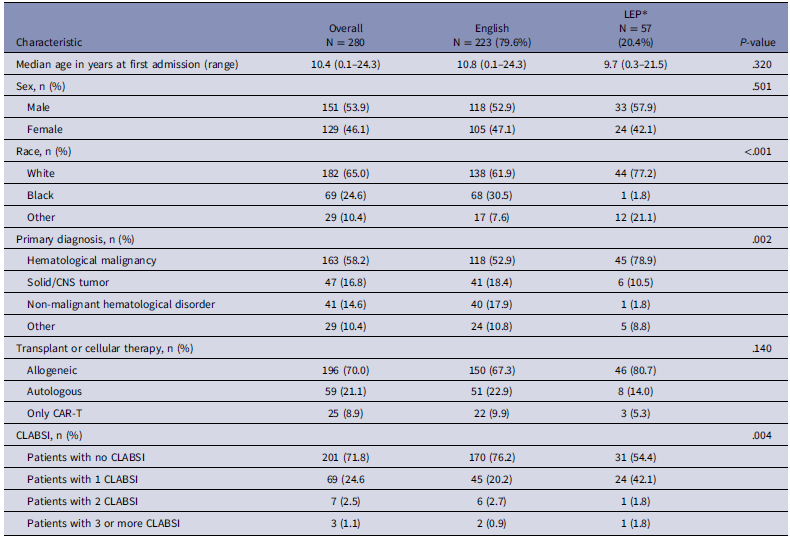
Table 1 summarizes the characteristics of the pediatric TCT patients included in the cohort. The median (range) age of patients was 10.4 (0.1–24.3) years with majority being of White race. The reported race was significantly different between the English-proficient patients compared to those with LEP (P < .001). A significant majority (77.2%) of patients with LEP were of White (77.2%) or other (21.1%) race while one third of English-proficient patients were of Black race (Table 1). While hematologic malignancies were the most common primary diagnosis for patients undergoing TCT in both groups, English-proficient patients were significantly more likely to have a non-malignant hematological disorder as a reason for TCT compared to patients with LEP (17.9% vs 1.8%, P = .002).
Characteristics of the retrospective cohort of pediatric hematopoietic and cellular therapy patients hospitalized on the transplant unit between January 1, 2021 and June 30, 2024

Table 1. Long description
A table comparing characteristics of pediatric hematopoietic and cellular therapy patients. The table has 11 rows and 6 columns. Column headers are Characteristic, Overall N = 280, English N = 223 (79.6 percent), LEP N = 57 (20.4 percent), and P-value. Row labels include Median age in years at first admission (range), Sex, n (percent), Race, n (percent), Primary diagnosis, n (percent), Transplant or cellular therapy, n (percent), and CLABSI, n (percent). Notable trends include significant differences in race distribution and primary diagnosis between English-proficient patients and those with Limited English Proficiency (LEP).
LEP, limited English Proficiency; CNS, central nervous system; CAR-T, chimeric antigen receptor T cells; CLABSI, central line-associated bloodstream infection.
*Languages of patients with LEP included Spanish (45 patients), Arabic (3), Ukrainian (3), French (1), Portuguese (1), Serbian (1), Vietnamese (1), and other languages (2).
Analysis: Wilcoxon rank sum test; Pearson’s Chi-squared test; Fisher’s exact test.
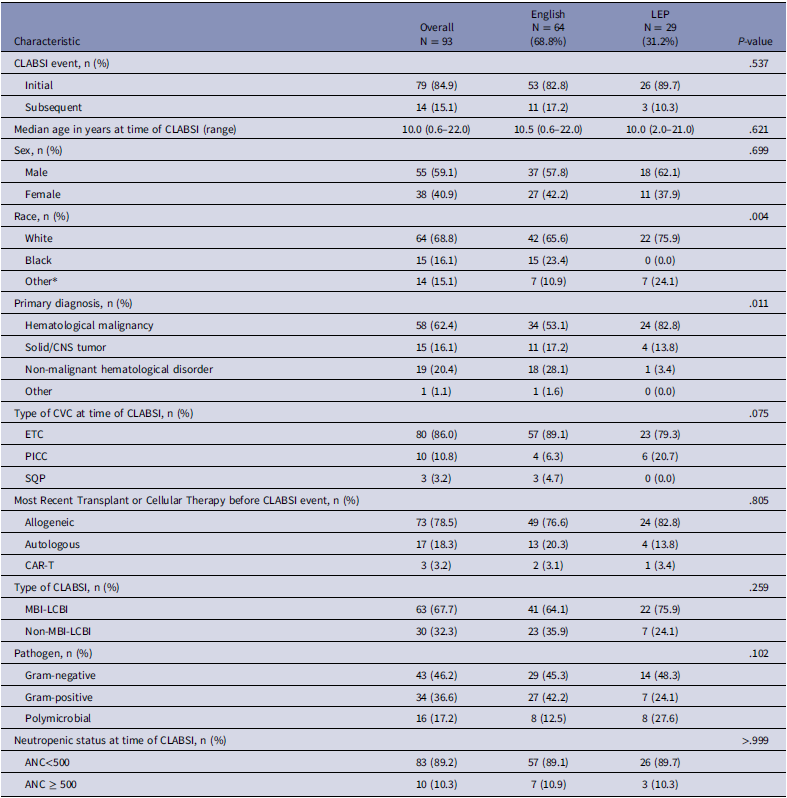
A total of 93 CLABSI events are characterized in Table 2. Like the baseline characteristics of the patient cohort, there was a significant difference in race and primary diagnosis of patients developing CLABSI between both groups (Table 2). All patients with LEP who developed CLABSI were of White (75.9%) or other (24.1%) race, while 23.4% of English-proficient patients were Black (P = .004). The majority of patients with LEP who developed CLABSI had hematological malignancy as their primary diagnosis. Both groups significantly differed in their primary diagnosis; 28.1% of English-proficient patients with CLABSI had a non-malignant hematological disorder as an indication for TCT compared to patients with LEP (3.4%, P = .011). Otherwise, there were no significant differences in the type of CVC, type of transplant or cellular therapy, neutropenic status, the number of CLABSIs per patient, the pathogen causing CLABSI, or the classification of CLABSI events (Table 2).
Characteristics of CLABSI events in pediatric hematopoietic and cellular therapy patients

Table 2. Long description
A table comparing characteristics of CLABSI events in pediatric hematopoietic and cellular therapy patients. The table has 16 rows and 5 columns. Column headers are Characteristic, Overall N = 93, English N = 64 (68.8 percent), LEP N = 29 (31.2 percent), and P-value. Row labels include CLABSI event, Median age in years at time of CLABSI, Sex, Race, Primary diagnosis, Type of CVC at time of CLABSI, Most Recent Transplant or Cellular Therapy before CLABSI event, Type of CLABSI, Pathogen, and Neutropenic status at time of CLABSI. Each row provides specific data points for each column, detailing the characteristics and their respective percentages or counts. Notable trends include significant differences in race and primary diagnosis between the English and LEP groups.
LEP, limited English Proficiency; CNS, central nervous system; CAR-T, chimeric antigen receptor T cells; CVC, central venous catheter; CLABSI, central line-associated bloodstream infection; ETC, external tunneled catheter; PICC, peripherally inserted central catheter; SQP, subcutaneous port; MBI-LCBI, mucosal barrier injury laboratory-confirmed bloodstream infection; ANC, absolute neutrophil count.
*Reported race values in the “Other” category included Pacific Islander (3), Asian (3), decline to answer (2), and other non-specified (6).
Analysis: Wilcoxon rank sum test; Pearson’s Chi-squared test; Fisher’s exact test.
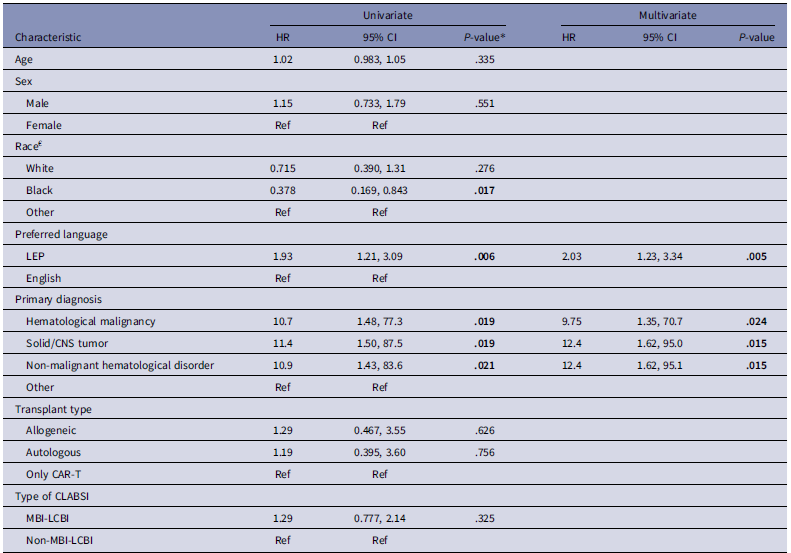
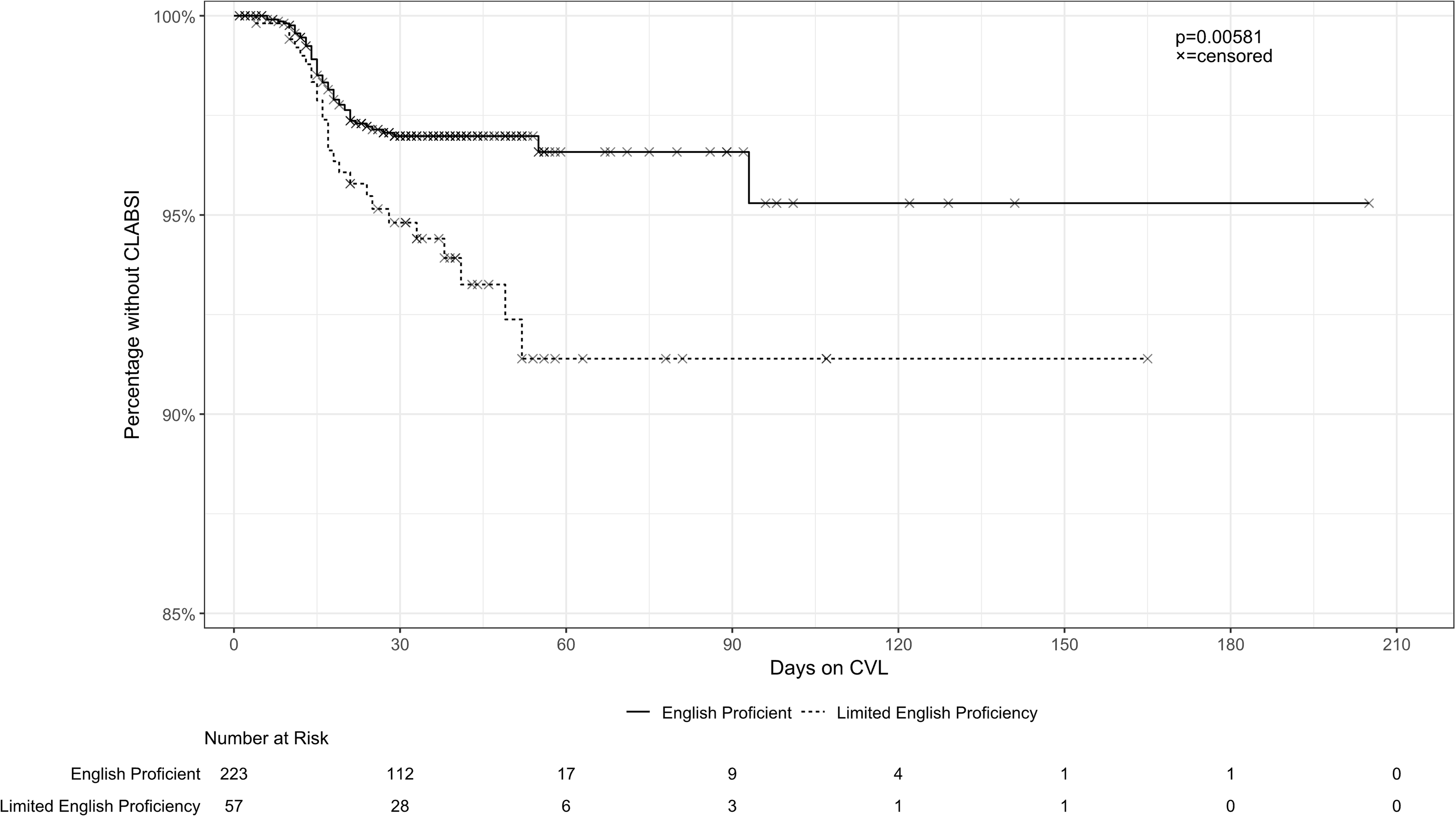
Table 3 shows the independent risk factors for development of CLABSI over time including the preferred language. Race, primary diagnosis, and the preferred language met the criterion of having a P-value < .2 on univariate analysis. However, race was found to be co-linear with the primary diagnosis. A better fit statistical model was achieved by removing race rather than primary diagnosis from the multivariable model. Adjusting for primary diagnosis, pediatric TCT patients with LEP had nearly twice the risk of developing CLABSI over time compared to English-proficient patients (HR 2.03, 95% CI [1.23, 3.34], Table 3 and Figure 1). To evaluate the effect of English-proficient patients with non-malignant hematologic disorders (most are local with sickle cell disease) on the findings, a sub-analysis was completed by excluding the non-malignant hematologic disorders from the cohort. As shown in the Supplement Table S1, excluding patients with non-malignant hematologic disorders did not change our findings that patients with LEP have more than twice the risk of developing CLABSI compared to English-proficient patients.
Univariate and multivariate cox proportional hazards regression analysis to evaluate independent risk factors for CLABSI over time in pediatric hematopoietic and cellular therapy patients

Table 3. Long description
A table with univariate and multivariate cox proportional hazards regression analysis to evaluate independent risk factors for CLABSI over time in pediatric hematopoietic and cellular therapy patients. The table has 10 rows and 6 columns. Column headers are Characteristic, Univariate HR, Univariate 95% CI, Univariate P-value, Multivariate HR, and Multivariate 95% CI, Multivariate P-value. Row labels include Age, Sex (Male, Female), Race (White, Black, Other), Preferred language (LEP, English), Primary diagnosis (Hematological malignancy, Solid/CNS tumor, Non-malignant hematological disorder, Other), Transplant type (Allogeneic, Autologous, Only CAR-T), and Type of CLABSI (MBI-LCBI, Non-MBI-LCBI). Each row provides hazard ratios (HR), 95% confidence intervals (CI), and P-values for univariate and multivariate analyses.
*Variables with P-value < .2 on univariate analysis were included in the multivariate analysis.
€Race was found to be co-linear with the primary diagnosis based on the model goodness-of-fit testing and therefore was removed from multivariable analysis.
LEP, limited English Proficiency; CNS, central nervous system; CAR-T, chimeric antigen receptor T cells; CLABSI, central line-associated bloodstream infection; HR, hazard ratio; 95%CI, 95% confidence interval; MBI-LCBI, mucosal barrier injury laboratory-confirmed bloodstream infection.
Kaplan-Meier curve for risk of CLABSI per preferred language in pediatric hematopoietic transplant and cellular therapy patients.

Discussion
The impact of healthcare disparities on preventable harm and hospital-acquired infections particularly in minority groups is significant and often underrecognized. This retrospective cohort study is the first to identify the risk for HAI CLABSI acquisition in pediatric TCT recipients with LEP. We found significantly higher rates of CLABSI in patients with LEP compared to their English-proficient counterparts. Although not focusing on pediatric TCT recipients, another pediatric study that evaluated the impact of patient’s self-reported race, ethnicity, and language preference on CLABSI rates found almost two-fold increased rates of CLABSI in patients with LEP. Reference McGrath, Bettinger and Stimpson13 Disparately higher CLABSI rates have been associated with both racial minority groups and those with LEP even after adjusting for other risk factors for line infections. Reference McGrath, Bettinger and Stimpson13 The complexity of medical care, as in patients undergoing TCT, further adds to this barrier to effective communication and has been linked to differences in adherence to treatment and recommendations as well as healthcare outcomes in families with LEP. Reference Robles, Troy, Schroeder, Martin and LeBlanc15
In our study, we have found that almost all patients with LEP were of White or other race while one third of English-proficient patients were of Black race. We have also found that race was colinear with primary diagnosis. These findings can be explained by the type and demographic distribution of the patient population served at our center. As previously explained, a number of our patients are referred from countries outside the US, mostly from Latin America. The majority of patients from Latin America are referred to our center for treatment of relapsed refractory leukemia or acute myeloblastic leukemia who subsequently receive TCT. In our study, we reported that 79% of patients with LEP have hematologic malignancy as their primary diagnosis. Patients from Latin American countries are usually recorded in the EHR of White race or others. On the other hand, almost 15% of the cohort received TCT for management of sickle cell disease; a disease that is mostly prevalent in Black African American people in the US. For these reasons, a higher proportion of English-proficient TCT patients were Black compared to only one patient with LEP. However, as shown in the Supplement Table S1, a sub-analysis showed that a diagnosis of non-malignant hematologic disorders did not drive our findings of increased risk for CLABSI in patients with LEP compared to English-proficient patients.
The role of race in healthcare disparities and outcomes has previously been reported. A study of 226,802 pediatric patients from the Pediatric Health Information System database of tertiary care children’s hospitals in the US showed persistently higher rates of CLABSI among Black and Hispanic children than their White counterparts. Reference Willer, Tobias, Suttle, Nafiu and Mpody16 The investigators noted variations in the utilization of interpreter services and variation in line maintenance practices by race and ethnicity as major contributors to this difference. A scoping review of 137 articles found consistent disparities in healthcare access and outcomes for LEP individuals compared to English-proficient populations, including lower utilization of ambulatory care, higher rates of hospitalization, and poorer outcomes in screening and specific health conditions. This study also highlighted how the current healthcare systems and policies are insufficient to address the barriers LEP individuals face. Reference Twersky, Jefferson, Garcia-Ortiz, Williams and Pina17 Although access to interpreter services and more inclusive and equitable patient and family educational materials are essential to address these barriers, data about its impact on quality care and improvement of outcomes remain limited and at times conflicting. Reference Cohen, Rivara, Marcuse, McPhillips and Davis18–Reference Stimpson, Johnson and Wood21 Majority of our patients with LEP are Spanish speaking for whom in-person certified interpreters were available at all hours. However, use of their services could not be consistently verified.
Communication problems and language barriers admittedly impact various aspects of healthcare and can contribute to disparities in patient safety outcomes in patients with LEP. Reference Lyren, Haines and Fanta12,Reference Cohen, Rivara, Marcuse, McPhillips and Davis18,Reference Flores, Laws and Mayo20,Reference Divi, Koss, Schmaltz and Loeb22 Language differences have significant implications on increased readmission rates, hospital length of stay, complication rates, and healthcare utilization and costs. Families with LEP may find it challenging to access high-quality healthcare services and have difficulty understanding and following provider directions. However, the social determinants of health construct are more complex than attributing healthcare disparities to only language and communication barriers. Additional cultural and socioeconomic barriers to seek optimal care are woven into this construct. Reference Twersky, Jefferson, Garcia-Ortiz, Williams and Pina17 There is a growing need for healthcare systems to focus on addressing and mitigating these complex barriers. 1,Reference Twersky, Jefferson, Garcia-Ortiz, Williams and Pina17 SJCRH is a non-profit organization that covers all medical costs of patients and living costs of their families including housing, transportation, food, and others regardless of their economic status. For this reason, we believe that our patients’ socioeconomic status was not a major driver for our findings of CLABSI risk.
The patient population represented in this study is highly complex, severely immunocompromised, and from a single center making generalizability of the study results challenging. However, the implications of health care disparities on healthcare-associated infections and outcomes extend beyond this population. To our knowledge, this is the first study evaluating the impact of language barrier on CLABSI rates in the immunocompromised post-TCT pediatric population. This study highlights the need to assess the impact of social determinants of health and their role in healthcare outcomes. Factors that contribute to disparities in HAI prevention may involve unconscious bias from healthcare professionals towards minority patients, as well as structural inequities that disproportionately affect these communities. Reference Chen, Khazanchi, Bearman and Marcelin23 Stimpson et al., when looking at disparities in CLABSI rates among different racial, ethnic, and language groups, emphasized the importance of embedding race and language variables into CLABSI measures transparently and devising targeted improvement strategies to minimize these gaps. Reference Stimpson, Johnson and Wood21 Equity-focused quality improvement initiatives, such as line care rounds with a Spanish English interpreter that was implemented in our transplant unit, have been shown to improve rates of HAIs and CLABSI in groups with language and ethnic disparities. Reference McGrath, Bettinger and Stimpson13
Our study has several limitations. Given its retrospective design, utilization of data abstracted from EHR potentially underestimates language preference. Also, other determinants of health such as ethnicity and cultural characteristics were not included in our study due to the inaccuracy of ethnicity documentation and the lack of cultural needs documentation in the EHR that fails to capture the full breadth of variations in our patient population. The utilization of interpreter services, particularly for line care education, could not be determined. Interpreter utilization is also likely underestimated because there are several other modalities of interpretation including telephone, video, and in-person interpreters that may not be consistently documented in EHR. Although differential adherence to CLABSI prevention practices might be an important factor, we did not include this variable in the study because of incompleteness of data over the study period due to change in the electronic health record and unavailability of data stratified by language. Also, some care practices provided by patients’ caregivers are not captured. However, based on our observations during CLABSI investigations, we found that language is a differential barrier in patients’ understanding of prevention practices. Therefore, this study was designed. This study did not evaluate outpatient CLABSI or CLABSIs occurring outside the transplant unit.
Conclusion
This study highlights the increased risk of CLABSI in pediatric TCT patients with language barriers, the risk of which likely extends beyond this patient group. Addressing these barriers through equitable strategies, such as language support services and culturally competent care, is crucial for reducing healthcare disparities, improving clinical outcomes, and promoting a more inclusive healthcare environment for diverse patient groups.
Supplementary material
The supplementary material for this article can be found at https://doi.org/10.1017/ice.2026.10532.
Acknowledgements
The authors acknowledge Shilpa Gorantla, in the Office of Quality and Patient Safety, Clinical Effectiveness & Analytics, for her help in data abstraction from EHR.
Financial support
No funding support was received for the work described in this article.
Competing interests
The authors have no financial relationships or other conflicts of interest to disclose. All authors contributed to the concept, design, data analysis, writing, and reviewing of the manuscript.