Introduction
Hyperkalemia (HK) is potentially life-threatening, characterized by elevated serum potassium (K) levels, and currently accounts for up to two-to-three percent of emergency department (ED) visits with more than 800,000 annual visits in the United States. Reference Singer, Thode and Peacock1–Reference Collins, Pitt and Reaven3 Prior work has shown that HK is associated with increased rates of hospitalization and health care costs. An analysis of data from the Nationwide Emergency Department Sample (NEDS) 4 found HK was estimated to account for US$1.18 billion of aggregate health care charges. Reference Rafique, Weir and Onuigbo5 The incidence of HK among patients transported by Emergency Medical Services (EMS) is currently unknown.
Potassium is the most abundant cation in the body with large concentrations located intracellularly. Reference Brown6 A significant gradient between intracellular and extracellular K concentration is required for normal cellular functions including nerve excitation and muscle contraction. Reference Giebisch7 The loss of K gradient across the cell membrane impedes normal nerve, muscle, and cardiac function. Reference Yan, Lankipalli, Burke, Musco and Kowey8 Most importantly, a loss of normal K gradient in myocytes accelerates repolarization leading to “peaked” T waves and delays conduction leading to depolarization abnormalities seen as prolonged PR and QRS intervals. Reference Dittrich and Walls9–Reference Diercks, Shumaik, Harrigan, Brady and Chan11 While the electrocardiogram (ECG) is only 34%-50% sensitive for identifying patients with HK, the presence of conduction changes on ECG is associated with higher risk of progression to arrhythmia. Reference Montague, Ouellette and Buller12–Reference Ettinger, Regan and Oldewurtel17 In cases of severe HK (usually K >6.5mEq/L), ventricular arrhythmias may occur and lead to sudden cardiac death. Reference Mattu, Brady and Robinson10,Reference Rafique, Peacock and Armstead18
Normal K homeostasis is maintained by renal excretion and redistribution of K into the intracellular space. Reference Brown6,Reference Giebisch7 Patients at risk for HK include conditions limiting the ability of the kidney to excrete K, such as chronic kidney disease (CKD), and conditions which shift potassium from the intracellular to extracellular space, such as metabolic acidosis or diabetic ketoacidosis (DKA) and medications which alter K homeostasis. Reference Jain, Kotla and Little19–Reference Medford-Davis and Rafique23
Patients with HK are asymptomatic in >50% of cases Reference An, Lee and Jeon14 or can have nonspecific symptoms including fatigue, muscle cramps, paresthesia, flaccid paralysis, vomiting, or diarrhea. Reference Jain, Kotla and Little19,Reference Pepin and Shields24,Reference Weisberg25 Of symptomatic patients with severe HK, the most common presenting symptoms include arrhythmia and cardiac arrest. Reference An, Lee and Jeon14
In the hospital setting, HK is usually identified through routine laboratory testing, however routine laboratory testing is not available in the prehospital setting. Historically, EMS protocols only allowed for empiric management of presumed HK in settings of cardiac arrest, however, delaying treatment can be dangerous and may lead to cardiac arrhythmia and eventual arrest.
Initial treatment of HK includes the use of calcium to stabilize the myocytes and restore normal cardiac electrical conduction along with medications to drive K intracellularly including insulin and beta agonists such as albuterol. Reference Jain, Kotla and Little19,Reference Weisberg25,Reference Ahee and Crowe26 Intravenous (IV) sodium bicarbonate may aid intracellular redistribution of K, especially in cases of HK resulting from acidosis. Although clinical data on the effectiveness of sodium bicarbonate are mixed and effect is likely to be delayed by hours. Reference Rafique, Weir and Onuigbo5,Reference Mahoney, Smith, Lo, Tsoi, Tonelli and Clase27 Rapid treatment of HK lowers serum K level and has been shown to decrease mortality. Reference An, Lee and Jeon14 Given the high risk of untreated HK when associated with ECG changes and relatively low risk of empiric HK treatment, prior studies have encouraged empiric treatment of presumed HK when classic ECG findings are present. Reference Mattu, Brady and Robinson10
An EMS protocol for empiric treatment of HK in patients presenting with both a clinical concern for HK and ECG findings consistent with HK was implemented. The purpose of this study is to assess protocol compliance and accuracy of prehospital HK treatment in non-cardiac-arrest patients transported by a single EMS system.
Methods
This was a retrospective, observational chart review of a single EMS system. It is a suburban and rural, non-fire-based, 9-1-1 system with 80,000 calls for service annually in an 1,100 square mile service area. It employs 300 Advanced Life Support (ALS) medics supported by 1,100 emergency medicine technicians from 13 fire departments in the county. This study was approved by the Baylor College of Medicine Institutional Review Board (Houston, Texas USA; IRB H-46847).
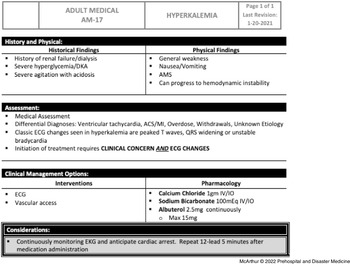
The EMS protocol for identification and treatment of HK is shown in Figure 1. Patients were identified by ALS crews for management under the HK protocol based on clinical concern for HK and ECG findings consistent with HK. Clinical concern for HK included history of CKD or end-stage renal disease (ESRD), severe agitation with concern for rhabdomyolysis or acidosis, or hyperglycemia with suspected DKA. The ECG findings consistent with HK include peaked T waves, widened QRS, and/or unstable bradycardia. Patients were excluded from the study if they were in cardiac arrest upon EMS arrival.
EMS Protocol for Identification and Empiric Management of Presumed HK.
Abbreviations: DKA, diabetic ketoacidosis; AMS, altered mental status; ACS, acute coronary syndrome; MI, myocardial infarction; ECG, electrocardiogram; IV, intravenous; IO, intraosseous; EKG, elektrokardiogramm; EMS, Emergency Medical Services; HK, hyperkalemia.

Empiric management of HK included calcium 1g IV or intraosseous (IO) for myocardial stabilization, sodium bicarbonate 100mEq IV or IO, and albuterol 15mg nebulized to shift K intracellularly. Patients were maintained on continuous cardiac monitoring and ECG was repeated five minutes after treatment.
A mandatory two-hour training session was administered prior to deployment of the HK protocol. Approximately 300 paramedics participated in the session. The training included a review of HK physiology and treatment pharmacology, classic HK-related ECG patterns, along with specifics of the treatment protocol (Figure 1). The training sessions occurred approximately one month prior to protocol deployment. Protocol-specific training videos and podcasts were also made available for reference during the study period. Providers demonstrated competency in recognizing HK-related ECGs and administering the treatment protocol through written exam, including ECG interpretation, at the conclusion of the mandatory training session.
The EMS electronic medical record (EMR) was queried for calls linked to the HK protocol or those that included “hyperkalemia” in the narrative. Cases with an initial presentation of cardiac arrest were excluded. Baseline demographics, vital signs, and treatments provided were obtained from the EMR. The ECGs were independently reviewed by a physician and a paramedic for presence of peaked T waves, bradycardia or widened QRS, and to assess overall appropriateness of protocol implementation. The physician and paramedic were blinded to the clinical case at time of ECG review. Cases of disagreement regarding appropriateness of protocol implementation or ECG findings were adjudicated by a second physician. Hospital records were reviewed to obtain initial K levels on ED arrival.
Statistical analysis was performed using Microsoft Excel version 16.54 (Microsoft Corporation; Redmond, Washington USA) and demographics and outcomes are presented using descriptive statistics.
Results
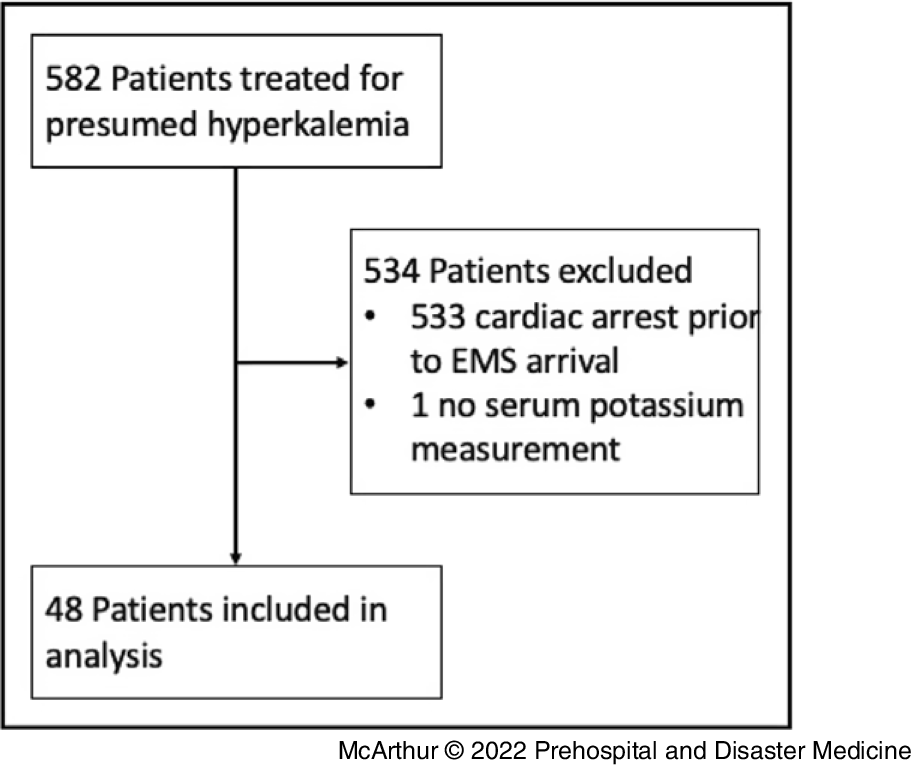
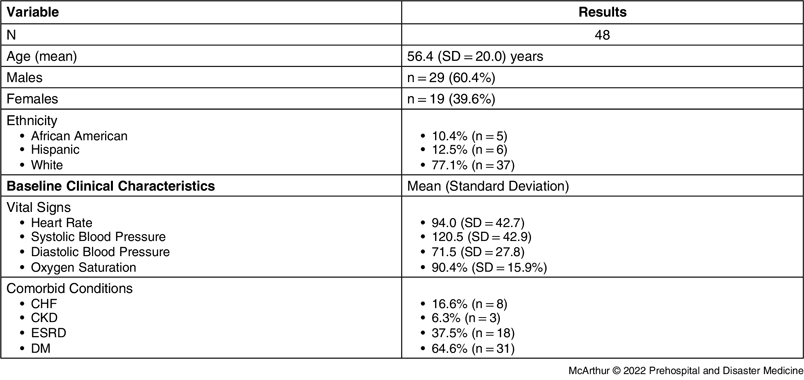
A total of 582 patients treated for presumed HK were identified over a three-year period from February 2018 through February 2021. Of those, 533 patients were excluded due to cardiac arrest prior to EMS arrival. One patient did not have data available for serum K upon ED arrival and was excluded from analysis (Figure 2). The 48 patients included in analysis had a mean age of 56 (SD = 20) years and were 60.4% (n = 29) male with 77.1% (n = 37) Caucasian, 10.4% (n = 5) African American, and 12.5% (n = 6) Hispanic. A past history of ESRD was present in 18 (37.5%) patients, diabetes mellitus in 31 (64.6%) patients, and CKD in three (6.25%) patients (Table 1).
Patient Enrollment Diagram.
Abbreviation: EMS, Emergency Medical Services.

Demographic and Clinical Baseline Characteristics

Abbreviations: CHF, congestive heart failure; CKD, chronic kidney disease; ESRD, end-stage renal disease; DM, diabetes mellitus.
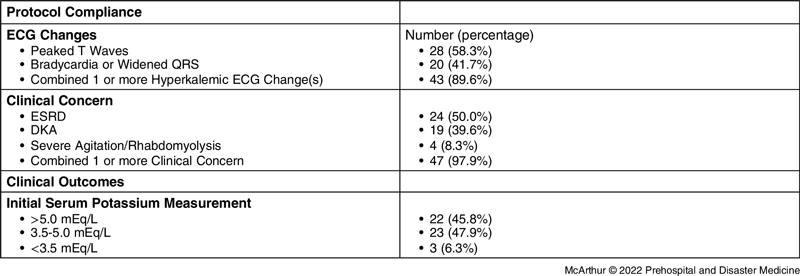
Clinical concern for HK was identified in 47 patients (97.9%). Clinical suspicion of HK was most commonly based on history of ESRD (n = 24; 50.0%), concern for DKA (n = 19; 39.6%), and severe agitation with concern for rhabdomyolysis (n = 4; 8.3%%). One case was miscategorized and did not have a clinical concern for HK (Table 2).
Protocol Compliance and Clinical Outcomes

Abbreviations: ECG, electrocardiogram; ESRD, end-stage renal disease; DKA, diabetic ketoacidosis.
Independent review of the ECG found peaked T waves in 28 (58.3%) and bradycardia or widened QRS present in 20 (41.7%) subjects. Overall, presence of one or more hyperkalemic-related ECG change was found in 43 (89.6%) cases with an interrater reliability of 0.81.
Patients treated for HK received calcium (n = 42; 87.5%), albuterol (n = 26; 54.2%), and sodium bicarbonate (n = 37; 77.1%). Treatment details are shown in Table 3.
Treatment Details

Of the patients treated per the HK protocol, initial blood draw at the receiving facilities showed K >5.0mEq/L in 22 (45.8%), K of 3.5-5.0mEq/L in 23 (47.9%), and K <3.5mEq/L in three patients (6.3%). No episodes of unstable tachyarrhythmia or cardiac arrest occurred during EMS treatment or transport.
Chart review showed that five patients did not meet criteria for treatment due to either lack of appropriate ECG findings or clinical suspicion. Of the five patients, four had normal K and one patient had K >5.0mEq/L on arrival at the ED after treatment by EMS.
Discussion
This is the first study evaluating an EMS protocol for empiric management of HK in the setting of clinical concern and characteristic ECG changes. The study found that ALS ambulance crews accurately applied the EMS HK protocol in 89.6% of patients. Adverse events of protocol implementation were minimal with only three patients (6.3%) found to be hypokalemic upon ED arrival and no cases of arrhythmia or cardiac arrest noted during transport.
The protocol was designed based on clinical signs and symptoms of HK, while taking into account the limited testing capability on EMS ambulances and the skillset of EMS providers. While HK-related ECG changes may lead to arrhythmia and ultimately cardiac arrest, they can also be non-specific. Reference Wrenn, Slovis and Slovis13,Reference Surnwicz28,Reference Rafique, Aceves, Espina, Peacock, Sheikh-Hamad and Kuo29 Therefore, the protocol used clinical concern to identify a population with higher pretest probability for HK in addition to including classic HK-related ECG changes. Presence of renal failure and metabolic acidosis have been associated with higher rates of HK. Reference Alfonzo, Soar and MacTier30 While metabolic acidosis could not be readily diagnosed without laboratory testing, hyperglycemia with concern for DKA and severe agitation with concern for rhabdomyolysis were identified as common clinical scenarios which could result in metabolic acidosis and HK and are easily recognized by EMS providers. Therefore, renal failure, hyperglycemia with concern for DKA, or psychomotor agitation with concern for rhabdomyolysis were the most readily identifiable clinical presentations to predict HK, and thus at least one of these factors was required to establish a clinical concern within the protocol.
Selection of empiric treatments for HK sought to balance the need for treatment with practical considerations of delivering care in the prehospital environment. Intravenous calcium for cardiac membrane stabilization and nebulized albuterol to redistribute K intracellularly were included as they have demonstrated effectiveness in the hospital setting Reference Rafique, Peacock and Armstead18,Reference Alfonzo, Soar and MacTier30 and are commonly available on ALS ambulances. Sodium bicarbonate is also readily available and potentially helpful in HK associated with metabolic acidosis and therefore included in the protocol. Insulin is commonly used in the hospital setting and has demonstrated effectiveness for management of HK, Reference Alfonzo, Soar and MacTier30 but was omitted from the protocol due to lack of refrigerators in the prehospital setting and the risk of hypoglycemia.
Ultimately, only 6.3% (n = 3) of patients treated per the protocol were found to be hypokalemic upon ED arrival. While these patients were possibly normokalaemic and inappropriately treated per the protocol, adverse effects were minimal during transportation. Since EMS lacks the ability to perform routine laboratory tests and HK has the potential of rapid decompensation, over-treatment without serious adverse events may outweigh the risks and is possibly acceptable.
Limitations
The study has several limitations. First, serum K levels were available post-treatment and only patients managed under the HK protocol were included in this analysis. As such, it is difficult to determine the true prevalence of HK in this population and the effectiveness of the protocol. Nevertheless, empiric treatment was found to be safe. Second, under-treatment of HK due to lack of IV access and/or avoidance of nebulized albuterol due to the COVID-19 pandemic was not captured and possibly under-reported. Third, this is a single EMS system retrospective evaluation with a small sample size, thus a larger prospective study is needed to generalize its results.
Conclusion
The study evaluated a novel EMS protocol for detecting and managing HK in the prehospital setting. It is feasible for EMS crews to administer this protocol with high degree of accuracy which may prevent sudden arrhythmia or decompensation during transport. A larger study is needed to make the results generalizable.
Conflicts of interest
The authors declare none.