

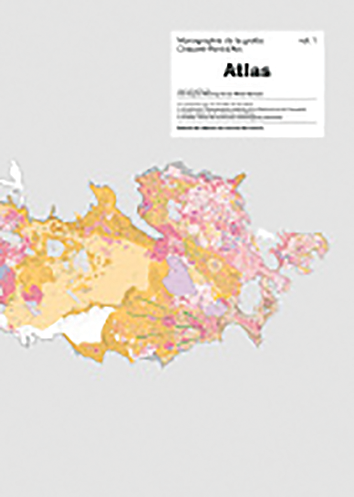
When the French government published the findings of excavations at Nineveh in 1849–1850 the resulting five-volume set of folios was so large and lavish that very few people, or libraries, could afford it; a subsequent account of French excavations at Khorsabad was so grand as to be “virtually unaffordable” (Reade Reference Reade and Brereton2018: 289 & 296). When I took delivery of the Chauvet Atlas, manhandling it onto the nearest structurally reinforced surface, it occurred to me that floating Nineveh's gigantic sculptures down the Tigris on rafts must have been a doddle compared to printing and distributing a 0.5m-high, 4kg, first volume of a planned Monographie de la Grotte Chauvet Pont d'Arc. Published by the government's Ministry of Culture, it shows that the impractical lectern-bible tradition is far from mort.
The 1994 discovery of the Upper Palaeolithic art of the Grotte Chauvet Pont d'Arc (Ardèche), by the speleologists Jean-Marie Chauvet, Éliete Brunel and Christian Hillaire, ranks as one of the most important in archaeology. With at least 426 animal drawings clustered in several dozen art panels across some 19 chambers and galleries spanning over 200m in depth, the art repertoire alone is exceptional. The drawings depict species including horse, bison, mammoth and lion, and abundant non-figurative handprints and stencils, palm prints and other ‘signs’ executed in red and black. Its charcoal drawings include scenes displaying a true concern with perspective and movement, and were created with an artist's hand that by any standard was masterful. The undisturbed palaeontology and archaeology on its floor, including >4000 faunal remains (90 per cent of which are of cave bear), preserves bear paw- and human footprints and affords us numerous chances to connect with the actions of individuals in the deep past. We see where bears slipped down wet slopes, sharpened their claws and dug hibernation hollows, and where humans dragged their fingers through clay walls.
The Atlas was conceived in 2014, the year in which the cave was inscribed as a UNESCO world heritage site. Its production involved 47 specialists, deploying cutting-edge field and laboratory studies. A full-sized replica of the cave—the largest of any decorated cave—opened nearby in 2015, and it can also be explored virtually in 3D (https://archeologie.culture.fr/chauvet/fr). The Atlas provides a state-of-the-art summary of Chauvet's study and interpretation for an academic audience. A number of high-quality papers and monographs have already brought much of its contents to the attention of specialists and the public, yet the Atlas adds considerably more detail, admirably achieving its purpose to orient the reader with the physical nature of the cave, the context of its art and the scientific techniques that have been used to study and conserve it. As befits such a magnificent site, it is exceptionally detailed. Commencing with topography, cave formation, sedimentology and interpretation, it progresses through the cave's archaeological context (including dating) to the presentation of each of its numerous galleries as a GIS-based atlas, making plentiful use of highly detailed plans and 3D lasergrammetric scans, and concludes with the complex problems of conservation.
The contributions of the team's scientists are impressive and surely reflect the international state of the art. This is not the place for critique, but I am not so impressed by the direction the Chauvet team has taken since 1994. Its first director, Jean Clottes, mistakenly took a handful of questionable radiocarbon measurements to indicate an Early and Mid Upper Palaeolithic age (Aurignacian ~36 000 and early Gravettian ~30 000 BP) for the art, contrary to all other age estimates that put it firmly in the Mid and Late Upper Palaeolithic; his successor, Jean-Michel Geneste, passively followed the resulting dogma; and the current director, Carole Fritz, aggressively defends it. The numerous criticisms of the ‘old chronology’ and proposals for a more likely ‘short chronology’ have been ignored, and continue to be so here; critical publications—including several of my own—are listed in the bibliography, but I could not find them cited in the text. Suffice it to say, I remain profoundly distrustful of the ‘official line’ (for a summary of the debate so far, see Jouve et al. Reference Jouve, Pettitt and Bahn2020 and references therein). It seems a pity that the impressive specialists have at times been misled by a directorial agenda that seeks to reinforce this questionable party line.
For a specialist this is a magnificent resource. Captions to its 302 illustrations are in French and English, presenting a highly detailed explication of all methods of study. The geology, cave formation, sedimentology, palaeoenvironment and conservation chapters alone provide the most useful introduction to cave science I have seen; the journey through the cave itself, from the collapsed cliff face and sediments blocking the cave's entrance to its deepest galleries, comes alive in magnificent detail; and its extensive bibliography is useful in its own right. Subsequent volumes will presumably focus on Chauvet's art, archaeology and palaeontology, and if they are of similar quality are eagerly anticipated. For those unlikely to visit the cave, the concept of the Atlas and the 3D virtual cave are both very welcome.
To return, like unwelcome back strain, to the volume's large size and heavy paper stock, it is as impractical as a lectern bible and was clearly not produced with the reader's comfort in mind. I cannot help feeling that it is an attempt, Moses-like, to lay down the law of the ‘old chronology’ in stone (it's heavy enough): thou shalt have no other age than ours! It will look good in a tabernacle in the facsimile gift shop, but as I found it easiest to use standing up (reverentially?) before it, and that it kept slipping off the two desks I supported it on, it made for a physically tiring read. No matter, however, the Atlas must surely rank as one of archaeology's greatest and inspiring achievements: an immense undertaking involving thousands of hours underground, and a meticulous record of this world heritage site.


