INTRODUCTION
Jaguars, snakes, and birds of prey were among the popular motifs Mesoamericans used to express elite ideology. In contrast, the Late Classic Cotzumalhuapan culture (on the Pacific coast of present-day Guatemala) relied in part on crab iconography to embody these beliefs. The following research proposes to show how and why authorities projected elitism via crab iconography in monumental art by providing an analysis of selected monuments from Cotzumalhuapa. Due to limited iconographic representations of crabs in this region, this research provides interpretations of comparative objects along with zoological, linguistic, and ethnohistoric data. I will outline the biological traits of crabs and relate them to symbolic meanings and associations with the feminine in both language and narrative. I will address the crab's cosmological significance and its associations with earth symbolism and agriculture via quadripartite rituals, and finally, offer interpretations of the monuments in which crab imagery appears.
The relatively high frequency of crab iconography on Cotzumalhuapan monumental art implies that the crab had ritualistic importance and, as such, it stands to reason that this importance would be reflected in linguistic and ethnographic sources. Inherent biological traits will also provide logical motives that may have led to the selection of this decapod for symbolic use. Since linguistic associations in Cotzumalhuapa are disputed for the Late Classic, adjacent languages and cultures will be analyzed and common themes will be derived. These traits and themes will then be compared to Cotzumalhuapan monuments, alongside comparative objects, to derive parallels.
NOTABLE BRACHYURAN PHYSIOLOGY, MORPHOLOGICAL, AND BEHAVIOURAL TRAITS
The following section will demonstrate how crab symbolism can be naturally derived by observing various biological traits. A triad of traits related to symbolic or practical uses demonstrates that the crab was not chosen arbitrarily.
The first such trait is “ecdysis” or molting (Brusca and Brusca Reference Brusca and Brusca1990:473). During this life stage, the crab becomes inactive as it begins to separate from its exoskeleton (Brusca and Brusca Reference Brusca and Brusca1990:474). The blood pressure within the carapace increases, forcing its expansion and causing the posterior section to fracture; the crab extricates itself through this crevice, sometimes regenerating lost limbs (Brusca and Brusca Reference Brusca and Brusca1990:473). This process is analogous to resurrection and regeneration.
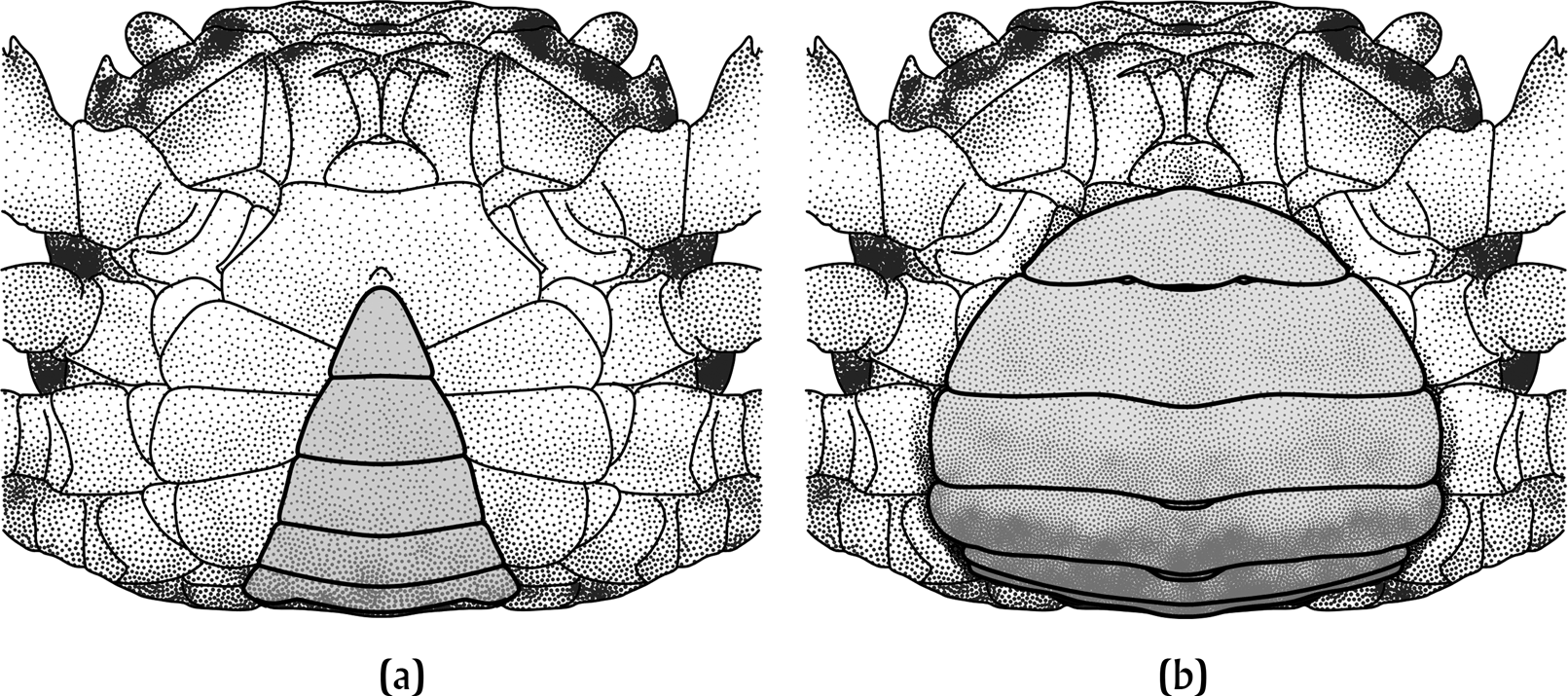
The second trait is sexual dimorphism: the sexes are distinguished by the shape of the abdomen and, for most, the size and asymmetry of their chelae, or pincers (Figure 1; Cumberlidge Reference Cumberlidge1999:323–324). Male abdomens are thin and triangular, while female abdomens are circular and contain the brood pouch, a flap-like “egg-storage device” (Cumberlidge Reference Cumberlidge1999:324; Linares Reference Linares1977:63). The round brood pouch will become relevant as we proceed. Female specimens usually have symmetrical pincers, while males often have asymmetrical ones (Cumberlidge Reference Cumberlidge1999:75).
The ventral section of the carapace: the (a) male and (b) female abdomen (both shaded in grey). Drawings by the author.

Thirdly, crab courtship and parturition are regulated by an environmental cue known as a lunar zeitgeber (Forward Reference Forward1987:173). Most littoral crab species release millions of larvae (zoea) in semi-lunar cycles during the largest amplitude ebb waves that coincide with new or full moon phases (Forward Reference Forward1987:174). Supralittoral crab species indirectly exposed to tidal changes depend on a direct and clear view of the moon for larval release (Forward Reference Forward1987:170). Freshwater species are unique, as they release fewer, already-developed juvenile crabs (Cumberlidge Reference Cumberlidge1999:79, 323). The former examples, however, imply lunar zeitgeber for freshwater species. The appearance of miniature crabs rising from the ventral portion of their mother after a lunar event may have driven the Cotzumalhuapans to associate the affair with mytho-religious events.
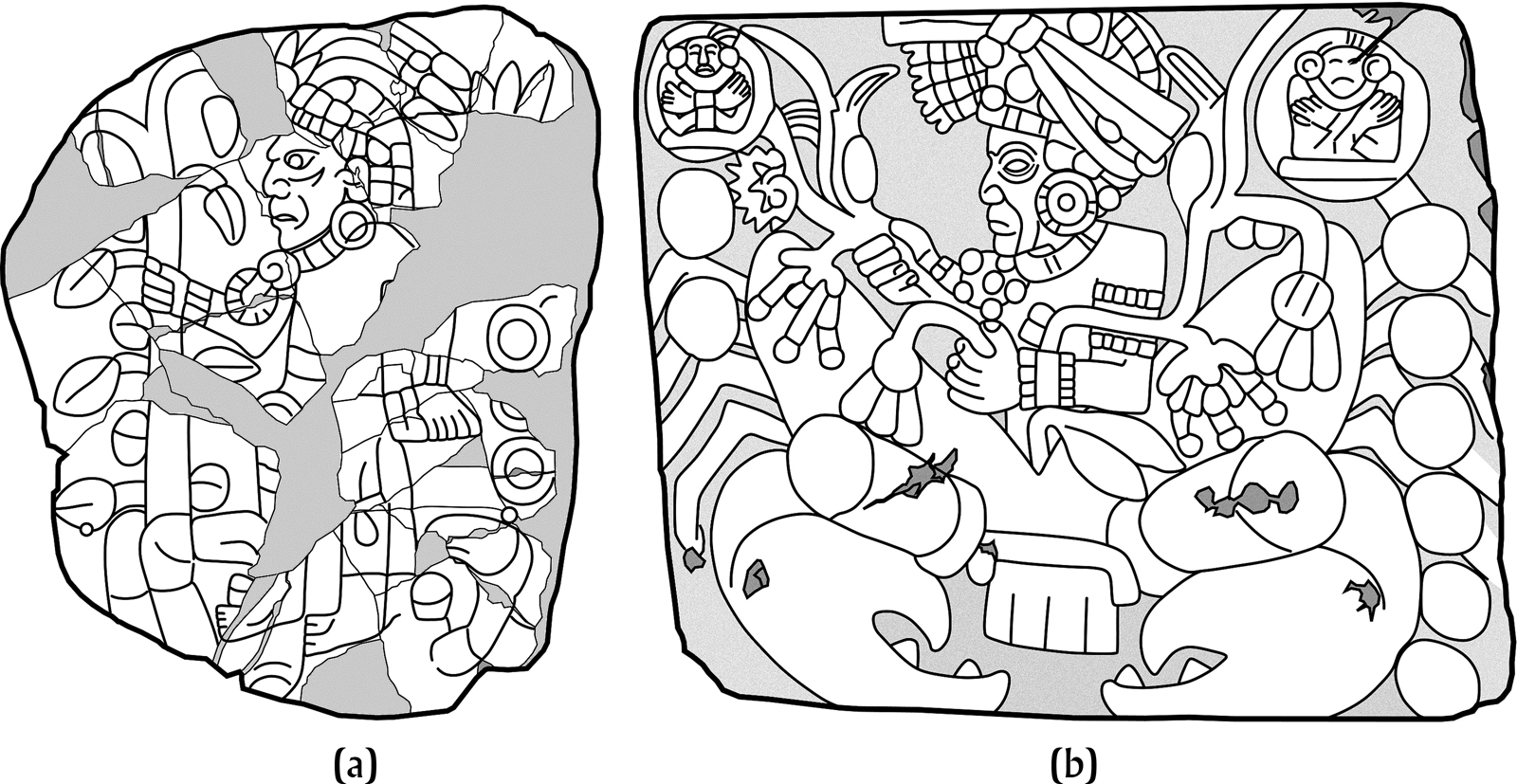
I have tentatively identified the crabs presented in Cotzumalhuapan iconography and in the region's traditions as belonging to the Psuedothelphusidae family, a freshwater species found chiefly in Neotropical mountain streams (Cumberlidge Reference Cumberlidge1999:49). Based on their iconographic and folkloric distribution, distinctly patterned carapace (series of grooves that segregate the internal organs), and exaggerated size, these crabs may belong to Pseudothelphusa magna (Rathbun Reference Rathbun1896). A second possibility is, as Lawrence G. Abele (personal communication 2010, 2012) suggests, Gecarcinus quadratus (Saussure 1853), a tropical, non-freshwater land species of crabs that “match the shape and color and have symmetrical claws,” like the crab pictured on Bilbao Monument 1 (Figures 2b and 3b). These are nocturnal crabs that inhabit forested areas, marshes, mangroves, and sandy beaches, dwelling in burrows above tide levels (Taylor and Spencer Davies Reference Taylor and Davies1981:197). They are stridulators, producing sound by rubbing certain body parts together, usually in defense (Abele et al. Reference Abele, Robinson and Robinson1973:147–151). It is important to note that faunal remains of Gecarcinus groups have been found in abundance at the Early/Middle Preclassic site of Chiquiuitan, Guatemala (Morgan Reference Morgan2010:329).
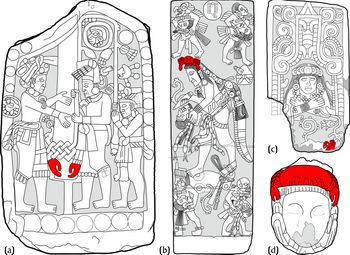
(a) Bilbao Monument 18. Redrawn by the author from a photograph provided by Diego Ramírez, Popenoe de Hatch (Reference Popenoe de Hatch, Bove and Heller1989:178, Plate 9.7), and Parsons (Reference Parsons1969:245, Plate 37). (b) Bilbao Monument 1. Redrawn by the author after photographs provided by Greene Reference Greene Robertson1995 and Ulli Wölfel. (c) Bilbao Monument 7. Redrawn by the author after photographs provided by Ulli Wölfel and Hellmuth (Reference Hellmuth1995:103). (d) Bilbao Monument 71. Redrawn by the author after a photograph of IV Ca. 7181 in the Ethnologisches Museum, Staatliche Museen zu Berlin.

(a) Palo Verde Monument 4 with crab headdress. (b) Closeup of the crab headdress from Bilbao Monument 1. Both drawings by the author after photographs provided by Oswaldo Chichilla and Ulli Wölfel, respectively.

THE CRAB AND ITS ASSOCIATIONS WITH THE FEMININE IN LANGUAGE AND TRADITION
Subsequently, this section will link the crab with the feminine gender through available folkloric and linguistic data. The term and concept for “crab” in many Mayan languages is overwhelmingly feminine. I am aware of the chronological differences between the Colonial period and the Late Classic and the dangers of attaching the meanings of one language to an unknown, although geographically close, language or culture. Please note that, in order to avoid confusion, the original orthography of Zipacna cognates are not kept.
An Achi’ story describes how three young corn goddesses were bathing in the River Cala, distracting Zipacna, who was carrying the mountain, Los Pajales, on his back (Shaw Reference Shaw1971:48–50). The River Cala separates Los Pajales from the mountain Meauan; the latter is a contraction of the form me'alajaw, “the daughter of a lord,” making this mountain feminine (Christenson Reference Christenson2007a:94; van Akkeren Reference van Akkeren2000:298). Zipacna was so intrigued that he set the mountain down to propose to the goddesses. They accepted, on the condition that he catch a crab for them to eat. During Zipacna's absence, one of the goddesses created a crab using her hair ribbon and placed it in a nearby cave, presumably in the mountain Meauan. They then instructed Zipacna to enter while on his back. Upon entering the cave, the goddesses trapped him inside by pushing a rock to cover the entrance (Shaw Reference Shaw1971:50).
In the Popol Vuh version, it is the Hero Twins who construct an artificial crab from a hollowed-out stone and a Bromelia flower. This epiphyte has long, pointed red petals that resemble crab legs (Christenson Reference Christenson2007a:94). Tedlock's (Reference Tedlock1996:248) K'iche’ informant, Andrés Xijol, noted the bromeliad's feminine connotations.
Since Meauan is feminine, the act of entering the cave can be viewed as Zipacna penetrating the vulva (or intercourse). What is more, an Itza legend recalls a toponym aj p'ich'ayim, or “place of the penis of the crocodile.” This place is associated with a point on the Tayasal peninsula where a legendary crocodile seduced an Itza maiden, which resulted in the release of the waters that created Lake Peten Itza (Lois Reference Lois1998:243). This crocodile may be a reference to the saurian form of Zipacna. Here, the toponym may suggest sexual intercourse and the release of water evoked during parturition.
Several other elopement stories further these feminine/crab associations. In an Alta Verapaz narrative, a corn goddess hid inside a crab shell to escape her father, Xucaneb (Karen Bassie-Sweet, personal communication 2008). In a Mopan tale, the lovesick sun courted the moon goddess but, when they departed together by canoe, the moon's grandfather ordered a Chac to stop them (Shaw Reference Shaw1971:176). As they escaped, the Chac hurled lightning bolts at them as the sun turned himself into a turtle and the moon into either a crab (Milbrath Reference Milbrath2000:33; Thompson Reference Thompson1930:128), an armadillo in the fuller Q'eqchi’ version (van Akkeren Reference van Akkeren2000:234), or a turtle in others. In Shaw's (Reference Shaw1971:176) version, the sun tells the moon to “climb on the crab quickly,” while, in Wilk's (Reference Wilk1979:5) short Q'eqchi’ version, the moon borrowed the crab's shell. As they escaped, the crab was struck by a lightning bolt, splitting her body; the pieces were collected and placed into twelve (or thirteen) containers, and creatures formed from all but one. The moon was reborn from the last (Shaw Reference Shaw1971:177; van Akkeren Reference van Akkeren2002:234). This last story has strong affinities with creation, resurrection, and regeneration. The crab acts as an avatar to the moon goddess, further linking it to lunar zeitgeber.
The lightning bolt above is an allusion to what the Popol Vuh calls paxil, that is, the cleft on the mountain where maize, pataxte, cacao, and other vegetation came into existence (Chinchilla Reference Chinchilla2007). This cleft was carved into the mountain's (or carapace's) surface by a lightning bolt, releasing the basic substance that created humankind (López Ramírez Reference López Ramírez2007:33; Martin Reference Martin and McNeil2006:158; Schele and Mathews Reference Schele and Mathews1999:217).
Additionally, van Akkeren (Reference van Akkeren2000:237) has identified Tequicistlán, meaning “Place of the Conch Shell,” as Rab'inal, a K'iche’ town. Similarly, Asselbergs (Reference Asselbergs2004:192–194) found that there are two examples of Rab'inal in the Lienzo de Quauhquechollan: one is Figure 4b and the other a glyph of a conch shell. Akkeren (Reference van Akkeren2002:59) argues that the latter is specifically the archeological site of Kaqyuq, just north of Rab'inal. An important note about Rab'inal is that, although the town is K'iche’, the toponym itself is actually Q'eqchi’ and translates to “the daughter of a lord,” essentially synonymous with the aforementioned Meauan, further insinuating the crab/feminine connection (Christenson Reference Christenson2007a:94; van Akkeren Reference van Akkeren2002:66). The Codex Tlaxcala also demonstrates a variation of this toponym (Figure 4a; Escalante Arce Reference Escalante Arce2004:196, Plate 24).
Toponyms for Tequicistlán from (a) the Codex Tlaxcala (Escalante Arce Reference Escalante Arce2004:196, Plate 24) and (b) the Lienzo de Quauhquechollan (Universidad Francisco Marroquín). (c) Crab hieroglyph with cartouche from El Castillo Monument 1 (Popenoe de Hatch Reference Popenoe de Hatch, Bove and Heller1989:182, Plate 9.10). Drawings by the author.

A Pipil legend from Izalco mentions helpers of the Boys of the Rain (essentially Chacs) called Kuyangkúua; one was the river crab (Schultze Jena Reference Schultze Jena, Rieken and Fortín1977:51, Reference Schultze Jena and Martínez2010:231). These crabs prevented the rains by collecting clouds and placing them into tecomates located inside the tops of mountains (Schultze Jena Reference Schultze Jena, Rieken and Fortín1977:58–59, Reference Schultze Jena and Martínez2010:234). If the Boys wished for rain, they would command the river crabs to release the clouds from the mountains. The latter is supplemented by the Mochó belief that the crab “creates holes in the earth that reach to the center of the hill where they bring the water. They are not killed for fear that this will provoke drought” (Petrich Reference Petrich1985:230; Stross Reference Stross2007:394). According to Gaitán (Reference Gaitán2006:393), an informant thanked the hill king (a Chac) for bringing falling blue crabs and fish to the earth via the winter storms. These are likely variants of the same theme separated by hundreds of kilometers along the pacific coast.
A Xinca story from Chiquimulilla recalls a king who wanted to find a husband for his daughter, Mime Rurume (López Ramírez Reference López Ramírez2007:44). Mime's secret lover, the archer Tuma Tosnay, had died, so the king sent messengers to kingdoms in search of a suitor (López Ramírez Reference López Ramírez2007:45–46). The princess refused to marry the chosen prince from Guazacapán because she still loved the late Tuma Tosnay. Thus, she was stoned to death (López Ramírez Reference López Ramírez2007:48–50). After the stones were removed, her eyes began to tear up, transforming into gushing water, while her body became a spring and her braids a grand waterfall. The bag containing the dowry from the prince began to move and opened up, revealing an enormous golden crab encrusted with precious stones, which ran to take refuge in the newly formed pool (López Ramírez Reference López Ramírez2007:54–55). Curiously, the area found in present day Pila de Santa Catarina is called the “birth of the princess” and not the “death” of the princes (López Ramírez Reference López Ramírez2007:54–55). There are also picaresque tales in western El Salvador of golden crabs associated with the female sexual organ (Araceli de Gutiérrez Reference Araceli de Gutiérrez1993:51).
Further linguistic evidence infers an etymological relationship between the words for “crab,” “moon,” and the “feminine.” In Yucatec, ix bau is the term for “crab,” herein accompanied by the gender prefix ix-, a feminine pronoun (Bolles Reference Bolles2001). Furthermore, the Mopan yux is a euphemistic metaphor for “crab” and “vulva” (Stross Reference Stross2007:392). Similarly, in K'iche’, “vagina” is t'ot’ and is synonymous for “land snail,” “seashell,” and “shellfish” (Christenson Reference Christenson2003:116). Other terms are yuxchele in Ch'olti’ or ya:x in Q'eqchi’, meaning “crab pincers” (Kaufman and Justeson Reference Kaufman and Justeson2003:654; Stross Reference Stross2007:394). Curiously, one reconstruction of Proto-Mayan for “vulva” is *yaax, while the reconstructed *yax means “crab,” suggesting a relationship (Stross Reference Stross2007:393). In Nahuatl (Pipil), the word métsti means “month,” “moon,” and “menstruation” (Schultze Jena Reference Schultze Jena, Rieken and Fortín1982:163). The Yucatec and Mopan equivalent for menstruation, “ú,” is synonymous with “moon” (Kaufman and Justeson Reference Kaufman and Justeson2003:500; Milbrath Reference Milbrath2000:32). The words yux and ú are associated, for there can be no ú without a yux. These subtle one-to-one relationships linguistically link crab and moon-goddess symbolism.
IX BAU AS PETEN AND TIME
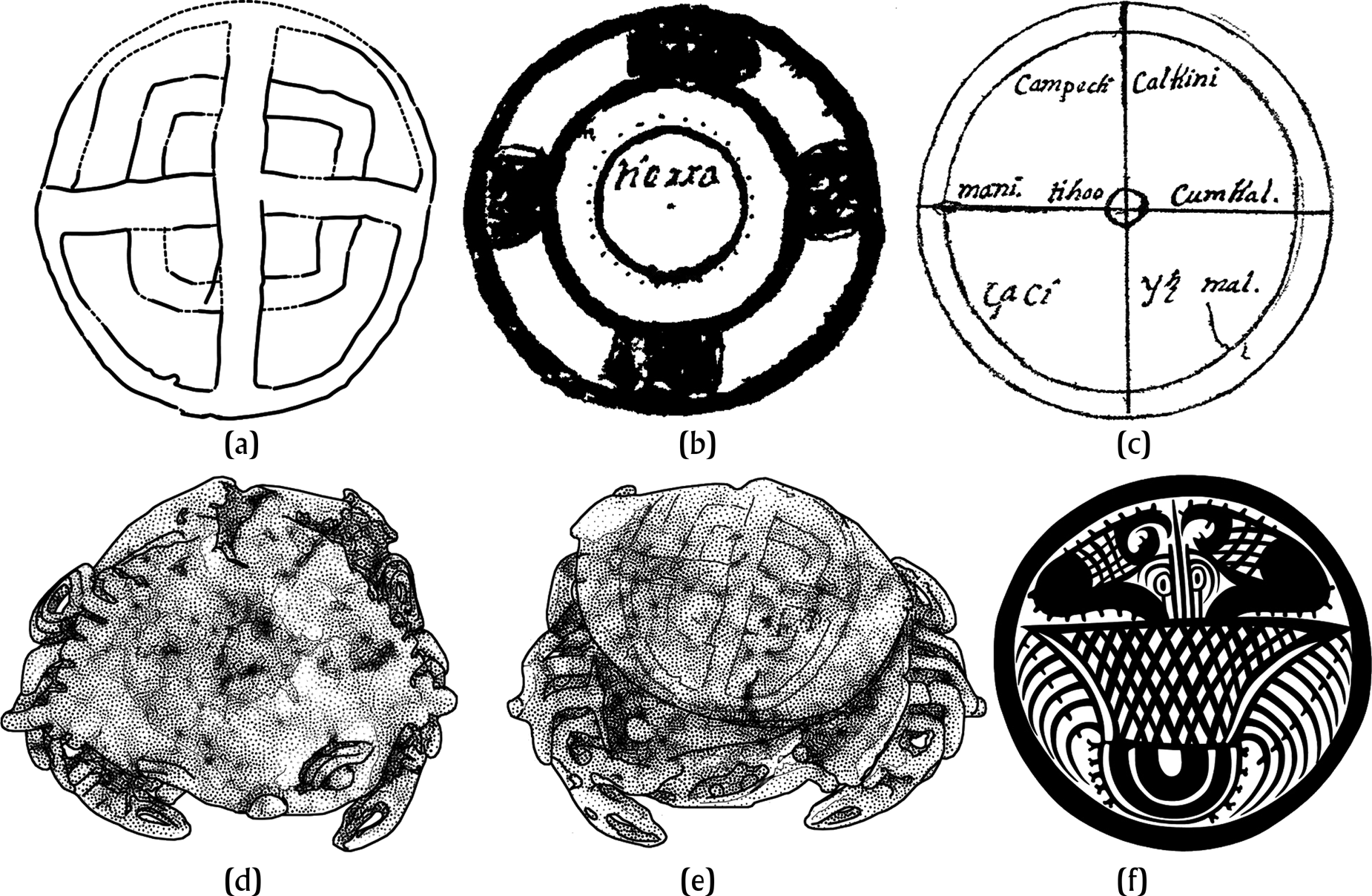
This section will attempt to associate crab symbolism with the earth and the calendar. Excavations at the Sacred Cenote in Chichen Itza in the 1980s found a golden crab bell with an incision on its underside (Figures 5a and 5e; Coggins and Shane Reference Coggins and Shane1984:91). The design is of a ring or circle containing a cross with a square or round element at its center, like other Mesoamerican quadripartite/quincunx motifs (Figures 5b, 5c, and 6c). Coggins and Shane (Reference Coggins and Shane1984:91) remarked that this motif was “not an immediately recognizable Mesoamerican symbol,” yet a direct comparison with two diagrams (Gordon Reference Gordon1913:26, 67) from the Chilam Balam of Chumayel marks its importance. Figures 5b and 5c show the sun's passage over the earth and a map of northern Yucatan, respectively (Taube Reference Taube1988:195, 197). The term “tierra” appears at the center of Figure 5b and is described by the Yucatec petel, “a ring,” the root of which, pet, means “circular” or “round” (Bolles Reference Bolles2001; Taube Reference Taube1988:195). Figure 5c encompasses most of northern Yucatan within a quadripartite circle wherein each corner represents a “cardinal direction” and the center represents the axis mundi. Taube (Reference Taube1988:195) claims its accompanying text describes the disk as petén, meaning “island” or “province,” signifying “the world” (Bolles Reference Bolles2001).
(a) The incised quadripartite design on the crab bell. (b) A diagram of the sun’s passage over the earth and (c) a map of the northern Yucatan, both from the Chilam Balam of Chumayel. (d) Top view of the golden crab bell and (e) ventral view with quadripartite symbol. (f) Conte Polychrome plate depicting crab with brood pouch. (a, d, e) Redrawn by the author after a photograph in Coggins and Shane Reference Coggins and Shane1984:Figure 1. (b, c) Redrawn by the author after figures in Gordon Reference Gordon1913:26, 67. (f) Redrawn by the author after a photograph from Linares Reference Linares1977:63, Figure 34.

Evidently, these examples share three commonalities: a circular shape, a quadripartite distribution, and a central device. Thompson's (Reference Thompson1970:195–196) ethnographic work showed the Maya world as a “flat square block with skies above and underworlds beneath,“ and the pre-Hispanic Maya perceived the world as a metaphorical “rectangular house or milpa” (Taube Reference Taube1988:193). Thus, the incised quadripartite shape on the crab's carapace can be interpreted as representing the cardinal directions, with the central device as a symbolic house or milpa whose totality represents petén. The curious location of the motif under the carapace is explained by the circular abdomen containing the brood pouch (Figure 1b). The “womb,” so to speak, links the incised quadripartite motif to fertility, fortifying its connection to agriculture. A polychrome plate from Panama (Figure 5f) features a female crab with an extended circular brood pouch (Linares Reference Linares1977:63).
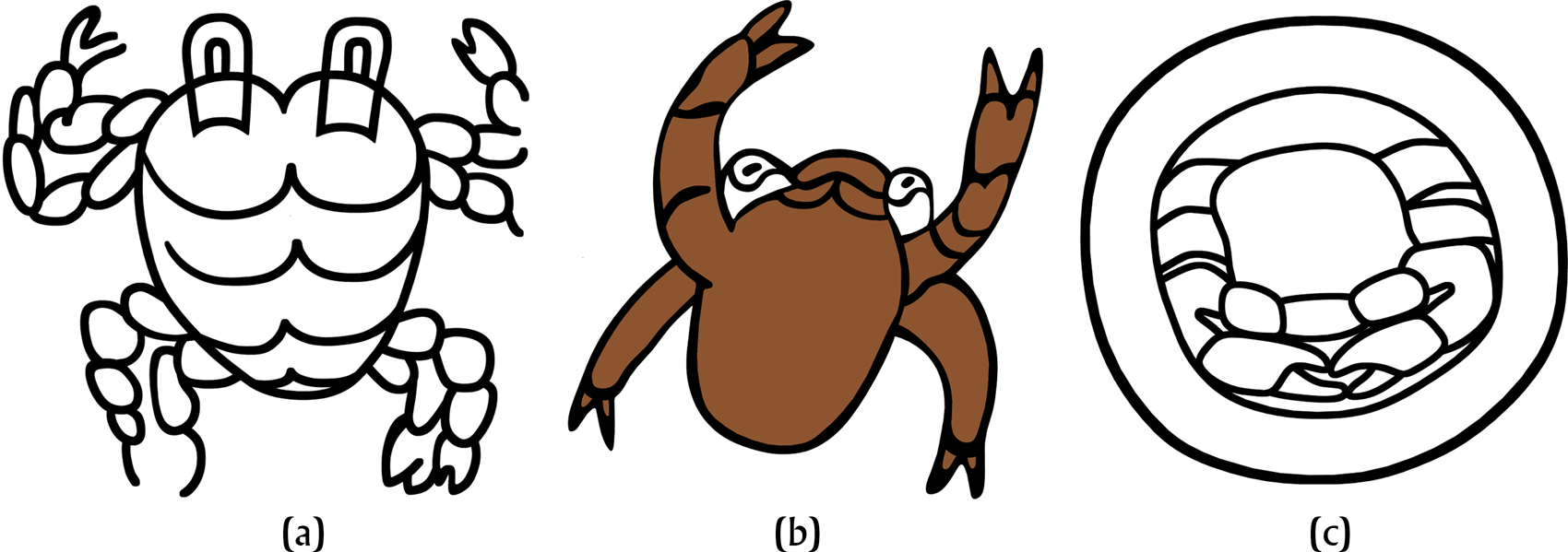
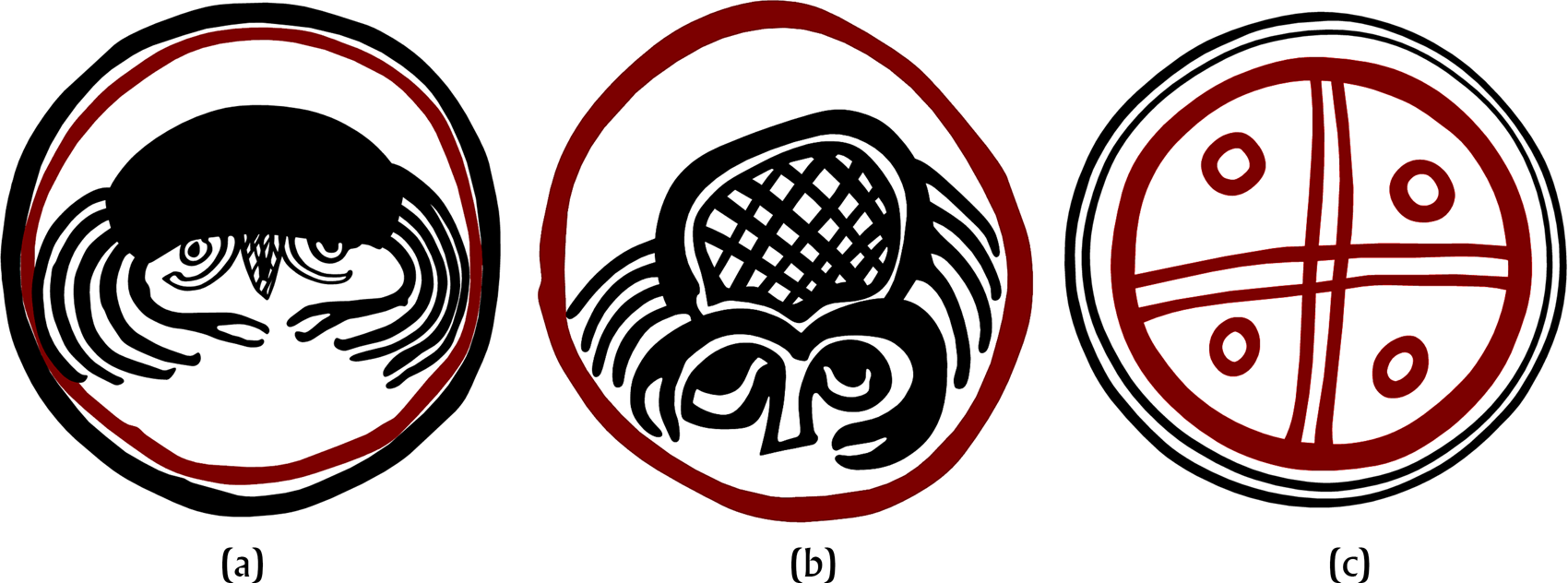
Two Copador vessels from Joya de Cerén share crabs as central motifs; these ceramic styles typically depict quadripartite motifs (Figure 6c) like the above. These Classic-period scenes show turtles as symbols for the earth, usually shown with Caban curls (an earth symbol resembling a curl) on their carapaces, “clearly symbolizing the earth”; sometimes the “earth net” motif will instead decorate turtle shells (Taube Reference Taube1988:193, 195, Reference Taube, Vail and Hernández2010:149). The crabs on these ceramics make use of a similar netted motif that could represent the earth, the same found on earth turtles (Taube Reference Taube, Vail and Hernández2010:149), undoubtedly a reference to the geometric pattern on their shells, suggesting that crab and turtle motifs can be interchanged (Figures 6a and 6b). The quadripartite symbol shown in Figure 6c has a simplified turtle carapace pattern that could be historically related to the Wasteko (Western Tancanhuitz) pet, meaning “turtle,” or the Mamean peetz or petz (Kaufman and Justeson Reference Kaufman and Justeson2003:635). Ceramics with crab motifs were also excavated at Kaminaljuyu, Guatemala.
Central motifs of three different Copador vessels from Joya de Cerén, El Salvador: (a) realistic representation; (b) stylized crab with heterogeneous claws; and (c) typical quadripartite motif. Drawn from photographs taken by the author.

Moreover, an example from the Chilam Balam of Kaua depicts a k'atun wheel (Maya calendar) with cardinal and intercardinal points at its center. With the Spanish gloss “mundo,” “world,” this provides a spatial component to these motifs (Taube Reference Taube1988:200). In Mayapan, there is a carved limestone turtle, the center of which contains a pit, with 13 Ahau glyphs carved “around the rim of the carapace,” indicating a complete round; 13 Ahau being the final round of the Katun (Taube Reference Taube1988:186, Figure 2a). These Postclassic- and Colonial-period references suggest that the quadripartite symbol and, in this case, the crab may possess temporal features, as well. The highland Chuj, Q'anjob'al, and Q'eqchi’ Maya share a crab month corresponding to the month Pax or Paxil (Rice Reference Rice2007:72–73), suggesting that the crab has calendrical links and supporting the crab-as-paxil hypothesis.
THE CRAB EARTH IN THE POPOL VUH
This section will briefly discuss the crab's role within the Popol Vuh. Mentioned already is the tale of when Zipacna was tricked by the hero twins to capture a giant crab (Christenson Reference Christenson2007a:96). As Zipacna entered the mountain Meauan on his back, the mountain settled on his chest, and he was turned to stone. This tale is like the Aztecan Xochiquetzal's seduction of Yappan, the black scorpion, in which Xochiquetzal climbs on top of Yappan, dominating him sexually (van Akkeren Reference van Akkeren2000:263). The latter, combined with Zipacna's hunger, a euphemism for sex, suggests not only sexual intercourse, but the domination of the feminine gender over the masculine (Tedlock Reference Tedlock1996:246; van Akkeren Reference van Akkeren2000:263). This story of Zipacna's defeat is also about the transformation of the crab carapace into “the surface of the first mountain” (van Akkeren Reference van Akkeren2000:271).
This curious line in the genesis portion of the Popol Vuh is often missed: “There is not yet one person, one animal, bird, fish, crab, tree, rock, hollow, canyon, meadow, or forest. All alone the sky exists. The face of the earth has not yet appeared. Alone lies the expanse of the sea…” (Christenson Reference Christenson2007a:58; my emphasis). We are provided with a list of first creations, all of which are informal categories. Curiously, the crab is the only invertebrate animal identified. This sets a certain precedence for this animal, and “begs the question why… this animal [is] singled out in this way in this very important litany of created creatures” (Allen J. Christenson, personal communication 2016). According to Christenson (Reference Christenson2007b:5), the list of the first creations has no obvious parallelism.
If we assume intentional pairing (common in the Popol Vuh), starting from the first pair of “person/animal,” the third pair produces “crab/tree.” It is important to mention, though, that this pairing is likely arbitrary since odd-numbered items in lists dissuades making any set of twos. Irrespectively, the crab reference may suggest otherwise. As mentioned earlier, the crab represents the surface of the earth and is a reference to paxil, notably suggested by the crevice produced by ecdysis and a corresponding highland Mayan crab month. The month Paxil/Pax has the patron god te’, “tree.” Although reaching, if we assumed a one-to-one relationship, the patron god of the crab month could also have been a tree, providing an explanation for their proximity in the creation line.
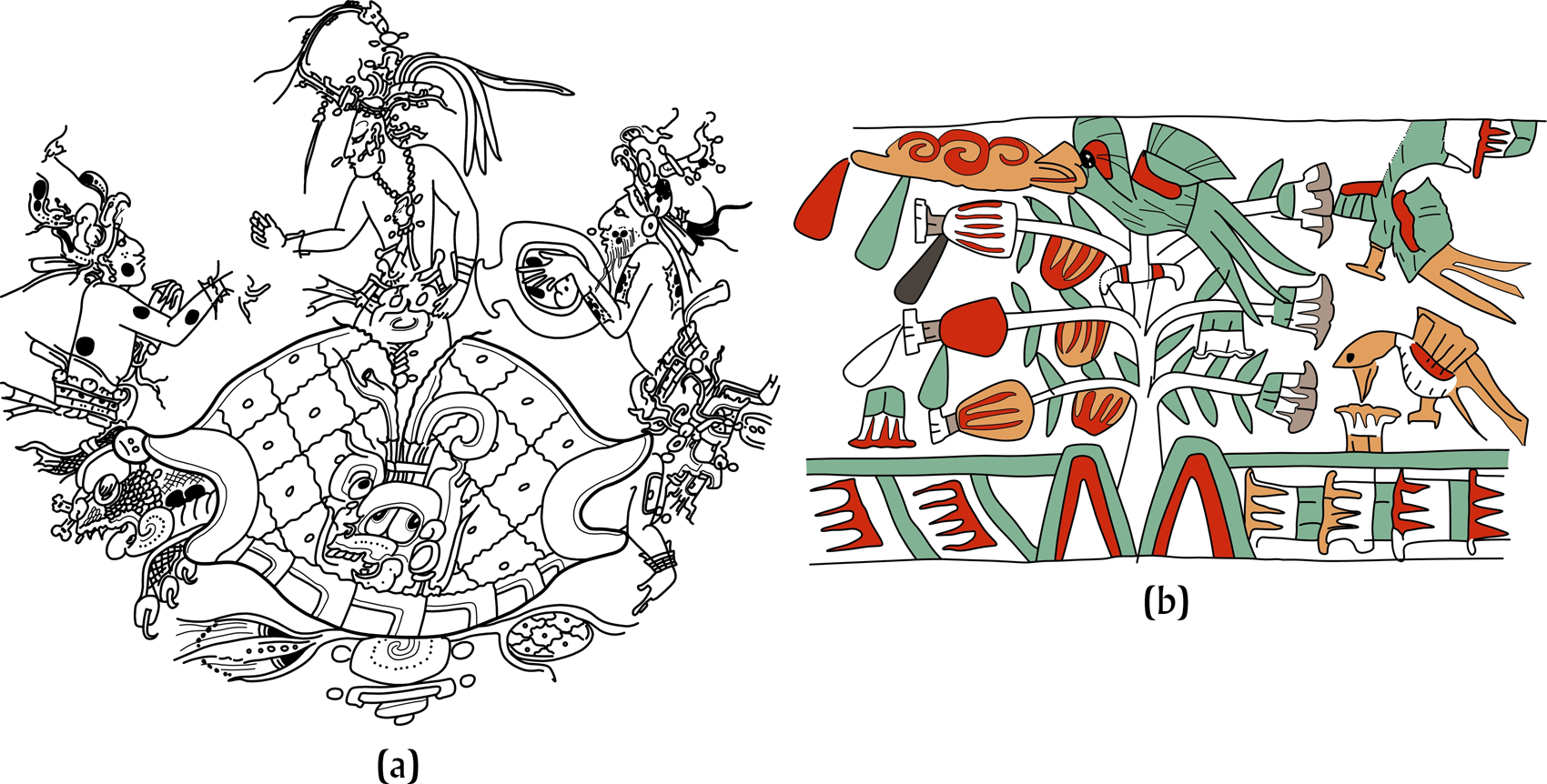
The Late Classic K1892 or “Resurrection” plate displays the Tonsured Maize God (or God C) emerging from the carapace of a turtle through a crevice, and with him are the Hero Twins, encouraging his reemergence (Figure 7a). The carapace in this scene symbolizes the dry surface of the earth. This scene may have parallels with a Late-Xolalpan-period vase (Figure 7b), which shows a cauliflorous tree emerging from a mountain/cleft, with a quetzal perched on top. The Classic Maya tended to use “Witz monsters,” represented as quadripartite zoomorphic entities or turtles with clearly defined clefts, to act as mountains or earth surfaces, often with the maize god and/or foliage, corn, or cucurbit vines emerging from the cleft. Though not well understood, the “crab/tree” pairing could be a euphemism for this relationship and may be foreshadowing the aforementioned transformation of the crab into the surface of the earth.
(a) Portion of a Late Classic codex-style plate redrawn from a photograph of MS1840 (K1892) from the Museum of Fine Arts, Boston, Massachusetts. (b) Section of a Teotihuacan-style tripod vase with bird perched on a tree, emerging from a mountain. Drawn from photographs taken by the author.

OTHER CRAB MOTIFS
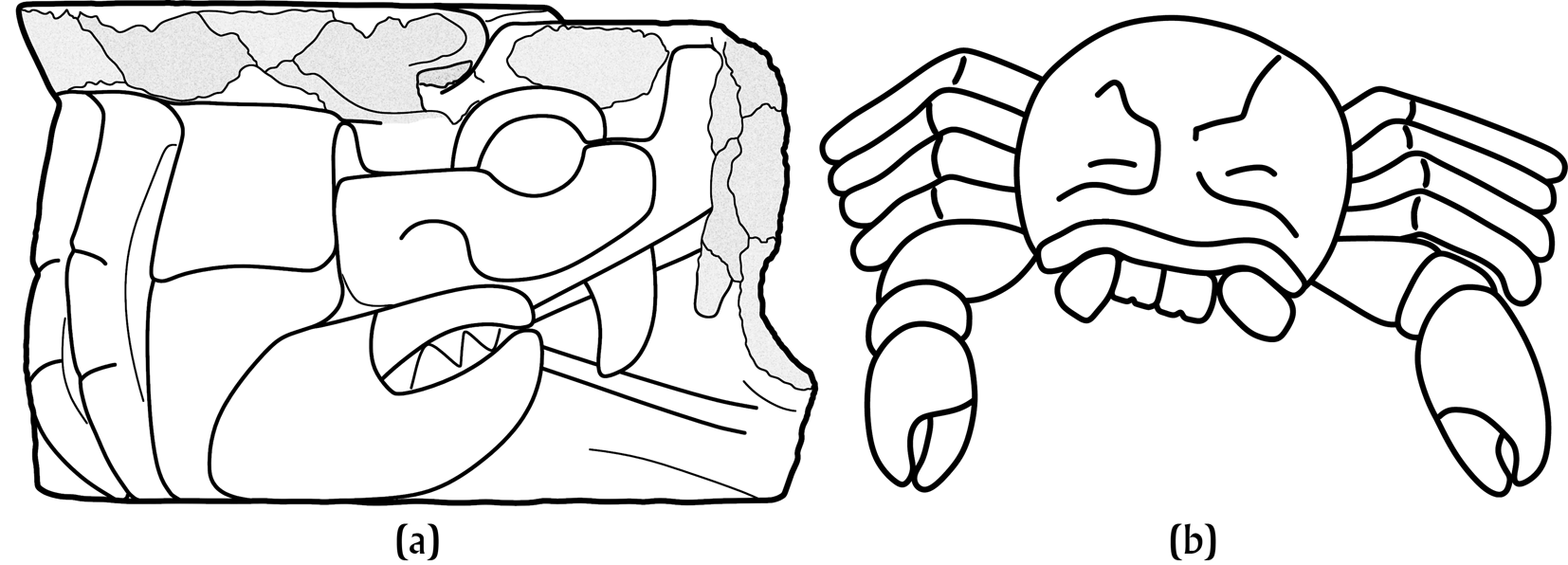
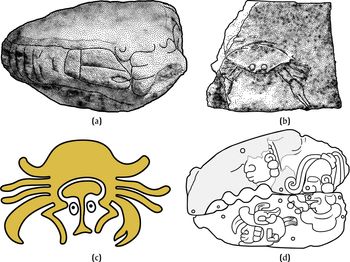
Although rare, crab iconography does appear in other parts of Mesoamerica. Some examples are from the Late Classic site of Comalcalco, a site that used kiln-fired bricks in lieu of limestone. Some bricks are incised with geometric, architectonic, human, and animal motifs, at least two of which are crabs (Figure 8b; Álvarez Aguilar et al. Reference Álvarez Aguilar, Landa Landa and Romero Rivera1990:125, Figure 82). The incised faces of the bricks were never seen, as they were covered by mortar (Álvarez Aguilar et al. Reference Álvarez Aguilar, Landa Landa and Romero Rivera1990:239). Based on the mandorla-shaped carapace and pincer type, the crab in Figure 8b is an Atlantic blue crab (Callinectes sapidus).
(a) Izapa Altar 16. Redrawn by the author from photograph from the Museo Arqueológico del Soconusco. (b) Incised brick with crab motif from Comalcalco. Redrawn by the author from a photograph provided by Visita al Mundo Maya (http://www.infomaya.jp). (c) Crab from aquatic border, west wall, Red Temple, Cacaxtla. Redrawn by the author from a photograph by Paul Czitrom Baus in Brittenham Reference Brittenham2015:101, Figure 147. (d) Carved Early Classic Mayan shell of a crab claw with three incised human profiles. Redrawn by the author after Kerr No. K7050 (Kerr Reference Kerr2018)..

Crabs also appear in painted murals: two or three are present in the murals of the Temple of the Warriors at Chichen Itza (Morris et al. Reference Morris, Charlot and Morris1931). The various water bands in the Cacaxtla murals also contain crab motifs; the most realistic rendition appears in the Red Temple (Figure 8c; Brittenham Reference Brittenham2015:101). The Lienzo de Quauhquechollan is bordered by a water band that also contains a very crude crab. All these crab motifs are accompanied by various sea creatures, and their use in these instances is not ritualistic but rather a representation of natural habitat. Crabs can also be found in the encyclopedic works of Sahagún and, in a rare instance, as a carved crab claw (Figure 8d).
CONTEMPORARY MAYAN QUADRIPARTITE-RELATED RITUALS
This supplementary information will add context to the following section. A Tzotzil ritual for constructing new homes from the town of Zinacantán is described by Vogt (Reference Vogt1979:85). The Tzotzil set a rope at the highest point of the house and attach it to four chickens, one at each of the four corners. These chickens are sacrificed, and their severed heads are buried at the center of the home (Mathews and Garber Reference Mathews and Garber2004:54). Once the house is finished, a final black rooster is sacrificed, and its head is buried at the center of the house, facing east (Mathews and Garber Reference Mathews and Garber2004:54). The Maya used east-west as a reference for their space, following the sun's path. The Tzotzil dance or walk in a counterclockwise direction, mimicking the sun's movement, starting in the east direction (Scherer Reference Scherer2015:106).
Somewhat analogous, during the planting of the milpa, the Xinca would sow crab claws in the field to encourage growth (Gaitán Reference Gaitán2006:381). This is a practical ritual, as exoskeletons of crustaceans contain chitin, calcium carbonate, and nitrogen, acting as both a natural pesticide and fertilizer for maize (Miranda Castro, personal communication 2017). Chitin and its derivatives have been proven to boost fungal and insect immunity by mimicking the compounds found in said pathogens, and also promote the growth of beneficial microbes that ultimately lead to improved crop yields and the remediation of soil contaminants (Sharp Reference Sharp2013:764–766). The Popol Vuh tells us that the gods measured the quadripartite space like one would measure a milpa, placing stakes at each corner, accentuating the four divisions (Christenson Reference Christenson2007a:56). Essentially, the mentioned rituals are all representations of quadripartite partitioning, which is meant to be a metaphor for creation (Mathews and Garber Reference Mathews and Garber2004:49).
DECAPOD ATTIRE AND THE YUX OF ABUNDANCE
The remaining section will attempt to analyze Cotzumalhuapan monuments and objects with crab motifs by providing context based on the above discussion. The first portion will focus primarily on ritual attire, mainly the “crab headdress.” Bilbao Monument 1 (Figure 2b) portrays a ritual involving five individuals—one in the center while the remaining appear to head to the four cardinal directions, two of which may be flying, while an inverted tassel headdress glyph rests at center top (Chinchilla Reference Chinchilla, Boone and Urton2011:69; Parsons Reference Parsons1969:104–105; Popenoe de Hatch Reference Popenoe de Hatch, Bove and Heller1989:188). This monument is part of the “ballgame stelas,” dated to the Laguneta phase (a.d. 400–700). They were arranged in two facing columns of four, aligned in a relative east-west position in a sunken court (Parsons Reference Parsons1969:56–57).
It could be argued that the Monument 1 characters, each holding a severed head, are committing a sacrificial offering, similar to the mentioned Tzotzil ritual. The inverted tassel headdress may be an event marker highlighting a political occasion such as a dethroning or accession. There also appears to be a bundle present at right center. The central figure is the largest, wearing ballgame regalia with a crab headdress while standing over a dismembered corpse (Figures 2b and 3b). Like contemporary Maya quadripartite rituals, I argue that our Cotzumalhuapan protagonist is partitioning space. If this is the case, the main character is personifying the axis mundi, legitimizing their control over the land and cosmos.
Moreover, Mesoamericans used birth dates for individual names, evident sometimes by a corresponding headdress. The “back” portion of El Castillo Monument 1 portrays a narrative of a protagonist climbing into the jaws of a monster (Popenoe de Hatch Reference Popenoe de Hatch, Bove and Heller1989:183; Taube Reference Taube1992:140). At the approximate center of this scene are two crab glyphs (Figure 4c; Parsons Reference Parsons1969:112). These may be calendar glyphs; Cossich and Chinchilla (Reference Cossich, Chinchilla, Laporte, Arroyo and Mejía2006:132) suggest that the glyphs likely represent days. The aforementioned carved limestone turtle with the 13 Ahau glyphs also hints at calendrical associations. Bilbao Monuments 1, 7, and 71 and Palo Verde's Monument 4 all depict crabs worn in headdresses (Figure 2b–2d, 3a, 3b).
There are two relevant explanations: the individual was born on and named after the crab month, and/or the crab symbolizes power and authority. To elaborate, if the Cotzumalhuapans had a crab month and it did correspond with the month Pax or Paxil, then the crab would be a likely cognate; wearing it legitimized authority. The crab-headdress monuments were attributed to both the Laguneta (a.d. 400–700) and Santa Lucia (a.d. 700–900) phases; if the crab represented a specific person, as opposed to a concept, then they may have been an important individual revered over a long time span.
It is important to detour and mention the unusual staff present on Bilbao Monument 18 (Figure 2a), approximating what Norman (Reference Norman1976:133) has called the “Tree-Staff.” The scene itself likely represents the transfer of power and authority from one person to another (Popenoe de Hatch Reference Popenoe de Hatch, Bove and Heller1989:193). In this case, the tree-staff is a twisted vine that “terminates in crab claws,” where the claws act as a base, and is a synecdoche to the whole crab (Parsons Reference Parsons1969:111; Popenoe de Hatch Reference Popenoe de Hatch, Bove and Heller1989:177). As Norman (Reference Norman1976:133) proposed, the staff may represent a world tree, and is a possible reference of the “crab/tree” pairing. The world tree has been represented iconographically as trees with twisted vines, or just as vines themselves; three such examples can be found in the North Temple on the East and West Columns, as well the West Balustrade, at the Great Ballcourt in Chichen Itza (Moreira Reference Moreira and Janick2015:130; Schele and Mathews Reference Schele and Mathews1999:249–250). Schele and Mathews (Reference Schele and Mathews1999:249) demonstrated that vines can be used in lieu of a world tree, by virtue of the “vine-entwined World Tree.”
This second portion primarily looks at the crab as an earthly platform. The turtle carapace in Postclassic iconography frequently acted as a support platform for blood-letting rituals (Taube Reference Taube1988:193, Figure 7a). Perhaps the crab also represented what Taube (Reference Taube1988:193) called the “foundation of ritual space.” Three examples of crab platforms are El Baúl Monuments 7 (Figure 9b) and 8 (Thompson Reference Thompson1948:20, 66, Figure 10e) and Izapa Altar 16 (Figure 8a; Norman Reference Norman1976:244, Figure 5.8). Returning to Monument 18, the crab acts as the base of the staff, simulating the surface of the earth, and the staff, as Norman (Reference Norman1976:134) suggests for Izapa Stela 25, may represent a World Tree rising from the earth. Therefore, I propose that handing over the tree-staff with a crab base from one person to the next represented the transfer of the power of creation that legitimized authority. The monument itself originally faced west, the direction of the setting sun, which may have been an intentional orientation.
(a) Jadeite plaque from the Great Cenote at Chichen Itza. Drawing by the author after a photograph from Parsons Reference Parsons1969:269, Plate 61f. (b) El Baúl Monument 7. Drawing by the author after a photograph from Coe Reference Coe1999:162, Figure 104.

El Baúl Monument 7 (Figure 9b; Coe Reference Coe1999:162) depicts a protagonist wearing an elaborate turban-styled headdress emerging from the cleft on a crab's carapace produced by a lightning bolt, a physiological reference to the crevice produced during ecdysis. The carapace has replaced paxil in this scene. Foliage sprouts from this crevice and is held or guided by the protagonist. Attached to the foliage ends are corn cobs and various flowers; the vine itself represents a conflation of various flora (Chinchilla and Coe Reference Chinchilla and Coe2007; Thompson Reference Thompson1948:20). This image is reminiscent of the Maize god's rebirth from the cosmic turtle depicted in various Late Classic monuments and notably on plate K1892 (Figure 7a; Popenoe de Hatch Reference Popenoe de Hatch, Bove and Heller1989). Therefore, this is possibly a representation of the Maize God or an impersonator being “resurrected” from the crab/earth via the cosmic yux (Moreira Reference Moreira2008). This monument also has two glyphs, possibly two dates, with the coefficients of two and six.
Sharing affinities with Monument 7 from El Baúl, the jadeite plaque (Figure 9a) excavated at the Sacred Cenote is probably an elite trade item from the Cotzumalhuapan region. Holes on the plaque suggest it was worn. It portrays a slightly different character, however, fully emerged from a carapace with no visible cleft. Still, growing out of the crab is a cacao (or pataxte) tree; the crab acts as fertile earth. Due to the limbs facing upwards, one could also argue that the crab is upside down and the character is emerging from the brood pouch. The protagonist grasps the tree, holding it like a staff and, thus, the tree could be a representation of a tree-staff. The staff also resembles the flora presented in El Castillo Monument 1 and possibly Palo Gordo Monument 25 (both not shown) and is also reminiscent of the aforementioned Late-Xolalpan-period vase. Both corn and cacao had religious importance in Mesoamerica since they emerged from paxil. The number system is written in the classic Cotzumalhuapan style, with the day Five Reptile Eye or Five Star (Cossich and Chinchilla Reference Cossich, Chinchilla, Laporte, Arroyo and Mejía2006:131). The individual wears a reptile-eye headpiece suggesting he is Five Reptile-Eye (Coggins and Shane Reference Coggins and Shane1984:59). The protagonist holding the cacao tree is stylistically like the “maize god” emerging from the crab's cleft on Monument 7.
CONCLUSION
Crab iconography in Cotzumalhuapa represented paxil, the feminine power of birth and regeneration. This motif was used to legitimize power and authority over time and space. The crab's cleft, a reference to ecdysis, was formed by the very same lightning bolt that struck paxil. Moreover, crab courtship and parturition tend to occur during lunar events (zeitgeber); given sexual dimorphism, females have rounded abdomens that act as egg-storage devices and have symmetrical chelae. Except for the abdomen, the crabs described are depicted accurately in Cotzumalhuapan art. The crab can tentatively be identified as Pseudothelphusa magna (Rathbun Reference Rathbun1896) or Gecarcinus quadratus (Saussure Reference Saussure1853), but no real need exists to identify the species. The folk traditions and linguistic evidence point out that crabs are generally feminine and are intrinsically linked to the moon goddess, assuming an important role in agriculture, attributed to the polymer chitin and via the rains.
Bilbao Monument 1 presents a crab headdress that, via sacrifices, allows for the reproduction of the delineation of the world. Bilbao Monument 18 shows how a tree-staff emerging from the earthly base represented by two chelae can be used to transfer authority from one person to another. Although out of scope, this tree-staff can be represented as a tree or as a vine. If the crab glyph is calendrical, it may represent the crab month, which itself corresponds to the month Paxil/Pax. The last two points appear to be a reference to the “crab/tree” set from the Popol Vuh. Finally, the crab in El Baúl Monument 7 is clearly paxil, literally representing the rising of maize and other flora (a vine) from the cosmic yux with the axis mundi at the central cleft. Furthermore, the jadeite pendant from the Sacred Cenote shows the protagonist holding the tree-staff over its earthly crab base; this action solidifies the position of the bearer of the pendant, i.e., their status as axis mundi. These monuments and objects reflected the Cotzumalhuapans worldview, their authority over creation, and their place in the cosmos.
As it stands, the crab worn in a headdress may have called to mind events/legends in which the feminine dominated the masculine, like in the previously mentioned Zipacna stories, whereas, in the cases where the crab is not depicted as headwear, it is clearly acting as paxil, the platform. Although further questions need to be addressed about the interpretations made thus far, the concepts of crabs as manifestations of the moon and paxil introduces an ignored fauna, appropriately situating the crab in Mesoamerican studies. While recognizing that more work needs to be done in this area, it is my hope that this paper encourages the start of future endeavors into this little-known aspect of Mesoamerican iconography, and to further efforts to reconstruct and understand the beliefs of the enigmatic people of the Pacific Coast.
RESUMEN
La iconografía del cangrejo en Mesoamérica es una novedad muy ignorada académicamente. En Cotzumalhuapa el cangrejo aparece ya sea como base o como corona, ¿Por qué? El Popol Vuh, por ejemplo, singulariza el cangrejo en la porción de creación, estableciendo así un precedente que queda inexplicado, ¿Por qué? Desafortunadamente, la lingüística y las afinidades culturales de Cotzumalhuapa son desconocidas. El autor busca respuestas en otras regiones y compara datos biológicos, lingüísticos y etnohistóricos.
El decápodo tiene un toque importante tanto biológico como de conducta. El cangrejo está identificado como un Pseudothelphusidae, una especie de agua dulce. Los cangrejos pasan por el proceso de ecdisis; una etapa de crecimiento en la cual el carapacho se rompe, permitiendo el crecimiento del cangrejo. La reproducción está regulada por las fases de la luna.
La evidencia lingüística indica asociación femenina vía eufemismo y marca de género. El mito maya de Zipacná y el cangrejo, así como cuentos de la diosa luna convirtiéndose en cangrejo, fuertemente sugiere que el cangrejo era femenino. Ecdisis es reflejado en lo último, donde el cangrejo es golpeado por un rayo. El cangrejo no fue escogido arbitrariamente por su rol de paxil, o como un símbolo femenino de creación y de luna, sino por su biología y comportamiento reflejando una visión del mundo existente.
El motivo del cangrejo en Cotzumalhuapa es interpretable. Los Tzotzil sacrifican cuatro pollos en cada esquina de una casa nueva, una vez la construcción ha terminado, ellos sacrificaban un gallo negro y ponen su cabeza en el centro. Este ritual es una recreación del génesis. Similarmente, el monumento Bilbao 1 retrata cuatro individuos, mientras una gran figura central usa un cangrejo como corona, todas las figuras sostienen cabezas humanas cortadas. Alternativamente, el cangrejo como corona puede representar nombre de un día como sugieren Cossich y Chinchilla, y consecuentemente el nombre de un personaje. Aunque existe un mes de cangrejo en los calendarios del altiplano que corresponden al mes de Paxil, apoyando la hipótesis del cangrejo como paxil.
Popenoe de Hatch anota que el Monumento 18 de Bilbao representa una entrega de poder. El par de tenazas del cangrejo representa la base del bejuco actuando como el bastón árbol. Las tenazas son una sinécdoque del cangrejo, y puede ser interpretado como un bejuco elevándose de la tierra; los bejucos han sido presentados como árbol mundial. El último sugiere un posible emparejamiento de ‘cangrejo/árbol’ insinuado en el Popol Vuh. El Monumento 7 de El Baúl es similar a una placa de jadeíta encontrada en Chichen Itza, ambas escenas muestran un cangrejo actuando como base de un individuo y un bejuco/árbol. El protagonista del Monumento 7 se eleva de la grieta del cangrejo, producido por el rayo.
Asumiendo que las interpretaciones son correctas, estos monumentos apuntan al motivo del cangrejo como representando el eje del mundo (el yux) y consecuentemente expresando el complejo cangrejo/paxil.
ACKNOWLEDGMENTS
I am hugely indebted to Dr. A. Richard Palmer of the University of Alberta, Dr. José Luis Villalobos Hiriart of the Universidad Nacional Autónoma de México, and Dr. Lawrence G. Abele of Florida State University for their help on all things decapods. I am equally as grateful to Dr. Susana Patricia Miranda Castro, of the Universidad Nacional Autónoma de México, for her insights to chitin applications in maize. I would like to express my sincere gratitude to Dr. Michael Coe, Dr. Oswaldo Chinchilla, Itxel Castro-Soto, and Matilde Sanchez for their helpful comments on earlier drafts of this paper. I am grateful to Karen Bassie-Sweet of the University of Calgary for her knowledge in Mayan folklore, and Dr. Allen J. Christenson of Brigham Young University for his Popol Vuh insights. A special thanks to Ulli Wölfel of the Universität zu Lübeck, Dr. Payson D. Sheets of the University of Colorado Boulder, and Diego Ramírez for providing high quality photos of monuments/ceramics from faraway lands, and, finally, to Isidro A. Moreira for translating the summary into Spanish.