


[A]ggression in some form seems to be necessary to the most self-effacing of human creatures.
–Peter Gay, The Cultivation of Hatred
Girls’ aggression simply does not work as a form of instrumental control. It is ineffective at the most basic level – that of communication.
–Anne Campbell, Men, Women, and Aggression
Accounting for the prevalence of enmity in nineteenth-century Western culture, Peter Gay evinces some surprise at the tenacious grip of the meek upon their aggression, which appears to satisfy a basic necessity of life. Uriah Heep alone attests to the harmony between Charles Dickens's social imagination and Gay's critical assessment that the Victorians had cause to treat their self-effacing neighbors with as much caution as the bellicose. But what about the more resignedly “umble” and solemnly self-diminishing denizens of Dickens's fictional world: the good girls at the center of so many novels? Why do aggression and resentment seem less compatible with their humility than with Heep's? Because, I would suggest, they are little. Littleness is certainly an idealized quality of girls in Dickens's novels. In particular, Nell Trent and Amy Dorrit share the epithet “little” as an indication of their preciousness, physical smallness, modesty, and, most importantly, self-abnegation in service of others. As a number of critics have observed, this selflessness takes many forms, including starvation, over-work, and self-erasure.Footnote 1 Such extremes of compassionate resolve and willful self-limitation, however, intimate the strictness of the nice girl and the difficulty of measuring up to her (as a) standard.Footnote 2 Dickens himself set this bar – if not precisely high, at so low a level as to require painstaking self-contortion to pass under it – in an 1847 speech to the Mechanics’ Institution at Leeds where he described women as “those who are our best and dearest friends in infancy, in childhood, in manhood, and in old age, the most devoted and least selfish natures that we know on earth, who turn to us always constant and unchanged, when others turn away” (Fielding 83). This definition of the best feminine endowments recognizes no difference between girls and women, because the female half of the human population remains “constant and unchanged” in service of male needs. Although Dickens calls upon women to be the bigger person in a moral sense, for girls, growing up appears a matter of remaining little, selfless, “constant.” For good self-effacing Victorian girls like Little Nell and Little Dorrit, aggression thus is necessary because enforcing self-negation requires enormous will power, but also perhaps because aggression guards the last modicum of selfhood belonging to those for whom selflessness is socially prescribed.
And yet, self-assertion and the preservation of selfhood do not exactly seem to be attainments wanting in any of Dickens's good little women. Little Dorrit, after all, displaced the title and narrative focus of the novel originally called Nobody's Fault, which repeatedly extols her as the paradigm (or paragon) of industry, duty, and charity for both men and women. Amy Dorrit's older sister Fanny may be acting like a brat but is not particularly off target about Amy's techniques of emotional manipulation when she complains (in Dickens's paraphrase), “It was not a right example, that she should be constantly stooping to be forgiven by a younger sister. And this was the Art of it – that she was always being placed in the position of being forgiven, whether she liked it or not” (615; bk. 2, ch. 14). Frequently bestowing forgiveness upon others and even more frequently bearing in silence the trespasses of others upon her labor, food, attention, and desires, Amy relates to other people primarily by allowing them to impose upon her. But Fanny sees a sadistic intention concealed within Amy's benevolence: the desire to impose a painful penance upon those who require her services. Amy would never presume to chide, but those around her nonetheless often feel chided. It seems particularly incongruous then to claim (as psychologist Anne Campbell does) that girls’ aggression does not successfully function “as a form of instrumental control” or “communication,” but this assertion may be more accurate in cases of overt control and communication. I would suggest that girls’ aggression works precisely as a form of instrumental control over self and others. It is a very specific type of control that feminist-inflected psychology has often itself been too nice to call passive aggression, preferring instead terms like “indirect aggression,” which Rachel Simmons defines as “covert behavior in which the perpetrator makes it seem as though there has been no intent to hurt at all” (21).Footnote 3
I open with a reference to late-twentieth-century feminist psychology and a behavior that may seem terminologically (if not emotionally) anachronistic for Dickens's novels because I want to emphasize both the persistent sources of passive aggression in girls and women and a persistent refusal to hear the very deliberate communications made through this behavior. Niceness and selflessness, I argue in this essay, are weapons used against and by girls in ways that Dickens's novels schematize. The imperative to “be nice” permeates Dickens's novels, especially in their didactic veneration for good girls and their good deeds. When Little Nell's strength flags on her cross-country journey to save her grandfather from his creditors, Dickens pauses to reflect, “Nature often enshrines gallant and noble hearts in weak bosoms – oftenest, God bless her, in female breasts – and when the child, casting her tearful eyes upon the old man remembered how weak he was, and how destitute and helpless he would be if she failed him, her heart swelled within her, and animated her with new strength and fortitude” (185; ch. 24). Nell's weakness makes her “fortitude” all the more remarkable as an instance of iron-willed selflessness. This ideal of female service and self-sacrifice, however, can be difficult (and, in Nell's case, deadly) to achieve as well as productive of much frustration. The injunction to be nice generates at least part of the girl's aggression insofar as it demands that she repress anger and self-centered desires. Lyn Mikel Brown and Carol Gilligan make a similar discovery in their study of girls’ development, Meeting at the Crossroads, when they argue that “the demand for nice and kind can be oppressive, a means of controlling and being controlled” (45). My reading of the nice girl in Dickens's novels develops this insight that niceness can be used to manipulate others; the girl not only feels the aggressive force of niceness imposed upon her but also instrumentally directs aggression outward through nice behavior. Such disguising of aggression as compassionate tolerance is what Fanny Dorrit objects to in her sister, whose acts of violence are so subtly staged that the mechanisms of their “Art” cannot be distinctly described – at least by Fanny.
It is significant, however, that Dickens paraphrases Fanny's analysis of her sister's draconian forgiveness, entering into her voice and her complaint and indirectly lodging his own complaint against the heroine whom he elsewhere praises lavishly: “what a great soul of fidelity within her,” “always thoughtful of the feelings of the weak” (112; bk. 1, ch. 9; 389; bk.1, ch. 31). Dickens, that is, acts passive-aggressively toward Amy. Explaining why he does so will, for the moment, need to be subordinated to noticing that he does so through a girl who makes her living as a dancer and actress. While passive aggression operates covertly and according to minimalist principles, its perpetrator nevertheless aims for a dramatic effect, and Dickens is nothing if not an ardent impresario. Fanny, incapable of suppressing her own irritation, serves Dickens as a prop to expose Amy's understated violence. Two features of passive aggression emerge from Dickens's implicit expression of hostility toward Amy: that it is cross-gendered and highly theatrical. Despite its feminized associations with weakness and duplicity, passive aggression is not exclusive to girls and women. In fact, when Alexander Welsh identifies passive aggression as a psychological character trait in and a structural function of Dickens's novels, his examples exclusively involve men: David Copperfield, Arthur Clennam, Pip, and Wilkins Micawber. Arguing that passive aggression is structurally divided between a weak protagonist and his aggressive doppelganger or author, Welsh illustrates this claim through David Copperfield who “attains what he wishes [while] those who stand in his way are bowled over – not by his own actions but by the course of events unrolled by Dickens” (From Copyright to Copperfield 146). Though casting Dickens as an omnipotent and self-assured author is hardly the point of From Copyright to Copperfield, “the master novelist behind Copperfield” certainly seems to eschew passivity in this particular example, suggesting that passive aggression is a dyadic affair in which the passive person cannot act upon his own aggression (147). Yet if we look at the good girls in Dickens's novels, we see passive aggression internal to single characters who deploy their aggression in shrewder forms than Welsh outlines. Dickens's little women put on subdued emotional performances seemingly alien to Dickens's flamboyant (not to say ham) style of theatrics. Surreptitiously delineating Amy's covert stage management practices through her sister, Dickens offers a glimpse of the subtle dramatic techniques in his own repertoire. And only a glimpse, because Dickens's more ostentatious theatrical tendencies mask his knowledge of the power that inheres in quiet self-restraint and cover his ambivalent feelings about the obligation to perform. His habit of entering into and stealing scenes from Amy and Nell (which I will delineate at greater length below) disguises but also exposes his strong resemblance to these girls who are both eager to please and resentful of their avid audiences.
As scenes go, Little Nell's incessant wandering and eventual death are among the most famous spectacles in the Victorian novel, providing an image of the vulnerable, desirable, and angelic female child in service of others, devoid of personal desires and guile. Never mind the fact that Nell continually seeks out dramatic employments that put her on display and allow her to beguile audiences at Mrs. Jarley's Waxworks and the church where she works as a verger; she is “the Victorian dream of moral selflessness,” “patently unaware of her sexual attractiveness,” and a “fully formed exemplar of feminine self-sacrifice.”Footnote 4 It is true that Nell's compassionate apprehension for her grandfather acts out in miniature what Nancy Armstrong describes in Desire and Domestic Fiction as “the constant vigilance and tireless concern for the well-being of others” modeled by the spiritualized version of the ideal woman that began to emerge in the eighteenth century (20). Nell, as we are told, “had no thought of any wants of her own, but prayed that God would raise up some friend for him” (340; ch. 45). This paradigm of female value that Armstrong outlines exalts both selflessness and self-regulation, two standards of measurement that are incompatible only if we understand selflessness as a complete ceding of selfhood. For girls and women, self-abnegation is a form of moral self-control, putting others before oneself as a sign of spiritually disciplined selfhood. Selflessness then, not only contributes to the development of individual interiority defined by a woman's capacity to adjust the borders of her selfhood in service of others, but also, as Armstrong suggests, qualifies the ideal woman to externally exercise the power of judging and overseeing others.Footnote 5 In its outward dispensation, selflessness thus can act as a form of aggression against others for whose benefit this form of self-control is ostensibly maintained.
This pattern of idealized self-management turned violently outward unfolds in Nell's guardianship of her grandfather. Dickens elevates Nell to the status of “superior creature” when she accepts that “her grandfather's preservation must depend solely upon her firmness,” but this steely selfless resolve later turns against her grandfather, disclosing Nell's equally strong anger at having to bear “the burden of their two lives” (323; ch. 43; emphasis added). Upon discovering her grandfather's plan to rob Mrs. Jarley, Nell makes up a nightmare premonition to terrify her grandfather into fleeing their comfortable jobs with the waxworks, thereby protecting Mrs. Jarley. Their pell-mell flight leads them away from the countryside and into the industrial hell of Birmingham by which time Old Trent has sufficiently overcome his fear to begin complaining about his discomfort:
“Why did you bring me here?” . . . “I cannot bear these close eternal streets. We came from a quiet part. Why did you force me to leave it?”
“Because I must have that dream I told you of, no more,” said the child, with a momentary firmness that lost itself in tears; “and we must live among poor people, or it will come again. Dear grandfather, you are old and weak, I know; but look at me. I never will complain if you will not, but I have had some suffering indeed.” (331; ch. 44; emphasis added)
Directed outward rather than inward, Nell's selfless strength of will, her “firmness,” shows its teeth. Vitally, Dickens's use of the word “firmness” to name both Nell's selfless strength and her irruption of anger indicates that Nell's hostility is not opposed to her altruistic self-control, but that very force. The firmness that Nell uses to fortify herself on their cross-country journey lacerates her mentally and physically, and she learns how to use it to wound others. Her single outburst against her grandfather's selfishness begins with a “momentary,” uncontrolled explosion of anger that is quickly moderated by tears of guilt, but this loss of self-restraint culminates in a reassertion of control. Nell lays a pointed guilt trip on her grandfather: “I never will complain if you will not, but I have had some suffering indeed.” He should quit his griping and follow Nell's example of silent suffering. But grandfather does not quite get the message and must be spoken to “firmly” once again when he complains about the “dreary way” he and Nell follow out of Birmingham and through decaying suburbs, monstrous factories, and rioting workers in order to find, as Nell says, a place “where we may live in peace, and be tempted to do no harm” (338; ch. 45). This “we,” of course, means “you,” since Nell aims to find a home that permits no opportunities for her grandfather to resume his dangerous gambling habit. Nell's suffering is audibly not so silent. And her selflessness is not simple submission but a performance of dutifulness that doubles as a weapon.
It is easy to overlook or dismiss such covertly-articulated aggression that the nice girl expresses on her own behalf. We certainly could read Dickens's good girls and their self-control as disciplinary models installed by the novel to naturalize and consolidate normative parameters for the modern subject.Footnote 6 Like Nell and Amy, Florence Dombey, Agnes Wickfield, and Esther Summerson appear to be not so much “pointing upward” as self-ward for the benefit or the compulsory instruction of characters and readers, but they also tend to rebuke through love and take over narrative with a self-dramatizing force that overflows the modest bounds of moral instruction – like Esther who calls herself “a tiresome little creature” when she fails to stop talking about herself in her first-person narrative (David Copperfield 806; ch. 63; Bleak House 85; ch. 9). Esther's repeated use of the word “little” as a self-deprecating and self-disciplinary force writes large her good behavior while simultaneously affording her the opportunity to keep expressing herself under the cover of ingenuous and ungovernable reportage: “I don't know how it is, I seem to be always writing about myself. I mean all the time to write about other people, and I try to think of myself as little as possible” (85; ch. 9). Insistently minimizing herself, Esther achieves maximum press for her good behavior. For Dickens's good girls, “little” connotes opposing qualities that these girls often instrumentally blend: powerless vulnerability and powerful self-control. In distinction from the familiar image of the helpless and victimized child, Nell and Amy are what James Kincaid describes as “a counter image so alien to our culture that we hardly notice it: the competent child” (“Dickens and the Construction of the Child” 37). Differently from Dickens's boys, the girls (specifically for Kincaid, Little Nell and Florence Dombey) “act and perform their own stories. They do not wait for others to write them” (38). Both Nell and Amy author themselves, actively making themselves little through self-abnegation and starvation, the latter habit holding them in a pre-pubescent state that contributes to the fantasy of changeless and dutiful femininity that these girls sustain for fathers and grandfathers. These two most explicitly and literally “little” women bear a more complicated physical relationship to womanhood than Dickens's other good girls, who similarly hunger for and sacrifice themselves for paternal love. But in every case, the goodness of these girls can become indirectly censorious and manipulative toward more than the representatives of patriarchy.Footnote 7
One of the most clearly schematized scenes of passive aggression in Little Dorrit details Amy's rejection of the gawky twenty-something boy whom Dickens identifies by the chapter title “Little Dorrit's Lover.” Indulging in a mope over her unrequited love for Arthur Clennam on the Iron Bridge where they once walked together, Amy finds her privacy interrupted by the unwelcome attentions of John Chivery, turnkey at the Marshalsea Jail. Startled into betraying “an expression in her face of fright and something like dislike” when John first surprises her, Amy, as Dickens writes, “checked it,” but she also redoubles the will power required to restrain her irritation into a circumlocutory strike on John's eagerness to please her:
As to me, . . . think as little of me as you can; the less, the better. When you think of me at all, John, let it only be as the child you have seen grow up in the prison, with one set of duties always occupying her; as a weak, retired, contented, unprotected girl. I particularly want you to remember, that when I come outside the gate, I am unprotected and solitary. (234, 236; bk. 1, ch. 18)
Responding, as expected of the nice girl, with modest self-effacement and consideration for John's feelings, Amy nonetheless pointedly manipulates him through her own self-staging as a vulnerable girl. Her repeated emphasis on her “unprotected” state in the world constructs her defenselessness as a condition both endearing and requiring respect.Footnote 8 The stabbing guilt – only ever implied – that John should feel for disturbing a dutiful girl with his desires becomes the instrument by which he must enforce Amy's rebuff upon himself. Amy's request that John regard her as a “child” and “an unprotected girl,” despite the fact that she is a twenty-two-year-old, economically self-sufficient woman, highlights the surprising power of the girl to make vulnerability and littleness into forces that serve her by operating parasitically through others.Footnote 9 Dickens elsewhere refers to Amy's physical smallness as “that unfortunate defect of hers, which came so often in her way,” but this assertion may be the biggest lie in a novel full of deception and swindles, because Amy's tiny frame and its enormous capacity for service mesmerize nearly every character in the novel (88; bk. 1, ch. 7). Her similarly size-conscious injunction to John that he “think as little of me as you can; the less, the better” requires John not to put her out of mind but to be always mindful of her. The self-miniaturizing rhetoric she employs, which seems to say she is not worth John's consideration, may exemplify a high standard of feminine modesty, but it also displays her tremendous control over her self-representation and the responses she intends it to provoke in others. Like the resilient Mrs. Merdle, Amy is “accomplished in the art of seeming to make things of small account, and really enhancing them in the process” (614; bk. 2, ch. 14). But to give an additional name with a slightly more Dickensian latency to Amy's tactics, I would say that she is “being cute” when she shrewdly buries aggression in meekness.Footnote 10
The Cut of Cuteness
The word “cute” rarely appears in Dickens's novels, perhaps because it is written so broadly across the corpus, hidden in plain sight. Signifying both charm and cleverness, cuteness appears most familiarly in the eccentricity of Dickens's characters: their distinguishing quirks, thingly quality, and general misshapen quaintness. The enduring appeal and memorability of these characters frequently serve as confirmation of Dickens's ingenuity. Claiming Dickens's caricatures and “monstrosities” as the “surest mark of his genius,” George Orwell describes this retinue of characters as “fixed for ever like little twinkling miniatures, painted on snuffbox lids, completely fantastic and incredible, and yet somehow more solid and infinitely more memorable than the efforts of serious novelists” (455). The differently inflected cunning of these creations and their creator brings out the divided rhetorical labor of the word “cute,” its reference to a charming object and a clever subject. But cuteness also blurs the difference between subject and object, active and passive, creator and creation. Orwell's segregation of Dickens from “serious novelists” should give us pause, since Dickens becomes in this description an eccentric vessel (or snuffbox) of intuition, hardly less object-like than the shimmering rococo characters he has impressed upon our minds by some magic, “somehow.” These characters, or redundantly teensy weensy “little . . . miniatures,” appear twee and seductively portable, but they are also treacherous objects that contain the stuff, or the snuff, of overpowering addiction. Readers of the novels certainly could not get enough of eccentric characters like Flora Finching, Dick Swiveller, and the Marchioness, and there were significant protests against the darkness and political polemics of Dickens's later novels within his lifetime.Footnote 11 Such demands that Dickens return to the style and subject matter of The Pickwick Papers spotlight an author placed under an imperative of cuteness that aggressively identifies him with the objects he produces.
It is Dickens who, if not the first, is arguably the most famous British writer to draw attention to the uncanny leakage between subjects and objects, persons and things.Footnote 12 As Dorothy Van Ghent observes in her canonical essay on the anthropomorphic aesthetic of Dickens's novels, “The animation of inanimate objects suggests both the quaint gaiety of a forbidden life and an aggressiveness that has got out of control. . . . It is as if the life absorbed by things has been drained out of people who have become incapable of their humanity” (214). The “quaint gaiety” and ungoverned “aggressiveness” that characterize Dickens's anthropomorphic objects nicely match the Oxford English Dictionary's most current definition of “cute” as an adjective “applied to people as well as things, with the sense of ‘attractive, pretty, charming’; also, ‘attractive in a mannered way.’” The cute object is charming but frequently made so through artificial means, a manufacture that can be violent and disfiguring. (Think of the adaptable prosthetic of the cuddly Captain Cuttle, the adorably fractured English of the Marchioness, or the postbox slit of a mouth that bespeaks Mr. Wemmick's obsessive cautiousness.) Merging persons and things, cuteness names the dominant aesthetic of Dickens's novels and his fashion of testing and (mis)shaping the human subject's borders. Moreover, the “mannered” or calculated charm that can pertain to the cute object or person points back to the earliest definition of cute – “acute, clever, keen-witted, sharp, shrewd” – and should remind us of Dickens's little women, who affect certain behaviors to influence or manipulate others.
Littleness may not be an absolute requisite of cuteness, but it is a prominent feature of many cute objects referenced by the OED and various twenty-first-century web sites dedicated to cataloguing cuteness: puppies, kittens, babies, children, cottages, cupcakes, and the foreshortened language of Twitter and baby talk. While the littleness of these objects and forms of prattle can mark them as vulnerable or banal, much of the journalistic language being used to describe the turn-of-the-twenty-first-century “cuteness surge” and the capacity of cuteness to “smother its critics with softness” indicates the strategic force of cuteness, which may be deployed not just by Madison Avenue or a nineteenth-century novelist but by cute objects themselves.Footnote 13 I opened this essay by establishing littleness as a name for the moral imperative to selflessness imposed upon the girl. This imperative is, without a doubt, violent, and in the guise of veneration, requires the girl to forcefully circumscribe her desires and her independence from the men in her life. Yet “little” also thereby identifies more than abused vulnerability; it points to the distinctively muscular self-control of certain girls in Dickens's novels. Defining cuteness in the very different realms of modernist poetry and the twentieth-century Japanese kawaii aethetic, Sianne Ngai notes a similar capacity for “cute objects to be helpless and aggressive at the same time,” suggesting that “this paradoxical doubleness is embedded in the concept of the cute from the start” (823). For Ngai, the duality of cuteness as well as its association with littleness is primarily linguistic:
Since cute derives aphetically, as the OED informs us, from acute, cuteness's etymology strikingly replicates the diminutive logic of the aesthetic it has come to name, since in aphaeresis words lose their initial unstressed syllables to generate shorter versions of themselves: lone derives from alone, til from until. But there is a key difference between cute and these other examples that result in conveniently abbreviated signifiers for the same signified. For while cuteness is an aesthetic of the round and soft . . . the word acute means coming to a sharp edge or point, while acuteness similarly suggests mental alertness, keenness, or quickness. So cute exemplifies a situation in which making a word smaller, more compact, or more cute results in an uncanny reversal, changing its meaning into the exact opposite. (827)
Diminutized like so many cute objects, the word “cute,” I would argue, does not thereby “lose” the sharpness associated with acuteness. It retains the telltale violence of a lopped off “a” by embedding it as a “cut.” The sharp and penetrating characteristics of acuteness never fully leave the cute object. Significantly, the shrewdness and cunning denoted by the word “cute” began to become latent meanings in the 1830s when this word first took on its modern association with appealing and vulnerable persons and things – and when Dickens was beginning his writing career. Long before the rise of twentieth-century American commodity culture, the larger context in which Ngai orients her discussion of cuteness, Dickens was delineating the ambivalence of cuteness in his characters. Although cuteness is a broadly applicable term for describing the aesthetic and affective aspects of Dickens's novels, I am primarily interested in establishing cuteness as a mode of passive aggression by which Dickens's good girls (and Dickens himself) actively stage themselves as vulnerable little objects in order to assert themselves and to fulfill particular desires.
The moral imperative to selflessness under which Dickens's good girls live might seem distinct from the entertainment imperative to cuteness Dickens undergoes, but both Dickens and his little women experience these injunctions as a pressing obligation to be pleasing. Amy and Nell enact the morality of being solicitous of others’ desires through acute responsiveness to their audience. Such heightened sensitivity, as we have seen with Nell, can wear the girl down to the point of a violent outburst. Dickens himself errs on the aggressive side of passive aggression in the preface to Little Dorrit when he tenders an “apology for so exaggerated a fiction as the Barnacles and the Circumlocution Office” and “make[s] so bold as to defend that extravagant conception Mr. Merdle” in response to contemporary critics’ charges of the novel's political naïveté and ridiculous caricature (5). Reference to the abuses of public office during the Crimean War and a list of real-life referents for the crooked financier Mr. Merdle follow Dickens's first expression of contrition and precede a second: “But, I submit myself to suffer judgment to go by default on all these counts, if need be, and to accept the assurance (on good authority) that nothing like them was ever known in this land” (5). Dickens conspicuously heaps coals of fire upon the heads of those who object to his novel's claims to realism and political acumen, but his closing insistence upon his own popularity – “I never had so many readers” – betrays lingering outrage and vulnerability to criticism (6). Not unlike Amy Dorrit, Dickens makes others feel his pain by emphasizing his own vulnerability and willingness to “submit.” His self-minimizing and self-justifying rhetoric in this preface (which typifies many of his prefaces) performs cuteness in its mixed modes of acquiescent adorableness, pointedly deployed charm, and aggressive demands for love and attention.Footnote 14
Rising to literary fame at the same moment when the word cute annexed an aesthetic of the adorable and endearing to its extant definition of a shrewd quality of mind, Dickens provides the OED with a citation of cuteness as straightforward cleverness in Barnaby Rudge.Footnote 15 However, his novels also map out the latent violence of cuteness, translating into narrative form the aphetic slice that never completely severs the cute from its etymological root in the word “acute.” In his 1846 Christmas book, The Chimes, Dickens most explicitly aligns cuteness with violence through the story's villain, Alderman Cute, a slick public servant who sadistically “puts down” the problems of his impoverished constituents. Cuteness, I want to emphasize, cuts – and in more than one direction. The cut of cuteness involves, as Amy Dorrit illustrates, the damage the cute thing can do under the cover of cuteness, and it also names the damage done to make someone or something cute in the first place. Many of Dickens's most memorable characters bear the marks of such abuse. Reduced to tears by Amy's subtle tactics for banishing him from the Iron Bridge, John Chivery receives hard knocks from the novel as well. That one of John's eyes cannot “collect itself” because he so frequently used to “peep through the keyhole” of the Marshalsea at Amy places him among the ranks of beloved characters in Dickens's novels whose subjectivity is warped into a type of object status by their environment (229; bk. 1, ch. 18). John's attempt to read the world actively, even voyeuristically, through his eye results in the deformation of that eye, and John along with it, bending visual acuity back on itself and creating another mangled but still cute (and cute because mangled) object in the Dickens collection. But why does the potential repulsiveness of John's lazy eye appeal rather than repel? In a study of cuteness as defined by twentieth-century pop-culture, Daniel Harris argues that “The grotesque is cute because the grotesque is pitiable, and pity is the primary emotion of this seductive and manipulative aesthetic that arouses our sympathies by creating anatomical pariahs” (4). Although I would not agree that all grotesque things are cute – some are irrecuperably disgusting – Dickens noticeably deploys the repulsive and damaged to provoke patronizing compassion in characters and readers.Footnote 16 Of John's awkward deference to Amy, we hear that “[t]here really was a genuineness in the poor fellow, and a contrast between the hardness of his hat and the softness of his heart (albeit, perhaps, of his head, too), that was moving” (235; bk. 1, ch. 18). Beleaguered by a hard-boiled hat and a soft-boiled head, “poor” John looks pitiful, non-threatening, and in need of some TLC, because the novel brings him to life through violent battery. Patronizing pity for the cute thing goes hand-in-hand with the sadism directed at it.
Theorizing John Chivery in terms of distortion, I owe a debt to Alex Woloch's poetics of character, The One vs. the Many. For Woloch, “Dickens's forceful caricature – his insistent distortions of secondary characters – is the wellspring of their affective force” (129). The constricted “socionarrative condition” of these characters – their minor narrative status frequently combined with a minoritized social position – contorts them into bizarre shapes and behaviors, making them “comic, grotesque, eccentric,” or what I am calling cute (Woloch 129, 126). Cuteness figures as the major unspoken term in Woloch's discussion of Dickens, particularly around the topic of “affective force,” which implies emotion compelled from readers by characters or author. It is not only, then, characters that are violently shaped, but charmed readers who are conditioned to respond to distortion as benign entertainment.Footnote 17 While Dickens may not squash, bend, addle, and mechanize his readers in the exaggerated or even cartoonish fashion that he employs to hammer out his characters, he certainly does put the squeeze on our emotions. In the midst of John Chivery's disastrously aborted proposal, Dickens insists upon John's respectability even as he mocks John's gaudy courting attire and melodramatic attachment to Amy: “The mournfulness of his spirits, and the gorgeousness of his appearance, might have made him ridiculous, but that his delicacy made him respectable” (236; bk. 1, ch. 18). This prescriptive two-step perpetuates the reader's entertainment at John's expense unabated by the respect we are encouraged to feel for him. Indeed, Dickens stokes his readers’ outrage on Amy's behalf as John makes his way to propose to her, commenting, “In this affair, as in every other, Little Dorrit herself was the last person considered” (230; bk. 1, ch. 18). This tactic of emphasizing Amy's vulnerability is the same that she herself deploys against John a few pages later. Author and self-authoring character possess a knack for employing “affective force” upon an audience to direct its judgment and attachments. Though, I would pause here to note that Amy's capacities for cruelty and cunning are as much products of her “socionarrative condition” as indicators of her taste for sadism – a taste that may be acquired to survive in the scarcity economy of the Marshalsea Jail. It should be remembered that Amy loses her “quiet self-command” when John attempts to propose to her not just because she has no romantic feelings for him, not just because she loves someone else, but because she recognizes that her father has basically pimped her to John in exchange for preferential treatment from John's father, the head jailor at the Marshalsea (235; bk. 1, ch. 18).
Skill at emotional manipulation links Dickens and Amy as (a)cute subjects, but even as the title character of Little Dorrit, Amy also bears a resemblance to the more object-like cute characters in Dickens's novels. As a protagonist, she occupies the narrative space that, as Woloch demonstrates, permits realism, development, and psychological depth. Yet, making this claim in regard to Amy presents a problem since personal growth and realistic characterization have so frequently been called into question around both her and Nell.Footnote 18 Their saintly, self-diminishing behavior flattens them into emblems of goodness: Little Dorrit and Little Nell instead of Amy Dorrit and Nell Trent. Like the minor characters in Dickens's novels that Woloch describes, these little women function allegorically, not simply, in their case, to illuminate the qualities of (other) protagonists through contrast but also to embody the lesson of female self-sacrifice. For instance, when the myopically benevolent Mr. Meagles praises Amy as the embodiment of “Duty,” his expression of admiration for her “active resignation” forms the centerpiece in the instruction of another girl: the “impetuous” Tattycoram whom the Meagleses adopt to be a servant to their petted daughter Pet (846; bk. 2, ch. 33; 340; bk. 1, ch. 27). Actively resigning herself, Amy is both a mere token of the Victorian imperative to female dutifulness and an immensely self-controlled person. Woloch's nearly exclusive focus on Dickens's male characters and his description of the “narrative process that underlies all of Dickens's work” in terms of a “central, but passive, protagonist who encounters a powerful, but distorted minor character,” cause him to overlook the active but neither entirely central nor fully rounded female protagonists present in certain Dickens novels (35). Little Dorrit can, in fact, be described as Arthur Clennam's story as much as Amy's; Arthur's persistent whining about his lack of will certainly slots him into the model of the passive central protagonist. And The Old Curiosity Shop allows its narrative thread to fray so much by the end of the novel that Thackeray could regard it as two separate stories, claiming to have “never read the Nelly part . . . more than once; whereas I have Dick Swiveller and the Marchioness by heart” (Collins 91). Nell may be the organizing principle in this novel and the curious object that sets its narratives in motion, but the novel loses its focus on her for chapters at a time, turning its attention to Bevis Marks or Dick Swiveller's rooms where Nell is unknown or barely remembered. Despite the dilution of narrative focus among several main characters in these novels, neither Amy nor Nell can reasonably be called a distorted minor character. Adapting Woloch's reading of the “allegorizing” force through which the novel makes minor characters function instrumentally, I would emphasize the different type of functional deformation practiced upon major girl characters by the narratives that allegorize and idealize them into impossibly nice figures (18).
Master Humphrey, the initial narrator of The Old Curiosity Shop, famously describes Little Nell as an allegory, concluding his first encounter with her by meditating on her “in her bed,” sleeping among the curiosities at her grandfather's shop: “I had her image, without any effort of imagination, surrounded and beset by everything that was foreign to its nature, and furthest removed from the sympathies of her sex and age . . . she seemed to exist in a kind of allegory” (19–20; ch. 1). The coy language of “seemed to” and “kind of” gives little sense of what Nell allegorizes other than difference. But difference is quite enough for Humphrey, since it creates distance between Nell and her surroundings and between Nell and Humphrey: breathing room for fantasizing. Nell as space-for-fantasy is precisely what Dickens appears to be offering not only to Humphrey but also to Thomas Hood, whose rhapsodic 1840 review of The Old Curiosity Shop caused Dickens to add to later editions of the novel the passage in which Humphrey frames Nell as an allegory. Hood likened the illustration of Nell asleep in bed to “an Allegory of the peace and innocence of Childhood in the midst of Violence, Superstition, and all the hateful and hurtful Passions of the world” (Collins 96). This incarnation of “peace and innocence” would be about as dull and flat as Amy Dorrit's personification of “Duty,” except for the erotic excitement lent to this scene by “Violence,” “Passions,” and grown men leering at Nell both inside and outside of the novel. There is a twofold cuteness in such allegorizing of the girl. The violent reduction of girls to two-dimensional virtues, like duty and innocence, parallels the sadism Dickens deploys to crank out a line of cute minor characters. Nell is too good to be true, the cardboard product of the self-serving patriarchal ideology of female dutifulness that Dickens, as we have seen, espoused in certain public speeches and heavy-handed passages in his novels. Yet Nell is also another kind of impossible object: a child, or, as Kincaid has argued, a construct composed of “the central features of desirability in our culture – purity, innocence, emptiness, Otherness” (Child-Loving 5). Insofar as this dominant conception of the child is an adult fabrication, it flattens young human beings like Nell into the representation of another person's desires, obscuring any disruptions the child herself causes in this fantasy. Hood's interpretation of Nell tells us more about his longing for an erotically endangered but simultaneously inviolable child than about the waking reality of Nell, who imbibes and expresses plenty of “hateful and hurtful Passions” over the course of the novel. Nell does, as I have illustrated, lash out at her grandfather, and she repeatedly demonstrates an understanding of the exploitive designs adults have upon her by carefully planning escapes from her grandfather's creditor, Quilp; the rapacious Codlin and Short, who hope to get a reward for returning her to her family; and the drunken men who ferry her and her grandfather to Birmingham. Yet the abiding image of Nell remains one of willing self-sacrifice and tranquil repose, often as seen through the admiring eyes of other characters in the novel.Footnote 19
The spectacle of Nell in bed and adored by multiple viewers should remind us of a third definition of “cute” not listed in most dictionaries, including the august OED: sexually appealing. No doubt the use of the word cute to label an erotic object is a distinctly American and post-nineteenth-century idiom. Yet I would argue that with Little Nell, Dickens inaugurates an erotics of cuteness around the girl that can be traced through Shirley Temple, Lolita, JonBenét Ramsey, and Dakota Fanning. Precociousness and keen responsiveness to an audience distinguish the girl's cuteness from the boy's differently delectable confusion and obtuseness in Dickens's novels. Dickens trades in the received idea – trotted out by the American media any time girls’ standardized test scores creep a few points above the boys’ – that girls naturally possess greater verbal and interpersonal acuity than boys: are more mature than boys. Confronting the star turns of Estella on Miss Havisham's stage, a bewildered and besotted Pip (at least as recalled by his adult self) records his impression that “she seemed much older than I, of course, being a girl, and beautiful and self-possessed” (Great Expectations 56; vol. 1, ch. 8). As with Estella, Nell's self-possession is a double-edged sword, wielded to pierce hearts but also demanded by the circumstances of her upbringing. Neither girl is legally, emotionally, or economically in full possession of herself. But to explain the girl's acute self-awareness as the result of abuse or neglect that destroys some type of natural innocence is to sound dangerously like Master Humphrey, chiding old Trent for sending Nell on solitary errands in London and clamoring for the preservation of her purity: “it always grieves me to contemplate the initiation of children into the ways of life, when they are scarcely more than infants. It checks their confidence and simplicity” (12; ch. 1). Confidence and simplicity, I suppose, are meant to be synonyms, implying something like naïve trustfulness. The confidence Nell puts in others, however, is wilier than Humphrey explicitly admits. In fact, it is not entirely clear whether Master Humphrey is attracted to Nell and to telling her story because she is so vulnerable and innocent or because she is so capable and shrewd.
If we regard the girl only as an erotic object, it becomes easy not to recognize her carefully staged techniques of seduction. The Nell who approaches Master Humphrey in the street to ask for directions is hardly a babe in the woods or unaware that she might be perceived as such. When Nell and Humphrey set off for the destination that she has cagily not named as her home, Humphrey reports,
She put her hand in mine as confidingly as if she had known me from her cradle, and we trudged away together: the little creature accommodating her pace to mine, and rather seeming to lead and take care of me than I to be protecting her. I observed that every now and then she stole a curious look at my face as if to make quite sure that I was not deceiving her, and that these glances (very sharp and keen they were too) seemed to increase her confidence at every repetition. (9; ch.1)
Nell's “sharp and keen” – or, as we should recognize them by now, cute – glances transfix Humphrey at least as much as her endangered state. While Humphrey situates Nell in his imagination as an object perpetually under threat (“surrounded and beset by everything that was foreign to its nature”) this is not the only image of Nell available in the novel. It is, notably, Nell who scents an actively malicious intention in Humphrey's reply to her request for directions: “Suppose I should direct you wrong” (9; ch. 1). Nell answers, “I am sure you will not do that . . . you are such a very old gentleman, and walk so slow yourself” (9; ch. 1). Though Humphrey could be suggesting that he might accidently mislead her through a mistaken sense of direction, Nell insists upon Humphrey's good intentions while alluding to his slow pace, which would hamper his ability to physically threaten her. Nell's “curious” interest in Humphrey and precocious trust in his goodwill produce exactly what she wishes, a guide home, and exactly what he wishes, a willing object of fantasy. Moreover, it is important to note that Nell is in a vulnerable position, navigating the streets of London at night, and knows it, using this awareness in her encounter with Humphrey. Her cuteness combines endangerment, cunning, and erotic appeal in a mix that makes it difficult to determine whether vulnerability or shrewdness predominates. If we do read Nell's solicitation of Master Humphrey as an act of pedophilic self-staging, her calculated self-display significantly resembles Dickens's editing of The Old Curiosity Shop to pander to Thomas Hood's admiration for Nell. Affording Hood a more lingering gaze at Nell's threatened innocence through the medium of Master Humphrey, Dickens, like every good child, responds attentively to adult desires. Such attentiveness is not simple obedience, but the type of (a)cuteness that is the child's seduction – a seduction aggressive in its allure and in its capacity to tease, punish, and deny desires directed its way.Footnote 20
Making a Scene
Charles Dickens knows a thing or two about cute self-staging, given his direction of (semi)-private theatricals, his public readings, and his early years as a child-star of sorts whose father stood him on tabletops and paraded him in public spaces to sing comic songs.Footnote 21 Even the thorough cleaning of a rented house in Paris fell under the purview of what Dickens called “my stage-managerial energies” (Letters 7: 724). He could not bear dirt or disorder but repeatedly represented both in the confines of his novels; public speeches and readings likewise offered him a space to manage chaos, embodied in these venues by a dissonant mass audience. Recording the experience of a public reading in Dublin, Dickens wrote to his sister-in-law, Georgiana Hogarth, “Everybody was at ‘Little Dombey’ today, and though I had some little difficulty to work them up in consequence of the excessive crowding of the place, and the difficulty of shaking the people into their seats, the effect was unmistakable and profound. The crying was universal, and they were extraordinarily affected” (Letters 8: 638). Due to his extreme popularity, Dickens frequently faced groups whose physical discomfort in packed theaters, preconceived expectations, and mixed-class composition threatened to prohibit or break the spell he wove. The distracted Dublin audience, as Dickens recounts, had to be worked up and shaken to attention before they succumbed to his affect with “universal” tears. Notable for its sentimentality, the death of Paul Dombey gave Dickens a three-handkerchief cudgel with which to work over the crowd and orchestrate their responsiveness. Citing Dickens's many references to his audience as a malleable collective, Helen Small argues, “Through Reading, the public is being made one body, and, more than that, a fully sympathetic body subject to the author-reader's masterly control” (283).Footnote 22 The emotional manipulation inherent in such entertainment can also be recognized as a form of cuteness. When Dickens writes home to Georgiana Hogarth, he does so in a self-satisfied tone of having subdued an unruly audience solely through the force of his charm. While I would not deny that there are many facets to Dickens's well-documented theatricality, his near-compulsive and eventually fatal need to win over an audience through the power of emotional manipulation mirrors his little women, who, like Nell, make their way through the world armed with no other tools of protection or advancement than the strength of their personal appeal and ability to please.
Pleasing and affecting others sometimes means putting them through an emotional wringer, and it also can involve staging oneself as endangered or mistreated in order to cultivate pity, attachment, and extreme sensitivity to one's victimization. Nell, as I have been trying to suggest, is adept at using her own vulnerability to influence the behavior of certain adult characters. Her death is the scene of The Old Curiosity Shop, and this episode, I want to argue, functions as a mechanism of passive aggression, a posthumous volley from an adolescent girl who has good reason to be angry, particularly with her ineffectual and misguidedly affectionate caretaker. But it is worth deferring a reading of Little Nell's death for a moment (thereby following Dickens's lead in building anticipatory excitement for it) in order to take a look at several “scenes” Dickens made about The Old Curiosity Shop that parallel Nell's pattern of disguising aggression with resignation, dutifulness, and precocity.
The second preface Dickens composed for The Old Curiosity Shop, written seven years after the completion of the novel and accompanying most subsequent editions, is a fascinating document. It frames Nell as the novel's central character and posits the scene of Nell asleep in the curiosity shop as the alluring genesis of the text, but it actually allots more space to explaining how the novel came to be separated from the Master Humphrey's Clock miscellany in which it originally appeared as a serial. The “desultory character” of these “detached papers” supposed to be authored by Master Humphrey and his friends did not charm many readers, so Dickens excised them from the subsequent single-volume edition of The Old Curiosity Shop in obedience to his readers’ distaste (5). “Though I now affect to make the confession philosophically, as referring to a by-gone emotion,” Dickens writes of this editorial act, “I am conscious that my pen winces a little even while I write these words. But it was done, and wisely done and MASTER HUMPHREY'S CLOCK, as originally constructed, became one of the lost books of the earth – which, we all know, are far more precious than any that can be read for love or money” (5). This deference to criticism and accompanying admission of the tender pains of editing also open a space for lashing out; in losing Master Humphrey's Clock, readers have lost a book more “precious” than any book ready-to-hand. Or, to translate this sentiment by its spirit rather than by the letter, we might read it as “I'm Charles Dickens! And in rejecting Master Humphrey, you have lost out on a piece of my inimitable genius.” Putting his pain and his obedience to an audience on display, Dickens also shows off his own specialness by jealously guarding it, denying any future access to that which should have been recognized as valuable. The cuteness of this passive-aggressive withholding lies in its perpetrator's pretense of guileless adherence to proper behavior. Such modest submission, however, is showy in its enactment. Significantly, several of the nineteenth-century examples the OED offers for the proper usage of the word “cute” aggressively solicit an audience's compliant gaze: “I'm goin’ to show you about as cute a thing as you've seen in many a day.” Or the question posed in the imperative mode: “Ain't it cute to see a Yankee Take sech everlastin’ pains?”Footnote 23 With the ring (or the American twang) of a peep-show artist or side-show barker, these calls to view and attest to cuteness recall Dickens's brand of showmanship, especially his demands for the audience's complete attention and confirmation. It is not only appealing and seductive objects like Nell being put on display in such shows, but the author himself who makes an attraction of his own responsiveness to an audience.
The flurry of letters Dickens posted about his suffering while writing the death of Little Nell, like the preface to The Old Curiosity Shop, showcase the pain of doing one's duty, but rather than violently shutting out their readers and teasing them with an occulted object (as Dickens does with Master Humphrey's Clock) these letters insistently cultivate sympathy. Long before the public reading tours, personal correspondence provided Dickens with a stage upon which to garner affection and model appropriate responses to his novels. In reply to fellow writer Basil Hall's praise for the serial progress of The Old Curiosity Shop, Dickens wrote, “What can I say to you in acknowledgement of your high commendation of the tale I am drawing to a close – with no common regret and pain do I assure you – for I am loath to finish it – and of the cheering encouragement you give me. . . . I cannot thank you enough for your generous applause” (Letters 2: 174). A similar letter to his friend W. C. Macready reads, “I am slowly murdering that poor child, and grow wretched over it. It wrings my heart. Yet it must be” (Letters 2: 180). Committing murderous violence that he is “loath” to but “must,” Dickens depicts himself as submitting to the demands of an undefined but redoubtable entity. While not grammatically expressed in the passive voice, these articulations of compulsion and pain modify their subject as a passive object. Dickens, on the one hand, effectively gets into character as Nell by making the agony of her death his own; on the other hand, this appropriated agony separates him from the child he is so conspicuously “murdering.” Every reference to Nell becomes an occasion to angle for sympathy and admiration for himself.Footnote 24 Giving instructions to George Cattermole, one of the illustrators for The Old Curiosity Shop, on the image that would close the novel, Dickens concluded, “I am, for the time being, nearly dead with work – and grief for the loss of my child” (Letters 2: 184). Explicitly occupying the position of bereaved parent, Dickens also resembles Little Nell in working himself unto death. This novel and its characters join together to beatify Nell's toil for her grandfather's sake and her “undiminished resolution not to betray by any word or sign her sinking state” (342; ch. 45). This latter characteristic separates Dickens's hard labor from Nell's: while she strives to hide her pain and suffering, he displays an audience-oriented need to showcase it over and over again. Nell's modesty and earnest self-abnegation would seem to set her in opposition to Dickens's melodramatic self-denial. Not for her the great revenge fantasy of childhood in which the child's death elicits the proper remorse and love from the self-absorbed, exploitive, or indifferent parent.
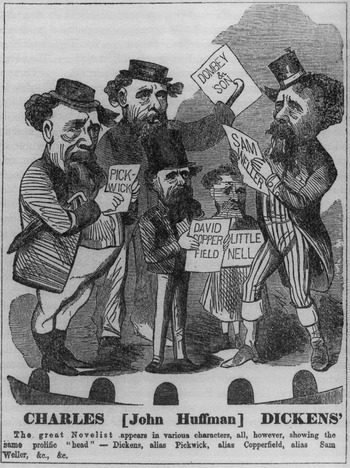
Yet at least one member of Dickens's public audience discerned an overlap in Nell and her ostentatious creator. An American cartoon advertising Dickens's public readings anomalously depicts Dickens as Little Nell – anomalously because Dickens never read from The Old Curiosity Shop on any of his toursFootnote 25 (Figure 4). The cartoon's four other images of Dickens accoutered to resemble his characters accurately name novels or characters from the novels he did perform. If the aim of costuming Dickens as Little Nell was the joke of putting the hoary and bearded Dickens in a dress, this effect could just as easily have been achieved by outfitting him as Sairey Gamp, whom he did portray for many delighted audiences. What this cartoon illustrates about Little Nell (perhaps in spite of itself) is her theatricality and her embodied emotional impact upon some readers. Like the death of “Little Dombey,” which Dickens did read on tour, Little Nell's story is a tearjerker. Dickens may have used this genre sadistically against his audience and the objects of his narratives, but he also (as we have seen) turned it upon himself, aligning himself emotionally with Nell in his absolute dutifulness and vulnerability to others’ desires. The powerful author figure who could commit acts of murder has as his double the powerless and exploited female child. This child-double had to be a girl, I believe, because the girl provides an image – which can be regarded with narcissistic self-pity – of personhood that will never be fully empowered, even by adulthood. Yet Nell's ability to stage her own obedience and pain duplicates Dickens's acute on- and off-stage shows. Like Dickens – taking his place on the stage – Nell knows how to reduce an audience to tears by tugging on their narcissistic sympathy for a neglected child.
Artist unknown, American cartoon of Dickens's public readings. c. February 1868. Reproduced in James Raven, Helen Small, and Naomi Tadmore, eds. The Practice and Representation of Reading in England (Cambridge: Cambridge UP, 1996), 286.
The scene of Nell lying dead in the church that becomes the final resting place on her journey, usually discussed by critics in terms of pathos or sentimentality, acts with equal success as a mechanism for passive aggression.Footnote 26 If we consider this static episode not simply from the mourners’ point of view but also from Nell's perspective (a task not quite as impossible as it sounds) Nell's oblique anger disturbs the mournful calm generated by the omniscient narration. The description of Nell's wake reads like a four-verse prose poem interrupted in its regular cadence and repetitive structure by Nell's instructions for the proper staging of her bier:
For she was dead. There, upon her little bed, she lay at rest. The solemn stillness was no marvel now.
She was dead. No sleep so beautiful and calm, so free from trace of pain, so fair to look upon. She seemed a creature fresh from the hand of God, and waiting for the breath of life; not one who had lived and suffered death.
Her couch was dressed with here and there some winter berries and green leaves, gathered in a spot she had been used to favour. “When I die, put near me something that has loved the light, and had the sky above it always.” Those were her words.
She was dead. Dear, gentle, patient, noble Nell, was dead. (537; ch. 71)
This is no doubt a pathetic scene, ripe for all sorts of cathexes.Footnote 27 It is also an intensely violent and manipulative scene. I, for one, cannot help noticing the way Nell's recorded voice punctures the reverent descriptions of her purity and patience, not to alter or modestly disown them, but rather to double them. That is to say, she, like the narrator, holds an investment in her peacefully resigned and pathetic persona. Reiterating the narrator's impression of the scene, Nell's calm devotion to the “sky above” dominates her self-staging and wrenches another sob from whoever may be looking on or reading along. The tableau: a good girl who did not deserve to die, clinging to life in death and crushingly in contrast to the ephemeral plant and animal life that outlives her. All of this wrenching, clinging, and crushing barrages anyone in its vicinity: the characters in the novel, readers in England, readers across the Atlantic. But it scores one particularly direct hit: Nell's grandfather, who dies shortly thereafter, “a broken-hearted man” (545; ch. 72). The old man's blindness, infantile dependency, and convoluted cant about gambling away his money for Nell's sake recede for a moment under the pressure of Nell's death, making him realize the physical and emotional pain she endured for him. “I have remembered since,” he tells the distraught Kit Nubbles, “she walked behind me, sir, that I might not see how lame she was” (534; ch. 71). Nell's grandfather may not recognize the difference between Nell sleeping and Nell dying – “Sleep has left me . . . It is all with her!” – but he knows she has snatched rest and relief from him (535; ch. 71). Take that, Grandfather!
Structurally, Nell's revenge upon her grandfather prefigures Dickens's move in the 1848 preface to The Old Curiosity Shop of exhibiting and then occluding a desirable object. Seduction becomes a form of revenge for both Nell and Dickens insofar as they punish others with a belated glimpse of their own absented value. Dickens uses this tactic of teasing the reader several times in the novel's denouement, building up suspense over whether or not Nell has died and then killing her twice over. When Kit Nubbles arrives to save Nell and her grandfather and reunite them with their long-lost relative, the single gentleman, he cannot get a clear answer from his former employer about what has happened to Nell. Like Kit, readers of the novel do not know Nell's fate at this point of the narrative, and we undergo various tortures at the hands of Nell's grandfather as he suggests that “she is still asleep,” that they can “hear her now,” and that “her hand” has moved “a little – a very, very, little” before we receive absolute confirmation that Nell is dead (533, 535; ch. 71). But in the next and penultimate chapter of the novel, Dickens revives Nell so that she can die all over again in the account the searchers hear from the group who attended her death bed:
She had been dead two days. They were all about her at the time, knowing that the end was drawing on. She died soon after daybreak. They had read and talked to her in the earlier portion of the night, but as the hours crept on, she sunk to sleep. . . . Opening her eyes at last, from a very quiet sleep, she begged that they would kiss her once again. That done, she turned to the old man with a lovely smile upon her face – such, they said, as they had never seen, and never could forget – and clung with both her arms about his neck. They did not know that she was dead, at first. (539; ch. 72)
“[H]ad been dead,” “died soon after,” “sunk to sleep,” “opening her eyes,” “was dead” but indiscernibly so: the rapid oscillation between a dead and a dying Nell puts this death on a repeat cycle that is tantalizing as well as brutal to its viewers. Regarding this scene from Nell's point of view, however, we can also see a fantasy fulfilled of the perpetual punishment experienced by those who did not love the child in a proper, timely, or sufficient manner. Like Nell, Amy Dorrit has powerful revenge fantasies, but manages to survive them – albeit not without painful self-mutilation.
Amy's Helping Hand
Amy's self-mutilation is most noticeable in her stunted physique: the result of long-term anorexic selflessness that demands she feed her father rather than herself. As Arthur Clennam discovers on his first visit to the Marshalsea, “[s]he had brought the meat home that she should have eaten herself, for her father . . . awaiting his supper at the table” (96; bk. 1, ch. 8). This habit, which Dickens refers to as one of the “moral phenomena of Little Dorrit,” physicalizes the selflessness that constitutes Amy's selfhood (68; bk. 1, ch. 5). One of the many nobodies in Little Dorrit, Amy establishes her identity as an adjunct to her family and through the work she does to keep them fed, clothed, and employed. She is nobody without her family but also nobody within it. The rest of the Dorrits, Arthur Clennam decides, “were lazily habituated to her, as they were to all the rest of their condition. . . . they regarded her as being in her necessary place; as holding a position towards them all which belonged to her, like her name or age” (108; bk. 1, ch. 9). Clennam's mildly outraged assessment of Amy's exploitation by her family betrays a certain blindness in the belief that her servitude is something “which belonged to her, like her name or her age.” Amy's name and age are both unstable, frequently treated by other characters as ciphers, and distinguishing characteristics that Amy to a large extent controls, just as she manages her family.Footnote 28 By virtue of Amy's carefully calculated physical bearing, both Arthur Clennam and the prostitute whom Amy meets the night she is locked out of the Marshalsea initially mistake her for a child; and Amy insists, even after her engagement to Arthur, that he call her Little Dorrit, a diminutive that preserves the pre-marital dynamic in which Arthur thinks of Amy as his moral compass, the “dear little creature [who] had influenced his better resolutions” (752; bk. 2, ch. 27).Footnote 29 In effect, Amy shapes and deforms herself in much the same way that Dickens violently fashions his cute characters. Like these characters, she is defined by extreme physical distortion and lives a kind of partial life, subordinated to the centrality of others. Yet, unlike cute characters such as John Chivery, she possesses a significant measure of control over her own physical and ontological status as well as over the behavior and emotions of others. What we might think of as her author-function – her self-shaping and government of her family – is a form of (a)cuteness. Much more so than The Old Curiosity Shop, in which Little Nell dies before she can fully warp herself into a grotesque adult-child like Amy Dorrit, Little Dorrit depicts the girl's cuteness as the violent disfiguration of self undertaken in order to manipulate and punish others.
It is frequently the case in Little Dorrit that selfhood can only be discerned through the violence done to a person (or to one's person) and can only be asserted through aggressive acts toward others. Arthur Clennam recognizes himself as “[t]rained by main force; broken, not bent” by his parents (35; bk. 1, ch. 2). Miss Wade sees every act of kindness made toward her as a condescending assault aimed to put her in her place as a social outcast. Mrs. Clennam mortifies herself and her adopted child, Arthur, in retribution for her husband's betrayal and in penance for her own murderous violence to Arthur's mother. And these are only a few of the characters who obsessively nurse the wounds that make them the people they hate to be. Amy Dorrit would seem the antidote to such venomous refusals of culpability and disfiguring self-pity with her forgetfulness of self and “solicitude for others” (115; bk. 1, ch. 9). But her compassion, or helping hand, also functions as an iron fist. Mr. Panks, claiming to be a fortune teller, reads “[y]ears of toil” in Amy's hand as well as divining the disposition of her family, a catalogue of individual roles that ends with the exclamation, “And what's this thinking for ’em all? Why, this is you, Miss Dorrit!” (307; bk. 1, ch. 24). Being a stealthy and capable manager of others’ affairs, Mr. Panks appreciates this capacity in Amy and recognizes it as a laudable form of supervisory labor. But Amy, making her own assessment of her filial management practices, reveals her understanding that such behavior may be accounted as officious. Long before meeting Panks, she discloses to Arthur Clennam that she occasionally deceives her family for their own good: “I could never have been of any use, if I had not pretended a little” (185; bk. 1, ch. 14). Under Arthur's responding “attentive look,” she mounts an internal critique with Arthur as mouthpiece, using language that prefigures Panks's description of her surreptitious style of government: “She feared that he was blaming her in his mind, for so devising to contrive for them, think for them, and watch over them, without their knowledge or gratitude” (185; bk. 1, ch. 14; emphasis added). The absence of “gratitude” for Amy's compassionate oversight could be read as ungratefulness or as resistance to her aggressive kindness. Notably, at the very moment when Amy internally admits that “thinking for” others is a blamable behavior, she is thinking for Arthur, thinking that he blames her.
Projecting and recognizing her own concerns upon the minds of others, Amy parasitically colonizes them, making them versions of herself in her mind as well as through her admonitory good behavior. Small wonder, then, that by the novel's conclusion, Arthur has fully internalized Amy as an ideal model of self-abnegating selfhood. Resigning himself to imprisonment in the Marshalsea because he has publically accepted the blame for investing his business partner's money in Mr. Merdle's Ponzi scheme, Clennam chastises himself with Amy's selfless image:
When I first gathered myself together . . . and set something like purpose before my jaded eyes, whom had I before me, toiling on, for a good object's sake, without encouragement, without notice, against ignoble obstacles that would have turned an army of received heroes and heroines? One weak girl! . . . in whom had I watched patience, self-denial, self-subdual, charitable construction, the noblest generosity of affections? In the same poor girl! (752–53; bk. 2, ch. 27)
If Amy, in her own moment of self-blaming by proxy, obliquely acknowledges her will to power, Arthur beats himself up with a vision of Amy in order to give himself over to her rule of “self-denial” and “self-subdual.” This girl is neither so “weak” nor so “poor” as to obscure the fact that she is stronger than “an army.” Her selflessness and compassion are her imperial force. She is the analogue of the novel's Barnacle family – tiny in name but mighty in force – whose desultory persistence and quite effectual ineptitude as public servants make them ideal figures for British colonialism, steadily “dispatch-boxing the compass” (422; bk. 1, ch. 34).
Dickens's own narratorial attempt in Little Dorrit to account for the origin of Amy's impulse to compassion – despite its panegyric tone – insinuates that Amy carefully carves out a self through the selfless behavior that throws her into relief against her feckless family. Claiming he cannot pinpoint at exactly what moment Amy recognized her family's improvidence or how clearly she sees it, Dickens asks, “Is it not enough that she was inspired to be something which was not what the rest were, and to be that something, different and laborious, for the sake of the rest. Inspired? Yes. Shall we speak of the inspiration of a poet or a priest, and not of the heart impelled by love and self-devotion to the lowliest work in the lowliest way of life!” (86; bk. 1, ch. 7). This “self-devotion,” however, can look more like devotion to self than devotion of self to others. We can more distinctly hear the irony of the term “self-devotion” when Mr. Dorrit praises his daughter Fanny upon her engagement to the wealthy and well-connected Edmund Sparkler as “a child brimful of duty and good principle, self-devoted to the aggrandizement of the family” (624; bk. 2, ch. 15; emphasis added). Yet Fanny makes this move out of social aspiration and a desperate desire to distinguish herself from her family. Not so differently for Amy, the famous “Child of the Marshalsea,” “self-devotion” and “lowliness” serve as a platform for saintly elevation and selfhood.
Through his lavish praise of Amy, Dickens – that other famous Child of the Marshalsea – cultivates a strong audience-relation for her. She is the seemingly vulnerable cute object that transfixes all who meet her by managing to survive and thrive in a violent world that by all rights should have ruined her. Her story, however, is not exactly unique. In the autobiographical fragment in which Dickens describes his employment at Warren's Blacking Factory and brief residence at the Marshalsea, he testifies to his own miraculous childhood survival story: “I know that, but for the mercy of God, I might easily have been, for any care that was taken of me, a little robber or a little vagabond” (Forster 29–30). Setting aside the self-constituting self-pity of this assertion as well as its passive-aggressive attack on the adults who did not take proper “care” of Little Charles, we might still notice how gosh darn cute Dickens makes himself merely through the use of the word “little.” Diminutizing his potential degeneracy into “a little robber or a little vagabond,” Dickens takes a bite out of the crimes he might have committed and the crime perpetrated against him. That is to say, he turns himself into a cheeky, non-threatening little rascal and takes a snap at anyone who could, as he writes earlier in the fragment, “cast away” such a “quick, eager, delicate” little thing (Forster 25). The cute child survives a damaging environment by going on the offensive and becoming a seductive entertainer: Little Charles by dexterously pasting labels on blacking jars before the crowd gathered at the factory window and by converting his childhood woes into matter for the novels that made him truly famous, Little Dorrit more cunningly still by seeming to abjure any showy or self-aggrandizing acts. Both Amy and Dickens are great not-quite-cover-up artists, who in their respective stories go to conspicuously dramatic lengths to conceal their residence in the Marshalsea from those on the outside.Footnote 30 Amy's most (a)cute talent, a talent augmented by Dickens's narration, is her ability to downplay her attention-grabbing performances – even sometimes in her own mind.
It may seem mistaken or cynical to attribute theatrical tactics of manipulation to a modest, self-contained heroine like Amy Dorrit for whom being “overlooked and forgotten, were, for herself, her chief desires” (309; bk. 1, ch. 24). But such hard work at being invisible draws all kinds of attention – from the inmates of the Marshalsea, Arthur Clennam, and the population of Venice who, after the newly rich Dorrits set up residence in that city, begin to look for “the little figure of the English girl who was always alone” (491; bk. 2, ch. 3). Like Esther Summerson, Amy Dorrit self-consciously constructs herself as a “little creature,” and she sometimes refuses to acknowledge to herself the extent to which such self-construction solicits consideration and outrage on her behalf from the people she encounters. Even when we get something like direct access to Amy's mind, her thoughts tend to be doubly-mediated through the narrator's implicit judgments upon the correctness of these ideas and her own tendency to route self-reflection through other characters. In a scene particularly rich for its complex interruptions and intersections of the characters’ and narrator's points of view, Amy comes to Arthur Clennam's lodgings to thank him for paying to release her brother from prison and to ask him not to give any more “testimonials” to her father. Arthur's concern for Amy's chilled appearance and ice-cold feet upon her arrival causes her to hide her “thin, worn shoe,” an action Dickens explains from her perspective:
Little Dorrit was not ashamed of her poor shoes. He knew her story, and it was not that. Little Dorrit had a misgiving that he might blame her father, if he saw them; that he might think, ‘why did he dine to-day, and leave this little creature to the mercy of the cold stones!’ She had no belief that it would have been a just reflection; she simply knew, by experience, that such delusions did sometimes present themselves to people. It was part of her father's misfortunes that they did. (183; bk. 1, ch. 14)
In this scene, Amy imagines how Arthur must see her: as a “little creature” neglected and abused by her father. Although she regards this idea as mistaken, Dickens's seamlessly interpolated report of her artless faith in her father (and the novel's previous two-hundred pages of work to show Dorrit living off of his daughter) demand that we view the mistake as Amy's. Yet one wonders about the extent of Amy's deluded love considering that she can very clearly – down to the phrasing – envision Arthur finding justifiable blame in her father eating his daughter's dinner and failing to recognize that his appetites leave her damaged and exposed. Imagining herself imaged as a “little creature,” Amy conjures a powerful retributive force against her father by mentally cataloguing her own vulnerability and exploited dutifulness. “Her mind's methods,” as Rosemarie Bodenheimer argues of this scene, “rely on the third person as internal antagonist” who allows her to “tread a very thin line between knowing and not knowing” that her father is blamable (48). Such antagonism is not solely Amy's self-directed chastening and repression of her resentment toward her father but also a fantasy that someone will recognize her father's abusiveness and punish him for it.
This revenge fantasy does not remain internal wish fulfillment. Amy enacts it by seducing Arthur into avenging her and becoming a superior, because obedient, father-lover figure. Her subtle – both minimal and penetrating – gesture of concealing her poorly shod feet is thoroughly cute. It draws Arthur's notice through Amy's characteristic act of withdrawal and “smote upon his heart” (183; bk. 1, ch. 14). With Arthur “on one knee at his work of kindling the fire” to warm her, Amy has him at her feet and keeps him there by shrinking away from the warmth, food, and notice Arthur proffers: making herself appear even more vulnerable in her resolute attempts to conceal her destitution (183; bk. 1, ch. 14). In being “smote” by Amy's pride, Arthur is smitten. But this seduction is a strange one. The erotic aspect of cuteness is precisely what the cute object seems both to flaunt and conceal. The cute thing often seduces through non-threatening and non-sexual pretenses. Unlike Nell, Amy is neither precocious nor beautiful. Her littleness and lowliness may not be familiar as erotic qualities, but she targets them at Arthur, the man in the novel most susceptible to the violence of cuteness and most likely to pick her up. Falling for Amy as an abused and neglected child – that is, falling in love with the image Amy constructs of herself – Arthur longs to give her his protection and mobility. In fact, literally picking Amy up becomes a fantasy for Arthur. When Amy leaves his apartment with her “big child,” the mentally retarded Maggy, Arthur follows stealthily to ensure their safety, thinking to himself, “So diminutive she looked, so fragile and defenseless against the bleak damp weather, flitting along in the shuffling shadow of her charge, that he felt, in his compassion, and in his habit of considering her a child apart from the rest of the rough world, as if he would have been glad to take her up in his arms and carry her to her journey's end” (189; bk. 1, ch. 14). Amy's “defenseless” and childish appearance attracts and holds Arthur's gaze, provoking his desire to be gentle. Arthur, who sees himself as having been bullied for forty years by his mother, finds in Amy a narcissistically appealing image of his own unappreciated dutifulness and a woman so apparently stunted in her physical and sexual development and so apparently shackled by familial devotion that she cannot push him (or anyone) around.
While cuteness may seem to operate in the above scene wholly outside of Amy's consciousness or control, since she does not know Arthur is following her, every attribute that attracts him to her has been previously put in play through their interactions: her modesty, self-reliance, lack of any guardian to protect her from the “rough world,” and particularly the identity Amy cultivates through contrast with Maggy. Gazing after her retreating figure in an earlier meeting, Arthur thinks to himself, “Little as she had always looked, she looked less than ever when he saw her going into the Marshalsea lodge passage, the little mother attended by her big child” (118; bk. 1, ch. 9). The novel's most pathetic charity case, Maggy showcases the power of Amy's patient compassion, and she serves as a prop by which Amy can affect a child-like and defenseless aspect as a means of self-preservation and self-assertion. Amy authors herself, like Dickens authors himself, as a “little vagabond,” etymologically, someone who strolls about, a petite flâneuse. Letting herself out to work and wandering the streets, Little Dorrit calls up Little Nell. The vulnerability and sexual availability of the working girl or the girl in public comprises one seduction tactic of Dickens's little women. While Nell approaches and solicits Master Humphrey in the street, Amy's seduction succeeds through withdrawal and shrinking. The erotics of weakness and elusiveness expressed through Amy's poses may be less obvious than Nell's direct appeals for attention, but they are equally effective, enticing, and forceful. Not only Arthur Clennam but many of the people Amy encounters on the night she and Maggy are locked out of the Marshalsea become transfixed by this apparent child and compelled to safeguard her on her way: “more than once, some voice, from among a knot of brawling or prowling figures in their path, had called out to the rest, to ‘let the woman and the child go by!’” (190; bk. 1, ch. 14). Whether such responses are realistic matters very little. What is important is Dickens's instructive insistence, in his representation of Amy and of himself as a child, upon the absolute seductiveness of a vulnerable child – an appeal that both author and character work hard to cultivate for themselves. But while Dickens and Amy aggressively associate themselves with childhood, Dickens persistently refuses that Amy is a performer both in the pages of Little Dorrit and in his comments upon this novel. Why he roundly denies her theatricality and explicitly dissociates himself from one of the most autobiographical figures in his novels are questions that open a window onto some surprisingly subtle aspects of Dickens theatrical practices.
In the midst of writing Little Dorrit, Dickens turned down a request for his amateur theatrical company to give a charity performance at the London home of the Waugh family. Giving as an excuse the time constraints of serial writing, Dickens added, “I have even a dramatic reason (in addition to the beckoning hand of Little Dorrit) for betaking myself to country quiet and country hours until the late Autumn. We have projects for another Play at home at Christmas time, and I must earn the leisure for that enjoyment in the future by diligent present work” (Letters 8: 116). Assiduous dedication to writing Little Dorrit will “earn” Dickens leisure time for (a) play. Separating work from drama, Dickens still manages to make a scene of his labors, depicting himself confined to the country and submitting to the “beckoning hand of Little Dorrit.” Amy Dorrit – parenthetically sequestered from anything “dramatic” – summons Dickens to “diligent” work like her own meticulous needlework, but she still has a “hand” in his epistolary drama as its killjoy taskmaster. Dickens implicitly loads upon Amy the frustration of having to give up pleasures, and in doing so, adopts Amy's passive-aggressive tactic of making the performance of one's duties a rebuke to those who do not appreciate this work. Mirroring Amy's understated theatricality, he also alludes to it by staging her as a punctilious aggressor whose hand performs a minimalist but powerful stage gesture. The trope of the hand plays a frequent part in Dickens's novels, where hands signify variously – as a synecdoche, famously, for the workers depicted in Hard Times and as metaphors, as William Cohen has shown us, for many kinds of social and sexual “manual conduct” in Dickens's novels.Footnote 31 Amy's busy little hands, all the more dexterously for their subtlety, play upon the heart strings of those who encounter her. Arthur Clennam discerns her first not as a face, since she “plied her needle in such removed corners,” but as a “quick little pair of busy hands” (68; bk. 1, ch. 5). It is these hands and their surprising capacity for skillful and unrelenting labor that attract Arthur's fascination, compassion, and eventually love. In the novel's final chapter when Arthur consents to marry Amy after her father's fortune has been lost, he kisses and holds her hand, which “seemed to court being retained” (849; bk. 2, ch. 34). Like Dickens, Amy knows the cute poses of diligent self-government and submission to duty “court” respect and love.
But is Amy actively trying to get people to give her a hand? Isn't she just a prop in the Dickens theater? After all, Dickens tells us when Amy goes to visit her sister Fanny at a rehearsal in the Covent Garden theater where she works that “Little Dorrit was almost as ignorant of the ways of theaters as of the ways of gold mines” (251; bk. 1, ch. 20). This type of statement gives Amy the alibi of virtuous benightedness about any type of acting or self-display. Certainly Deidre David sees only one meaning in the title of her essay “Little Dorrit's Theater of Rage,” which stars Tattycoram, Miss Wade, and Mrs. Clennam but explicitly excludes Amy from the theater and the “resentful” group of women in this novel (261). Yet Amy is hyper-aware that she is always on stage despite her ignorance of brick-and-mortar theaters. Having become, over the course of her childhood, a celebrity of the Marshalsea, “she passed to and from it shrinkingly now, with a womanly consciousness that she was pointed out to everyone” (93; bk. 1, ch. 7). The woman conscious of being watched plays the modest girl and gets more attention for being shy and youthfully innocent than for directly resisting her fame. Her modesty is a form of rage. Dickens may claim to be unable to explain the origin of Amy's humility or her unrelenting self-sacrifice on behalf of her family, but we can perhaps deduce motivations from effects. From quite early in her childhood, Amy labors thanklessly to sustain the family, and as Dickens describes, “she drudged on, until recognized as useful, even indispensible” (86–87; bk. 1, ch. 7). Indispensability exceeds simple utility. Amy makes herself a necessity to her family's survival, and being indispensible gives her the power to influence and punish her family. Holding this power without overtly exercising it, holding it over the family, grants her more leverage for getting her own way than all of the explosive rage, bitter rebukes, and extravagant self-mortification of the angry women and girls in Little Dorrit.Footnote 32
Moreover, in the sites where we ostensibly get direct access to Amy's voice and thoughts – the two letters she sends to Arthur Clennam from Italy – her self-representation is highly self-conscious, written with a novelist's attention to form and affect. Though they are veiled love letters, these missives echo the manipulative language Amy uses to blow off John Chivery in her requests that Arthur “not forget” and that he “remember me only as the shabby girl you protected with so much tenderness” (580; bk. 2, ch. 11; 495; bk. 2, ch. 4). Perhaps the most highly-crafted and cruelest part of the letters is their painful recounting of Pet (Meagles) Gowan's unhappy marriage. Describing the loneliness and unappreciated devotion of the woman Arthur loves, Amy casts Pet as her double and also uses Pet's image to punish Arthur in two distinctively barbed postscripts: “P.S. Particularly remember that you are not to be uneasy about Mrs. Gowan. Her words were, ‘Very well and very happy.’ And she looked most beautiful,” “P. S. Particularly remember that Minnie Gowan deserves the best remembrance in which you can hold her. You cannot think too generously or too highly of her” (495; bk. 2, ch. 4; 581; bk. 2, ch. 11). Repetitively using the pretense of an afterthought, Amy wounds Arthur in what she believes to be his most tender spot and reproves him for overlooking her own similarly faithful love. Dickens, of course, ultimately pens these letters that each stand as independent chapters in the novel. But these letters, like the one he sent to the Waugh family while writing Little Dorrit, embed their authors’ frustration and rage as well as their self-conscious techniques of disguising and sharpening these emotions through charming and dutiful modes of address. “[M]y sending you another little letter,” Amy writes to Arthur with torturous meekness and deference, “can . . . give you no other trouble than the trouble of reading it (perhaps you may not find leisure for even that, though I hope you will some day)” (575; bk. 2, ch. 11).
Amy Dorrit's theater is explicitly modest as well as anti-theatrical in its anxiety about duplicity: two excellent means of concealing and perpetuating a powerful performance.Footnote 33 As she confesses to Arthur Clennam of her pretense of leaving her father alone for a night to go to a party, “I hope there is no harm in it. I could never have been of any use if I had not pretended a little” (185; bk. 1, ch. 14). Yet this admission also involves pretense, since Amy uses the excuse of a party less to check up on her sister and uncle at the theater (as she tells Arthur) than to visit Arthur. Her pretending extends beyond the “useful,” allowing her to indulge her desire to be with Arthur, whom she has been stalking from afar. The strength of sexual desire in Amy's theater of modesty – played out in a kind of dumb show with Arthur as the thick-headed dummy who doesn't realize he is the romantic lead – matches and merges with the strength of the rage she expresses through modesty. When Arthur follows Amy home from her employment at his mother's house, he discovers the secret of her residence in the Marshalsea Jail and observes Amy's nightly performance of (not) having dinner with her father:
She filled his glass, put all the little matters on the table ready to his hand, and then sat beside him while he ate his supper. Evidently in observance of their nightly custom, she put some bread before herself, and touched his glass with her lips; but Arthur saw she was troubled and took nothing. Her look at her father, half admiring him and proud of him, half-ashamed for him, all devoted and loving, went to his inmost heart. (97; bk. 1, ch. 8)
The spectacle of Amy's expressive “look” at her father touches Arthur's “inmost heart” as does her embarrassment at her father's overacted magnanimity and hints about the monetary “shape” of the testimonial he expects from Arthur (98; bk. 1, ch. 8). While Dorrit entertains Arthur with stories of the various pleasing ways in which he has received testimonials, Arthur notices Amy's “delicate head beginning to droop” and becomes distracted by her pantomime accompaniment to her father's performance: “To see her hand upon his arm in mute entreaty half repressed, and her timid little shrinking figure turning away, was to see a sad, sad sight” (98; bk. 1, ch. 8). Only “half repressed,” Amy's eloquent hand catches Arthur's eye. The modest sign of shame stifled by a pride that would not have this shame be known also spotlights Amy's patient endurance of a shameful father. More, it intimates Amy's fury at her father and her vigilantly controlled desire to make it clear that she knows how ridiculous and pathetic he is. An uncomfortable spectator to this vignette, Arthur sees precisely what Amy puts up with.
If this sleight of hand by which Amy rebukes her father and conceals her resentment was a one-time slip of the hand, I might justly be accused of making a big scene out of a little thing. But this gesture is as habitual to Amy as inanition. Even when the Dorrit family fortunes improve and the mention of Arthur Clennam is forbidden to Amy because of his association with the prison, Amy continues to play out a version of the scene Arthur witnessed in the Marshalsea. When Mr. Dorrit attempts to shame Amy for the discomfort she displays in “Society,” she feels sorrowful, “[n]ot for herself,” but for her father, whom she recognizes as not having escaped the “shadow of the Marshalsea wall” in his mania that the family be treated with proper respect in the high-society world that appears to her as only a “superior sort of Marshalsea” (501; bk. 2, ch. 5; 536; bk. 2, ch. 7). But Amy feels anger at her father as well as pity – though this rage is as thoroughly contorted as that of her father. Referring allusively to Amy's homesickness for the prison and its inmates, Mr. Dorrit chides her for “constantly reviv[ing] the topic, though not in words” (502; bk. 2, ch. 5). He knows from experience that his daughter's techniques of torture are not as loud or grandiose as his own. True to form, Amy's response to his complaints is not expressed in words but in an ambiguously checking and soothing motion of her hand:
She laid her hand on his arm. She did nothing more. She gently touched him. The trembling hand may have said, with some expression, ‘Think of me, think how I have worked, think of my many cares!’ But, she said not a syllable herself.
There was a reproach in the touch so addressed to him that she had not foreseen, or she would have withheld her hand. (502; bk. 2, ch. 5)
With no Arthur Clennam to witness this scene, Amy's act would not appear to derive any benefit from a touched and outraged audience. As Dickens says, “she would have withheld her hand” had she known it conveyed a “reproach.” But the love expressed by Amy's gentle touch itself becomes an act of battery. As Mr. Dorrit winds down his tirade about requiring Amy to act like a lady for her “own sake,” Dickens notes, “The touch was still upon his arm. . . . Her head drooped, and he could not see her face; but her touch was tender and quiet, and in the expression of the dejected figure there was no blame – nothing but love. He began to whimper” (504; bk. 2, ch. 5). Amy's unconditional love is the rebuke to her father.Footnote 34 This pompous, silly, selfish, terrified old man hardly deserves such love, or so the novel suggests even in the face of its more generous advocacy for charity and compassion. Amy, however, hardly needs to reproach her father through her unrelenting devotion because Dickens expresses a reproof on her behalf. Speaking, weirdly, for Amy's “trembling hand,” Dickens articulates the labor and “cares” her father has loaded upon her. Arthur Clennam is not required to notarize this scene because Amy and Dickens have an audience of readers who have been conditioned by previous scenes to respect and feel outrage on behalf of Amy's exploited personhood. Through the repetitive structure of these scenes, Amy and Dickens collude in punishing the bad parent by invoking the attention and indignation of whatever audience is available. Yet when Dickens speaks on Amy's behalf, he simultaneously pushes her into the spotlight and cuts her out of it by casting her as the quiescent cute object while performing his own acute stage management by chastising the insensible father and expressing the aggression that the good girl is supposedly too good to feel.
Why does Dickens habitually cut Amy off from the aggression of cuteness that he also displays her as deploying? And why must he, as he does with Little Nell, appropriate the girl's pain and aggression? First, because he is selling a culturally legible narrative – which is reassuring and erotic to certain readers – about the vulnerability of the “child” and the zealous selflessness of women. To put it bluntly, conventionality and familiarity pay in monetary dividends and cultural capital. But Dickens is more than a mouthpiece for received ideas or an author warmly receptive to his audience. His pleasure in wooing and entertaining an audience, as we have seen, could tip into compulsion and resentment at the demands made upon him by those who did not properly appreciate his labor. Good girls like Amy and Nell share a similar resentment, but they model styles of performance alternative to Dickens's ostentatious and explicit narratorial and stage performances. Through his shaping omniscient voice and his correspondence full of theatrical references and self-staging, Dickens diverts attention from his good girls’ own effective performances. The subtlety and inconspicuous obtrusiveness of Nell's and Amy's cute behavior thus make them potentially more successful, because largely unrecognized, performers than Dickens.
Lack of recognition is perhaps the most intolerable experience Dickens can imagine. We can see this in an anecdote about his sister Fanny's successes on stage recounted in the autobiographical fragment – itself a document, like Master Humphrey's Clock, which Dickens could not quite suffer to exist unacknowledged. While working in the blacking factory, Dickens attended an event at the Royal Academy of Music, where his sister was enrolled, during which she received a prize for her achievements. About this Dickens wrote, “‘I could not bear to think of myself – beyond the reach of all such honorable emulation and success. The tears ran down my face. I felt as if my heart were rent. I prayed, when I went to bed that night, to be lifted out of the humiliation and neglect in which I was. I never had suffered so much before. There was no envy in this’” (Forster 36–37). Dickens longs to “emulat[e]” the girl performer, a wish re-enforced rather than cancelled out by the negation of “envy” in this statement. Giving Amy Dorrit a dancer sister also named Fanny, Dickens draws a parallel between himself and his modest heroine as overlooked siblings of a theatrical older sister. The pathos of this obscurity is sheer spectacle, staged by an adult novelist rather than an endangered child. In becoming the most famous author and entertainer of his time, Dickens completely eclipsed his sister's performance. Yet this spectacular, theatrical Dickens performs perhaps his greatest trick in acting as if he is incapable of not acting. He appears so thoroughly wed to melodrama and omniscient commentary as to be blind to the instances when his good girls perform by seeming not to perform at all. If Amy and Nell act by pretending not to act, Dickens acts by pretending to be obtuse to any form of acting beyond the most literal and histrionic sort. It is telling, though, that when Dickens was trying to select a name for Little Dorrit, he considered both Amy and Fanny.Footnote 35 Amy, who “had all the manner and much of the appearance of a subdued child,” might just as easily have born the name of the theatrical sister (68; bk. 1, ch. 5). Ultimately, Dickens separated the explicit actress from the covert performer, and by this decision, reserved a space in the person of the good girl to encode his intimate knowledge of the cute behavior that is a form of authoring, of manipulating and managing others, while leaving almost no trace of this work. This passive-aggressive behavior, Dickens demonstrates, is so cute we can't bear it. Can't withstand it. And have not refused to put up with it, because we do not allow ourselves to perceive it operating in and through the vulnerable figures of good little women and children.



