Introduction
The most important risk factor for dementia is age. With increasing life expectancy and demographic transition, the number of dementia patients will also rise. In Germany in 2005, the population aged 65 years and older consisted of over 15 million persons (19% of the total population). Over the next decades this number will rise – depending on the statistical assumptions – to between 21 and 25 million persons (over 30% of the total population) (Statistisches Bundesamt, 2006). A Delphi consensus study has estimated that presently 24.3 million people worldwide suffer from dementia (Ferri et al., Reference Ferri2005).
Several studies have shown that dementia has a strong impact on mortality (see the overview in Guehne et al., Reference Guehne, Riedel-Heller and Angermeyer2005). Accompanying risk factors are the severity of dementia (Schäufele et al., Reference Schäufele, Bickel and Weyerer1999; Larson et al., Reference Larson2004; Andersen et al., Reference Andersen, Lolk, Martinussen and Kragh-Sørensen2010), type of dementia (Fitzpatrick et al., Reference Fitzpatrick, Kuller, Lopez, Kawas and Jagust2005; Waring et al., Reference Waring, Doody, Pavlik, Massman and Chan2005; Koedam et al., Reference Koedam2008), comorbidities (Noale et al., Reference Noale2003; Larson et al., Reference Larson2004; Guehne et al., Reference Guehne, Matschinger, Angermeyer and Riedel-Heller2006; Sinforiani et al. Reference Sinforiani2010), or disability (Noale et al., Reference Noale2003). Moreover, a higher mortality rate was found in men than in women (Sinforiani et al., Reference Sinforiani2010).
However, most of the existing studies on dementia mortality face limitations. The study by Noale et al. (Reference Noale2003) is based on a prevalent cohort and can therefore not estimate survival from dementia onset. Larson and colleagues (Reference Larson2004) do not compare dementia patients with non-demented controls, and others included only small or geographically limited samples or recruited only in special settings, such as memory clinics, leading to non-representative samples (Schäufele et al., Reference Schäufele, Bickel and Weyerer1999; Waring et al., Reference Waring, Doody, Pavlik, Massman and Chan2005; Guehne et al., Reference Guehne, Matschinger, Angermeyer and Riedel-Heller2006; Koedam et al., Reference Koedam2008; also see Dewey and Saz, Reference Dewey and Saz2001; Guehne et al., Reference Guehne, Riedel-Heller and Angermeyer2005). A positive example of mortality studies must also be identified. The relatively large cohort study by Helmer et al. (Reference Helmer, Joly, Letenneur, Commenges and Dartigues2001) is a good example of a study that compares incident dementia patients with controls. However, the cohort was followed from 1988 to 1998, hence its results are rather old.
Therefore, the aim of this study was to provide a clear estimate on survival after the first diagnosis of dementia compared with a control group adjusted for age, sex, comorbidities, and nursing care dependency. In order to adequately assess the extra impact of dementia on mortality besides “normal aging” and counteract the limitations of former studies, a large sample of unselected and incident dementia patients was compared to an age- and sex-matched control group without dementia.
Methods
Design and study population
This study is based on the claims data of a cohort of patients with incident dementia and age- and sex-matched controls, which has been described in detail elsewhere (Eisele et al., Reference Eisele2010; Koller et al., Reference Koller2010; van den Bussche et al., Reference van den Bussche2011). In brief, our cohort was derived from the Gmünder ErsatzKasse (GEK), a statutory health insurance company, which insured 1.7 million people across Germany (about 2% of the German population). We included only patients with a first diagnosis of dementia in ambulatory care between the first quarter of 2005 and the first quarter of 2006. All patients included had a period free from this disease in at least four quarters before the first quarter with such a code and a following time of one year with diagnoses during which they also had to be insured. Quarters had to be chosen because this is the basic time period for coding diagnoses in ambulatory care in Germany. Patients were included if the following criteria were fulfilled:
• aged at least 65 years;
• at least one ICD-10 code for dementia from the following list (F00.x, F01.x, F02.0, F02.3, F03, G30.x, G31.0, G31.1, G31.82, G31.9, and R54) in ambulatory care in at least three of the four consecutive quarters; and
• continuous insurance period in the year before and after the first code was recorded.
At least three quarters with diagnoses in the first year after the first diagnosis had to be chosen to ensure a valid diagnosis and to prevent including accidental or diagnoses by exclusion.
The control group was drawn from the population without any dementia diagnosis with a 4:1 matching based on age, sex, the number of visited physicians, and the number of contacts with physicians in outpatient care within the four quarters before the incidence quarter. The observation periods of the matched controls were chosen to be identical to those of the dementia counterparts, i.e. controls had to be continuously insured within the years of observation too. The quarter in which one of the codes indicating dementia appears for the first time is called the “incidence quarter.” This and the following three quarters are referred to as the “incidence year.” This notation was also used for the control group. The observation after the year of incidence could vary between the first quarter of 2006 and the first quarter of 2007; patients were therefore followed up for a maximum of five years.
The original cohort consisted of 1,848 patients with an incident diagnosis of dementia and 7,392 matched controls. For this study, we excluded all persons co-insured as a dependent, mostly spouses without their own income. We also excluded members without uninterrupted insurance time during the year of incidence and members who left the GEK insurance company for reasons other than death within the study period (n = 187). Both criteria were applied to avoid informative censoring in the survival analysis (e.g. if an insurance period ends due to death but this reason is not documented). Therefore, our final cohort consisted of 9,053 persons: 1,818 with incident dementia and 7,235 controls.
Covariates
All covariates were assessed in the incidence year. We used ambulatory diagnoses as well as service data of long-term care insurance. Services funded by German long-term care insurance are provided to those who require support in their activities of daily living, including personal hygiene, eating, and mobility. Entitlement is independent of age. There are three levels of care dependency related to the estimated time required for assistance: considerable (level 1), severe (level 2), and extreme care dependency (level 3) (for details, see Bartholomeyczik and Hunstein, Reference Bartholomeyczik and Hunstein2004; Rothgang, Reference Rothgang2010). If care dependency changed within the incidence year, we considered the highest level in our analyses.
As a comorbidity measure we used the Elixhauser Index, which has been developed for risk-adjustment in studies using administrative data (Elixhauser et al., Reference Elixhauser, Steiner, Harris and Coffey1998). Among several comorbidity measures commonly applied to these data, a recent study found that the Elixhauser Index had the best predictive performance for mortality (Quail et al., Reference Quail, Lix, Osman and Teare2011). These findings were consistent across populations with different diseases and age characteristics. The Elixhauser Index includes 31 diseases that were assessed in ambulatory care. As recommended by the authors, each of the 31 conditions is coded as a dichotomous variable (present or absent in the year of incidence) and is included in the analyses as an own variable. Although the Elixhauser Index was originally created using ICD-9 codes, an adaptation for ICD-10 data has been developed by Quan et al. (Reference Quan2005) and was used in our study.
Statistical analyses
The main outcome measure was the survival time. Follow-up started on the first day after the incidence year (1 January 2006 for the ones with the first quarter of incidence in 1/2005 to 1 January 2007 for the ones with a first diagnosis in 1/2006). The study period ended on 1 January 2011. We assessed crude survival with the Kaplan–Meier method, stratified for dementia (yes/no). Furthermore, the Cox proportional hazard regression was performed to estimate hazard ratios (HR) and 95% confidence intervals (95% CI). We conducted a crude analysis, including only dementia as an independent variable (model 1). In model 2 the highest level of care dependency (four categories), sex (two categories), and age (as a continuous variable) were entered as further independent variables. In model 3, we further added the Elixhauser comorbidity index. Specific analyses were made for each care level. To take possible gender differences into consideration, we calculated models 2 and 3 for men and women separately. The Kaplan–Meier curves were stratified for dementia (yes/no). Additionally, we calculated the crude HR for each care level and an HR adjusted for age and sex.
All analyses were performed using the Statistical Analysis Systems SAS (Release 9.2, SAS Institute Inc. Cary, NC, USA).
Results
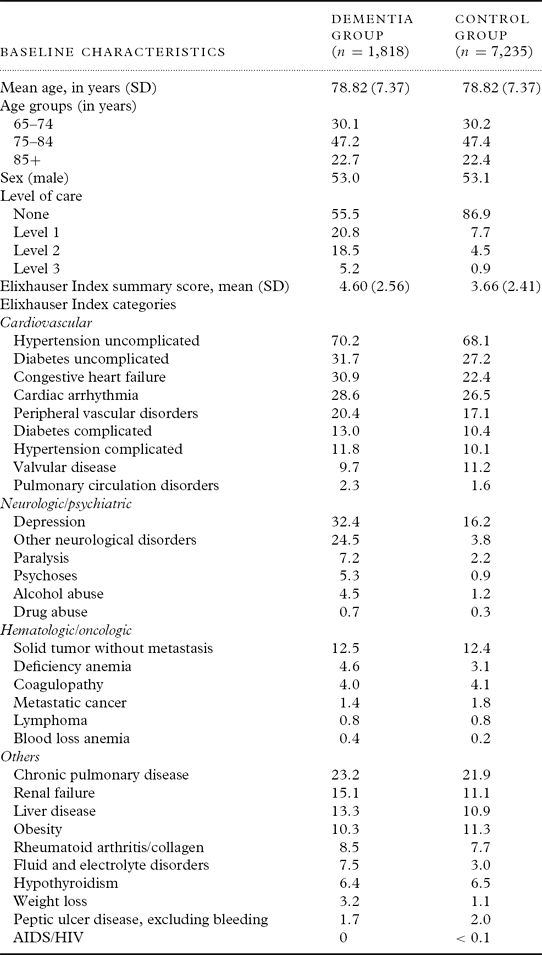
A total of 1,818 dementia patients with a first diagnosis and 7,235 matched controls were analyzed. Baseline characteristics of the cohort, including the comorbidities according to the Elixhauser Index, are shown in Table 1.
Baseline characteristics of patients with incident dementia and age- and sex-matched controls
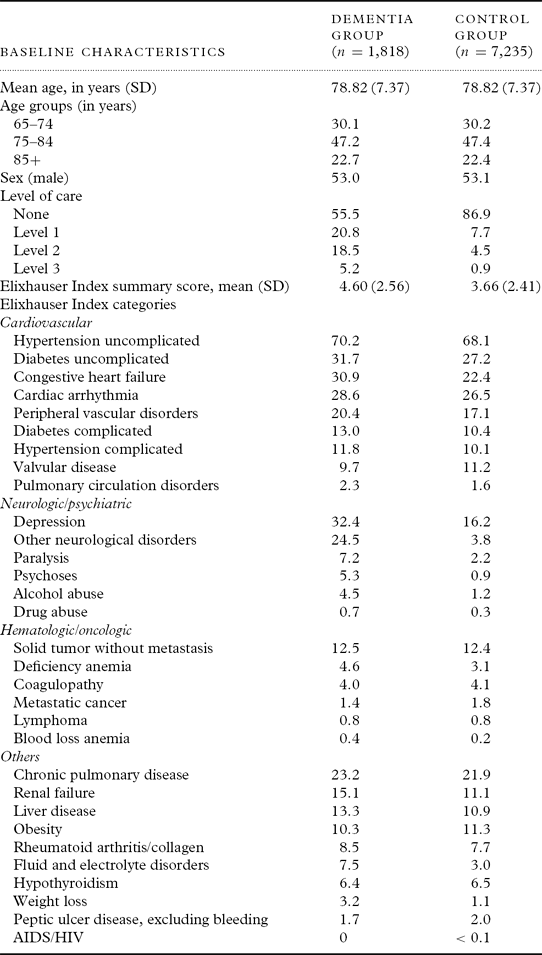
Because of the matching criteria, dementia patients and controls do not differ according to age or sex. There are noticeable differences concerning care dependency between the groups. Almost half of the dementia patients (44.5%) are already care-dependent in the year of the first diagnosis for dementia, whereas only 13.1% of the controls have a care level. Dementia patients have an overall higher prevalence of comorbidities than controls, but the differences vary across the diseases. Noticeably, a higher proportion of dementia patients suffer from neurological and psychiatric diseases.
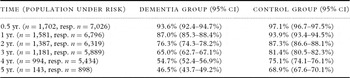
The mean follow-up was 3.8 years (SD: 1.3), 3.3 years for dementia patients and 3.9 years for controls. The cumulative survival rates are presented in Table 2. It shows continuously higher mortality in the dementia group compared with the control group. After the five-year observation period 46.5% of the dementia patients are still alive compared to 68.9% of the controls. The corresponding Kaplan–Maier curve is shown in Figure 1.
Survival* in patients with incident dementia and age- and sex-matched controls

* Follow-up started on the first day after the incidence year.
Survival* of dementia patients and controls.*Follow-up started on the first day after the incidence year.

Mortality grows continuously faster in the dementia group and is almost linear, as is mortality for controls, but in a flatter way. To account for care dependency, we performed survival analyses for each care level. For this, four distinct cohorts were selected: one for persons without care dependency and three for the single care levels. The results are shown in Figure 2.
Survival* stratified by levels of nursing care dependency. Hazard ratio (HR; adjusted) for sex and age. *Follow-up started on the first day after the incidence year.

While there is still a significant difference between dementia patients and controls without care dependency, this effect disappears for all care levels. Persons in the control group who are care-dependent show a similar mortality trend to the dementia patients. However, it has to be mentioned that dependent dementia patients are younger than controls. Mean age for the first care level is 76.8 years for dementia patients and 77.8 years for controls. This difference in age grows up to 4.5 years for nursing care level 3 (mean age 81.3 vs. 85.8 years). The five-year mortality grows with the severity of care dependency, whereas after the five-year follow-up, 64% of the dementia patients without care dependency are still alive (75% of the control group; see Figure 2a). The survival rate decreases to about one-third for both the groups with care dependency level 1 (Figure 2b) and to less than 20% in persons with care dependency level 3 (Figure 2d). To account for different age distributions within the care strata, we included not only the crude HR but also age- and sex-adjusted HR in the graphics. While the significant difference between dementia and controls with care level 1 remains almost unchanged, the non-significant differences throughout the different care levels disappear when adjusted for age and sex in care levels 2 and 3. Even after the adjustment, there is no significant difference in mortality for dementia and controls with care level 1.
In order to control for various influences on dementia mortality, we performed three distinct Cox proportional hazard regression models. The results are shown in Table 3. In the first model, we calculated the HR for “death” only, including dementia status as a predictor. According to this calculation, incident dementia patients have a two-fold risk of dying within the five-year period compared with the control group. Since the control group was matched according to age and sex, no adjustment for these variables was made in model 1.
Factors associated with mortality: results of Cox regression

* Model 3 further adjusted for 31 comorbidities of the Elixhauser Index (not shown in table).
In model 2 we added the care dependency levels. With this the effect of dementia diagnosis weakens but stays significant with a HR of 1.5. The mortality risk also increases with the care dependency level. Compared with non-dependent persons, a care dependent person with level 3 has a 4.5-fold risk of dying in the observation time (4.4 for men and 4.6 for women). In this model we also adjusted for age and sex, finding significant effects for both variables. With every year the mortality risk increases by 9%, and men have a higher mortality risk than women.
All effects shown in model 2 are also found in model 3, where we additionally adjusted for 31 disease complexes of the Elixhauser Index (HR for single conditions not shown). When controlled for comorbidities, all other effects were reduced only slightly. When stratified for sex, no major differences between the strata were observed in model 2 or 3. However, with higher levels of care dependency, women have a slightly increased risk for mortality. The inclusion of the Elixhauser Index did not change much of the predictors but resulted in a better model fit (data not shown).
Discussion
In our data analysis of 1,818 persons with an incident dementia diagnosis and 7,235 controls matched by age, sex, and health service utilization, we analyzed the influence of dementia on mortality over a five-year follow-up period. Compared with age- and sex-matched controls, patients with dementia had a two-fold increased mortality risk. The dementia diagnosis as a strong risk factor was still present after controlling for age, sex, level of care dependency, and comorbidity. Irrespective of dementia, nursing care dependency is a strong predictor for mortality. In the four distinct Kaplan–Meier curves stratified for the level of care dependency, the dementia diagnosis loses much of its influence. However, within the population with nursing care dependency, dementia patients were younger than controls. Therefore, when adjusted for age, a higher mortality for dementia patients with a specific care level is found only for levels 2 and 3, but no significant differences could be found for care level 1 (see Figures 2a–d). Comorbidity slightly influenced the impact of incident dementia on survival.
Our findings correspond to some of the results of previously published studies on mortality in incident dementia patients. Noale et al. (Reference Noale2003) performed a similar model strategy based on an Italian cohort of over 65-year-olds. These authors controlled for disability as a marker for severity of dementia similar to nursing care dependency in our model. Comparable to the results of our study, the authors found a strong effect for the dementia diagnosis itself, as well as for male sex, some comorbidities, and disability. The HR for disability was 1.98 (Noale et al., Reference Noale2003) and therefore lower than our estimated HR for care dependency. This difference might be explained through different definitions of care dependency used in our study (based on a comprehensive assessment by the long-term care insurance company) and disability used in the study by Noale et al. (Reference Noale2003) (based on the assessment of activities of daily living (ADL) and instrumental activities of daily living (IADL) only).
Concerning the mortality rate, a very wide range of results have been reported. In the study by Agüero-Torres et al. (Reference Agüero-Torres, Fratiglioni, Guo, Viitanen and Winblad1999), 70% of the dementia patients died within the five-year observation period compared with 53.5% in our cohort. This difference might be due to the age difference of the cohorts. Agüero-Torres et al. (Reference Agüero-Torres, Fratiglioni, Guo, Viitanen and Winblad1999) included persons aged 75 years and older who were not suffering from dementia at the time of their recruitment, while we included persons with incident dementia starting from the age of 65 years. Also, a higher mortality is shown in the study by Schäufele et al. (Reference Schäufele, Bickel and Weyerer1999), where 45.3% of the patients died within a follow-up period of approximately 2.5 years. However, their sample size of 117 patients was rather small, so the estimates have to be interpreted carefully. Other studies found quite similar results to our findings with a high mortality in dementia patients (Helmer et al., Reference Helmer, Joly, Letenneur, Commenges and Dartigues2001; Larson et al., Reference Larson2004; Waring et al., Reference Waring, Doody, Pavlik, Massman and Chan2005).
We included comorbidities of the dementia patients and their controls in our analyses. As stated before, there are very few studies taking this into account (see overview in Guehne et al., Reference Guehne, Riedel-Heller and Angermeyer2005). Noale et al. (Reference Noale2003) included diabetes and chronic heart diseases in their analysis, both attributing to a higher mortality risk in dementia patients as well as non-dementia controls even when controlling for disability. Larson et al. (Reference Larson2004) found some influence of diabetes, ischemic heart disease, urinary incontinence, or wandering on dementia mortality. However, the systematic control for comorbidity through an index has not been used in other studies.
The comorbidities measured with the Elixhauser Index show higher prevalence in the dementia cohort in most cases. The inclusion of the index adjusted the model to a better fit, but did not change the influence of dementia. We did not include the estimated hazard ratios in the regression model results shown in Table 3, since it was not the question of primer research to identify the influence of certain diseases other than dementia on mortality. Also, certain Elixhauser categories (such as “other neurological disorders”) might be too broadly defined to show a single disease's impact on mortality. This is only true for a few categories and breaking the categories down would lead to a smaller number of patients affected and therefore to bigger confidence limits of the effect sizes. It might be that care dependency itself is a good proxy for comorbidity and functional impairment in elderly persons.
Strengths and limitations
Field studies in elderly persons often face special challenges, e.g. a high number of institutionalized or cognitive impaired persons who tend not to participate in the studies or non-participation because of protective behavior of family members, or exclusion because of comorbidities (Riedel-Heller et al., Reference Riedel-Heller, Busse and Angermeyer2000). These problems do not arise using claims data, which include all insured persons independent of their current state of health; also, the sampling is not vulnerable to various biases, such as interviewer effects.
A large health insurance claims database enabled us to compare mortality rates of dementia patients and controls without selection bias because of communication problems, very old age, institutionalization, or location. We know the exact date of death and can control for other patient-related factors such as age, sex, level of care dependency, and comorbidities. We could therefore calculate valid estimates of dementia mortality. Health insurance claims data offer a great data source to show real life disease progression and mortality.
However, some limitations have to be addressed. Socioeconomic status could not be considered in our analysis, since it does not appear in our claims data. Previous studies that controlled for socioeconomic variables in the analyses of dementia mortality did not often find significant effects. Xie et al. (Reference Xie, Brayne and Matthews2008) analyzed the mortality of incident dementia cases in England and Wales, controlling also for marital status and residential situation (institutionalized vs. community). The authors found no significant influence of these variables in a multivariate analysis (Xie et al., Reference Xie, Brayne and Matthews2008). Gühne et al. (Reference Guehne, Matschinger, Angermeyer and Riedel-Heller2006) controlled for education and living in a nursing home, but also did not find a significant influence in the multivariate Cox model. Education did not have a significant influence on dementia mortality in the study by Wolfson et al. (Reference Wolfson2001) or in the study published by Helmer et al. (Reference Helmer, Joly, Letenneur, Commenges and Dartigues2001). Given the above results of previous studies, we assume that the models in our study adequately represented influencing factors of mortality in dementia patients. Nevertheless, the inclusion of more socioeconomic or cultural factors would be beneficial for future research on dementia mortality in Germany and would strengthen our results.
We also did not distinguish between different types of dementia. Previous studies have shown that patients suffering from vascular dementia show higher mortality than patients with Alzheimer's disease (Agüero-Torres et al., Reference Agüero-Torres, Fratiglioni, Guo, Viitanen and Winblad1999; Fitzpatrick et al., Reference Fitzpatrick, Kuller, Lopez, Kawas and Jagust2005; Koedam et al., Reference Koedam2008). Within our data source, over half of the coded dementia diagnoses are F03: unspecified dementia. This is probably due to the fact that a more precise diagnosis is not needed for reimbursement issues, the primary function of claims data. However, it is a clinical reality in outpatient care in Germany that decisions on treatment in patients with dementia are often being made without a precise etiological diagnosis.
In our analysis, the incidence of dementia was defined as the first coded diagnosis. We know very well that the coding of dementia diagnoses is made rather late due to taboo, stigmatization, difficulty in the diagnostic process, and poor therapeutic options (van Hout et al., Reference van Hout, Vernooij-Dassen, Bakker, Blolm and Grol2000; Mitchell, et al., Reference Mitchell, Meader and Pentzek2011). We included only cases with at least three diagnoses of dementia in four consecutive quarters, which must have led to the exclusion of some cases who died within a year after the first diagnosis of dementia. By applying these inclusion criteria we wanted to strengthen the validity of the data, excluding tentative diagnoses or wrongly coded diagnoses. However, by doing so, we might have underestimated the number of dementia cases, especially the mild cases and early stages, as well as the very fast progressing cases who died within the first year after the initial diagnosis.
Conclusion
Dementia is a significant risk factor for mortality in elderly patients and has to be considered as a life-limiting illness. Its mortality risk is also present when controlled for different levels of long-term care dependency in these patients. Non-dementia controls with a similar care dependency also show a higher mortality rate than persons without nursing care dependency. We interpret the levels of care dependency as an indicator for the severity of dementia, which has been shown to be a major risk factor for mortality (Guehne et al., Reference Guehne, Matschinger, Angermeyer and Riedel-Heller2006; Andersen et al., Reference Andersen, Lolk, Martinussen and Kragh-Sørensen2010).
Conflict of interest
None.
Description of authors’ roles
Daniela Koller and Falk Hoffmann performed data analysis and wrote the paper. Birgitt Wiese compiled the statistical model strategy. All authors interpreted the data, critically revised the paper, read, and approved the final paper.
Acknowledgments
We thank the Gmünder ErsatzKasse (GEK; now BARMER GEK) for providing the data. Preliminary work was funded as part of the German Research Network on Degenerative Dementia (KNDD) by the German Federal Ministry of Education and Research (grants: O1GI0710, 01GI0716, and 01GI0717). This study was supported by grants from the Jackstädt-Stiftung.
We would like to thank Gerhard Schön, Department of Medical Biometry and Epidemiology (Hamburg), for the preliminary work on the development and implementation of this cohort.