INTRODUCTION
Animal manure has to be considered as a source of nutrients for the crops as prescribed in the European Union (EU) Nitrate Directive with reference to protection of the environment (EU 1991). The current legislation in Denmark based on the Nitrate Directive prescribes, among other things, that farms keep a balance between the number of animals and the area of cultivated land, and also that the nutrients are accounted for (Mikkelsen et al. Reference Mikkelsen, Iversen, Kjær, Feenstra and Jones2005). The export of nutrients in animal manure to neighbours has to be reported in the nutrient accounts of both the exporting and importing farm. This requirement has led to a shortage of land for manure application in some counties, as the application rate in animal manure in several regions exceeds the maximum rate of 170 kg (N)/ha (European Commission 2007). Export of nutrients in liquid slurry for farms in other counties, or even countries, necessitates storage and transport, and sometimes a second storage at the recipient farm. This is expensive due to the large volumes of water involved.
Reducing the slurry volume by separation into a liquid and a (DM)-rich solid fraction seems to be useful. In 2002, the Danish legislation introduced a rebate on the requirement of the owned share of land for slurry application when the slurry is separated into two or more fractions. The rebate allows 25% less land to be owned when implementing a simple separation technology or 50% less when using a more efficient technique for separation. The rebate allows farms, particularly pig farms, to expand their stock further without having to acquire additional, frequently expensive, land for spreading the slurry to meet the requirement of the share of land owned by livestock farmers.
The solid fraction, consisting of fibrous material and obtained by the use of simple separation technologies such as filtration or centrifugation, has enhanced dry matter (DM), nitrogen (N) and phosphorus (P) concentrations. A decanter centrifuge is the most effective device for mechanical separation (Møller et al. Reference Møller, Sommer and Ahring2002b; Balsari et al. Reference Balsari, Santoro, Dinuccio, Gioelli and Petersen2006). Although DM comprises 0·07 of the mass of the slurry (Møller et al. Reference Møller, Maahn and Skaaning2002a), the DM-rich fibrous fraction from a decanter centrifuge may have a DM content of 330 g/kg, suggesting that the fibrous fraction may be handled and stored in the same way as farmyard manure until application as a nutrient source for crop production is appropriate.
During storage of farmyard manure in heaps, a significant biodegradation of organic compounds takes place, normally resulting in both aerobic and anaerobic conditions, and the temperature may reach c. 70°C inside the heap (Petersen et al. Reference Petersen, Lind and Sommer1998). The high temperatures and a high ammonium content in farmyard manure result in significant ammonia volatilization and loss of N by denitrification, including nitrous oxide emission (Petersen et al. Reference Petersen, Lind and Sommer1998). During storage of manures, significant loss has been reported: 10–50% from solid manures (Kirchmann Reference Kirchmann1985; Petersen et al. Reference Petersen, Lind and Sommer1998; Chadwick Reference Chadwick2005; Larney et al. Reference Larney, Buckley, Hao and McCaughey2006), 5–40% from deep litter (Sommer & Dahl Reference Sommer and Dahl1999; Osada et al. Reference Osada, Sommer, Dahl and Rom2001; Sommer Reference Sommer2001; Wolter et al. Reference Wolter, Prayitno and Schuchardt2004) and 15% from the fibrous fraction of separated slurry (Hansen et al. Reference Hansen, Henriksen and Sommer2006). The porous structure of the fibrous fraction causes a potential for a higher N loss, particularly as ammonia. Livestock farmers would like to export the fibrous fraction, but N losses during storage and handling of the fibrous fraction are supposed to be significant and are not accepted in the nutrient accounting system. Nitrogen losses as ammonia and nitrous oxide are also undesirable due to their environmental impacts.
The plant availability of the remaining N in the fibrous fractions is thought to be influenced by the content of mineral N and by the N turnover processes in the soil as reported by Kirchmann (Reference Kirchmann1985) for solid manures. Mineralization of organic N soon after application is the dominating process for manures with a low carbon (C) to N ratio or manures decomposed under aerobic conditions during storage, whereas N immobilization exceeds mineralization at high C:N ratios and for manures stored anaerobically (Kirchmann Reference Kirchmann1985; Thomsen & Olesen Reference Thomsen and Olesen2000). Mineralization of organic N also takes place after anaerobic storage, but significant amounts of simple decomposable compounds such as volatile fatty acids accumulate during storage, causing immobilization of manure N after application to the soil (Kirchmann & Lundvall Reference Kirchmann and Lundvall1993).
The aim of the present study was to quantify the loss of C and N during storage of the fibrous fraction of separated, digested pig slurry under farm-scale conditions and to study the effects of storage on the availability of N in the fibrous fraction after application to soil. In addition, the separation efficiency for DM, C, total N and total P was calculated.
MATERIALS AND METHODS
Separation of slurry in Denmark is often associated with biogas plants. Although c. 0·04 of the total volume of animal slurry is treated at either on-farm or central biogas plants, only two on-farm plants with a stable and continuous production of fibrous fraction based on separation of digested slurry using a decanter centrifuge could be located for the present study. The continuously produced fibrous fraction was stored throughout the winter in on-farm heaps until spreading on to the field in the spring to utilize the nutrients in crop production. The sampling procedure for the monitoring programme may take this handling scheme into account by using sampling in time during heap growth and sampling in space when the storage is emptied for field application. The calculations were based on the assumption of mass balance of non-volatile components.
Sampling of fresh fibrous fraction – sampling in time
The two farms used in the present study were both located in Jutland, Denmark, and pig slurry is the major input to the biogas plants. The livestock at Farms 1 and 2 produce 280 and 410 t animal slurry weekly, respectively, corresponding to a production of 10–12 t of fibrous material per week (Table 1). The feeding in these large-scale pig productions was carefully controlled to obtain efficient utilization of the feed and a high production rate. This implies only slight variation in nutrient content of the slurry over time. To obtain a high and stable gas yield, a relatively constant proportion of organic residues was added to the pig slurry before feeding into the biogas reactor. At Farm 1, the biogas reactor was fed daily with 14 t fish residues (6 kg N/t, 0·6–1·4 kg P/t) and 40 t pig slurry, while the digestion reactor at Farm 2 was fed daily with 45 t slurry plus waste products (fish oil and vegetable oil) comprising 0·03 of the total input volume. Minor variations, due to slurry originating from different housing sections and residue supply, were levelled out during the digestion process in the biogas reactor due to a retention time of 18 and 13 days at Farms 1 and 2, respectively.
Livestock and manure production on fresh weight basis at the two farms

Therefore, only slight variations were expected in the digested slurry and in the two fractions produced by separation immediately after the digested slurry leaves the biogas plant. Using 3-week sampling intervals over 5 months, Møller et al. (Reference Møller, Maahn and Skaaning2002a) obtained a coefficient of variation (CV) of 6–16% for the parameters DM, total N, ammonium N, P, potassium (K), copper (Cu) and zinc (Zn) at Farm 2. On this basis, a 4–6-week sampling interval was assumed satisfactory to take the variation in time into account.
Using a decanter centrifuge as the simple separation technique, the digested slurry was divided into a solid, fibrous fraction and a liquid fraction. The continuously produced fibrous fraction was loaded on to a trailer, which was tipped weekly on to an on-farm outdoor storage area. Fresh fibrous fraction was sampled from the conveyor loading the trailer. On Farm 1, six samples of fresh fibrous fraction were taken from August 2004 to January 2005. On Farm 2, the fresh fibrous fraction was sampled nine times from June 2004 to March 2005.
Each sample of fibrous fraction weighed 2 kg, made up of 4–6 sub-samples taken by hand. At each sampling date, parallel samples of unseparated digested slurry and the liquid fraction of separated slurry (2 litres each) were taken from the pipeline flow, which enabled calculation of the separation efficiency.
Sampling of stored fibrous fraction – sampling in space
As the fibrous fraction was assumed to be uniform when produced, variation at the end of storage may be attributed to duration of storage as well as decomposition processes and losses during storage. A high loss of volatile components was expected, particularly ammonia from the heap surface, making the chemical properties of the surface at the end of the storage phase significantly different from the central part of the heap. For the second part of the monitoring programme, random samples were taken from within these two strata of the heap, with the most samples in the central part as it was assumed to be the most valuable part representing the largest volume of the heap.
During establishment of small static heaps of mixed farmyard manure (c. 10 m3) for measurement of gaseous losses, CV values ranging from 4 to 9% were obtained for DM and total N, 5–21% for P and K, but 17–51% for ammonium N during establishment of the heaps (Petersen et al. Reference Petersen, Lind and Sommer1998). Despite mixing, farmyard manure is a heterogeneous mixture of faeces, urine and straw that is assumed to be more variable than the stored fibrous fraction originating from separation of digested slurry. It was therefore assumed that about ten samples from the central part of the heap and five samples from the surface would be sufficient to take the spatial variation in the heaps into account, except for ammonium N. That may require more samples, increasing the cost. Practical conditions may have reduced the number of samples taken.
The fibrous fraction store (c. 3×8×30 m, H×W×L) at Farm 1 was emptied on 8 February 2005 and nine samples were taken from the centre of the heap and four from the surface during the process. The fibrous fraction was then transferred and reloaded at the recipient farm for a second storage period. Four and nine samples were taken from the surface and centre, respectively, of the new oblong conical heap (c. 2×5×120 m, H×W×L), while this heap was removed for field application at the recipient farm on 1 April 2005. At Farm 2, the on-farm store (c. 3×10×40 m, H×W×L) was emptied on 28 April and five samples were taken both from the centre and surface of the heap.
Each stratum (centre or surface) of the heap was divided into sections, and individual handling and analysis of the samples from each section enabled examination of the variation within heap and stratum. Each sample of fibrous fraction weighed 2 kg and consisted of 4–6 sub-samples taken randomly by hand.
The fibrous fraction and slurry samples taken at the two farms were analysed for chemical properties and the samples of fibrous fraction were used in a soil incubation experiment. All samples were stored at −18°C until analysis in April 2005. Sub-samples of fibrous fraction were stored at 2°C from April until the start of the soil incubation experiment in September 2005.
Climate data were extracted from the PlanteInfo climate database (http://www.PlanteInfo.dk). Overall, the daily mean temperature ranged from 20°C in August to −5°C in February for both farms. During the sampling period, 450 mm precipitation was recorded in the 10×10 km2 grid that included Farm 1 and 730 mm in the 10×10 km2 grid including Farm 2. August, September and October were particularly rainy with several days receiving more than 10 mm, resulting in about half of the precipitation for the sampling period falling in these 3 months. The monthly precipitation was 45–60 mm during the remaining months and was more evenly distributed. The total precipitation at Farms 1 and 2 was 8 and 3% less, respectively, than for a similar period in a normal year based on the 1961–90 average.
Analytical methods and calculations
After freeze-drying, the samples were analysed for DM (80°C for 18 h) and total C using dry combustion (CNS-1000, Leco, USA). Although C was not determined in all samples, at least three samples for each fraction were randomly selected for analysis. Ammonium N (NH4-N) was analysed colorimetrically (AutoAnalyzer 3, Bran+Luebbe, Germany) after extraction with 1m potassium chloride. Total Kjeldahl nitrogen (total N) was analysed using a Kjeltec 2300 (Foss, Denmark) distillation and titration unit. Total P, Cu and Zn were analysed by atomic absorption spectroscopy (AAnalyst 300 Spectrometer, PerkinElmer, USA) after incineration at 450°C for 3 h and treatment with nitric acid and hydrochloric acid. To estimate the loss of DM, C and N, the non-volatile and non-leachable elements P, Cu and Zn were used as internal references.
Separation efficiency of DM, C, N and P was calculated from a mass balance by using the non-volatile elements as references. The total masses as well as the masses of the reference elements before separation of the digested slurry are assumed to equal the mass after separation. Using Cu as the reference element gives:


where T is the mass of manure and Cu is the concentration of copper in manure. Isolating Tfibrous in Eqn 1a and rewriting Eqn 1b:

Setting Tdigested slurry to 1 t, Tliquid and Tfibrous may be calculated:


The separation efficiency expressed as a proportion of the mass of elements total N, ammonium N and total P in the fibrous fraction in relation to the mass in the digested slurry may now be calculated using the measured concentration in the fractions and the estimated mass of the two fractions, e.g.:

Losses from the heap were also calculated from mass balances using the non-volatile elements P, Cu and Zn as references. Because the distribution between the surface and the interior of the heap was unknown, mass balances were calculated for each of the two parts of the heap. Thus, the mass balance for N is:

where N is the concentration of nitrogen, T the mass of manure and X the loss of nitrogen. Assuming that the loss of non-volatile element is zero, a mass balance using copper as an example can be expressed:

Isolating Tafter storage and inserting in Eqn 5, the loss X may be isolated:

For 1 t of fresh fibrous fraction, the loss of a volatile element can now be calculated using the concentrations of the volatile and a non-volatile element. The loss may be related to 1 t of fresh fibrous fraction and expressed as percentage using:

Merging Eqns 7 and 8 corresponds to the mass balance calculations in Larney et al. (Reference Larney, Buckley, Hao and McCaughey2006).
Measurement of manure-N mineralization in soil
An incubation experiment was performed in 250 ml polyethylene bottles to study the potential plant availability of N in the fresh and stored fibrous fractions of separated slurry sampled at the two farms during the monitoring programme. Samples of fibrous fraction equivalent to 18 mg total N were placed on 30 g soil (dry weight basis) and then covered with another 30 g soil (300 mg N/kg soil) to simulate an incorporation of manure in soil. The soil was a loamy sand with a pH of 6·5 containing 21 g C/kg soil, 2·1 g N/kg and 8% clay sampled in 0–20 cm depth of an arable field (Research Centre Foulum, Tjele, Denmark, 56°30′N, 9°34′E). The water content was adjusted to comprise 0·55 of the water-holding capacity, which gives optimal conditions for microbial activity. The bottles were covered with perforated Parafilm (three 2 mm diameter holes) to give a minimum of evaporation under aerobic conditions. The bottles were placed in a dark, temperature-controlled room at 10°C which is the average soil temperature during spring in Denmark. The soil moisture content was kept nearly constant by weighing the bottles weekly and adding extra water, if necessary, to bring them back up to the starting weight. The experimental conditions ensured minimal ammonia loss after the application. Each of the 51 samples of fibrous fraction in Table 3 was incubated in triplicate. Soil samples without manure addition were incubated as controls under the same conditions. After 12 weeks of incubation, corresponding to the growing season of spring barley, the soil mineral N (ammonium, nitrite and nitrate) was extracted with 2m potassium chloride (1:2) and analysed colorimetrically (AutoAnalyzer 3, Bran+Luebbe, Germany) for determination of the plant availability of manure N.
The difference between inorganic N in the amended and unamended soil after 12 weeks of incubation is denoted as the net availability of manure N (Manure-Nnet availability). The inorganic N applied with manure is denoted Manure-Ninorganic. The net mineralization of manure N (Manure-Nnet mineralization) during the incubation is calculated as the difference between Manure-Nnet availability and Manure-Ninorganic, assuming that gaseous losses were negligible. The figures were expressed as proportions of total N applied in manure (Manure-Ntotal).
Recordings of Manure-Nnet mineralization in triplet were related to the Ctotal:Norganic ratio determined in 42 samples using the procedure GLM (Version 8.02, SAS Institute Inc., Cary, NC, USA).
RESULTS
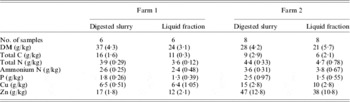
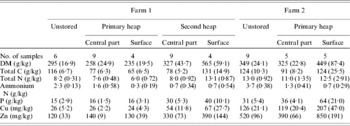
The chemical composition of the slurries and fibrous fractions from the two treatment plants is shown in Tables 2 and 3, respectively. In general, the CV for the slurries and fresh fibrous fraction was the lowest at Farm 1 (CV 3–13% for DM, C and N and 4–20% for P, Cu and Zn except for a single combination with CV 30%) and most of the parameters analysed were within the expected range (calculated from Tables 2 and 3). The higher variation at Farm 2 (CV 3–15% for DM, C and N in digested slurry and the fibrous fraction 17–35% for DM, C and N in the liquid fraction and 17–40% for P, Cu and Zn) may be a result of the more variable operation of the biogas plant and slurry separator used there. In samples from the heap at the end of the storage phase, ammonium N was the most variable parameter (CV 36–63%) and, in general, all recordings for the other parameters in the heap surface (CV 8–23% for DM, C and N and 18–33% for P, Cu and Zn) were higher and more variable than for the central part of the heap (CV 6–12% for DM, C and N and 7–19% for P, Cu and Zn) (calculated from Table 3). The variations for the heap samples were slightly higher than expected based on the above-mentioned considerations regarding the sampling regime, but calculation of the mean separation efficiency and the mean losses of C and N were based on the three reference elements P, Cu and Zn, reducing the influence of variance for the individual reference elements.
Nutrient content (fresh weight basis) of the digested slurry prior to separation and the liquid fraction of separated slurry sampled parallel to the sampling of fresh fibrous fraction. Mean with standard deviation in parentheses. Only three samples were used for the determination of total C

Nutrient content (fresh weight basis) in the fibrous fractions before and after on-farm storage in heaps at two farms. Mean with standard deviation in parentheses. Only three samples were used for the determination of total C in the unstored (fresh) fibrous fraction at the two farms

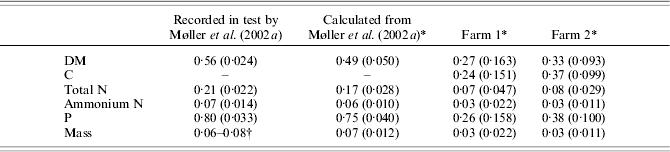
The separation efficiencies, based on the chemical composition of digested slurry and the liquid fraction (Table 2) and use of Eqns 3 and 4, were 0·08–0·10 for total N and 0·30–0·46 for total P (Table 4). The obtained efficiencies for P were comparable with the efficiencies for DM and C, but the efficiency for ammonium N was only 0·03.
Separation efficiencies calculated as mass of elements in the fibrous fraction as proportions of the unseparated digested slurry. Mean values of calculations using the P, Cu and Zn concentrations in Table 2 with standard deviation in parentheses
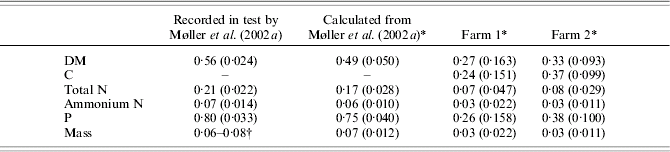
† Range read from figure in Møller et al. (Reference Møller, Maahn and Skaaning2002a).
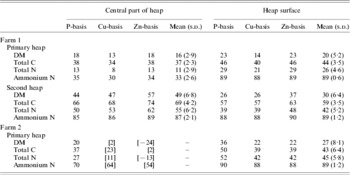
Assuming that the mass of P, Cu and Zn is maintained in the heaps during storage, losses of C and N from heaps increase the concentration of these non-labile elements. The results in Table 3 confirm this, except for Cu and Zn in samples from the centre of the heap at Farm 2. A probable reason for this deviation may be the varying use of mineral Cu and Zn as feed additives to counteract diarrhoea at Farm 2. The Cu and Zn concentrations in the digested slurry at Farm 2 were more than twice that at Farm 1 (Table 2), and the CV was five times higher. It has been assumed that the number of samples was too small to capture the variation in the use of Cu and Zn at Farm 2.
The non-labile elements were used as internal standards in calculation of the C and N losses (Table 5). Due to the above-mentioned problems for the heap centres at Farm 2, these losses are underestimated and, when negative, clearly erroneous. With these exceptions, there was an acceptable accordance between the losses calculated on P, Cu and Zn basis and average values are subsequently used.
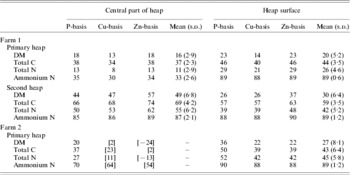
The C loss from the surface of the primary heap was 43% on average of the two farms, increasing to 59% after storage in a reloaded heap at Farm 1. The total N loss from fibrous fraction located at the heap surface was 26 and 45% for the primary heap at Farms 1 and 2, respectively. After storage of the reloaded heap at Farm 1, the total N loss from the heap surface increased to 42%. A significant proportion of the total N loss from the heap surface is assumed to be via ammonia volatilization, as 89% of the ammonium content in fresh fibrous fraction was lost (Table 5).
Both C and N losses were smaller from the heap centres compared with the losses from fibrous fraction located at the surface. The average C loss from heap centres at the two farms was about 37% of the content in the fresh fibrous fraction, corresponding to 85% of the loss from the surface. The total N loss from the centre was 11 and 27% at Farms 1 and 2, respectively, corresponding to only 40–60% of the loss from the surface. At Farm 1, only 33% of the original content of ammonium N was lost from the centre, but during reloading the manure was remixed, giving conditions for significant ammonia volatilization from the material formerly located at the centre of the first heap.
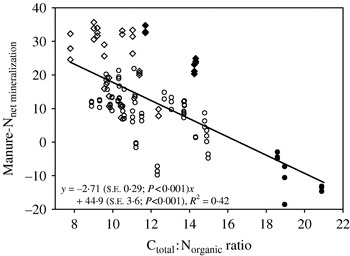
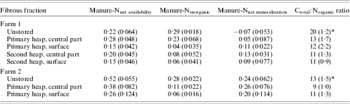
The Nammonium:Ntotal ratio in the fresh fibrous fractions was approximately 0·3 for both farms (Manure-Ninorganic in Table 6) with ammonium N commonly regarded as being the N fraction most readily available to plants. The availability changed during soil incubation and after 12 weeks the proportion of manure-Nnet availability of the fresh Farm 1 fibrous fraction was 0·22 compared with 0·52 for fresh Farm 2 fibrous fraction (Table 6). Thus, the fresh and unstored Farm 1 fibrous fraction showed a negative net mineralization after 12 weeks comprising 0·07 of the total N applied (Table 6), whereas a significant net mineralization comprising 0·24 of the total N was observed for the fresh Farm 2 fibrous fraction. It was hypothesized that the differences in net N mineralization could be related to the C:N ratio, and it was found that the net mineralization of organic N in the fibrous fractions was negatively related (P<0·001) to the Ctotal:Norganic ratio (Fig. 1).
Relationship between net N mineralization of organic N in fresh and stored fibrous fractions from two biogas plants separating digested pig slurry and their Ctotal:Norganic ratio. Plant 1 (○, ●) and Plant 2 (◊, ◆). Each of the 51 sub-samples of fibrous fraction from the monitoring programme was incubated in triplicate. Open and filled symbols represent stored and fresh fibrous fractions, respectively.

Net N mineralization of unstored (fresh) and stored fibrous fractions in soil (Manure-Nnet mineralization) as proportions of applied total manure N. Manure-Nnet mineralization was calculated as the difference between the net availability of inorganic manure N after 12 weeks of incubation (Manure-Nnet availability) and the content of inorganic N in the applied fibrous fraction (Manure-Ninorganic). Each of 51 sub-samples of fibrous fraction from the monitoring programme (Table 3) was incubated in triplicate. The corresponding Ctotal:Norganic ratios are given in the last column. Standard deviation in parentheses

* The number of sub-samples in each fibrous fraction appears from Table 3, but for the Ctotal:Norganic ratio of unstored fibrous fraction, n=3.
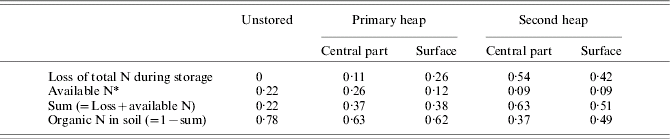
The proportion of organic N remaining in soil after a few months of decomposition (equivalent to the first growing season) was calculated for three storage scenarios: unstored, one-stage storage or a two-stage storage including reloading of the heap (Table 7). The manure-Nnet availability (Table 6) was adjusted for N losses during storage to express the availability as proportion of N in fresh fibrous fraction. The results demonstrate that short-term storage of fibrous fraction with moderate C loss during storage leaves a significantly higher proportion of N in organic form when applied to soil compared with a two-stage storage of the fibrous fraction having a high C loss during storage (Table 7).
Partitioning of N loss, available N and residual organic N in soil after incubation for 12 weeks of unstored (fresh) and on-farm stored fibrous fraction from Farm 1. The figures are expressed as proportions of initial N in fresh fibrous fraction
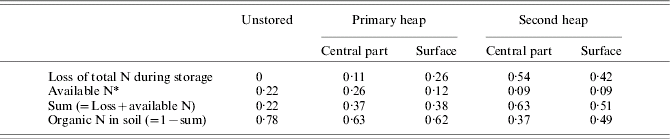
* Corresponding to the first column in Table 6 multiplied by (1−loss of total N) to adjust for loss during storage.
DISCUSSION
Separation efficiency
The separation efficiencies in Table 4 are at the lower end of separation efficiencies reported by Balsari et al. (Reference Balsari, Santoro, Dinuccio, Gioelli and Petersen2006) and they do not meet the Danish legislation thresholds of >0·20 and >0·60 for N and P, respectively, needed to obtain the rebate on the share of land owned by the livestock farmer needed for the spreading of slurry. The calculated separation efficiencies at the two farms were also well below reported figures based on weighing the produced fractions (Møller et al. Reference Møller, Maahn and Skaaning2002a; Balsari et al. Reference Balsari, Santoro, Dinuccio, Gioelli and Petersen2006). The use of internal references seems to be a feasible method, as fairly similar figures on separation efficiency to those reported by Møller et al. (Reference Møller, Maahn and Skaaning2002a) were obtained by inserting their reported concentrations of the solid and liquid fractions into Eqns 3 and 4 (Table 4). Thus, the low separation efficiencies obtained in the present study were not due to the calculation method, but rather represent on-farm everyday operation efficiency of the used decanter centrifuges. Although the farmer may achieve the rebate on the requirement of the owned share of land when the separation efficiency reaches legislated thresholds, he or she may have other reasons for separation, e.g. fulfilling national legislation based on the Nitrate Directive (EU 1991) by exporting N in the fibrous fraction beyond the farmgate, and therefore the farmer may have adjusted the decanter used for separation to a less efficient separation. In fact, the latter reason is the most important today as the Danish legislation on requirement for owned land for slurry application was reduced in spring 2007, reducing the rebate on the requirement that could be obtained by slurry separation.
Losses during storage in heaps
The C losses during storage of the fibrous fraction (Table 5) are higher than the C loss of 28% observed by Hansen et al. (Reference Hansen, Henriksen and Sommer2006) after 4 months' storage of a similar fibrous fraction derived from digested pig slurry. The C losses mainly occurred by CO2 evolution and, to a lesser extent, by CH4 emission when the fibrous fraction was stored in a cone-shaped static heap of 1·5 m×4·8 m (height×diameter) with a mass of less than 10 t (Hansen et al. Reference Hansen, Henriksen and Sommer2006). In contrast, the heaps in the present study were loaded with 10–12 t weekly and it is well known that the ratio of aerobic to anaerobic decomposition in heaps depends on heap size and oxygen supply. Thus, the proportion of C loss due to CH4 emission may also have been higher in the present study carried out at farm scale.
The N losses from the central part of the primary heap at Farm 1 are in accordance with the overall losses of 15% recorded by Hansen et al. (Reference Hansen, Henriksen and Sommer2006). Those authors measured the ammonia loss directly, but recorded only a minor N loss via ammonia volatilization (0·3%), while one-third of the loss was in nitrous oxide emission and two-thirds of the loss could not be accounted for. In contrast, an ammonia emission of 3·5% of total N was recorded during 12 days of storing the fibrous fraction in 0·5 m3 static heaps (Gioelli et al. Reference Gioelli, Balsari, Dinuccio, Santoro and Petersen2006). These figures are not able to account for the N losses recorded in the present study, particularly the ammonium N losses from the heap surface and the reloaded heap. Measurements of ammonia emission from small pilot-scale heaps may be underestimated due to loss prior to the start of measurement caused by handling the fibrous fraction during establishment of the pilot heap. In addition, the heap temperature at farm-scale heaps may be higher and sustained compared with small pilot heaps.
Leaching losses of nitrate could not be excluded, as the heaps were uncovered and exposed to precipitation in the present study, but Petersen et al. (Reference Petersen, Lind and Sommer1998) only recorded a nitrate leaching loss of 1–4% during uncovered storage of solid pig manure. Similarly, Sommer & Dahl (Reference Sommer and Dahl1999) recorded a leaching loss <0·8% of the initial N in composting deep litter. It has been assumed that nitrate leaching losses in the same range could be expected from fibrous fractions stored in heaps, as the DM content of the fresh fibrous fraction exceeded 300 g/kg (Table 4).
The present study identifies significant C and N losses during storage of fibrous fraction in heaps. However, the pathways of N losses were not identified, but they need to be better quantified when storing the fibrous fraction of separated slurry. Although not quantified, it is assumed that a significant proportion of the N loss may be due to ammonia volatilization that typically takes place during the first week of storage (Sommer & Dahl Reference Sommer and Dahl1999; Osada et al. Reference Osada, Sommer, Dahl and Rom2001; Sommer Reference Sommer2001; Hansen et al. Reference Hansen, Henriksen and Sommer2006). Since the 1980s, national action plans have aimed to reduce ammonia emissions by increasing the utilization of N in animal manures. The results from the present study indicate that losses from the fibrous fraction of separated animal slurry may not be in line with this aim, unless further efforts are made to reduce the losses during storage. Losses can be somewhat reduced by covering or compaction of the manure heap (Sommer Reference Sommer2001).
The loss of N during storage reduces the fertilizer value of the fibrous fraction, and the loss as ammonium N has environmental impacts, particularly when the heap is placed close to ammonia-sensitive ecosystems. Similarly, losses of C as greenhouse gasses have environmental impacts and represent a loss of energy. Before incineration of the fibrous fraction with the aim of recovering energy, which recently has been legalized in Denmark, the fibrous fraction will also be stored for some time, but according to the present results the storage time should be reduced to a minimum to reduce ammonia and C losses.
Mineralization potential of fibrous fractions
The differences in net mineralization (Table 6) indicate that the fibrous fraction from Farm 1 contained more decomposable C causing N immobilization and/or less mineralizable N than that from Farm 2. The high manure-Nnet availability in the fresh fibrous fraction from Farm 2 accorded with the mineral fertilizer equivalent obtained in field experiments incorporating fresh fibrous fractions of the same origin before sowing of spring barley (Sørensen Reference Sørensen2003; Sørensen & Thomsen Reference Sørensen and Thomsen2005; Birkmose et al. Reference Birkmose, Sørensen, Rubæk and Petersen2006).
The fibrous fraction is normally stored for up to 12 months until application is suitable for utilization of the nutrients in crop production, and the nitrogen value of stored fibrous fraction is therefore of interest to the farmer. Thus, the fertilizer values of fresh fibrous fraction obtained in field experiments that exclude the impact of losses during storage are not representative of farming practice. Therefore, from a practical point of view, the question is: How does manure-Nnet availability change as an aggregated function of the losses during storage and the mineralization potential of the stored fibrous fraction? For the fibrous fraction from Farm 1, the manure-Nnet availability remained nearly the same after storage, despite N losses during storage (Table 6). The losses were counteracted by an increase in the manure-Nnet mineralization, which accounted for 0·05–0·13 of total N in the stored fibrous fraction. In contrast, the manure-Nnet availability of the fibrous fraction from Farm 2 was reduced during storage, but the manure-Nnet mineralization was unaffected by storage (Table 6).
The negative relation between the Ctotal:Ninorganic ratio and the net mineralization (Fig. 1) confirms previous findings of Chadwick et al. (Reference Chadwick, John, Pain, Chambers and Williams2000), who found a similar negative relationship between Ctotal:Norganic ratio and net N mineralization for ammonium-stripped manures. Although the fresh fibrous fraction from Farm 2 differed somewhat from the general relationship (Fig. 1), the immobilization in fresh fibrous fraction from Farm 1, due to a high Ctotal:Norganic ratio, emphasizes that it may be necessary to analyse the quality of fibrous fraction, expressed as the Ctotal:Norganic ratio, to include the mineralization potential in the prediction of the N availability in the fibrous fraction from a specific separation plant or storage.
Implications of storage on residual organic manure N in soil
The high P content in fibrous fraction implies that the fraction has to be applied at rates not exceeding the crop P requirement. Assuming P is retained in the heap during storage, the rate of manure N applied in the field must be decreased by increasing storage time due to N losses during storage.
The greater input of organic N to soil using short-term stored fibrous fraction compared with two-stage stored fibrous fraction (Table 7) indicates that decomposition of organic N in fibrous fraction of separated slurry takes place more readily in heaps than in the soil, probably because microbial residues are more protected in soil (Ladd et al. Reference Ladd, Amato, Grace and Van Veen1995) than in a manures heap. Other types of manures also undergo a two-stage storage procedure; for instance, deep straw bedding starts decomposing when in use and after being cleared out it is often stored for a variable length of time in outdoor heaps until field application. It may be expected that the observed effects on C and N turnover by two-stage storage may also be found in other types of solid manures, but this needs further investigation.
The decomposition of fibrous fraction during storage in heaps has advantages and disadvantages. Organic matter in soil is generally regarded as having a beneficial effect on soil fertility and normally a high level of N-rich organic matter is desirable in soil. On the other hand, the applied organic N is mineralized over decades, and in periods without a growing crop, the risk of nitrate leaching is increased on fertile soils high in organic matter content (Sørensen & Amato Reference Sørensen and Amato2002). However, the conflicting aims of minimizing nitrate leaching and maintaining a high organic matter level can be combined by growing crops and catch crops with a high N uptake potential during the autumn and winter periods (Thomsen Reference Thomsen2005).
Thanks to the team of laboratory technicians for their assistance in sampling and analysing the manures and carrying out the incubation experiment. An anonymous referee is gratefully acknowledged for comments to improve the manuscript.