INTRODUCTION
In the lower Mekong region of Thailand, Laos and Cambodia, 80% of the rice area is rainfed lowland, in which the main wet-season rice crop is grown in bunded fields with little or no access to supplementary water (Fukai and Ouk, Reference Fukai and Ouk2012). These low-input systems contribute to household, local and regional food security, as well as to local and increasingly export markets. But their sustainability is under pressure due to fragile soils of coarse texture, low pH, low water-holding capacity and low soil fertility (Linquist and Sengxua, Reference Linquist and Sengxua2001), declining labour availability due to off-farm employment options in Thailand and locally (Manivong et al., Reference Manivong, Cramb and Newby2014a), and increasing seasonal variability due to climate shifts (Wheeler and von Braun, Reference Wheeler and von Braun2013). Further, farmers have limited resources and little access to credit, so are reluctant to invest in inputs which could improve productivity and livelihood, albeit with an element of risk (Newby et al., Reference Newby, Manivong and Cramb2013). Finally, traditional transplanting is labour intensive, particularly for women and children, and has high levels of drudgery. Dry direct seeding (DDS) may offer one opportunity, with potential to save labour, reduce drudgery and improve resource-use efficiency (Clarke et al., Reference Clarke, Jackson, Keoka, Phimphachanvongsod, Sengxua, Simali and Wade2018; Joshi et al., Reference Joshi, Kumar, Lal, Nepalia, Gautam and Vyas2013; Kumar and Ladha, Reference Kumar and Ladha2011).
In southern Lao PDR, farmers have traditionally established their rainfed lowland rice crops by transplanting, or by broadcasting when labour is scarce (Manivong et al., Reference Manivong, Newby, Cramb and Robbins2014b). Transplanting into puddled soils with standing water has facilitated reliable seedling establishment with favourable nutrient availability, especially of Fe, Zn and P, and with pH buffered towards neutrality through creation of anaerobic soil conditions, which also suppress weeds (Joshi et al., Reference Joshi, Kumar, Lal, Nepalia, Gautam and Vyas2013; Ponnamperuma, Reference Ponnamperuma1964). In contrast, in DDS systems, rice is established in unpuddled soils prior to ponding of water, which favours weed emergence and survival, while the availability of P, Zn and Fe in soil is reduced (Kumar and Ladha, Reference Kumar and Ladha2011; Ponnamperuma, Reference Ponnamperuma1964). The low fertility of soils in southern Laos further exacerbates these problems (Linquist and Sengxua, Reference Linquist and Sengxua2001). Thus, for DDS rice, nutrients would be less available to the seedlings than in transplanted rice, and this would reduce early seedling vigour, while nutrient demand rises during the critical first six-week period for weed competitiveness (Zimdhal, Reference Zimdhal2004). In the absence of irrigation or sufficient timely rainfall to ensure early ponding of water in the bunded fields, DDS would therefore encounter greater weed pressure, which would only be relieved when sufficient rainfall creates anaerobic flooded soils, in which rice has a competitive advantage (Wade et al., Reference Wade, Fukai, Samson, Ali and Mazid1999). As a result, yield outcomes from DDS are more variable than in transplanted rice, due to the potential for greater nutrient and weed problems in DDS (Huang et al., Reference Huang, Zou, Jiang, Xia, Feng, Cheng and Mo2011; Yadav et al., Reference Yadav, Gill, Humphreys, Kukal and Walia2011). In their absence, however, yields of DDS and transplanted rice are often comparable, or yields of DDS rice may even exceed transplanted rice (San-oh et al., Reference San-oh, Mano, Ookawa and Hirasawa2004).
In surveys of farmers, weeds are regularly cited as the biggest challenge in DDS (Fujisaka et al., Reference Fujisaka, Moody and Ingram1993; Joshi et al., Reference Joshi, Kumar, Lal, Nepalia, Gautam and Vyas2013; Pandey et al., Reference Pandey, Mortimer, Wade, Tuong, Lopez, Hardy, Pandey, Mortimer, Wade, Tuong, Lopez and Hardy2002; Rao et al., Reference Rao, Johnson, Sivaprasad, Ladha and Mortimer2007). Kumar and Ladha (Reference Kumar and Ladha2011) provided a comprehensive review of weed management options for DDS. Cultural methods included stale seedbed (land preparation, allowing weeds to germinate, then ploughing again or using herbicide to kill weeds before sowing), land preparation through tillage and land levelling, and residue mulching. Chemical methods include use of pre-emergent and post-emergent herbicides. Manual and mechanical methods included spot hand weeding, and the use of simple implements, such as rotary weeders. Mechanical weeding in row-seeded rice saves time and reduces crop damage (Rao et al., Reference Rao, Johnson, Sivaprasad, Ladha and Mortimer2007). Ducks could be introduced to utilise weeds and insects as food, while their manure could serve as an additional fertiliser for rice (Suh, Reference Suh2014). In Thailand, some farmers have switched between DDS and transplanting after several years to control build-up of weeds (Pandey et al., Reference Pandey, Suphanchaimat and Velasco2012).
Joshi et al. (Reference Joshi, Kumar, Lal, Nepalia, Gautam and Vyas2013) concluded that integrated weed management is essential in DDS systems and Lao farmers are starting to adopt DDS more widely, driven by increasing labour scarcity and more variable onset of monsoon rainfall under climate shifts (Clarke et al., 2017), with the area increasing from 80 ha in 2014 and 835 ha in 2015, to more than 15 000 ha in 2016. For this expansion in DDS to be sustainable, however, the change in practice must not only give flexibility in sowing time and save labour. For stable productivity comparable with or superior to transplanted rice, DDS management must ensure rice seedlings have access to the nutrients they need in order to be competitive with weeds. The weeds must also be controlled, with the competitive balance shifted in favour of the rice by suppressing weed growth. To achieve this, mechanised DDS, with banding of fertiliser with the seed at sowing, is proposed as the basis for a viable system, along with post-emergence weed control. Consequently, this paper examines sustainable DDS practices against the inferences above, using an initial farmer survey and on-farm experiments in Savannakhet and Champassak provinces of southern Lao PDR. The objectives were (i) to obtain farmer perceptions of DDS, the successes and problems encountered, and their interest in assessing alternative nutrient and weed management technologies on farm, (ii) to examine responses of rainfed lowland rice to nutrients, weed control and especially integrated nutrient–weed management, based around mechanised DDS and (iii) to consider the implications for sustainable DDS, farmer livelihood, food security and adoption of DDS more widely.
MATERIALS AND METHODS
Farm household survey
Farmers (n = 64) in five villages (Ban Allanvattana, Ban Phaikhong, Ban Phoneyanyang, Ban Chelamaung and Ban Meuang Khai) representing four districts (Champhone, Outhomphone, Atsaphanthong and Songkhone) in Savannakhet Province of southern Lao PDR, who had used DDS, were surveyed in 2016 to understand their experiences and outcomes at the field and household level (Supplementary Table S1, available online at https://doi.org/10.1017/S0014479718000145). This included information about yield performance, management practices, the challenges they experienced when using DDS, potential options they envisaged for adaptation to improve DDS outcomes and their willingness to try alternative strategies on their farm with us.
Experimental designs and locations of on-farm experiments
Two DDS rice experiments were conducted in southern Lao PDR using nested factorial designs. Experiment 1 comprised five nitrogen application treatments (N), and was conducted in five districts (D) in southern Lao PDR in 2015, with five farms per district. The districts were Champhone A, Champhone B, Phalanxay and Phin in Savannakhet Province, and Phonthong in Champassak Province. At each farm, the treatments were randomised in 4 × 5 m plots. Experiment 2 comprised three weed control × three fertiliser treatments in a factorial design, which was conducted in four farms in southern Lao PDR in 2016, and comprised two farms in Champhone A district, one farm in Champhone B district and one farm in Phin district. Again, treatments were randomised in 4 × 5 m plots. Characteristics of the districts used in these DDS experiments are shown in Table 1, including soil analyses, timings of key events and varieties sown. In Savannakhet in the 2015 season, there was a dry start relative to the long-term mean, while in 2016, the start was less dry, but August was especially dry (Table S2). In contrast, in Champassak, 2016 was favourable, while 2015 was generally drier than average for Champassak, but nevertheless still received double the rainfall of Savannakhet.
Characteristics of the five environments used in dry direct seeded rice experiments in southern Lao PDR in 2015 and 2016; toposequence position: high, mid or low.

Treatments and data collection
In Experiment 1, each site received a basal dressing of 15, 15 and 15 kg ha−1 of N, P and K, respectively, which was banded with the seed at sowing at a depth of 3 cm. In all farms, plots were dry direct sown using a four-row drill behind a hand tractor in 0.25 m row spacing, and with a seeding rate of 45 kg ha−1. The five nitrogen application treatments, which provided an additional 60 kg N ha−1 by broadcasting in treatments 2–5 over the basal application of 15 kg N ha−1, were (i) nil, (ii) N applied at 20 days after emergence (DAE), (iii) N applied in two splits at 40–45 and 60–65 DAE, (iv) N applied in three splits at 30, 50 and 70 DAE and (v) N applied in three splits at 20, 40 and 60 DAE. Due to the dry start in 2015, farmers were forced to modify their N applications, as the soils were too dry at 20 days. Consequently, treatment 2 was delayed from 20 to 30 days, except at Viengxay, which was delayed to 50 days. Likewise, the 20 day dressing was not possible in treatment 5, so was reduced to two splits only at 40 and 60 days. The other three treatments (1, 3 and 4) were not affected. Of the split application treatments, 100% was applied in the single split (2), 50% in each of two splits (3 and 5), while three splits were applied as 20, 40 and 40% (4). Plots were observed regularly during growth, and grain yields (Mg ha−1) were obtained at maturity from a 20 m2 sample from each plot.
In Experiment 2, the three weed control treatments were (i) unweeded, (ii) hand weeded at 21 days and (iii) ducklings introduced at 21 DAE at a rate of 200 ducklings ha−1. The three fertiliser treatments were (i) farmer practice, (ii) broadcast at 14 days and (iii) drilled with the seed at sowing. In farmer practice, farmers chose 16–20–0 kg ha−1 of NPK (treatment 1), while broadcast at 14 days and drilled with seed at sowing used 15–15–15 kg ha−1 of NPK. Three farmers banded their fertiliser with the seed at sowing, while at Allanvattana, the farmer broadcast the fertiliser at 7 days. Each plot was photographed at 21, 36 and 51 days from a height of 1.5 m using a smart phone, and each image was converted to canopy cover (%) with the Canopeo app (Oklahoma State University, http://canopeoapp.com/). Plant samples (1 m2) were cut at the soil surface at 21, 36 and 51 days, separated into rice and weeds, and dry mass (DM, g m−2) obtained for rice and weeds on each occasion. At maturity, a final dry mass sample of the rice only was obtained (1 m2), separated into grain and straw, and harvest index was calculated. Grain yield (Mg ha−1) was measured at maturity from a 4 m2 sample from each plot, and final DM of rice (Mg ha−1) was calculated from grain yield and harvest index.
Statistical analysis
In experiment 1, a nested factorial analysis of variance (AOV) was obtained for grain yield, from the on-farm experiments conducted with five nitrogen treatments over five districts in southern Lao PDR, and with five farms per district. Sums of squares (SS) and their degrees of freedom (dF) were assigned to district (SS–D), nitrogen (SS–N), district × nitrogen (SS–D × N) and residual error (SS for farm and all of its interactions). Likewise, in Experiment 2, a nested factorial AOV was obtained from on-farm experiments conducted in four districts, each comprising three weed control × three fertiliser treatments. SS and dF were assigned to district (SS–D), weed (SS–W), fertiliser (SS–F), district × weed (SS–D × W) and residual error (SS for all fertiliser interactions). Means were compared using l.s.d. (P < 0.05 or P < 0.10 as appropriate) for main effects and interactions (Steel and Torrie, Reference Steel and Torrie1960). Percent variation in each stratum of the nested factorial AOV was also obtained in Experiment 2.
RESULTS
Farm household survey
Selected household characteristics and experiences are shown in Table 2. For the 64 farmers surveyed (Table S1), the average DDS experience was 1.7 years, the median experience was 1 year, and the range was from 1 year (61%) to 4 years (8%). Statistical analysis confirms that there is a significant relationship between district and number of season's experience (P = 0.0012), and between districts for the average proportion of the farm area using DDS (P = 0.0065). No other significant relationships exist. The average grain yield reported from DDS was 1.91 Mg ha−1, compared to 2.04 Mg ha−1 from traditional methods, and this difference was not significant (P < 0.05). The traditional method was generally transplanting, with only one farmer reporting broadcasting seed by hand. Impact on overall grain yield was variable, with 31% reporting no change, 28% an increase and 42% a decrease.
Household characteristics by district from the farm household survey. The number of seasons experience using DDS, and the area sown using DDS as a percentage of farm area, were significant at the district level (P = 0.0012 and P = 0.0065, respectively).

Labour savings were one of the main reasons given for farmers choosing to use the DDS technique. In this survey, labour savings of DDS were about 7.9 days ha−1, or about 30% compared to transplanting. Weeding time was almost double for DDS (7.3 days ha−1) than transplanting (4.2 days ha−1), although in 2016, weeds were a serious problem in both transplanted and direct seeded rice. Most of the labour saved using DDS was for women (69%) who would otherwise be transplanting for many weeks or months. Children and elder members of the household also saved time (8%), often in combination with women (23%). The time women saved when not transplanting was primarily devoted to housework (44%), or a combination of housework and vegetable production and livestock raising (39%). Off-farm income included handicrafts, a shop and working in a rubber plantation. Children had more time to go to school, or to help with livestock rearing.
Weeds were the biggest problem faced by farmers using DDS (61%), with a further 12% saying that they were a problem along with pest or disease. In 90% of cases, farmers reported that weeds had increased under DDS. Pests were also found to be problematic (25%). In transplanting, farmers also reported that weeds were their biggest problem in 2016 (60% alone, and 20% with weeds and pests). In both systems, most farmers controlled weeds by hand (78%), with the next most common approach being to do nothing (13%). Only one farmer mentioned using herbicide. All farmers said they would use DDS in the following seasons (100%). Although they reported problems with weeds and pests, and average yields were slightly lower than transplanted rice in 2016, farmers cited labour savings (47%), timeliness of operations, improved productivity, low investment, or a combination of these (44%), as the reasons to continue to use DDS for crop establishment.
Farmers had many suggestions for ways in which the DDS technology could be adapted for better performance within their systems. For land preparation, ploughing and allowing the paddy to ‘sun dry’ for 2–3 weeks was the most common response (39%). Farmers recommended ploughing before and after rain almost equally (17 and 20%, respectively). Physically transforming the paddy by land levelling and enlargement was also proposed (24%). Farmers noted that land preparation should be performed in lower paddies first, with higher paddies either not sown or sown last (64%).
The recent expansion in area of DDS in Savannakhet has been dependent on increased access to small drill seeders designed to be used behind a hand tractor. Ideas for adapting these four-row drill seeders revolved around being able to change the seed rate (13%), in order to change the resulting plant spacing (57%). Specifically, farmers wanted the resulting plant stand to ‘look like transplanting’. For weed control, hand weeding was most frequently reported (38%), perhaps as other options are not commonly practiced. Nevertheless, herbicides, ducks, cutting rice and weeds together, rotary-hoeing and land preparation were all mentioned to varying degrees (5–14% each).
Ensuring uniform application of fertiliser was also considered important (20%). For managing fertiliser, farmers mentioned basal application (17%) or placing fertiliser with the seed (14%), but the most common response was a desire to apply basal fertiliser with the seed, and to top-dress later (59%), which was in line with recent technical recommendations (P. Sengxua, NAFRI, personal communication). Farmers were unable to fulfil this aim, however, as they lacked the equipment to mechanically direct drill seed and fertiliser together. The most commonly available machines from Thailand did not have a fertiliser box, so there was interest in assessing our four-row drill seeder, which could do both.
Anecdotal evidence revealed that farmers were reluctant to use chemicals, citing lack of information, cost and health as concerns. Overall, farmers were interested to assess mechanised DDS, fertiliser banding and use of hand weeding or ducklings to suppress weeds, so on-farm experiments were designed to address these needs, as reported below.
Nitrogen in on-farm experiments
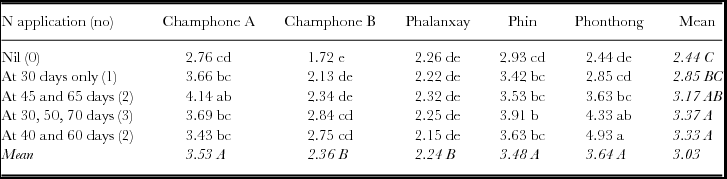
In the nested AOV for Experiment 1, district, nitrogen and district × nitrogen were all significant sources of variation for grain yield (F = 41.04, 12.96, 3.25, respectively, P < 0.01). On average, grain yields in Phalanxay and Champhone B districts were much lower than in Champhone A, Phin and Phonthong districts (Table 3). In contrast, 2–3 split applications of N increased grain yield, while a single application of N at about 30 days did not increase grain significantly under the dry start encountered in the 2015 season. At the low yielding sites, 2–3 splits of N resulted in no response in grain yield at Phalanxay, and a 50% increase in grain yield at Champhone B. At the high-yielding sites, 2–3 split applications of N increased grain yield by 30% at Champhone A and Phin, and by 75% at Phonthong. The highest grain yields were attained in Phonthong district with 2–3 split applications of N.
Experiment 1: Rice grain yield (Mg ha−1) in five N treatments × five districts in southern Lao PDR in 2015. l.s.d. for D, N and D × N were 0.43, 0.41 and 0.96 (P = 0.01).

Weed control and fertiliser in on-farm experiments
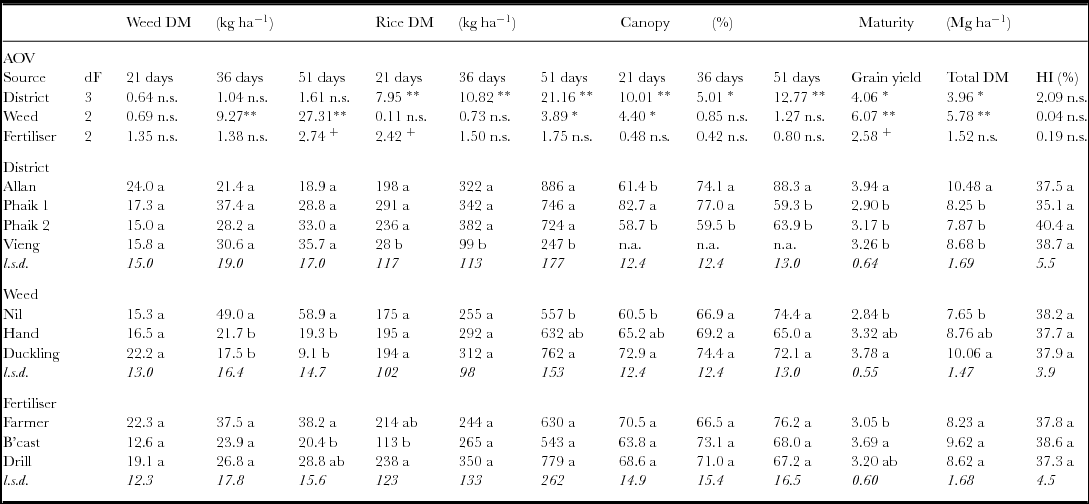
Nested factorial AOV showed district was a significant source of variation for DM accumulation of rice at 21, 36 and 51 days, for canopy cover at 21, 36 and 51 days and for final DM and grain yield at maturity (P = 0.01 to 0.05; Table 4). Weed control was a significant source of variation for weed DM at 36 and 51 days (P < 0.01), rice DM at 51 days (P < 0.05), canopy cover at 21 days (P < 0.05) and total DM and grain yield (P < 0.01) at maturity (Table 4). Fertiliser was only a significant source of variation for weed DM at 51 days, rice DM at 21 days and grain yield (P < 0.10).
Experiment 2: F values for the nested AOV for dry weight (DM) of weeds and rice and their combined canopy cover at 21, 36 and 51 days; and grain yield, total DM and harvest index of rice at maturity, +P < 0.10, *P < 0.05, **P < 0.01. Means for main effects of district, weed and fertiliser are shown, with their l.s.d. (P < 0.05). Means followed by the same letter do not differ significantly (P < 0.05).

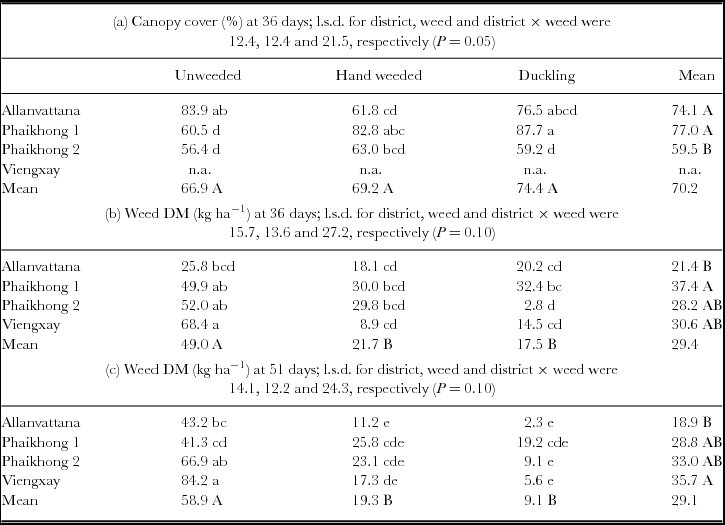
The response of canopy cover at 36 days differed significantly between districts (P < 0.05; Table 5), with Phaikhong 2 having less cover than Phaikhong 1 and Allanvattana. On average, weed control methods did not differ, though they interacted with district. Duckling and hand weeded had greater cover than unweeded at Phaikhong 1, unweeded had greater cover than hand weeded at Allanvattana, but there was no response in Phaikhong 2. Canopy cover was unexpectedly high in unweeded in Allanvattana (83.9%), in contrast to the other districts. For weed DM at 36 days (Table 5), unweeded had a significantly higher weed DM than hand weeded or duckling on average, and especially in Viengxay. Unweeded DM at Allanvattana was half that of other districts at 36 days. By 51 days, weed DM in unweeded significantly exceeded hand weeded and duckling, with the difference significant in Viengxay, Phaikhong 2 and Allanvattana, but not significant in Phaikhong 1 (Table 5). On average, weed DM in unweeded was four times that in hand weeded and duckling at 51 days.
Canopy cover (%) of rice and weeds at 36 days (a), and DM of weeds at 36 (b) and 51 (c) days (kg ha−1), for three weed control treatments in each of four districts in Lao PDR in 2016. Main effect means followed by the same capital letter, and interaction means followed by the same small letter, do not differ significantly (P < 0.10), based on l.s.d. for main effects and interactions shown for each trait.

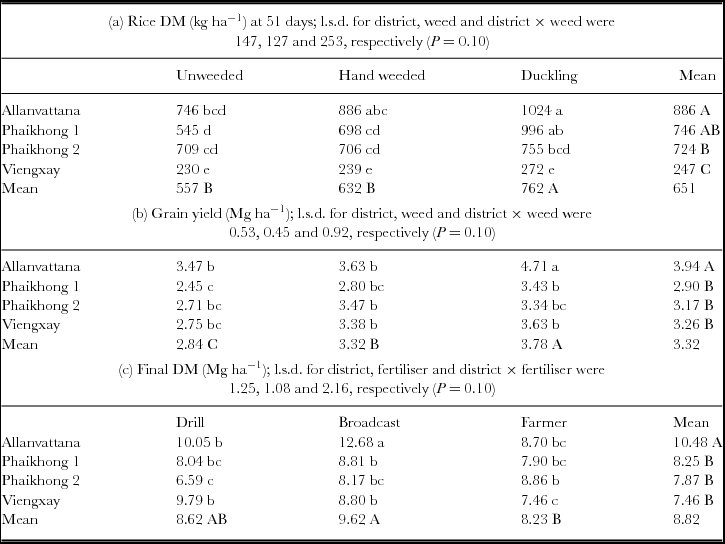
Rice DM at 51 days was approximately the inverse of patterns in weed DM at the same stage. Rice DM was significantly higher in duckling on average, and especially in Phaikhong 1 and Allanvattana, while Viengxay had low rice DM and was unresponsive (Table 6). At maturity, grain yield in ducklings exceeded hand weeded, which in turn exceeded unweeded on average, and especially in Allanvattana and Phaikhong 1 (Table 6). Allanvattana had higher grain yields than other districts, especially in ducklings.
Experiment 2. Rice DM at 51 days (kg ha−1) for three weed treatments (a), grain yield (Mg ha−1) for three weed treatments (b) and final DM (Mg ha−1) for three fertiliser treatments (c), in each of four districts in Lao PDR in 2016. Main effect means followed by the same capital letter, and interaction means followed by the same small letter, do not differ significantly (P < 0.10), based on l.s.d. for main effects and interactions shown for each trait.

The overall relationship between DM of rice and weed, and their subsequent expression in final DM and grain yield of rice, is shown in Figure S1. Early reduction in weed DM was associated with greater rice DM, which carried through to final DM and grain yield, with ducklings causing the highest yielding (Figure S1a). When percent variation for each stratum in the nested factorial AOV is considered (Table S2), the district × fertiliser interaction was a significant source of variation for weed DM at 21 days, rice DM at 21 days, final DM and harvest index. The district × fertiliser interaction for final DM showed Allanvattana had higher DM than other sites in response to fertiliser, and especially in the broadcast treatment at maturity (Table 6). Overall, drilled fertiliser had lower DM of weeds and higher DM of rice 21–51 days, but at maturity, broadcast fertiliser had higher final DM and grain yield (Figure S1b).
DISCUSSION
In considering the current context for farmer management of DDS, key needs and hence research questions centre around low-input integrated nutrient–weed management options. Hand weeding is commonly used but is labour intensive. Ducklings offer the potential to control weeds and improve productivity due to nutrient addition. The on-farm trials reported here provide some indication and supporting evidence for options to manage fertiliser and weeds within the DDS system to enhance productivity, in line with farmer preferences.
Nitrogen application strategies
The soils used in Champhone A and B and Phalanxay were generally more fertile than those in Phin and Phonthong, where organic C levels were extremely low (Table 1). DDS was always conducted in early June, and the chosen cultivars were similar in time to flowering (Table 1), although TSN9 and VT450-2 may be higher yielding than TSN7 and TDK8 (Sengxua et al., Reference Sengxua, Samson, Bounphanousay, Xayavong, Douangboupha, Harnpichitvitaya, Jackson and Wade2017). All of these sites were quite sandy in texture (Linquist and Sengxua, Reference Linquist and Sengxua2001), and toposequence position could be an important influence on crop duration (Wade et al., Reference Wade, Fukai, Samson, Ali and Mazid1999). Crop maturity was observed here to be slightly later in the mid toposequence at Phalanxay (Table 1). Seasonal conditions could further exacerbate these trends (Table S2), with the dry start in 2015 making it difficult to apply split applications of nitrogen early, reducing the likelihood of any early growth response. This dry start in 2015 could account for the lesser response to a single split application of N in experiment 1 (Table 3). Conversely, yields in the absence of split applications of N did not seem to closely match the soil nutrient analyses, so other factors must also have been involved, perhaps weeds, which would also have been favoured by the dry start, especially in the absence of ponded water (Kumar and Ladha, Reference Kumar and Ladha2011). Nevertheless, the recommended 2–3 split applications of N produced the highest yields, especially in the lower fertility districts of Phin and Phonthong (Table 3).
Weed control strategies
Canopy cover must reflect the presence of both the rice and weed components, though rice provides most of the DM. Small early-emerging weeds in DDS, in the absence of ponded water, could explain high estimates of early ground cover, while contributing little DM (Table 5a). Nevertheless, experiment 2 demonstrated the importance of early weed control, with weed DM increasing substantially in the unweeded treatment (Table 5b), and continuing to increase with time (Table 5c). In contrast, wseed control measures reduced weed DM (Table 5b), and reduced it further through time (Table 5c), especially in the presence of ducklings. The presence of ducklings for weed control could reduce pest incidence by insect predation, while at the same time, could also increase nutrient availability via excretion, which could explain the advantage over hand weeded. Districts differed in weed DM, with less weed DM in Alanvattana. The rice capitalised on these changes in weed competition, with rice DM showing almost opposite responses to weed dry matter by 51 days (Table 6a). The lesser response in rice DM to weed control at Alanvattana, relative to other districts, was due to its lesser weed pressure. These patterns in rice DM at 51 days carried through to maturity (Table 6b), as illustrated clearly in Figure S1a for the three contrasting weed control treatments. When weed DM was less, the higher rice DM at 51 days was able to carry through to maturity, resulting in higher final DM and grain yield, though harvest index was not affected (Table 4). These responses were consistent with the critical first six-week period for weed competition reported by Zimdhal (Reference Zimdhal2004), in the absence of later-emerging highly competitive grass weeds, such as Echinochloa spp., which can also reduce yield later.
Nutrient application strategies
For rice DM at 21 days, fertiliser was significant (P < 0.10), with fertiliser drilled with the seed resulting in a higher initial DM than broadcast, with farmer practice intermediate (Table 4). Though not significant, the trend was similar at 36 and 51 days. Likewise, for weed DM at 51 days, fertiliser was significant (P < 0.10), with farmer practice having the larger weed DM, exceeding the broadcast application, with drilled fertiliser intermediate (Table 4). Again, though not significant, the trend was similar at 21 and 36 days. Consequently, the response to fertiliser application method seems consistent from 21 to 51days, with drilled fertiliser benefitting early rice DM at 21 days, which resulted in a lesser increase in weed DM in the drilled treatment, relative to farmer practice (Figure S1b). In this case, however, the response did not carry through to maturity, where broadcast fertiliser had the higher final DM and grain yield (Figure S1b). This higher average yield in broadcast may be due to the higher final DM at Allanvattana, especially with broadcast fertiliser (Table 6c). Weed pressure was lower at Allanvattana, so broadcast fertiliser could have remained available there until after the dry August, in contrast to other sites. Presumably, the rice would access broadcast fertiliser later than when drilled with seed, unless the fertiliser was already taken up by weeds (or otherwise lost, e.g. to leaching). Consequently, at Allanvattana, rice in the broadcast treatment may have accessed the fertiliser around heading (September), which would have greater impact on final DM and grain yield. As a result, on average, final DM and grain yield were greater in broadcast in these conditions, despite the higher potential established by day 51 under drilled fertiliser. Under more favourable conditions, the earlier potential may have been expressed, but this requires further testing.
Implications from the farmer survey
Weeds were the biggest problem faced by farmers. 2016 was a particularly bad year for weeds due to rainfall deficit (Table 3), which favoured weed growth throughout the growing season. Thus, weeds were a problem in rice in general, so their incidence was less dependent on the establishment method than might normally be the case (Huang et al., Reference Huang, Zou, Jiang, Xia, Feng, Cheng and Mo2011; San-oh et al., Reference San-oh, Mano, Ookawa and Hirasawa2004; Yadav et al., Reference Yadav, Gill, Humphreys, Kukal and Walia2011). By use of DDS, however, farmers not only saved labour relative to transplanting, but the labour requirement was spread over a longer period, thereby reducing peak demand, and requiring fewer people, which was more compatible with other demands for labour, such as vegetable production or livestock rearing.
Saving labour was cited as one of the driving factors for adoption of the DDS technique. Thus, options for weed control that fitted within the preferred low-input (including low-labour) systems are required to help farmers improve productivity. There was a sense among Lao farmers, and supported by government policy, that farmers would prefer to minimise chemical use if possible; furthermore, agrochemicals were usually expensive, personal protective equipment was not available, and instructions were not written in the Lao language. Additionally, rice paddies in southern Laos support a vast array of animals, insects and plants that contribute to household food security, and it is important that this element of the wider agro-ecological system is considered in any recommendation strategies. In northern Laos, such non-rice products from paddies have been found to contribute more to household food security than the rice itself, so freedom from agrochemical damage is important in these smallholder systems. In neighbouring regions of Thailand, however, the use of herbicides in dry-seeded rice increased from 36 to 92% between 1998 and 2009 (Pandey et al., Reference Pandey, Suphanchaimat and Velasco2012), so a similar trend may be anticipated in Lao PDR, if farmers do not have viable alternatives to agrochemicals for weed and pest control.
Currently, most farmers managed weeds by hand weeding, or did nothing and traded-off yield against labour inputs. While hand weeding was most frequently reported, this could be because other options were not commonly practiced at this stage, suggesting a need to promote alternative techniques. The results here suggest ducklings provided an additional option for weed suppression (Section 4.2), while saving labour, and at the same time, providing yield benefits in rice beyond hand weeding alone, and in an environmentally sustainable manner.
Farmers responded enthusiastically to the duckling trials, observing that weed control was good in paddies containing ducks (with no additional weeding required), in addition to being able to make a profit selling ducks and eggs. Profit ranged from 320 000 LAK to 3.2 million LAK (AU$53–$567), with an average of 1.8 million LAK (AU$293) after around four months. Profit depended on the amount of additional feed supplied. Where the natural feed availability was high (weeds, insects, snails, etc.), there was no need for additional feed, which increased profits. In terms of labour requirements, ducklings fit well with the farming system in terms of time management, only requiring around 11 days per season (i.e. only 30 minutes per day once the fence and hut has been constructed). Potential barriers to adoption include availability of ducklings at key times in the season and up-front investment costs (around 1 million LAK or AU$166).
Farmers reported a range of potential options for adapting and improving the mechanised DDS technology to fit within their systems. The ability to adjust seeding rate was deemed important, particularly to reduce plant density closer to that of traditional transplanting approaches. For managing fertiliser, the most common desire was to be able to apply basal fertiliser with the seed, and then top-dress later, in line with local technical recommendations (P. Sengxua, NAFRI, personal communication). But farmers often lacked the machinery to do this, and wanted seeding machinery with adjustable seed rate and a fertiliser box, such as we introduced here, with positive responses to banded fertiliser with the seed. Further options should also be considered, such as mechanical weeding, either with rotary weeders, or perhaps by repositioning the seeder tines behind the hand tractor for shallow inter-row cultivation once the rice is tillering, especially if the soil surface is dry and early weed pressure is severe.
Farmers noted that sowing should be performed in lower paddies first, with higher paddies either sown later or not at all. This is consistent with experience elsewhere on ease of land access and expected crop duration from high to low topography (Wade et al., Reference Wade, Fukai, Samson, Ali and Mazid1999), but also takes account of the compromise between labour productivity and production risk. Low-yielding and high-weed-pressure locations higher in the topography are less favoured (coarser soil texture, lower soil fertility and a lesser duration of standing water; Linquist and Sengxua, Reference Linquist and Sengxua2001), so perhaps would require herbicides to assure their weed control, which may be cost prohibitive. Indeed, during the introduction of multi-crop seeders by Australia's Crawford Fund in seven districts of Savannakhet in March 2017, several farmers independently suggested they would use them to sow forage and fodder crops on the higher topographic positions, as that should provide superior household income to low-yielding rice there. Making land use consistent with its suitability, while still supporting food security and farmer livelihood, is an important system consideration.
CONCLUSION
This research has important consequences for subsistence farmers in rural Laos and elsewhere, who are still dependent on rice as a major component of household food security. As labour shortage is forcing the replacement of transplanting, and with DDS yields more variable than transplanted rice due to weeds and unreliable nutrient responses, there is a need to develop robust strategies based on locally tested options. This paper demonstrates that weed control is a major concern for farmers in southern Laos who have adopted DDS. In order to avoid farmers becoming heavily dependent on chemical methods of weed control as is common in locations where DDS has been adopted on a wide scale, it is timely to explore alternative options, including integrated approaches to weed and nutrient management. The results presented here clearly demonstrated the benefits of placing nutrients with the seed for early vigour and weed competitiveness. Likewise, early weed control using ducklings or hand weeding supressed weeds and increased rice growth, which carried through to final dry matter and yield, with ducklings providing an additional yield benefit over hand weeding. Consequently, mechanised DDS with fertiliser banded with the seed, fertiliser top-dressed later, together with ducklings for weed suppression, is an example of the use of ‘many small hammers’ in integrated nutrient–weed management (Rao et al., Reference Rao, Johnson, Sivaprasad, Ladha and Mortimer2007), rather than relying on one large hammer alone. Such integrated nutrient and weed management approaches can reduce yield variability and improve sustainability of DDS rice systems, with important implications for smallholder farmers and their environments.
Acknowledgements
This work was supported by the Australian Centre for International Agricultural Research (ACIAR) under grant number CSE/2014/086, Crop-Livestock Systems Platform for Capacity Building, Testing Practices, Commercialisation and Community Learning. We thank farmers, and Provincial and District Agriculture and Forestry Officers for their work in conducting the on-farm trials.
SUPPLEMENTARY MATERIAL
To view supplementary material for this article, please visit https://doi.org/10.1017/S0014479718000145