Implications
Heat stress effects on sow reproduction are well known. However, most studies were conducted in warm climates using data of nearby weather stations. Temperature and humidity values recorded on-farm are rarely used. The temperature–humidity index (THI), which became important in judging heat stress effects in cattle, is hardly used in sows. This study showed that climatic conditions during summer months under moderate conditions have adverse effects on sow fertility, whereas piglet survival is favored by elevated temperature and THI. Considering the predicted heat waves owing to changing climatic conditions, effects may become more pronounced in the future.
Introduction
Owing to their low sweating capacity, sows are very sensitive to high ambient temperatures. Negative effects of increased temperatures on sow reproduction include prolonged weaning-to-service intervals, increased numbers of regular and irregular returns to estrus, reduced litter size (Edwards et al., Reference Edwards, Omtvedt, Tuesman, Stephens and Mahoney1968; Almond and Bilkei, Reference Almond and Bilkei2005; Suriyasomboon et al., Reference Suriyasomboon, Lundeheim, Kunavongkrit and Einarsson2006) and reduced milk yield (Renaudeau and Noblet, Reference Renaudeau and Noblet2001). Considering the rising reproductive performances of sows, which have been realized in the last decades and resulted in rising metabolic heat production of the animals, heat stress effects may even be expected under conditions of moderate climates. Nevertheless, studies on heat stress in sows were conducted under subtropical and tropical conditions mostly, and thus, are not directly comparable to the moderate climatic conditions in Germany or Central Europe in general. Furthermore, as predicted by the Intergovernmental Panel on Climate Change (2007), changing climatic conditions will increase the incidence of heat waves. Even though the climate in Germany is moderate, summer heat waves and the predicted higher temperatures have potential detrimental effects on animal health, welfare and productivity (Renaudeau et al., Reference Renaudeau, Collin, Yahav, de Basilio, Gourdine and Collier2012; Sanker et al., Reference Sanker, Lambertz and Gauly2013). Direct and indirect effects of global warming on dairy cows are well described in literature, but regional effects are not well examined (Gauly et al., Reference Gauly, Bollwein, Breves, Brügemann, Dänicke, Das, Demeler, Hansen, Isselstein, König, Lohölter, Martinsohn, Meyer, Potthoff, Sanker, Schröder, Wrage, Meibaum, von Samson-Himmestjerna, Stinshoff and Wrenzycki2013); on pigs there is even less information available. Heat stress in animals begins with the excess of the upper critical temperature of the thermoneutral zone (Black et al., Reference Black, Mullan, Lorschy and Giles1993), which in sows was reported to be about 22°C (Bianca, Reference Bianca1976). Recent results of Bloemhof et al. (Reference Bloemhof, Mathur, Knol and van der Waaij2013) confirmed this threshold for different sow genotypes under a warm climate in Spain. Besides, temperature being the most important parameter whenever the thermal environment of an animal is assessed, the relative humidity plays an essential role as well. Though, relative humidity was thought to play a minor role within the thermoneutral zone, it becomes more important for pigs with increasing temperatures (Huynh et al., Reference Huynh, Aarnink, Verstegen, Gerrits, Heetkamp, Kemp and Canh2005). Thus, a variety of indices were developed to describe thermal effects on animals including the relative humidity in addition to the temperature. The temperature–humidity index (THI) is commonly used as an indicator of heat stress, particularly in dairy cows (Brügemann et al., Reference Brügemann, Gernand, König von Borstel and König2012). However, THI thresholds for heat stress in sows have not been described for Central European environmental conditions. Therefore, the objective of this study was to assess the effect of temperature and THI on the reproductive performance of sows and piglet survival under climatic conditions of Northern Germany.
Material and methods
Animals and housing systems
The study included six piglet producing farms located in Lower Saxony, Northern Germany. Herd sizes varied from 228 to 1116 sows. Sow genotypes originated from four breeding organizations, namely BHZP (Ellringen, Germany), Hermitage Germany (Golzow, Germany), Danzucht (DanAvl, Kopenhagen, Danmark) and PIC Germany (Schleswig, Germany). The percentages of observations for the corresponding genotypes in the whole data set were 53%, 27%, 17% and 3%, respectively. All sows were kept in closed insulated and mechanically ventilated stables. Sows were kept in single confinement for artificial insemination for the following 4 weeks. During the waiting period, sows from five farms were kept in groups and one farm kept sows in single crates throughout the whole waiting period. One week before farrowing, sows were moved to single farrowing crates. All farms induced birth by injection of prostaglandin F2α on the 114th day of pregnancy. Piglets were weaned after 21 to 28 days. Sows were fed once or twice a day and water was available ad libitum. Three types of ventilation systems were used in the farms, namely stream ventilation systems (air inlets or nose ventilation), diffusive ventilation through porous channels and corridor ventilation, where the air was supplied through the doors. In the farrowing units four farms had nose ventilation and two farms used corridor ventilation. In the servicing units two farms had air slots, two porous channels and two had corridor ventilation. In the waiting units air was supplied through corridor ventilation in three farms, porous channel in one and by wall inlets in the other two farms.
Temperature, relative humidity and THI
Air temperature and relative humidity were measured at 15 min intervals by data loggers (Tinytag Plus 2, TPG-4500; Gemini Data Loggers, Chichester, UK) from July 2011 to August 2012. In each farm six data loggers were installed with two in the farrowing, servicing and waiting compartment, respectively. They were adjusted to hang freely from the ceiling at a height of 1.3 to 1.5 m in the farrowing and servicing units and 1.7 m in the waiting unit in order to prevent sows from reaching the devices. The loggers were installed away from sources of heat, such as heaters for piglets or solar radiation through windows. Outside temperature and relative humidity were obtained from the nearest weather station of the German meteorological service (DWD). The distance of the stations to the farms was 14 km on average. Pre-analysis showed that temperature and THI did not differ significantly between the compartment types, thus similar climatic conditions were assumed in all compartments of the same compartment type of each farm.
Hourly averages of the two data loggers of each compartment were used to calculate the THI according to the following formula of the National Weather Service Centre Region (NWSCR, 1976):
 $${\rm THI}=\left[ {\left( {{\rm 1}.{\rm 8T}} \right){\plus}{\rm 32}} \right]-\left[ {0.{\rm 55}\ \left( {{\rm RH}/{\rm 1}00} \right)} \right]{\times}[(({\rm 1}.{\rm 8T}){\plus}{\rm 32})-{\rm 58}]$$
where T is the air temperature in °C and RH the relative humidity in %. Average and maximum daily THI as well as monthly means were calculated.
Sow reproductive performance data
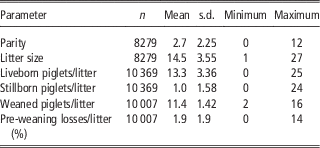
Individual sow data were extracted from the management software of the farms. In all farms the herd-monitoring PC-program db-Planer (Version V1209; BHZP) was used. Data included sow identity, mating date, parity, farrowing date, number of liveborn, stillborn and weaned piglets, weaning date and pre-weaning mortality. The total number of piglets born was calculated from the data. A total of 8279 successful inseminations were analyzed after breeding within the studied period and a second data set contained 10 369 litters that were born within the studied period. Table 1 gives an overview of the reproductive performance data.
Reproductive performance parameters of the six studied farms

Statistical analysis
Data were analyzed using the statistical package SAS 9.3 (SAS Institute Inc., Cary, NC, USA). Parity was grouped in five classes as following: 1=maiden gilts; 2=first parity sows; 3=sows with two litters; 4=sows with three and four litters; and 5=sows with more than four litters. Seasons were defined in the following way: spring (March to May), summer (June to August), autumn (September to November) and winter (December to February) according to the meteorological seasons. Sow performance data and the according climate data were merged. The climate data from the servicing units were used to study the climatic effect for the period around breeding on the total number of piglets born. Those climate data recorded in the farrowing units were used for the period before and after farrowing on the parameters liveborn, stillborn, weaned piglets and the pre-weaning mortality. Cleaning periods in the farrowing units were excluded from the analysis.
The data were analyzed separately for each of the 7 days postpartum and post breeding and 5 days antepartum. A period of 5 days before farrowing was chosen because the sows of all farms were then kept in the farrowing units. The period 7 days postpartum was chosen due to the fact that pre-weaning mortality is described to be highest within this period (Quiniou et al., Reference Quiniou, Dagorn and Gaudré2002). Furthermore, means for the 1st, 2nd and 3rd week post insemination were calculated, referring to studies that indicate the greatest effects within this time period (Bloemhof et al., Reference Bloemhof, Mathur, Knol and van der Waaij2013). Data for each dependent variable were analyzed with a mixed model that included fixed effects of parity (1 to 5), season (1 to 4), farm (1 to 6), and the interaction effect between parity and season as well as farm and season. The effect of daily THI or temperature was included in the model as a covariate. As shown in the following, the model included the effect of the individual animal within farm as random:
 $${\rm Y}_{{ijklmn}} =\mu {\plus}{\rm P}_{i} {\plus}{\rm S}_{j} {\plus}\left( {{\rm PS}} \right)_{{ij}} {\plus}{\rm F}_{k} {\plus}\left( {{\rm FS}} \right)_{{ki}} {\plus}{\rm THI}_{l} {\plus}a\left( {\rm F} \right)_{m} {\plus}{\varepsilon}_{{ijklmn}} $$
where Y ijklmn is the observation; µ the overall mean; P i the effect of parity (i=1 to 5); S j the effect of season (j=1 to 4); (PS) ij the interaction effect between parity and season; F k the effect of farm; (FS) ki the interaction between farm and season; THI l the effect of THI (or temperature) as covariate; a(F) m the individual random animal effect within farm; and ε ijklmn the residual random error. A separate data analysis for each day was conducted owing to the data structure where the covariate independent variables (temperature and THI) had different values for the consecutive days while the response of the dependent variable (e.g. number of liveborn piglets) was the same for all subsequent consecutive days. Tukey adjusted post-hoc comparisons (α<0.05) were employed to partition effects of the factors. The results are presented as least square means and their standard errors.
Results
Environmental conditions
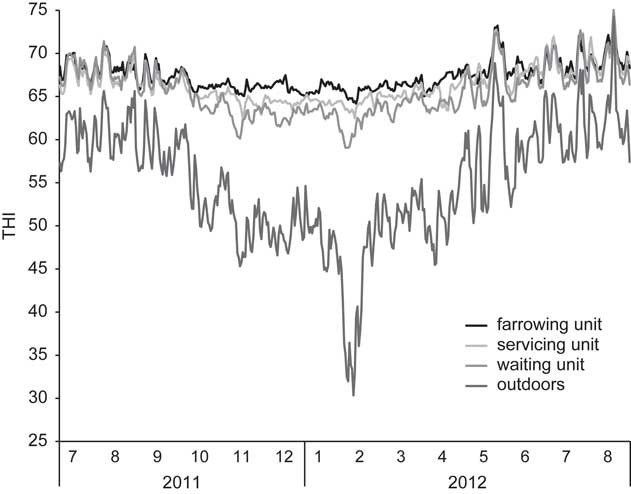
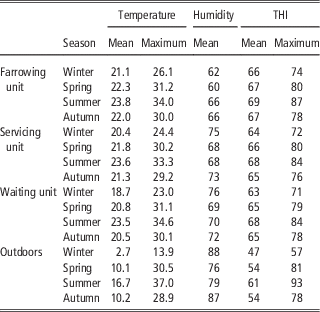
Figure 1 shows the course of the average THI in the different units and outdoors throughout the studied period. From May to September all compartments had similar average THI values and temperatures. The indoor measurements followed the course of the outdoor climate. In the colder seasons, from October to April, the farrowing units were more independent from the outside climate and had a constantly warmer climate than the waiting and servicing units. Temperature and THI in the waiting units dropped lower in the winter months than in the other two compartments. The seasonal mean and maximum temperatures, relative humidity and THI throughout the studied period are given in Table 2. Except for the farrowing units mean relative humidity was lowest in spring and summer. Maximum temperatures exceeded 30°C in all seasons apart from winter. Differences of the average indoor THI were low between seasons. Mean outdoor temperature, relative humidity and THI during the studied period were 10.8°C, 82.5%, and 54, respectively.
Average daily THI*-values measured in the farrowing, servicing and waiting units and outdoors throughout the experimental period in the six piglet-producing farms located in Northern Germany. *THI=[(1.8T)+32]–[0.55 (RH/100)]×[((1.8T)+32)–58] (NWSCR, 1976). THI=temperature–humidity index.

Mean and maximum temperature and temperature–humidity index (THI) and mean relative humidity in the four seasons throughout the studied period in the farrowing, servicing and waiting compartments and outdoors

Seasonal and parity effects on reproductive performance
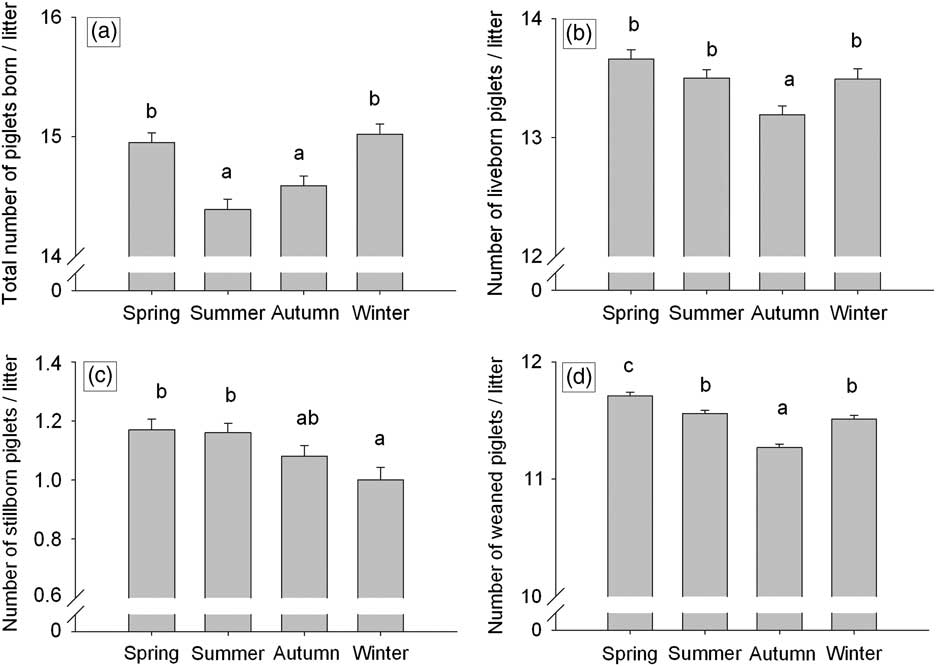
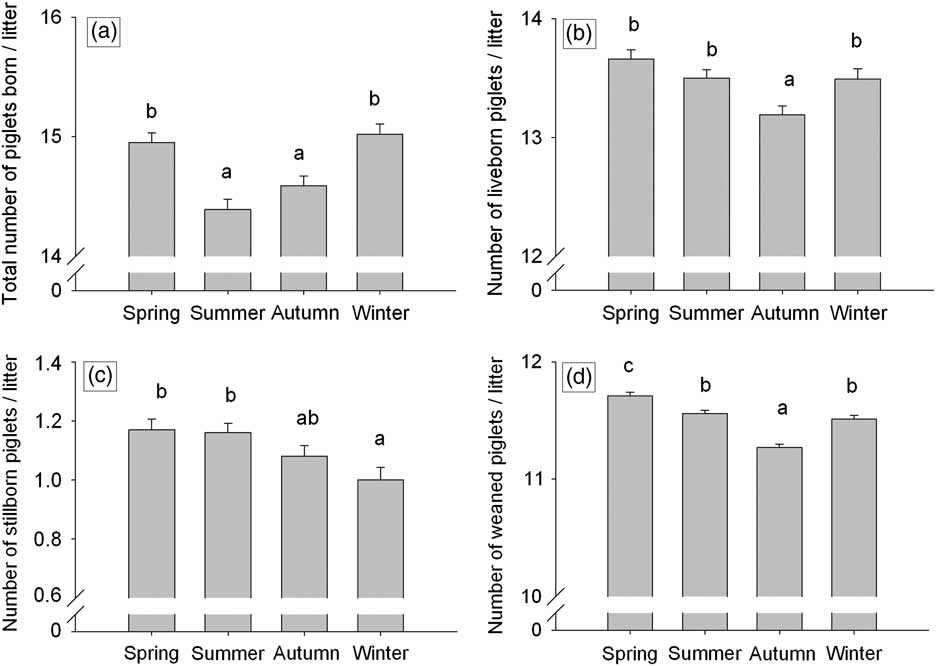
Season and parity significantly influenced sow reproductive performance parameters (P<0.001). Sows inseminated in summer and autumn had significantly reduced numbers of piglets born per litter (Figure 2a; P<0.001). Sows farrowing in autumn had fewer liveborn piglets (P<0.05) than in the other three seasons (Figure 2b). The number of stillborn piglets born in spring and summer was higher (P<0.01) compared with winter (Figure 2c). The highest and the lowest numbers of weaned piglets were quantified in spring and autumn, respectively (Figure 2d; P<0.05), whereas numbers did not differ between summer and winter (P>0.05).
Seasonal effects on the total number of piglets born measured on the day of breeding (a) and the number of liveborn (b), stillborn (c) and weaned piglets per sow (d) when measured on the day of farrowing. a,bDifferent superscripts indicate significant differences at P<0.05 (Tukey-test).
The effect of parity on the total number of piglets born as well as the number of liveborn piglets significantly increased to a maximum in the second and third to fourth parity and decreased again in sows with more than five parities (P<0.01). The number of stillborn piglets was lowest in first parity sows (0.8), but then increased significantly with increasing parity up to 1.44 in sows with more than five parities (P<0.05). The number of weaned piglets was highest in maiden gilts with 12.2 piglets/litter and decreased to 11.0 in sows with more than five parities (P<0.001). The interaction of season and parity was significant for liveborn, stillborn and weaned piglets and the pre-weaning mortality. In spring and summer second parity sows had the highest number of liveborn piglets while in autumn and winter third and fourth parity sows had the greatest number. Except for spring, maiden gilts and sows with more than four litters had the lowest numbers of liveborn piglets. Maiden gilts had the second highest number of liveborn piglets within that season. Throughout all seasons gilts had the lowest number of stillborn piglets, which increased from maiden gilts and second parity sows to sows exceeding the fourth litter in all seasons. Nearly identical numbers of weaned piglets were found throughout all seasons. Number of weaned piglets decreased from maiden gilts to sows with more than four litters. Pre-weaning mortality was nearly constant throughout all seasons and parities. Gilts had the lowest pre-weaning mortality in spring and autumn.
Climatic effects on sow fertility and piglet survival
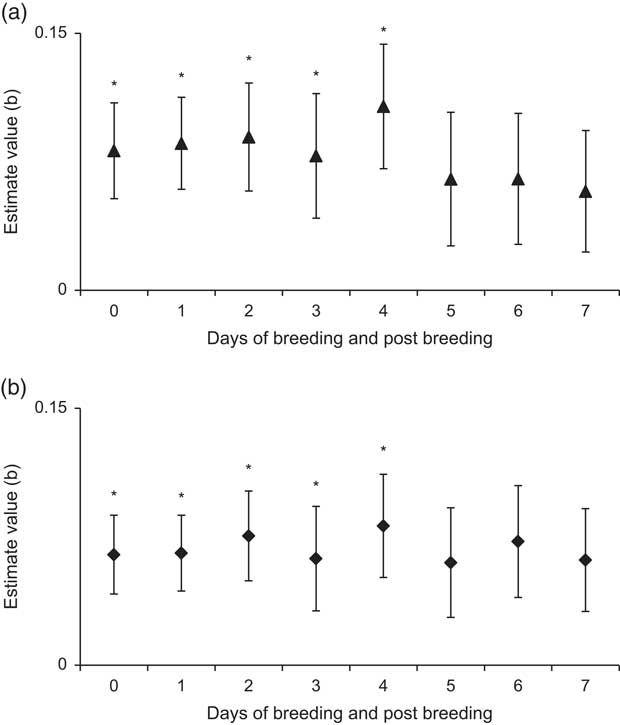
Coefficients of correlation between temperature and THI, respectively, and reproductive parameters were in general low (ranging from −0.08 for pre-weaning mortality to 0.08 for weaned piglets), although mostly statistically significant, except for the number of total born piglets, where only day 2 was significant (P<0.05). A warmer climate in the 1st week after insemination had a significantly positive effect on the total number of piglets born (P<0.05). Results for the 2nd and 3rd week after insemination indicated non-significant influences of temperature and THI on the total number of piglets born (P>0.05). Therefore, the data were analyzed on a daily basis only for the 1st week after insemination. On the day of breeding and post-breeding days 1 to 4, significantly positive linear effects (shown as covariate estimate effects – b-values in Figure 3a and b) of temperature and THI on the total number of piglets born per litter were quantified (P<0.05).
Regression coefficients of temperature (a) and temperature–humidity index (THI) effects (b) on the total number of piglets born per litter when measured on the day of breeding and 7 days post breeding. *Significant regression coefficients at P<0.05.

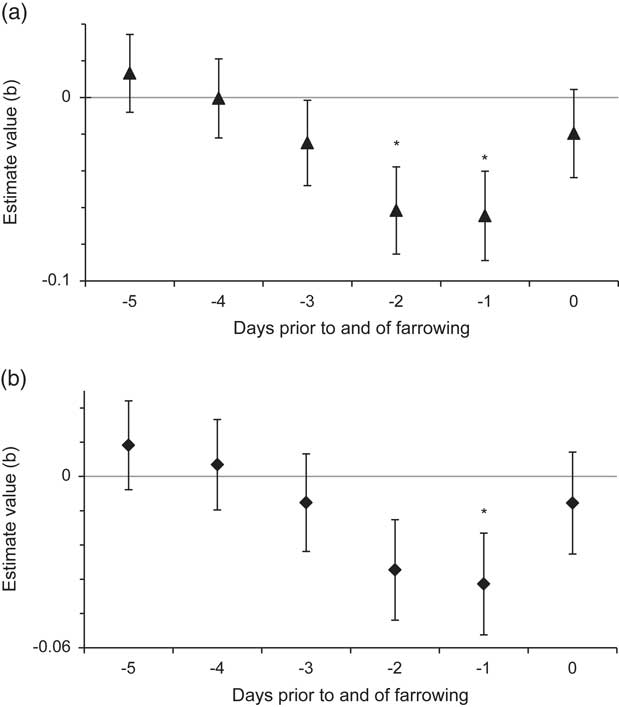
As shown in Figure 4a, temperature was negatively related to the number of liveborn piglets on the 2 days before parturition (P<0.05). THI had a negative effect on the number of liveborn piglets on the day before farrowing (P<0.05; Figure 4b). No effect of temperature or THI on the number of stillborn piglets was found (P>0.18).
Regression coefficients of temperature (a) and temperature–humidity index (THI) effects (b) on the number of liveborn piglets per litter measured on the 5 days prepartum and the day of parturition. *Significant regression coefficients at P<0.05.

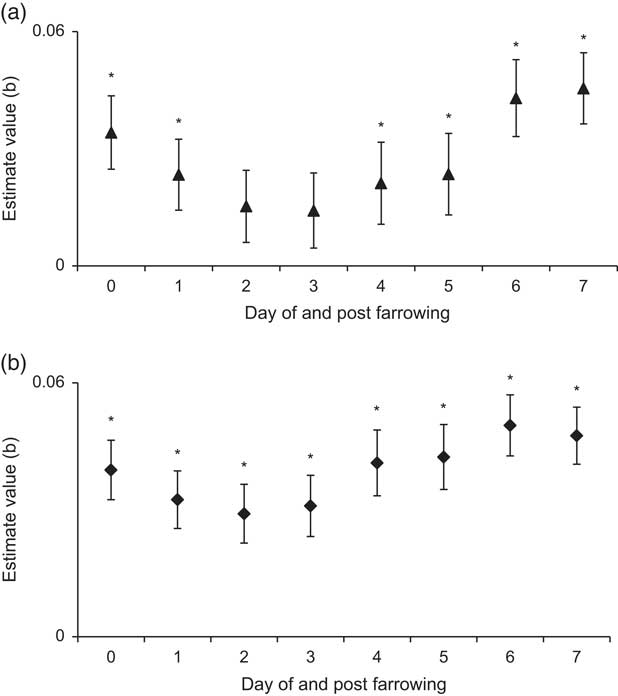
Higher temperatures on the day of farrowing, the 1st and the 4th to 7th day postpartum were associated with a higher number of weaned piglets (P<0.05; Figure 5a). Similar findings were recorded for the THI values for all days from the day of farrowing on (P<0.01; Figure 5b) The pre-weaning mortality was significantly reduced if temperature and THI increased on the day of farrowing and on the 5th day after farrowing for rising THI values (P<0.05). The interaction of farm and season was significant for all variables (P<0.05).
Regression coefficients of temperature (a) and temperature–humidity index (THI) effects (b) on the number of weaned piglets when measured on the day of farrowing and the 7 postpartum days. *Significant regression coefficients at P<0.05.

Discussion
Environmental conditions
The thermal environment of animals is complex. Air temperature alone describes the climatic environment insufficiently (McArthur, Reference McArthur1987; Nardone et al., Reference Nardone, Ronchi, Lacetera and Bernabucci2006). Beside temperature, relative humidity, air movement and radiation have significant influences on the thermal balance and well-being of animals (Seedorf et al., Reference Seedorf, Hartung, Schröder, Linkert, Pedersen, Takai, Johnson, Metz, Groot Koerkamp, Uenk, Phillips, Holden, Sneath, Short, White and Wathes1998). However, in closed insulated and mechanically ventilated buildings air temperature and relative humidity in combination are appropriate parameters for the assessment of the thermal environment (Seedorf et al., Reference Seedorf, Hartung, Schröder, Linkert, Pedersen, Takai, Johnson, Metz, Groot Koerkamp, Uenk, Phillips, Holden, Sneath, Short, White and Wathes1998). As the results of the present study demonstrated, mean and maximum values for temperature and THI from spring to autumn reached levels that are assumed to induce heat stress in sows considering the commonly proposed upper critical temperature of 22°C (Bianca, Reference Bianca1976; Bloemhof et al., Reference Bloemhof, van der Waaij, Merks and Knol2008). The climatic conditions inside the barns are controlled by the ventilation rate, but high maximum temperatures indicate the limits of thermoregulation in mechanically ventilated buildings (Boon, Reference Boon1978; Seedorf et al., Reference Seedorf, Hartung, Schröder, Linkert, Pedersen, Takai, Johnson, Metz, Groot Koerkamp, Uenk, Phillips, Holden, Sneath, Short, White and Wathes1998). Mean relative humidity was within the normal range throughout the studied period. While low relative humidity should be avoided causing dust generation and drying of mucous membranes of the upper respiratory tract, high relative humidity in combination with high ambient temperatures can be detrimental to pigs, as a result of the limited heat loss through evaporation (Seedorf et al., Reference Seedorf, Hartung, Schröder, Linkert, Pedersen, Takai, Johnson, Metz, Groot Koerkamp, Uenk, Phillips, Holden, Sneath, Short, White and Wathes1998).
For cattle in subtropical and tropical climates, THI formulas were proposed with different weights put on the temperature and relative humidity (Bohmanova et al., Reference Bohmanova, Misztal and Cole2007; Sanker et al., Reference Sanker, Lambertz and Gauly2013). The THI produces an index value, which represents the effect on the animal (Hahn et al., Reference Hahn, Gaughan, Mader and Eigenberg2009). For Central European climatic conditions a particular formula is not available. Using the formula proposed by the National Research Council (1971) Brügemann et al. (Reference Brügemann, Gernand, König von Borstel and König2012) suggested a heat stress threshold of THI=60 for cattle in Northern Germany, which is much lower than the thresholds determined by studies in the United States.
In this study, the formula proposed by the NWSCR (1976) was chosen referring to studies in sows that were performed under comparable environmental conditions (Haeussermann et al., Reference Haeussermann, Hartung, Jungbluth, Vranken, Aerts and Berckmans2007). Although the effects of the temperature in comparison to the THI on the various reproductive parameters studied here differed only slightly and the importance of the relative humidity under Central European conditions is lower than for subtropical and tropical conditions, the use of the THI is recommended whenever the thermal environment is evaluated.
Seasonal and parity effects on reproductive performance
Season is known to influence the reproductive performance of sows, which is confirmed by our results. Although the domestic pig is considered non-seasonal regarding its reproductive behavior, a reduction in the reproductive performance of the sow in summer and autumn led to the term ‘seasonal infertility’ (Wan et al., Reference Wan, Hennessy and Cranwell1994; Love et al., Reference Love, Klupiec, Thornton and Evans1995). For the seasons summer and autumn the greatest effect on litter size, number of liveborn and weaned piglets was noted. Heat stress and photoperiod were suggested to be the main reasons for seasonal infertility (Love et al., Reference Love, Klupiec, Thornton and Evans1995), which was lately supported by results of Auvigne et al. (Reference Auvigne, Leneveu, Jehannin, Peltoniemi and Sallé2010). But Wan et al. (Reference Wan, Hennessy and Cranwell1994) stated, that if these were the major causes, all farms should be concerned and seasonal infertility should not occur in winter months. Accordingly, seasonal infertility is an effect of various stressors on individual animals including management, stock people, parity, health status, housing and feeding (Nardone et al., Reference Nardone, Ronchi, Lacetera and Bernabucci2006; Hälli, Reference Hälli2008).
As expected, parity influenced the reproductive performance of the sows. In agreement with other studies gilts had a lower litter size than multiparous sows, which can mainly be explained by their lower BW and size (Tantasuparuk et al., Reference Tantasuparuk, Lundeheim, Dalin, Kunavongkrit and Einarsson2000; Suriyasomboon et al., Reference Suriyasomboon, Lundeheim, Kunavongkrit and Einarsson2006; Bloemhof et al., Reference Bloemhof, Mathur, Knol and van der Waaij2013). With increasing parity, the number of piglets increases through an increase in ovulation rate and uterine capacity and at higher parities is reduced by age (Leenhouwers et al., Reference Leenhouwers, van der Lende and Knol1999). Consistently, the number of stillborn piglets decreased from the first to the second parity, because of a shorter duration of birth and wider birth channels (Leenhouwers et al., Reference Leenhouwers, van der Lende and Knol1999). Gilts had the highest number of weaned piglets although litter size and the number of liveborn piglets were lower than in third and fourth parity sows. This can be partly explained by the cross-fostering of piglets and the use of gilts as nurses.
Climatic effects on sow fertility and piglet performance
The period in which sows are exposed to heat stress during pregnancy plays an important role (Edwards et al., Reference Edwards, Omtvedt, Tuesman, Stephens and Mahoney1968; Omtvedt et al., Reference Omtvedt, Nelson, Edwards, Stephens and Turman1971; Black et al., Reference Black, Mullan, Lorschy and Giles1993). As previously reported, gilts are most sensitive in the 1st weeks after insemination and last part of pregnancy, but not during mid-pregnancy (Edwards et al., Reference Edwards, Omtvedt, Tuesman, Stephens and Mahoney1968; Omtvedt et al., Reference Omtvedt, Nelson, Edwards, Stephens and Turman1971). Omtvedt et al. (Reference Omtvedt, Nelson, Edwards, Stephens and Turman1971) found the greatest reduction in viable embryos 8 to 16 days post breeding concluding that the implantation period is the most critical period for heat stress. These results were recently confirmed by Bloemhof et al. (Reference Bloemhof, Mathur, Knol and van der Waaij2013) who found that the period between 7 days prior and 12 days after successful insemination had the most pronounced effect on the number of total born piglets. According to these results we focused our analysis on the period from the breeding day until the following 3 weeks and around farrowing. Negative effects on litter size were not found and indicate that temperature and THI did not reach levels during breeding at which negative effects on litter size are induced. The increase in the total number of piglets born with increasing temperature or THI after insemination is only expected for the range of climatic values measured in the present study. A further increase is only expected until a certain threshold above which a decline in the total number of piglets is expected. Almond and Bilkei (Reference Almond and Bilkei2005) found a significant reduction of litter size comparing weeks with temperatures above 35°C and beneath 30°C. Negative effects of high temperature, high relative humidity and the combination of both on litter size were reported by Suriyasomboon et al. (Reference Suriyasomboon, Lundeheim, Kunavongkrit and Einarsson2006). However, other studies did not confirm adverse effects of temperature and THI on litter size or the number of stillborn piglets (McGlone et al., Reference McGlone, Stansbury and Tribble1988a; Johnston et al., Reference Johnston, Ellis, Libal, Mayrose and Weldon1999). High temperatures or THI 2 days before farrowing reduced the number of liveborn piglets. This is in accordance with Omtvedt et al. (Reference Omtvedt, Nelson, Edwards, Stephens and Turman1971) who found significantly higher numbers of stillborn and less liveborn piglets in heat-stressed gilts from 102 to 110 days post breeding.
While sows have a temperature optimum of about 22°C (Black et al., Reference Black, Mullan, Lorschy and Giles1993; Bloemhof et al., Reference Bloemhof, van der Waaij, Merks and Knol2008), the lower critical temperature in piglets lies at about 33°C in the first days of life (Bianca, Reference Bianca1976). We suppose that this is the reason why increasing temperature and THI values during the first days after farrowing are associated with a higher number of weaned piglets and lower pre-weaning mortality. A warmer climate after birth reduces the risk of hypothermia and death. This is supported by the data provided by McGlone et al. (Reference McGlone, Stansbury, Tribble and Morrow1988b) who found that piglet survival was improved at 30°C in contrast to thermoneutral conditions of the sow. However, in their study piglet weight gain was suppressed under hot conditions. Negative effects of high ambient temperatures on piglets are likely to be caused by lower milk yields of heat-stressed sows (McGlone et al., Reference McGlone, Stansbury, Tribble and Morrow1988b; Johnston et al., Reference Johnston, Ellis, Libal, Mayrose and Weldon1999; Renaudeau and Noblet, Reference Renaudeau and Noblet2001). The creation of a farrowing barn with a thermal environment that simultaneously fulfills the needs of the litter and the sow is not easy to obtain (McGlone et al., Reference McGlone, Stansbury, Tribble and Morrow1988b). There are two possible ways to ensure a suitable environment for sows and piglets. On the one hand, a warm microenvironment for the piglets and its delimitation to the sow by covering piglet boxes with zone heating is possible (McGlone et al., Reference McGlone, Stansbury, Tribble and Morrow1988b), though not commonly used under practical conditions in Germany and problems with the delimitation may occur. On the other hand, a warm environment for the piglets and zone cooling for sows can be used (McGlone et al., Reference McGlone, Stansbury and Tribble1988a). Nevertheless, effective cooling methods for sows such as drip cooling, turned out to have negative effects on litter performance on concrete floors (McGlone et al., Reference McGlone, Stansbury and Tribble1988a). In our study, the farm effect included the ventilation system and also ventilation rate next to genotype, management, nutrition and building effects. An interaction of farm and season was expected but no generalized conclusions can be drawn from these particular results.
In conclusion, the present findings demonstrated that sows kept in closed stables are exposed to heat stress conditions in Northern Germany during the summer months. Temperature and THI affected the reproductive performance of the sows and the survival of the piglets. While increased climatic values at the time of farrowing negatively affected the reproductive performance of the sows, piglets’ survival increased with higher temperature and THI values. Considering rising metabolic heat loads of the sows owing to increasing reproductive performance and the predicted changes of the climatic conditions ventilation systems should be optimized to alter effects of summer heat waves.
Acknowledgments
The project was supported by the Ministry for Education and Research within the network NaLaMa-nT – sustainable land use management in the Northern German lowlands (033L029B). The authors would like to thank all farmers who participated in this study.