Introduction
Alzheimer's disease and related dementias (ADRD) affect 46.8 million people in the world and close to one-fifth of people living with ADRD reside in mainland China (Prince et al., Reference Prince, Wimo, Guerchet, Ali, Wu and Prina2015). By the year 2050, the number of people living with ADRD in mainland China is estimated to increase to 40 million and comprise one-third of the global estimate (Alzheimer's Association, 2013). The increasing prevalence of ADRD brings concerns about stigma, which is broadly considered one of the main barriers to help-seeking and early intervention (e.g. Piver et al., Reference Piver, Nubukpo, Faure, Dumoitier, Couratier and Clément2013; Herrmann et al., Reference Herrmann, Welter, Leverenz, Lerner, Udelson, Kanetsky and Sajatovic2018; Woo et al., Reference Woo, Chung, Woo and Chung2019). Family members, family care-givers, health professionals, lay public and individuals living with ADRD may all experience stigma, which has been well documented in the United States of America (USA) and Europe (e.g. Werner et al., Reference Werner, Mittelman, Goldstein and Heinik2011; Piver et al., Reference Piver, Nubukpo, Faure, Dumoitier, Couratier and Clément2013; Herrmann et al., Reference Herrmann, Welter, Leverenz, Lerner, Udelson, Kanetsky and Sajatovic2018). Prior studies indicate that the lay public's stigma towards ADRD is prevalent among Hong Kong people and Asian Americans living in the USA (e.g. La Fontaine et al., Reference La Fontaine, Ahuja, Bradbury, Phillips and Oyebode2007; Liu et al., Reference Liu, Hinton, Tran, Hinton and Barker2008; Cheng et al., Reference Cheng, Lam, Chan, Law, Fung, Chan, Tam and Chan2011; Woo and Chung, Reference Woo and Chung2013). Living with ADRD may make Asian Americans and their entire family ‘lose face’ (i.e. loss of respect) (Woo, Reference Woo2017) and could lead to ‘social death’ (i.e. loss of social identity) (Yang and Kleinman, Reference Yang and Kleinman2008). Some have even interpreted ADRD as ‘retribution for past sins’ of their family (Woo and Mehta, Reference Woo and Mehta2017: 760) or as a form of insanity (Liu et al., Reference Liu, Hinton, Tran, Hinton and Barker2008).
Although stigma from mental illness has gained increasing attention in mainland China (e.g. Zhou, Reference Zhou2012; Zhou et al., Reference Zhou, Pan, Zhao, Lin, Li, Zhang and Liu2015), studies specifically focusing on ADRD stigma in China is very limited. The closest reference group – to our knowledge – is older Chinese Americans. Studies examining stigma in Western populations have found that stigma can lead to discrimination against persons with ADRD; their own fear and anxiety about ADRD; and delayed diagnosis and treatment (e.g. Werner et al., Reference Werner, Mittelman, Goldstein and Heinik2011; Piver et al., Reference Piver, Nubukpo, Faure, Dumoitier, Couratier and Clément2013; Herrmann et al., Reference Herrmann, Welter, Leverenz, Lerner, Udelson, Kanetsky and Sajatovic2018). The growing population of Chinese older adults living with ADRD, along with the negative impact of stigma, highlights the need for additional research on this topic.
A notable conceptual framework to help understand the roots of stigma associated with ADRD is the Framework Integrating Normative Influences on Stigma (FINIS) (Pescosolido et al., Reference Pescosolido, Martin, Lang and Olafsdottir2008). This framework employs Goffman's (Reference Goffman1963) notion of stigma and argues that ‘understanding stigma requires a language of social relationships’ (Pescosolido et al., Reference Pescosolido, Martin, Lang and Olafsdottir2008: 431). In this framework, the micro-, meso- (or social network) and macro- (or societal) levels of factors ‘set the normative expectations’ (Pescosolido et al., Reference Pescosolido, Martin, Lang and Olafsdottir2008: 434) and combine to establish and maintain stigma.
FINIS incorporates different levels of these factors to help explain the causes of stigma. At the micro-level, demographic characteristics of individuals, illness characteristics (e.g. cognitive health status) and others combine to shape one's status. FINIS suggests that individual-level factors that make people behave ‘outside of social norms’ (Pescosolido et al., Reference Pescosolido, Martin, Lang and Olafsdottir2008: 435) would ‘mark difference’ and increase stigma. In line with FINIS, older adults with difficulties in self-care, depressive symptoms and cognitive impairment cannot meet ‘normative expectations’ and therefore may hold devalued statuses and more stigma. Prior empirical studies in Western countries also suggested associations between physical health, depression and perceived stigma of ADRD (e.g. Markowitz, Reference Markowitz1998; Burgener et al., Reference Burgener, Buckwalter, Perkhounkova and Liu2015). It remains unknown whether health, particularly cognitive health, would be associated with perceived stigma among the Chinese population.
In the present study, we also focus on the effects of social networks (i.e. the web of family members and friends that surround Chinese older adults) given social networks are at the core of FINIS (Pescosolido et al., Reference Pescosolido, Martin, Lang and Olafsdottir2008) and traditional Chinese culture (Yang and Kleinman, Reference Yang and Kleinman2008). Prior empirical findings among the general public (e.g. in the USA, Australia and Hong Kong region) seem to be consistent regarding the protective effects of real-life exposure – which some have employed as a proxy index measure of social networks – to people with ADRD (e.g. Adams and Partee, Reference Adams and Partee1998; Werner, Reference Werner2005, Reference Werner2006; Cheng et al., Reference Cheng, Lam, Chan, Law, Fung, Chan, Tam and Chan2011; Phillipson et al., Reference Phillipson, Magee, Jones and Skladzien2014). In other words, these findings suggested that increased contact or experience with people who have ADRD reduces lay people's stigma. The stigma from lay people is not only towards those with ADRD, but also themselves, given a hypothetical situation that the lay person might develop ADRD. However, both quantitative and qualitative studies among Chinese American immigrants have opposite findings: being a family care-giver or having a first-degree relative with ADRD would not reduce stigma towards people living with ADRD in this population (Liu et al., Reference Liu, Hinton, Tran, Hinton and Barker2008; Woo, Reference Woo2017). These opposing findings provoke many lines of research inquiry. For example, why have previous studies reported inconsistent findings with regards to the effects of social networks on perceived stigma towards persons living with ADRD? One plausible answer may reside in the impact of the size and quality of one's social network which may outweigh that of real-life exposure to persons living with ADRD. One's interactions with people living with ADRD only constitute a part of his or her social network and it would not tell us whether such interactions are beneficial or not. It is critical to examine social networks from its size (number of supportive family members and friends) and quality (e.g. family cohesion and family neglect). In the present study, we explore this possibility.
Findings on the effects of knowledge of mental health illness are also mixed. For instance, studies found ADRD knowledge would reduce stigma towards people living with ADRD in Israel (Werner and Davidson, Reference Werner and Davidson2004) and among ethnic minorities in the USA (Laditka et al., Reference Laditka, Laditka, Liu, Price, Friedman, Wu, Bryant, Corwin and Ivey2013). However, several studies among Chinese and Chinese Americans seem to contradict prior findings: ADRD knowledge would increase the perceived threat of ADRD (Gray et al., Reference Gray, Jimenez, Cucciare, Tong and Gallagher-Thompson2009; Sun et al., Reference Sun, Gao and Coon2015; Gao et al., Reference Gao, Gao, Guo, Sun and Zhang2020; Shi et al., Reference Shi, Sun, Liu and Marsigliain press). The US Surgeon General's Report (US Department of Health and Human Services, 1999) also concluded that contrary to people's expectations, stigma did not decline with the promotion of ADRD knowledge in the past decades. Moreover, evidence shows that knowledge of schizophrenia symptoms increased stigma towards people with schizophrenia (Penn et al., Reference Penn, Guynan, Daily, Spaulding, Garbin and Sullivan1994).
In Chinese Confucian teaching, ‘an individual is fundamentally a social or relational being’ (Tsui and Farh, Reference Tsui and Farh1997: 60). Heavily influenced by Confucianism, Chinese people tend to view themselves as interdependent and a ‘small circle of people’ (i.e. family and friends who they can ‘talk about anything with’ or ‘open their hearts to’; Gold, Reference Gold1985: 665) is at the core of all social networks. Through interactions in the ‘clan-like small networks’ (Luo and Yeh, Reference Luo and Yeh2012: 64), Chinese older adults may assume the reactions of the ‘small circle’ if they themselves were suffering from ADRD someday and define ADRD stigma in their own way. One's ‘small circle’ may help guarantee a friendly and safe environment for disclosure of ADRD and maintaining one's self-esteem. Particularly, for Chinese older adults, having a cohesive family full of respect, love, care and mutual support may generate confidence that these persons and their families can resist the stigmatised image shaped by the mass media and culture, and therefore perceive less stigma. On the contrary, experiences of family neglect may make Chinese older adults feel unsafe and lose hope for family care and respect, and therefore increase perceived stigma. Drawing from the FINIS and prior empirical studies, we believe stigma is socially constructed and are interested in examining the effects of the size and quality of social networks on perceived stigma.
In this article, we examined the perceived stigma – belief about another's attitudes towards other people – associated with ADRD in a group of urban Chinese older adults, and explored the effects of factors described in the FINIS conceptual framework. To advance knowledge in this area, we focus on the effects of health (i.e. mental, physical and cognitive health) and social network factors (i.e. social network size, family cohesion and elder neglect) on the perceived stigma of ADRD. Furthermore, we explored the possible interaction effects between social network and health factors. Based on the FINIS framework and reasons specified above, we tentatively hypothesised that (a) the poor health of community-dwelling older adults would be related to higher levels of perceived stigma; (b) having a strong family and social network (i.e. having a cohesive family and experience of no family neglect) would be related to lower perceived stigma; and (c) social network factors would moderate the effects of health factors (i.e. self-rated health, depressive symptoms, cognitive abilities, daily functional status) on stigma.
Method
Data for this cross-sectional study were collected by student interviewers in two ageing communities (QB community and YC community) in Wuhan city in 2016. The QB community has 1,567 households with 4,100 people in a region of 25 acres. Most residents in the QB community are retirees from the same state-owned enterprise who have lived there in older buildings built three decades ago. The YC community is larger, covering an area of 100 acres, with 3,185 households of about 10,000 people. Residents in the YC community are quite diverse; and live in relatively modern apartment buildings built 15 years ago. More details of the two communities have been described elsewhere (Gao et al., Reference Gao, Gao, Guo, Sun and Zhang2020). Residential committees helped spread the word but did not have a complete list of all households, so we recruited participants mainly by door knocking. Door knocking is a successful strategy in this study because it helped us reach those hidden ‘behind closed doors’ (Davies, Reference Davies2011: 292) – older adults with health problems (e.g. cognitive impairment, vision problems) or family problems (e.g. elder neglect). Student interviewers visited households in pairs for safety consideration. To increase recruitment, interviewers reached out to potential participants through community events and fairs, public places or other preferred locations in the community.
Eligibility criteria for recruitment of Chinese older adults included: age 60 years or older and living in either community for at least one year, irrespective of their present household registration. In three hours of training provided by the first author, students were informed of the rights of participants, the research purpose, the survey content, ways of doing Montreal Cognitive Assessment (MoCA; Nasreddine et al., Reference Nasreddine, Phillips, Bédirian, Charbonneau, Whitehead, Collin, Cummings and Chertkow2005) screening and interviewing skills around sensitive issues (e.g. ADRD stigma, experience of elder neglect). Student interviewers used ‘shizhi’ when describing ADRD. ‘Shizhi’ is a polite way to indicate some aspect of cognition is impaired. The first author and student interviewers ensured that all participants read the informed consent letter approved by the School's Institutional Review Board. We piloted the questionnaire on two older adult volunteers and then surveyed 510 older adults from QB community and 244 from YC community, which spanned from October to December 2016. Questionnaires were interviewer-administered in homes, public spaces in the community or other preferred locations. Non-monetary incentives (bags of washing power) were used. The survey took about 45 minutes to complete. We provided ADRD training programmes after the data collection.
Measures
Perceived stigma
The nine-item perceived stigma assessment tool asked participants to respond to dichotomous questions, given a hypothetical situation that they develop ADRD. We selected eight appropriate items for our older participants from the STIG-MA survey (Piver et al., Reference Piver, Nubukpo, Faure, Dumoitier, Couratier and Clément2013) and deleted two items that cause confusion when translating into the Chinese language. The eight items include fear of avoidance (e.g. ‘Do you think others would avoid you because of the disease?’), emotional responses (e.g. shame or embarrassment), reluctance to disclose ADRD (e.g. ‘Would you rather people did not know about your disease?’), impact on the family (e.g. ‘Would your neighbours, your colleagues have less esteem for your family?’), fear of loss of family support (e.g. ‘Do you think your family would stay with you and support you?’), fear of loss of respect from neighbours or colleague (‘e.g. Would your neighbours, your colleagues have less respect for you?’). The first author added one question regarding fear of loss of family respect (i.e. ‘Do you think your family would think you are useless because of the disease?’). The perceived stigma index was calculated as the sum of all items. The total score ranges from 0 to 9, with higher scores indicating higher levels of perceived stigma of ADRD. The Kuder-Richardson Formula 20 (KR-20) is a measure of internal consistency for scales with dichotomous choices. As the nine-item perceived stigma assessment tool consisted of dichotomous questions (1 = yes, 0 = no), we used KR-20 to indicate its internal consistency (KR-20 = 0.72).
Social network
Variables consisted of social network size and the quality of the family relationship. Size of social networks was assessed by the six-item Lubben Social Network Scale (Lubben et al., Reference Lubben, Blozik, Gillmann, Iliffe, Kruse, Beck and Stuck2006) which has been validated with Chinese older adults (Chang et al., Reference Chang, Sha, Chan and Yip2018). Participants were asked to indicate the number of supportive relatives and friends on a five-point Likert scale (from 0 = none to 5 = nine or more). An example of questions was ‘How many relatives do you feel at ease with that you can talk about private matters?’ Higher scores represent a larger social network size (Cronbach's alpha = 0.80). In this study, we only measured the quality of the family relationship and did not capture the quality of other relationships (e.g. friends, colleagues). Older adults’ quality of the family relationship was indicated by the family cohesion scale and elder neglect scale. Having a cohesive family and experience of no family neglect means a high-quality family relationship.
Family cohesion
The ten-item Family Orientation sub-scale of the Chinese Personality Assessment Inventory (CPAI-2) to assess family cohesion was selected given that it has been validated previously in the Chinese population (Cheung et al., Reference Cheung, Leung, Fan, Song, Zhang and Zhang1996).Footnote 1 Participants were asked whether or not they agreed with statements about their family relationship (e.g. ‘I often have serious clashes of opinion with my family’). The family cohesion index was calculated as the sum of all items. Higher scores (ranging from 0 to 10) indicate higher levels of family cohesion (Cronbach's alpha = 0.76).
Elder neglect
Older adults were asked to indicate whether the following situations had happened in the past year: ‘Have any of your family members never visited you or contacted you? Or been indifferent to you when living with you?’, ‘Have any of your family members ever refused to help you pay medical bills, rent or food when you were in need, even when requested by you?’ and ‘Have any of your family members ever abandoned you in a clinic, hospital or any other public place?’ Elder neglect has occurred when each situation has happened and was dichotomously coded (1 = occurrence of elder neglect, 0 = no occurrence). This measure has been validated among the Chinese American population (Gao et al., Reference Gao, Sun and Hodge2016).
Health status
Older adults’ health status was indicated by a five-point self-rated general health scale, the adapted seven-item activities of daily living (ADL; α = 0.94) (Katz et al., Reference Katz, Ford, Moskowitz, Jackson and Jaffe1963) and the eight-item instrumental activities of daily living (IADL; α = 0.89) (Lawton and Brody, Reference Lawton and Brody1969). Depressive symptoms were assessed by the 12-item Center for Epidemiological Studies Depression Scale (CES-D; Boey, Reference Boey1999; α = 0.76); cognitive abilities were measured by the Montreal Cognitive Assessment (MoCA; Nasreddine et al., Reference Nasreddine, Phillips, Bédirian, Charbonneau, Whitehead, Collin, Cummings and Chertkow2005).
Knowledge of ADRD
The 24-item ADRD knowledge scale were adapted from the 13-item Epidemiology/Etiology Disease Scale (EDS; Roberts et al., Reference Roberts, Connell, Cisewski, Hipps, Demissie and Green2003) and the 30-item Alzheimer’ s Disease Knowledge Scale (ADKS; Carpenter et al., Reference Carpenter, Balsis, Otilingam, Hanson and Gatz2009) and have been validated in samples of Chinese Americans (Sun et al., Reference Sun, Gao and Coon2015). The scale incorporated the latest research findings on ADRD and tested Chinese older adults’ knowledge of ADRD diagnosis, symptoms, causes, care, etc. Higher scores (ranging from 0 to 24) indicate having more ADRD knowledge.
Real-life exposure
Two questions were presented to participants to obtain measurements of real-life exposure. These questions determined whether participants had contact with people with ADRD and whether participants have provided care for people with ADRD (e.g. Adams and Partee, Reference Adams and Partee1998; Werner, Reference Werner2005, Reference Werner2006; Cheng et al., Reference Cheng, Lam, Chan, Law, Fung, Chan, Tam and Chan2011; Phillipson et al., Reference Phillipson, Magee, Jones and Skladzien2014) but did not examine the frequency of interactions nor the quality of such interactions. Demographic control variables included age, gender, education level and monthly family income (from 1 = less than 600 yuan to 17 = more than 8,000 yuan).
Analytic strategies
SPSS version 23 was utilised to store and analyse survey data. We used listwise deletion because the level of missingness fell well below 1 per cent. Descriptive analyses were conducted to depict demographic characteristics of the sample and variables of interest. Spearman correlations, t-tests and analyses of variance (tables not shown) were conducted to examine the bivariate relationships among perceived stigma, demographic variables, ADRD knowledge, real-life exposure, health variables and social network variables. Linear regressions were conducted for hypothesis testing. We entered demographic variables, ADRD knowledge and real-life exposure in the first model, added health variables in the second model and social network variables in the third model, and put interactions between health variables and social network variables in the final model.
Results
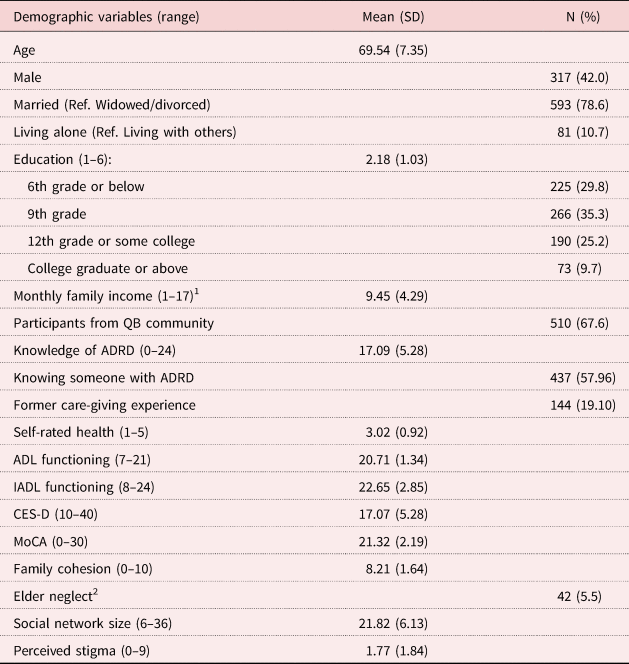
The average age of the 754 participants was 69.54 years (standard deviation (SD) = 7.35). About 60 per cent of the sample were female, only one-third had more than nine years of education, about one-quarter reported some income difficulty, 10 per cent lived alone, 7.6 per cent had religious beliefs and 77.4 per cent were married. On average, participants had two children (SD = 0.99).
Survey sample demographics

Notes: N = 754. SD: standard deviation. Ref.: reference category. ADRD: Alzheimer's disease and related dementias. ADL: activities of daily living. IADL: instrumental activities of daily living. CES-D: Center for Epidemiological Studies Depression Scale. MoCA: Montreal Cognitive Assessment. 1. Monthly income was assessed from 1 = less than 600 Chinese yuan to 17 = more than 8,000 Chinese yuan. 2. Elder neglect was dichotomously coded (1 = the occurrence of elder neglect, 0 = no occurrence).
Stigma towards ADRD was salient in this sample. The mean stigma score is 1.77 (SD = 1.84). About 70 per cent of participants show some levels of stigma (stigma score >1). In a hypothetical situation, 33.9 per cent of participants reported they would rather people did not know about the disease; 33.8 per cent believed that they would lose self-esteem because of the disease; 20 per cent thought others would avoid them if they had ADRD; 19.2 per cent believed that their family would think they are useless because of the disease; 17.1 per cent reported that neighbours and colleagues would have less respect for them; 15.7 per cent thought the disease would cause shame or embarrassment; 14.2 per cent believed that their spouses would not stay with them and support them; about 12 per cent reported that they would not tell the person they are closest to; and only 10.5 per cent believed neighbours or colleagues would have less esteem for their family.
At the bivariate level, higher levels of perceived stigma were associated with lower self-rated health (r = −0.10, p < 0.01), poorer ADL functioning (r = −0.07, p = 0.05), poorer IADL functioning (r = −0.09, p < 0.05), higher levels of depressive symptoms (r = 0.23, p < 0.01), lower levels of cognitive status (r = −0.17, p < 0.01), higher levels of ADRD knowledge (r = 0.07, p = 0.06), experience of family neglect (r = 0.13, p < 0.01) and less family cohesion (r = −0.30, p < 0.01).
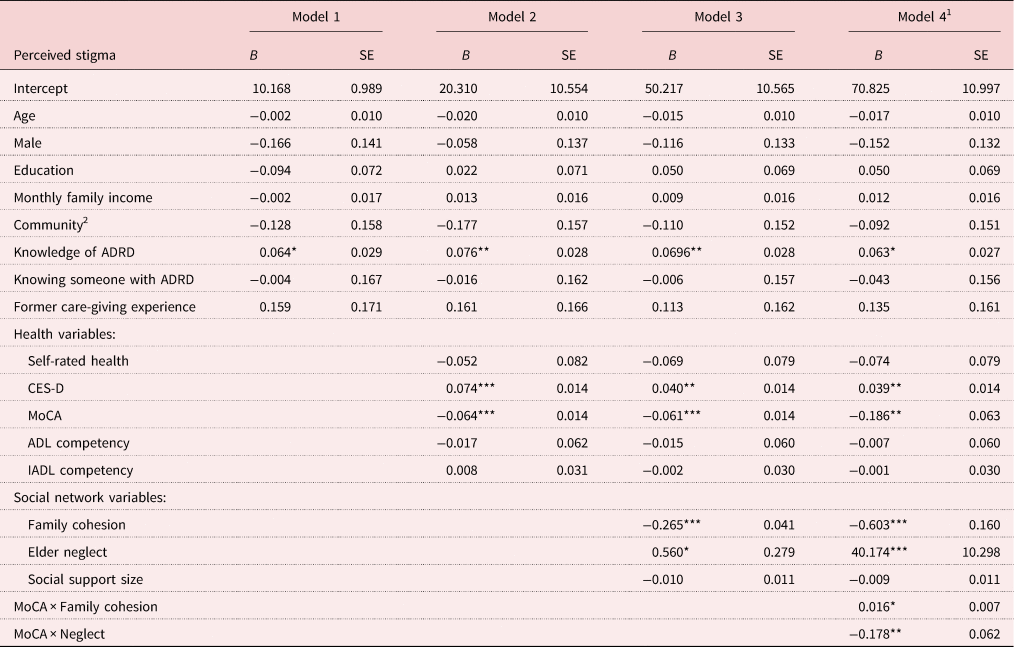
Linear regressions were computed to test hypotheses (see Table 2). In Model 1, no demographic variables were significantly associated with perceived stigma. The effects of ADRD knowledge were statistically significant while the effects of real-life exposure to people with ADRD were not. In Model 2, we entered health variables. CES-D and MoCA scores were statistically associated with perceived stigma while ADL, IADL and self-rated health were not. In the Model 3, independent variables including social network size, experience of elder neglect and family cohesion were added. ADRD knowledge was statistically significant after controlling all covariates. Having an incohesive family (B = −0.27, standard error (SE) = 0.04, p < 0.001) and experience of neglect in the family (B = 0.56, SE = 0.28, p < 0.05) increases perceived stigma of ADRD among Chinese older adults living in urban communities. The significance of CES-D and MoCA remained. In Model 4, we added interaction effects of significant social network factors: family cohesion and elder neglect. The significant interactions between MoCA scores and family cohesion (p < 0.05) and between MoCA scores and elder neglect (p < 0.01) indicated that a high-quality family relationship moderated the associations between cognitive health and perceived stigma. Interactions between social network variables and other health variables (i.e. self-rated health, ADL, IADL and CES-D) are not significant and we did not report these results.
Results of the linear regression analyses

Notes: SE: standard error. Ref.: reference category. ADRD: Alzheimer's disease and related dementias. ADL: activities of daily living. IADL: instrumental activities of daily living. CES-D: Center for Epidemiological Studies Depression Scale. MoCA: Montreal Cognitive Assessment. 1. Model 4 is the interaction effect model. 2. Community was dichotomously coded (0 = QB community, 1 = YC community).
Significance levels: * p < 0.05, ** p < 0.01, *** p < 0.001 (two-tailed).
Discussion
To the best of our knowledge, this study is the first to date that specifically focused on the perceived stigma of ADRD in individuals from mainland China. The present study describes how Chinese community-dwelling older adults with different levels of cognitive abilities perceive ADRD stigma and enriches our understanding of the family contexts that construct their perceptions.
Among the nine items of the perceived stigma scale, a notable finding revealed how Chinese older adults’ disclosure of ADRD varied depending on with whom they share information. Their ‘reluctance to disclose to general people’ scored highest while ‘reluctance to disclose to closest ones’ scored the second lowest. A possible explanation might be that Chinese older adults may feel it necessary to disclose the disease to their family because culturally they expect support and care from their family, particularly when their family is cohesive and supportive. Disclosing the disease to outsiders such as neighbours, (former) colleagues or others not only may not help but also may put them at risk of losing self-esteem.
Among the social network factors, the hypothesis that a good quality of family life would be related to lower perceived stigma was supported. In a cohesive family environment with love, care and trust, Chinese older adults tend to have confidence that family support is available if they need care due to a disease like ADRD. Such confidence may affect their self-esteem at older age and help form a normalised view of ADRD. Feelings of shame, embarrassment and uselessness due to ADRD are less likely to appear. The experience of elder neglect in the family is the opposite. Indifference of family members may inhibit Chinese older adults from disclosing the disease; experience of abandonment in public and refusal of support may cause them to lose trust in family care. This may also help explain the finding that the ratings of ‘reluctance to disclose to closest ones’ from the perceived stigma scale garnered the second lowest ranking. When a cohesive family helps resist perceived stigma, it is easy to understand that most Chinese older adults in the present study would disclose the disease to closest ones or beloved family members.
The other social network factor – social support network size – was not related to perceived stigma. Having a supportive network where they can ‘open hearts’ and ‘talk about anything’ would ideally make Chinese older adults feel safe to disclose the disease and alleviate their worries of social exclusion. However, the size of friends or family members in this network may not matter. A larger support network could indicate more heterogeneity of views of ADRD that might counteract each other. Exposure to such views may have mixed effects on the older adults. This may also partially explain the finding that ‘reluctance to disclose to general people’ garnered the highest ranking in this sample.
We also found that real-life exposure to persons living with ADRD would not reduce perceived stigma. This is not surprising because prior studies of Chinese American immigrants have similar findings: exposure to relatives with ADRD would not reduce stigma (Liu et al., Reference Liu, Hinton, Tran, Hinton and Barker2008; Woo, Reference Woo2017). Although more than half of the sample knew someone with ADRD and about 20 per cent had taken care of people with ADRD, we still do not know whether such interactions are negative, neutral or positive. Older adults’ negative interactions in their real-life exposure (e.g. observing people with ADRD neglected by family members) may increase perceived stigma while positive interactions (e.g. taking good care of their older parents/spouses with ADRD) would do the opposite. Real-life exposure to persons living with ADRD is simply one aspect of older adults’ social networks.
We found that higher knowledge of ADRD is related to more perceived stigma. In line with the argument in existing studies that indicated a positive relation between ADRD knowledge and perceived threat of ADRD among Chinese or Chinese Americans (Gray et al., Reference Gray, Jimenez, Cucciare, Tong and Gallagher-Thompson2009; Sun et al., Reference Sun, Gao and Coon2015; Gao et al., Reference Gao, Gao, Guo, Sun and Zhang2020; Shi et al., Reference Shi, Sun, Liu and Marsigliain press), we affirmed that more knowledge of ADRD co-exists with higher stigma and more fear, suggesting providing information or increasing knowledge of ADRD alone will not reduce stigma or fear. Future intervention programmes need to incorporate critical components that specifically target the amelioration of stigma in the older Chinese population.
In terms of health variables, cognitive decline in Chinese older adults was significantly associated with perceived stigma. It is possible that those with cognitive impairment may have already personally experienced negative attitudes or discriminations, therefore, perceiving more ADRD stigma. However, due to the cross-sectional nature of this study and abundant research on the corrosive impact of stigma on health (e.g. Mak et al., Reference Mak, Cheung, Law, Woo, Li and Chung2007; Li et al., Reference Li, Wang, Williams and He2009; Hatzenbuehler et al., Reference Hatzenbuehler, Phelan and Link2013), we cannot rule out the possibility that ADRD stigma may worsen older adults’ cognitive abilities, which warrants further longitudinal studies. We also found depressive symptoms were significantly associated with perceived stigma among Chinese community-dwelling older adults, which is consistent with prior stigma studies among people with ADRD (e.g. Burgener and Berger, Reference Burgener and Berger2008) and care-givers (e.g. Liu, Reference Liu, Hinton, Tran, Hinton and Barker2008).
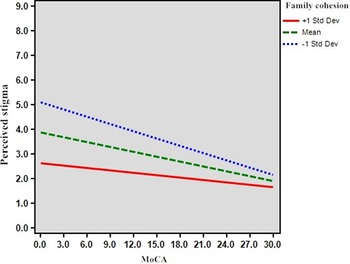
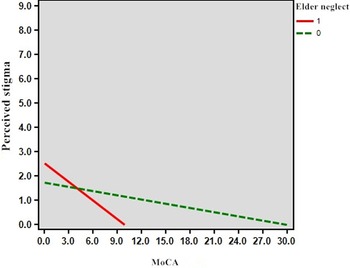
To understand better the social network factors that affect the relationship between significant health indicators (i.e. MoCA and CES-D scores) and perceived stigma among Chinese older adults, we performed interaction analyses, using the quality of family life (i.e. family cohesion/elder neglect) as moderators (see Figures 1 and 2). The interactions between quality of family life and cognitive health are significant but interactions between quality of family life and depressive symptoms are not. In this study, cognitive decline was more robust in increasing the perceived stigma of ADRD in older adults who had less-supportive family. A similar pattern was observed using the experience of family neglect as a moderator. A possible explanation is that a cohesive and free of neglect family would buffer the negative effect of cognitive decline on perceived stigma of ADRD. In other words, older adults believe a cohesive family would guarantee support, care and respect, a belief that can counteract the stigmatised image shaped by the mass media and culture. This further affirms the protective roles (both direct and indirect) of positive family dynamics in addressing stigma towards ADRD. A cohesive family may also buffer the negative effects of ADL, IADL difficulties or depressive symptoms, and then directly or indirectly influence people's attitudes towards health or perceptions of a specific disease. But such interactions may not be influential in people's perceptions of ADRD.
An interaction effect of Montreal Cognitive Assessment (MoCA) scores and family cohesion on perceived stigma of Alzheimer's disease and related dementias with covariates controlled.
Note: Std Dev: standard deviation.

An interaction effect of Montreal Cognitive Assessment (MoCA) scores and elder neglect on perceived stigma of Alzheimer's disease and related dementias with covariates controlled.

There are certain limitations of this study which should be noted. First, we only measured the quality of family relationships and did not capture the quality of friendships. Limited by the variables included in this study, we could not examine whether the quality of friendships has effects on older adults’ perceived stigma and recommend it to be examined in future studies. Second, FINIS is a broad conceptual map but we only explored the effects of social networks. A more comprehensive inquiry into macro-level factors, such as media and Chinese culture, is strongly recommended for future studies. Third, the prevalence of perceived stigma is probably underestimated in this study. Because of our recruitment strategy, we cannot compute the response rates in the communities; residents with stigmatised attitudes may simply stay away from our student interviewers or hide ‘behind the closed doors’ in our ‘door-knocking’. Fourth, this study did not collect information about whether the respondents had direct family members with a diagnosis of ADRD. It is possible that Chinese older adults with direct family members who are diagnosed with ADRD would perceive stigma differently from those without. Fifth, we recruited one or two older adults from the same household, but we did not pair them in the recruitment process. We did not include family-level variables either. Thus, it is unfortunately impossible to conduct cluster analysis.
Lastly, our study only surveyed two ageing communities in Wuhan city. Future research should focus on perceived stigma and ADRD with other ageing communities in various regions in China.
Conclusion
While the medical and research community continue to make tremendous strides in advancing innovation and discovery for persons with ADRD, there is indeed a critical role that service and support programmes can play in reducing the perceived stigma of ADRD and therein supporting cognitive and emotional wellbeing. In the present study, the robustness of one's family networks was found to moderate associations between cognitive scores and perceived stigma, underscoring the importance of family dynamics in shaping Chinese older adults’ perceived stigma towards ADRD. These findings have implications for future programme and policy design. For example, community-based education and public health practice should consider family dynamics in designing and delivering anti-stigma and awareness-raising programmes. Moreover, efforts should be adopted to build cohesive and protective families, so that Chinese older adults can feel supported when confronted with ageing-related diseases such as ADRD.
Acknowledgements
The views expressed in this paper are those of the authors and not necessarily of the authors’ organisations, including the US Administration on Aging/Administration for Community Living, US Department of Health and Human Services.
Financial support
This study was supported by the National Social Science Fund of China (No. 17CRK017).
Ethical approval
The Institutional Review Board (IRB) of the School of Sociology at Huazhong University of Science and Technology approved study procedures.