1. Introduction
This paper is about gender agreement and the variation that exists, both synchronically and diachronically, between lexical gender agreement and semantic gender agreement. Lexical gender agreement, also known as syntactic or grammatical gender agreement, is agreement that is based on the lexically stored gender of a noun, while semantic, or referential, gender agreement is agreement that is based on certain properties of the referent, such as animacy or sex.Footnote 1 Languages differ with respect to the type of gender agreement they display. In English, for instance, pronouns show exclusively semantic gender agreement: Masculine and feminine pronouns are used for male and female referents, respectively, and neuter pronouns are used for inanimate referents and sometimes animals. In contrast, in Dutch, each noun has a lexically stored gender, and agreement targets typically show agreement with this lexical gender. However, even in languages such as Dutch, with a nominal gender system, semantic agreement occurs, especially with human referents. An example of this agreement variation in Dutch is shown in 1.
-
(1)


In example 1, the determiner and the relative pronoun are neuter, agreeing with the neuter gender of the noun meisje ‘girl’, while the personal pronoun is feminine, agreeing with the sex of the referent. With nouns such as meisje, the semantic gender of the referent conflicts with the lexical gender of the noun, and this semantic gender is apparently able to override lexical gender in the personal pronoun.
This agreement variation is not uncommon crosslinguistically: It is often possible for personal pronouns to agree semantically, while other agreement targets agree with the lexical gender of the noun. This is captured in Corbett's (Reference Corbett1979, Reference Corbett1991) Agreement Hierarchy, presented in 2 below.
-
(2)
Crosslinguistically, personal pronouns are most inclined toward semantic agreement, while attributive (or adnominal) elements, such as determiners and attributive adjectives, tend to agree with the lexical gender of the noun. However, the two types of agreement are not necessarily distinguished categorically from each other, with every agreement target showing either lexical or semantic gender agreement. Instead, individual agreement targets can display variation between the two types of agreement, with the likelihood of semantic agreement being higher in elements at the right of the hierarchy.
This intra-target agreement variation is clearly visible in Dutch. Example 1 above has two possible variants, shown in 3a,b below.
-
(3)
The personal pronoun can be neuter instead of feminine, as in 3a, although this is infrequent and seems more formal. Also, the relative pronoun shows variation between lexical and semantic agreement. While it agrees lexically in 3a, which is the norm, it can agree semantically as well, as in 3b, particularly in informal spoken language.Footnote 3
In view of the Agreement Hierarchy, Corbett (Reference Corbett1979) proposes a diachronic relation between the two types of agreement, in which semantic agreement is first introduced in the personal pronoun and then potentially moves leftward on the hierarchy, gradually encroaching on the domain of lexical gender: “This leads to the diachronic predication to be made from the hierarchy—namely that semantic agreement will first affect the rightmost position and then spread leftwards” (Corbett Reference Corbett1979:218). This pathway suggests that lexical agreement is generally the older type of agreement, while semantic agreement is an innovation that starts in the pronoun.
However, it is not necessarily the case that semantic agreement is always new compared to lexical agreement. Semantic agreement may have always been part and parcel of gender systems that display it. It seems that, at least in the West Germanic languages, semantic agreement with animate referents has long existed alongside lexical agreement. Specifically, semantic agreement based on the sex of the referent already occurred in Old and Middle High German (Birkenes et al. Reference Birkenes, Chroni and Fleischer2014) and in Old English, when English still had a nominal gender system (Curzan Reference Curzan2003). An example from Middle Dutch was encountered in the present study with the neuter noun wif ‘woman’, shown in 4 below.
-
(4)
In view of the Agreement Hierarchy discussed above, example 4 is particularly remarkable, as it not only shows semantic agreement in the personal pronoun sij, but also in the relative pronoun die, which directly follows the neuter-marked antecedent.
In present-day Dutch, and in several other Germanic varieties today, another semantic agreement principle has been found to play a role in pronouns: the degree of individuation of the referent (Van Haeringen Reference Van Haeringen1936, Reference Van Haeringen1951; Fletcher Reference Fletcher and Fletcher1987; Siemund Reference Siemund2002; Audring Reference Audring2006, Reference Audring2009). A distinction is made between referents with a high degree of individuation, that is, things that are countable and bounded in nature, such as concrete objects, and referents with a low degree of individuation, things that are uncountable and unbounded in nature, such as materials and liquids. Referents with a high degree of individuation tend to trigger masculine and common gender agreement, while referents with a low degree of individuation tend to trigger neuter gender agreement. Examples of this semantic agreement from the Corpus Gesproken Nederlands (Corpus of Spoken Dutch) are shown in 5 below (from Audring Reference Audring2006:95–99).
-
(5)
Example 5a shows the use of a masculine pronoun in reference to a neuter noun denoting a concrete object, while example 5b shows the use of a neuter pronoun with a common gender noun denoting a mass.
In addition to Dutch, pronominal agreement of this kind—masculine agreement with objects and neuter agreement with masses—has been found in Helgoland Frisian (Wahrig-Burfeind Reference Wahrig-Burfeind1989), West Jutland Danish (Ringgaard Reference Ringgaard1973, Braunmüller Reference Braunmüller2000), and in several English dialects, in particular West Somerset English (Siemund Reference Siemund2002, Reference Siemund2008). Semantic agreement with neuter pronouns has also been found in City Frisian (Wahrig-Burfeind Reference Wahrig-Burfeind1989) and in Flemish (De Vogelaer & De Sutter Reference De Vogelaer and De Sutter2011, De Vos & De Vogelaer Reference De Vogelaer and De Sutter2011). A similar phenomenon with respect to the use of neuter has been found in Standard Danish, Norwegian, and Swedish, which show semantic neuter agreement with referents of low individuation in the predicative adjective (Braunmüller Reference Braunmüller2000; Enger Reference Enger2004, Reference Enger2013). An example from Norwegian with the masculine noun vodka ‘vodka’ is shown in 6 below (from Enger Reference Enger2004:6).
-
(6)
Also, in Romance varieties, which have a system of masculine and feminine lexical gender, etymologically neuter forms are used with referents of low individuation. This has been observed in South-Central Italian dialects, mainly in pronouns and determiners, and in Spanish dialects, in pronouns and postnominal adjectives (Fernández-Ordóñez Reference Fernández-Ordóñez, Bubenik, Hewson and Rose2009). An example from a Spanish dialect with the masculine noun vinu ‘wine’ is shown in 7 below (from Fernández-Ordóñez Reference Fernández-Ordóñez, Bubenik, Hewson and Rose2009:58).
-
(7)
The question arises concerning the origin of this semantic agreement based on individuation. It has been suggested that this type of agreement is a new development in these European varieties. Fernández-Ordóñez (Reference Fernández-Ordóñez, Bubenik, Hewson and Rose2009), for instance, states the following:
Some Western Indo-European (IE) languages, namely English, Ibero-Romance, Scandinavian and South-Central Italian varieties, have developed new gender distinctions based on the count/mass interpretation of nouns.
(p. 55)
and
these mass/count distinctions seem to be new and independent developments of older IE gender systems that are usually well known.
(p. 56)
More specifically, it has been suggested for Dutch that agreement based on individuation has developed as a result of changes that occurred in the nominal gender system (Audring Reference Audring2006, Reference Audring2009; De Vos & De Vogelaer Reference De Vogelaer and De Sutter2011). Dutch no longer has the original three Germanic genders, since masculine and feminine nominal gender conflated into common gender in the 17th century. Audring (Reference Audring2006, Reference Audring2009) proposes that the resulting mismatch between the nominal genders in Dutch, common and neuter, and the genders of the personal pronoun, masculine, feminine and neuter, instigated the development of a new, semantic agreement system in pronouns:
When regarded with unbiased eyes, the ‘wrong’ pronouns of spoken Dutch represent a useful and ingenious case of recovery from a historical problem. Speakers of Dutch have reinvented their pronoun genders by putting new semantic foundations under the gender system.
(Audring Reference Audring2009:217)
This suggestion has been followed up by De Vos & De Vogelaer (Reference De Vogelaer and De Sutter2011), who studied pronominal agreement in the dialect of Moerzeke, a Flemish dialect of Dutch in which the distinction between masculine and feminine nominal gender still exists but is disappearing, since the distinction is only sporadically marked in the noun phrase. They found the use of masculine pronouns for feminine nouns and vice versa, with all kinds of referents, which can be considered agreement errors resulting from the loss of the masculine-feminine distinction in the adnominal marking. Additionally, they found the use of neuter pronouns for both masculine and feminine nouns with referents that have a low degree of individuation. In line with Audring's (Reference Audring2009) suggestion, De Vos & De Vogelaer (Reference De Vogelaer and De Sutter2011:276) interpret this finding as the rise of an innovative agreement system caused by the apparent breakdown of the three-gender system: “This process can be considered an instance of morphological regularization, in other words, the rise of an innovative rule system when the traditional system becomes too opaque to be successfully acquired.”
However, as with semantic agreement based on sex, agreement based on individuation may not be a new phenomenon in Dutch. Audring (Reference Audring2009:194) also notes that “even in a thriving three-gender system, there can be some degree of semantic agreement, coupled to conceptual distinctions such as natural gender and individuation.” It is possible therefore that semantic agreement based on individuation has always existed beside lexical gender agreement in Dutch. The fact that it is found in several different Germanic and Romance varieties suggests that it could be an older Germanic or Indo-European feature.
There are, in fact, indications that individuation was part of the semantic basis of the Proto-Indo-European (PIE) genders. Ever since it was found that the PIE gender system did not originally consist of three genders, but two, with the third gender, feminine, developing later, it has been clear that sex could not have been the semantic basis of the PIE genders (see Luraghi Reference Luraghi2011). Instead, several theories on the development of PIE gender involve a connection between the genders and individuation. Lehmann (Reference Lehmann1958), for instance, proposes that PIE gender was a variable feature of nouns, and that gender variation was based on different interpretations of the referent as either an individual, a collective, or a resultative/mass entity. In a reconstructed lexicon of PIE nouns, Matasović (Reference Matasović2004:133–134) also observes semantic tendencies in gender assignment that appear to run along the lines of individuation: While nouns referring to humans, animals, and most plants are consistently masculine/feminine, nouns referring to fluids and substances are always neuter. Following Lehmann Reference Lehmann1958, Leiss (Reference Leiss2000) observes remnants of meaning-based gender variation in Old High German, where nominal gender variation appears to distinguish between a count, collective, and mass interpretation of the referent.
Kraaikamp (Reference Kraaikamp2012) argues for Dutch that, although the association between the genders and individuation has not been preserved in lexical gender, it is still visible in cases where nominal gender is variable. Since lexical gender is a fixed, invariable feature of nouns, it cannot easily respond to meaning changes over time, making any patterns in lexical gender assignment vulnerable to disruption. However, the semantic pattern still surfaces in cases where nominal gender is variable, for instance, with double gender nouns (see also Semplicini Reference Semplicini2012) and with nominalized adjectives. Nouns referring to materials, such as steen ‘stone’ or diamant ‘diamond’, can occur in different genders, with a concomitant shift in meaning. They are assigned common gender when they refer to a unit of the material, ‘a stone’ or ‘a diamond’, and they are neuter when they refer to the material as a mass, ‘stone’ or ‘diamond’ (Haeseryn et al. Reference Haeseryn, Romijn, Geerts, de Rooij and van den Toorn1997). Nominalized adjectives show a similar gender alternation associated with a meaning difference. They are assigned common gender when they refer to an individual, for example, de mooie ‘the pretty one’, but neuter when the referent is not individuated, as in het mooie ervan ‘what is nice about it’. The fact that individuation plays a role in nominal gender as well as pronominal gender suggests that the semantic association of the genders is not an innovation that started in pronouns, but something that has always been part of the Dutch gender system.
This paper addresses the question of when semantic agreement based on individuation developed in Dutch pronouns, particularly if it developed after the change from a three-gender system to a two-gender system or if it existed before this change. Data from Middle Dutch, where the three nominal genders were still in place, can shed light on this issue. If agreement based on individuation resulted from the loss of the three-gender system, it is not expected to occur before this change.
This paper presents the results of a corpus study of pronominal gender agreement in Middle Dutch and is organized as follows. The next section discusses semantic agreement in present-day Dutch in more detail and formulates the specific expectations for the corpus study. Section 3 describes the sources and methodology of the corpus study. The results are presented in section 4, followed by a discussion of the findings in section 5. Section 6 concludes this paper.
2. Gender Agreement in Present-Day Dutch
Standard Dutch spoken in The Netherlands today (subsequently referred to as “Dutch”) has two nominal genders, common and neuter, where common gender is a conflation of former masculine and feminine gender. Several Eastern and Southern Dutch dialects, particularly Flemish dialects, still distinguish the original three nominal genders. Also, dictionaries of Standard Dutch sometimes still report masculine or feminine gender for common gender nouns. However, the distinction between masculine and feminine nouns is no longer made in Standard Dutch spoken in The Netherlands.
Common and neuter gender are expressed on determiners, such as the definite article (de versus het), and on the attributive adjective (mooie versus mooi ‘pretty’, for instance).Footnote 4 In the pronominal domain, the two genders are expressed on the relative pronoun (die versus dat) and on the distal and proximal demonstrative pronouns (die, deze versus dat, dit). The personal pronoun expresses masculine (hij, hem), feminine (zij, haar), and neuter (het) gender. The feminine pronoun is used exclusively with female referents in informal spoken language (Audring Reference Audring2009:92). The masculine personal pronoun agrees lexically with common gender nouns.Footnote 5
Lexical gender assignment is largely arbitrary in Dutch. There exists a limited set of semantic and formal regularities, such as that nouns referring to adult humans or nouns ending in -de or -te are usually assigned common gender. However, there are no general rules behind the assignment of common or neuter gender to nouns (see, for instance, Haeseryn et al. Reference Haeseryn, Romijn, Geerts, de Rooij and van den Toorn1997).
As discussed in section 1, determiners and adjectives agree with the lexical gender of the noun, while pronouns show variation between lexical agreement and semantic agreement on the basis of the sex and degree of individuation of the referent. Audring (Reference Audring2009) captures the relevant semantic distinctions in the Individuation Hierarchy, shown in 8.
-
(8)
The Individuation Hierarchy is essentially an elaboration of the Animacy Hierarchy (Silverstein Reference Silverstein and Dixon1976), in which the inanimate part of the hierarchy is further subdivided.Footnote 6 The degree of individuation of entities decreases from left to right on the hierarchy. Entities with a high degree of individuation have a clearly bounded shape, are countable, and have specific characteristics, whereas entities with a low degree of individu-ation have an unbounded shape or unclear boundaries, are uncountable, and have less specific characteristics. Animate entities have the highest degree of individuation, and within that category, humans are more individuated than animals.Footnote 7 Next to animals there is the category of bounded objects, such as a book or a cup, and bounded abstracts, such as a question or a word. More lowly individuated are specific masses, which are specific instantiations of masses, such as my tea or this wine. Unbounded abstracts, such as love or nature, and unspecific masses, such as snow or honey, have the lowest degree of individuation.
In her study of Dutch spoken language data from the Corpus Gesproken Nederlands (Corpus of Spoken Dutch), Audring (Reference Audring2009) found that pronouns display a semantic agreement pattern along the lines of individuation when they do not agree with the lexical gender of the noun. Masculine and common pronouns are used for referents with a high degree of individuation, including humans, animals, objects, and bounded abstracts. Neuter pronouns are used for referents with a low degree of individuation, including specific masses, unbounded abstracts, and unspecific masses. This type of agreement was found to be frequent. Personal and demonstrative pronouns show semantic agreement in 65% of the cases where lexical and semantic gender conflict, that is, with neuter nouns referring to highly individuated entities, such as fototoestel ‘camera’, and common gender nouns referring to lowly individuated entities, such as olijfolie ‘olive oil’. The relative pronoun shows semantic agreement as well, but less frequently, in 25% of the cases (Audring Reference Audring2009:159–160). This difference is in line with Corbett's Agreement Hierarchy presented in section 1, which states that relative pronouns are less inclined toward semantic agreement than personal pronouns.
Another factor that determines the frequency of semantic agreement in Dutch is the position of the referent on the Individuation Hierarchy. Semantic agreement occurs significantly more often with referents at the extreme ends of the hierarchy than with those toward the middle (Audring Reference Audring2009:167–168). This is explained by the fact that referents at the ends of the hierarchy have a more saliently high or low degree of individuation. When lexical gender conflicts with semantic gender, as with neuter for individuated referents or common gender for referents of low individuation, this conflict is most prominent with referents at the outer ends of the hierarchy. It is therefore not unexpected to find most semantic agreement there.
The present-day Dutch gender system thus uses two different bases for gender agreement: lexical gender, which is largely arbitrary, and semantic gender, which is based on the degree of individuation and sex of the referent. This leads to competition and agreement variation in those cases where the two genders do not coincide. This situation may have always existed in Dutch if the genders have always had a semantic interpretation. Semantic agreement with animate referents is known to have existed already in Middle Dutch, alongside lexical agreement (see section 1). The expectation is that semantic agreement with inanimate referents existed in Middle Dutch as well, with masculine pronouns used for referents that have a high degree of individuation and neuter pronouns used for referents that have a low degree of individuation.
3. Sources and Methodology
3.1. Textual Sources and Data Collection
The texts used for this study had to meet three important requirements: They had to date from before the conflation of masculine and feminine nominal gender in Dutch; they had to be prose texts, so that considerations of rhyme or special styles are not at play; and they had to contain a relatively high number of pronominal references to inanimate referents. It was decided to look at 16th century recipe books. The following two texts were used: Een notabel boecxken van cokeryen (the Boecxken), printed in Brussels ca. 1514, and Dat batement van recepten. Een secreetboek uit de zestiende eeuw (the Batement), printed in Antwerp in 1549. The Boecxken is a collection of food recipes. It contains 175 recipes, comprising approximately 17,000 words in total. The Batement is a collection of food recipes and recipes for medicinal and household purposes. It contains 258 recipes, comprising approxi-mately 22,000 words in total. Both texts were printed in the first half of the 16th century.
The authors of the recipes are anonymous, but the names of the printers are known, as are the locations where the books were printed, Brussels and Antwerp. The choice for texts from cities in the southern part of the Dutch speaking area was practical, as no suitable sources from the north were available for this study. Most of the Middle Dutch literature is from the south, as the culturally most important cities of the Dutch speaking area were located there until the fall of Antwerp in 1585. However, the three-gender system observed in these southern texts can be considered to be representative of the system that must have preceded the gender system of both present-day Southern and Northern Dutch.
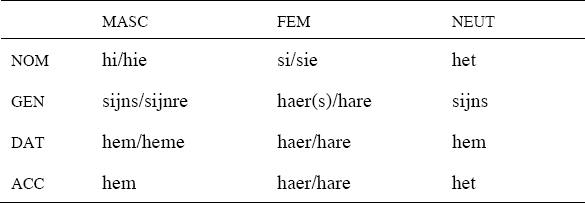
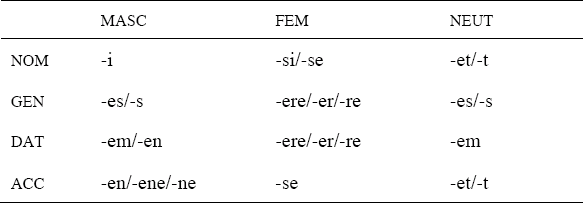
All pronominal references to singular nominal antecedents were manually extracted from the texts. All types of pronouns were collected, including personal pronouns—freestanding as well as cliticized forms—demonstrative pronouns, relative pronouns, and possessive pronouns. Sequences of pronouns with the same antecedent were included. The clitic personal pronoun was the most frequently attested form. The gender-case paradigms of the freestanding and clitic personal pronoun are shown in tables 1 and 2 below.Footnote 8
Paradigm of the singular personal pronoun in Middle Dutch.

Paradigm of the clitic singular personal pronoun in Middle Dutch.

Note that there are gender syncretisms in some case forms, such as the dative form hem, which is both masculine and neuter. Pronouns with ambiguous forms were recorded as such in the results.
References to plural antecedents were not included in this study, because there are no gender distinctions in the plural. Also not included were references to disjunctions, conjunctions, lists, and other combi-nations of nominal antecedents, because in these cases, the antecedent does not have a (single) gender. Combinations of nominal antecedents were frequently found, because ingredients are combined and subsequent pronominal references then tend to refer to the resulting mixture. The sentence in 9 provides an example of this kind of reference.
-
(9)
It is interesting to note that with such references to mixtures, neuter pronouns are almost always used. This is in line with the expectation for mass referents, which these mixtures always are. However, as more than one nominal gender can be involved in such cases, these references were not included. Note that such methodological decisions were made with the intention to maximize the possibility of falsifying the hypothesis.
References that involved more than one plausible antecedent were excluded as well. This would be the case, for instance, with quantifier phrases such as een bolleken eyiuns ‘a ball of onion’, whereby it is unclear if the reference is to the quantifier, bolleken, or the quantified, eyiun. References to nouns that are not in the dictionary and whose gender and/or exact meaning remained uncertain were excluded as well. Finally, references with invariant neuter pronouns were excluded. These occur in nominal copula phrases, such as Daerna neemt tartre, dat is droessem van wijn die gedroocht is ‘Then take tarter, that is, wine sediment that has been dried’. In such phrases, the pronoun does not show gender agreement but is invariantly neuter.
3.2. Categorization: The Gender of the Antecedent
For each pronominal reference, the gender of the pronoun and the type of pronoun was recorded. The gender of the antecedent was determined and the referent was categorized according to its semantic class. The methodology used to determine the gender of the antecedent is described below.
The gender of the antecedent was based on adnominal gender marking, namely, gender-distinctive forms of determiners, adjectives or nominal case endings, and the gender listed for the noun in the Middelnederlandsch Woordenboek (MNW; Middle Dutch dictionary).Footnote 9 This dictionary, by Jacob Verdam and Eelco Verwijs, covers the Dutch vocabulary from ca. 1250 to ca. 1550. Its nine parts were published consecutively from 1885 to 1929.
Adnominal gender marking was considered the most reliable indication of the antecedent's gender, as this is a direct reflection of the gender attributed to the noun by the author. It was therefore considered the primary source for the antecedent's gender. However, the additional use of dictionary information was inevitable, because gender marking is not always present, and if it is, it is sometimes ambiguous. If there was no marking, the gender of the antecedent was based on the dictionary gender of the noun. If the gender marking was ambiguous, the gender of the noun was based on this marking in combination with the dictionary gender. How these two sources of information were mapped onto each other is explained below. In some cases, when the gender marking on the antecedent itself was absent or ambiguous, the same noun occurred within the same or within a neighboring related recipe with unambiguous marking. This marking was then taken into account as adnominal gender marking.
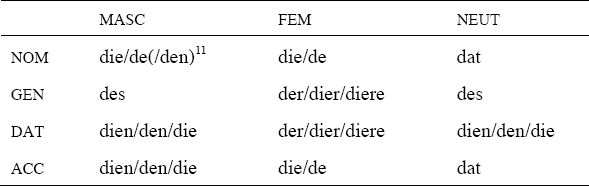
The dictionary was used in combination with the gender marking on the antecedent in cases where this gender marking was ambiguous. Ambiguous gender marking exists because of syncretisms in the gender-case paradigms of adnominal elements. To illustrate this, the Middle Dutch paradigm of the singular definite article is given in table 3 below.Footnote 10
Paradigm of the definite article singular in Middle Dutch.

The table shows that the form of the definite article is the same for masculine and feminine gender in the nominative case, and for masculine and neuter gender in the genitive and dative case. If such ambiguous gender marking was encountered, the gender of the antecedent was determined on the basis of this marking in combination with the dictionary gender of the noun. For example, if the adnominal gender marking was masculine/feminine, and the gender listed for the noun in the dictionary was masculine, the antecedent was considered to have masculine gender; if the dictionary listed more than one gender for the noun—for example, masculine and neuter—the noun was once again considered to have masculine gender. If the dictionary genders coincided with the ambiguous marking on the antecedent—in this example, if the dictionary genders were masculine and feminine—the ambiguity remained, and the antecedent was labeled as having ambiguous masculine/feminine gender. These ambiguous-gender antecedents were not excluded from the data, but, as indicated in the results section, they were excluded from the quantitative analyses.
With respect to the dictionary gender, it can of course never be said with certainty that the gender of a noun given in the dictionary is in fact the gender attributed to that noun in the text. A problem with dictionary gender is that nominal gender is subject to regional and diachronic variation, which may not be captured by the dictionary. The MNW at least aims to report gender variation and uncertainty regarding nominal gender. It regularly lists more than one gender for a particular noun, pointing either to uncertainty about the noun's gender or to gender variation.Footnote 12 The gender information in the MNW generally proved to be reliable for the texts used in this study. In those cases where a noun was marked for gender in the text, the dictionary gender was almost always in accordance with this marking. Only three cases were encountered where the dictionary gender and the gender marking in the text did not match. Therefore, the MNW was considered a fairly reliable source of information regarding nominal gender.
3.3. Categorization: The Semantic Class of the Referent
For each pronominal reference, the referent was categorized according to its position on the Individuation Hierarchy. The large majority of referents were inanimate, for which the following semantic classes were distinguished:
-
(i) object
-
(ii) bounded abstract
-
(iii) unbounded abstract
-
(iv) mass
In the context of the texts that were studied, some animal referents, such as een visch ‘a fish’, could, in principle, be classified as either animate or inanimate. When such referents occurred in the context of cooking and were referred to as lifeless ingredients, they were classified as objects.
The distinction between objects and masses was most relevant for this study. However, referents were sometimes ambiguous between an object and a mass interpretation. An example of such an object/mass referent is shown in 10.
-
(10)
In this example, den palinck could, in principle, refer to a singular eel or a mass of eels. In some cases, the larger context disambiguated these readings. For instance, if the fish had been chopped up earlier in the recipe, the referent was clearly a mass. However, in cases where the context did not clearly point to an object or a mass reading, the referent was classified as ambiguous object/mass.
For masses, a distinction between specific masses and unspecific masses was originally made, following Audring Reference Audring2009 (see section 2). However, this distinction proved to be irrelevant in the present study, as no significant differences between the two categories were found (see note 14 in section 4.2). The distinction is therefore not discussed further, and the two types of masses are subsumed under one category.
4. Results
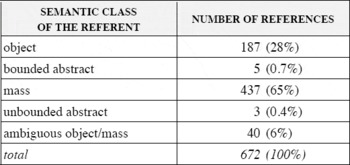
A total number of 731 pronominal references were collected, of which 672 were references to inanimate referents.Footnote 13 The majority of these referents were concrete objects and masses. Very few abstract referents were found. The number of references per semantic class is presented in table 4 below.
Number of data per semantic class.

In the analyses that follow, the references to ambiguous object/mass referents are excluded, as they cannot be used to test the hypothesis.
4.1. References to Masses and Unbounded Abstracts
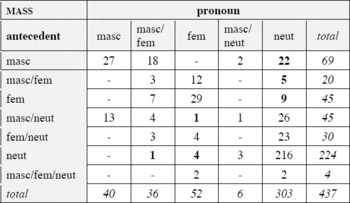
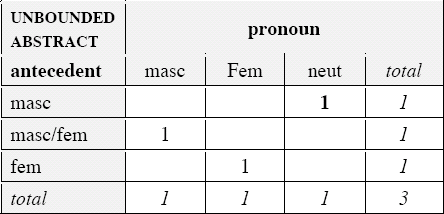
Tables 5 and 6 below show the cases of pronominal agreement with referents that have a low degree of individuation, that is, masses and unbounded abstracts, respectively. The genders of the antecedents are shown on the left, and the genders of the pronouns that refer to them are shown at the top. Ambiguous genders are indicated with a slash. For the antecedents, ambiguous gender means that the noun could be one of the two or three indicated genders, according to the dictionary and/or the adnominal marking. For the pronouns, it means that the pronoun has an ambiguous form with respect to gender, due to gender syncretisms in particular case forms, such as the masculine/feminine nominative form die of the demonstrative and relative pronoun.
Gender of antecedents and pronouns referring to masses.

Gender of antecedents and pronouns referring to unbounded abstracts.

Note that, with masses and unbounded abstracts, deviations from lexical gender were expected with non-neuter antecedents, that is, with masculine and feminine nouns (top three rows in table 5, all rows in table 6). The tables show that the pronouns mostly agree with the gender of their antecedents, but not always. The cases where the gender of the pronoun clearly deviates from that of the antecedent (cases of “gender switch”) are marked in bold. A total of 42 switches occur with masses. These switches show a clear pattern. They are predominantly switches to neuter with masculine and feminine antecedents. With neuter antecedents, only very few switches occur. References to unbounded abstracts were very rare, but they showed a similar pattern: One switch is found with a masculine antecedent, which is to neuter gender.
With the antecedents that have ambiguous lexical gender, it is in many cases uncertain whether the pronoun agrees with the lexical gender of the antecedent or not. However, it is interesting to note that with masculine/neuter antecedents and feminine/neuter antecedents, the majority of the references are with neuter pronouns. These could be either cases of lexical agreement with neuter nouns, or they could be switches to neuter gender with masculine and feminine nouns. It is not unlikely that some of these cases are switches to neuter, considering that such switches were found with unambiguously masculine and feminine nouns.
The same uncertainty exists with masculine/feminine antecedents (20 in total). Here, the use of masculine and feminine pronouns could be cases of lexical agreement with masculine and feminine nouns, respectively; or, they could be switches to masculine and feminine gender with feminine and masculine nouns, respectively. The latter seems unlikely, however, considering that no switches to masculine gender were found with unambiguously feminine nouns and no switches to feminine gender were found with unambiguously masculine nouns. Because of the uncertainties with antecedents that have ambiguous gender, references to these antecedents were left out from the quantitative analyses that follow.
Note that the issue is different for pronouns with ambiguous gender. Some pronominal case forms are ambiguous between two genders, for instance, the masculine/feminine nominative form die. If such a form does not conflict with the gender of the antecedent—for instance, if the antecedent of die is a masculine (or feminine) noun—the pronoun is said to agree with the noun's gender, as it cannot be considered to deviate from it. Such cases are counted as instances of lexical agreement in the quantitative analyses below.
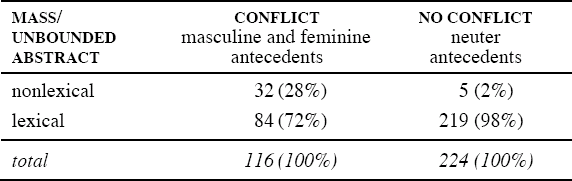
In table 7, the total number of cases of lexical and nonlexical agreement are shown for the different antecedents. The results for masses and unbounded abstracts are conflated here. The results are shown separately for antecedents whose gender conflicts with the low degree of individuation of the referent (that is, masculine and feminine nouns), versus antecedents whose gender does not conflict with it (that is, neuter nouns). Antecedents with ambiguous gender have been left out of the data here. Cases of nonlexical agreement are those where the pronoun evidently does not agree with the gender of the antecedent. Cases of lexical agreement are those where the pronoun agrees with the gender of the antecedent.Footnote 14
Lexical and nonlexical agreement with masses and unbounded abstracts.

It is clear from the table that the agreement behavior is not the same for the different antecedents. With masculine and feminine antecedents, pronouns agree in lexical gender in only 72% of the cases, while they do so in 98% of the cases with neuter antecedents. The association between the gender of the antecedent—that is, conflicting or not conflicting—and the type of agreement—that is, lexical or nonlexical—is statistically significant: χ2 (1)= 51 p<0.001.
The 32 cases of nonlexical agreement with masculine and feminine nouns are all switches to neuter gender. They can therefore be referred to as cases of semantic agreement. They involve 13 different nouns and 27 unique antecedents.Footnote 15 Some examples are shown in 11–13 below. In 11, a neuter clitic personal pronoun is used with the noun zeem ‘honey’, which is marked for masculine gender on the determiner and adjectives.
-
(11)
Example 12 below shows a sequence of pronouns in which a gender switch occurs. The antecedent is medecijne ‘medicine’, which is feminine according to the dictionary. The pronominal sequence shows a gender switch. First, a masculine/feminine relative pronoun is used, de welke ‘that which’, which agrees with the lexical gender of the antecedent, but later on a neuter clitic pronoun is used.
-
(12)
Example 13 shows semantic neuter agreement with a demonstrative pronoun. The pronoun is used in reference to ghymbere ‘ginger’, which is marked for masculine gender on the adjective.
-
(13)
Example 14 shows a switch to neuter in reference to a mass and in reference to an unbounded abstract. The first one occurs with the antecedent wijn ‘wine’, which is accompanied by a masculine/neuter determiner, and which is masculine according to the dictionary. The second switch to neuter occurs with die weedom ‘the pain’, which is accompanied by a masculine/feminine determiner and is feminine according to the dictionary.
-
(14)
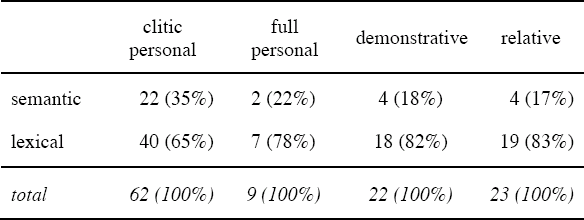
As the examples show, semantic agreement was found with different types of pronouns. It was found with personal pronouns—both clitics and full forms—demonstrative pronouns, and relative pronouns. The tendency toward semantic agreement may differ per pronoun type. In particular, the Agreement Hierarchy described in section 1 predicts that relative pronouns are least inclined toward semantic agreement. Table 8 shows the amount of lexical and semantic agreement per pronoun type.
Lexical and semantic agreement per pronoun type for masses/unbounded abstracts with masculine and feminine antecedents.

It appears that clitic personal pronouns have the strongest tendency toward semantic agreement (35%). Full personal pronouns, demonstrative pronouns, and relative pronouns all show a weaker tendency toward semantic agreement (22%, 18%, and 17%, respectively). However, multiple chi square tests between all pronoun types reveal no statistically significant associations between the type of pronoun and the type of agreement. Even the difference between clitic personal pronouns and relative pronouns, which respectively show the highest and the lowest proportion of semantic agreement, is not statistically significant: Fisher's Exact, p=0.122.
4.2. References to Objects and Bounded Abstracts
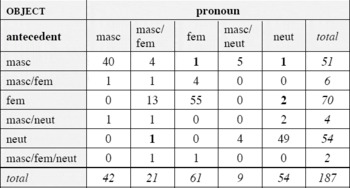
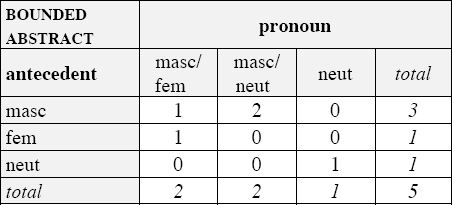
Tables 9 and 10 show the cases of pronominal agreement with referents that have a high degree of individuation—objects and bounded abstracts, respectively. With these referents, deviations from lexical gender were expected with nonmasculine antecedents, that is, with feminine and neuter nouns (third and fifth row from the top in table 9, second and third row in table 10). Cases where the gender of the pronoun clearly deviates from the gender of the antecedent are marked in bold.
Gender of antecedents and pronouns referring to objects.

Gender of antecedents and pronouns referring to bounded abstracts.

The results for objects and bounded abstracts are very different from those for masses and unbounded abstracts. Hardly any deviations occur, and the few that do go in different directions. Switches to masculine gender were expected, but only one switch to masculine/feminine gender was found.
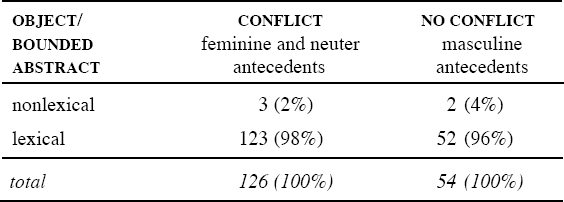
The total number of cases of lexical and nonlexical agreement with objects and bounded abstracts is shown in table 11 below. The results are shown separately for antecedents whose gender conflicts with the high degree of individuation of the referent (that is, feminine and neuter nouns) versus antecedents whose gender does not conflict with the referent (that is, masculine nouns). Antecedents with ambiguous gender have been left out of the data here.
Lexical and nonlexical agreement with objects and bounded abstracts.

The table shows that, with objects and bounded abstracts, the pronouns almost always agree lexically, regardless of the gender of the antecedent (conflicting or not conflicting). The association between the condition—conflicting or no conflicting gender of the antecedent—and the type of agreement is not statistically significant: Fisher's Exact p=0.637.
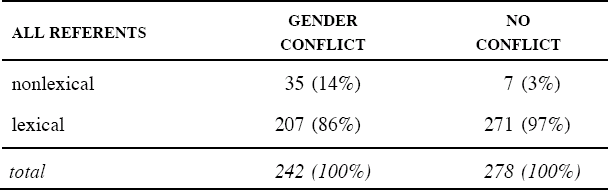
Table 12 below shows the results for all referents together: the results for cases of a gender conflict (that is, masculine and feminine nouns referring to masses/unbounded abstracts and neuter nouns referring to objects/bounded abstracts) and the results for cases of no gender conflict (that is, neuter nouns referring to masses/unbounded abstracts and masculine nouns referring to objects/bounded abstracts).
Total lexical and nonlexical agreement (all referents).

The percentage of nonlexical agreement in cases of a gender conflict comes down to a total of 14%.Footnote 16 In the cases of no gender conflict, the percentage of nonlexical agreement remains at a low 3%.
5. Discussion
The results of this study show that Middle Dutch pronouns do not always agree with the lexical gender of the antecedent noun; sometimes they show semantic gender agreement, based on the degree of individuation of the referent. As in present-day Dutch, neuter pronouns tend to be used for referents with a low degree of individuation, regardless of the gender of the antecedent noun. This finding indicates that this type of agreement did not develop in response to the loss of the Germanic three-gender system, as this system was still in place in Middle Dutch, but that this semantic agreement already existed before this change. This finding is in line with the idea that the association between neuter gender and a low degree of individuation is an old Germanic feature, which possibly dates back to PIE (Lehmann Reference Lehmann1958, Leiss Reference Leiss2000, Matasović Reference Matasović2004, Luraghi Reference Luraghi2011).
What has not been found in the present study is semantic agreement of masculine pronouns with inanimate referents that have a high degree of individuation, that is, objects and bounded abstracts, which is found in present-day Dutch. This could mean that this type of agreement either did not exist at all in Middle Dutch or that it was very infrequent and could not be attested in this study. Based on the current data, it appears that semantic agreement takes place only with referents at the ends of the Individuation Hierarchy in Middle Dutch, with masses and unbounded abstracts at the right end and with human referents at the left end (recall the example of semantic agreement with wif ‘woman’ in section 1):
-
(15)
This distribution of semantic agreement is more limited than what is seen in present-day Dutch, where semantic agreement occurs with referents from all categories on the hierarchy. However, the distribution mirrors the frequency distribution of semantic agreement observed in Dutch today. As mentioned in section 2, the frequency of semantic agreement in present-day Dutch is not the same with all referents: It occurs mostly with referents at the ends of the hierarchy, which have a most saliently high or low degree of individuation. These referents appear to be the only ones that trigger semantic agreement in Middle Dutch.
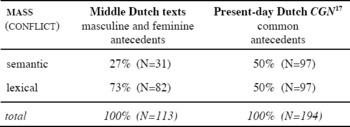
Semantic agreement did not only occur with fewer referents in Middle Dutch, but it seems to have been generally less frequent compared to semantic agreement in present-day Dutch. Focusing on semantic agreement with masses, which is found in both time periods, a quantitative comparison can be made with Audring's (Reference Audring2009) findings for present-day Dutch. Table 13 below compares the ratio of semantic to lexical agreement with nouns referring to masses in the Middle Dutch texts with the ratio found for masses in the Corpus Gesproken Nederlands (CGN; Corpus of Spoken Dutch) by Audring (Reference Audring2009). As the comparison involves written and spoken language, it should be viewed with some caution. However, it is generally believed that the difference between spoken and written language used to be much smaller than it is today. Therefore it is likely that the Middle Dutch texts closely resemble the spoken language of the time.
Ratio of semantic to lexical agreement in Middle Dutch and present-day Dutch.

The data in table 13 indicate that semantic agreement with masses occurs almost twice as often today (50%) as it did in Middle Dutch (27%). This difference is statistically significant: χ2 (1)=14.958 p<0.001.
The comparison between Middle Dutch and present-day Dutch suggests that the ratio of semantic to lexical gender agreement has shifted over time. The fact that semantic agreement also occurs with objects in present-day Dutch may relate to this change. When semantic agreement is infrequent, it may only occur with referents that have an extremely high or low degree of individuation, such as humans and masses. As semantic agreement becomes more frequent, it may occur with referents that have a more moderate degree of individuation as well, including objects.
Interestingly, De Vos & De Vogelaer (Reference De Vogelaer and De Sutter2011) found the same semantic agreement pattern in the Flemish dialect of Moerzeke. In their questionnaire study, participants produced semantic agreement with animate referents and with mass nouns, but not with objects. Although a quantitative comparison of the data is a bit difficult, as the Flemish data were elicited, it is interesting that semantic agreement with mass nouns occurred only in 15% (N=117/651) of the cases.Footnote 18 This indicates that, as in Middle Dutch, the frequency of semantic agreement in this dialect is generally lower than in present-day Standard Dutch. This difference suggests that there could indeed be a connection between the frequency of semantic agreement and whether or not semantic agreement also occurs with referents that take a middle position on the Individuation Hierarchy.
If the ratio of semantic to lexical agreement has shifted over time, this raises the question of why such a shift has occurred. Lexical nominal gender has not disappeared in Dutch, as it has, for instance, in English: Nominal gender is still clearly marked on adnominal elements in Dutch, and speakers are well aware of whether a noun is common or neuter. Nevertheless, it does appear to have become easier to overrule the lexical gender of the noun in pronominal agreement.
There are two likely causes for this increase in the prevalence of semantic agreement. First, the conflation of masculine and feminine nominal gender could play a role, in the way suggested by Audring (Reference Audring2006, Reference Audring2009). Uncertainty about agreement with common gender nouns—that is, whether or not they should be referred to with a masculine or a feminine pronoun—may cause speakers to rely on semantic agreement rather than lexical agreement. However, this uncertainty only exists with common gender nouns, not with neuter nouns. Therefore, the conflation of masculine and feminine gender does not directly explain the rise of semantic agreement with neuter nouns referring to objects, which is precisely the type of agreement that exists in present-day Dutch but was not found in Middle Dutch.
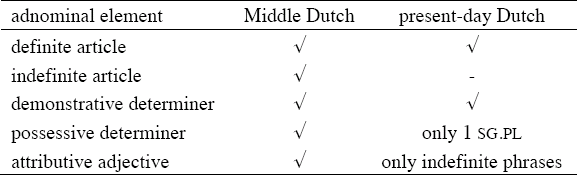
Another possible cause for the increase in the prevalence of semantic agreement is a change in the general visibility of lexical gender, as proposed by Kraaikamp (Reference Kraaikamp2012:207–208). There could be a relation between how frequently lexical gender is marked in the noun phrase and how likely pronouns are to agree semantically instead of lexically. This factor is related to the loss of the masculine-feminine distinction in Dutch, but it is not the same. As Dutch lost the distinctive marking for masculine and feminine gender in adnominal elements, leading to the conflation of these two genders, Dutch also lost gender marking entirely in some adnominal elements. Consequently, a notable difference between the Middle Dutch and present-day Dutch gender systems is not only the number of nominal genders, but also the number of elements that mark gender. Table 14 below gives an overview of the most frequent adnominal elements and shows whether or not they mark gender in the two stages of the language.
Gender marking in adnominal elements in Middle Dutch and present-day Dutch.

In Middle Dutch, the indefinite article marked gender; however, this is no longer the case in present-day Dutch, where the indefinite article is invariantly een. All possessive determiners marked gender in Middle Dutch, whereas only the 1st person plural possessive marks gender today (common onze and neuter ons ‘our’, but invariant mijn ‘my’, jouw ‘your’, etc.). Although the attributive adjective still marks gender in indefinite noun phrases (with the common -e and neuter -Ø suffix), it is now invariantly inflected with -e in definite contexts. As adnominal elements generally show lexical and not semantic gender agreement, the loss of these gender markers has led to a decrease in instances of lexical gender marking in the Dutch noun phrase. It is possible that the resulting lower visibility of lexical gender has reduced the weight of lexical gender in the existing competition between lexical and semantic agreement in the pronoun.
The results from a questionnaire study by De Vogelaer & De Sutter (Reference De Vogelaer and De Sutter2011) on semantic agreement in Flemish dialects support the idea that there is a relation between adnominal gender marking and semantic agreement. This study compared semantic neuter agreement with masses in West and East Flemish dialects that differ in the extent to which gender is marked in the noun phrase; in particular, the study focused on the distinction between masculine and feminine gender. This distinction is sometimes still marked through an inflectional -n on the definite article and attributive adjective, but this is limited to certain phonological contexts. The crucial difference between the dialects is whether the indefinite article still marks the distinction by a separate masculine form ne(n), besides feminine een and neuter e(en), or is invariantly een. Semantic agreement was found to be more frequent in those dialects where the indefinite article is invariant. De Vogelaer & De Sutter (Reference De Vogelaer and De Sutter2011) interpret this finding as an indication that semantic agreement is caused by the disappearance of the distinction between masculine and feminine nominal gender. However, it could be relevant that in the dialects without the masculine indefinite form, the indefinite article has become invariant and therefore no longer marks lexical gender at all. Considering this, the higher frequency of semantic agreement in these dialects may not be due to the loss of distinctive masculine and feminine forms, but rather to the complete loss of a gender marking element.
The picture that emerges is that changes in adnominal gender marking have allowed an existing semantic agreement pattern to gain ground in Dutch. A similar shift in agreement preference may have occurred in other Germanic varieties where agreement based on individuation has been observed. The relevant question that needs to be asked now is not what caused this type of agreement to develop, but rather what makes it surface more frequently.
6. Conclusion
This paper reported on a corpus study of pronominal gender agreement in Middle Dutch. In present-day Dutch, pronouns show variation between lexical gender agreement and semantic gender agreement that is based on the degree of individuation of the referent. The same kind of semantic agreement is found in several other Germanic varieties. This study showed that this agreement variation already existed in Middle Dutch. In particular, neuter pronouns can agree semantically with referents that have a low degree of individuation, regardless of the gender of the antecedent noun. The fact that this is found in Middle Dutch, where the original three-gender system was still in place, shows that this type of agreement did not develop in response to the change from three to two nominal genders, but already existed before this change. This finding supports the idea that the semantic interpretation of the genders along the lines of individuation is an old Germanic feature, which possibly dates back to PIE. What seems to have changed over time in Dutch is the frequency of semantic agreement, which has increased in proportion to lexical agreement. This shift in agreement preference is likely due to changes in adnominal lexical gender marking. The extent to which lexical gender is marked in the noun phrase and the resulting visibility of lexical gender may be a determining factor in the variation between the two kinds of agreement.