Schoenberg's belated expressionism and the history of material
Charles Rosen once hailed the form of Schoenberg's String Trio as ‘an astonishing synthesis of neo-classicism and chromatic expressionism’, characterizing as ‘particularly impressive’ the work's ‘reminiscences of the [composer's] earlier style’.Footnote 1 In thus validating these elements of stylistic reminiscence in the Trio, Rosen was writing against the grain of scholarly reception history, not just of the work in question but of Schoenberg's twelve-note compositions in general. The value of Schoenberg's twelve-note corpus had hitherto often been predicated on its ability to offer solutions to technical and, by extension, structural and formal problems.Footnote 2 From the vantage-point of such a compositional Problemgeschichte, references to the pre-dodecaphonic style in the late works were inevitably seen as unwarranted intrusions from an outmoded stage in the historical development of the material, unnecessary reminders of compositional problems long since resolved. Standard accounts of Schoenberg's compositional development had tended to treat individual works merely as episodes in a narrative of structural progress, with questions of musical form reduced to issues of coherence and continuation. The primary basis for differentiating between early, mature, and late dodecaphonic styles tended to be motivic, harmonic, and set-class analysis.Footnote 3 Pitch in its narrow sense (often treated exclusively in terms of pitch class) thus became the dominant analytical category, since it was the parameter that seemed to embody Schoenberg's most innovative compositional strategies. Meanwhile the textural and timbral aspects of the American twelve-note works – those elements that Schoenberg referred to as ‘my music with colours’Footnote 4 – were, until recently, seldom accorded the significance that Rosen evidently believed them to deserve. As a consequence, such phenomena as the colouristic elaboration of instrumental timbre by means of artificial harmonics, tremolandos, pizzicatos, and sul ponticello – not to mention the remarkable chiaroscuro effects created by sharp juxtapositions of texture and violent contrasts of register and dynamics – found themselves largely ignored in the analytical interpretation of Schoenberg's late music.Footnote 5
A commentator who was quick to recognize the importance of moments of ‘rupture’ in Schoenberg's twelve-note works was Theodor W. Adorno. Adorno speaks of Schoenberg's late oeuvre as the climax of the ‘tendency to dissociation, the growing neutralization [Vergleichgültigung] of the material, palpable since the beginning of twelve-tone technique’. He interprets the appearance of tonal strategies in Schoenberg's dodecaphonic works as the breakthrough of expressive freedom within the repressive, inhuman rationality of twelve-note composition.Footnote 6 The co-existence of tonal and post-tonal styles that is typical of Schoenberg's late period would, of course, come to be regarded as a problem for both music historiography and music analysis.Footnote 7 However, certain of Schoenberg's statements in his later years suggest a tacit recognition in his own music of the phenomenon Adorno described as Lossage vom Material, literally a ‘breaking [away] from the material’ – a feeling of alienation from, indifference towards, or even transcendence (through mastery) of the highly structured material generated by the twelve-note technique. In a letter to his former student Josef Rufer, dating from 1951, Schoenberg seemed to dismiss questions regarding formal design and twelve-note structure in the Phantasy, emphasizing instead the quintessentially expressionist quest for creating forms free of convention.Footnote 8 Form, according to Schoenberg, is the unhindered flow of musical ideas conceived and juxtaposed spontaneously. His comments at the conclusion of the essay ‘My Evolution’ on the increasing intrusion of tonal sonorities into the twelve-note works of his American period suggest a similar ambivalence towards the supposed ‘purity’ and historical necessity of the technique. Schoenberg seems to reject at this point in his output a deliberate, conscious compositional strategy, whether in the interests of achieving a kind of technical synthesis or of provoking an inner, dialectical conflict between styles or methods that were ‘non-contemporaneous’ – belonging to different phases of his output. At the conclusion of the essay, Schoenberg re-emphasizes the equally expressionist ideals of compositional spontaneity and creative unorthodoxy, referring to the ‘consonant harmonies’ in his twelve-note works as ‘surprising appearances’ – ‘surprising even to me’.Footnote 9 The 1941 essay ‘Composition with Twelve Tones’ likewise resists equating the self-sufficient ‘playing with tones’ with the composition's aesthetic significance.Footnote 10 This essay is saturated with poetic references to metaphors of light, heavenly space, and mystical visions, mixing technical language with allusions to the book of Genesis and Swedenborg's mystical theosophy. Schoenberg's letters to such friends as Busoni, Zemlinsky, and Kandinsky from the period prior to World War I demonstrate that his concept of the musical idea was always anything but formalistic. In a letter to Alma Mahler in 1910 he wrote that music is nothing but ‘colours, noises, lights, sounds, gestures, gazes’.Footnote 11 Furthermore, in a letter to his friend and mentor Ferruccio Busoni in 1909 he articulates his quest for a new musical language free from ‘all forms, from all symbols of cohesion and of logic’.Footnote 12
Schoenberg's consistently anti-formalist conception of musical expression has clear implications for a hermeneutic approach to his late instrumental works, with their obvious reminiscences of the style of the years around 1910. Other writers, most notably Michael Cherlin, have addressed the significance of memory in Schoenberg's music. Writing on the String Trio, Cherlin suggests three different ‘domains’ in which memory operates: firstly, the ‘network of time spans, musical events, and their transformations’ within the work; secondly, ‘memories from other musical experiences’ (which relate the String Trio not only with the larger body of Schoenberg's twelve-note compositions but also with works and styles of others); and, thirdly, connections of musical experiences with extra-musical events or emotions.Footnote 13 Cherlin's examination of retrospection in Schoenberg's String Trio, however, differs from that in the present article in its concentration on musical references to the tonal tradition, such as Beethoven's phrase structure or the Viennese waltz. This article will instead pursue the threads leading from the late dodecaphonic chamber works to the composer's own ‘creative past’, specific moments in which Schoenberg makes ‘music about his own music’. In particular, it focuses on processes of signification deriving from the musical surface, the irruption of those colouristic elements associated with the pre-dodecaphonic works that Rosen noted in the String Trio. These textures – styled variously in the literature as sound sheets or Klangflächen (Martina Sichardt), episodes of suspension (Elmar Budde), and sound tapestries (Siegfried Mauser) – convey a rich set of connotations that invoke aspects of the musical, aesthetic, and cultural context of Schoenberg's music before World War I, as well as tropes of the heavenly and the ethereal that stretch back even further to the works of such predecessors as Mahler and Wagner.Footnote 14 These sound sheets, representing a central musical topos in Schoenberg's atonal-expressionist early style, return in the String Trio and the Phantasy transformed into ‘sheets of light’, thus creating within these works ambivalent and iridescent passages of music that become radiant moments of resemblance.
Klangfläche and Weltanschauungsmusik: a topos in the making
In the years before and during World War I, from the string sextet Verklärte Nacht, Op. 4, of 1899 to the oratorio Die Jakobsleiter, begun in 1915, Schoenberg made frequent use of what recent German scholars have termed Klangflächen. Applying the term Klangfläche to the melodic-contrapuntal style of Schoenberg's expressionist oeuvre might seem confusing. As a descriptive category of musical texture it is more commonly linked to the music of composers such as Ligeti or Penderecki, whose cluster orchestration has often been represented as the paradigmatic mode of ‘timbre’ composition.Footnote 15 Schoenberg's Klangflächen have little to do with these dense, immobile, or micro-polyphonic sound masses. Neither are they congruent with Schoenberg's famous concept of Klangfarbenmelodie, realized in ‘Farben’, the third of his Fünf Orchesterstücke, Op. 16. Schoenberg's Klangflächen resemble much more the type of textures Adorno found in Herzgewächse, Op. 20. Adorno described the transparent but complex sound of this work as resulting from the combination of a hovering, ‘glassy’ vocal quality and a ‘ringing, plucking, highly coloured and, with it, bass-less, almost non-gravitational’ kind of accompaniment.Footnote 16 The term Klangfläche also embraces certain kinds of texture that preserve at least a rudimentary sense of melody and accompaniment. In terms of temporality, Klangflächen create a sense of suspended time (through the use, for instance, of sustained notes or ostinatos). They tend to be associated with a specific sound quality, involving bright, high-register sonorities, often veiled or distanced through ‘noise’ effects such as harmonics and percussion.
Drawing on Adorno, Martina Sichardt introduced the term Klangflächen to the field of music analysis in her studies of Schoenberg's stylistic idiom in the years leading up to Die Jakobsleiter.Footnote 17 According to Sichardt, Klangflächen as expressions of mystical experience are related to visions or images of the spherical or celestial. Siegfried Mauser, in his investigation of Schoenberg's expressionistic music dramas Erwartung and Die glückliche Hand, observes similar textures, describing them as static and timbrally stratified compositional episodes based on a mobile ostinato.Footnote 18 For Mauser, these orchestral sound tapestries have distinct dramaturgical properties, functioning as ambivalent episodes of intensification and suspension (zeitlose zusammengedrängte Spannungspunkte) in the dramatic course of events. It is Sichardt who takes the more decisive step towards assigning semantic signification to Klangflächen, relating the celestial sound sheets in Schoenberg's works to images of nature bound up with what she calls ‘symbolic figures of speech’ in the poems that Schoenberg was setting to music. To Sichardt, Klangflächen embody ‘Schoenberg's imaginative idea of an ethereal sonority’, an idea reminiscent of the ‘bygone era of Weltanschauungsmusik with its affinity for celestial moods’. The frequent appearances of ‘ethereal sonorities’ and ‘celestial moods’ in Schoenberg's works prior to World War I, from ‘Entrückung’ (the final movement of the Second String Quartet) to Die Jakobsleiter, transfer the nineteenth-century ideas of absolute music as the supreme organon of truth – the substitute for religion and theology in a secularized world – to the early twentieth century.Footnote 19 According to Sichardt, the shimmering sound sheets express the breakthrough of mystical visions in Schoenberg's music. The significance of Klangflächen as a key element of Schoenberg's Weltanschauungsmusik is, as Carl Schorske makes clear, deeply rooted in the culture and collective psyche of Vienna around 1910. In a period of social dissolution and psychic upheaval, Schoenberg renews his search for ‘his own, metaphysical God, who stands for the mysterious, unitary plenitude of reality, which no principle can comprehend’.Footnote 20 Schoenberg's quest for a true vision of the world (Anschauung der Welt) should thus be differentiated from a mere world-view (Weltanschauung) understood as a ‘subjective and ideological distortion of reality’.Footnote 21 With this background in mind, it is not sufficient to describe a Klangfläche as mere background texture or colouristic sound effect. The features of instrumental timbre, articulation, texture, and instrumentation that comprise Schoenberg's Klangflächen acquire ‘extra-musical’ significance through their association with key text-bound metaphors such as light, radiance, and ascension. In this way the concept of the Klangfläche goes far beyond the scope of a mundane category of texture composition or style analysis. Schoenberg's Klangflächen convey musical and extra-musical dimensions, sensuous experience, and mystical vision.Footnote 22
As suggested earlier, Schoenberg's Weltanschauungsmusik echoes the gestures and images of ascension and transfiguration found in such monumental works as Wagner's Tristan und Isolde or Mahler's Das Lied von der Erde. In the context of Wagner's Tristan the concept of Weltanschauungsmusik depicts the drama of Liebeslust and Liebestod: the work's final apotheosis represents the transfiguration of human striving in a final redemption at the moment of death. One aspect of large-scale formal design that plays an important role in the analysis of Weltanschauungsmusik is the discontinuous, circular form, itself emerging from ‘the love-death dialectic’, which ‘carries linear time into three-dimensional space’.Footnote 23 In the finale of Mahler's Eighth Symphony Hermann Danuser identifies a combination of non-directional temporality and a dramaturgical topos of ascension, motivated by the subject of the literary text: man's search for God leads him ‘upwards’ in a symphonic ascent which culminates in the ‘transcendental landscapes’ of the final scene of Goethe's Faust, part II. The ‘space of absolute transcendence’ Danuser identifies is reached by means of a Klangfläche that appears twenty-six bars before the Chorus mysticus enters (with ‘Alles Vergängliche’, Fig. 199). This is a remarkable sound-sheet, combining piccolo, harmonium, celesta, piano, and two harps. Eventually, at the conclusion of the Chorus mysticus (Fig. 218), a ‘moment of apparition’ occurs, in which a group consisting of four trumpets and three trombones reappears ‘in isolated position’ (isoliert posiert) outside the ‘primary sounding body’ of the orchestra.Footnote 24
The association of Mahler's symphonic sound tapestries with Goethe's transcendental landscapes turns image into imagination and mimesis into the absolute. As we know from his famous lecture on Mahler, Schoenberg enthusiastically embraced Mahler's conception of Weltanschauungsmusik, fused with the expressionistic struggle to overcome existential loneliness through subjective expression:
Mahler has spoken of death, of resurrection, of fate; he has composed Faust. And these are supposed to be the greatest things. […] In reality, there is only one greatest goal towards which the artist strives: to express himself. […] [N]ext to that, everything else is unimportant, for everything else is included in it: death, resurrection, Faust, fate – but also the lesser and yet not less important moments, the emotions of the soul and the spirit which make a man creative. Mahler, too, tried only to express himself.Footnote 25
Elmar Budde offers an interesting textural analysis that reveals the subterranean relationship between outward representation in Mahler's symphonies and musical inwardness in Webern's aphoristic forms, a relationship analogous to that between Mahler andSchoenberg.Footnote 26 Budde's observations support the hypothesis that Klangflächen played a crucial role in early twentieth-century conceptions of musical forms, as a musical trope of mystical experience that projected the exalted and ecstatic enthusiasm of late nineteenth-century Weltanschauungsmusik onto seemingly antagonistic, aphoristic, expressionistic forms. Klangflächen signalled the shift from outwardness to inwardness, from collective, public salvation to subjective experiences of revelation, expressed musically by the shift from monumental apotheosis to ephemeral and intermittent musical episodes. Looking back at Mahler's Weltanschauungsmusik from the perspective of Webern's aphoristic forms, Budde singles out short, apparently subordinate sections in the große Formen of selected symphonies and vocal works, sections that contain significant textures with Klangfläche characteristics. Significantly, Budde's approach reinforces the plausibility of interpreting Klangflächen as striking events with form-determining power and unusual expressive potential. Instead of searching in the most obvious places, namely the grandiose gestures of symphonic finales, Budde locates Klangflächen episodes within so-called exterritorial fields – short moments of suspension that are located between major junctures of the form and which seem, momentarily, to dissolve its structural coherence.
In the course of his investigations into these episodes of suspension, Budde generates a set of characteristic features that complement the aforementioned descriptions of Schoenberg's Klangflächen. By combining the observations of Adorno, Sichardt, Mauser, and Danuser with those of Budde, a heuristic set of features and criteria of Klangflächen can be established as a tool for further analytical investigations. In varying juxtapositions and combinations these features are: ostinato textures, or small gestures and figures that melt into iridescent sound tapestries; transparent sonorities, such as the spherical timbre of bright strings, harp, and celesta; the ‘noisiness’ of percussion instruments; the use of circling or wave-like melodic contours; ‘distant’ (including literally offstage) sound effects; the sense of suspended time; and, not least, associations with images of nature such as moonlight, night, sea, crystal, or heaven, and metaphors of motion such as flying, hovering, or ascending.
Budde's exploration of the subterranean relationship between Mahler and Webern makes it even more plausible to posit a latent relationship between the pantheistic late nineteenth-century conceptions of Weltanschauungsmusik and the spiritual inwardness of Schoenberg's early twentieth-century expressionism. Schoenberg's notion of ‘airy themes’ (rauschende Themen), coined in his lecture on Mahler, introduces a further interesting perspective. In his essay on Klangflächen Budde interprets the attribute ‘airy’ in the literary sense: as a characterization of the ‘noisy’ (geräuschhafte) timbre of the episodes of suspension in Mahler's works. In this way he draws attention to the kind of timbral quality that plays a crucial role in the following analysis of the relationship between Schoenberg's late Phantasy for violin and piano and his earlier and unfinished mystical oratorio Die Jakobsleiter.
Resemblance and distortion: on the return of Klangflächen in the Phantasy, Op. 47
The Phantasy for violin and piano was Schoenberg's last instrumental work.Footnote 27 It remains capable of alienating first-time listeners with its harsh sonorities and shattered musical prose, while its resistance to conventional formal models – such that might explain the logic of phrase formation and texture juxtaposition – leaves the listener in a state of insecurity as to what will happen next.Footnote 28 As with its even more idiosyncratic predecessor, the String Trio, the listener is compelled to look for alternatives to immanent thematic and motivic functions, becoming more sensitive to the different kind of musical logic offered by extrinsic referentiality. Thus the similarities between certain aspects of the composer's early and late musical idioms gain new significance.
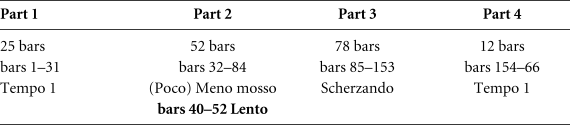
A particular episode in the Phantasy captures the attention of the listener familiar with Schoenberg's oeuvre because of the intense effect of ‘double exposure’ it creates: a melodic cantilena stands out not only as an extraordinary musical event in its own right but also for the associations it evokes with a moment located in Schoenberg's musical past. This passage is marked Lento in the score and is situated in the middle of the second part of the large-scale form (see Table 1).
Outline of the four main sections of the Phantasy, Op. 47.
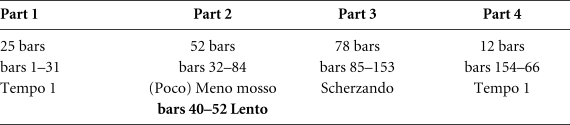
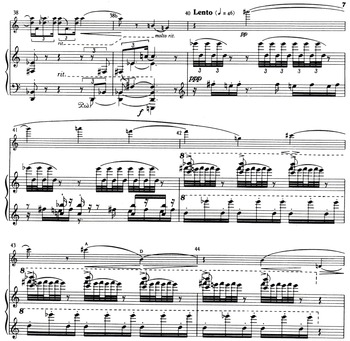
From the score it is evident that what produces this striking aural effect is the ostinato structure of the Lento's piano texture. This texture consists of a repetitive, oscillating pendulum figure, marked piano pianissimo. The pitch content of this ostinato has been prepared by the sustained sonority in the piano part in bar 39, which comprises the same hexachord. But now the set of pitches is elevated to a much higher register and is fragmented into circling, oscillating ostinato figures (bars 40–42ff). The effect of the texture might be described as a ‘standstill’, imbued with a sense of vibrant tension. This episode constitutes one of the most beautiful passages in the work, representing its work-immanent past and future, to speak in temporal terms. For an instant the harsh sonority and shattered syntax are suspended, as is the insistent and relentless drive of the rhythmic-motivic momentum. In terms of Formenlehre, the Lento would probably be characterized simply as a further extension of the more subdued lyrical and melodic character of the preceding Meno mosso.Footnote 29 Yet the expressive potency of the Lento section cannot be explained by means of conventional analytical strategies alone, as its ambiguous musical function challenges any categorical classification, such as that of a conventional lyrical second theme – or, indeed, a lyrical second movement in a double-function form.
Schoenberg, Phantasy for violin with piano accompaniment, bars 38–44. Corrected reprint © 1978, Edition Peters. International copyright secured. All rights reserved. Reproduced by permission.

The violin part at this point is marked pianissimo, and according to the testimonies of performers who rehearsed the piece with Schoenberg, he intended the Lento to be played with muted dynamics, sounding as if from a remote space.Footnote 30 This combination of timbral features has often been linked with the spherical, ethereal, or celestial – metaphorical attributes that immediately associate this musical moment with notions of spiritual or mystical experience (see Example 1). It takes, perhaps, an eccentric performance of the work, such as that of Yehudi Menuhin and Glenn Gould, to open up a hermeneutic window in the otherwise blank walls of immanent interpretation and reveal glimpses of forgotten musical and extra-musical landscapes.Footnote 31 At the start of the Lento Menuhin's violin sound suddenly abandons the euphony (Wohllaut) that it had sustained throughout the preceding Meno mosso passage. The warm sonority of the violin is transformed into an airy, brittle timbral quality, while Gould's treatment of the ostinato texture reveals what would otherwise have been an unfulfilled possibility, in that he lets the accompanying figuration, with its delicate Spielfiguren, sound like sustained sound-sheets, creating a sequentially ascending gesture.Footnote 32 Thus the beginning of the Lento (bar 40) sounds as if the now ‘dematerialized’ instrumental ‘voice’ were hovering over crystalline sheets of light.Footnote 33 Menuhin, following Gould's lead, creates an equally striking effect simply through subtle nuances of timbre and articulation. In a way that transcends the prescriptions of the notation, the piano texture seems ultimately to merge with the brittle, airy grain of the violin timbre, an effect that enhances the impression of the Lento as an episode of suspension.
This sudden turn in the performance by Menuhin and Gould from the relative euphony of the preceding Meno mosso to the disembodied pallor of the violin cantilena – along with the creation of a ‘sound sheet’ in the accompaniment – is needed to draw attention to a particular instance of sensuous resemblance. The expressive sound-colours unleashed by Gould and Menuhin's sensitivity to nuances of timbre serve to transport the listener from the sound sheets of the Phantasy to a similar moment in one of Schoenberg's most stylistically significant works from three decades earlier, his mystical oratorio Die Jakobsleiter.Footnote 34 This is the moment of the offstage Höhenmusik, played by a solo violin, and the beginning of the ‘Great Symphonic Interlude’ (see Example 2).
Schoenberg's instruction regarding the expressive articulation of the melody in bar 602 of Die Jakobsleiter – ‘Sehr ruhig und breit, doch ohne Dehnungen und ohne bedeutende Schwellungen’ (very calmly and broadly, but without the extension or marked swelling of notes) – could just as easily be applied to the Lento melody: both gestures consist of stretched and softly arched melodic trajectories articulated in a smooth legato and unfolding at a slow tempo. The dynamic is pp in the case of the Phantasy, and ppp in the case of the oratorio interlude. Both melodies evoke the impression of remote space: in the case of Die Jakobsleiter this effect is achieved by the performer's physical disappearance from the stage to offstage or above stage. The allusion to the violin solo in Die Jakobsleiter is a striking incidence of similarity in a number of dimensions – contour, articulation, dynamics, register, phrase trajectory, and tempo. Moreover, the immediate musical contexts of the respective melodies – the episodes that precede and follow them and their accompanying textures – also demonstrate remarkably similar features.Footnote 35 Gould exaggerates this sensuous event of ‘double exposure’ in his performance of the sound sheets in the Phantasy, emulating the celesta sound that in turn recalls the sound tapestries of the transitional episodes preceding the violin solo in the oratorio.Footnote 36
Schoenberg, Die Jakobsleiter, bars 602–7. Off-stage violin solo. © 1974, Belmont Music Publishers/UE 13356. International copyright secured. All rights reserved. Reproduced by permission.

By detaching and re-contextualizing a moment of resemblance in this way, Schoenberg creates a relationship between an event in a purely instrumental work without text or programme and a remote, original context, where the music conveys extra-musical meaning – the musical metaphor of transformation, the transcendental moment on the threshold between the material world and a spiritual heaven marked by the Höhenmusik of Die Jakobsleiter. Thus, by means of metaphorical association, the separated domains of non-referential musical meaning and extra-musical meaning merge. The violin cantilena is no longer just a significant moment in the Phantasy's immanent formal development but also an image that recalls a key episode in Schoenberg's mystical drama. For an instant, musical imagery turns into metaphorical image, timbre into colour, gesture into figure, and musical form into musical dramaturgy.
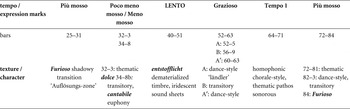
The sensuous similarity of musical textures has the power to create meaning, and thus the expressive scope of Schoenberg's late work is expanded by means of these new possibilities of metaphorical association and memory-based cognition. This is what might be called the creative faculty of mimetic recollection.Footnote 37 On the other hand, self-reflexive remembrance can also operate by means of distortion. Detaching a musical moment and then re-contextualizing it establishes a sense of distance. In this way the return in the late works of textures taken from Schoenberg's creative past goes beyond simple imitation or self-borrowing: the ethereal melody and celestial textures of Die Jakobsleiter reappear in the context of the Phantasy, but in a different, distorted setting that makes timbre and texture sound brittle, fragile, gebrochen. The ecstatic orchestral sound tapestries and spherical voice in Die Jakobsleiter find themselves situated in much more ‘extreme’ surroundings – a musical landscape of harsh furioso outbreaks, burlesque dance figures, exclamations, melodic hiccups, sudden interruptions, and ironic-naïve Spielfiguren (see Table 2).
Schoenberg, Phantasy, Op. 47. Part 2, from Più mosso to Più mosso (formation of instrumental ‘scenes’).

The moment of remembrance in the Phantasy thus expresses the experience of the past in the present as an allegorical experience of time.Footnote 38 The violin solo, which in the oratorio signified the ecstatic moment of transition and ascension from the material to the spiritual world, now reappears in the radically altered musical context of the Phantasy. Detached from the spiritual enthusiasm of the expressionist period, the distorted Klangfläche conveys the ambiguous experience of belatedness and the erosion of time. The way in which one of the most profound images of a mystical vision in Schoenberg's oeuvre is now transformed into a subtle, almost dematerialized gesture suggests that utopian beliefs have collapsed back into an individual struggle for faith. The resolute confidence of the spiritual prophet and saviour now turns into the diffidence of the belated expressionist.Footnote 39
Repeated and distorted: sound sheets in Part 3 of the String Trio, Op. 45
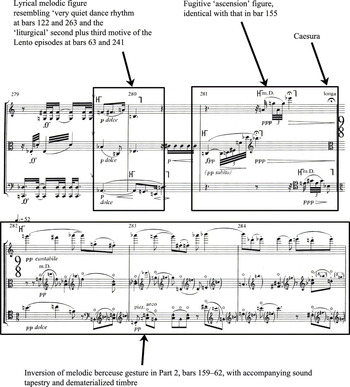
In bar 282, at the end of Part 3 of the String Trio, a texture appears that resembles the iridescent sound sheets of the later Phantasy (see Example 3). These bars of the String Trio contain explicit instructions in the score concerning timbral character and instrumental articulation. Each instrument is required to play con sordino. The principal melody is given to the violin, playing in its brilliant register, though pp, while the sound tapestries of the accompanying voices are saturated with artificial and natural harmonics. Throughout this passage strong accents are avoided. The general mood is calm, with no noteworthy expressive shifts or changes. Not least, the tempo mark indicates a pulse slower even than the basic tempo of the piece, just as the Lento of the Phantasy is also the slowest tempo in that work.
Schoenberg, String Trio, Op. 45, bars 279–84 (from three bars before start of Cantabile section). © 1950, Belmont Music Publishers. Ed. Christian Martin Schmidt © 1982, Schott/Universal Edition. International copyright secured. All rights reserved. Reproduced by permission.

The sound sheets in the String Trio and the Phantasy diverge in terms of their location within the works' large-scale syntax. According to conventional Formenlehre, the String Trio's final part is a recapitulation section. Dahlhaus, in his essay ‘Schönberg und die Programmusik’, suggests a five-part design to the piece, relying on the model of sonata form. Part 1 is the exposition, and the 1st Episode (bar 52) the subordinate theme (in sonata movement form) or slow movement (in sonata-cycle form). Part 2 (bar 133) presents a scherzo, beginning with an allusion to waltz or ländler, after which the 2nd Episode (bar 180) presents the development section in contrapuntal style. Part 3 (bar 208) forms the concluding recapitulation.Footnote 40 Dahlhaus thus uses the principles of Formenlehre to analyse the piece. Yet his essay ends with a dialectical move in true Adorno style. Aware of the precarious character of his statements on the formal design of the Trio, he tries to explain the peculiarity of the identical recapitulation and the non-thematic ‘patchwork’ character of its small-scale syntax as a Late Style phenomenon, a deliberate mise-en-scène of a paradox.Footnote 41
What remains a general, though suggestive, observation in Dahlhaus's essay might be concretized by an interpretation of the sound sheets that emerge in the String Trio's final part. The Cantabile, from bar 282 onwards, is introduced by a shadowy, agitated passage resembling the transitional Più mosso that preceded the Meno mosso in the Phantasy. Then suddenly we encounter a motive of a minor second followed by a minor third – hence belonging to the generic class of trichords that Alexander Ringer has associated with tropes of the sacred and liturgical.Footnote 42 This conjunct melodic figure is followed by a melodic ascent. With its overall upward trajectory, the compressed series of melodic figures prepares the listener for the entry of the violin melody in bar 282 (see Example 3). Its intervallic contour, an exact inversion of the pitch-class intervals of the violin line in bars 159–62, reveals a retrospective relationship with the pastoral idyll of that earlier passage's melodic ‘berceuse’ character.Footnote 43 To Martin Boykan the Cantabile section from bar 282 marks the highpoint of a process of resolution and repose that culminates with the recapitulation.Footnote 44 Michael Cherlin too senses in the violin theme a certain relaxation of tension, owing to the relative simplicity of the row partitioning and the return to the row area of the beginning.Footnote 45 Noteworthy, though, is the way in which the inverted melody changes its timbral character: the euphonious sonority of the ‘berceuse’ becomes dematerialized in the timbre of the violin at bar 282. The iridescent sound tapestries of the accompanying parts contribute further to the immaterial character of this particular passage – a striking analogy with the ethereal sound sheets in the Phantasy.
As in the Phantasy there is here a self-reflexive, self-critical aspect to the reemergence of a Klangfläche. The ‘disembodied’ return of the ‘berceuse’ melody from Part 2, transformed into fragile sound sheets, exemplifies the dialectic between mimetic perfection and critical disintegration in Schoenberg's Late Style. Distortion signifies an act of distancing, a process of spatial disembedding and emotional alienation that seems the result of a desire to escape the limitations of self-imitation. At the same time, the notion of resemblance is also the precondition of anamnesis, the recollection of forgotten events of the past. Hence the nostalgic return of the ‘berceuse’ melody finds itself embedded within the kind of accompanying texture that evokes the Klangflächen – signifiers of some of the most spiritual moments in the composer's past.
Towards a Late Style poetics of remembrance
As one of the String Trio's most beautiful moments, the section from bar 282 expresses the ephemeral recovery of forgotten memories. This moment of Umschlag or dialectical reversal – recalling the sudden turn from sensuous euphony to immaterial pallor in the Phantasy – represents another breakthrough of the ‘poetics of remembrance’ in Schoenberg's Late Style. In this concluding section, I shall distill Schoenberg's ‘poetics of remembrance’ from Adorno's notions of Schoenberg's Spätstil.
In the middle of Adorno's extensive essay on ‘Schoenberg and Progress’, we encounter what is perhaps a surprising reference to the author of À la recherche du temps perdu, the great novel on remembrance of the past. One might well ask what Schoenberg has in common with Proust, who, in his monumental project, according to Walter Benjamin, ‘did not describe a life as it actually was, but a life as it was remembered by the one who had lived it’.Footnote 46 Proust's name appears in numerous places in Adorno's extensive literary oeuvre. Amongst them is this remarkable passage from his Aesthetic Theory, a passage that revealingly brings together Adorno's ‘aesthetics of the fragment’ with his famous notion of the ‘beautiful moment’ (schöne Stelle):Footnote 47
Accordingly, contrary to current aesthetic views, the whole in truth exists only for the sake of its parts – that is, its kairos, the instant – and not the reverse […]. Whoever lacks an appreciation for beautiful passages – in painting, too, as with Proust's Bergotte, who, seconds before his death, is captivated by a small section of a yellow wall in a Vermeer painting – is as alien to the artwork as one who is incapable of experiencing its unity.Footnote 48
This short passage reveals latent empathetic aspects of Adorno's otherwise almost unbearably fatalistic conception of Late Style as a signifier of catastrophe in the history of art and the end of the nineteenth-century humanist project.Footnote 49 Nowhere is this fatalism more evident than in his comments on Schoenberg's final twelve-note works in the essay entitled ‘Arnold Schönberg (1874–1951)’. The late works, he wrote,
begin to acquire the character of the fragment, the shadow of which followed Schoenberg's art throughout his life. His last pieces give a fragmentary impression, not merely in their brevity but in their shriveled diction. The dignity of the great works devolves on splinters.Footnote 50
The paragraphs on ‘Music as Knowledge’ in Philosophy of New Music, written in American exile during World War II, contain this peculiar passage, concealed in a footnote:
It is in their stance of knowing that artworks become critical and fragmentary. Schoenberg, Picasso, James Joyce, and Franz Kafka, as well as Marcel Proust, are in agreement about what in artwork today has any chance of surviving.Footnote 51
What resonates in these remarks on Schoenberg's Spätstil is the experience of the real catastrophe of civilization that Adorno shared with Schoenberg, Benjamin, and the whole lost generation of exiled European Jews. To Adorno, Schoenberg's Late Style, in which the harshness of expression breaks any semblance of coherent form into pieces, signifies nothing less than the true expression of the catastrophe of civilization, the end of history, and the failure of the idea of historical, cultural, and spiritual progress. Adorno understands Schoenberg's late twelve-note works as the expression of the end of art, or of art as individual expression. Today we scarcely understand what Adorno, Schoenberg, Benjamin, and their generation went through. However, Adorno goes too far when he reduces Schoenberg's late works to an allegory of lost individual freedom, discounting Schoenberg's enduring belief in the power of the subject to express itself autonomously. One might recall that even at the end of the 1940s, after World War II, Schoenberg had not forgotten what he confessed to Busoni: his quest for individual self-expression, the quest for liberation from any theoretical constraints and historical models.
However, Adorno's notion of Late Style also harbours a more human and empathetic side. In the aforementioned passage from Aesthetic Theory, where he writes of Proust's Bergotte as captivated by a patch of yellow in a Vermeer painting, Adorno sounds more like Benjamin than like Hegel or Marx. Here he allows himself to celebrate the aesthetic moment itself, portrayed as a moment of remembrance, of bliss (Augenblick der Glückseligkeit) in the face of existential danger.Footnote 52 It is the very moment at which Proust's Bergotte feels ‘at home’, a moment beyond reality and historical time, in which the character is captivated by a painting or, more precisely, by the aesthetic qualities of a moment in the painting, a glimpse of part of a yellow wall. Throughout this passage from Aesthetic Theory resonates one of the most empathetic passages in ‘Spätstil Beethovens’. The nearness of his own death makes the artist lose the power to create images of a perfect and complete world:
Touched by death, the hand of the master sets free the masses of material that he used to form; its tears and fissures, witnesses to the finite powerlessness of the I confronted with Being, are its final work.Footnote 53
It takes an ephemeral, tender gesture to turn historical catastrophe into a moment of personal, individual remembrance in the face of death, a beautiful moment quite different from expressionless, barren conventions and gestures of disintegration (Zerfall).Footnote 54
Accordingly, those radiant moments of remembrance in Schoenberg's Late Style invite us to dwell in the particular moment, isolating it from its musical context, instead of immediately rushing to the next. Released from historical models of progress and continuity, Schoenberg's last two chamber works invite the listener to participate in their play with memory, beyond the frame of a perception of form that is limited to immanent structural functions. These works do not call for an understanding of musical meaning that restricts itself to questions of intrinsic coherence and the integration of parts within a perfect totality. Rather, they invite the listener to follow the traces of the past – Schoenberg's own creative past – evoked in those sensuous moments of memory.
As ephemeral glimpses of bygone ecstatic visions, the Klangflächen in the late works enact the melancholy experience of lost time by means of distorted resemblance. Signifying as they do the heritage of a longstanding spiritual quest in Schoenberg's late instrumental music, these sound sheets affirm the ability of mimesis to elude structure, allusion to transcend the boundaries of immanent form, and memory to supplant history.