Introduction
What explains the variation in how states collectively deal with shared public health challenges across different world regions? The article tackles this puzzle by comparing regional health governance in Central and South America. To do so, we adopt the conceptual framework of regional health governance modes (RHGMs), which allows us to address institutional design issues (that is, how governance is institutionalised) while exploring the process of collective health policymaking that takes place within regional institutions (that is, how governance is enacted and by what types of actors). A key issue in the IR governance debate is the role of external actors, both state and non-state, in the provision of governance goods and services,Footnote 1 and this is at the heart of the article's findings. We show that Central America's health governance has been driven by external actors, whereas South America's health governance was driven by states and remained insulated from the influence of external actors. Drawing from the global health governance scholarship and comparative regionalism, we argue that the explanation for such variation lies in the interplay of state capacity and regional leadership. In Central America, weak state capacity combined with the absence of a regional leader willing to provide governance resources. This opened up space for external actors to contribute actively to regional health governance, complementing the governance of actual governments. This resulted in the emergence of an exogenously-driven governance mode. In South America, the presence of states endowed with relevant capacities in the health sector interacted with Brazil's regional leadership, which supported regional institution building and promoted a South-South cooperation agenda based on intra-regional exchanges among South American health bureaucracies. This led to the emergence of an endogenously-driven governance mode autonomous from vertical North-South cooperation and resistant to external actors’ influence.
To test our argument on the impact of state capacity and regional leadership on RHGMs, we conduct a comparative case study analysis of the regional health governance efforts pursued within the Central American Integration System (SICA) and the Union of South American Nations (UNASUR).Footnote 2 The member states of SICA and UNASUR equipped the two regional organisations (ROs) with bodies specifically devoted to public health: the Committee of Central American Health Ministers (COMISCA) and the Health Council of UNASUR (UNASUR Health). COMISCA and UNASUR Health are sector-based institutions headed by member states’ health ministers, where decisions are made by consensus and formally subordinated to the approval of the intergovernmental political bodies of SICA and UNASUR. Despite these similarities, a closer look at COMISCA and UNASUR Health reveals significant variation in the two bodies’ institutional design and policymaking, which is indicative of the different RHGMs developed in Central and South America. We explore such variation by comparing key dimensions of the two bodies’ institutional design, as well as their policymaking in the field of access to medicines. This allows us to shed light on the determinants of RHGMs in the two regions.
The article provides the following contributions to the literature. It represents the first effort to compare RHGMs in Central and South America, whose variation is theoretically relevant for exploring the drivers of health governance in Latin America as well as in other world regions. By illuminating the impact of the interplay of state capacity and regional leadership on RHGMs, the article contributes to the comparative regionalism research agenda. Furthermore, the article contributes to the scholarship on global health governance by shedding light on the logic and effects of external actors’ involvement in the provision of regional health governance solutions in the Global South.
The article is structured as follows. The first section bridges the gap between global health and comparative regionalism, introducing an innovative theoretical framework centred on state capacity and regional leadership as the determinants of RHGMs. Section two discusses research design and methodology issues. Section three presents empirical evidence relating to the differences in state capacity and regional leadership in Central and South America. Section four examines the variations in the institutional design of regional health governance in Central and South America. Section five analyses the variations in the two regions’ health governance efforts in the field of access to medicines. The conclusion summarises how different configurations of state capacity and regional leadership determined variation in the modes and effects of health governance in Central and South America. In particular, the conclusion discusses how Central America's exogenously-driven RHGM has proven more resilient than South America's endogenously-driven RHGM. The former has not only delivered collective goods in the field of access to medicines but also responded to the COVID-19 pandemic. The latter succumbed to intergovernmental conflicts, which led to the dismantling of regional health institutions, the paralysis of health governance initiatives, and the subsequent lack of a regionally coordinated response to COVID-19.
1. The determinants of RHGMs: Bridging the gap between global health and comparative regionalism
The concept of global governance emerged in IR scholarship to grasp the efforts to regulate interdependent transnational relations through the formulation of shared norms and rules, as well as through multilateral functional cooperation, in the absence of an overarching supranational authority.Footnote 3 Global governance can thus be defined as collective action aimed at managing cross-border issues and providing collective goods. This involves states as well as non-state actors such as international organisations (IOs), international non-governmental organisations (INGOs), and the market.Footnote 4
Global health governance
The concept of global governance has been extensively applied to the field of public health, which has traditionally registered high levels of transnational cooperation in the areas of disease prevention and the promotion of well-being across societies. The relevance of public health in IR is due to the inherent characteristics of a policy sector marked by high levels of interdependence among states.Footnote 5 The complexity of transnational health challenges has stimulated a rich literature on global health governance, which maps the key actors involved in governance-making across the globe and analyses the challenges for legitimacy and effectiveness posed by transnational coordination.Footnote 6 This literature shows how the increasing globalisation of health challenges intensified the involvement of external state (for example, donor governments) and non-state (for example, the WHO or the Bill and Melinda Gates Foundation) actors in domestic health governance. This tendency has been particularly strong in developing countries with weak state capacity to provide basic health services and tackle cross-border health challenges. The literature investigated the influence of external actors on the decisions of policy-makers in weak states,Footnote 7 discussing the impact of external funding on those states’ autonomy in and ownership of health policymaking.Footnote 8
The literature on global health governance has privileged the global level, analysing the role and performance of the WHO, global public-private partnerships like the Vaccine Alliance (GAVI) and transnational philanthropies and NGOs, and exploring their impact on domestic health governance, particularly in the developing world. As such, scholars have under-researched a key component of global health governance: the regional dimension.Footnote 9 Regions have emerged as a strategic policy space, located between the domestic and the global, in which to tackle shared challenges, govern interdependences, and provide collective goods.Footnote 10 This is particularly the case with respect to transnational health challenges, which produce severe negative externalities among neighbouring states.
Regional governance and public health
Governance-based approaches to the study of regionalism first appeared in scholarship on the EU, aimed at capturing the complexity of the interactions between European states, supranational bodies, and subnational actors.Footnote 11 Nonetheless, scholars of regionalism have increasingly identified in the concept of governance a tool for cross-regional comparison.Footnote 12 The comparative regionalism literature has investigated the role of ROs as catalysts for governance-making, exploring how regional institutions provide privileged arenas for the coordination between states, IOs, foreign governments, and external donors.Footnote 13 The tendency of states to engage in governance initiatives within ROs has been related to a set of demand and supply-side factors: tackling transnational challenges, signalling to external actors, and deflecting governance transfer by external actors, as well as other considerations relating to regional leadership and the normative diffusion of external models.Footnote 14
The literature has paid particular attention to two supply-side drivers of regional governance: regional leadership and external actors. Scholars investigated how the presence of a state with leadership capacity affects the design and effects of regional governance.Footnote 15 Regional leaders can steer institution building and policymaking by use of material incentivesFootnote 16 and/or by socialising neighbouring governments into their visions of how to articulate regional governance, and persuading them to follow their lead.Footnote 17 On the other hand, the literature analysed the impact of external actors (for example, the EU and other state and non-state donors) on the institutional design and policy orientations of regional governance, with a strong focus on sub-Saharan Africa and Southeast Asia.Footnote 18 Furthermore, scholars investigated the impact of external actors’ involvement on the ownership and effectiveness of regional governance processes and institutions.Footnote 19
Scholars of regionalism have conducted research specifically on regional health governance in and across different regions, with a focus on ROs such as the EU,Footnote 20 ASEAN,Footnote 21 UNASUR,Footnote 22 MERCOSUR,Footnote 23 ECOWAS, and SADC.Footnote 24 However, this scholarship has struggled to incorporate the theoretical insights generated by the IR literature on the drivers and modes of regional governance. As a result, there is little systematic comparative work on the conditions under which different RHGMs emerge across regions. This article fills this gap by developing a theoretical framework for the comparative analysis of RHGMs, which incorporates three key variables derived from the global health governance scholarship and comparative regionalism: state capacity, regional leadership, and external actors’ involvement.
The theoretical framework
We argue that RHGMs are determined by the interplay of state capacity (SC) and regional leadership (RL). Such interplay explains the variation in the institutional design and policymaking of regional governance efforts. We define RHGMs as those institutionalised modes of coordination among state and non-state actors that produce shared norms and rules, and deliver regional collective goods in the public health area.
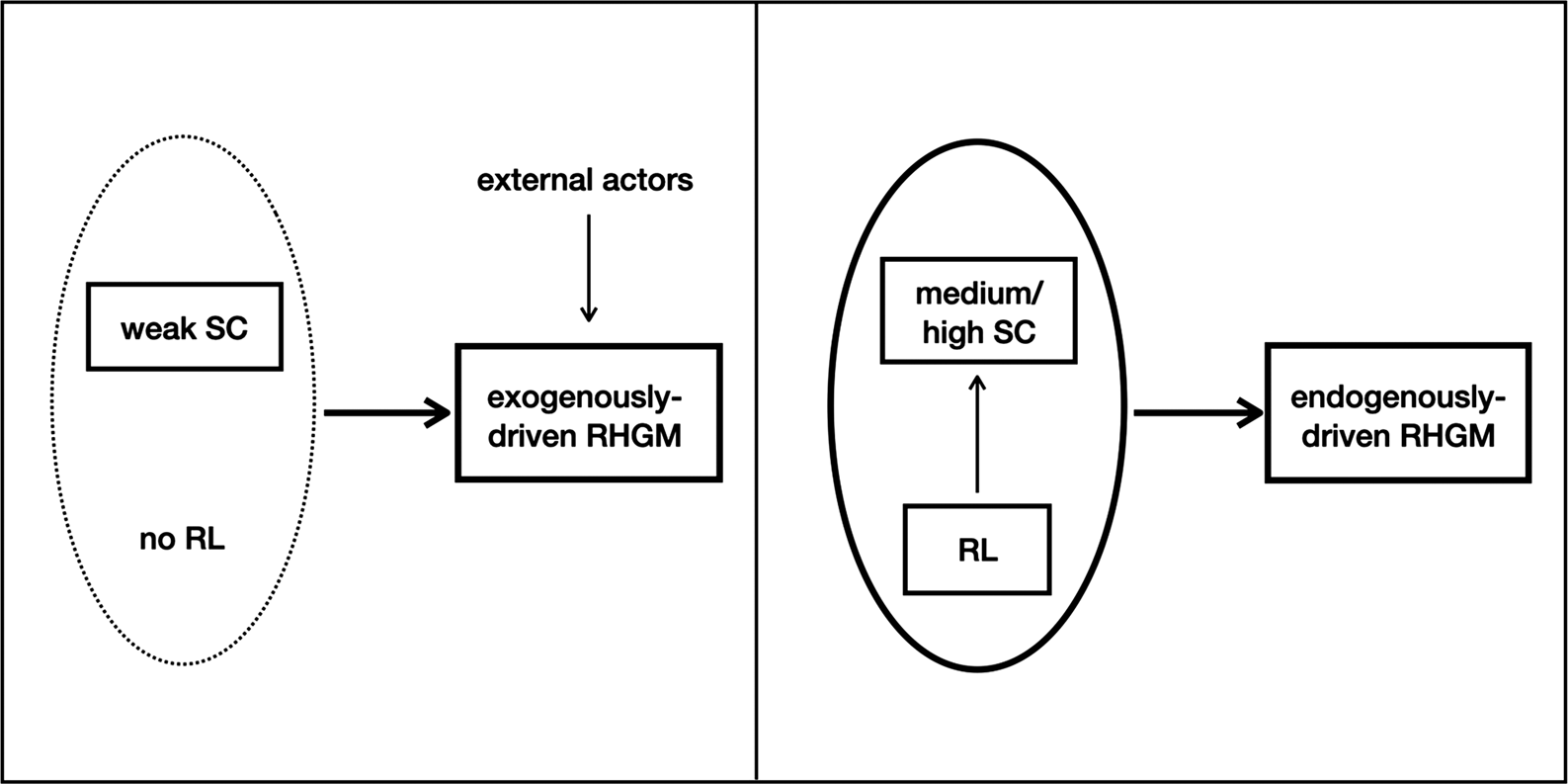
We posit that the interplay of weak aggregated SC in a given region and the absence of a state willing to exercise RL and capable of providing governance resources leads to the emergence of a RHGM driven by external actors, which influence governance-making through funding and technical assistance. We define this mode of governance as an exogenously-driven RHGM (see Figure 1). On the other hand, we argue that the interplay of medium/high aggregated SC plus the presence of a state willing and able to exercise RL by sustaining institution building and mobilising neighbouring countries’ SC leads to a RHGM centred on intra-regional exchanges, and less dependent on external actors. We define this mode of governance as an endogenously-driven RHGM (see Figure 1).
The theoretical framework.
Source: Authors' own elaboration.

2. Research design, methodology, and data
This article investigates the variation in the RHGMs of Central and South America. We argue that such variation results from the interplay of SC and RL in the two regions.
Operationalisation of the dependent variable
We operationalise the dependent variable RHGM in a dichotomous manner: a RHGM can be exogenously driven or endogenously driven. The former is driven by external actors, which shape the design of regional institutions and influence regional policymaking through funding and expertise. The latter is driven by states, which design regional institutions, finance their activities through national quotas, and autonomously formulate regional policies, keeping external actors at the margins of the process. We dichotomise the dependent variable because our interest is to explain the variation in the principal driver of health governance in the two regions.
Operationalisation of the explanatory variables
Following an organisational approach, we define state capacity (SC) as ‘the bureaucratic, managerial, and organisational ability to process information, implement policies, and maintain governing systems’.Footnote 25 Four indicators for assessing SC have emerged from the literature: resources, presence of the state, quality of bureaucracy, and coherence of mandates.Footnote 26 To operationalise SC in the public health sector, we adopt the first two indicators.Footnote 27 The first of these refers to the resources that a state has at its disposal to provide public health services to its population. We operationalise this indicator as a function of: (1) domestic general government health expenditure per capita and (2) external health expenditure as a percentage of total health expenditure. The second indicator, presence of the state, refers to a state's infrastructural capacity to penetrate its surrounding society and territory. We operationalise this indicator as a function of: (3) the number of doctors per 10,000 population; (4) the number of hospital beds per 10,000 population; and (5) the capacity to ensure treatment coverage across the population, which we measure through the antiretroviral therapy coverage among people living with HIV. The aggregated SC of a group of countries can rank high, medium or low based on how they score against these indicators, relative to the OECD average. We take the latter as the benchmark for high SC.
We define regional leadership (RL) as a relational concept that entails not only the material capacity to provide regional collective goods, but also the willingness to do so, as well as the capacity to articulate a persuasive idea of collective action that elicits the backing of neighbouring states.Footnote 28 As such, RL is present when a state (1) has the capacity to drive regional institution building and policymaking; (2) is willing to bear the costs of leadership, and (iii) has the following of other states. We adopt an issue-specific approach to RL, whereby RL can be exerted in a specific issue area without necessarily being projected in others. This means there can be multiple leaders in a given regional governance initiative.
The comparative case study method
This article employs comparative case study analysis to address the following question: What explains the variation in how states collectively deal with shared public health challenges across different world regions? Comparative, cross-regional studies of the logics of regional governance have focused on securityFootnote 29 and economic integration.Footnote 30 Less attention has been devoted to explaining cross-regional variation in RHGMs. We conduct the first systematic comparison of regional health governance in Central and South America by focusing on the institutional design of SICA's COMISCA and UNASUR Health and their governance efforts in the area of access to medicines. An innovative comparison of this nature affords a prime opportunity to explain empirical variation in external actors’ influence on regional health governance, which in turn allows for new insights to be generated on the determinants shaping RHGMs across the Global South.
Case selection responds to a most similar cases design, whereby the two cases take on similar values of relevant confounding variables, but different values of the two independent variables of interest (that is, SC and RL) during the periods under investigation (2001–20 for Central America and 2008–20 for South America). Both Central and South America have a dynamic history of regional cooperation, which accelerated in 1950s–1960s and led to the emergence of formal regional institutions that dealt with economic integration, as well as with a variety of other policy sectors, including, prominently, public health.Footnote 31 In 1956 the Central American states launched the Meeting of Health Ministers of Central America and Panama (REMCAP). Since then, Central American health authorities have continued to pursue regional health cooperation, which – starting from the 1990s – got embedded into the institutional framework of SICA. South American states have been cooperating in the field of public health since the 1970s in the subregional frameworks of the Hipólito Unanue Agreement on Health Cooperation between Andean Countries (CONHU) and the Amazon Cooperation Treaty. Throughout the 1980s, both regions experienced a democratisation process (which in Central America was accompanied by a peace process) that stimulated the emergence of new regional institutions – SICA, MERCOSUR, the Andean Community (CAN), and the Amazon Cooperation Treaty Organization – and the intensification of the regional social agenda, with an emphasis on health. In South America, the member states of MERCOSUR created the Meeting of Health Ministers and the Technical Sub-Group on Health, while the members of CAN inserted CONHU into the Andean Integration System, leading to the emergence of the Andean Health Body (ORAS-CONHU). In Central America, the member states of SICA established the Central American Social Integration System, which provided the legal framework for the emergence of multiple sectoral councils, including COMISCA.Footnote 32 As such, historical precedents of regional cooperation were present in the two cases under investigation.
The two regions take on similar values also of a key domestic variable for the study of foreign policy decisions: the ideology of presidents.Footnote 33 In fact, the ideological orientations of the heads of state in power in Central and South America during the periods under investigation were relatively heterogeneous in both regions. They ranged from left wing (for example, Hugo Chávez in Venezuela and Mauricio Funes in El Salvador) and left-of-centre (for example, Lula da Silva in Brazil and Álvaro Colom in Guatemala) to right wing (for example, Álvaro Uribe in Colombia and Antonio Saca in El Salvador) and right-of-centre (for example, Sebastián Piñera in Chile and Oscar Arias in Costa Rica).Footnote 34 Although South America was populated by multiple left-wing or left-of-centre presidents when the region's RHGM emerged between 2009 and 2011, there were some relevant exceptions to this trend (for example, Piñera in Chile and Uribe and Manuel Santos in Colombia). This shows how South American presidents’ ideological orientations were far from being homogeneous even during the region's ‘left turn’. If we take the data set provided by Federico Merke and Diego Reynoso, we can observe variation in the location of both Central and South American presidents in the analytical spectrums ideology driven versus pragmatic foreign policy, and South versus North geopolitical orientation.Footnote 35 This confirms that presidents’ political orientations were relatively heterogenous in both regions. As a consequence, we posit that the comparison of Central and South America allows testing our hypothesis on the impact of SC and RL on RHGMs.
We investigate the mechanism through which the independent variables of interest that differ between the two cases affect their outcomes. In so doing, we show how the interplay of different configurations of SC and RL led to the emergence of different RHGMs in Central and South America.
Data
To generate the empirical evidence needed to prove the impact of SC and RL on RHGMs in Central and South America, we utilised a combination of qualitative and descriptive quantitative data. First, we conducted 15 semi-structured interviews with decision-makers and bureaucrats from the member states of SICA and UNASUR, as well as with external donors and regional experts from different Central and South American health institutions. The appendix lists the interviews. We selected interviewees by applying a positional sampling strategy, whereby individuals’ direct participation in the initiatives under investigation determined their inclusion in the sample. Positional sampling ensures the reliability of the evidence generated through interviews.Footnote 36 We carried out our fieldwork in Brasilia, Buenos Aires, Rio de Janeiro, Quito, and San Salvador, between May 2011 and March 2020. When we were unable to conduct our interviews in person, we conducted online interviews. Second, we generated an original dataset on Central and South American countries’ SC in the health sector, drawing from existing datasets elaborated by the WHO, the Pan-American Health Organisation (PAHO), and the OECD. (The complete dataset is available in the online supplementary material). Finally, secondary literature and official documents issued by national, regional, and multilateral institutions provided additional sources of empirical evidence that served the purpose of testing the reliability of the evidence gathered from primary sources. The adoption of such a triangulation strategy increases the credibility of findings.Footnote 37
3. SC and RL in Central and South America: Exploring the determinants of RHGMs
In this section, we present the empirical evidence relating to SC and RL in the health sector in Central and South America.
SC in the public health sector in Central and South America
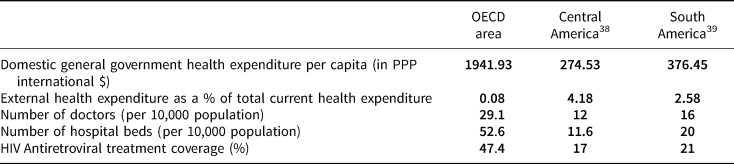
An asymmetry exists between Central and South American states in terms of the capacity to provide public health services to their populations, with the South American region displaying, on average, higher aggregated SC than Central America across the board (Table 1).
Indicators of aggregated SC in the public health sector (2000–14).

Source: Authors’ own elaboration based on data from the OECD, PAHO, and WHO. (The entire dataset, including data disaggregated per country, is available in the online supplementary material.)
The Central American region has traditionally been characterised by state weakness, the pervasive involvement of external actors, and repeated attempts to pursue regional cooperation.Footnote 40 Multilateral agencies and external donors have substituted for Central American states’ lack of economic and technical capacities to foster development and regulate their societies.Footnote 41 The health sector is subject to this general trend. Central America remains below the OECD and South American averages in terms of both public health spending and infrastructural capacity to provide public health services. This explains why Central American states have relied heavily on the support of external actors, as evidenced by the large share of external resources within total health expenditures, which reaches 4.18 pe cent in Central America compared to 2.58 per cent in South America and 0.08 per cent in OECD countries. Weak public health spending has impinged on Central American states’ human resources (for example, number of doctors), infrastructural capacities (for example, hospital beds), and ability to provide treatment coverage in the fight against deadly transmissible diseases like HIV (see Table 1). Data disaggregated by country show deep intra-regional asymmetries. In particular, Costa Rica and Panama have performed significantly better than the regional averages across all indicators. Costa Rica spent, on average, more than 6 per cent of its GDP on health, whereas Guatemala spent little more than 1 per cent. Likewise, in 2014 Costa Rica and Panama spent US $850 and US $907 on health per capita, respectively, whereas Honduras and Guatemala spent US $142 and US $166, respectively (see online supplementary material).
The limited resources of most Central American states have hampered the development of medicine production capacities and of the regional pharmaceutical market.Footnote 42 This has been exacerbated by the small size of Central American states’ population and GDP, which inhibited the development of healthcare industries capable of sustaining an inward-oriented strategy in strategic fields like medicine production. Central America represents the seventh largest pharmaceutical market in Latin America, ranking behind Chile, and relies heavily on imports of medicines from extra-regional markets. The largest importers of the region are Costa Rica and Guatemala.Footnote 43 Furthermore, most of the pharmaceutical manufacturing infrastructures of Costa Rica and Panama – Central America's economic powerhouses – belong to multinational pharmaceutical laboratories like AstraZeneca, Bayer, and Roche. Costa Rica is the only Central American state with indigenous pharmaceutical companies (for example, Gutis and Speratum), whereas Panama has focused on becoming a hub for transnational healthcare companies rather than on developing medicine production capacities.Footnote 44
South America is also marked by intra-regional asymmetries in the area of public health, with Bolivia, Guyana, and Suriname ranking considerably lower than the regional average across multiple indicators. This is particularly evident with regard to dependence on external resources – 5.63 per cent, 1.14 per cent and 4.58 per cent of total public health expenditure, respectively – and the number of doctors per 10,000 population: 5.75, 4.44, and 7.69, respectively. On the other hand, Argentina, Brazil, Chile, and Uruguay perform above the regional average across the board (see online supplementary material). In any case, South American states display, on average, higher levels of government health spending and a higher number of doctors and hospital beds than Central American states. This allows South American states to be less dependent on external aid, and to ensure higher treatment coverage for deadly transmissible diseases such as HIV, than their Central American counterparts (see Table 1).
A case in point is medicine production. Several South American states – above all, Argentina and BrazilFootnote 45 – developed the capacity to produce medicines through public and private laboratories.Footnote 46 Argentina is a pioneer in the production of medicines in South America and counts 160 domestic enterprises and 210 laboratories that produce for the national market (accounting for 50 per cent of the domestic pharmaceutical market).Footnote 47 Brazil is the largest market for pharmaceuticals in Latin America (sixth in the world), and its capacity to produce drugs is unparalleled in the region, with 241 laboratories active in the country (60 per cent of them Brazilian-owned). This is the result of a systematic state effort to build up a domestic pharmaceutical industry, starting in the 1950s, when Brazil became a major exporter of antibiotics. This trend accelerated in the early 1990s when the Brazilian government invested heavily into Brazil's manufacturing capacity in order to tackle the HIV-AIDS epidemic and sustain the country's newly established universal healthcare system.Footnote 48 The administrations of Fernando Henrique Cardoso (1994–2002) and Lula da Silva (2002–10) further stimulated the production of generic medicines, which now account for one-third of Brazil's medicine market.Footnote 49 Two of Brazil's largest pharmaceutical laboratories are public: the Drug Technology Institute (Farmanguinhos) and the Immunobiological Technology Institute (Biomanguinhos), which every year manufacture several million doses of vaccines (for example, for yellow fever and polio), diagnostic tests (for example, for HIV and dengue fever), and pharmaceutical units (antiretrovirals plus medication for malaria, Chagas disease, hepatitis, and diabetes).Footnote 50 Both laboratories belong to the Oswaldo Cruz Foundation (FIOCRUZ), a public health agency that provides 40 per cent of the drugs purchased by the health ministry. This has allowed Brazil to gain bargaining power and technological autonomy vis-à-vis international laboratories.Footnote 51 Differently from Central America, the size of the population and the economy of some South American states – Brazil and Argentina, in particular – created a higher potential for inward-oriented strategies based on the development of endogenous medicine production capacities.
RL in Central and South America
The Central American region has traditionally lacked a regional leader, but not necessarily because of the lack of states endowed with superior material, ideational, and/or entrepreneurial capacities. Indeed, Costa Rica and Panama have displayed higher SC than their Central American neighbours, not only in the health sector, but across all the main indicators of socioeconomic development.Footnote 52 Additionally, Costa Rica played a central role in the 1980s Central American peace process. However, both states have consistently eschewed regional leadership ambitions at the Central American level, privileging instead the global multilateral level. Panama has sought to establish itself as a ‘global hub’ – particularly in the fields of logistics, transport and finance – while refusing to play such a role for Central America. Following the same logic, in May 2020 Costa Rica launched the ‘COVID-19 Technology Access Pool’ (C-TAP)Footnote 53 in partnership with the WHO. It is worth noting that Costa Rica never took similar leadership initiatives at the regional level, and that its global leadership bid via C-TAP did not meet with a general consensus among Central American states – Guatemala and Nicaragua declining back it. In sum, despite their superior material and entrepreneurial capacities, Costa Rica and Panama have never pursued RL in Central America. The RL vacuum in Central America has been filled by external actors such as the EU, and the cooperation agencies of countries such as Spain and the US.Footnote 54
South America has had in Brazil a state with the capacity to exercise RL. Particularly since the end of the Cold War, Brazil has driven regional governance efforts by launching the idea of South America as an autonomous geopolitical region.Footnote 55 Health cooperation became a pillar of Brazil's RL under the Lula administrations, as evidenced by the substantial increase in the federal resources earmarked for regional cooperation projects, which went from 2.78 million reais in 2005 to 13.8 million in 2009.Footnote 56 The pivotal role of public health in Brazil's foreign policy did not start with Lula, but rather with Cardoso in the late 1990s, when Brazil displayed a remarkable activism in global health negotiations in support of the production of generic antiretroviral drugs.Footnote 57 Brazil's health diplomacy turned decisively to the region during the Lula administrations, which regarded health cooperation as instrumental in the consolidation of Brazil's RL in South America.Footnote 58 Under the leadership of Health Minister José Gomes Temporão (2007–10), Brazil exploited its diplomatic clout, economic power and superior capacity in the health sector to become the agenda setter of South America's health governance, and to promote its South-South health cooperation project at the regional level.Footnote 59
Besides Brazil, the South American region has had in Argentina a secondary power with the capacity to exercise RL, particularly in the Southern Cone.Footnote 60 Despite declining clout, in the early 2000s the Argentine government (under the leadership of Health Minister Ginés González García) coordinated joint meetings of all South American health ministers, and drove the first joint purchases of medicines by South American states.Footnote 61 In so doing, Argentina showed its capacity to exercise RL at both the diplomatic and the technical level, particularly in the area of access to medicines.
4. The institutionalisation of RHGMs: Exploring the variations in the institutional design of COMISCA and UNASUR Health
In 2001 Central American governments formally created COMISCA, a regional institution devoted to public health cooperation, and inserted it within the institutional framework of SICA.Footnote 62 The establishment of COMISCA was a response to the severe public health crisis caused by Hurricane Mitch in October 1998, which pushed Central American governments to intensify regional cooperation to consolidate national health systems.Footnote 63 External actors played a key role in the institutionalisation of COMISCA by providing external funding and technical assistance that compensated for the limited capacities of Central American states.Footnote 64 In so doing, external actors gained a central role in the design of COMISCA, and in the setting of the regional health agenda. South American states subsequently created UNASUR Health in December 2008, on the back of a Brazilian government proposal under Lula; this aimed to consolidate pre-existing health cooperation initiatives that had been pursued at the level of subregional ROs such as CAN, MERCOSUR, and the Amazon Cooperation Treaty Organization. To make this a reality, Brazil proposed the creation of a regional institution specifically devoted to public health governance within the newly created institutional framework of UNASUR.Footnote 65 COMISCA and UNASUR Health were both envisioned as strategic platforms for articulating regional governance responses to shared health challenges. However, the two bodies’ institutional designs differed in terms of objectives, organisational structure, and sources of funding. Analysis of these differences allows us to uncover the variation in the RHGMs that have emerged in Central and South America.
The objectives of COMISCA and UNASUR Health
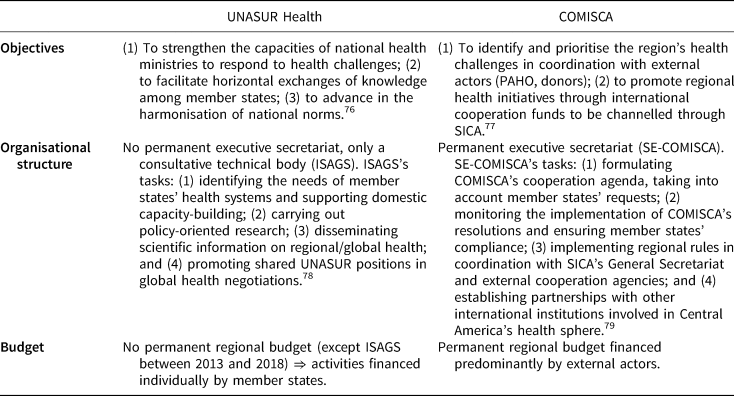
Analysis of the objectives enshrined in the constitutive treaties of these two regional bodies shows an interesting variation (Table 2). Central American governments designed COMISCA as a policymaking platform for redefining the priorities of regional health governance through the external support of international cooperation. On the other hand, South American governments designed UNASUR Health as a tool for reinforcing horizontal exchanges among member states and consolidating national health systems. As a result, UNASUR Health emerged as an inward-oriented institution focused on intra-regional cooperation, whereas COMISCA was designed as an outward-oriented governance platform focused on attracting resources from external actors.
Variation in the institutional design of COMISCA and UNASUR Health.

Source: Authors’ own elaboration.
The organisational structure of COMISCA and UNASUR Health
In 2007, the Central American health ministers agreed to create the Executive Secretariat of COMISCA (SE-COMISCA). SE-COMISCA is a permanent technical body in charge of facilitating the coordination and implementation of intergovernmental initiatives. SE-COMISCA has acted as the driver of Central America's health governance, providing policy inputs, participating in the implementation phase, facilitating coordination among member states’ health authorities, and representing them at the hemispheric and global multilateral levels. COMISCA also comprises eleven technical commissions and two working groups composed of issue-specific experts from member states’ health ministries, which deal with issues like obesity prevention, teenage pregnancy, the control of transmissible diseases, and access to medicines. COMISCA's technical commissions were created on the basis of a proposal formulated by SE-COMISCA, which acts as their technical coordinator.Footnote 66 SE-COMISCA thus exercises a tangible agenda-setting power, which results from member states’ delegation of authority to it.Footnote 67
UNASUR Health lacked a permanent executive secretariat with the characteristics of SE-COMISCA. In 2011 the member states created the South American Institute of Governance in Health (ISAGS), which acted as a consultative agency of UNASUR Health (see Table 2).Footnote 68 Member states occasionally delegated to ISAGS task-specific authority to carry out policy-oriented research and data gathering, yet they carefully avoided endowing it with agenda-setting power. ISAGS thus acted as a think tank at the service of member governments,Footnote 69 which were exclusively entitled to full ISAGS membership, while external actors could only apply for observer status. ISAGS was an outcome of the RL exercised by the Brazilian government, which envisioned it as a space for sharing knowledge, training officials, and establishing regional networks of national health institutions. The Lula administration's vision of regional health cooperation was predicated on the idea that South American states had to move away from vertical North-South cooperation in favour of horizontal exchanges of knowledge among national health authorities.Footnote 70 UNASUR Health also encompassed five technical groups and six structuring networks. The former were made up of experts from national health ministries, and developed cooperation initiatives in areas such as access to medicine, the social determinants of health, and health surveillance. The latter were formed by member states’ specialised health institutions, and dealt with issues such as the fight against cancer and public health education. The networks were set up on the back of a proposal from Brazil's health ministry, which rested on the idea of building a structure for health cooperation that would stretch across member states’ health authorities, as a tool for promoting endogenously-driven capacity building.Footnote 71
Sources of funding for COMISCA and UNASUR Health
COMISCA – like all regional institutions in Central America – gets the bulk of its funding from external actors. Member states are expected to pay an annual quota of US $15,700, yet many have been delaying payments or missing them altogether, making SE-COMISCA heavily dependent on extra-regional funds. SE-COMISCA's 2016 Management Report shows that 90.74 per cent of its budget was financed by external actors, such as the cooperation agencies of Spain, Taiwan, and the US.Footnote 72 On the other hand, UNASUR Health did not count on an autonomous budget, but rather received project-specific funds from the UNASUR general budget, which was financed through national quotas. Consequently, South American states financed health cooperation activities by drawing on national budgets. ISAGS was UNASUR Health's only body to get regular funding (US $2.5 million annually) from the UNASUR budget. Yet ISAGS was created in a phase of institutional transition in which national quotas for financing UNASUR's budget had yet to be defined. Thus between 2011 and 2013, the Brazilian government fully financed ISAGS.Footnote 73 More broadly, the UNASUR General Regulations establish that contributions from third-party donors must be approved by UNASUR's political bodies by consensus.Footnote 74 This severely limited member states’ capacity to attract external resources for financing specific cooperation projects developed within UNASUR's sectoral councils.Footnote 75
The comparative analysis of the institutional design of COMISCA and UNASUR Health reveals a significant variation in the involvement of external actors therein, and in the delegation of authority to technical regional institutions. We argue that such cross-regional variation is explained by the interplay of SC and RL in Central and South America. Central American countries’ limited SC in the health sector interacted with the absence of a state willing to exercise RL in support of regional health governance. As a consequence, external actors drove the institution-building process, shaping COMISCA's design and paying for the bulk of its budget. This is particularly evident in the genesis of SE-COMISCA, which can be considered the product of external actors’ pressure on Central American states to create a permanent technically-oriented body in charge of coordinating interstate cooperation and monitoring implementation, and capable of interfacing effectively with external donors.Footnote 80 On the other hand, the design of UNASUR Health was the result of the interaction between Brazil's RL and South American countries’ SC in the health sector. The Brazilian administration of Lula pushed forward both materially (for example, financing the establishment of ISAGS) and ideationally its South-South cooperation project, whereby it was envisaged that horizontal cooperation between South American states would replace vertical North-South cooperation driven by external donors. This proposal interacted with the presence of other South American states endowed with relevant capacities in specific areas of public health, such as Argentina in the field of access to medicines. This led to the establishment of a regional institution characterised by issue-specific platforms for intra-regional exchanges among national health bureaucracies. UNASUR Health remained largely insulated from external actors’ influence, and firmly under the grip of member states’ national executives, due to the strictly intergovernmental design of UNASUR.
5. RHGMs in action: The variations in COMISCA and UNASUR Health's governance efforts in the field of access to medicines
To grasp the differences between the RHGMs of Central and South America, we need to explore how regional governance works in practice within COMISCA and UNASUR Health. We do so by analysing the initiatives undertaken by two regional bodies in the field of access to medicines, which allows us to uncover the differences in the patterns of agency underlying health governance in the two regions.
The articulation of a regional pharmaceutical policy in Central America
Broadening access to medicines is one of the most daunting challenges faced by Central American states, which have traditionally displayed an insufficient capacity to acquire essential medicines due the high costs of local manufacturing and the high prices set by external providers.Footnote 81 In response to this situation, in December 2006 SICA's health ministers created the Technical Commission for Medicines (CTSM), bringing together specialists from the different member states. The CTSM became a platform for the coordination of an interstate joint negotiation strategy for the purchase of medicines (the so-called ‘Joint Negotiation COMISCA’), whose aim is to obtain lower prices from international laboratories.
In 2008 the CTSM held a first negotiation round, which resulted in the definition of a list of medicines for which member states negotiated a harmonised price. The prime movers behind the initiative were three external actors: PAHO, AECID, and the Inter-American Development Bank (IADB). PAHO provided financial and technical resources that facilitated regional coordination within the CTSM. A representative of PAHO was granted permanent membership status within the CTSM, alongside that of member state officials. AECID provided external funding in support of the joint negotiation initiative, which was channelled through PAHO (using the Spain-PAHO Cooperation Fund) and SE-COMISCA (through the Spain-SICA Cooperation Fund). In particular, AECID funded the development of the software used by SE-COMISCA for prequalification and negotiation, and the organisation of workshops aimed at strengthening member states’ capacity to assess and regulate medicine provision according to international best practice. The IADB provided financial and logistical support in the operational phase.Footnote 82 The articulation of Central America's pharmaceutical policy was thus the outcome of a triangulation strategy carried out by three external actors in collaboration with SE-COMISCA (Table 3).
External support to Central America's regional pharmaceutical policy.

Source: Authors’ own elaboration.
Between 2009 and 2019, the COMISCA member states held ten joint negotiations, which made significant progress in terms of access to medicines in Central America – lowering prices, rationalising regional purchases, and improving medicinal quality. The joint negotiations allowed Central American states to pay between 25 and 30 per cent less for a list of 68 medicines – and for some drugs up to 600 per cent less – generating regional savings of US $61 billion over the period 2009–16.Footnote 86 COMISCA's joint negotiations have also helped to align Central American states with higher international standards, improving the quality of medicines circulating in the region. This was illustrated by the 2017 decision of the International Organization for Standardization to award COMISCA's joint procurement mechanism the ISO 9001:2015 Quality Management System standard. The improvement in purchasing procedures has benefited a wider public at the domestic level, especially those who cannot afford private health services. Indeed, the medicines procured through joint negotiation are not for sale in pharmacies, but distributed through public health institutions. At the same time, the joint negotiations have proven attractive for pharmaceutical companies, which benefit from a higher predictability of sales and stronger guarantees on purchasing commitments from Central American governments.
Central American states have sought to further institutionalise and extend the scope of COMISCA's joint procurement mechanism. In 2017 health ministers decided to devote 0.5 per cent (increased to 2 per cent in 2019) of the regional savings accumulated between 2009 and 2017 to financing the joint negotiation process.Footnote 87 Furthermore, Central American governments reached an agreement to extend the negotiations’ scope to medical devices and other sanitary products. Finally, in COMISCA's last round of joint negotiation in June 2019, member states agreed upon a list of pharmaceutical companies to invite to the table, and added ten new medicines to the collective purchase list.Footnote 88 Overall, according to SICA's General Secretary, COMISCA's joint procurement mechanism saved Central American states US $11.9 million in 2019.Footnote 89
In sum, COMISCA's joint negotiation has become a success story. The initiative confirms the relevance of external actors (Spain's AECID, PAHO, and IADB) in Central America's RHGM. External actors drove COMISCA's joint negotiations by providing funding and expertise that helped Central American states build up their capacity to broaden access to essential medicines. This contributed to the provision of a regional collective good in the health sector. Interestingly, the case of COMISCA's joint procurement mechanism also reveals the key facilitating role of SICA's technical regional bureaucracy in Central America's health governance-making. SE-COMISCA helped member states work together to identify a shared list of priority medicines and bring international laboratories on board.Footnote 90 We posit that the exogenously-driven RHGM underpinning Central America's pharmaceutical policy resulted from the interplay of Central American countries’ weak SC in the field of access to medicines, and the lack of RL in that area. This opened a policy space for external actors to contribute to the provision of governance resources, in collaboration with a technically-oriented regional institution (SE-COMISCA), thus pushing Central American states towards a coordinated response to a shared public health challenge.
Regional coordination in the field of access to medicines within UNASUR Health
South America is marked by significant asymmetries in states’ capacity to access essential medicines, which are conditioned by economic issues such as market size and GDP per capita. To address this challenge, South American states developed three regional initiatives within the scope of UNASUR Health's Technical Group for Universal Access to Medicines (GAUMU): (1) mapping the differences in prices paid by member states for essential medicines imported from outside the region; (2) mapping member states’ capacity to produce medicines; and (3) the coordination of shared positions in the WHO Assembly. The first two projects aimed at providing policy-oriented information that could be used to define price-negotiation strategies vis-à-vis international laboratories, and at constituting a regional production network for generic drugs. The leading actors behind the two initiatives were the health ministries of Argentina and Brazil, which shared a strategic interest in the development of a regional market for the production and commercialisation of generic drugs.Footnote 91 Since the 1990s, the Brazilian state has developed a medicine production capacity that is strong by the standards of the region – part of the country's autonomy-oriented development strategy.Footnote 92 Under Health Minister Gomes Temporão, the Brazilian government invested heavily in strengthening public laboratories’ production capacities, with the objective of achieving technological autonomy.Footnote 93 Within UNASUR Health, Minister Temporão promoted the idea of a ‘regional health industrial complex’, seeking to socialise the other South American states into the strategic relevance of increasing the region's autonomy in medicines production. Brazil's proposal received the active support of Argentina's health ministry. Since the early 2000s, Argentina had displayed a strong interest in regional coordination, as well as remarkable leadership capacity, in the field of access to medicines.Footnote 94 This drove the first joint medicine procurement effort conducted by South American states in 2003.Footnote 95 Argentina continued to exercise RL in the area of access to medicines within UNASUR Health, taking on the coordination of GAUMU and pushing forward two cooperation projects: the price database and the mapping of medicine production capacities. The two proposals interacted positively with South American governments’ growing interest in widening access to essential medicines, leading South American health ministers to finance the projects in 2013. The other actors involved in the initiatives were ISAGS and UNASUR's General Secretariat. Member states selected ISAGS as the projects’ technical administrator, to which they delegated administrative and executive tasks. UNASUR's General Secretariat signed an agreement with ISAGS for the disbursement of US $300,000 to finance the implementation of the price database and the mapping of production capacities.
The UNASUR price database project started in 2014 with the negotiation of a list of essential medicines for price mapping. The negotiation was coordinated by Argentina with ISAGS's support.Footnote 96 In 2015, Brazil's health ministry shared with the other South American states the software it had developed for creating its national price database. In December 2016, member states launched a new software application designed to collect and systematise data on medicine prices in the region, based on the Brazilian software. In 2017, member states agreed on a list of 34 medicines to subject to price monitoring for one year. Drawing on the information gathered, ISAGS conducted a preliminary study that detected significant asymmetries in the prices paid by different member states. According to the study, South American states could save US $1 billion per year by collectively negotiating with international laboratories on the basis of the lower prices recorded for each of the prioritised medicines.Footnote 97 However, after a promising start, the price bank project suffered a sudden setback caused by the severe political and institutional crisis that hit UNASUR in 2018,Footnote 98 which led to the paralysis of all cooperation activities within UNASUR Health.
The second project was the mapping of production capacities of medicines in South America. The project's long-term objective was to increase South American states’ autonomy from multinational economic actors by stimulating the emergence of a regional network of medicine production based on Argentina and Brazil's productive capacities.Footnote 99 In 2018 ISAGS started to coordinate the mapping of member states’ public and private production capacities, which was expected to provide inputs for the coordination of a regional medicine production strategy. However, as in the case of the mapping of medicine prices, the project experienced a sudden paralysis caused by UNASUR's institutional breakdown.
The third regional governance initiative pursued by South American states within GAUMU concerned the coordination of a set of common positions at the WHO Assembly in the domain of access to medicines.Footnote 100 In particular, between 2010 and 2014, the UNASUR member states articulated eight joint positions relating to issues such as the impact of intellectual property rights on states’ access to medicines, the production of generic (particularly biogeneric) medicines, research and development on ‘neglected diseases’, and the setting of standards against counterfeiting.Footnote 101 Several of the joint UNASUR initiatives succeeded in eliciting a revision of existing global regulations and standards, shifting the focus from intellectual property considerations to sanitary ones – particularly the need to ensure broader access to essential medicines in developing countries.Footnote 102 The prime movers behind UNASUR's health diplomacy were, once more, the health ministries of Argentina and, to a lesser extent, Brazil.Footnote 103 They used GAUMU to socialise the other member states into their global health agenda relating to access to medicines. Argentina exercised a firm leadership within GAUMU, exploiting its capacities in the production of generic medicines and the coordination of regional price negotiations to drive the promotion of joint UNASUR positions in the WHO. Argentina's RL was a consequence of its national interest in overcoming the limitations posed by intellectual property rights to the production of and access to essential medicines, which was actively supported by the governments of Bolivia, Ecuador and Colombia.Footnote 104 But once again, South American states’ health governance efforts suffered a setback due to the breakdown of UNASUR, which led to the dismantling of GAUMU and the abandonment of regionally coordinated health diplomacy initiatives in the WHO.
In sum, within UNASUR Health, South American states pursued three governance initiatives that led to the adoption of shared methodologies for the harmonisation of national data on medicine prices and production capacity, and to the coordination of joint positions in global health negotiations. Differently from the Central American case, external actors did not play any relevant role in the initiatives, which were designed, financed, and implemented by member states under the RL of Argentina and Brazil, and with ISAGS's technical support. Argentina and Brazil's RL interacted with the existence of SC for medicine production in other South America states: Chile, Colombia, and – before the economic crisis – Venezuela. This resulted in an endogenously-driven RHGM in the field of access to medicines. However, the strictly intergovernmental dynamic underlying South America's RHGM made it vulnerable to intergovernmental conflicts, which led to the breakdown of UNASUR and the subsequent paralysis of regional health governance efforts.
Conclusions
This article investigated the variation in the RHGMs of Central and South America. We compared the institutional design and policymaking of COMISCA and UNASUR Health in order to identify the drivers of health governance in the two regions, focusing particularly on the issue of access to medicines. The empirical evidence shows that Central America's health governance has been driven by external actors that provided funding, gave technical assistance that consolidated COMISCA's institutional design (equipping it with a permanent executive secretariat), and influenced its policymaking. Central America's exogenously-driven RHGM delivered significant results in the area of access to medicines, producing a joint procurement mechanism that allowed Central American states to increase their access to essential medicines for chronic diseases such as HIV, diabetes, and cancer. External state (AECID) and non-state (IADB and PAHO) actors drove the initiative, financing the development of COMISCA's joint negotiation platform through the regional channel of SE-COMISCA, which sustained interstate coordination and provided technical assistance.
On the other hand, the paper shows that South American governments constructed a RHGM based on intra-regional exchanges among national health authorities, insulated from external actors’ influence. South America's endogenously-driven RHGM was led by the health ministries of Brazil and Argentina, which drove regional institution building and policymaking. Through UNASUR Health, South American states conducted an innovative mapping of medicine prices and production capacity in the region, with the objective of facilitating joint procurements and the establishment of a regional production network. After a promising start, both projects suffered a setback due to UNASUR's institutional breakdown in 2018, which led to the paralysis of the governance activities pursued within UNASUR Health, and to the dismantling of ISAGS. Likewise, the disintegration of UNASUR caused the disarticulation of South American states’ regional coordination efforts at the global WHO level.
We showed that the variation in the RHGMs of Central and South America is explained by the interplay of SC and RL in the two regions. Central American states have traditionally suffered from weak SC in the health sector, which affected their ability to deal with public health challenges. Despite the existence of intra-regional asymmetries – Costa Rica and Panama rank significantly higher than their neighbours across all health indicators – no Central American state was willing to exercise RL in support of health governance. As a consequence, Central American governments sought the help of external actors, who invested in strengthening regional health institutions and interstate policy coordination. External actors enlisted a regional technical body, SE-COMISCA, to help them coordinate Central America's health governance, particularly in the area of access to medicines.
On the other hand, South America's RHGM resulted from the interaction between the RL of Brazil and Argentina and the presence of several South American states endowed with relevant SC in the public health sector. The Brazilian administration of Lula drove the institution-building process, promoting the establishment of UNASUR Health's structuring networks and financing the creation of ISAGS, and pushed forward an intergovernmental South-South cooperation agenda that mobilised the SC of other South American countries. Argentina drove both politically and technically the elaboration of a regional policy on access to medicines, which built on Argentina and Brazil's medicine production capacities. Furthermore, Argentina persuaded its neighbours to join its effort to promote changes in global health regulations regarding access to medicines, leading the coordination of a set of joint UNASUR positions within the WHO.
Interestingly, South America's endogenously-driven RHGM proved vulnerable to the breakout of intergovernmental conflicts, such as those triggered by the Venezuelan crisis, which led to the institutional breakdown of UNASUR. In response to UNASUR's paralysis, nine member states including Brazil withdrew from the RO, prompting the disintegration not only of UNASUR, but also of South America's regional health governance architecture. Concretely, the disintegration of UNASUR resulted in the dismantling of UNASUR Health and ISAGS, which were subordinated to and dependent on the political decision-making bodies of UNASUR. The intergovernmental logic underlying South America's RHGM thus made it vulnerable to the traditional weakness of South American regionalism: states’ persistent reluctance to delegate authority to technical regional institutions, which makes governance efforts dependent on unstable intergovernmental dynamics.Footnote 105
The dismantling of the regional institutions underpinning South America's RHGM has severely hindered South American states’ ability to develop a coordinated strategy for containing the spread of the COVID-19 virus in the region. UNASUR's breakdown precipitated sub-regional fragmentation, pushing South American states to try to address COVID-19 within existing ROs like CAN and MERCOSUR. However, these efforts have fallen short of South America's need for common strategies in relation to quarantine protocols, the deployment of testing and tracing technologies, and the joint purchase of essential medicines (for example, vaccines) and medical equipment. South America's situation stands in contrast to how Central American states have responded to COVID-19. With the support of SICA's General Secretariat and the Coordination Centre for Disaster Prevention in Central America and the Dominican Republic (CEPREDENAC), Central American states have developed a regional contingency plan against COVID-19Footnote 106 based on the data generated by SICA's COVID-19 Information and Coordination Platform,Footnote 107 and with the financial backing of the Central American Bank for Economic Integration (CABEI). CABEI also provided a specific credit line (worth US $50 million) to each member state for the purchase of vaccines against COVID-19. The responsiveness of Central America's RHGM confirms the importance of regional institutions – technically oriented ones in particular – for the coordination of shared responses to severe transnational health challenges.
From a theoretical point of view, the article contributes to comparative regionalism by shedding light on the impact of SC and RL on regional health governance structures and processes. The generalisation scope of our findings is limited to Latin America. That said, we posit that the theoretical framework developed in this article could be used for investigating the determinants of RHGMs in other world regions. Additionally, the article contributes to the literature on global health governance by providing an in-depth comparative analysis of the drivers, modes, and effects of health governance in two regions, which complements the literature's traditional focus on global health institutions and dynamics. More specifically, the article illuminated the driving role of external actors (state and non-state) in the articulation of regional governance responses to transnational health challenges in the Global South. Furthermore, through the comparison of the RHGMs of Central and South America, the article highlighted the limits of purely intergovernmental governance arrangements, like UNASUR, whose vulnerability to domestic political changes and intergovernmental conflicts can jeopardise the sustainability of regional health governance. On the other hand, the case of SICA-COMISCA in Central America shows how the proactive involvement of external actors, coupled with the establishment of regional technically-oriented institutions, increases the effectiveness and sustainability of health governance efforts, particularly in world regions marked by limited state capacity.
Acknowledgements
This article is part of the research project ‘Exploring the Drivers, Modes, and Effects of Regional Health Governance: A Cross-Regional Comparison of Latin America and Europe’, which has received funding from Chile's National Commission for Scientific and Technological Research (CONICYT) through Fondecyt de Iniciación (Grant No. 11200118). An earlier version of this article was presented at the 2019 International Studies Association Annual Convention in Toronto. We thank all those who participated in that event for their feedback. We are particularly grateful to Carla Alberti for her insightful comments on key methodological aspects of the manuscript and to Erica Martinelli and Diego Telias for their invaluable research assistance. We also thank RIS's three anonymous reviewers for their excellent suggestions.
Supplementary material
To view the online supplementary material, please visit: https://doi.org/10.1017/S0260210521000206
Appendix
List of interviews