INTRODUCTION
The production of European wild boar (Sus scrofa L.) meat has increased over the past few years in countries such as Chile and new export markets are opening for the products. The majority of the wild boar in Chile are farmed using a semi-extensive production system, in which the animals have access to pasture (Skewes & Morales Reference Skewes and Morales2006). A nutritionally important amount of pasture has been shown to be consumed by growing wild boar (Hodgkinson et al. Reference Hodgkinson, Lopez and Navarrete2009; Quijada et al. Reference Quijada, Bitsch and Hodgkinson2012). However, previous studies that have evaluated the pasture intake of these animals have been short term, where pasture intake was determined over a few weeks of the growth period. No previous studies in which grass consumption was determined throughout the main growth period of these animals (weaning to slaughter weight of approximately 40–45 kg) have been conducted.
There is a movement towards producing domestic pig meat in ‘ecologically friendly’ outdoor systems, with many consumers valuing meat produced in systems where the animals spend time outdoors, often with access to grass. Whereas some studies have been carried out to determine pasture intake by these animals (Andresen & Redbo Reference Andresen and Redbo1999; Mowat et al. Reference Mowat, Watson, Mayes, Kelly, Browning and Edwards2001; Gustafson & Stern Reference Gustafson and Stern2003), at present, there appears to be no information on pasture intake over the main part of their growth period (20–110 kg live-weight).
For both the domestic pig and the European wild boar produced in semi-extensive systems, knowledge of the nutritional contribution that pasture makes to animals over the growth period will give clarity on the importance of pasture in this system. The farmer can thus make informed decisions regarding investments to improve pasture quality for grazing by these animals. It is also important information to allow a precise formulation of the supplemental diets for these animals.
The objective of the present study was to determine the pasture intake of European wild boar and domestic pigs regularly over the growth period (60 days old to slaughter weight). An additional objective was to determine the proportion of the grazing period that each animal type spent on different activities, especially grazing.
MATERIALS AND METHODS
The methodology used in the present study was approved by the Committee for the Ethical Use of Animals in Experiments of the Universidad Austral de Chile. The study was carried out from spring to autumn (November 2014 to April 2015) in two adjacent 700 m2 fenced paddocks. The paddocks were sown with Lolium perenne L. (cultivar Arrow AR1) and Trifolium repens L. (cultivar Huia) in 2010 at a level of 30 and 8 kg/ha of seeds, respectively. In April 2013, the paddocks were over-sown with the same species. Soil samples were taken annually and fertilizer applied accordingly, including the application of calcium hydroxide [Ca(CO2)2] as required to correct soil acidity. During the 6 months before the study began, the pasture was cut to a height of 7–8 cm each time the sward height reached 20 cm and the cut material removed from the paddocks.
Twelve 60-day-old (±1 day) purebred European wild boar (six castrated males and six females, average live-weight [ ± s.e.m.] 6·8 ± 0·37 kg) and twelve 70-day old domestic pigs (Large White × Landrace, six castrated males and six females, average live-weight [ ± s.e.m.] 24·1 ± 0·66 kg) were used in the study. All animals came from commercial farms and were nose-ringed. Prior to their arrival at the Experimental Facilities, the domestic pigs had received a commercial diet following weaning at 28 days old. The wild boar had access to a commercial diet, but were weaned immediately prior to leaving the commercial farm.
As the wild boar came from a farm with a lower biosecurity level than the domestic pigs, they arrived 10 days before the domestic pigs and were maintained in a quarantine area for the first 10 days. During this quarantine period, they were examined regularly by a veterinarian and treated with ivermectin (Ivermec® 1% at a dose of 300 mg/kg live-weight via subcutaneous injection) the day after they arrived. Thus, all animals were the same age when the study started (±1 day).
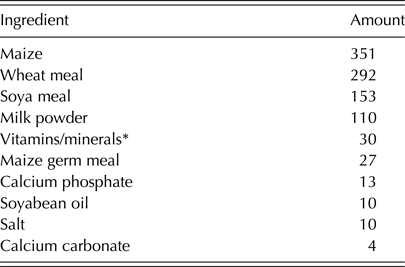
Each day during the study, the animals grazed from 08·00 until 16·00 h, after which they entered small pens (two animals per pen) where they had ad libitum access to a supplemental diet (Table 1) for 1 h. The animals were then housed in concrete-floored pens at 18 ± 1·0 °C until the following day with a 12-h night. Water was available at all times. The animals were weighed weekly.
Ingredient composition of the supplemental diet (g/kg)

* Vetersal cerdos and Vetervit, Veterquimica S.A., Chile.
As wild boar can be aggressive towards other animals (such as domestic pigs), the grazing management was such that the two animal types were always separated. One animal type (wild boar or domestic pig) grazed in each of the two paddocks each day, with the animals changed between paddocks each day (one day grazing one paddock, the following day grazing the other paddock). The paddocks were each sub-divided into four areas for grazing rotations. One area was used for grazing intake determinations (see below) and the remaining three areas in each paddock were grazed for five successive days, after which the animals were moved to the next area, rotating through the three areas in each paddock (total rotation time through the three areas was 15 days). After each area had been grazed, the pasture was cut to a height of 7–8 cm and the cut material was removed to maintain the pasture in a more homogeneous state and to prevent the pasture from entering a reproductive state (and altering the nutritional characteristics of the pasture), as the amount of pasture available was always greater than the amount that the animals consumed. The paddocks were irrigated as required to ensure a continual supply of pasture.
At the beginning of the study (day 2), on day 140 and day 205, the botanical composition of pasture in the two paddocks was determined. For each determination, a total of 12 pasture samples were collected (area 0·04 m2) with the material cut to ground level. The pasture species from each sample were manually separated and dried in an oven at 60 °C for 48 h. The dry matter (DM) content of each species was then determined. At the same times, a further three pasture samples (area 0·2 m2) cut to ground level were also collected from each paddock before grazing. The samples were freeze-dried, finely ground and analysed for DM (Bateman Reference Bateman1970), crude protein (CP, Micro Kjeldahl method; AOAC International 1995), gross energy (GE, via bomb-calorimetric; Bateman Reference Bateman1970), acid detergent fibre (ADF; van Soest et al. Reference van Soest, Robertson and Lewis1991) and neutral detergent fibre (NDF; van Soest et al. Reference van Soest, Robertson and Lewis1991).
Pasture and diet consumption determinations
The pasture and supplemental diet consumption was determined every 14 days for 5 months (a total of ten determinations) with the first determination carried out 1 week after the domestic pigs arrived. In one area of each of the two paddocks (area 4), six pens were set up. At the beginning of the trial the pens had a surface area of 5 m2, and the surface area was gradually increased for each pasture consumption measurement to ensure that the pasture intake of the animals was not limited by pasture availability but at the same time that the area was small enough to allow the pasture intake to be determined. At the end of the trial the pens had a surface area of 8 m2. Following each grazing determination, the pens were moved to a new pasture area within area 4, always ensuring that the area used had a consistent covering of pasture with no evidence of damage to the pasture (e.g. from treading during a previous pasture consumption determination).
The animals were randomly divided into six pairs per animal type, with each pair comprised one female and one castrated male. The same pairing was maintained throughout the pasture and supplemental diet consumption determinations.
For each pasture consumption evaluation, a pair of animals entered each of the six pens in each paddock from 08·00 to 16·00 h. Immediately following the grazing period, the animal pairs entered feeding stations (1 pair per station) and had free access to a known quantity of the supplemental diet (Table 1) for 1 h. The feed remaining was weighed and diet consumption was calculated (difference between the amount of feed offered and that remaining divided by two animals). Water was available at all times. After feeding, the animals entered the concrete-floored pens until the following day.
The apparent pasture consumption was estimated from each grazed pen by manually cutting three samples pre- and post-grazing from each pen, cut to soil level (0·04 m2). The sampled areas were randomly chosen within each pen. The samples were dried at 60 °C in a forced-air oven until constant weight was achieved (usually 72 h) to obtain DM weight.
The pasture availability of each entire pen pre- and post-grazing was calculated using the relationship between the amount of DM in the sample and the total surface area available for grazing. The amount of DM consumed per animal was estimated as the difference between the pre- and post-grazing DM availability divided by two animals. Due to the difference in growth rates, and thus bodyweight between the wild boar and domestic pigs, their consumption of pasture and supplemental diet was determined on a metabolic bodyweight basis (LW0·75).
Behaviour observation
For each behaviour observation, each animal was observed during four consecutive days while grazing. The first behaviour observation period was during the week following the first pasture consumption determination (to ensure that the animals were already accustomed to the experimental routine before the behaviour observations). Behaviour observations were also carried out over 4 days during the week following the fifth and the ninth pasture consumption determinations.
Before the observation periods began, the appropriate distance between the observer and the animals was determined. It was important, particularly in the case of the wild boar, that the observers did not affect the behaviour of the animals and that their activity could be identified. The distance considered appropriate was that where the animals did not appear to be watching the observer, or remain facing the direction of the observer. An elevated position at a distance of approximately 15 m from the nearest paddock fence was used.
On each observation day, the back of each animal was marked with a marker pen in such a way so as to permit the identification of the animal amongst the other animals by the observers from the observation point. Two trained observers observed the animals on each observation day, one observing the wild boar and the other the domestic pigs. During the observation days, each animal's activity was manually recorded by the observers every 5 min throughout the grazing period (8 : 00–16 : 00 h), with the activities differentiated between grazing, rooting (either with the snout or foot), walking, running, playing, lying down, drinking and other activities. Thus, a total of 96 observations were made daily for each animal during each of the 4-day behaviour observation periods. The proportion of time that the animals spent on each activity was determined.
Statistics
All statistical analyses were conducted using SAS (SAS Institute Inc. 2006). A significance level of P < 0·05 was used. For the consumption data, the experimental unit was the pair of animals and the variables were expressed per animal. Previous to the statistical analyses, the data were checked for normality using the Kolmogorov–Smirnov method (Steel et al. Reference Steel, Torrie and Dickey1997). When the data were not found to be normal, it was transformed using the Blom method in SAS.
An analysis of variance (ANOVA) was used to determine whether there was a significant difference between the wild boar and domestic pigs in terms of their intake of pasture, supplemental diet and total DM intake, the proportions of their total intake represented by pasture and supplemental diet, their average daily gain and feed conversion efficiency.
An ANOVA was conducted using a model for repeated measures analysis to determine whether there was a difference between the domestic pigs and wild boar in the time spent on each activity during the grazing period.
RESULTS
The domestic pigs had no health problems and had a daily gain over the 140 days of the trial of (mean ± s.e.m.) 758 ± 13·6 g/day. During the second month of the trial, four of the wild boar suffered from an infection with Salmonella and were removed from the trial and treated. The remaining eight animals remained healthy throughout the study and had a daily gain (mean ± s.e.m.) of 180 ± 16·6 g/day.
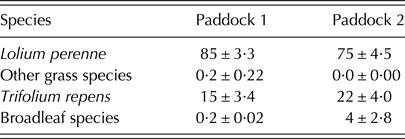
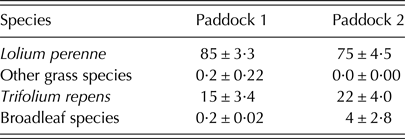
The botanical composition and pre-grazing pasture availability of each paddock is presented in Table 2. The proportions of the different grass species varied notably in the different paddocks. The DM availability for all the paddocks was in the range 1700–1813 kg DM/ha, except for one sampling in one paddock that had a notably lower DM availability (1163 kg DM/ha). The average daily temperature during the grazing periods (08·00–16·00 h) ranged from 12·5 to 19·3 °C.
Botanical composition (%, mean ± s.e.m., dry matter basis, n = 18) of the two paddocks used in the study
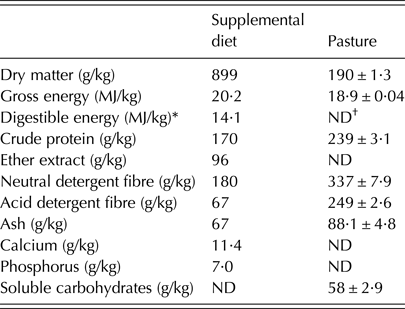
The determined chemical composition of the supplemental diet and pasture during the study are presented in Table 3. The pasture remained in a vegetative state throughout the trial with no flowering stalks observed. The nutritional composition of the pasture did not significantly change over the study.
Determined chemical composition (dry matter basis) of supplemental diet and pasture (mean ± s.e.m., n = 18)

* Calculated using data on DE contents of individual ingredients as supplied by ingredient manufacturers.
† Not determined.
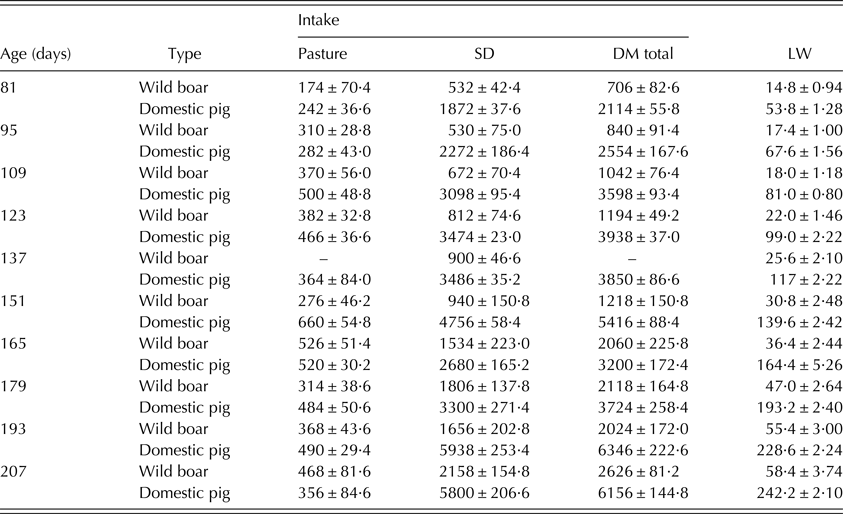
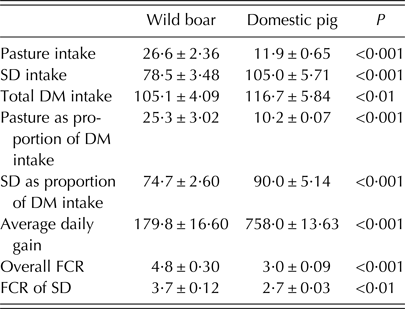
The intakes of pasture, supplemental diet and total DM intakes determined during each of the intake measures is presented in Table 4, along with the age of the animals at each intake determination. Due to a problem in the laboratory, there is no pasture intake for the wild boar when they were 137 days old. The live-weight of the animals when each intake determination was carried out is also recorded in Table 4. While the domestic pigs and wild boar were of the same age, their live-weights were notably different throughout the study. Due to this difference, they were compared on a metabolic bodyweight basis, with the results shown in Table 5. On a metabolic bodyweight basis, the wild boar consumed significantly more pasture DM than the domestic pigs (P < 0·001), with pasture comprising 0·25 of their DM intake, while only comprising 0·10 of the DM intake of the domestic pigs. However, the wild boar had a significantly lower supplemental diet intake than the domestic pigs (P < 0·001) with the overall DM consumption being greater in the domestic pigs than the wild boar (P < 0·01).
Intakes (g/day)* of pasture, supplemental diet (SD) and total dry matter (DM), and live-weight (LW, kg) of growing domestic pigs (n = 6) and wild boar (n = 4) from 81 to 207 days of age (mean ± s.e.m.), dry matter basis

* Each value corresponds to the intake of two animals.
Average intake (metabolic bodyweight basis, kg DM/kg live-weight0·75) of pasture and supplemental diet (sd), overall intake and proportions of total DM intake (%) represented by pasture and sd for wild boar (n = 4) and domestic pigs (n = 6) in a semi-extensive production system; average daily gain (g/day), overall feed conversion efficiency (FCR) and FCR only considering SD intake (DM basis) are also presented*.

* All data (each n) is the average of data from two animals.
In terms of the feed conversion ratio (FCR, kg of feed DM consumed per kg increased bodyweight) throughout the study, the domestic pigs were notably more efficient than the wild boar (P < 0·001), with the wild boar requiring an average intake of 4·8 kg feed DM (pasture and supplemental diet) for each kg of growth, while the domestic pigs required 3·0 kg DM. When only the supplemental diet intake was considered, the wild boar had a FCR of 3·7, whereas the domestic pigs had a FCR of 2·7 (DM basis).
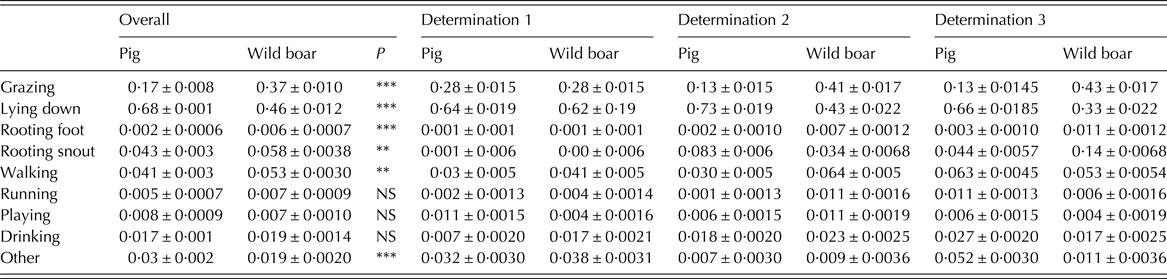
In terms of the behaviour of the two types of animals (Table 6), overall the wild boar were more active than the domestic pigs, with the wild boar spending more time on activities such as grazing (P < 0·001), rooting (P < 0·001), and walking (P < 0·01), while the domestic pigs spent over two-thirds of their time lying down (P < 0·001). It was interesting to note that when the animals were around 85 days old, both types of animal spent the same proportion of their day grazing. This changed, however during the second and third behaviour observations, where the wild boar spent over 0·40 of their time grazing, whereas the domestic pigs spent only around 0·13 of their time grazing.
Proportion of grazing period (mean ± s.e.m.) that domestic pigs (n = 12) and wild boar (n = 8) spent on each type of activity

Results are presented overall per animal type and when the animals were 85 days old (determination 1), 140 days old (determination 2) and 198 days old (determination 3).
NS not significant (P>0.05); ** P< 0.05; *** P<0.001.
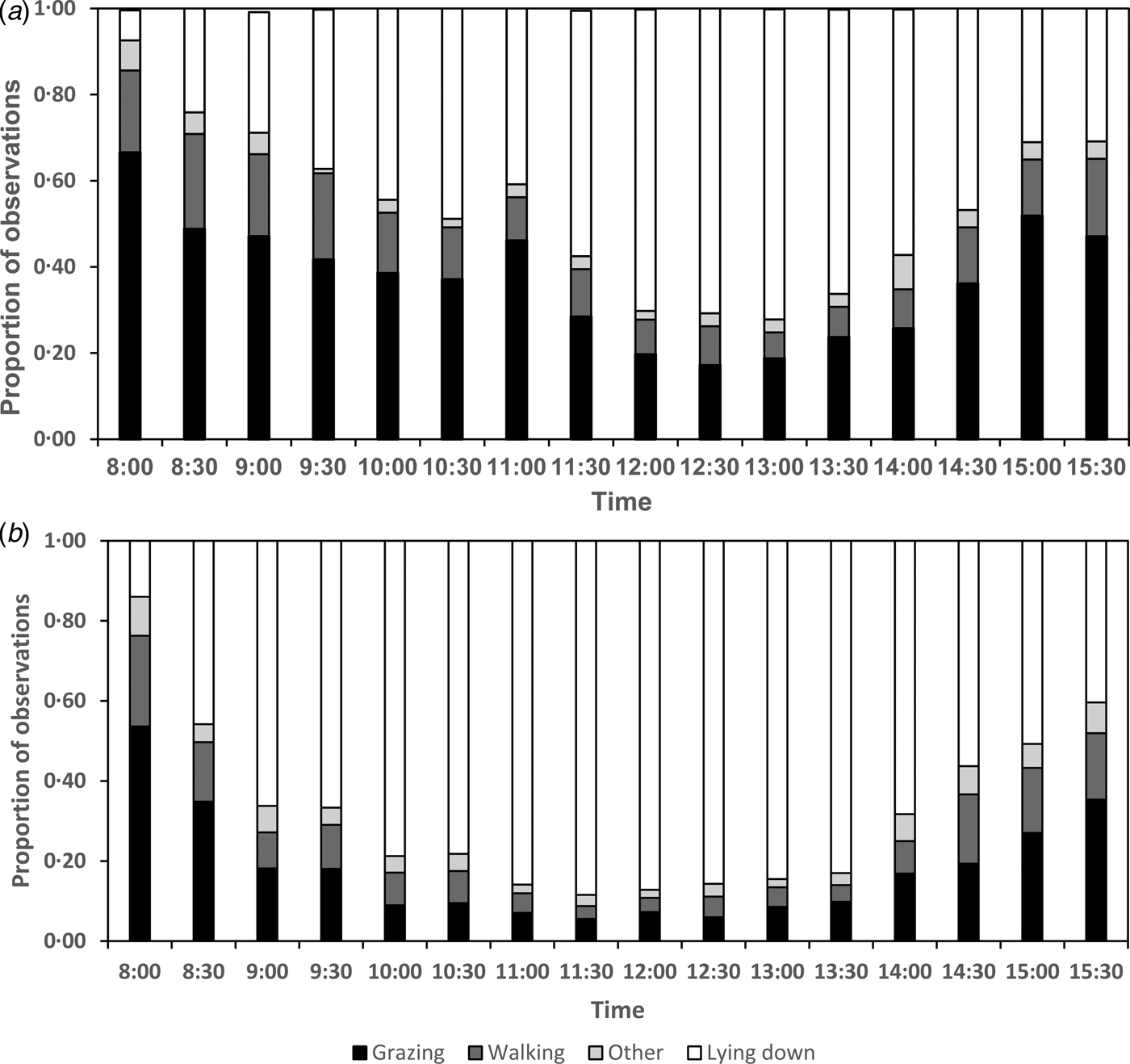
The proportion of time overall during each 30-min period of the 8-h grazing periods that the animals spent grazing, walking or lying down in shown in Fig. 1. Over the grazing period, the animals tended to graze more when they entered the paddocks in the morning, with the proportion of animals grazing decreasing towards midday then increasing again in the afternoon (Fig. 1).
Proportion of time that wild boar (a, n = 8) and domestic pigs (b, n = 12) spent on different activities within each 30-min period of 8-h grazing periods.

DISCUSSION
Pasture has been shown to contribute a significant quantity of nutrients both for the domestic pig (Lindberg & Andersson Reference Lindberg and Andersson1998) and wild boar (Hodgkinson et al. Reference Hodgkinson, Lopez and Navarrete2009). For animals such as the domestic pig, the incorporation of pasture as a complement to the concentrated diet can lower feeding costs (Kephart et al. Reference Kephart, Hollis and Danielson1998), with the potential for substitution of the concentrated diet by pasture. The inclusion of pasture in the diet of the wild boar has been shown to increase the growth rate of these animals, compared with animals that do not have access to pasture (Rivero et al. Reference Rivero, López and Hodgkinson2013c ).
In countries such as Chile, wild boar production usually involves raising the animals in a semi-extensive system, with access to pasture (Skewes & Morales Reference Skewes and Morales2006). As well as being a source of nutrients for the animals, raising the animals in semi-extensive production systems where the animals spend time in paddocks each day can be expected to have a good public perception by consumers who perceive the system to have a greater animal welfare associated with it, which leads to greater consumer demand for the meat produced. The number of domestic pigs being raised in ‘outdoor’ production systems is also increasing. Previous studies to examine pasture intake and grazing behaviour of wild boar (Hodgkinson et al. Reference Hodgkinson, Lopez and Navarrete2009; Reference Hodgkinson, Matus and Lopez2013; Rivero et al. Reference Rivero, López and Hodgkinson2013b , Reference Rivero, López and Hodgkinson c ) or the pasture intake in the domestic pig (Andresen & Redbo Reference Andresen and Redbo1999; Mowat et al. Reference Mowat, Watson, Mayes, Kelly, Browning and Edwards2001; Gustafson & Stern Reference Gustafson and Stern2003) have been short-term studies. In the present study, the intake of pasture and supplemental diet, as well as grazing behaviour, was determined regularly throughout the entire principal growth period of these animals.
With pasture being considered a high-fibre feed, especially when in the reproductive phenological stage, it is recommended that the animals should receive it in the vegetative physiological stage for it to provide a greater level of digestible energy (DE; NDF < 550 g/kg organic material; van Wieren Reference van Wieren2000) as was the case in the present study. The predominant pasture species in both paddocks were perennial ryegrass (L. perenne) and white clover (T. repens), with over 0·96 of the pasture DM pertaining to these two species. These pasture species have high levels of DE for both the domestic pig (Vestergaard et al. Reference Vestergaard, Danielsen and Larsen1995; Kephart et al. Reference Kephart, Hollis and Danielson1998; Lindberg & Andersson Reference Lindberg and Andersson1998; Gustafson & Stern Reference Gustafson and Stern2003) and wild boar (Quijada et al. Reference Quijada, Bitsch and Hodgkinson2012).
The herbage-cutting technique was used in the present study to estimate pasture consumption. The herbage-cutting technique (Commonwealth Agricultural Bureaux 1961) is considered to provide a fair estimate of the apparent daily intake of herbage mass (DM) and nutrients, with minimal interference on animal grazing behaviour, which may occur with other techniques used to estimate forage intake. This method can be subject to a bias when the grazing period (time between taking samples pre- and post-grazing) is too long, due to growth of the pasture during this period (Commonwealth Agricultural Bureaux 1961). However, with the 8-h grazing period used in the present study, the amount of pasture growth during the grazing period would have been very low, and should not have affected the precision of the method. This method has been used previously in studies to estimate pasture consumption with wild boar (Hodgkinson et al. Reference Hodgkinson, Lopez and Navarrete2009; Rivero et al. Reference Rivero, López and Hodgkinson2013b ).
The method used to record their behaviour, where sequential observations are made of the animals throughout the day, is a standard method to record animal grazing behaviour. It has been previously used to study the behaviour of sows (Edwards et al. Reference Edwards, Anssems, Horrell, A'Ness and Eddison1996; Horrell et al. Reference Horrell, A'Ness, Edwards and Eddison2001; Studnitz et al. Reference Studnitz, Jensen and Jorgensen2003) and wild boar (Hodgkinson et al. Reference Hodgkinson, Matus and Lopez2013; Rivero et al. Reference Rivero, López and Hodgkinson2013b ).
The mean growth rates of the wild boar in the present study (180 g/day) were within the range of growth rates reported in previous studies (116–233 g/day; Weiler et al. Reference Weiler, Claus, Schnoebelen-Combes and Louveau1998; Hodgkinson et al. Reference Hodgkinson, Schmidt and Ulloa2008, Reference Hodgkinson, Lopez and Navarrete2009, Reference Hodgkinson, Matus and Lopez2013). This growth rate suggests that the Salmonella infection that affected four of the wild boar (which were removed from the study and treated) did not have a sub-clinical impact on the remaining wild boar. The growth rates of the wild boar were much lower than the growth rates for the domestic pigs in the present study (758 g/day). The growth rates of the domestic pigs in the present study were within the range of growth rates reported in previous studies with domestic pigs under grazing conditions (543 g/day; 879–912 g/day Gustafson & Stern Reference Gustafson and Stern2003). The previous studies reported on a shorter growth period that than of the present study.
The pasture intakes of both the wild boar and domestic pigs varied notably both between animals and between measurement days. This variation has been previously noted in other studies (Gustafson & Stern Reference Gustafson and Stern2003; Hodgkinson et al. Reference Hodgkinson, Lopez and Navarrete2009; Rivero et al. Reference Rivero, López and Hodgkinson2013c ). The consumption of the supplemental diet showed less variation, and steadily increased with increased live-weight of the animals. The bodyweight of the domestic pigs and wild boar differed throughout the study. The trial began when the animals were 60 days old, which is the typical age of weaning for the wild boar (Rivero et al. Reference Rivero, Hodgkinson and López-Villalobos2013a ; Alvarez et al. Reference Alvarez, Hodgkinson and Flores2014) and concluded when the animals were around 7 months old, which is the typical age for slaughter for wild boar (Rivero et al. Reference Rivero, Hodgkinson and López-Villalobos2013a ; Alvarez et al. Reference Alvarez, Hodgkinson and Flores2014). Due to the difference in bodyweight between the wild boar and domestic pigs the consumption data were compared on a metabolic bodyweight basis between the two animal types. It is important to note, however, that for both animals the duration of the study coincided with their growth period when produced for meat.
On a metabolic bodyweight basis, the pasture DM consumption by the wild boar was over double that in the domestic pigs, with 0·25 of the DM intake of the wild boar being pasture, compared with 0·10 of the DM intake of the domestic pigs. However, the domestic pigs consumed a greater level of supplemental diet than the wild boar.
The greater FCR of the domestic pigs compared with the wild boar was expected. The wild boar that were used in the present study were from a commercial wild boar farm, and came from animals that were captured in the wild. They have only been on-farm for a few generations and have had very little genetic selection on-farm; up to now the main genetic selection of these animals has been a natural selection which occurs in nature. For forest conditions, it is not an advantage or the animals to have a fast growth rate as this requires a high level of feeding that may not be possible under natural conditions.
The greater level of activity of the wild boar compared with the domestic pigs is consistent with the greater efficiency of the domestic pigs (less activity means more dietary energy available for growth). As well as spending two-thirds of their time lying down, the domestic pigs were observed to generally move at a much slower rate than the wild boar and were even observed regularly to graze while lying down (in this case their behaviour was recorded as ‘grazing’). The wild boar, however, were always moving except when they were lying down (lying down 0·46 of the grazing period), and walked around a lot while they were grazing.
Using the botanical composition of the pasture from the present study and published DE values of the pasture species for the wild boar (Quijada et al. Reference Quijada, Bitsch and Hodgkinson2012) and domestic pigs (Gustafson & Stern Reference Gustafson and Stern2003), the average DE content of the pasture can be estimated to be 11·1 and 8·4 MJ/kg DM for the wild boar and domestic pig, respectively. The supplemental diet contained 14·0 MJ/kg (calculated value). From these data, it can be calculated that throughout the growth period, the wild boar obtained 0·20 of their total dietary energy from the pasture whereas the domestic pigs obtained 0·07 of their total energy from the pasture. The latter value in the domestic pig is similar to the value of 0·05 estimated by Edwards (Edwards Reference Edwards2003). This value for the wild boar is lower than the values estimated by Quijada et al. (Reference Quijada, Bitsch and Hodgkinson2012) who estimated that wild boar about 24–30 kg live weight satisfy from 0·30 to 0·34 of their total DE requirements through pasture consumption in summer. These results confirm that that European wild boar consume a nutritionally important amount of pasture throughout their main growth phase. Therefore, it is important that farmers ensure that they have access to pasture that is of a good quality in terms of its botanical composition and plant phenological stage.
It is important to note that while the domestic pigs only consumed 0·07 of their energy from pasture, this pasture consumption will have a significant positive effect on the costs to feed these animals. The main cost for the farmer when raising pigs is their diet. Of this, the supplemental diet will be a major cost, with the pasture having a much lower cost (assuming the land is available). For each kg of live-weight increase, the domestic pigs consumed 2·7 kg of supplemental diet while the wild boar consumed 3·7 kg. If the animals did not have access to the pasture, the intake of the supplemental diet would have been greater, and/or the growth rate of the animals would have been lower.
In conclusion, over the main growth period, and when considered on a metabolic bodyweight basis, European wild boar consumed a greater quantity of pasture then domestic pigs. Approximately 0·20 of the total DM intake of wild boar was provided by pasture, whereas only 0·10 of the total DM intake of domestic pigs was pasture. The domestic pigs consumed a greater quantity of supplemental diet than the wild boar. The wild boar obtained 0·20 of their total daily dietary apparent energy intake from pasture, whereas the domestic pigs obtained 0·07 of their total daily dietary apparent energy through pasture consumption. In the semi-extensive (outdoor) production system, pasture contributes a nutritionally important quantity of energy to domestic pigs and European wild boar.
The authors wish to thank Andrea Pineda, Paulina Cardenas and Magdalena Maldonado for technical help during this study. This work was supported by a grant from the Chilean National Fund for Science and Technology (FONDECYT), Project 1130722.