I Introduction
Regulatory processes across EU Member States have become increasingly more complex due to Europeanisation and transposition processes, and in the past decade we have witnessed regulatory reforms, often called “better regulation” or “smart regulation”.Footnote 1 Thus, legislative and regulatory processes increasingly emphasise such regulatory tools as regulatory impact assessments (RIA), consultation procedures, monitoring and reduction of administrative burdens, and ex-post evaluation. Particularly, RIA has in recent years received attention in many countries.Footnote 2 RIA is a type of ex-ante policy appraisal procedure, formally regulated and obliging individual originators to follow a set of rules for the definition of policy problems, the identification of (non)regulatory options (including alternatives to traditional regulation), appraisal versus the status quo, consultation among stakeholders and the analysis of feasible options.
RIA procedures have been promoted by a range of national and international actors for their potential to enhance the proper use of knowledge and manage the regulatory system.Footnote 3 In the EU, for example, impact assessment is seen as a major part of the drive for Better and Smart Regulation,Footnote 4 which includes the use of knowledge, openness, transparency and inclusion of multiple stakeholder groups. In addition, these reforms also target “horizontal” functions of the regulatory state, through provision of minimum standards for consultation and analytic properties of draft proposals and information contained, sets of rules for each phase of proposal preparation, scrutiny for considering options and possible impacts to be integrated (showing trade-offs across sectors) and ex-post evaluation of efficiency and effectiveness.
In sum, RIA processes are conceptualised in a rational policy-making manner, where assessment processes induce usage of knowledge. Literature explicitly linking knowledge utilisation and regulatory impact assessment is relatively sparse but growing.Footnote 5 Existing empirical research demonstrates that the conduct and results of the RIA process may be used in various ways, shaped by the political actors involved. In this regard, three approaches to the role of knowledge in policy making are commonly identified:Footnote 6 technical-instrumental, strategic, and symbolic. Dunlop developed four types of RIA usage: instrumental, political (corresponding to strategic), communicative (corresponding to symbolic) and perfunctory.Footnote 7 These models correspond to three templates of rational political analysis, control of agencies and creation of legitimacy by increasing transparency in the regulatory process.Footnote 8
But who oversees the regulators and ensures compliance with these requirements? Is it possible to challenge the draft proposal if it omits any of the steps or the whole process altogether, or if it does not fulfil minimum standards and the information contained is of poor quality? The answer to these questions is linked to a widespread consensus that seems to be emerging on the merit of having a strong regulatory oversight body (“ROB”) for RIA.Footnote 9
Both quantitative and qualitative studies show that the existence of strong central regulatory oversight is important for the quality of information contained in RIAsFootnote 10 and thus can enhance instrumental use of RIAs. In fact, there is a positive correlation across OECD member states between the centralisation of regulatory oversight and the technical capacity of bureaucrats to conduct regulatory policy appraisal.Footnote 11 Thus, the major implication of RIA reforms is the creation of a centralised oversight mechanism for quality control, guidance and accountability. Also, the OECD strongly encourages, through soft law mechanisms of RIA policy recommendations, the establishment of a central oversight body as the single most significant quality assurance mechanism.Footnote 12
Consequently, there has been diffusion of RIA oversight systems to virtually all OECD and EU members.Footnote 13 In fact, De FrancescoFootnote 14 argued that the creation of a central oversight mechanism with its own staff and budget is directly linked to the length of time that has elapsed since adopting an RIA, along with political factors and economic conditions. In OECD countries, there is a wide range of central oversight mechanisms that vary in role and structure.Footnote 15 Only a few studies have shown that an oversight body on its own is not necessarily a decisive factor in increasing the instrumental quality of RIAs. For example, Staroňová found that standardisation of RIA documents had a bigger effect on broadening the overall scope of RIAs than an oversight body that was fragmented and had no real power, having only a symbolic oversight function.Footnote 16
Notwithstanding the theoretical arguments and empirical evidence for varying RIA usage, there are no analyses that assess the role of regulatory oversight bodies in RIA and decision-making processes. Thus, this article explores the introduction of an RIA oversight mechanism in five Central and Eastern European countries: the Czech Republic, Estonia, Hungary, Slovakia and Slovenia. These five CEE countries joined the EU in 2004, thus sharing a common regulatory pressure for EU legislative harmonisation. Also, they share the timing of RIA reforms to increase efficiency and co-ordination in the second phase of RIA adoption in the period of 2010–2015. At the same time, the five countries differ in how the RIA oversight body is constructed, despite reforms being conducted at the same time, ranging from a single body in a ministry hierarchically at the same level as other ministries (Hungary), and a single body in a ministry with informal networks across ministries and the Government office (Estonia), through several bodies in four different ministries (Slovakia) and an independent RIA committee (the Czech Republic), to decentralised oversight (Slovenia). The focus is on the role of institutionalising the relevant arrangements and on the characteristics of this central oversight structure. The timespan covered, from 2010 to 2015, is when regulatory reforms occurred in all of these countries.
This article tackles the following research questions: (1) What has mobilised the establishment of RIA oversight across CEE countries? (2) How does the oversight structure contribute to the functionality of RIA use? We examine also the extent to which the work of the oversight body proves useful for the Government, and how oversight strengthened the role of the horizontal coordinator vis-à-vis technical instrumental capacities of line ministries in producing RIAs; and (3) What oversight role did they adapt? In doing so, the article draws on analysis of existing legal frameworks, content analysis (formal documents, oversight body reports) and 36 in-depth interviews (6 in the Czech Republic, 10 in Estonia, 6 in Hungary, 6 in Slovakia, and 8 in Slovenia) with chairs of oversight bodies, civil servants in line ministries and members of the oversight body. It also draws on the observation of two oversight body meetings (the Czech Republic and Slovakia). The case studies provide a comparative analysis of formal institutional frameworks of central oversight mechanisms, the rules they have established, and the formal machinery for enforcing them.
II Roles of RIA oversight
The oversight body for RIA is part of regulatory oversight, typically meaning “a hierarchical supervision of regulatory action by executive and legislative actors”,Footnote 17 and reviews the flow of new regulations using RIA.Footnote 18 According to Wiener, an oversight mechanism can be located in the judiciary (judicial review of administrative action), the executive centre (central structure in the presidency, Government office, prime minister’s office or agency, or as an advisory committee), the legislature (legislative review of administrative action) or an independent entity (neutral review board, ombudsman, or auditor).Footnote 19
Both the US and the EU have centralised their oversight mechanisms within the executive branch, though under different institutional designs.Footnote 20 At the EU level, the Impact Assessment Board (IAB) was established in December 2006 and was located in the office of the Secretariat General of the EC. Its main mandate was to issue opinions on the quality of impact assessments conducted by the Directorates General (DGs) with the aim of ensuring that they are of high quality and examine different policy options. The IAB was originally composed of five high-level officials, specifically the Deputy Secretary General of the Commission and four Directors from DG Enterprise, DG Environment, DG Employment and DG ECFIN. In 2015 the IAB was replaced by the Regulatory Scrutiny BoardFootnote 21 to foster higher independence in quality control. The Board is chaired by a Commission Director General and consists of three external experts and three high level Commission officials who are selected through an open call. In the US, the Office of Information and Regulatory Affairs (OIRA) within the Office of Management and Budget was established in 1980 within the Executive Office of the President. It has approximately 50 non-political experts as staff and its basic role is to review agencies’ policy proposals and RIAs, primarily utilising cost-benefit analysis as a tool. Its mandate is derived from a series of Executive Orders issues by the President.
There are several key roles and attributes identified by the literature for an RIA oversight mechanism to function properly: expertise, political accountability, co-ordination from a whole-of-government perspective, decision-making rules, and functions/authority/power. Renda ascribes powers and functions to the efficiency of this oversight, such as advocacy, consulting, guidance, challenge, co-ordination, training, yearly reporting and maintaining institutional relations.Footnote 22 According to OECD reviews a key role of oversight mechanism is co-ordination and supervision, advocacy, challenging function, advice and support.Footnote 23 Wiener and Alemanno claim that political accountability enhances the ability of the oversight mechanism to influence decision-makers and thus it is to be close to power, such as to the centre of the Government (the President or Prime Minister) or to a powerful ministry, such as the Ministry of Finance.Footnote 24 Similarly, Staroňová identifies political support as one of the key factors for how oversight has been constructed during the reform of RIA processes or how successfully oversight influences decision-making.Footnote 25 Expertise and political accountability can be in tension if expert advice differs from political decision-makers’ opinions. Nevertheless, Wiener and Alemanno claim that it is the role of the oversight mechanism to become the intermediary between the two and explain trade-offs related to political decisions vis-à-vis those of experts.Footnote 26
In addition, we believe that making decisions on ROBs reform and/or institutionalisation based on knowledge of past experience and learning are of key importance. This approach describes different learning modes, for which we use Claudio Radaelli.Footnote 27 Radaelli views learning as instrumental (evidence about the effects updates the tool), legitimacy-seeking and political (interaction in the specific political economic environment).Footnote 28 Thus, bureacratic learning means that the principal agents of learning are civil servants within the bureacracy itself. External versus internal learning is not defined in the learning literature, but comes rather from knowledge management, where internal learning occurs when members of the organisation (civil servants) generete and distribute new knowledge within the boundaries of the organisation. Empirically, these concepts mean that we should observe if and how any learning occurs, and who are the agents initiating learning (civil servants, politicians, expert professional networks, transnational communities).
There is a long tradition of research on how knowledge is used in policy process, which has identified a number of knowledge utilisation roles. Most of the literature notes the technical instrumental role, which corresponds most closely with the original intention of RIAs. Clearly, this function is demonstrated in international organisations’ accounts of how governments make use of expert knowledge in policy making. The emphasis is on the analytical function of the oversight body that controls the quality of the undertaken analyses in RIAs and where expertise dominates. Similarly, setting up and institutionalising a regulatory oversight mechanism can mean that the government sincerely wants to increase the quality and efficiency of the regulatory activities and wants to get the best possible expertise and evidence to do so, and in this way even enhance and contribute to overall policy learning and knowledge production. In this sense regulatory oversight is strong, and signals that the issue of regulatory quality is taken seriously and hence assumes a technical-instrumental role. Still, increasingly the literature on the sociology of knowledge utilisation questions the technical instrumental role.Footnote 29 Some authors have instead raised concerns about misuse of knowledge in the context of strategic (ie political/tactical) use.Footnote 30 RIAs then play a strategic role, as a way of substantiating predetermined policy and political choices.Footnote 31 RIAs can, thus, be an instrument to support prior beliefs and preferred policy options, to strategically substantiate actions that have already been taken. In such a scenario, an oversight body can also play a strategic role and is structured and institutionalised in such a way that it helps support and validate evidence or support for what the government wants to do strategically. In short, ROB has a strategic (or political) use by actors for political self-interest.
Some authors suggest that research and knowledge also play a symbolic role. Thus, RIAs and ROBs can be designed simply to signal to the broader community (domestic or international) that the government is taking appropriate action to address oversight issues, rather than truly controlling and substantiating the decision-making process, or even assisting in knowledge production. Hence the oversight body takes on a somewhat symbolic role of signalling that something is being done to external expectations rather than being truly integrated into real decision-making processes. This notion corresponds also to Radaelli’s cross-national emulation form of learning, where the regulatory impact assessment tool is transplanted and can lead to its symbolic use.Footnote 32
Whether ROB is institutionalised, and in what form, depends on characteristics of the main dimensions and the actors involved.
1 Theoretical framework and indicators
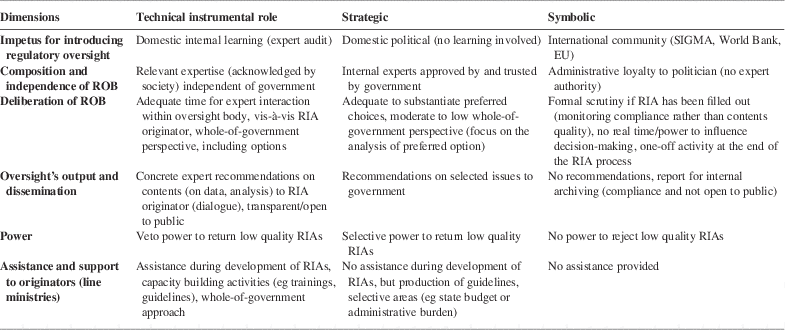
While theoretically these three roles can be identified relatively easily, it is more challenging to do so in practice. In this article we would like to suggest a framework that can help us understand the roles of RIA oversight bodies by a number of indicators, independent of narratives from actors involved. These indicators are linked to these bodies’ attributes. They are loosely inspired by Boswell’s indicators for the different functions of research in policy making and various uses of RIAs in policy making, but adjusted to the institution of ROBs.
Impetus for introducing RIA oversight body. First, it is important to look into the motivations behind reforming RIA processes and introducing such an oversight body, since this indicates the level of seriousness of bringing the oversight mechanism closer to decision-making and utilising knowledge and expertise. Thus, if institutionalisation of the technical-instrumental ROB model is envisioned, true learning needs to take place in order to anchor the body in such a way that it would fit the existing decision-making and legislative processes. An indicator for such intention is an expert audit conducted domestically, which based on internal learning recommends where and how to set up such an oversight body. If domestic drive for introducing an oversight body does not include any form of learning but rather wants to improve political control over regulators, we took this as an indicator for the strategic model. These two approaches for setting up an oversight body also correspond to Radaelli’s distinguishing between two forms of learning: instrumental and political. Finally, where there is a symbolic function, we would expect the international community and its reports to be a reform agent pushing the politicians and administration to introduce such a body.
Composition and independence. A key attribute of RIA oversight is reliance on expertise and professional staff,Footnote 33 since RIA as a tool of evidence-based policy-making aspires to “help people make well-informed decisions about policies, programs, and projects by putting the best available evidence at the heart of policy development and implementation”.Footnote 34 Where the oversight is valued for its technical-instrumental role, we would expect the staff to be chaired and composed by experts qualified and capable for independent judgement, ie economists and lawyers, but other professionals from social sciences may be included as they are increasingly influenced by behavioral economics. Otherwise, “any regulatory oversight body lacking expertise or headed by a non-expert political appointee may simply exercise politicized influence over expert regulators and thereby undercut its legitimacy”.Footnote 35 In other words, if the oversight body has a strategic function, we would expect the chair to be a political appointee or experts trusted by politicians to deliver recommendations in line with governmental choices and lending legitimacy to such choices. Finally, if the oversight has a symbolic function, we would expect its composition to be administrative without real expertise, authority or capacity to review the quality of RIAs conducted.
Deliberation. A third dimension is related to how an RIA oversight body conducts its meetings in order to determine the quality of RIAs and plans its overall volume of work ahead of time. Where RIA oversight has a technical-instrumental role, we expect it to have sufficient space and expertise for deliberation focusing on the contents of RIAs: options, evidence and analysis provided. Staroňová warns that too often RIA oversight happens at the wrong time and place, not allowing for real deliberation between the oversight and originator or for options analysis.Footnote 36 Where that is the case, and oversight (similarly to RIA itself) focuses on the preferred option’s quality (quality of assessment rather than options analysis), this would signal the oversight has a strategic role. Where there is symbolic function, we do not expect the RIA oversight body to conduct any in-depth content quality control, but rather to focus on formal conformity of RIAs to stipulations of the law.
Output and dissemination. This dimension focuses on the output of RIA oversight deliberation, whether in the form of concrete recommendations to originators on improving RIA contents, to politicians on further steps, or for openness to the public. In the technical-instrumental RIA oversight role, we expect detailed recommendations on how to improve the quality of RIAs and sufficient time for originators to work upon them. The findings are publicly available. In the strategic RIA oversight model, we expect selective focus on a preferred choice with limited time for the originators to work on recommendations of RIA oversight. When the symbolic role is in place, we expect output in the form of a statistical report rather than case-by-case analysis of individual RIAs, and reports are often of an internal nature.
Power. The fifth dimension looks at what possibilities RIA oversight has at hand to convey dissatisfaction with quality control and recommendations for improvement, and whether there is sufficient time for the originator to react to these and improve the content of RIAs. In the technical-instrumental model, we expect the oversight to have the power to reject low quality RIAs based on expertise, and to stop the legislative process in order for the originator to improve the quality. The strategic model is selective in rejecting low quality RIAs, and does so in an unpredictable and ad hoc manner based on linkage to political preferences. In the symbolic model, oversight does not have the power and capacity to sanction poor quality RIAs.
Assistance and support from RIA oversight to line ministries. The sixth dimension is related to the role of RIA oversight in analytic capacity-building, and whether the oversight is actively involved in providing advice to line ministries. When a technical-instrumental role is in place, we expect RIA oversight to be actively involved in assistance to originators during RIA development (eg on the use of evidence, its interpretation, methods of analysis, etc) in order to secure sufficient consideration of options, stakeholder participation and analysis. In the strategic model, the assistance is limited to guidelines without direct interaction with the originator during RIA development. The symbolic model features no assistance, due to the limited capacity of the oversight itself.
Framework for assessing the role of the regulatory oversight body (ROB)

Source: author.
III Comparison of RIA oversight mechanisms across countries
1 Impetus for introducing regulatory oversight
In two countries (Estonia and Slovenia), the impetus came from the National Audit Office (NAO), which initiated a performance audit in order to increase the quality of performance and efficiency. This is quite a broad interpretation of the NAO mandate in CEE countries, which usually focus only on audits of adherence to the law. From the perspective of the Estonian advisor to the Auditor General, there is nobody else to do this kind of audit independently. Similarly, the Slovenian audit officer noted that the NAO is not only independent enough to do such a job, but is actually obliged to pose difficult questions. In both cases, it was the NAO management that picked the topic of the internal audit and decided to check on the process of the preparation, operation and co-ordination of law preparation:
“... this was a matter of expanding the mandate to the ‘economic control of the Government’ which entitles us to do financial audits, performance audits and compliance audits. However, this does not say what it means… I think I can easily argue that proper regulatory impact has a lot to do with good governance and the good governance of tax payers’ money. One of the worst aspects in impact assessment that we saw was relating legislation solely to the budgets…”Footnote 37
Both Estonian and Slovenian NAO reports found serious deficiencies, which were addressed in recommendations and calls for corrections, including a call for bigger control and oversight (independently of each other however). In the words of the Slovenian audit officer:
“... we have proposed to ensure bigger control… whether this control will be automatic or it will be in the form of a [oversight] body depends on how they [audited bodies – ministries, parliament, Government Office] will implement it. We just show them the goal that they should reach; how they reach it, it’s their decision. If they will implement it through a body, it’s one of the possibilities.”Footnote 38
Thus on the basis of these, the Rules of Procedures of the Government (not Parliament) were changed in 2010 in Slovenia and in 2012 in Estonia. In Estonia, the (weak) oversight mechanism was moved from Parliament closer to the Executive. In addition, the traditional oversight anchored in the Government Office has been complemented by a new unit in the Ministry of Justice (Legislative Quality Division in Estonia) as of January 2013, drawing special attention to review draft laws and RIAs. Estonia traditionally had a strong oversight body anchored in the State Chancellery, which in the past did not focus on RIAs per se but on the general policy-making process and strategies with spill-over effect on RIAs.Footnote 39 In Slovenia, however, the shift of focus on RIAs from Parliament to Executive was not accompanied by an oversight mechanism on the horizontal level. Instead, the Ministry of Economy, with a better regulation agenda, somewhat fulfils some regulatory oversight tasks.
In the Czech Republic the renewed interest in RIAs started in 2010 with the change of Government, and continued even following another change of Government in 2013. Here, the first internal audit report on the inefficiency of RIA guidelines was prepared in 2009 by the Ministry of Interior (to which the RIA co-ordination unit had been moved, from the Government Office). Only with the change of the Government in 2010 were the recommendations transformed into new general principles and into practice under the direct supervision of a renowned economist and fan of RIA; he also became the first head of the newly-created RIA committee. As a result, the new Government strengthened the institutional framework as of January 2012 by shifting the RIA unit from a line ministry (the Ministry of Interior) to the Government Office under the direct supervision of the Deputy Prime Minister in charge of the legislative process. The RIA unit became administrative and expert support for a newly-created regulatory oversight: the RIA committee of the Legislative Council of the Government. A very important step for setting up the RIA committee was the existence of an economic advisory council to the Government, which had already grouped together most important economists in the country to advise and provide expertise in economic issues. Most of the future members of the RIA committee were drawn from there.Footnote 40
Hungary and Slovakia did not conduct any internal audits or other evaluation that would bring knowledge and data to the design of reforms. In Slovakia, reforms were the result of better regulation initiatives, triggered by SIGMA Reports. On the basis of these, civil servants in the Ministry of Economy triggered reform in 2008 but were isolated in their efforts and were not necessarily backed by politicians. As a result a plural oversight mechanism was created, anchored in four ministries: the Ministry of Economy, Ministry of Finance, Ministry of Environment and Ministry of Labour and Social Affairs, each safeguarding its specific area. Nevertheless, important elements of the reform were in reality either not introduced or simply downplayed. In 2015 the newly-appointed state secretary (a political figure) of the Ministry of Economy expressed interest and support for the bottom-up initiative in his ministry, and overarching oversight – an RIA Committee – was created at the Legislative Council of the Government as of October 2015.
Hungary is an interesting case. New interest in RIA and reform of RIA was triggered by the incoming Orban Government in 2010, with the aim of having an efficient tool to keep bureaucracy under control and to check whether policy actions would lead to increased popularity or even show the public positive impact.Footnote 41 To this end, oversight for RIA was assigned to a newly-created RIA sub-unit vested in a body charged with oversight of the quality of legislation – the Office of the Deputy State Secretary for Public Administration Strategy at the Ministry of Public Administration and Justice. Since 2010, part of the RIA unit also became ECOSTAT (the former Statistical office). Political support was crucial for introducing the changes, but it was linked to only one person: the Minister of Justice and Public Administration. Nevertheless, the same Government lost interest in the changes it had introduced, due to the leakage of the practice of providing evidence for positive impact of the introduced governmental measures and a subsequent media scandal, and eventually ECOSTAT was abolished in 2012.Footnote 42
In summary, the triggers for reform differ, from an external push for better regulation impact (Slovakia); through an internal political push to increase legitimacy of policies (Hungary); to an internal push in seeking improvements in the overall quality of performance or legislation by auditing RIA processes (the Czech Republic, Estonia, Slovenia). Thus, in the final three countries we can observe bureaucratic learning by conducting internal audits of RIA processes prior to its reform.
2 Composition and independence
In the Czech Republic, both the RIA unit and RIA committee are comprised of mostly economic and legal experts who are highly recognised within the bureaucracy and across society. The RIA unit (six analysts) at the Government Office brought together, on the informal request of the Deputy Prime Minister for Legislation, civil servants/experts who were the architects of the RIA system back in 2007, piloted the RIA system in 2008, and participated in the internal audit of the system that brought about the reform.Footnote 43 The reform also created an independent oversight body: a new RIA Committee of the Legislative Council of the Government, consisting of 16 independent experts from outside civil service, who are prominent economists and lawyers from academia or associations (eg a bank association) or who have previously worked with RIA in the EU or OECD. The selection of the RIA Committee members was entirely left to the first head of the RIA Committee – Professor Mejstřík – with no interference from either politicians or civil servants, since many names were already known to policy makers as advisors in the Economic Committee. Their reputation and expertise is considered to be so great that even with the change of the Government, nobody requested any change of RIA Committee experts. If anybody steps down from this function, he or she suggests a new expert from outside with a similar reputation in the field. The effort is to have an equal distribution of field expertise represented in the Committee. Thus, members are selected in order to signal instrumental expertise and independence for RIA oversight.
By contrast, in Hungary today, the RIA unit at the Ministry of Public Administration is a small one, comprising four civil servants (a lawyer, economist, and political scientist, and one economist on contract) with little if any credibility in expertise. Rather, they are viewed as pure administrative bureaucrats. This was not always the case. Originally, when in 2010 an oversight body was created including ECOSTAT, its task was to establish a centre to support the RIA activities of line ministries with methodological assistance, creating an RIA database, collecting complex data and preparing macroeconomic models for simulations in complex horizontal RIA issues. It was to be the research and methodological centre of the RIA unit with almost 20 staff between 2010-2012, in order to be able to provide expertise, data and more complex analyses for impact assessment for other agencies.Footnote 44 The rationale behind creating this support unit was that the problems individual ministries were facing related to big data collection and analysis. It was the task of ECOSTAT to provide background material, based on requests from individual line ministries. However, before finishing the database, models and piloting the first complex RIAs, ECOSTAT lost its mandate and position in 2012, and its staff was reduced to five people who are no longer involved in RIA oversight. Including ECOSTAT into an RIA unit can be seen as a means of ensuring the RIA unit was seen as authoritative, thereby bolstering reputation in oversight (its sponsor in the Orban Government was also keen to produce findings to support its policies). As this did not succeed, oversight’s strategic role was reduced to a symbolic role with no real expertise in place. An interviewee noted:
“In the bureaucratic hierarchy ECOSTAT was always a background institution to the Ministry of Public Administration, so it has had this kind of quasi government agency status with expertise and credibility… But I think that ECOSTAT was losing its importance, also in the eyes of the political decision makers. And they just wanted to see it as not such a strong and independent excellence centre within the public sector, so they just reduced it into a more bureaucratic office.”Footnote 45
In Slovakia, an updated version of the joint methodology of 2010 created four RIA oversight units as analytical centres at four different ministries. Thus oversight was broken down to four ministries depending on the type of RIA (the Ministry of Finance oversees impacts on the state budget and the informatisation of society; the Ministry of Economy oversees impacts on the business environment; the Ministry of Labour, Social Affairs and Family oversees social impacts; and the Ministry of Environment oversees impacts on the environment) with limited, if any, mutual co-ordination. In addition, these units were understaffed (2–3 people, having other tasks besides just RIA oversight), with little expertise; the only exception is the Ministry of Finance, where the relevant oversight unit had three sub-units and is part of a bigger Department on Budgetary Policy. In her empirical evidence Staroňová showed that the other three RIA oversight centres (excepting the Ministry of Finance) had low authority and inadequate powers, which resulted in little increase of quality.Footnote 46 In late 2015 a new reform created an RIA Committee of the Legislative Council of the Government, comprising representatives from the ranks of civil servants, each coming from the original four RIA oversight Ministries, the Government Office, and the Ministry of Interior, totalling 8–9 members.
In Estonia, RIA oversight is anchored with an RIA unit at the Ministry of Justice that has three divisions: for public law, private law and legislative quality. Together there are 35 staff members, 11 in the legislative quality division, most of them lawyers (there are also social scientists, a mathematician, and a single economist). The unit focuses mostly on the quality of legal acts, and accompanying RIAs are of secondary importance. However, in Estonia a unique symbiosis between RIA oversight in the Ministry of Justice and the Government Office developed, uniting several processes in policy making: stakeholder engagement, strategic planning and EU transposition oversight. The Government Office strategic planning unit has a long successful history of horizontal co-ordination and stakeholder engagement oversight, with spillover effects on other policy processes.Footnote 47 The head of the Government Office strategic unit sees RIA oversight as follows:
“So, basically, we pretty much took the existing materials prepared already by the Ministry of Justice and together with them we just developed it further, so that it would put it in the context of three different policy processes. One, which is the preparation of the primary legislation, is certainly mostly something the Ministry of Justice was interested in; but since we also develop quite a lot of strategy documents, we call them Development Plans, which has a different procedure, but we thought that it can be also improved in the same way, that there would be a necessary step of doing RIA in a preparation process of those documents… And the third one is the context of preparation of EU-initiated legislation, since the principle there is that the earlier you start [with RIA] the better. And because there is a very good well-functioning EU co-ordination mechanism through our own Government Office unit – European Union Secretariat.”Footnote 48
Despite the recommendations of the NAO in Slovenia there was not adequate political support to establish one horizontal RIA oversight. Instead, different supervisions are anchored in different places: the Ministry of Interior oversees administrative consequences, the Legislative Office is responsible for consistency with law, the Secretary General oversees quantitative impacts (mostly on budgets) and the Ministry of Public Administration oversees better regulation. An interviewee from the Ministry of Public Administration noted, “So we have very decentralised supervision, so if you want to have centralised supervision we have to establish a body which is independent.”Footnote 49
3 Deliberation and output
In the Czech Republic, initial assessments, obligatory to all originators of draft bills, are produced for all proposals when the annual Plan of Legislative Works of the Government is composed each year. This is the decision-making stage, where the generic forecasts regarding the consequences of a decision are made and arguments as to the necessity for an extensive RIA are presented. The aim is to retrench resources and oblige the ministries, before they start drafting a new regulation, to go through a logical sequence of questions to identify whether the regulation is at all necessary. The result of the first part of the RIA process is the Plan of Legislative Tasks of the Government that states, among other things, on which legal acts the comprehensive RIA is to be conducted. This is also the phase when: (1) both the RIA unit and RIA Committee actively step into the filtering process and check whether or not RIA is to be part of the process, taking into consideration the priorities of the Government and overall workload, and in this way coordinate overall legislative planning; and (2) already filtered RIAs to be further developed are subdivided according to their substantive nature to 2–3 members of the Committee (RIA rapporteurs) who are responsible for following up the quality from this phase until (re)submission to the Government by providing consultation to line ministries. Once an RIA is officially submitted, these RIA rapporteurs also prepare a draft written Statement (several pages long) on the quality of various RIA aspects, including how to tackle options, consultation processes and the impact assessment. These statements, together with the RIA and draft law, are then circulated among RIA committee members prior to its sitting.
The Czech RIA Committee meets approximately every three weeks, which makes 17–18 meetings per calendar year, for a half-day deliberation where 3–4 RIAs are covered at each meeting. The aim is to discuss written Statements on the RIA, first in committee and then face-to-face with originators, who have to defend how they looked for alternatives and undertook consultation or analysis. The reason for discussing the draft Statement to the RIA by the rapporteur is “to discuss the RIA among all members of the Committee, where rapporteur(s) introduce their view, all the others talk about it and we try to reach consensus….I do not remember any voting, we always reach consensus by talking”.Footnote 50 The originators come in the teams that prepared an RIA (3–4 people), and when interviewed they noted that they felt like students at final state exams; on the one hand they feared the face-to-face meeting, but also appreciated having a chance to explain and discuss and learn in this way.
RIA oversight in Slovakia does not take a whole-of-government approach and does not use deliberation as a means of producing a joint Statement towards RIA quality, be it as four ministerial bodies (2010–15) or the current RIA Committee comprising civil servants from these ministries (as of 2015). First, both the former four ministerial oversight bodies and current RIA committee members do not divide RIAs to be examined by their substantive field, as is the case in the Czech Republic; rather they divide the concrete RIAs according to the substantive assessments conducted (fiscal assessments, environmental, etc), and each member representing a specific supervising body prepares an RIA Statement only on this one particular assessment area. Moreover, both the former four ministerial oversight bodies and current RIA Committee members do not meet in person to discuss the quality of RIAs jointly. Instead, the RIA unit (administrative support unit at the Ministry of Economy) puts together individual parts of statements as developed by RIA oversight members, and the first time the RIA oversight members (of the four bodies or current Committee) see the other parts of the overall Recommendations for improvement is when it is sent out to the originator. Thus, the mode of operation did not change with the RIA Committee’s introduction. The RIA Committee meets in person approximately three times a year to discuss mostly methodological issues related to RIA processes and that is the only means of co-ordination, though informal means might be in operation. Consequently, the output of RIA oversight does not tackle RIAs as complex issues with alternatives to be considered, but again focuses only on assessments of preferred choices.
Estonia utilises strategies and legislative intents for forecasting the necessity of comprehensive RIAs. This template became obligatory with the reform, and “serves as an RIA roadmap in the EC.”Footnote 51 It is also the phase when the RIA oversight and Strategy unit look into the intents, in order to facilitate a coordinated consultation process and stakeholder engagement. The workload is divided among the experts in the units, who cover certain ministries/sectors and policy areas based on their expertise. From this point on, they communicate closely with the people in line ministries who actually prepare RIA documentation to oversee the whole exercise. An official from the Government Office noted that cooperation between the oversight unit and originator is “important to see, so that the RIA is not just something one or two persons come up with from their desk”.
Estonia achieves co-ordination via formal and informal networks. RIA oversight organises meetings with heads of legal departments of line ministries once a month in order “to coordinate the process in advance and to discuss important questions, what are the problems now, how can they be solved, and in this way to coordinate also this legal quality.”Footnote 52 The RIA unit decided to utilise this network of legal departments; though they do not prepare RIAs, they are responsible for the overall quality of the regulation prepared in line ministries.
In Hungary the mandate of the RIA unit is by far less, although officially it is to coordinate and assist ministries in RIA performance as well as to perform quality control. Nevertheless, this task is in practice only a formal administrative checking on whether RIA templates have been filled out in the form of a database sheet, and original analysis is not included. Even the databases are not publicly available. Thus, the RIA unit looks solely at the cells of the sheet and not into background information, analysis or rationale for filling out the sheet in a certain way. An analyst from an influential think tank who prior to 2010 was involved in RIA processes commented on the situation as follows:
“[RIA sheets] are just not filled out and they miss concrete reference to background research papers. I have never seen a research paper published; all of these templates are there to summarize the supposed background research activities but I have never seen the real research papers beyond, and I think they are there basically to show these things to the OECD and whoever is coming here to survey the country, but basically they are not effective.”Footnote 53
Even during the time that the RIA unit included ECOSTAT, no real quality control was taking place. ECOSTAT’s task was to establish a centre to support the RIA activities of line ministries by creating an RIA database, collecting complex data and preparing macroeconomic models for simulations, rather than providing quality oversight. However, only the oversight body (ECOSTAT) was expected to be involved directly in producing background analyses and drafting complex RIAs together with line ministries. This, however, never happened since ECOSTAT lost its mandate and position in 2012. The fate of the ECOSTAT and purely administrative role of the RIA unit suggest that it may have a role of legitimising governmental policies.
In Slovenia, the materials defining the baseline for decision-making and preparing draft regulation are, prior to consideration by the Government, reviewed by the Secretariat General of the Government. Unfortunately the materials are reviewed only from a technical perspective, meaning that they check if the material contains mandatory elements: a summary of cooperation with stakeholders, and impact assessment. The quality is not reviewed at all. The materials are also reviewed by the Governmental Office of Legislation. They review the drafts from a legal perspective: is the draft in line with the Constitution, supranational and national regulations and with legal drafting guidelines. No output in written form is being produced.
4 Power
The RIA Committee in the Czech Republic has veto power to stop the legislative process entirely if it finds the RIA (or the regulation) of inadequate quality. Thus, based on the discussion, the Committee can decide to recommend the regulation and RIA for a Cabinet meeting, return the proposal to the originator for further reworking, or reject it entirely (recommend rejection to the Cabinet) if it finds the regulation to be redundant or conducive to excessive regulatory burdening. Annually, the Committee rejects from five to ten items of approximately 70–80 discussed RIAs. Another 35–50 items are returned for reworking (Government Office reports). Only about 20 items are sent on in the decision-making process without additional comments. The RIA committee also conducts independent audits of the RIA process with recommendations; these recommendations are the basis for minor process changes that have taken place as of February 2014.
RIA oversight in Estonia utilises different means to fight inadequate RIA quality because, being anchored in the Ministry of Justice, it faces hierarchical problems (in words of an interviewee “there is no one more equal among the equals”). Both the RIA oversight body and Strategic unit issue opinions which are non-mandatory during the inter-ministerial review process, first for legislative intent and later for a draft proposal. Here again, opinions are provided in a joint package from the Ministry of Justice/Government Office; nevertheless opinions are subdivided into “legal” and “RIA” opinions. The practice is that the RIA oversight can approve RIA without comments, with comments (to be incorporated by the originator) or reject it. The rejection in reality takes place only if backed up politically by the minister.
Introduction of legislative intent in the early phase of legislative decision-making (similar to the EC “Roadmap”) provided RIA oversight the possibility to step into the process with the power to reject low quality items. Already in this phase RIA oversight checks the evidence in justification for intervention and “this has helped to retrench resources already at the very early phase ... we have also managed to block quite a few ideas from going forward because it didn’t seem reasonable to interfere with regulation or to deal with this issue at all.”Footnote 54 This early intervention also gave RIA oversight the possibility to work with originators and gradually to gain in reputation and credibility. This was backed politically in 2015 when the Minister of Justice strongly declared that RIA oversight is the “leader in better regulation and if you [line ministries] don’t have a good RIA, it will break your initiative”.Footnote 55 This made quite a big difference and in 2015 approximately 30% of proposals were rejected based on RIA oversight analysis, and the originators were asked to provide more information.
In Slovakia, efforts were made to improve RIA oversight by the recent creation of an RIA overarching Committee to unite the fragmented supervision and hierarchical problems the individual supervising ministries had vis-à-vis other line ministries. The new mechanism addressed many former problems related to low fit of oversight with overall legislative and decision-making processes,Footnote 56 such as the voluntary character of the first filtering phase in the preparation of the legislative plan, the character of oversight opinions provided during inter-ministerial review that were not considered to be “oversight body opinion” but rather collected with other substantive opinions of the Ministry and presented in an aggregated manner, and too strong an informal position by part of the oversight body (Ministry of Finance) at the expense of the others. The current RIA Committee oversight has a stronger position because of a better fit with the legislative process and has the power to reject low quality RIAs. The decision whether or not to reject RIA comes as a sum of individual statements of RIA Committee members when stating the final supportive or non-supportive position. This is a relatively rigorous process, since a single individual non-supportive conclusion means the overall statement is non-supportive. However, this statement is non-binding. Nevertheless, since the RIA Committee is part of the Legislative Council with high authority, informally the originators rewrite and resubmit RIAs that received non-supportive statements.
IV Discussion and conclusions
Previous studies by scholars, international organisations and governments have paid attention to concepts and measures of the extent and quality of RIAs. Indeed, indicators of the quality of RIAs and overall process have become prominent items on reform agendas leading to the introduction of RIA oversight mechanisms across countriesFootnote 57 with the expectation of improving the regulatory environment. Nevertheless, there is inadequate literature trying to capture RIA oversight, though RIA success and/or failure can depend more decisively on overall RIA governance. This article has examined RIA oversight mechanisms in five CEE countries: the Czech Republic, Estonia, Hungary, Slovakia and Slovenia. The foregoing analysis has revealed interesting cross-country variance in RIA oversight institutionalisation. How can one account for such differences and what role do institutions have in such accounts?
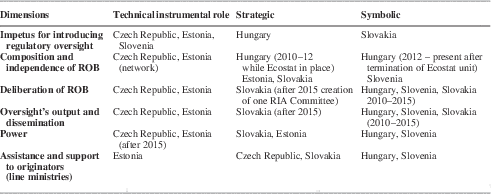
Overall, all of the countries but Slovenia, where oversight is decentralised, have some kind of RIA oversight body, with varying structures. These general types differ in terms of impetus for RIA oversight creation, expert composition, deliberation, supervision (formal, content), assistance provided to line ministries (involvement in drafting RIAs), support (training, guidelines, methodologies) and powers (see Table 2). These differences can influence the range of purposes and roles RIA oversight can assume. We have argued that in addition to their instrumental role they are likely also to play a strategic role to substantiate particular policy preferences or to legitimise certain government initiatives, or may play a symbolic role to signal to international organizations their willingness to construct RIA processes.
RIA oversight body roles in 5 countries (2010–2015)

The Czech Republic and Estonia are both inclining towards technical-instrumental RIA oversight, despite having different institutional structures. They both have deep internal learning preceding complex RIA reform, explicitly linking RIAs to legislative planning and not simply to drafting laws, making it a continuous process in parallel with decision-making. The internal audit that precedes decisions on RIA oversight, choice of independent experts in the RIA Committee, strength of the RIA unit supporting oversight, close interaction with line ministries, consensual decision-making on RIA statements, and face-to-face discussion with originators on RIA rationale all strongly suggest RIA oversight in the Czech Republic has an instrumental role, designed to foster expertise and learning in the process. However, in Estonia RIA oversight does not have such strong expert independence or powers and features. Nevertheless, it elaborates the concept of communication and discussion, bringing more knowledge into RIA development through networks of RIA experts across line ministries and the Government office. This understanding is in line with the Dunlop et al concept of communicative usage. In this sense, Estonian RIA oversight appears to have combined features of instrumental and strategic roles.Footnote 58
These results reflect three important factors of RIA oversight in the Czech Republic and Estonia that enhance whole-of-government approach and overall co-ordination. First, work on RIAs and RIA oversight starts even prior to the Plan of Legislative tasks, with describing the problem, analysing different policy options, identifying the need for regulation, and determining which items need to be analysed in greater depth in comprehensive RIAs, and where the RIA oversight body is involved in its planning, justification quality based on evidence and subsequent approval/rejection. In particular, the effective consideration of options, which lies at the heart of RIA, relies heavily on the integration of different perspectives and information very early on in both countries. Second, comprehensive RIAs are not required for all items but are limited to priority issues, which tackles the capacity problem both in originating line ministries and the RIA oversight body. In addition, already at this early stage experts from RIA oversight are assigned to policy areas and assist the originators in RIA development, if required. Third, both countries value face-to-face consultation and deliberation among the experts from RIA oversight and with originators. In the Czech Republic this is done in face-to-face meetings between experts from RIA oversight and originators, and in Estonia this is conducted with the help of informal networks and co-ordination.Footnote 59
In addition, in the Czech Republic, all the items that go to Government sessions outside of the Legislative Plan are required to have a comprehensive RIA by default. In this way, any effort to bypass the RIA oversight system is tackled. Once items where a comprehensive RIA is expected are identified (and approved by the oversight body), the work starts immediately and not at the end of the process. This regulatory planning process provides early notification to line ministries and other agencies, as well as to the public, about regulatory initiatives at a time when it is still possible to fundamentally revise the regulatory decision on the basis of knowledge and information from RIA and RIA oversight.
Slovakia, by contrast, appears to conform fairly closely to having a strategic role, because of the lack of internal learning, deliberation and lack of attention on a whole-of-government perspective. The findings suggest that its RIA Statements do not particularly influence governmental decision-making in terms of alternatives but rather show evidence for a preferred choice. At the same time, effort invested in the recreation of fragmented supervision in RIA Committee creation imply that the government was keen to signal that it was taking action. Nevertheless, this is a relatively new mechanism worth investigating further, as to whether the Government takes the Commission’s recommendations seriously.
Turning to Hungary, the composition, impetus, fate of ECOSTAT and manner of deliberation all suggest that its role was partly strategic to legitimise governmental actions using (big) data and partly symbolic to signal to the public the benefits it brings. Hungary offers a fascinating case of how a brilliant idea to tackle low capacities in line ministriesFootnote 60 and legitimising intentions can become derailed: a media scandal from the leakage of such a popularising role for RIA oversight in its ECOSTAT sub-unit forced the Government to distance itself and diminish its role to being purely symbolic.
The form of institutionalisation matters in the way RIA oversight mechanisms are perceived and performed. Currently there are no blueprints for success, but our research suggests that such activities need to be sufficiently institutionalised to allow long-term commitment amongst the main players, while also being capable of operating at some distance from everyday political decisions. Thus, the model of the Czech Republic and Estonia could be especially relevant at an international level. First, RIA has triggered processes of capacity building within, and co-ordination across, line ministries at the stage of policy formulation. Second, they established strong oversight with the power to stop the legislative process if an RIA is poor (and politically backed).
The findings show that all of the countries studied have made efforts to upgrade their respective systems to address these deficiencies in the system and to eliminate formalism, but with varying degrees of success. The main reform features in theory resonate strongly with internationally acknowledged principles of RIA, such as the introduction of RIA oversight. Nevertheless, these RIA oversight bodies in some countries tend to illuminate rather than radically alter existing RIA processes, except perhaps for the Czech Republic and potentially Estonia. Interestingly, these are the countries where internal learning through audit of RIA processes mobilised reform, where political accountability is the strongest, expert deliberation valued and a new RIA process was linked directly to decision-making. Yet the potential of these reforms needs to be verified vis-à-vis actual RIA performance.