Introduction
Rapid tranquillisation (RT) aims to quickly calm the severely agitated patient, in order to reduce the risk of imminent and serious violence to self or others (National Institute for Health and Clinical Excellence, 2005); guidance on clinical practice issued by NICE is currently under review. Although medicines may be prescribed to manage agitated patients, de-escalation and non-pharmacological treatment should be used first in order to reduce the risks to the patient from medication and its administration.
RT is widely used in a variety of settings (Curtis & Capp, Reference Curtis and Capp2003; National Institute for Health and Clinical Excellence, 2005; Baker et al. Reference Baker, Lovell and Harris2008; Brown et al. Reference Brown, Chhina and Dye2010; Innes & Iyeke, Reference Innes and Iyeke2012; Choudhury et al. Reference Choudhury, Dewsbery, Williams and Hovey2011; Loynes et al. Reference Loynes, Innes and Dye2012; Stewart et al. Reference Stewart, Robson, Chaplin, Quirk and Bowers2012; Akram et al. Reference Akram, Slavin and Davies2014a, Reference Akram, Slavin and Daviesb; L. Choong, S. Sangha, A. Hubble, unpub. data, 2012). Whilst there is no consensus on RT practice and the frequency of physical monitoring following RT administration (Innes & Iyeke, Reference Innes and Iyeke2012; Loynes et al. Reference Loynes, Innes and Dye2012), it is clear that this monitoring should occur to minimise possible harm caused by this intervention (National Institute for Clinical Excellence, 2005). RT may be used with restraint where the patient is unwilling or unable to comply with the use of oral RT, making the parenteral route preferable in these situations.
Restraint is also widely used in mental health care settings (Loynes et al. Reference Loynes, Innes and Dye2012), although the techniques used remain controversial. A recent report by Mind (2013) identified a wide variation in practice across 51 NHS mental health trusts with between 38 and 3000 incidents of restraint per trust in 2010–2011. They identified nearly 1000 reports of injury occurring after the use of restraint over the same period of time. A UK-based national practice survey based on self-reporting (Wright et al. 2006) indicated that restraint occurred on average three times per month per ward across the sample. However, it should be noted that these figures may not specifically be related to restraint used with RT.
Restraint has been associated with fatal (Banerjee et al. Reference Banerjee, Bingley and Murphy1995; Aiken et al. Reference Aiken, Duxbury, Dale and Harbison2011) and non-fatal (Aiken et al. Reference Aiken, Duxbury, Dale and Harbison2011) physical trauma, and it has been suggested that effective use of de-escalation techniques and RT may reduce the need for physical restraint (Innes and Iyeke, Reference Innes and Iyeke2012). It is therefore important that restraint is used judiciously where other methods have failed or are inappropriate.
The Central and North West London NHS Foundation Trust and NICE consider that all medication given in the short-term management of disturbed or violent behaviour should be considered as part of RT (including pro re nata (PRN) medication; National Institute for Clinical Excellence, 2005). This includes offering oral medication to patients who are presenting as agitated to de-escalate a situation. Within the Central and North West London NHS Foundation Trust, the medicines used for RT are prescribed on the PRN section of the medicine chart.
RT practice within the Central and North West London NHS Foundation Trust is audited annually via a point-prevalence survey and focuses on the medicines used, prescribed doses and the post-dose physical monitoring required by the Trust. Analyses of RT practice and use of restraint have been published in the literature but data sets have been relatively small (Choudhury et al. Reference Choudhury, Dewsbery, Williams and Hovey2011; L. Choong, S. Sangha, A. Hubble, unpub. data, 2012). We are not aware of a previous audit of the use of restraint with or without RT within this Trust but a small data set has been published (Akram, Reference Akram, Slavin and Davies2014a, b).
As a note for international readers, within the UK publicly-funded mental health care is provided by a National Health Service (NHS) trust which will provide care in a certain geographical or local government administrative area. Within this trust, care is provided by different service lines as a means of organising expertise and specialities. The Central and North West London NHS Foundation Trust provides mental health services within five London boroughs and Milton Keynes, but may accept patients from other trusts into its specialist services (e.g. long-term mental health rehabilitation, eating disorders unit, female PICU).
This audit aimed to quantify and describe RT use within the Central and North West London NHS Foundation Trust by borough and service line, specifically looking for trends in the route of RT and whether restraint was used. This analysis contains data from a geographically large trust with a diverse population and services, and therefore provides an overview of current practice with a large data set allowing meaningful trends to be identified readily.
METHOD
Retrospective, quantitative data for all RT incidents between April 2011 and November 2012 inclusive were captured from the incident reporting database, including electronic incident reports (collated on Datix®) and paper-based reports. Incident form completion is a mandatory requirement for any incident of RT. Data was analysed in Microsoft Excel®. As this was an audit using existing data ethical approval was not required.
Electronic incident forms on Datix® include a number of mandatory fields that require completion prior to submission. Where possible, these mandatory fields were used as the basis for data collection and analysis to reduce subjectivity within the sample.
RESULTS AND DISCUSSION
Number of RT incidents
Overall, a total of 2267 incidents occurred in the 19 month data period across the Trust as a whole. This equates to approximately four incidents per day. These incidents all occurred in inpatient settings.
By service line
Within the Trust, patient care is delivered by means of teams working within service lines. The acute service line (ASL) consists of open wards, psychiatric intensive care units (PICUs) and home treatment teams (HTTs). These services mainly treat adults with acute functional mental health conditions. A total of 1594 (70%) RT incidents occurred in the ASL.
The remainder of the RT incidents occurred in the following service lines at a much lower frequency: learning disabilities (n=348, 15%); rehabilitation (n=165, 7%); older person & healthy aging (OPHA) (n=112, 5%); and offender care (n=19, 1%). 29 incidents (1%) did not report the service line; this is now a mandatory requirement on Datix®. Of note, each of these service lines reported more oral RT than intramuscular (IM) RT. The low number of reports of RT in the offender care service line was due to the Trust not having significant secure services (two wards) and consequently there is a low frequency of RT incident reports from this service line.
Of the 1594 RT reports in the ASL, 1006 (63%) incidents occurred on open wards and 588 (37%) incidents on PICUs. At the time of the sample, inpatient service provision for the ASL consisted of 5 PICUs and 21 open wards. Therefore, the higher number of incidents on open wards may be due to the fact that there were nearly four times more open wards than PICUs. Accounting for the difference in number of wards, RT was used 2½ times more frequently on the PICUs than on the open wards (based on a mean of 118 RT incidents per PICU and 48 per open ward). This would seem consistent given the increased acuity of illness seen in the PICU environment although no figures are available for comparison with other service providers.
By borough
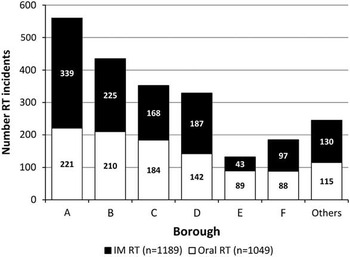
There was some variation in RT reporting across the boroughs for which the Trust provides mental health services as shown in Figure 1.
RT incidents reported by borough (n=2238, 29 incidents excluded since route of administration not specified).

Admissions to the inpatient units within each borough are mainly restricted to the residents of that borough. Outliers from other boroughs are exceptional, for example where there was no available bed in the outlying borough’s mental health unit, and these patients are transferred to the ‘correct’ unit once a bed is available.
Borough A reported the most use of RT within the sample, but boroughs B and D, with a similar overall population size, reported much less RT use. It should also be noted that the mental health unit for borough B had two PICUs on site during the time of the data set but reported less RT than borough A. Boroughs C and E reported more oral RT use than IM RT which may be due to more consistent reporting of these incidents. Boroughs E and F have specialist services but no locked ward or PICU and are thus excluded from further analysis. Refer to Figure 1, which displays results by route of administration.
RT use within PICUs
There were five PICUs within the Trust. Four of these are male only units and one is exclusively for female patients who are referred from a wider area.
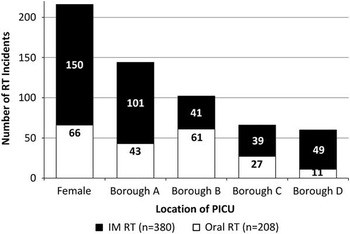
Of the 588 RT incidents reported across the five PICUs, 216 (37%) occurred on the female PICU compared with 102 (17%), 144 (25%), 66 (11%) and 60 (10%) incidents on each of the male PICUs. In all PICUs other than one male PICU, IM RT use was reported more frequently than oral. The female PICU reported 66 incidents of oral RT and 150 incidents of IM RT; over twice the amount. Refer to Figure 2 for a breakdown of RT incidents by PICU.
Number of oral and IM RT incidents within PICUs (n=588).
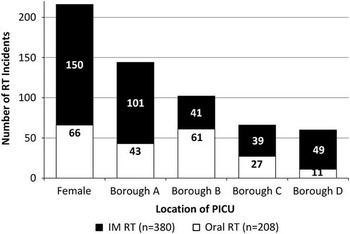
It is thought that the higher number of reports of RT on the female PICU may be due to an increased level of aggression; this may be related to differences in diagnosis in females who require admission to the PICU compared with those of males (O’Brien et al. Reference O’Brien, Cramer, Rutherford and Attard2013). The female PICU accepts referrals from a wide geographical range. This range may also be reflected in the higher proportion of IM RT from this PICU. However, the use of RT on the basis of sex could form an area of further investigation.
Restraint
Restraint was reported in over half of all RT incidents (n=1300, 57%) with most incidents occurring in the ASL (n=888 of 1300, 68%). The records of eight incidents did not state the route of RT administration and these were excluded from further analysis.
Of the 888 incidents of RT involving restraint 309 (35%) occurred on PICUs against 571 (64%) on open wards. When accounting for the numbers of PICUs and open wards, restraint RT incidents were seen more frequently on PICUs, with a mean of 62 incidents per PICU against approximately 27 per open ward. As would be expected, more restraint RT incidents were associated with IM administration than oral administration (718 vs 162 respectively) in the ASL.
Behaviours leading to RT administration
When reporting incidents of RT administration on Datix®, a mandatory drop down field appears asking for the reason for administration.
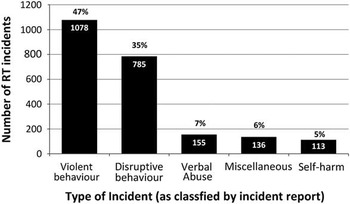
Figure 3 shows the breakdown of incidents resulting in RT being administered. These results are unsurprising and in line with other reports (Curtis & Capp, Reference Curtis and Capp2003; Baker et al. Reference Baker, Lovell and Harris2008; Stewart et al. Reference Stewart, Robson, Chaplin, Quirk and Bowers2012). Further qualitative data on the nature of the incident were not available for examination.
Type of incident preceding RT use.

Route of RT administration
NICE considers all medication given in the short-term management of disturbed or violent behaviour as part of RT (National Institute for Health and Clinical Excellence, 2005) including pro re nata (PRN) medication and orally administered medicines. Of the total 2267 RT incidents, 29 did not specify the route of administration and were excluded from analysis (this is now mandatory information on Datix®).
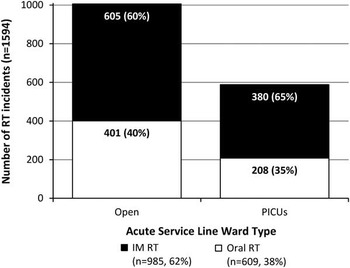
The proportion of IM to oral RT (60:40 respectively) was not found to depend on the ward type in the ASL when ward types were grouped together (see Fig. 4). The IM route was reported more frequently than the oral route in both ward types in the sample despite guidance advising preferential use of oral RT wherever possible. It is possible that this may be due to under reporting; staff completing incident reports may not consider oral medicines to be RT, causing low reporting rates of oral administration and consequently skewing the proportion of IM RT reported.
RT incidents and route of administration acute service line only.

No other routes were used for RT (e.g. intravenous, buccal), as reported by Brown et al. (Reference Brown, Chhina and Dye2010).
Consequences of RT administration
Despite the risks of RT, restraint and the possible consequences of violent behaviour, there were no reports of major injury or death in any RT incident report. 89% of incidents resulted in no injury and only 11% resulted in minor injury (such as fractures to the fingers, thumb or toes, laceration, bruise, abrasion, bite or sprain). This is in keeping with other reports (Innes & Curtis, Reference Innes and Curtis2013) which have found that there are low numbers of patient safety incidents relating to RT reported to the National Reporting and Learning System in the UK.
LIMITATIONS OF THIS STUDY
The main limitation of this study is that information related to the rates of RT reporting are based on the numbers of wards and not bed numbers available on the respective wards because accurate data is not available for the data period. Considering that PICUs tend to have lower numbers of beds than open wards, the frequency of RT reports may be skewed as a result.
It was not possible to ascertain the type of restraint used, and how patient safety was maintained, from the data given the quantitative nature of this data set. Analysis of the qualitative data from the incident reports could form the basis of further work, but was not possible here given the substantial size of the data set.
The data is limited in that the chronology of the events cannot be ascertained from the data; it is only possible to record whether restraint and RT were used within the same incident report. For example, it cannot be ascertained whether RT was administered which then resulted in restraint or restraint was performed in order to administer RT.
CONCLUSIONS
To the authors’ knowledge, this is the first time that a substantial data set has examined the use of RT and restraint with frequency reported although smaller data sets have been published (Akram Reference Akram, Slavin and Davies2014a, b). The present paper also contains 19 months’ worth of data from one trust covering a large geographical area, which may be helpful in providing a benchmark of current practice within the UK for mental health service providers.
The analysis shows that there is a high use of RT although the evidence base for this practice is limited. It is expected that this published report of a substantial data set will add to this body of evidence.
This analysis shows that most RT (oral and IM) occurred in acute adult mental health services, even in a trust which has a broad range of services. It is noted that the trust does not contain significant inpatient forensic services which could affect results.
IM RT was used more frequently than oral treatment. It is felt that this may reflect lower rates of reporting of oral RT administration, partly due to staff perception that oral administration is not ‘real RT’. Further work with staff to encourage reporting of oral RT use in line with NICE guidance (National Institute for Clinical Excellence, 2005) is an ongoing process and all newly appointed clinical staff attend training on the Central and North West London NHS Foundation Trust’s RT policy. However this finding warrants further investigation.
RT was reported proportionately more from PICUs than open wards. Given the acuity of mental illness seen in PICU settings this may seem obvious, however our finding that PICUs administered RT over twice as frequently as open wards should emphasise that staff working within PICUs should be well trained in the use of RT and restraint. However, this finding does not negate all mental health nursing staff, regardless of the service settings, being aware of and familiar with RT practice guidelines.
Acknowledgements
Thanks to preregistration pharmacists Brindha Ganthan and Ayla Atalar for their work in the data processing and analysis.
Financial support
This research received no specific grant from any funding agency, commercial or not-for-profit sectors.
Conflict of interest
None.