When Russians learn English: how the semantics of causation may change
When people learn a second language, the semantic systems of their two languages can interact. One way they can interact is in the “forward” direction, as when learners assign L1 meanings to L2 words. These effects are predicted in models of bilingual memory which hold that words in the L2 are understood via translation into words in the L1 (Kroll and Stewart, Reference Kroll and Stewart1994; Kroll and Tokowicz, Reference Kroll, Tokowicz, Kroll and De Groot2005; Francis, Reference Francis, Kroll and De Groot2005, inter alia). Less well-known – and more puzzling – are interactions in the reverse direction. Sometimes learning a second language can lead to changes in the semantic system of the first language, even when the learner continues to use his/her first language on a regular basis (Seliger and Vago, Reference Seliger and Vago1991; Laufer, Reference Laufer and Cook2003; Tsimpli, Sorace, Heycock and Filiaci, Reference Tsimpli, Sorace, Heycock and Filiaci2004; Köpke, Reference Köpke, Schmid, Keijzer and Dostert2007; Schmid, Reference Schmid and Köpke2007).
There have been many reports of how learning a second language can lead to changes in the L1 at the level of individual words (Otheguy and Garcia, Reference Otheguy, Garcia, Ornstein-Galicia, Green and Bixler-Marquez1988; Athanasopoulos, Reference Athanasopoulos2001; Pavlenko, Reference Pavlenko2002, Reference Pavlenko and Cook2003, Reference Pavlenko and Schmid2004; Ben-Rafael, Reference Ben-Rafael and Schmid2004; Hutz, Reference Hutz and Schmid2004; Laufer, Reference Laufer and Cook2003; Marian and Kaushanskaya, Reference Marian and Kaushanskaya2007, inter alia). For example, Otheguy and Garcia (Reference Otheguy, Garcia, Ornstein-Galicia, Green and Bixler-Marquez1988) describe how Cuban immigrants to the US extend the meaning of the verb correr “to run” to include the metaphorical meaning of running for office. Hutz (Reference Hutz and Schmid2004) describes a case study in which his informant overextended the verb gehen “to walk” by analogy to the verb English verb go, to a situation involving flying. Pavlenko (Reference Pavlenko and Schmid2004) reports how Russian L2 users of English used the Russian adjective for unhappy, neschastlivaia, in a situation where the unhappiness was temporary, which is acceptable in English, but not in Russian. Such studies demonstrate how learning a second language can lead to relatively local changes in the L1 lexicon.
Interestingly, however, several recent findings indicate that the effects of learning a second language may extend beyond individual words to entire classes of words. This possibility is suggested by recent studies showing that learning a second language can lead to changes in the syntax–semantic interface, that is, to the semantics that coordinates syntactic knowledge with knowledge from other domains (Gűrel, Reference Gűrel and Schmid2004; Montrul, Reference Montrul2004; Tsimpli et al., Reference Tsimpli, Sorace, Heycock and Filiaci2004; Sorace, Reference Sorace, Cornips and Corrigan2005). To the extent that the syntax–semantic interface can be changed, there can be broad-range consequences for how events in the world are described since meaning at the phrasal level involves an interaction between the meaning of the lexical terms and the semantics of the syntax (Jackendoff, Reference Jackendoff2002; Levin and Rappaport Hovav, Reference Levin and Rappaport Hovav2005; Goldberg, Reference Goldberg2006).
In this paper, we examine the hypothesis that changes in the syntax–semantic interface might lead to changes in the way that speakers of Russian and English describe causal events. We begin by offering an account of the general notions of CAUSE and ENABLE in terms of a new theory of causation, the dynamics model (Wolff, Reference Wolff2007). We then provide an overview of how the notions of CAUSE and ENABLE are expressed in Russian and English and identify ways in which the semantics of these two languages differ; specifically, we note that Russian is more selective in the range of entities that can serve as syntactic subjects. We then propose the the tendency hypothesis, which offers an explanation of how this difference at the syntax–semantics interface interacts with the meaning of causal verbs to produce a difference in the range of situations these verbs can be used to describe; specifically, we explain how different constraints on subjects can affect whether an interaction is described with a CAUSE- or ENABLE-type verb. We then examine the potential consequences of these differences for the semantic systems of bilinguals; in particular, we investigate the possibility that differences in the syntax–semantic interface might lead to “backwards influence”. We offer an account of why such differences should lead to backwards influence by adapting recent work on the memory phenomenon of retrieval-induced reconsolidation (Nader, Schafe and Le Doux, Reference Nader, Schafe and LeDoux2000; Walker, Brakefield, Hobson and Stickgold, Reference Walker, Brakefield, Hobson and Stickgold2003; Alberini, Reference Alberini2005; Forcato, Burgos, Argibay, Molina, Pedreira and Maldonado, Reference Forcato, Burgos, Argibay, Molina, Pedreira and Maldonado2007). To the extent that learning a second language can lead to changes in the syntax–semantic interface, learning a second language can lead to changes in the types of words chosen to describe causal events. These predictions are tested in two experiments involving English and Russian monolinguals and bilinguals.
The dynamics model of causal representation
The concept of CAUSE has been frequently treated as a semantic primitive in both the linguistic literature (Dowty, Reference Dowty1979; Pinker, Reference Pinker1989; Jackendoff, Reference Jackendoff1990; Pustejovsky, Reference Pustejovsky1991; Levin and Rappaport Hovav, Reference Levin and Rappaport Hovav1995) and the psychological literature (e.g., Schank, Reference Schank1972; Gentner, Reference Gentner and Norman1975; Norman, Rumelhart and the LNR Research Group, Reference Norman and Rumelhart1975; Miller and Johnson-Laird, Reference Miller and Johnson-Laird1976). However, recent work in psychology, linguistics, philosophy, and artificial intelligence suggests that the concept of CAUSE is a composite (for a review, see Wolff, Reference Wolff2007). The dynamics model, which is based on Talmy's (Reference Talmy1988) theory of force dynamics, provides a new account of how the concept of CAUSE might be decomposed.
Everyday language suggests that we think about causal relations in terms of force. We say, for example, The force of his argument changed my mind, or Peer pressure led my son to skip class. The dynamics model is an account of how people might interpret and represent causal relationships (Wolff, Reference Wolff2003, Reference Wolff2007; Wolff, Song and Driscoll, Reference Wolff, Song and Driscoll2002; Wolff and Song, Reference Wolff and Song2003; Wolff, Klettke, Ventura and Song, Reference Wolff, Klettke, Ventura, Song, Ahn, Goldstone, Love, Markman and Wolff2005). It assumes that people represent causal relations in a manner that partially copies, or reproduces, the way in which causal relationships are instantiated in the world. Specifically, the dynamics model holds that people represent causal relationships in terms of configurations of forces.
The sentences in 1, which describe static situations, provide further intuitive support for this view. In each situation described in sentences (1a–d), nothing happens. Because nothing happens, there is no regular sequence of events or transfer or exchange of energy, at least at the macro-level. Rather, what is present in each of these situations is a configuration of forces. According to the dynamics model, it is this configuration of forces that makes these situations causal.
- (1)
a. Inertia causes the weighted pen to remain motionless
b. Air pockets cause the cork to remain on top of the water.
c. Dirt caused the valve to remain open.
d. Natural conforming tendencies in the putty cause it to stay in place.
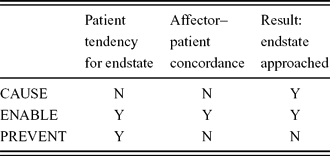
From a force dynamic perspective, the concept of CAUSE is one member of a family of concepts that also includes the concepts of ENABLE and PREVENT, among others. Each of these concepts represents an interaction between an affector and a patient (the entity acted on by the affector). As outlined in Wolff and Song (Reference Wolff and Song2003), different causal concepts can be distinguished with respect to three main dimensions. Specifically, as summarized in Table 1, the concepts of CAUSE, ENABLE, and PREVENT can be captured in terms of (i) the tendency of the patient for a result, (ii) the presence or absence of concordance between the affector and the patient, and (iii) progress toward a result. A patient's tendency toward the endstate is loosely defined as a physical or intentional inclination for a particular result. For example, objects tend to fall when they are knocked off shelves and people tend to drink when they are thirsty. Affector–patient concordance is defined as present when the actions of the affector facilitate, or at least do not oppose, the tendency of the patient. Finally, a patient will progress towards a result when the resultant force that is produced by the interaction of the patient and affector pushes the patient towards a particular result.
Representations of CAUSE, ENABLE and PREVENT in the dynamics model (Wolff, Reference Wolff2007).
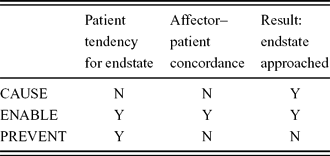
Y = Yes, N = No
The semantics of these three dimensions is illustrated by the sentences in (2) below. Consider the example of causation in (2a). In this sentence, the patient (the tree) does not have a tendency for the endstate (falling down). The affector (high wind) is not in concordance with the patient and the result occurs. In enabling situations, as in (2b), the tendency of the patient (the bridge) is for the result (to hold weight). The affector (steel reinforcements) does not oppose the patient but rather facilitates the patient, and the result occurs. In preventing situations, as in (2c), the patient (the containers) has a tendency for the result (falling off the truck). The affector (the chains) opposes the tendency of the patient and the result does not occur.
- (2)
a. High winds caused the tree to fall down.
b. Steel reinforcements enabled bridge to hold more weight.
c. Chains prevented the containers from falling off the truck.
The dynamics model makes a number of predictions. For example, it predicts that the concepts of CAUSE, ENABLE and PREVENT should be similar to each other in meaning since each concept shares one feature in common with each other concept: CAUSE and ENABLE both specify progress towards the endstate; ENABLE and PREVENT both specify patients with a tendency for the endstate; CAUSE and PREVENT both specify a lack of concordance. Wolff and Song (Reference Wolff and Song2003) tested the equal-similarity prediction by asking participants to sort twenty-three verbs expressing various kinds of causation into piles according to their similarity to one another. Multidimensional scaling indicated that these verbs fell into the three major categories: a CAUSE category (e.g., cause, force, get), an ENABLE category (e.g., allow, enable, help), and a PREVENT category (e.g., block, prevent, stop). Importantly, the verb clusters associated with each of these concepts were roughly equidistant from one another, just as predicted by the theory. The dynamics theory has also been tested and supported in a series of experiments in which people described animations generated from a physics simulator that instantiated the patterns of physical forces hypothesized for each causal concept (see Wolff and Zettergren, Reference Wolff and Zettergren2002; Wolff, Reference Wolff2007).
Expressions of causation in Russian and English
The dynamics model provides a set of distinctions for understanding the meanings of various causal expressions. Here we focus on the semantics of a particular kind of causal expression, periphrastic causative constructions (Baron Reference Baron1977; Cole Reference Cole1983; Radford Reference Radford1988; Kozinsky and Polinsky Reference Kozinsky, Polinsky, Comrie and Polinsky1993; Helms-Park, Reference Helms-Park2001; Wolff, Reference Wolff2003; Song and Wolff, Reference Song, Wolff, Achard and Kemmer2005). Periphrastic causative constructions are two-clause expressions that encode the notions of CAUSE and RESULT in different clauses. For example, in the periphrastic causative construction in (3), the main (matrix) verb (i.e. caused) expresses the notion of CAUSE while the embedded verb (i.e. open) expresses the particular RESULT.Footnote 1
(3) Alison caused the door to open.
Periphrastic causative constructions name two participants: the affector and the patient. In (3), the affector would be Alison and the patient, the door. In the literature on causative expressions, the affector is often referred to as the cause and the patient as the causee. We will use these two sets of terms interchangeably.
In English, there are approximately 50 verbs that can appear as the matrix verb in a periphrastic causative construction (Wolff and Song, Reference Wolff and Song2003). Several studies have shown that these matrix verbs fall into the three basic categories of causation posited by the force dynamic model: CAUSE-type verbs (see (4a)), PREVENT-type verbs, (4b), and ENABLE-type verbs, (4c) (Wolff et al., Reference Wolff, Song and Driscoll2002; Wolff and Song, Reference Wolff and Song2003).
- (4)
a. bribe (n/a), cause (vyzyvat’), compel
(prinuzhdat’), convince (ubezhdat’), drive (n/a),
have (n/a), impel (pobuzhdat’), incite
(podstrekat’), induce (pobuzhdat’), influence
(vliiat’), inspire (vdokhnovliat’), lead
(pobuzhdat’), move (pobuzhdat’), persuade
(ugovarivat’), prompt (vyzyvat’), push
(podtalkivat’), force (vynuzhdat’), get (n/a),
make (zastavliat’), rouse (podnimat’), send
(otpravliat’), set (n/a), spur (pobuzhdat’), start
(n/a), stimulate (stimulirovat’)
b. bar (pregrazhdat’), block (pregrazhdat’),
constrain (stesniat’), deter (sderzhivat’),
discourage (otgovarivat’), dissuade (otgovarivat’),
hamper (zatrudniat’), hinder (meshat’), hold
(zaderzhivat’), impede (prepiatstvovat’), keep
(n/a), prevent (predotvrashchat’), protect
(predokhraniat’), restrain (sderzhivat’), restrict
(ogranichivat’), save (spasat’), stop (uderzhivat’)
c. aid (pomogat’), allow (pozvoliat’), enable (davat’
vozmozhnost’), help (pomogat’), leave
(ostavliat’), let (pozvoliat’), permit (razreshat’)
Periphrastic causative constructions are also available in Russian. Rough translations of many of the verbs are provided in (4). Here, we focus on the rough translations of CAUSE and ENABLE verbs. In the case of CAUSE verbs, the closest translation of the verb make is zastavit’, and the closest translation of the verb force is vynudit’, though the verb force can also be translated with the verb zastavit’ (Katzner, Reference Katzner1994; Wheeler, Falla and Unbegaun, Reference Wheeler, Falla and Unbegaun1995). Example sentences using these two verbs are shown in (5).
- (5)
a.

b.

The closest translation for the verb cause is, perhaps, vyzvat’. However, unlike the other CAUSE verbs, vyzvat’ cannot be used as the matrix verb in a periphrastic causative expression, but rather is restricted to mono-clausal situations, as in (6).
- (6)
a.
b.
Russian also has rough translations of several English ENABLE verbs. The verbs allow and let are most closely translated by the verb pozvolit’. The closest translation of the verb enable is the verb phrase dat’ vozmozhnost’, which means “to give an opportunity”. The closest translations of the verbs help and permit are pomoch’ and razreshit’, respectively (Katzner, Reference Katzner1994; Wheeler et al., Reference Wheeler, Falla and Unbegaun1995).Footnote 2 Periphrastic causative constructions using ENABLE verbs are shown in (7).
(7)
Syntactic subjects in Russian and English
As shown above, many of the English periphrastic causative verbs have rough translations in Russian. In both languages, according to the dynamics model, the key difference between ENABLE and CAUSE constructions concerns whether or not the patient (or causee) has a tendency for the result. However, a careful examination of these causal constructions in the two languages reveals that the translations do not always refer to the same range of situations, as will be shown below. We suggest that this difference in semantics might be traced to a broader cross-linguistic difference in the types of entities that can appear in subject position.
According to Guilfoyle (Reference Guilfoyle, Carnie and Guilfoyle2000), there may be at least two kinds of languages with respect to permissible subjects (but see Alexiadou and Schäfer, 2006). Type A languages (like Dutch and Irish) restrict the subject position to entities that can initiate events. Practically speaking, subjects in Type A languages tend to be sentient, or at least “self-energetic”. Type B languages (like English) allow for a greater range of entities, including entities that not only initiate events but also merely participate in them. For example, one of the hallmarks of Type B languages is that they allow for so-called instrument subjects (e.g., the knife in The knife cut the bread) while Type A languages do not. On the basis of this diagnostic, we suggest that Russian is a Type A language. As noted by Comrie (Reference Comrie1981, p. 72–73), Russian is more restricted in its use of non-agentive subjects than is English. In support of this hypothesis, none of the sentences in (8), all of which include instrument subjects and are acceptable in English, can be directly translated into Russian.
(8)
Non-agentive subjects are sometimes acceptable in Russian, but they generally need to be natural forces that do, in fact, generate their own energy, as exemplified in (9).
(9)
This restriction on subjects should, in principle, extend to the main and embedded subjects of periphrastic causatives. Consistent with this prediction, when the causer in a periphrastic causative construction is non-sentient, the construction cannot be directly translated into Russian even though it is fully acceptable in English, as in (10).
(10)
Similarly, when the causee in a periphrastic causative construction is non-sentient, the construction cannot be translated into Russian either, even though it is fully acceptable in English, as in (11).Footnote 3
(11)
Occasionally, causers in a Russian periphrastic causative construction can be inanimate, but again, such exceptions appear to be limited to natural forces which are, by definition, capable of self-initiation, as in (12) and (13), respectively.
(12)
(13)
The Russian restriction on subjects applies to ENABLE constructions as well. As illustrated in (14), non-sentient causees in ENABLE constructions are acceptable in English but not in Russian.Footnote 4
(14)
The tendency hypothesis: how English and Russian causal expressions differ in meaning
According to what we will call the tendency hypothesis, semantic constraints regulating the distribution of subjects affect how causal situations are described and understood. In Russian, subjects appear to be restricted to entities that are sentient or self-energetic. This restriction may lead Russian speakers to focus on forces that are generated from within the cause or causee, such as the force generated by a car engine or the force initiated by a person's intention. In English, speakers may look for, and take into account, not only forces internal to the cause or causee but also other, external forces that may be present, for example, gravity, friction, or natural forces such as the wind. Since a periphrastic causative construction includes two subjects, restrictions on the subject can have consequences for both the cause and causee in such constructions. In Russian, the periphrastic causative construction may be limited to situations in which the actions of the causee are driven by forces that are internal to the causee, while in English the periphrastic construction may be used to describe situations in which the actions of the causee are driven by forces that are either internal or external to the causee. For example, in the sentence John caused Mary to break the window, the actions of the causee are those of Mary. According to the tendency hypothesis, a Russian translation of this sentence would imply that the act of breaking the window was generated by Mary. In English, this sentence might have this reading, but it could also mean that Mary's actions were due to an external force, such as John's pushing her into the window. We do not mean to imply that Russian speakers are insensitive to external forces; rather, that such forces are not considered when evaluating the forces associated with the cause and causee in a periphrastic causative construction, and by extension, the tendency of the causee.
The difference in meaning between internal and external causation is roughly captured by the difference in the meanings of the verb cause on the one hand and the verbs make and force on the other. In English, these verbs seem to differ somewhat in the extent to which external forces are considered when determining patient tendency. More specifically, we suggest that make and force are used to describe situations in which internal forces are given more weight; cause seems more appropriate for situations in which external forces also come into play. To illustrate, imagine a man suspended over a pool of water, a woman cuts a rope, and the man falls into the pool. We could say The woman caused the man to fall into the pool, but it sounds somewhat odd to say The woman made the man fall into the pool or The woman forced the man to fall into the pool. We suggest that cause is more appropriate in this case because the man's tendency to fall into the pool is completely due to the external force of gravity.
In Russian, it would be very odd to say The woman made the man fall into the pool (Zhenshchina zastavila muzhchinu upast’ v bassein) or The woman forced the man to fall into the pool (Zhenshina vynudila muzhchinu upast’ v bassein). Moreover, the equivalent of The woman caused the man to fall into the pool is not available in Russian. As noted above, the verb for cause in Russian, vyzvat’, cannot be used as the matrix verb in a periphrastic causative expression. According to the tendency hypothesis, this is because the tendency of the patient in a periphrastic causative construction in Russian is based on internal forces only, and as just noted above, the verb cause is used when external forces are seen to be involved. Probably the nearest translation of a periphrastic causative construction containing the verb cause would be a bi-clausal sentence with a causal conjunctive such as because as in The man fell into the pool because the woman cut the rope (Muzhchina upal v bassein potomy chto zhenshina pererezala verevku).Footnote 5
An interesting consequence of the tendency hypothesis is that Russian and English speakers may differ in the range of situations they describe as causal as opposed to enabling. Importantly, we propose that this difference is not due to differences in the meaning of CAUSE and ENABLE verbs in the two languages, but rather to the way the meanings of these verbs interact with the semantics of subjects in the two languages. To sum up, we propose that the types of subjects that are permissible in subject position may lead speakers to take into account different aspects of experience – internal or external forces – when determining how causal events are described.
Testing for differences in causal description
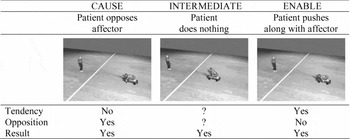
The tendency hypothesis makes predictions for how speakers of English and Russian will describe causal interactions. Consider the series of situations depicted in Figure 1. In each panel, a man holds a rope and pulls another man on a dolly across a line. In the panel on the far left, the man on the dolly resists by pushing the dolly backwards. According to the dynamics model, speakers of English should describe this interaction with a construction containing a CAUSE verb because the man on the dolly does not have a tendency for the result, the man pulling the rope opposes that tendency, and the result (crossing the line) occurs. Russian speakers should describe the situation in the same way: they should also view the patient as not having a tendency for the result because the force he is generating is directed away from the line.
Properties that distinguish different kinds of causal interactions associated with the stimulus materials used in Experiment 1.

In the panel on the far right, the man on the dolly pushes himself toward the line. The dynamics model predicts that English speakers should describe this interaction with a construction containing an ENABLE verb because, unlike in the first panel, the man on the dolly has a tendency for the result. Russian speakers are also expected to describe the scenario with an ENABLE verb because the tendency of the patient can be seen to be internally generated.
In the middle panel, the man on the dolly simply sits there. From an English speaker's perspective, the tendency of the man is potentially ambiguous. On the one hand, it might appear that he intends to cross the line since he is facing in the direction of the line. On the other hand, the dolly is physically difficult to pull and the man is only adding more weight to it, so there is no physical tendency to cross the line. According to the tendency hypothesis, English speakers viewing this scene could consider either the internal, or psychological, forces (i.e., the man's intentions) or the external, or physical, forces (i.e., friction). Depending on their focus, they could use either CAUSE or ENABLE to describe this situation. Russian speakers, in contrast, should focus on the forces internal to the man and, given the direction he is facing, should prefer to describe this situation with an ENABLE construction.
Consequences for the second language learner
Cross-linguistic differences in the semantics of subjects could lead to changes in the way second language learners describe causal events in their first language. Before describing how such effects might be manifested in the responses to the scenes in Figure 1, we will offer an account of why such influences might be expected to occur.
As described above, it is predicted that English and Russian monolingual speakers will differ in how they describe causal events and that this difference can be traced to a difference in the syntax–semantic interface of the two languages. The possibility that learning a second language might lead to changes in how a speaker describes causal events is supported by recent work showing that semantic criteria at the syntax–semantics interface can undergo change in the course of learning a second language. Such changes are exemplified by losses in the pragmatic principles licensing null subjects in Greek and Italian (Tsimpli et al., Reference Tsimpli, Sorace, Heycock and Filiaci2004), changes in the morpho-semantic knowledge that guides the encoding of grammatical aspect in Spanish (Montrul, Reference Montrul2004), and changes in the grammatical knowledge that governs pronominal binding in Turkish (Gűrel, Reference Gűrel and Schmid2004).
From a psychological perspective, this phenomenon of L2→L1 influence is supported by recent work on memory with respect to the phenomenon of retrieval-induced reconsolidation (Nader, Schafe and Le Doux, Reference Nader, Schafe and LeDoux2000; Walker et al., Reference Walker, Brakefield, Hobson and Stickgold2003; Alberini, Reference Alberini2005; Forcato et al., Reference Forcato, Burgos, Argibay, Molina, Pedreira and Maldonado2007).Footnote 6 The basic idea in retrieval-induced reconsolidation is that reactivation of a consolidated memory can result in memory traces becoming temporarily labile and susceptible to editing and modification. The phenomenon was elegantly demonstrated in a study by Walker et al. (Reference Walker, Brakefield, Hobson and Stickgold2003). Their study took place over three days. On day 1, participants in one condition learned a repeating five-element sequence that they typed out on a keyboard. On day 2, the same participants learned a different five-element sequence. On day 3, their memory for the first sequence was tested. The results showed that participants’ memory for the first sequence on day 3 suffered no interference from the second sequence (and actually improved). A very different pattern was observed in the second condition. On days 1 and 2, participants in this condition also learned two five-element sequences. The key difference was that on day 2, the participants briefly practiced the sequence from day 1 before learning the second sequence. On day 3, their performance on sequence 1 fell dramatically. The brief practice on day 2 apparently reactivated the memory for sequence 1 and rendered it susceptible to interference from the second sequence. A similar set of findings was observed in Forcato et al. (Reference Forcato, Burgos, Argibay, Molina, Pedreira and Maldonado2007) with respect to items in declarative (as opposed to procedural) memory.
In the context of second language learning, the implication of retrieval-induced reconsolidation is that the first language may be susceptible to change when elements in the L2 reactivate their analogs in the L1. It is interesting to note that retrieval-induced reconsolidation may be limited to direct (as opposed to indirect) reactivations of a memory trace. Memories that are merely associated with the memories being reactivated do not appear to become vulnerable to disruption or change (Debiec, Doyère, Nader and LeDoux, Reference Debiec, Doyère, Nader and LeDoux2006). Extending this finding to second language learning, it may be that the phenomenon of retrieval-induced reconsolidation is restricted to highly similar elements in the L1 and L2. Indeed, as noted by several researchers, similarity between L1 and L2 structures may be a necessary condition for the first language to have an effect on the second (Altenberg, Reference Altenberg, Seliger and Vago1991; Isurin, Reference Isurin2000; Köpke, Reference Köpke, Suarez, Ramallo and Rodiguez-Yanez2004, Reference Köpke and Köpke2007).
As discussed above, Russian appears to be more selective than English in the range of entities that can serve as syntactic subjects. In particular, in Russian, subjects may be restricted to entities that can generate internal forces while in English, the forces may be either internal or external. A native speaker of Russian learning English will, of course, produce and comprehend an innumerable number of expressions containing subjects. The grammatical role of subject in Russian is likely to be (implicitly) perceived as highly similar to the grammatical role of subject in English. In learning English, then, speakers of Russian may reactivate the semantic criteria associated with subjects in Russian. According to the mechanism of retrieval-induced reconsolidation, reactivation of these criteria will make them susceptible to modification. Over time, these criteria might change in a manner that makes them more like those in English; specifically, over time, the semantic conditions regulating subjects in Russian might be extended to include entities that act on other entities by virtue of external forces. Once the criteria for subjects change, the way Russian bilinguals describe causal situations will likely change as well. In particular, Russian bilinguals should be more likely than Russian monolinguals to describe ambiguous situations (like the one depicted in the middle panel of Figure 1) with a CAUSE construction. This prediction, along with the predictions derived for English and Russian monolinguals, was tested in the experiment described in the following section.
Experiment 1
Russian monolinguals, English monolinguals, and Russian–English (L1 = Russian) bilinguals viewed and described the 3D animations depicted in Figure 1. We predicted that all groups would describe the animations at the far left and far right with a CAUSE verb (make/zastavit’) and an ENABLE verb (let/pozvolit’), respectively. For the intermediate animation, we predicted that English monolinguals would prefer make/zastavit’ while Russian monolinguals would prefer let/pozvolit’. Finally, we predicted that Russian bilinguals would differ from the Russian monolinguals in the direction of the English monolinguals, even when describing the animations in Russian.
Methods
Participants
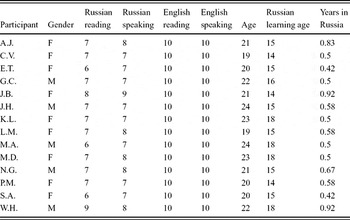
The participants were 16 English monolinguals attending the University of Memphis, 16 Russian monolinguals (11 living in Moscow and 5 living in Memphis), and 16 Russian–English bilinguals (L1 = Russian; 14 living in San Francisco and 2 living in Memphis). Russian monolinguals and Russian–English bilinguals rated themselves on their ability to read English, speak English, read Russian and speak Russian on a 0–10 point scale. On this scale, 0 designated extremely low and 10, extremely high. Participants also indicated their gender, current age, the age at which they began to learn English in school, the number of years they had been in the United States and their highest degree obtained.
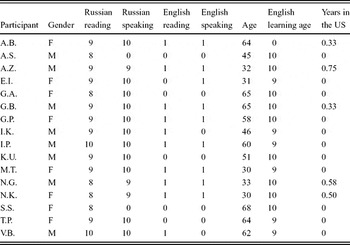
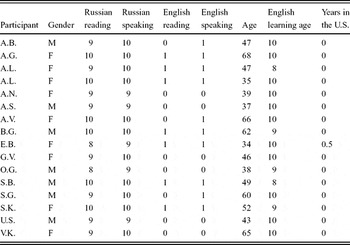
Table 2 lists the information provided by the Russian monolinguals. Fifty percent of the participants were male. The mean age was 50.25. All of the participants had at least a Bachelor's degree and had lived their entire life in Russia, except for five individuals who had just moved to Memphis (see below). The participants’ exposure to English was very limited. It is a common requirement in Russia that schoolchildren study a foreign language for at least four years, usually English. Instruction begins in the fourth grade and involves language courses that meet twice a week for 45 minutes. The instruction is geared towards reading comprehension rather than verbal or written communication. There is no foreign language requirement in college, unless it is the person's major, or the student is in the Arts and Sciences and is working towards his/her Ph.D. Given that the average age was 50, the average number of years after receiving limited exposure to English was 37 years. As shown in Table 2, all of the Russian monolinguals described their ability to read and speak in English as extremely low. The monolingual Russians were friends and relatives of the second author's grandparents.
Characteristics of the Russian monolinguals that participated in Experiment 1.

Five of the Russian monolinguals had recently moved to Memphis. These participants had a mean age of 44.8 years and had been in the United States for between four and nine months. None of the participants had used English since 13 years of age. The participants did not have sufficient English skills to be employed in the US. Three of the participants were stay-at-home wives or mothers. The remaining participants, both men who were 64 and 65 years of age, moved to the US to help their children. Their exposure to English was quite limited: at home they spoke in Russian, watched Russian news channels on TV, and bought groceries at the local ethnic food store. All five participants rated their English skills as extremely low. It is for these reasons that these participants were classified as monolinguals.
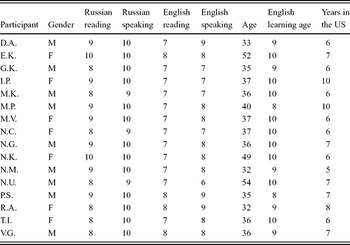
The average age of the Russian bilinguals was 38.56 years old. Fifty-six percent were male. The majority of the bilinguals lived in a Russian-speaking community where they spoke Russian everyday but also had jobs (mostly programming) where they used English. None of the bilinguals began learning English before the age of 8 years. Their average number of years in the US was 6.89. Their average self-rated English reading and speaking ability was 7.5, and their average self-rated Russian reading and speaking ability was 9.2. Table 3 lists the information provided by the Russian bilinguals. The bilinguals’ self-ratings suggest that they were fluent or near-fluent in both English and Russian.
Characteristics of the Russian–English bilinguals that participated in Experiment 1.

Materials
The materials were the three animations depicted in Figure 1. The animations were approximately 300 frames in length and ran at 30 frames/second (approximately 10 seconds long). The animations were made with an animation package called Discreet 3D Studio Max version 4. The sentences in English used the CAUSE verb make and the ENABLE verb let. The Russian sentences used rough translations of these two verbs: zastavit’ “make” and pozvolit’ “let/allow”.
Procedure
The animations were presented in random order on Windows-based computers. After each animation, participants chose which one of two sentences best described the animation. Specifically, English speakers chose from the sentences The man in red made the man in green cross the line and The man in red let the man in green cross the line while Russians (monolinguals and bilinguals) chose from the rough translations of these sentences, 


 . If participants felt that neither sentence described the scene, they could choose the option “none of the above” (=“

 ”). Participants indicated their answers by clicking a radio button next to their choice.
The English monolinguals were tested in a lab setting at the University of Memphis. In contrast, the Russian monolinguals and bilinguals were tested in a home setting by the second author. In the case of the Russian bilinguals in particular, the entire experiment was conducted in Russian and began with an extended conversation in Russian to assure that the bilingual was in a Russian ‘mode’ (Grosjean, Reference Grosjean and Nicol2001).
Results and discussion
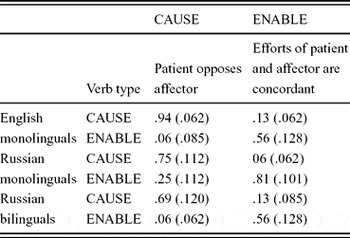
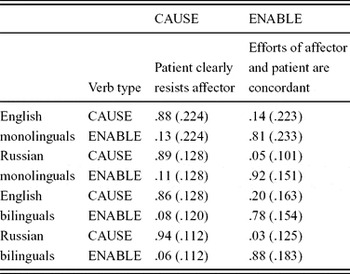
The results were consistent with the predictions. As shown in Table 4, when the patient clearly did not have a tendency for the result, English and Russian mono- and bilinguals used the CAUSE verb. When the patient clearly did have a tendency for the result, all participants used the ENABLE verb. Thus, the situations that were predicted to elicit similar descriptions from the speakers of all three language groups did just that.
Proportion of times the CAUSE and ENABLE sentences were chosen for the two ends of the CAUSE–ENABLE series in Experiment 1 along with associated standard errors of the mean.

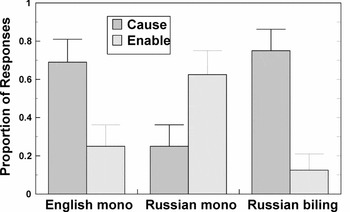
Of primary interest was how the speakers of each group would describe the intermediate situations, in which the tendency of the patient was unclear and the patient showed no sign of being able to accomplish the event on his own (see Figure 2). For these scenes, monolingual English speakers used a CAUSE verb while monolingual Russian speakers used an ENABLE verb. Most interestingly, the Russian–English bilinguals patterned like monolingual English speakers despite the fact that they performed the task in Russian. Specifically, Russian–English bilinguals described the intermediate scene with an ENABLE verb, consistent with the hypothesis that learning a second language can lead to changes in the syntax–semantic interface in the first language.
Proportion of times the CAUSE and ENABLE sentences were chosen for the intermediate animation with associated standard errors of the mean in Experiment 1.

The conclusions described above were supported by analysis of variance. Participants were more likely to use a CAUSE verb (make/zastavit’) for the animation in which the patient pushed away from the endstate (M = .79, SD = .410) than for the animation in which the patient pushed toward the endstate (M = .15, SD = .357), F(1,45) = 44.63, p < .005. Focusing still on participants’ CAUSE descriptions, there was an unpredicted overall effect of language group, F(2,45) = 3.316, p < .045; however, Bonferroni post-hoc tests failed to show any significant differences between any two language groups. The interaction between language group and scene type (CAUSE vs. ENABLE) was also non-significant, F(2,45) = .882, p = .421. A similar pattern of results was obtained when considering participants’ use of the ENABLE verb, let/pozvolit’. Participants were more likely to use an ENABLE verb for the animation in which the patient pushed toward the endstate (M = .64, SD = .483) than for the animation in which the patient pushed away from the endstate (M = .13, SD = .334), F(1,45) = 42.04, p < .005. No other effects were significant for the animations at the ends of the CAUSE–ENABLE series.
While the three language groups responded similarly to situations where the patient pushed away from or towards the endstate, differences emerged with respect to the intermediate situation, in which the patient simply sat on the dolly. Figure 2 shows the proportion of times that English and Russian monolinguals and Russian–English bilinguals chose the CAUSE and ENABLE sentences for this animation.
Participants’ use of CAUSE descriptions differed across the language groups, F(2,45) = 72.42, p < .005. Planned comparisons revealed that English monolinguals (M = .69, SD = .479) were more likely than Russian monolinguals (M = .25, SD = .447) to describe the intermediate situation with a CAUSE description, p = .01. This difference supports the hypothesis that the verbs make and zastavit’ differ in the range of situations they can describe. Similarly, participants’ use of ENABLE descriptions differed across the language groups, F(2,45) = 28.23, p < .01. Planned comparisons revealed that Russian monolinguals (M = .63, SD = .500) were more likely than English monolinguals (M = .25, SD = .447) to describe the intermediate situation with an ENABLE description, p = .019. This difference supports the hypothesis that the verbs let and pozvolit’ also differ in the range of situations that they can describe.
Having established that speakers of Russian and English differ in their descriptions of causal situations, we turn to the question of whether learning a second language affected the bilinguals’ descriptions of causation in their first language. Indeed, as predicted, planned comparisons indicated that the Russian bilinguals (M = .75, SD = .447) were more likely than Russian monolinguals to describe the intermediate animation with the CAUSE sentence, p = .003. Planned comparisons also indicated that Russian bilinguals (M = .12, SD = .342) were less likely than Russian monolinguals to describe the intermediate animation with the ENABLE sentence, p = .002. In sum, the difference between these two groups suggests that learning English may have led to an extension of the meaning of the Russian construction containing the CAUSE verb zastavit’. The change can be explained in terms of retrieval-induced reconsolidation. When Russians learn English, the semantic constraints on possible subjects in their L1 may loosen due to their reactivation while learning English such that the semantics of subjects in their L1 more closely resembles the semantics of subjects in their L1, English. As a consequence, Russian bilinguals’ choice of CAUSE and ENABLE verbs will change in the direction of English.
The results suggest that the semantic system of the Russian bilinguals changed. However, it is possible that the results of this experiment might be limited to the particular verbs that were considered, make/zastavit’ and let/pozvolit’. To the extent that the results reported above are due to a change in the syntactic–semantic interface, the pattern should generalize to other verbs and to a wider range of scenarios. In addition, to the extent that the change in the Russian bilinguals’ first language was due to retrieval-induced reconsolidation, it should be possible to change the semantics of subjects in the other direction. When a native English speaker learns CAUSE and ENABLE verbs in Russian, they might retract the range of situations described by CAUSE verbs and expand the range of situations described by ENABLE verbs in English. This follows because, without further assumptions, retrieval-induced reconsolidation allows for both broadening and narrowing of semantic criteria.Footnote 7 These various possibilities and predictions were addressed in the second experiment, described in the following section.
Experiment 2
In Experiment 2, the materials and procedures were the same as in Experiment 1, except that there were four language groups (English and Russian monolinguals, and Russian–English and English–Russian bilinguals); four series of animations instead of one; and the sentence choices were based on two different CAUSE (make/zastavit’ and force/vynudit’) and ENABLE verbs or verb phrases (help/pomoch’ and enable/dat’ vozmozhnost’) each instead of one. Three of the four sets of animations depicted interactions between two sentient entities. However, one set of animations depicted an interaction between two non-sentient entities (i.e., a boat and a fan). As discussed in the introduction, it appears that Russian periphrastic causative constructions are largely restricted to interactions between sentient entities. We anticipated that the sentences for the last set of animations would sound odd in Russian. This set was included nevertheless to see whether the results for this type of interaction would pattern like those in which the two entities were sentient. As in Experiment 1, we predicted that the four language groups would describe the two ends of the CAUSE–ENABLE series in the same way but would differ on the intermediate animations. In particular, we predicted that Russian bilinguals would describe the intermediate animations like English monolinguals, replicating one the main findings of the previous experiment. In addition, we predicted that the English bilinguals would describe the intermediate animations like Russian monolinguals, thereby providing evidence in support of the view that changes in the L1 are driven by retrieval-induced reconsolidation.
Methods
Participants
The participants were 16 English monolinguals attending the University of Memphis, 16 Russian monolinguals (15 living in Moscow and one living in Memphis), 16 highly proficient Russian–English bilinguals (L1 = Russian) living in San Francisco and 14 moderately proficient English–Russian bilinguals (L1 = English) living in Moscow. As in Experiment 1, participants rated themselves on their ability to read English, speak English, read Russian and speak Russian on a 0–10 point scale in which 0 designated extremely low and 10 designated extremely high. Participants also indicated their gender, current age, the age at which they began to learn English in school, the number of years they had been in the United States and their highest degree obtained. The Russian monolinguals and Russian–English bilinguals were different from those tested in Experiment 1.
Table 5 lists the information provided by the Russian monolinguals, who were recruited by the second author's grandparents. The average age was 48.25 and 56% were females. As in Experiment 1, all of the participants had at least a Bachelor's degree and had lived their entire life in Russia, except for one individual who had moved to Memphis 6 months earlier. Exposure to English was extremely limited for all of the participants and based on English classes taken between 9 and 13 years of age. As shown in Table 5, all of the Russian monolinguals described their ability to read and speak in English as extremely low.
Characteristics of the Russian monolinguals that participated in Experiment 2.

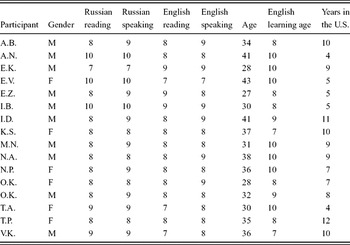
Table 6 lists the information provided by the Russian–English bilinguals. These bilinguals were living in a Russian community in San Francisco and had jobs in which they had to use English. The average age of the participants was 34.19 and 32% were female. Most of the bilinguals were programmers. The average number of years that they had been in the US was 7.8. Their average self-rated English reading and speaking abilities were 8 and 8.3, respectively. Their average self-rated Russian reading and speaking abilities were 8.4 and 8.8, respectively.
Characteristics of the Russian–English bilinguals that participated in Experiment 2.

Table 7 lists the information provided by the English–Russian bilinguals. The average age of the participants was 21.36 and 64% were female. These bilinguals were students at Moscow State University. They took classes every day in Russian and lived with families who did not speak English. However, because of the large number of English speakers at the school, the English bilinguals maintained regular use of English. Their average number of years in Russia was 0.6 (7.2 months). Their average self-rated English reading and speaking ability was 10, and their average self-rated Russian reading and speaking ability was 7.24.
Characteristics of the English–Russian bilinguals that participated in Experiment 2.

Materials
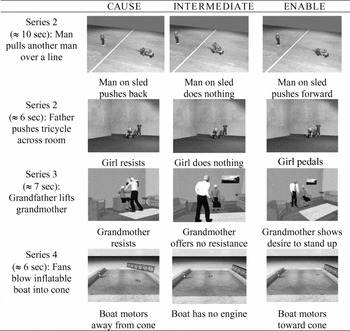
Twelve animations were used to create four CAUSE–ENABLE series. One of the series (Series 1) was the same as in Experiment 1 (see Figure 1 above). The remaining series are shown in Figure 3 along with descriptions and average lengths. For each of the intermediate animations, the patient did not initiate any action and did not move until acted upon.
The four series of animations used in Experiment 2 along with average lengths and descriptions of what occurred.

Procedure
Participants viewed twelve randomly-ordered animations. After each animation, they chose which of two possible sentences (or “none of the above”) best described the occurrence. For CAUSE sentences, the matrix verb was either make/zastavit’ or force/vynudit’ while for ENABLE sentences, the matrix verb was either help/pomoch’ or for the verb enable, the verb phrase dat’ vozmozhnost’ (literally, “to give an opportunity”). Sample Russian and English sentences used in this experiment are listed in the Appendix. Participants clicked a radio button on the computer screen to indicate their choice.
As in Experiment 1, the English monolinguals were tested in a lab setting at the University of Memphis and the Russian monolinguals and bilinguals were tested in a home setting. The English bilinguals were tested in their school. In the case of the Russian and English bilinguals in particular, the entire experiment was conducted in their first language and was preceded by an extended conversation in their first language in an attempt to establish the relevant language mode.
Results and discussion
The findings replicated the results from the first experiment with a wider range of scenarios and verbs. In particular, the findings provide further evidence that expressions encoding the notions of CAUSE and ENABLE differ across languages and that learning a second language can lead to changes in the meanings of these expressions not only in Russian but also in English.
Table 8 shows the proportion of times that all four language groups chose the CAUSE and ENABLE sentences for animations at opposite ends of the CAUSE–ENABLE series. As can be seen, there was an effect of scene type: participants were more likely to use expressions with CAUSE verbs (make/zastavit’ or force/vynudit’) for the animations in which the patient pushed away from the endstate (M = .89, SD = .154) than for animations in which the patient pushed towards the endstate (M = .11, SD = .171), across both participants, F p(1,60) = 942, p < .005, and items, F i(1,24) = 190, p < .005. There was also an interaction between language group and scene type that was significant across participants, F p(3,60) = 4.75, p < .01, but not items, F i(3,24) = .695, p = .564. This interaction reflects the relatively uninteresting finding that the size of the effect of scene type differed across languages. Importantly, though, the effect of scene type was present for all four language groups. No other effects were significant.
Percentage of times the CAUSE and ENABLE sentences were chosen for the two ends of the CAUSE–ENABLE series in Experiment 2 along with associated standard errors of the mean.

A similar pattern of results was obtained when considering participants’ use of expressions containing ENABLE verbs or verb phrases, help/pomoch’ or enable/dat’ vozmozhnost’. Participants were more likely to use expressions containing ENABLE verbs for animations in which the patient had a tendency for the endstate (M = .85, SD = .187) than for animations in which the patient did not have a tendency for the endstate (M = .09, SD = .151), across both participants, F p(1,60) = 653, p < .005, and items, F i(1,24) = 177, p < .005. No other effects or interactions were significant.
In sum, the results indicate that all four groups of speakers strongly preferred CAUSE sentences to describe animations in which the patient pushed away from the endstate (opposing the affector) and ENABLE sentences for animations in which the patient pushed toward the endstate (in concordance with the affector). These results provide further evidence that the notions of CAUSE and ENABLE are clearly distinguished in both English and Russian. The results also indicate that participants in all four groups viewed the animations as reasonably good examples of the categories of CAUSE and ENABLE since the sums of all responses for each animation was close to or at 100 percent, indicating that participants rarely chose “none of the above”.
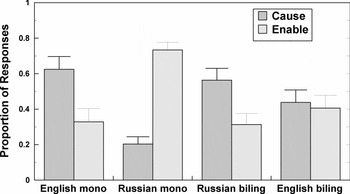
While all of the participants agreed on how to describe the ends of the CAUSE–ENABLE series, differences appeared for the intermediate situations in which the patient had an ambiguous tendency and showed no initiative. Figure 4 shows the percentage of times that English and Russian monolinguals and Russian–English and English–Russian bilinguals chose CAUSE and ENABLE sentences for the intermediate animations in the four series.
Proportion of times the CAUSE and ENABLE sentences were chosen for the intermediate animations in Experiment 2.

Focusing on the intermediate animations, participants’ use of CAUSE descriptions for the different language groups differed significantly across participants, F p(3,60) = 8.68, p < .005, while there was only a statistical tendency across items, F i(3,12) = 3.03, p = .071. Planned comparisons revealed that English monolinguals (M = .63, SD = .289) were more likely than Russian monolinguals (M = .20, SD = .164) to describe the intermediate situation with a CAUSE description, across both subjects, p < .005, and items, p < .05. This difference supports the hypothesis that the meanings of the expressions containing the CAUSE verbs make/zastavit’ and force/vynudit’ differ across the languages. Participants’ use of ENABLE descriptions for the different language groups mirrored that of CAUSE descriptions. ENABLE descriptions for the different language groups differed significantly across participants, F p(3,60) = 9.45, p < .005, and items, F i(3,12) = 4.36, p = .027. Planned comparisons revealed that Russian monolinguals (M = .734, SD = .170) were more likely than English monolinguals (M = .328, SD = .299) to describe the intermediate situation with an ENABLE description, across both subjects, p < .005, and items, p < .01. This difference supports the hypothesis that the meanings of the ENABLE verbs help/pomoch’ and enable/dat’ vozmozhnost’ differ across the languages.
In addition to showing that the meanings of causal expressions can vary across the languages, the results show how learning a second language can change the meaning of the causal expressions in one's first language. In particular, planned comparisons indicated that the Russian bilinguals (M = .563, SD = .266) were more likely than the Russian monolinguals to describe the intermediate animation with a CAUSE sentence, across both subjects, p < .005, and items, p < .05. Turning to ENABLE descriptions, planned comparisons indicated that Russian bilinguals (M = .313, SD = .250) were also less likely than Russian monolinguals to describe the intermediate animation with an ENABLE sentence, across both subjects, p < .005, and items, p < .05. The difference between the Russian bilinguals and monolinguals cannot be explained in terms of language since the Russian bilinguals performed the task in Russian, just like the Russian monolinguals. Rather, the difference between these two groups suggests that learning English changed the semantics of the CAUSE and ENABLE constructions. There was no evidence that Russian bilinguals differed from the English monolinguals in how they described the intermediate situations in terms of the proportion of CAUSE (p p = .49, p i = .48) or ENABLE (p p = .75, p i = .86) sentences chosen.
The influence of learning a second language on one's first language was also demonstrated in the case of the English–Russian bilinguals. Most tellingly, the English bilinguals (M = .44, SD = .281) chose CAUSE descriptions less frequently than did the English monolinguals, across participants p < .05, but not across items, p = .239. This result implies that the English bilinguals did not describe the intermediate scenes like English monolinguals, even though they performed the task in English. While the English bilinguals differed from the English monolinguals, they also differed from the Russian monolinguals. In particular, the English bilinguals described the intermediate scenarios with CAUSE descriptions more often than the Russian monolinguals, across participants, p < .05, but not across items, p = .148.
Whereas the Russian bilinguals differed from the Russian monolinguals and patterned like the English monolinguals, the English bilinguals did not pattern like either of the monolingual groups. This difference between the English and Russian bilinguals might be explained by the amount of time each group of speakers had spent in their second language setting. Whereas the Russian bilinguals had been living in the US for an average of 7.8 years, the English bilinguals had spent less than a year (M = 0.6 years) in Moscow. Thus, the pattern of results for the English–Russian bilinguals might represent a transition from an English to a Russian way of representing the meaning of causal expressions.
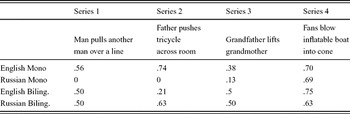
While there was consistency in how the speakers of the different language groups described the scenarios, there were also some differences. Table 9 shows the proportion of times participants used CAUSE descriptions to describe the intermediate situations broken down by language group and item. The table reveals that there were pronounced differences between the languages in Series 1–3. However, for Series 4, all language groups preferred to describe the intermediate scenario with a CAUSE description. Interestingly, this was also the only series of animations in which the interaction involved no sentient entities. The results suggest that the cross-linguistic differences in CAUSE and ENABLE expressions might be restricted to situations involving sentient entities, or entities that are capable of initiating and carrying out the result on their own.
Proportion of responses to the intermediate scenarios where people chose the CAUSE responses broken down by language group and item.

Overall, the pattern of results in Experiment 2 closely mirrored the pattern observed in Experiment 1. In Experiment 1, the CAUSE verbs were make and zastavit’ and the ENABLE verbs were let and pozvolit’ while in Experiment 2, the CAUSE verbs were make/zastavit’ and force/vynudit’ and the ENABLE verbs or verb phrases were help/pomoch’ and enable/dat’ vozmozhnost’. The replication of the results from Experiment 1 indicates that the results from both experiments are not specific to the particular verbs used in each experiment. Further analyses of the results from Experiment 2 revealed that the pattern of results was the same for both types of CAUSE and ENABLE expressions. Thus, the results appear to reflect a phenomenon that concerns groups of verbs rather than individual lexical items.
General discussion
The results from this research suggest that the meaning of causal expressions can differ across languages. In both Experiment 1 and Experiment 2, English and Russian monolinguals differed in their use of CAUSE and ENABLE constructions in describing ambiguous events. The results also suggest that such cross-linguistic differences can lead to changes in the bilingual's first language. In both Experiment 1 and Experiment 2, bilinguals’ descriptions of causal events in their first language differed from those of monolinguals for the same events and changed in the direction of their second language.
Internal versus external causation
According to the tendency hypothesis, the types of entities that can appear as subjects may lead speakers to focus on different aspects of an event when deciding how the event can be described. Specifically, if the language restricts the subject position to entities that are self-energetic (as in Russian), then the tendency of the patient (or causee) may be evaluated only with respect to forces that are generated within the patient. When entities in the subject position are not so restricted – as in English – speakers may look for, and take into account, not only forces internal to the patient, but also external forces that may be present (e.g., gravity, friction).
It is potentially interesting to contrast the tendency hypothesis with Levin and Rappaport Hovav's (Reference Levin and Rappaport Hovav1995) hypothesis about the difference in meaning between unergative and unaccusative intransitive verbs. According to Levin and Rappaport Hovav (Reference Levin and Rappaport Hovav1995), unaccusative verbs (e.g., melt, burn, break, open) describe happenings that are typically conceptualized as being brought about by external causes.Footnote 8 Unergative verbs (e.g., laugh, run, dance, sneeze), in contrast, describe happenings that are conceptualized as being brought about by internal causes. The relationship between Levin and Rappaport Hovav's (Reference Levin and Rappaport Hovav1995) hypothesis and the tendency hypothesis concerns different parts of a causal event. As frequently noted, sentences denoting causal relations often imply the occurrence of two events: a causing subevent and a resulting subevent (Dowty, Reference Dowty1979; Levin and Rapoport, Reference Levin and Rapoport1988; Jackendoff, Reference Jackendoff1990; Van Valin, Reference Van Valin1990; Croft, Reference Croft1991; Pustejovsky, Reference Pustejovsky1991, among others). Levin and Rappaport Hovav's (Reference Levin and Rappaport Hovav1995) distinction between internal and external causation concerns the resulting subevent, that is, whether the change of state is driven by internal or external forces. The tendency hypothesis, on the other hand, concerns the causing subevent described by the embedded clause. For example, in the sentence John made Mary open the window, the causing subevent in the embedded clause would be Mary's actions. This sentence is acceptable in Russian because, according to the tendency hypothesis, the patient in a periphrastic causative construction in Russian must be able to initiate its own actions. In contrast, Kathy caused the rock to fall is not acceptable in Russian because rocks cannot initiate their own actions.
Where the constraint on subjects might come from
According to Levin and Rappaport Hovav (Reference Levin and Rappaport Hovav1995), whether a change of state is internally or externally caused is part of the meaning of the verb. In contrast, constraints on subjects are probably not specified in the lexicon. According to Guilfoyle (Reference Guilfoyle, Carnie and Guilfoyle2000), from the perspective of generative grammar, the difference between Type A and Type B languages is specified in the syntax. Specifically, she suggests that in Type A languages, the external argument raises to the specifier of TP (Tense Phrase), which allows the entity to be checked for time (i.e., whether it is the initiator of the event). In Type B languages (like English), the external argument raises to the specifier of AgrS (Subject Agreement), in which case the subject entity is only checked for its being a participant in the event.
An alternative – though not necessarily mutually exclusive – possibility is that the constraints on subjects are not specified directly, but rather arise as an emergent property of various other properties of the language. A proposal of this type is suggested by Hawkins (Reference Hawkins1985).Footnote 9 Hawkins’ main interest was in contrasting English and German, but his insights extend to Russian. Russian, like German, has a rich case system which allows for freedom in word order (Thompson, Reference Thompson1977). English, on the other hand, has only the last vestiges of a case system and, as a consequence, has a more fixed word order than either Russian or German. Fixed word order presents a potential problem for language understanding since principles of pragmatics (e.g., given/new organization) often favor changes in word order. One way a language with fixed word order can satisfy the needs of pragmatics is to allow for a wider range of entities in the subject position. Thus, in languages where word order is relatively fixed, like English, the range of entities that can appear in the subject position will likely be greater than in languages where grammatical relations are marked. It may be for this reason, then, that languages like English, but not Russian, allow for instrumental subjects and causees that are non-sentient.
What changes in the second language learner
A common view in second language acquisition research is that the interaction between the first and second languages shifts over the course of acquisition (see Schmid and Köpke, Reference Köpke and Köpke2007). Initially, learners may manifest instances of L1 influence in their L2 (forward influence). Such influences fade, however, as the learner develops proficiency in the L2. In more advanced stages of bilingualism, the direction of influence can change and the second language can have an impact on the first language (backward influence). Schmid and Köpke (Reference Köpke and Köpke2007) challenge this account in arguing that the direction of influence is bi-directional, at least in the advanced stages of bilingualism. Schmid and Köpke's (Reference Schmid, Köpke and Köpke2007) proposal is compatible with the mechanism of change offered in this paper. The process of retrieval-induced reconsolidation can work in either direction: elements in the L2 can reactivate elements in the L1 and lead to change in the L1, or elements in the L1 can reactive elements in the L2, leading to change in the L2. The direction of this change may depend on the bilingual's “language mode” (Grosjean, Reference Grosjean and Nicol2001). As noted by Schmid (Reference Schmid and Köpke2007), there are a variety of potential language modes a bilingual might engage in. For example, some bilinguals might find themselves in communities consisting of both L1 and L2 speakers in which codeswitching is frequent and the chance of retrieval-induced reconsolidation is raised. In other situations, bilinguals might interact mostly with monolinguals from either their first or second language, which might promote a monolingual mode in which switches and mixing are avoided, and the chance of retrieval-induced reconsolidation is lowered (see also Köpke, Reference Köpke and Köpke2007). In sum, the likelihood of the occurrence and direction of the language influence will likely depend on the language environment, which will influence the language modes that bilinguals engage in.
Evidence that influence can occur in both directions was obtained in a recent study by Marian and Kaushanskaya (Reference Marian and Kaushanskaya2007). The authors examined lexical borrowing and semantic and syntactic transfer in Russian–English bilinguals. Participants were asked to describe an event from their life in either their first or second language. Overall, bilinguals were more likely to make L1 → L2 transfers (than L2 →L1 transfers) when the concepts were purely semantic. For example, when speaking in English, the bilinguals made statements like I was very hungry and was happy to see the table. In Russian such a statement is acceptable since the word for table, stol, can mean either the actual table or the food on the table. In contrast, their L2 → L1 transfers tended to be syntactic. Many of these syntactic transfers most likely involved accompanying semantic information, so they were probably similar to those observed in the studies reported in this paper. Hence, while transfer might occur in either direction, L2 → L1 influence might be more common for semantics at the syntax–semantics interface than for semantics in the lexicon.
Second language influence versus attrition
When transfer occurs from L2 to L1, it can result in changes that might be construed as instances of language attrition. As noted by Köpke (Reference Köpke, Suarez, Ramallo and Rodiguez-Yanez2004), the notion of language attrition has been defined in many ways, but most definitions imply an L2 influence on the L1 that leads to a negative change, including a decline or loss of language ability or competence. The changes described in our paper could be described as attrition in the sense that the bilinguals’ judgments deviated from the standards set by monolinguals. However, such deviations do not seem overly negative, just different. It is for this reason that we have followed researchers such as Cook (Reference Cook and Cook2003) and Pavlenko (Reference Pavlenko and Cook2003, Reference Pavlenko and Schmid2004) by referring to these changes as exemplifying L2 → L1 influence rather than language attrition (see also Hohenstain, Eisenberg and Naigles, Reference Hohenstain, Eisenberg and Naigles2006; Marian and Kaushanskaya, Reference Marian and Kaushanskaya2007).
An even more precise characterization of the phenomena observed in this paper can be provided given Pavlenko's (Reference Pavlenko1999, Reference Pavlenko2002, Reference Pavlenko and Cook2003, Reference Pavlenko and Schmid2004) framework for describing types of language change. According to Pavlenko, transfer from the L2 to the L1 can take the form of “borrowing” of L2 elements that may be lacking in the L1, “restructuring” via the deletion or incorporation of L2 elements into the L1; “convergence” of elements from the L1 and L2 into a single integrated system; “shifting” of the L1 structures or values in the direction of L2 structures or values; and “attrition”, whereby L1 elements are permanently lost due to the influence of the L2. In our studies, the apparent changes to the L1 can be viewed as exemplifying either restructuring or shifting. They can be viewed as restructuring because they apparently involved the deletion or incorporation of an L2 element into the L1, specifically, consideration of external forces. The findings can also be viewed as demonstrating shifting in that there was a move away from L1 values and boundaries toward those specified by the L2.
Consequences for the conceptual system
One of the key findings in this research is that Russian bilinguals differed from Russian monolinguals in their descriptions of scenes depicting ambiguous tendency even though both groups described the scenes in Russian. One possible interpretation of these results is that learning English not only changed the syntax–semantic interface in the Russian bilinguals’ L1, but maybe also influenced their underlying conceptual system. In effect, the results might be interpreted as providing support for at least one version of the Whorfian hypothesis (Whorf, Reference Whorf and Carroll1991/1950/1941). While we are sympathetic to this possibility, such a conclusion does not necessarily follow from the data.
If the conceptual and semantic systems are one and the same, the results from our experiments could be taken as supporting a change at the conceptual level. However, as pointed out by several theorists, the semantic and the conceptual do not constitute a single system (Pinker, Reference Pinker1994; Levinson, Reference Levinson, Pederson and Nuyts1997; Pavlenko, Reference Pavlenko1999; Jackendoff, Reference Jackendoff2002). One reason for distinguishing these systems is that word meanings are ambiguous in a way that concepts are not (Pinker, Reference Pinker1994; Levinson, Reference Levinson, Pederson and Nuyts1997). For example, if we say The paper is on the desk we might be referring to a newspaper, an individual sheet of paper, a pile of shredded paper, or an important document. In a given situation, the correct referent may be known without ambiguity, despite the ambiguity of the sentence. Another reason for separating the two systems is that people can have thoughts without having the words to express those thoughts (Pinker, Reference Pinker1994). There are very strong reasons to believe that infants, for example, have many concepts well before they have the words to express them (for a review, see Bowerman, Reference Bowerman, Gumperz and Levinson1996). With respect to causation, in particular, several studies have shown that the first notions of causation appear relatively early in development (for a review, see Cohen, Amsel, Redford and Casasola, Reference Cohen, Amsel, Redford, Casasola and Slater1998), well before the ability to describe causal relationships (Bowerman, Reference Bowerman, Wanner and Gleitman1982). Because of the difference between semantic and conceptual systems, linguists have taken pains to distinguish the concept of CAUSE from the verb cause (Fodor, Reference Fodor1970; Cruse, Reference Cruse1972; Dowty, Reference Dowty1979; Lakoff and Johnson, Reference Lakoff and Johnson1999) since the verb cause might include other abstract components of meaning besides CAUSE in its representation or differ from CAUSE in terms of its presuppositions (Dowty, Reference Dowty1979).
With respect to the present results, the chief reason why we cannot confidently assume that they indicate a change in the concept of CAUSE is that the dependent measure we used was linguistic. Because it was linguistic, we cannot tell whether the difference between the Russian monolinguals and bilinguals reflected a change in the conceptual system or only a change in the semantic system, that is, a change in the meaning of the periphrastic causative constructions containing the CAUSE and ENABLE verbs. To investigate a change in the conceptual system, we would need to use a non-linguistic dependent measure, such as memory for an event, reaction time to recognition, or some kind of similarity judgment.
A study of Indonesian–English bilinguals offers more direct evidence for how learning a second language might bring about a change at the conceptual level (Boroditsky, Ham and Ramscar, Reference Boroditsky, Ham and Ramscar2002). Indonesian differs from English in that it lacks tense marking. The authors predicted that this difference would correspond to differences in cognitive preference and performance in two non-linguistic tasks, namely, similarity judgments and memory for pictures. After establishing that English and Indonesian monolinguals differed in a similarity task, Boroditsky et al. (Reference Boroditsky, Ham and Ramscar2002) tested Indonesian–English bilinguals on the same task in two different language contexts. That is, one group of bilinguals was tested in Indonesian and the other group was tested in English. In general, the bilinguals’ performance corresponded to the language mode: they performed more like Indonesian monolinguals when tested in Indonesian than when tested in English and vice versa for the English testing condition. Likewise, in a matching task, Indonesian–English bilinguals tended to perform according to the language context of their test, exhibiting better memory for the time frame of an action when tested in English than in Indonesian. However, the bilinguals’ similarity ratings (task 1) in the Indonesian condition fell somewhat in between that of the Indonesian monolinguals and English speakers. The authors attribute this result to the bilinguals’ experience with English. This study is noteworthy because non-linguistic measures were used, allowing the authors to more directly access the conceptual system. With respect to the current study, the logical next step would be to examine whether any non-linguistic correlates accompany the linguistic shift.
Conclusion
Often, the words and constructions in one language differ in meaning from their rough translations in another language. Here we investigated the potential consequences of these differences in meaning for the semantic system of the bilingual. In two experiments we found evidence that Russian and English speakers have a common system for representing the semantics of causal expressions, as specified in the force dynamics model. However, it appears that speakers of Russian and English emphasize different aspects of experience when computing the components of meaning that differentiate different categories of causation. Our findings also suggest that learning a second language may lead people to focus on different aspects of experience when choosing and understanding causal expressions in their first language.