Introduction
Trace fossils, especially arthropod trackways and trails, provide evidence for the initial landfall of animals, and extend the stratigraphic range of key taxa involved in the transition. They also provide evidence for their walking techniques. Cambrian and Ordovician nonmarine ichnofaunas are particularly significant in terms of what they reveal about the earliest phases of the colonization of land. Although they might not reflect the establishment of permanent nonmarine biotas (Minter et al., Reference Minter, Buatois, Mángano, Davies, Gibling, MacNaughton and Labandeira2017), they are nonetheless significant.
The earliest trackways on dry land are from Middle-Late Cambrian (500 Ma) eolian deposits (Potsdam Group) of northern New York State, southeastern Ontario (MacNaughton et al., Reference MacNaughton, Cole, Dalrymple, Braddy, Briggs and Lukie2002; Hagadorn et al., Reference Hagadorn, Collette and Belt2011), and tidal flat deposits in Quebec and at Blackberry Hill, Wisconsin (Gass, Reference Gass2015; Braddy et al., Reference Braddy, Gass and Gass2022). Those trackways, 6–13 cm wide, with series of 7–11 tracks, and a medial impression, are assigned to Protichnites Owen, Reference Owen1852. Associated body impressions from Blackberry Hill indicate that the maker of the Protichnites from that locality was the euthycarcinoid (stem myriapod) Mosineia Collette and Hagadorn, Reference Collette and Hagadorn2010 (Edgecombe et al., Reference Edgecombe, Strullu-Derrien, Góral, Hetherington, Thompson and Koch2020). Molecular clocks suggest that myriapods diverged in the Cambrian, in line with the date of the fossils from Blackberry Hill.
Three-dimensionally preserved burrows, with a W-shaped backfill, from paleosols in Pennsylvania are cited as evidence for myriapod burrowing and animal-plant interactions (Retallack, Reference Retallack2001), although Davies et al. (Reference Davies, Rygel and Gibling2010) suggested that these rocks are not paleosols, but instead were deposited in the sea. Narrow myriapod trackways (Diplichnites Dawson, Reference Dawson1873) and tram-like trails (Diplopodichnus Brady, Reference Brady1947) from Cumbria, England (> 450 Ma) are attributed to myriapods moving around the margins of ponds in a volcanic landscape. New trails, recently discovered, indicate that they were preserved on rippled volcanic tuffs, by dying myriapods killed by the ash (Shillito and Davies, Reference Shillito and Davies2018). The suggestion that they were deposited in water, and that their variation is due to changes in speed, rather than sediment moisture content, is unlikely because trackway morphology is not time dependent, as opposed to the protraction period:retraction period gait ratio, which tends not to vary (Smith et al., Reference Smith, Braddy, Marriott and Briggs2003). Explanations of why myriapods moved onto land usually relate to the appearance of land plants in the Ordovician, which represents a major ecological shift.
Other arthropod groups had different reasons for moving onto land. Eurypterids, an uncommon (~250 species) group of Paleozoic (Middle Ordovician to late Permian), predatory aquatic chelicerates (Selden, Reference Selden1981; Tollerton, Reference Tollerton1989) that grew to 2.5 m long (Braddy et al., Reference Braddy, Poschmann and Tetlie2008) and lacked the adaptations necessary for terrestrial feeding—a preoral cavity, as in terrestrial arachnids. Aquatic predator evasion is a possibility (Trewin and McNamara, Reference Trewin and McNamara1995), with the land representing a safe refuge. Animals able to endure life on land would have had a selective advantage. The ability to periodically migrate into nonmarine settings or across land to reach restricted water bodies during spawning periods could have been the reason for eurypterids moving onto land. A ‘mass-molt-mate’ hypothesis has been proposed for eurypterids, whereby they migrated en masse into nearshore environments (e.g., lagoons) to molt and mate (Braddy, Reference Braddy2001a). This is supported by abundant accumulations of their molts (e.g., in the Bertie Waterlime), the occurrence of juveniles and their trackways in marginal settings (as described here), their reproductory and respiratory paleophysiology, and comparisons with living horseshoe crabs and semiterrestrial crustaceans (Braddy, Reference Braddy2001a; Vrazo and Braddy, Reference Vrazo and Braddy2011). Many amphidromous animals cluster together to maximize reproductive potential, e.g., the xiphosuran Limulus Müller, Reference Müller1785, a living relative of the eurypterids, which undertake seasonal mass migrations onto beaches along the eastern coast of the USA (Cheng et al., Reference Cheng, Chabot and Watson2016).
Fossil trackways of eurypterids include the largest arthropod-produced trace fossils in the fossil record (Briggs and Rolfe, Reference Briggs and Rolfe1983; Almond, Reference Almond2002; Whyte, Reference Whyte2005). Eurypterid trackways are generally rare and mostly monotypic, with the exception of Palmichnium antarcticum Gevers et al., Reference Gevers, Frakes, Edwards and Marzolf1971 (Draganits et al., Reference Draganits, Braddy and Briggs2001; Morrissey et al., Reference Morrissey, Braddy, Dodd, Higgs and Williams2011) that can occur in so-called veritable stamping grounds (Braddy, Reference Braddy2001a).
The earliest example of a eurypterid trackway on land is from the Middle Ordovician of New York State (Sharpe, Reference Sharpe1932). It is preserved on a desiccated surface of a mudflat (tidally influenced environment). This indicates that eurypterids were capable of amphibious excursions by at least the Middle Ordovician. Given its importance for our understanding of the ecology of early eurypterids, this trackway is redescribed here and its ichnotaxonomic and behavioral implications are assessed. It is interpreted as produced by a medium-sized stylonurid eurypterid, not a pterygotid as Sharpe (Reference Sharpe1932) suggested. The animal crawled up onto the shoreline, a physiologically stressful and dangerous task, so it must have served some purpose.
Geological setting
In the latter half of the Ordovician, a volcanic island arc collided with Laurentia causing the Taconic Orogeny, a mountain-building period that folded and eroded marine shales throughout northeastern America. The resulting sediments that were deposited in the Rondout Basin in the vicinity of Kingston, New York State, were called the Hudson River Shales but are now termed the Bushkill Shale of the Martinsburg Formation, a 3–4 km thick clastic wedge outcropping in the Hudson Valley, which probably equates to the lower part of the formation in Pennsylvania and New Jersey (Waines, Reference Waines1986). Structural complexities make correlation difficult. These Middle-Upper Ordovician strata comprise graded, occasionally conglomeratic, commonly tabular cross-laminated (sometimes also trough cross-bedded, indicating channeling) sandstones and shales that were deposited from the base of the slope of a delta that lay to the southeast, through to the lower, middle, and upper slope facies. An enlargement of the delta, with associated shallowing and molasse-like deposition, was a prelude to the Hudson Valley phase of the Taconian Orogeny that folded the sediments into the Marlboro Syncline during the late Ordovician. In eastern New York, the late Silurian Rondout Formation was deposited unconformably on top of the Middle Ordovician deposits, with the Upper Ordovician and early Silurian sediments absent. This ‘Taconic Unconformity’ is particularly well exposed at Hill (cement) Quarry, on the Vlightberg, a hill near Rondout, a suburb of Kingston, in New York State (Van Ingen and Clarke, Reference Van Ingen and Clark1902).
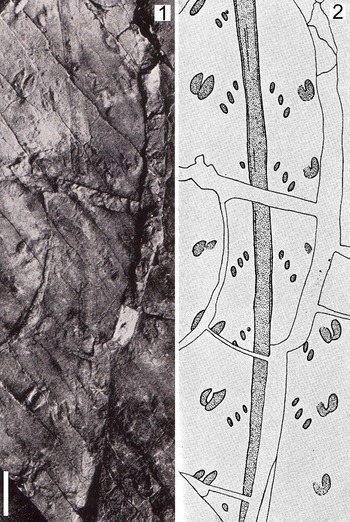
The trackway that is the subject of this study (Figs. 1, 2) was discovered in 1918 by Prof. J.J. Galloway near the southern side of the entrance to this quarry, where the overturned Hudson River Shales (Upper Chazyan/Mohawkian) are truncated by the unconformity. It was first described by Sharpe (Reference Sharpe1932); 1.8 m of exposed trackway was discovered, with one end < 2 m away from the unconformity! This trackway is preserved in hyporelief on the base of a medium-grained, drab-colored, thinly bedded sandstone, 4 cm thick, with molds of mudcracks, indicating subaerial exposure, as part of a mudflat. Ripple marks are also present on the surface and cross-bedding is apparent on the edge of the slab. Generally, conditions are unsuitable for the preservation of epigenic traces in the higher intertidal zone because they are prone to erosion. This trackway is only preserved because the mud baked hard in the sun. The trackway was actually produced in a mud layer shortly after it was exposed but before this surface was baked hard. Finally, a sand layer gently washed over the surface, on a rising tide, preserving the trackway for posterity.
Palmichnium gallowayi (Sharpe, Reference Sharpe1932) n. comb., holotype, CU 25,225, Middle Ordovician Martinsburg Formation, Rondout, New York State; medial impression and outer and inner tracks: (1) photograph after Sharpe (Reference Sharpe1932); (2) interpretive drawing, after Sharpe (Reference Sharpe1932); reprinted with permission of the American Journal of Science. Scale bar = 5 cm.

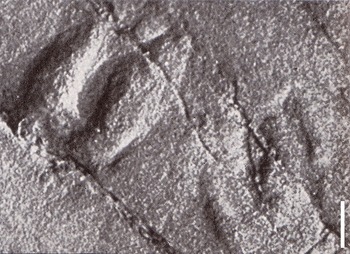
Palmichnium gallowayi (Sharpe, Reference Sharpe1932) n. comb, magnification of series structure from CU 25,225 (see Fig. 1); inner tracks on the right; after Sharpe (Reference Sharpe1932), used with permission of the American Journal of Science. Scale bar = 1 cm.

Materials and methods
Terminology
The terminology of Braddy (Reference Braddy, Briggs and Crowther2001b) is used throughout. The trackway was reconstructed graphically, effectively removing the mudcracks, before measuring. The outer tracks are denoted by the letter ‘A’ with successive inner tracks ‘B’ to ‘E.’ Eurypterid prosomal appendages are designated by Roman numerals I–VI.
Repositories and institutional abbreviations
The trackway that is the subject of this study was photographed in the field by Sharpe (Reference Sharpe1932) and a slab was collected, which now resides in the paleontology collection of Columbia University (CU 25,225). Other specimens examined in this study are deposited in the following institutions: Paleontological Research Institution, Ithaca, New York (PRI); Peabody Museum of Natural History, Yale University (YPM); and Weis Earth Science Museum, Menasha, Wisconsin (WM/P). Specimens that are figured but not numbered are field specimens.
Systematic paleontology
Ichnogenus Palmichnium Richter, Reference Richter1954
Type ichnospecies
Palmichnium palmatum Richter, Reference Richter1954, from the Early Devonian Nellenköpfchen Formation, near Urbar, Koblenz, Germany.
Diagnosis
Large trackways, usually with symmetrically opposed series of three to five tracks disposed en echelon, each track ranging from subcircular to concave, the outer track sometimes paddle-shaped, the series arranged at a high angle to the midline. Medial impression (groove or ridge) usually present (revised after Briggs and Rolfe, Reference Briggs and Rolfe1983).
Remarks
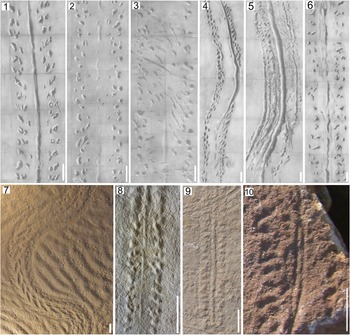
This trackway was originally referred to the ichnogenus Protichnites, which was first based on trackways from the Cambrian Potsdam Sandstone. Protichnites was originally divided into six ichnospecies based on the number of tracks in a series and their arrangement: Protichnites septem-notatus Owen, Reference Owen1852 (7 tracks), Protichnites octo-notatus Owen, Reference Owen1852 (8), Protichnites latus Owen, Reference Owen1852 (9), Protichnites multinotatus Owen, Reference Owen1852 (10+), Protichnites lineatus Owen, Reference Owen1852 (medial and lateral impressions), and Protichnites alternans Owen, Reference Owen1852 (suggested alternate symmetry, but unlikely) (Fig. 3.1–3.6). Hitchcock (Reference Hitchcock1858) removed the hyphens, and defined Protichnites as a trackway of variable external width with series of five or more tracks (of various morphologies) with a medial impression, not limited to any particular producer. Seilacher (Reference Seilacher, Schinderwolf and Seilacher1955) and Keighley and Pickerill (Reference Keighley and Pickerill1998) suggested that Protichnites should be applied to all arthropod trackways with a medial impression (and Diplichnites for those without). Häntzschel (Reference Häntzschel and Teichert1975, fig. 61, 1b) designated Protichnites septemnotatus as the type ichnospecies, although illustrated a specimen with two parallel medial impressions. Burton-Kelly and Erickson (Reference Burton-Kelly and Erickson2010) diagnosed Protichnites as a trackway with any external width, any number of tracks in opposing series, and a single medial impression. They rediagnosed Protichnites septemnotatus with opposing series of seven tracks and a continuous or discontinuous single medial impression, centrally or marginally placed, emphasizing the importance that Owen (Reference Owen1852) originally placed upon the number of tracks per series.
Protichnites: (1–6) Owen's (Reference Owen1852) drawings of the holotypes of the original six ichnospecies of Protichnites, Cambrian, Potsdam Sandstone, Quebec, 45.3151°N, 73.8779°W: (1) Protichnites septemnotatus Owen, Reference Owen1852 (from Owen, Reference Owen1852, pl. 9); (2) Protichnites octonotatus Owen, Reference Owen1852 (from Owen, Reference Owen1852, pl. 10); (3) Protichnites latus Owen, Reference Owen1852 (from Owen, Reference Owen1852, pl. 11); (4) Protichnites multinotatus Owen, Reference Owen1852 (from Owen, Reference Owen1852, pl. 12); (5) Protichnites lineatus Owen, Reference Owen1852 (from Owen, Reference Owen1852, pl. 13); (6) Protichnites alternans Owen, Reference Owen1852 (from Owen, Reference Owen1852, pl. 14); (7–10) a variety of forms commonly assigned to Protichnites, Cambrian, Elk Mound Group, Blackberry Hill, central Wisconsin, 44.7075°N, 89.5071°W: (7) Protichnites eremita Hagadorn and Seilacher, Reference Hagadorn and Seilacher2009, YPM IP 204961, photographed by S. Butts; (8) WM/P 982, collected by J. Gass; (9, 10) field specimens. Scale bars = 5 cm.

Other ichnospecies assigned to Protichnites have since been established, some of which bear only remote resemblance to Owen's original ichnospecies, and might need to be transferred elsewhere. These include Protichnites carbonarius Keighley and Pickerill, Reference Keighley and Pickerill1998 (4 tracks arranged in rhomboid series) and Protichnites scoticus Salter in Harkness, Reference Harkness1856 (6 tracks). Protichnites eremita Hagadorn and Seilacher, Reference Hagadorn and Seilacher2009, from the Cambrian Elk Mound Group of Blackberry Hill, Wisconsin, sometimes has obscure or blade-like tracks (as from pusher legs) within a broad trough. Its shingled imprints along the midline are tilted to the right (Fig. 3.7). These were originally interpreted as produced by a dextrally coiled snail shell, carried by a stem-group chelicerate, to avoid dessication of its gills, like hermit crabs do today (Hagadorn and Seilacher, Reference Hagadorn and Seilacher2009). However, a Protichnites was then discovered with a drag mark that morphed into the shingled imprints as the animal made a sharp turn, which correspond in morphology to the postabdomen of the euthycarcinoid Mosineia macnaughtoni Collette and Hagadorn, Reference Collette and Hagadorn2010, from the same locality (Collette and Hagadorn, Reference Collette and Hagadorn2010; Collette et al., Reference Collette, Gass and Hagadorn2012). Mosineia probably carried its tail to the side because it was disoriented and near death, spiraling to its demise, unable to keep its tail off the sand (Braddy et al., Reference Braddy, Gass and Gass2022). Similar death traces (mortichnia) of myriapods have recently been described from Brazil (Netto et al., Reference Netto, Corrêa, Lima, Sedorko and Villegas-Martín2021). Therefore, the main motivation of the first pioneering arthropods on land seems to be sheer survival. The Moon was closer to the Earth a half billion years ago, so tidal flats were more extensive than they are today, and any animals remaining in tidal pools could easily get stranded as they gradually dried up during the ebbing tide. Wide morphological variation is seen within Protichnites, even within the trackways from one locality (Fig. 3.7–3.10).
Arthropod trackway ichnotaxonomy is sometimes regarded as paleophilately, but it provides a fundamental framework to facilitate comparison and classification. If we consider the vast diversity and disparity of arthropods throughout geological history, and the extramorphological variation resulting from behavioral and preservational complexities of trackway production (Davis et al., Reference Davis, Minter and Braddy2007), it is not surprising that it is a complex subject. Some workers are often reluctant to distinguish ichnotaxa beyond the ichnogenus-level, thus the use of ‘Protichnites isp.’ and ‘Diplichnites isp.’ has become commonplace. An attempt to standardize ichnotaxonomic concepts was undertaken by Bertling et al. (Reference Bertling, Braddy, Bromley, Demathieu, Genise, Mikuláš, Nielsen, Nielsen, Rindsberg, Schlirf and Uchman2006): all ichnotaxa should be based on morphology alone, not any assumptions regarding the producer. The criteria upon which arthropod trackway ichnotaxa should be based were also discussed by Trewin (Reference Trewin1994), Keighley and Pickerill (Reference Keighley and Pickerill1998), and Minter et al. (Reference Minter, Braddy and Davis2007). Trackway morphology varies depending on behavioral factors (e.g., walking technique), sediment characteristics (water content, binding by microbial mats), and preservational factors (substratum consistency, e.g., whether they were produced subaerially or subaqueously), which highlights an inherent problem with arthropod trackway ichnotaxonomy.
A revision of Protichnites is beyond the scope of this paper, but previous suggestions that it be applied to all arthropod trackways with a medial impression, regardless of external width, is here deemed unworkable because it would unite trackways as disparate as Stiaria intermedia Smith, Reference Smith1909 (1 cm wide aptergote insect trackway; Minter and Braddy, Reference Minter and Braddy2009) and Palmichnium kosinskiorum Briggs and Rolfe, Reference Briggs and Rolfe1983 (80 cm wide hibbertopterid eurypterid trackway). It would seem reasonable to restrict Protichnites to trackways with seven or more tracks per series, with a medial impression, as in Protichnites septemnotatus (the type ichnospecies). Although not advocating producer-related ichnotaxonomy, careful selection of diagnostic criteria that reflect major arthropod groups could be worthwhile, e.g., distinguishing trackways produced by chelicerates, which generally have six pairs of prosomal appendages.
Walter (Reference Walter1984) transferred Protichnites gallowayi Sharpe, Reference Sharpe1932 to his monotypic ichnogenus Sharpichnium Walter, Reference Walter1984. Selden (Reference Selden1984) suggested that Protichnites gallowayi was similar to Paleohelcura Gilmore, Reference Gilmore1926, although it and Octopodichnus Gilmore, Reference Gilmore1927 differ in their alternate symmetry (Trewin and McNamara, Reference Trewin and McNamara1995). Symmetry alone might not be a reliable ichnotaxobase (Draganits et al., Reference Draganits, Braddy and Briggs2001), but their smaller size and bifid tracks, relative to the external width, can also distinguish them (Braddy and Milner, Reference Braddy and Milner1998). Living scorpions and spiders can produce Paleohelcura-like trackways (e.g., Brady, Reference Brady1947; Sadler, Reference Sadler1993; Davis et al., Reference Davis, Minter and Braddy2007) and spiders can produce Octopodichnus.
Protichnites gallowayi is also similar to Kouphichnium Nopsca, Reference Nopcsa1923, which has opposing series of five tracks, arranged in a chevron, but the tracks are much smaller and the posterior track generally has a characteristic tridactyl shape, produced by the so-called pusher leg (appendage VI) of a xiphosuran, and the medial impression is much narrower. Three ichnospecies of Kouphichnium were interpreted as produced by eurypterids (King et al., Reference King, Stimson and Lucas2019).
Protichnites gallowayi is most similar to trackways assigned to the ichnogenus Palmichnium, in its external width, wide medial impression, morphology and proportions of the tracks, and their arrangement as series. Palmichnium comprises Palmichnium palmatum, the type ichnospecies, made by a eurypterid using a subaerial flop-type maneuver, leaving coxal imprints; Palmichnium antarcticum (Gevers et al., Reference Gevers, Frakes, Edwards and Marzolf1971; Hedge et al., Reference Hedge, Shillito, Davies, Butler and Sansom2019), made by stylonurids; Palmichnium capensis (Anderson, Reference Anderson1975), made by an onychopterellan using a subaqueous hop-type maneuver (Braddy and Almond, Reference Braddy and Almond1999); Palmichnium stoermeri Briggs and Rolfe, Reference Briggs and Rolfe1983, made by a mixopterid, with a staggered symmetry; Palmichnium kosinskiorum, made by a hibbertopterid; Palmichnium macdonaldi Braddy, Reference Braddy1995, made by a swimming adelophthalmid; and Palmichnium pottsae Braddy and Anderson, Reference Braddy and Anderson1996, made by a walking adelophthalmid with an irregular symmetry (Poschmann and Braddy, Reference Poschmann and Braddy2010). Palmichnium culmicum Pfeiffer, Reference Pfeiffer1968 lacks tracks and therefore should be excluded. Arcuites bertiensis Vrazo and Ciurca, Reference Vrazo and Ciurca2017, a eurypterid swimming trace from the Silurian of Ontario and Pennsylvania, looks like undertracks of Palmichnium, but the direction of travel is opposite to that interpreted by these authors.
Palmichnium gallowayi (Sharpe, Reference Sharpe1932) new combination
Figures 1, 2
- Reference Sharpe1932
Protichnites gallowayi Sharpe, p. 355, figs. 1, 2.
- Reference Caster1938
Protichnites gallowayi; Caster, p. 28–30.
- Reference Selden1984
Protichnites gallowayi; Selden, p. 43.
- Reference Walter1984
Sharpichnium gallowayi; Walter, p. 68, fig. 2c.
- Reference Braddy and Milner1998
Protichnites (= Palmichnium) gallowayi; Braddy and Milner, p. 1120.
- Reference Braddy, Tollerton, Racheboeuf, Schallreuter, Webby, Droser and Paris2004
Protichnites (= Palmichnium); Braddy, p. 138, table 2.
- Reference Poschmann and Braddy2010
Sharpichnium gallowayi; Poschmann and Braddy, p. 113.
Holotype
CU 25,225. No additional material known.
Diagnosis
Medium-sized trackway, consisting of opposing series of five tracks, either side of a medial impression, bordered by narrow, sharp ridges. Outer two tracks are large and pear-shaped; inner three tracks are smaller and more elliptical, arranged in a chevron, converging relative to the midline (revised after Sharpe, Reference Sharpe1932).
Occurrence
Near the southern side of the entrance to Hill (cement) Quarry, on the Vlightberg, a hill near Rondout (41.9206°N, 73.9851°W), a suburb of Kingston, in New York State (Van Ingen and Clarke, 1902) where the overturned ‘Hudson River Shales’ (i.e., locally the Bushkill Shale of the Martinsburg Formation; Middle Ordovician; Upper Chazyan/Mohawkian) is truncated by the Taconic Unconformity.
Description
This trackway is preserved in hyporelief on the base of a medium-grained, thinly bedded sandstone (Fig. 1). Its preserved length comprises several sets. The external width averages 150 mm, the internal width 33 mm. The external to internal width ratio is 4.5. The trackway has opposing series of five tracks on either side of a wide medial impression that varies from 16–22 mm wide, bordered by narrow, sharp ridges. Within the medial impression are thinner discontinuous linear imprints. The outer two tracks were interpreted as a single bifid imprint by Sharpe (Reference Sharpe1932), but they are actually separate as they sometimes cross cut each other and the angle between them varies. The outer two tracks are well-defined and teardrop-shaped (i.e., oval with a slightly more angular anterior) and the inner three tracks are smaller, less perfectly preserved, in lower relief, and elongate-oval. The individual track morphologies are best observed at set 2 of the left side (Fig. 2). The outer (A) tracks are 28 mm long and 14 mm wide, their long axis inclined toward the midline at 26°. The B tracks are 36 mm long and 15 mm wide, inclined toward the midline at 40°. The C tracks are 18 mm long and 11 mm wide, their axis inclined away from the midline by 14°. The D tracks are 22 mm long and 7 mm wide, parallel to the midline. The inner (E) tracks are 14 mm long and 3 mm wide, inclined away from the midline by 15°. The series are symmetrically arranged (opposite symmetry) with fairly regular repetition. The stride length varies between 76 and 97 mm, averaging 90 mm. The series angle of the inner tracks (C–E) is 49°.
The trace maker
Sharpe (Reference Sharpe1932) suggested that an arthropod with ‘bifurcate’ appendages produced this trackway. He interpreted that a eurypterid, possibly a pterygotid, was responsible, with the outer two tracks (interpreted as a single bifid imprint) produced by their large chelicerae (or possibly a ‘chelate’ swimming paddle) and the inner tracks produced by the shorter walking legs.
However, a pterygotid producer is unlikely for several reasons. Pterygotids reliably range from the early Silurian to Middle Devonian (Tetlie, Reference Tetlie2007). Reports of Tremadoc pterygotids from Morocco, based on “a swimming paddle, telson, and two chelicerae … clearly place[d] within the pterygotids … among taxa such as Jaekelopterus and Pterygotus” are based on an anomalocaridid (Lamsdell et al., Reference Lamsdell, Van Roy and Briggs2015a, p. 277). Lamsdell et al. (Reference Lamsdell, Briggs, Liu, Witzke and McKay2015b) resolved Megalograptus Caster and Kjellesvig-Waering, Reference Caster and Kjellesvig-Waering1964 in a derived position, dragging down the ghost range of all eurypterids, including pterygotids, into the Lower Ordovician. However, this phylogenetic hypothesis is not supported by several primitive traits of megalograptids and the eurypterid fossil record more generally.
Størmer (Reference Størmer1976) suggested that terrestrial pterygotid locomotion was unlikely, given their large size and slender walker legs. Pterygotids likely used an octopodous gait involving appendages III–VI. They could not have achieved stable locomotion on land because their opisthosoma was too long; it is unlikely they ever came onto land. Underwater, pterygotids probably used a lobster-like trippling gait (Selden, Reference Selden1984), buoyed by the water. Swimming was their most effective means of locomotion. Their broad telson was initially considered an adaptation for propulsion, their paddles acting as balancing organs (Kjellesvig-Waering, Reference Kjellesvig-Waering1964). Plotnick and Baumiller (Reference Plotnick and Baumiller1988) interpreted the telson as acting like a rudder, with propulsion achieved by the paddles, and pterygotids were interpreted as agile swimmers. However, computer modelling of their swimming techniques (Knight, Reference Knight1997) indicates that they were actually rather poor swimmers due to their relatively small paddles and large bodies. Drag and lift coefficients of their paddles were higher than those of Eurypterus De Kay, Reference De Kay1825 due to their greater area, but they were good lift-producing hydrofoils. The paddles would need to beat at 3 Hz to provide sufficient thrust, even at low speeds, but scaling of portunid crabs indicates that they could only beat at 0.4 Hz. Plotnick and Baumiller's (Reference Plotnick and Baumiller1988) objections to carangiform swimming highlighted whales, sharks, and ichthyosaurs, with a narrow caudal peduncle and broad tail fins, which maximize speed. If speed was not a primary concern, the telson could have contributed to locomotion. Although it was an optimal shape to function as a rudder, this does not preclude it from also generating thrust; it probably did both. Accordingly, pterygotids probably swam in a manatee-like manner, slowly cruising over the substratum, with gentle oscillations of their body, their paddles acting as hydrofoils. It is generally assumed that pterygotids needed to be fast and agile to catch prey, but if their prey (e.g., phyllocarids, thelodonts, pteraspids, and osteostracans with armor) also moved slowly, this might not have been necessary.
It is also unlikely that pterygotids used their large chelicerae in ambulation; they were adapted to rapidly capture prey, as evident by their low mechanical advantage (Selden, Reference Selden1984; Anderson et al., Reference Anderson, McCoy, McNamara and Briggs2014; McCoy et al., Reference McCoy, Lamsdell, Poschmann, Anderson and Briggs2015). The chelicerae would extend in a surprise attack. The terminal denticles are more pointed, for puncturing and gripping prey. The chelicerae could also hold, manipulate, and dismember hard prey, despite suggestions to the contrary (Laub et al., Reference Laub, Tollerton and Berkof2010); the free ramus was solid cuticle with the muscles located in the fixed ramus. Pterygotid chelicerae had the force required to puncture fish dermal armor, as evident in praedichnia in the dorsal head shield of a Lechriaspis patula Elliott and Petriello, Reference Elliott and Petriello2011 (cyathaspid) from the Emsian of northern Utah (Elliott and Petriello, Reference Elliott and Petriello2011). Acutiramus Ruedemann, Reference Ruedemann1935 might even have used its prominent oblique denticle (with a serrate posterior margin on the fixed ramus) to saw up prey. Backwardly directed denticles on the rami would have effectively snared, grasped, and sliced slippery or struggling prey.
A mud-grubbing mode of life was proposed by King et al. (Reference King, Miller and Stimson2017), based on Monomorphichnus-like raking marks from the Emsian of New Brunswick. The denticles on the chelicerae were suggested to have raked or sieved the sediment like some modern crabs, but pterygotids would not have been able to open their chelicerae wide enough to create such scratch marks. It is more likely that these Monomorphichnus Crimes, Reference Crimes1970 were made by a sweep-feeding stylonurid eurypterid.
The actual producer of Palmichnium gallowayi can be determined by comparing the trackway morphology with the types and size of Ordovician arthropods. The many-legged homopodous myriapods and their stem group, the euthycarcinoids, can be disregarded as a potential producers, because they have too many legs. The variation in track size and distance from the midline indicates that a moderate-sized, decapodous, heteropodous arthropod was responsible. The most likely candidates comprise chelicerates because their anatomy (size and leg number) match closely that of the trackway. Arachnids (which produce Paleohelcura and Octopodichnus, see above) were too small and occur later in the fossil record. Xiphosurans (which produce Kouphichnium, see above), and synziphosurines (producing an unnamed trackway, Seilacher and Hemleben, Reference Seilacher and Hemleben1966, fig. 2d; Seilacher, Reference Seilacher2007, pl. 7; attributed by Stürmer and Bergström, Reference Stürmer and Bergström1981) are a possibility, but they are also too small at this time, e.g., Lunataspis Rudkin, Young, and Nowlan, Reference Rudkin, Young and Nowlan2008 from the Late Ordovician of Manitoba and unnamed taxa from the Lower Ordovician of Morocco (Van Roy et al., Reference Van Roy, Orr, Botting, Muir, Vinther, Lefebvre, Hariri and Briggs2010, fig. 2e). The chasmataspidid Hoplitaspis Lamsdell, Gunderson, and Meyer, Reference Lamsdell, Gunderson and Meyer2019 was large enough, but it had a swimming paddle, which should be reflected in the trackway morphology. Putative Chasmataspis Caster and Brooks, Reference Caster and Brooks1956 (see Dunlop et al., Reference Dunlop, Anderson and Braddy2004) trackways (Retallack, Reference Retallack2020, fig. 3a, b) resemble Palmichnium antarcticum with series subparallel to the midline, although their terrestrial capabilities are unknown. Putative Cambrian Chasmataspis-like resting traces (Dunlop et al., Reference Dunlop, Anderson and Braddy2004) are here interpreted as produced by phyllocarids because they predate the chasmataspidid body-fossil record and bivalved phyllocarid carapaces occur on the same slab.
This leaves eurypterids as potential producers. The six species of eurypterids found by Chadwick, noted by Sharpe (Reference Sharpe1932), from the same formation at Broom Street Quarry, are actually pseudofossils (Tollerton, Reference Tollerton2004). Reliable Ordovician eurypterids (Braddy et al., Reference Braddy2004, table 25.1), include Megalograptus from the Martinsburg Formation of New York State, Swatara Gap, Pennsylvania, and Fagg, Virginia (Walkowicz and Plotnick, Reference Walkowicz and Plotnick2011). Pentecopterus Lamsdell et al., Reference Lamsdell, Van Roy and Briggs2015a from the Middle Ordovician of Iowa, is large enough, but its anterior spinose appendages, and those of megalograptids, would not have produced the number and shape of tracks in this trackway. They would probably produce trackways with some imprints of these large appendages, as in Palmichnium stoermeri (see Hanken and Størmer, Reference Hanken and Størmer1975). Like some of the most marine eurypterids, it is also unclear whether they had similar terrestrial capabilities as later eurypterids, despite this portrayal in popular media.
The lack of a paddle-shaped outer track indicates that a primitive stylonurid eurypterid, with appendages V and VI similar in morphology and shorter appendages II–IV, was responsible. A large, rhenopterid-like Brachyopterus stubblefieldi (Størmer, Reference Størmer1951), known from the Caradoc of Wales, is the most likely producer of this trackway. They had five pairs of relatively simple, unspiniferous walking legs, capable of producing the morphology seen in this trackway.
Production of the trace
The eurypterid that produced this trackway used appendages II–VI in locomotion, i.e., was decapodous, as in xiphosurans. The outer A and B tracks print clearly, indicating that the body was actively held above the substrate. Either the eurypterid had sufficient musculature to hold a stable posture or, as Sharpe (Reference Sharpe1932) considered, very shallow water was present that carried most of the weight of the animal. The inner series (tracks C–E) are less perfectly preserved, indicating that the animal's weight was borne primarily by the back legs. The relatively broad medial impression indicates that the animal dragged its body as it hauled itself across the mudflat, with the thinner, inner, discontinuous, medial linear imprints produced by the animal's telson making regular contact with the substratum. The broad medial impression has sufficient depth to indicate that it bore most of the animal's weight, with the mud squished-up at the sides, creating the narrow, sharp ridges.
The size, distance from the midline, and orientation of the outer (A) tracks indicate that appendage VI was probably responsible. The fact that the outer two (A and B) tracks have their long axis inclined toward the midline indicates the approximate angle that they were held relative to the body. Similarly, the orientation of the inner three tracks indicates that the anterior appendages projected forward, essentially ‘pulling’ the animal forward through the mud.
This is in contrast to Palmichnium palmatum, in which Richter (Reference Richter1954) noted that its medial impression forms a ridge, representing the mound left by mud pressed up between opposing limbs, the club-shaped imprints bordering this ridge produced by the coxae (Hanken and Størmer, Reference Hanken and Størmer1975). Palmichnium palmatum shows transverse tracks produced by the swimming paddle outside of a series of three inner tracks, made by appendages III–V. Richter (Reference Richter1954) interpreted Palmichnium palmatum as produced by an unsupported animal on soft mud, possibly a wet subaerial surface, the animal sinking down into it. It lifted itself on its walking legs then fell forward making imprints of its coxae. This shows that the producer was not stable as it walked, with its only means of locomotion an unstable subaerial flop.
The opposite symmetry of Palmichnium gallowayi indicates that opposing limbs were moved in phase, as in a swimming stroke. Limulus walks by moving paired appendages in phase. It rarely comes ashore, except to breed and spawn, therefore the constraints of stable terrestrial locomotion are not needed. Evidence for the direction of travel comes from the series orientation, which generally converge in Palmichnium (Richter, Reference Richter1954; Gevers et al., Reference Gevers, Frakes, Edwards and Marzolf1971; Anderson, Reference Anderson1975; Hanken and Størmer, Reference Hanken and Størmer1975; Briggs and Rolfe, Reference Briggs and Rolfe1983; Braddy, Reference Braddy1995; Braddy and Anderson, Reference Braddy and Anderson1996) as in Kouphichnium (xiphosuran trackways), but in contrast to Paleohelcura (longer-legged, more terrestrial scorpions) that tend to diverge in the direction of movement. Sediment back-push mounds can also infer the direction of travel, but these are not present in this case.
As arthropods moved out of the water, they crossed a functional threshold from in-phase (aquatic) to more stable out-of-phase (terrestrial) gaits (Braddy, Reference Braddy, Briggs and Crowther2001b). In-phase leg movements are used in swimming and feeding, whereas out-of-phase movements provide more support on land. Most eurypterid trackways, including Palmichnium gallowayi, show opposing symmetry indicating that their producers were not well-adapted for walking on land.
Fossil trackways can reveal important information about the transition of life onto land, but it is crucial that we interpret these data correctly, in light of the body-fossil record of potential producers and functional constraints. As Sir Richard Owen (Reference Owen1852, p. 225) noted, referring to the Cambrian trackways from Potsdam in Canada, “Old nature speaks as plainly as she can do by them; and if we do not fully thereby read her meaning, the fault is in our own powers of interpretation.”
Remarks
This trackway is sufficiently different from the other ichnospecies of Palmichnium to warrant separate ichnospecific status. Notably, it has series of five tracks, the outer two tracks much larger than the inner three. Palmichnium gallowayi n. comb. is therefore proposed for this trackway.
Acknowledgments
M. Vrazo is thanked for useful discussions. We also thank D. Knaust and an anonymous reviewer for their helpful reviews. This paper is dedicated to the memory of P. Getty, whose work on fossil arthropod trackways set the standard.