1. Introduction
Today, a rapidly growing interest has developed in understanding the electrostatic perturbations in electron–positron–ion (EPI) plasmas which are found in astrophysical objects such as white dwarfs (Shapiro & Teukolsky Reference Shapiro and Teukolsky1983), neutron stars (Michel Reference Michel1991), pulsar magnetospheres (Michel Reference Michel1982), active galactic nuclei (Miller & Witta Reference Miller and Witta1987), solar flare plasma (Kozlovsky, Murphy & Share Reference Kozlovsky, Murphy and Share2004) and in laboratories such as ultra-small electronic devices (Markovich, Ringhofer & Schmeiser Reference Markovich, Ringhofer and Schmeiser1990), metallic thin flims (Crouseilles, Hervieux & Manfredi Reference Crouseilles, Hervieux and Manfredi2008) and nanostructures, quantum free-electron lasers (Serbeto et al. Reference Serbeto, Mendonca, Tsui and Bonifacio2008) and numerical simulations (Gallant et al. Reference Gallant, Hoshino, Langdon, Arons and Max1994), the modified Penning–Malmberg trap and the buffer gas technique (Surko, Leventhal & Passner Reference Surko, Leventhal and Passner1989) used for accumulating a large number of positrons. The linear phenomena of these plasmas are well known, but the nonlinear phenomena are currently the focus of theoretical and numerical investigations (Manfredi Reference Manfredi2005; Brodin & Marklund Reference Brodin and Marklund2007; Shukla Reference Shukla2009; Tribeche et al. Reference Tribeche, Aoutou, Younsi and Amour2009; Mamun & Shukla Reference Mamun and Shukla2010a ,Reference Mamun and Shukla b ; Sahu Reference Sahu2010; El-Shamy et al. Reference El-Shamy, El-Taibany, El-Shewy and El-Shorbagy2012; Chawla, Mishra & Tiwari Reference Chawla, Mishra and Tiwari2013; Hossen, Ema & Mamun Reference Hossen, Ema and Mamun2014a ; Hossen, Nahar & Mamun Reference Hossen, Nahar and Mamun2014b ; Hossen et al. Reference Hossen, Nahar, Sultana and Mamun2014d ; Hossen & Mamun Reference Hossen and Mamun2015). Most astrophysical plasmas contain ions, electrons and positrons on account of the long lifetime of the positrons. Electron–positron (EP) plasmas are instances of a larger class of equal-mass plasmas that owe their unique characteristics to the symmetry between the two oppositely charged species. Electron–positron plasmas have been studied theoretically because of their relevance in astrophysical substances. Three component EPI plasmas can exist in nature (Chatterjee, Ghosh & Sahu Reference Chatterjee, Ghosh and Sahu2012) and the study of such plasmas is important in roder to know the nonlinear phenomena. It is clear that the behaviour of these EPI plasmas having positrons is different from the two-component plasmas containing electrons and ions.
In celestial compact objects such as white dwarfs and neutron stars, there have been extensive efforts made to study the fundamental properties of matter under extreme conditions (Chandrasekhar Reference Chandrasekhar1931a
,Reference Chandrasekhar
b
, Reference Chandrasekhar1935; Garcia-Berro et al.
Reference Garcia-Berro, Torres, Althaus, Renedo, Loren-Aguiltar, Crsico, Rohrmann, Salaris and Isern2010; Hossen, Nahar & Mamun Reference Hossen, Nahar and Mamun2014c
; Hossen & Mamun Reference Hossen and Mamun2015). The high density of degenerate matter in these compact objects is one of these extreme conditions generated when stars have terminated burning thermonuclear fuel and thus no longer produce thermal pressure. These interstellar objects shrink notably and thereby the density of the interior becomes unusually high. The degenerate electron number density in such a compact object is so high (in white dwarfs, the degenerate electron number density can be of the order of
 $10^{30}~\text{cm}^{-3}$
or even more (Mamun & Shukla Reference Mamun and Shukla2010a
,Reference Mamun and Shukla
b
)) that the electron Fermi energy is comparable to the electron mass energy and the electron speed is comparable to the speed of light in a vacuum. The equation of state for degenerate electrons in such interstellar compact objects has been mathematically explained by Chandrasekhar (Reference Chandrasekhar1935) for two limits, namely, the non-relativistic and ultra-relativistic limits. The degenerate electron equation-of-state of Chandrasekhar is
 $P_{e}\propto n_{e}^{5/3}$
for the non-relativistic limit and
 $P_{e}\propto n_{e}^{4/3}$
for the ultra-relativistic limit, where
 $P_{e}$
is the degenerate electron pressure and
 $n_{e}$
is the degenerate electron number density. For these interstellar compact objects, the degenerate pressure for the ion fluid is given by the following equation,
 $$\begin{eqnarray}\displaystyle & P_{i}=K_{i}{n_{i}}^{{\it\alpha}}, & \displaystyle\end{eqnarray}$$
where
 $$\begin{eqnarray}\displaystyle & {\it\alpha}=\displaystyle \frac{5}{3};\quad K_{i}=\frac{3}{5}\left(\frac{{\rm\pi}}{3}\right)^{1/3}\frac{{\rm\pi}\hbar^{2}}{m}\simeq \frac{3}{5}{\it\Lambda}_{c}\hbar\,c, & \displaystyle\end{eqnarray}$$
for the non-relativistic limit (where
 ${\it\Lambda}_{c}={\rm\pi}\hbar/mc=1.2\times 10^{-10}~\text{cm}$
and
 $\hbar$
is the Planck constant divided by
 $2{\rm\pi}$
). While for the cold positron fluid,
 $$\begin{eqnarray}\displaystyle & P_{pc}=K_{pc}{n_{pc}}^{{\it\alpha}} & \displaystyle\end{eqnarray}$$
and while for the electron and hot positron fluids,
 $$\begin{eqnarray}\displaystyle & P_{e}=K_{e}{n_{e}}^{{\it\gamma}}\quad \text{and}\quad P_{ph}=K_{ph}{n_{ph}}^{{\it\gamma}}, & \displaystyle\end{eqnarray}$$
where for the non-relativistic limit (Chandrasekhar Reference Chandrasekhar1931a ,Reference Chandrasekhar b , Reference Chandrasekhar1935; Mamun & Shukla Reference Mamun and Shukla2010a ,Reference Mamun and Shukla b )
 $$\begin{eqnarray}\displaystyle & {\it\gamma}={\it\alpha}=\frac{5}{3};\quad K_{pc}=K_{e}=K_{ph}, & \displaystyle\end{eqnarray}$$
and for the ultra-relativistic limit (Chandrasekhar Reference Chandrasekhar1931a ,Reference Chandrasekhar b , Reference Chandrasekhar1935; Mamun & Shukla Reference Mamun and Shukla2010a ,Reference Mamun and Shukla b )
 $$\begin{eqnarray}\displaystyle & {\it\gamma}=\displaystyle \frac{4}{3};\quad K_{e}=K_{ph}=\displaystyle \frac{3}{4}\left(\frac{{\rm\pi}^{2}}{9}\right)^{1/3}\hbar\,c\simeq \frac{3}{4}\hbar\,c. & \displaystyle\end{eqnarray}$$
Quantum plasmas are important because of their wide-ranging applications in various contexts such as in dense astrophysical compact objects (notably, white dwarfs and neutron stars) (Ali et al.
Reference Ali, Moslem, Shukla and Schlickeiser2007; Roy, Tasnim & Mamun Reference Roy, Tasnim and Mamun2012; Akhter, Hossain & Mamun Reference Akhter, Hossain and Mamun2013a
,Reference Akhter, Hossain and Mamun
b
; Hossen et al.
Reference Hossen, Nahar, Sultana and Mamun2014e
; Hossen, Ema & Mamun Reference Hossen, Ema and Mamun2015), and in labrotory plasmas (Markovich et al.
Reference Markovich, Ringhofer and Schmeiser1990; Dyakonov & Shur Reference Dyakonov and Shur1996; Faure et al.
Reference Faure, Glinec, Pukhov, Kiselev, Gordienko, Lefebvre, Rousseau, Burgy and Malka2004; Marklund & Shukla Reference Marklund and Shukla2006). Shah, Mahmood & Haque (Reference Shah, Mahmood and Haque2011) considered an unmagnetized hot EPI plasma system to study the electrostatic solitons and they observed that both the lower and upper branches of the Langmuir waves can propagate in such plasmas. The nonlinear propagation of PAW in an EP plasma with an electron beam has been investigated by Nejoh (Reference Nejoh1996) who found that the maximum amplitude of the wave decreases as the positron temperature increases and the region of PASW spreads as the positron temperature increases. The propagation of the PASW is very important not only from the academic point of view, but also from the view of its vital role in understanding the electrostatic disturbances in space and laboratory plasmas. The PASW are the low frequency electrostatic waves in a plasma system where the restoring force is provided by the thermal pressure of electrons and inertia is provided by the number density of positrons. The phase speed of PAW is much greater than the positron thermal speed and less than the electron thermal speed, i.e.
 $V_{Tp}\ll V_{p}\ll V_{Te}$
, where
 $V_{p}$
is the phase speed of PASW,
 $V_{Tp}$
is the thermal speed of the positrons and
 $V_{Te}$
is the thermal speed of the electrons. Chatterjee et al. (Reference Chatterjee, Ghosh and Sahu2012) studied the nonlinear propagation of ion acoustic waves in an unmagnetized plasma. Zeba, Moslem & Shukla (Reference Zeba, Moslem and Shukla2012) investigated a collisionless EPI quantum plasma with ultra-relativistic degenerate electrons and positrons and also studied the existence regions for ion solitary pulses. Roy et al. (Reference Roy, Tasnim and Mamun2012) examined the principal features of solitary waves and double layers in an EPI plasma. Zobaer, Roy & Mamun (Reference Zobaer, Roy and Mamun2013) addressed a degenerate dense plasma containing non-relativistic degenerate cold ions and both non-relativistic and ultra-relativistic degenerate electron fluids and also studied the fundamental features of electrostatic shock structures. Ali et al. (Reference Ali, Moslem, Shukla and Schlickeiser2007) showed that a quantum plasma (containing electrons, positrons and ions) exhibits the behaviour of high-plasma particle number densities and low-temperatures. Hossen & Mamun (Reference Hossen and Mamun2014a
,Reference Hossen and Mamun
b
) considered a relativistic quantum plasma and investigated the profiles of solitary, shock and double layer structures. Ghosh, Chandra & Paul (Reference Ghosh, Chandra and Paul2012) studied the relativistic effects on the linear and nonlinear properties of electron plasma waves using the one-dimensional quantum hydrodynamic (QHD) model for an electron-ion dense quantum plasma. Masood, Mirza & Hanif (Reference Masood, Mirza and Hanif2008) observed that the strength and the steepness of the quantum ion acoustic shock wave increases with decreasing stretched time coordinate by considering an unmagnetized quantum plasma consisting of electrons, positrons and ions employing the QHD model. Popel, Vladimirov & Shukla (Reference Popel, Vladimirov and Shukla1995) considered the three component EPI plasmas and observed the reduction of the ion-acoustic soliton amplitudes in the presence of positrons in such multi-species plasma. Tribeche et al. (Reference Tribeche, Aoutou, Younsi and Amour2009) observed the nonlinear PASW concerning the dynamics of mobile cold positrons. El-Shamy et al. (Reference El-Shamy, El-Taibany, El-Shewy and El-Shorbagy2012) addressed a four component EPI space plasma and observed the features of the head-on collision between two PAW.
To the best of our knowledge, no theoretical investigations have been made to study matter under extreme conditions by considering PASW in both non-relativistic and ultra-relativistic limits. Therefore, it is worthwhile to present a first study for the PASW where degenerate plasma pressure, planar geometry and relativistic effects play a pivotal role. This investigation can be effectively utilized in many astrophysical situations (e.g. non-rotating white dwarfs, neutron stars, etc.) and laboratory devices.
2. Governing equations
An unmagnetized, collisionless, four component, degenerate dense plasma system consisting of non-relativistic cold positrons, non/ultra-relativistic degenerate electron and hot positron fluids and positively charged static ions has been considered. At equilibrium, we have
 $n_{pc0}+n_{ph0}+n_{i0}=n_{e0}$
, where
 $n_{pco}$
,
 $n_{pho}$
,
 $n_{e0}$
, and
 $n_{i0}$
are the unperturbed number densities of cold positron, hot positron, electron and ion, respectively. The dynamics of the one-dimensional PASW in such a four component degenerate dense plasma system is governed by the following normalized equations,
 $$\begin{eqnarray}\displaystyle & \displaystyle \frac{\partial n_{pc}}{\partial t}+\frac{\partial }{\partial x}(n_{pc}u_{pc})=0, & \displaystyle\end{eqnarray}$$
 $$\begin{eqnarray}\displaystyle & \displaystyle \frac{\partial u_{pc}}{\partial t}+u_{pc}\frac{\partial u_{pc}}{\partial x}+\frac{\partial {\it\phi}}{\partial x}+\frac{K_{1}}{n_{pc}}\frac{\partial {n_{pc}}^{{\it\alpha}}}{\partial x}=0, & \displaystyle\end{eqnarray}$$
 $$\begin{eqnarray}\displaystyle & \displaystyle \frac{\partial {\it\phi}}{\partial x}-\frac{K_{2}}{n_{ph}}\frac{\partial {n_{ph}}^{{\it\gamma}}}{\partial x}=0, & \displaystyle\end{eqnarray}$$
 $$\begin{eqnarray}\displaystyle & \displaystyle \frac{\partial {\it\phi}}{\partial x}-\frac{K_{3}}{n_{e}}\frac{\partial {n_{e}}^{{\it\gamma}}}{\partial x}=0, & \displaystyle\end{eqnarray}$$
 $$\begin{eqnarray}\displaystyle & \displaystyle \frac{\partial ^{2}{\it\phi}}{\partial x^{2}}={\it\beta}n_{e}-{\it\sigma}n_{ph}-n_{pc}-{\it\mu}, & \displaystyle\end{eqnarray}$$
 $n_{s}$
is the plasma number density of the species
 $s$
(
 $s=e$
for electron,
 $pc$
for cold positron and
 $ph$
for hot positrons) normalized by its equilibrium value
 $n_{s0}$
,
 $u_{s}$
is the plasma species fluid speed normalized by
 $C_{pm}=(m_{e}c^{2}/m_{p})^{1/2}$
with
 $m_{e}$
(
 $m_{p}$
) being the electron (positron) rest mass and
 $c$
being the speed of light in a vacuum,
 ${\it\phi}$
is the electrostatic wave potential normalized by
 $m_{e}c^{2}/e$
with
 $e$
being the magnitude of the charge of an electron, the time variable (
 $t$
) is normalized by
 ${\it\omega}_{pi}=(4{\rm\pi}n_{pc0}e^{2}/m_{p})^{1/2}$
and the space variable (
 $x$
) is normalized by
 ${\it\lambda}_{m}=(m_{e}c^{2}/4{\rm\pi}n_{pc0}e^{2})^{1/2}$
. Here,
 ${\it\beta}$
(
 $=n_{e0}/n_{pc0}$
) is the ratio of electron to cold positron number density,
 ${\it\sigma}$
(
 $=n_{ph0}/n_{pc0}$
) is the ratio of hot positron to cold positron number density and
 ${\it\mu}$
(
 $=n_{i0}/n_{pc0}$
) is the ratio of ions to cold positron number density. We have defined
 $K_{1}={n_{pc0}}^{{\it\alpha}-1}K_{pc}/m_{e}c^{2}$
,
 $K_{2}={n_{ph0}}^{{\it\gamma}-1}K_{ph}/m_{e}c^{2}$
and
 $K_{3}={n_{e0}}^{{\it\gamma}-1}K_{e}/m_{e}c^{2}$
.
3. Derivation of the K–dV equation
The nonlinear propagation of PASW has been examined by deriving the K–dV equation using (2.1)–(2.5). We have employed a reductive perturbation technique to study the electrostatic perturbations propagating in the relativistic degenerate dense plasma and introduced the stretched coordinates (Maxon & Viecelli Reference Maxon and Viecelli1974; Hossen et al. Reference Hossen, Nahar and Mamun2014b ,Reference Hossen, Nahar, Sultana and Mamun d ) as
 $$\begin{eqnarray}\displaystyle & {\it\zeta}={\it\epsilon}^{1/2}(x-V_{p}t), & \displaystyle\end{eqnarray}$$
 $$\begin{eqnarray}\displaystyle & {\it\tau}={\it\epsilon}^{3/2}t, & \displaystyle\end{eqnarray}$$
 $V_{p}$
is the wave phase speed (
 ${\it\omega}/k$
with
 ${\it\omega}$
being angular frequency and
 $k$
being the wave number of the perturbation mode) and
 ${\it\epsilon}$
is a smallness parameter.
We then expand
 $n_{s}$
,
 $u_{s}$
and
 ${\it\phi}$
in power series of
 ${\it\epsilon}$
:
 $$\begin{eqnarray}\displaystyle & n_{s}=1+{\it\epsilon}n_{s}^{(1)}+{\it\epsilon}^{2}n_{s}^{(2)}+\cdots \,, & \displaystyle\end{eqnarray}$$
 $$\begin{eqnarray}\displaystyle & u_{s}={\it\epsilon}u_{s}^{(1)}+{\it\epsilon}^{2}u_{s}^{(2)}+\cdots \,, & \displaystyle\end{eqnarray}$$
 $$\begin{eqnarray}\displaystyle & {\it\phi}={\it\epsilon}{\it\phi}^{(1)}+{\it\epsilon}^{2}{\it\phi}^{(2)}+\cdots \,, & \displaystyle\end{eqnarray}$$
 ${\it\epsilon}$
. To the lowest order in
 ${\it\epsilon}$
, using (3.1)–(3.5) into (2.1)–(2.5), we get
 $u_{pc}^{(1)}=V_{p}{\it\phi}^{(1)}/(V_{p}^{2}-K_{1}^{\prime })$
,
 $n_{pc}^{(1)}={\it\phi}^{(1)}/(V_{p}^{2}-K_{1}^{\prime })$
,
 $n_{ph}^{(1)}={\it\phi}^{(1)}/K_{2}^{\prime }$
,
 $n_{e}^{(1)}={\it\phi}^{(1)}/K_{3}^{\prime }$
, and
 $V_{p}=\sqrt{K_{2}^{\prime }K_{3}^{\prime }/({\it\beta}K_{2}^{\prime }-{\it\sigma}K_{3}^{\prime })+K_{1}^{\prime }}$
. The relation
 $$\begin{eqnarray}\displaystyle & V_{p}=\sqrt{{\displaystyle \frac{K_{2}^{\prime }K_{3}^{\prime }}{{\it\beta}K_{2}^{\prime }-{\it\sigma}K_{3}^{\prime }}}+K_{1}^{\prime }} & \displaystyle\end{eqnarray}$$
represents the dispersion relation for the positron-acoustic (PA) type electrostatic waves in the degenerate plasma system under consideration.
We study the nonlinear propagation of these PA type electrostatic waves in a degenerate dense plasma. To the next higher order in
 ${\it\epsilon}$
, we obtain a series of equations,
 $$\begin{eqnarray}\displaystyle & \displaystyle \frac{\partial n_{pc}^{(1)}}{\partial {\it\tau}}-V_{p}\frac{\partial n_{pc}^{(2)}}{\partial {\it\zeta}}+\frac{\partial }{\partial {\it\zeta}}\left[u_{pc}^{(2)}+n_{pc}^{(1)}u_{pc}^{(1)}\right]=0, & \displaystyle\end{eqnarray}$$
 $$\begin{eqnarray}\displaystyle & \displaystyle \frac{\partial u_{pc}^{(1)}}{\partial {\it\tau}}-V_{p}\frac{\partial u_{pc}^{(2)}}{\partial {\it\zeta}}+u_{pc}^{(1)}\frac{\partial u_{pc}^{(1)}}{\partial {\it\zeta}}+\frac{\partial {\it\phi}^{(2)}}{\partial {\it\zeta}} & \displaystyle \nonumber\\ \displaystyle & \qquad +\,K_{1}^{\prime }\displaystyle \frac{\partial }{\partial {\it\zeta}}\left[n_{pc}^{(2)}+\frac{({\it\alpha}-2)}{2}(n_{pc}^{(1)})^{2}\right]=0, & \displaystyle\end{eqnarray}$$
 $$\begin{eqnarray}\displaystyle & \displaystyle \frac{\partial {\it\phi}^{(2)}}{\partial {\it\zeta}}-K_{2}^{\prime }\frac{\partial }{\partial {\it\zeta}}\left[n_{ph}^{(2)}+\frac{({\it\gamma}-2)}{2}(n_{ph}^{(1)})^{2}\right]=0, & \displaystyle\end{eqnarray}$$
 $$\begin{eqnarray}\displaystyle & \displaystyle \frac{\partial {\it\phi}^{(2)}}{\partial {\it\zeta}}-K_{3}^{\prime }\frac{\partial }{\partial {\it\zeta}}\left[n_{e}^{(2)}+\frac{({\it\gamma}-2)}{2}(n_{e}^{(1)})^{2}\right]=0, & \displaystyle\end{eqnarray}$$
 $$\begin{eqnarray}\displaystyle & {\it\beta}n_{e}^{(2)}-{\it\sigma}n_{ph}^{(2)}-n_{pc}^{(2)}=0. & \displaystyle\end{eqnarray}$$
Now combining (3.7)–(3.11), we have deduced a K–dV equation,
 $$\begin{eqnarray}\displaystyle & \displaystyle \frac{\partial {\it\phi}^{(1)}}{\partial {\it\tau}}+AB{\it\phi}^{(1)}\frac{\partial {\it\phi}^{(1)}}{\partial {\it\zeta}}+B\frac{\partial ^{3}{\it\phi}^{(1)}}{\partial {\it\zeta}^{3}}=0, & \displaystyle\end{eqnarray}$$
where the nonlinear coefficient
 $A$
and the dispersion term
 $B$
are given by
 $$\begin{eqnarray}\displaystyle & \displaystyle A=\left[\displaystyle \frac{3V_{p}^{2}+K_{1}^{\prime }({\it\alpha}-2)}{(V_{p}^{2}-K_{1}^{\prime })^{3}}+\frac{{\it\beta}({\it\gamma}-2)}{{K_{3}^{\prime }}^{2}}-\frac{{\it\sigma}({\it\gamma}-2)}{{K_{2}^{\prime }}^{2}}\right], & \displaystyle\end{eqnarray}$$
 $$\begin{eqnarray}\displaystyle & \displaystyle B=\displaystyle \frac{(V_{p}^{2}-K_{1}^{\prime })^{2}}{2V_{p}}. & \displaystyle\end{eqnarray}$$
The stationary solitary wave solution of K–dV equation is,
 $$\begin{eqnarray}\displaystyle {\it\phi}^{(1)}={\it\phi}_{m}\text{sech}^{2}\left(\frac{{\it\xi}}{{\it\Delta}}\right), & & \displaystyle\end{eqnarray}$$
where the special coordinate,
 ${\it\xi}={\it\zeta}-u_{0}{\it\tau}$
, the amplitude,
 ${\it\phi}_{m}=3u_{0}/A$
and the width,
 ${\it\Delta}=(4B/u_{0})^{1/2}$
. For suitable values of the parameters, A of (3.12) may be 0 or
 ${\sim}0$
. Then, (3.12) is unable to describe the nonlinear wave features and a higher order (i.e. modified K–dV) equation is required to describe the system. It can also be said that for nearly critical values of the plasma parameter the nonlinear structures will disappear and one can consider the higher order nonlinearity by deriving a modified K–dV equation.
4. Derivation of the modified K–dV equation
We have examined the electrostatic perturbations propagating in a relativistic degenerate dense plasma due to the effect of dispersion. By considering a higher order term, we have derived a mK–dV equation employing the reductive perturbation method using (2.1)–(2.5), a new set of stretched coordinates (Maxon & Viecelli Reference Maxon and Viecelli1974) has been introduced for the modified K–dV equation as
 $$\begin{eqnarray}\displaystyle & {\it\zeta}={\it\epsilon}(x-V_{p}t), & \displaystyle\end{eqnarray}$$
 $$\begin{eqnarray}\displaystyle & {\it\tau}={\it\epsilon}^{3}t. & \displaystyle\end{eqnarray}$$
 ${\it\epsilon}$
, using (4.1), (4.2) and (3.3)–(3.5), into the (2.1)–(2.5), we find the same results as for solitons with the K–dV equation.
To the next higher order in
 ${\it\epsilon}$
, we have obtained a set of equations, which, after using the values of
 $n_{pc}^{(1)}$
,
 $u_{pc}^{(1)}$
,
 $u_{ph}^{(1)}$
and
 $n_{e}^{(1)}$
, can be simplified as
 $$\begin{eqnarray}\displaystyle & \displaystyle u_{pc}^{(2)}=\displaystyle \frac{V_{p}^{3}+2K_{1}^{\prime }V_{p}+K_{1}^{\prime }V_{p}({\it\alpha}-2)}{2(V_{p}^{2}-K_{1}^{\prime })^{3}}({\it\phi}^{(1)})^{2}+\frac{V_{p}}{V_{p}^{2}-K_{1}^{\prime }}({\it\phi}^{(2)}), & \displaystyle\end{eqnarray}$$
 $$\begin{eqnarray}\displaystyle & \displaystyle n_{pc}^{(2)}=\displaystyle \frac{3V_{p}^{2}+K_{1}^{\prime }({\it\alpha}-2)}{2(V_{p}^{2}-K_{1}^{\prime })^{3}}({\it\phi}^{(1)})^{2}+\frac{{\it\phi}^{(2)}}{V_{p}^{2}-K_{1}^{\prime }}, & \displaystyle\end{eqnarray}$$
 $$\begin{eqnarray}\displaystyle & \displaystyle n_{ph}^{(2)}=\displaystyle \frac{{\it\phi}^{(2)}}{K_{2}^{\prime }}-\frac{({\it\gamma}-2)({\it\phi}^{(1)})^{2}}{2(K_{2}^{\prime })^{2}}, & \displaystyle\end{eqnarray}$$
 $$\begin{eqnarray}\displaystyle & \displaystyle n_{e}^{(2)}=\displaystyle \frac{{\it\phi}^{(2)}}{K_{3}^{\prime }}-\frac{({\it\gamma}-2)({\it\phi}^{(1)})^{2}}{2(K_{3}^{\prime })^{2}}, & \displaystyle\end{eqnarray}$$
 $$\begin{eqnarray}\displaystyle & \displaystyle {\it\rho}^{(2)}={\textstyle \frac{1}{2}}{A\unicode[STIX]{x0030A}}({\it\phi}^{(1)})^{2}, & \displaystyle\end{eqnarray}$$
 $$\begin{eqnarray}\displaystyle & {A\unicode[STIX]{x0030A}}=-\left[\displaystyle \frac{{\it\beta}({\it\gamma}-2)}{2(K_{3}^{\prime })^{2}}-\frac{{\it\sigma}({\it\gamma}-2)}{2(K_{2}^{\prime })^{2}}+\frac{3V_{p}^{2}+K_{1}^{\prime }({\it\alpha}-2)}{2(V_{p}^{2}-K_{1}^{\prime })^{3}}\right]. & \displaystyle\end{eqnarray}$$
To further higher order of
 ${\it\epsilon}$
, we obtain a set of equations
 $$\begin{eqnarray}\displaystyle & \displaystyle \frac{\partial n_{pc}^{(1)}}{\partial {\it\tau}}-V_{p}\frac{\partial n_{pc}^{(3)}}{\partial {\it\zeta}}+\frac{\partial u_{pc}^{(3)}}{\partial {\it\zeta}}+\frac{\partial }{\partial {\it\zeta}}[u_{pc}^{(2)}n_{pc}^{(1)}+n_{pc}^{(2)}u_{pc}^{(1)}]=0, & \displaystyle\end{eqnarray}$$
 $$\begin{eqnarray}\displaystyle & \displaystyle \frac{\partial u_{pc}^{(1)}}{\partial {\it\tau}}-V_{p}\frac{\partial u_{pc}^{(3)}}{\partial {\it\zeta}}+\frac{\partial }{\partial {\it\zeta}}[u_{pc}^{(1)}u_{pc}^{(2)}]+\frac{\partial {\it\phi}^{(3)}}{\partial {\it\zeta}}\hspace{122.39996pt} & \displaystyle \nonumber\\ \displaystyle & \displaystyle \quad +\,K_{1}^{\prime }\frac{\partial }{\partial {\it\zeta}}\left[n_{pc}^{(3)}+({\it\alpha}-2)(n_{pc}^{(1)}n_{pc}^{(2)})+\displaystyle \frac{({\it\alpha}-2)({\it\alpha}-3)}{6}(n_{pc}^{(1)})^{3}\right]=0, & \displaystyle\end{eqnarray}$$
 $$\begin{eqnarray}\displaystyle & \displaystyle \frac{\partial {\it\phi}^{(3)}}{\partial {\it\zeta}}-K_{2}^{\prime }\frac{\partial }{\partial {\it\zeta}}\left[n_{ph}^{(3)}+({\it\gamma}-2)(n_{ph}^{(1)}n_{ph}^{(2)})+\displaystyle \frac{({\it\gamma}-2)({\it\gamma}-3)}{6}(n_{ph}^{(1)})^{3}\right]=0, & \displaystyle\end{eqnarray}$$
 $$\begin{eqnarray}\displaystyle & \displaystyle \frac{\partial {\it\phi}^{(3)}}{\partial {\it\zeta}}-K_{3}^{\prime }\frac{\partial }{\partial {\it\zeta}}\left[n_{e}^{(3)}+({\it\gamma}-2)(n_{e}^{(1)}n_{e}^{(2)})+\displaystyle \frac{({\it\gamma}-2)({\it\gamma}-3)}{6}(n_{e}^{(1)})^{3}\right]=0, & \displaystyle\end{eqnarray}$$
 $$\begin{eqnarray}\displaystyle & \displaystyle \frac{\partial ^{2}{\it\phi}^{(1)}}{\partial {\it\zeta}^{2}}={\it\beta}n_{e}^{(3)}-{\it\sigma}n_{ph}^{(3)}-n_{pc}^{(3)}. & \displaystyle\end{eqnarray}$$
 $u_{pc}^{(2)}$
,
 $n_{pc}^{(2)}$
,
 $n_{ph}^{(2)}$
,
 $n_{e}^{(2)}$
and
 ${\it\rho}^{(2)}$
, we obtain an equation of the form
 $$\begin{eqnarray}\displaystyle & \displaystyle \frac{\partial {\it\phi}^{(1)}}{\partial {\it\tau}}+{\it\beta}^{\prime }\{{\it\phi}^{(1)}\}^{2}\frac{\partial {\it\phi}^{(1)}}{\partial {\it\zeta}}+B\frac{\partial ^{3}{\it\phi}^{(1)}}{\partial {\it\zeta}^{3}}=0, & \displaystyle\end{eqnarray}$$
where the value of
 $B$
is as before and
 ${\it\beta}^{\prime }$
is given by
 $$\begin{eqnarray}\displaystyle {\it\beta}^{\prime }={\it\alpha}^{\prime }B, & & \displaystyle\end{eqnarray}$$
 $$\begin{eqnarray}\displaystyle {\it\alpha}^{\prime } & = & \displaystyle \frac{15V_{p}^{4}+12K_{1}^{\prime }V_{p}^{2}+18K_{1}^{\prime }V_{p}^{2}({\it\alpha}-2)}{2(V_{p}^{2}-K_{1}^{\prime })^{5}}+\frac{3{(K_{1}^{\prime })^{2}({\it\alpha}-2)}^{2}}{2(V_{p}^{2}-K_{1}^{\prime })^{5}}\nonumber\\ \displaystyle & & \displaystyle +\,\frac{K_{1}^{\prime }({\it\alpha}-2)({\it\alpha}-3)}{2(V_{p}^{2}-K_{1}^{\prime })^{4}}-\frac{{\it\beta}({\it\gamma}-2)(2{\it\gamma}-3)}{2{K_{3}^{\prime }}^{3}}+\frac{{\it\sigma}({\it\gamma}-2)(2{\it\gamma}-3)}{2{K_{2}^{\prime }}^{3}},\end{eqnarray}$$
 $$\begin{eqnarray}\displaystyle B=\frac{(V_{p}^{2}-K_{1}^{\prime })^{2}}{2V_{p}}. & & \displaystyle\end{eqnarray}$$
In order to trace the influence of different plasma parameters on the propagation of electrostatic solitary waves in degenerate dense plasma, we have derived the mK–dV equation (4.14). The stationary solitary wave solution of the standard mK–dV equation is obtained by considering a frame
 ${\it\xi}={\it\zeta}-u_{0}{\it\tau}$
(moving with speed
 $u_{0}$
) and the solution is,
 $$\begin{eqnarray}\displaystyle {\it\phi}^{(1)}={\it\phi}_{m}\text{sech}\left(\frac{{\it\xi}}{{\it\delta}}\right), & & \displaystyle\end{eqnarray}$$
where the special coordinate,
 ${\it\xi}={\it\zeta}-u_{0}{\it\tau}$
, the amplitude,
 ${\it\phi}_{m}=\sqrt{6u_{0}/{\it\beta}^{\prime }}$
, the width,
 ${\it\delta}={\it\phi}_{m}\sqrt{{\it\gamma}_{1}},{\it\gamma}_{1}={\it\alpha}^{\prime }/6$
and
 $u_{0}$
is the plasma species speed at equilibrium.
5. Derivation of the further mK–dV equation
In order to trace the nonlinear structures around the critical values, neither the K–dV nor mK–dV equation is suitable for describing the PASW. To examine the propagation of PASW in the vicinity of the critical positron density region, we assume a non-zero value for the
 $({\it\phi}^{(1)})^{2}$
of the Poisson’s equation and finally one can derive the following nonlinear equation
 $$\begin{eqnarray}\displaystyle & \displaystyle \frac{\partial {\it\phi}^{(1)}}{\partial {\it\tau}}+[AB{\it\phi}^{(1)}+{\it\alpha}^{\prime }B\{{\it\phi}^{(1)}\}^{2}]\,\frac{\partial {\it\phi}^{(1)}}{\partial {\it\zeta}}+B\,\frac{\partial ^{3}{\it\phi}^{(1)}}{\partial {\it\zeta}^{3}}=0. & \displaystyle\end{eqnarray}$$
Equation (5.1) is known as the further mK–dV (fmK–dV) equation and the values of the constants are as defined earlier. The compressive soliton solution (Mowafy et al. Reference Mowafy, El-Shewy, Moslem and Zahran2008; El-Shewy et al. Reference El-Shewy, Abo el Maaty, Abdelwahed and Elmessary2011; Elwakil et al. Reference Elwakil, Abulwafa, El-Shewy and Abd-El-Hamid2011) of (5.1) is
 $$\begin{eqnarray}\displaystyle {\it\phi}_{+}^{(1)}=\frac{6u_{0}/A{\it\alpha}^{\prime }}{{\it\phi}^{(1)}\sinh ^{2}(\sqrt{u_{0}/2A}{\it\xi})-{\it\phi}^{(2)}\cosh ^{2}(\sqrt{u_{0}/2A}{\it\xi})}, & & \displaystyle\end{eqnarray}$$
and the rarefactive soliton solution (Mowafy et al. Reference Mowafy, El-Shewy, Moslem and Zahran2008; El-Shewy et al. Reference El-Shewy, Abo el Maaty, Abdelwahed and Elmessary2011; Elwakil et al. Reference Elwakil, Abulwafa, El-Shewy and Abd-El-Hamid2011)
 $$\begin{eqnarray}\displaystyle {\it\phi}_{-}^{(1)}=\frac{6u_{0}/A{\it\alpha}^{\prime }}{{\it\phi}^{(2)}\sinh ^{2}(\sqrt{u_{0}/2A}{\it\xi})-{\it\phi}^{(1)}\cosh ^{2}(\sqrt{u_{0}/2A}{\it\xi})}. & & \displaystyle\end{eqnarray}$$
In the following § 6, we examine numerically the influence of plasma parameters on the propagation of PASW in a dense quantum plasma.
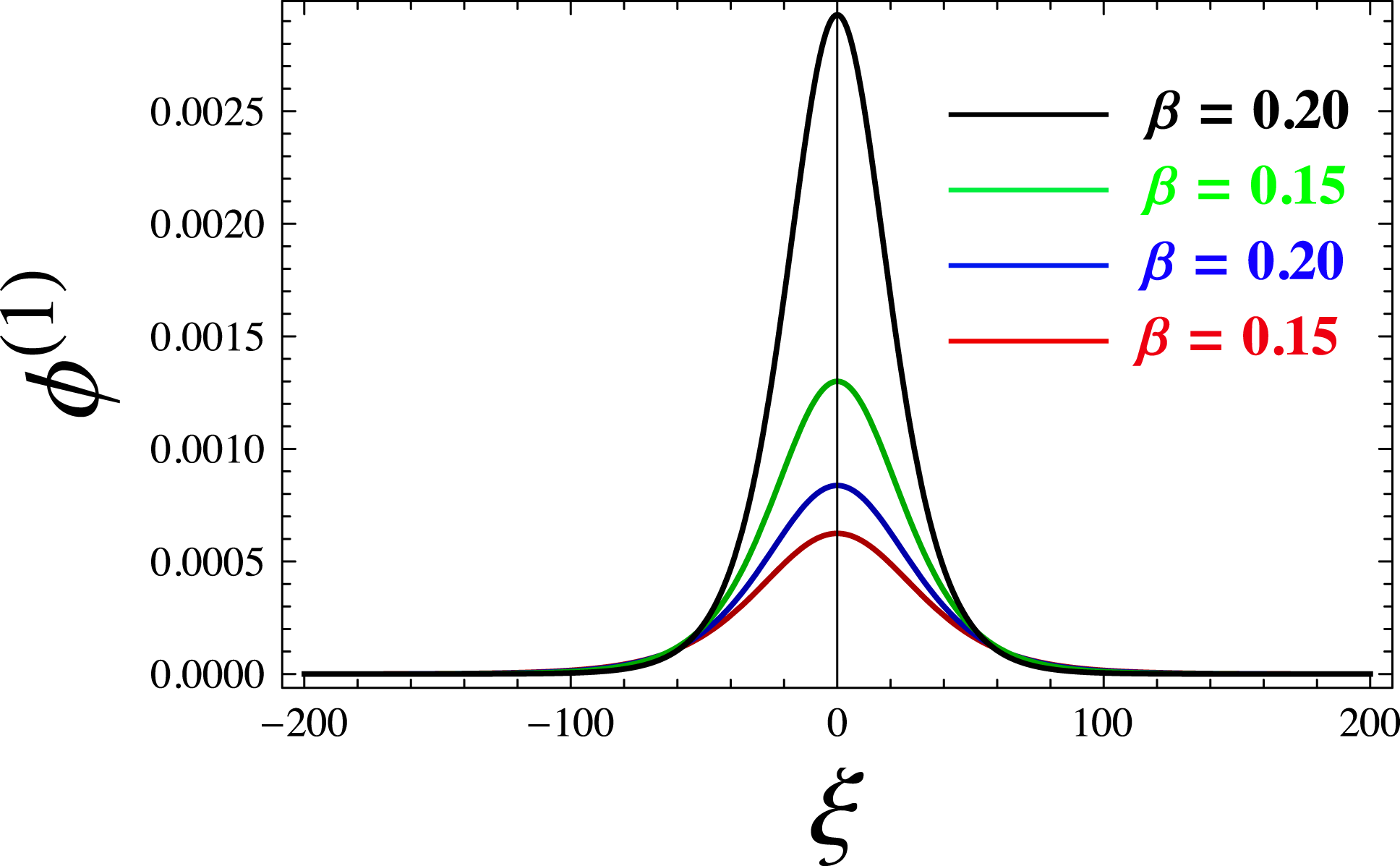
The variation of amplitude of PA K–dV solitons with
 ${\it\beta}$
for
 $u_{0}=0.01$
and
 ${\it\sigma}=0.01$
. The black and green solid lines represent the ultra-relativistic case and the blue and red solid lines represent the non-relativistic case.

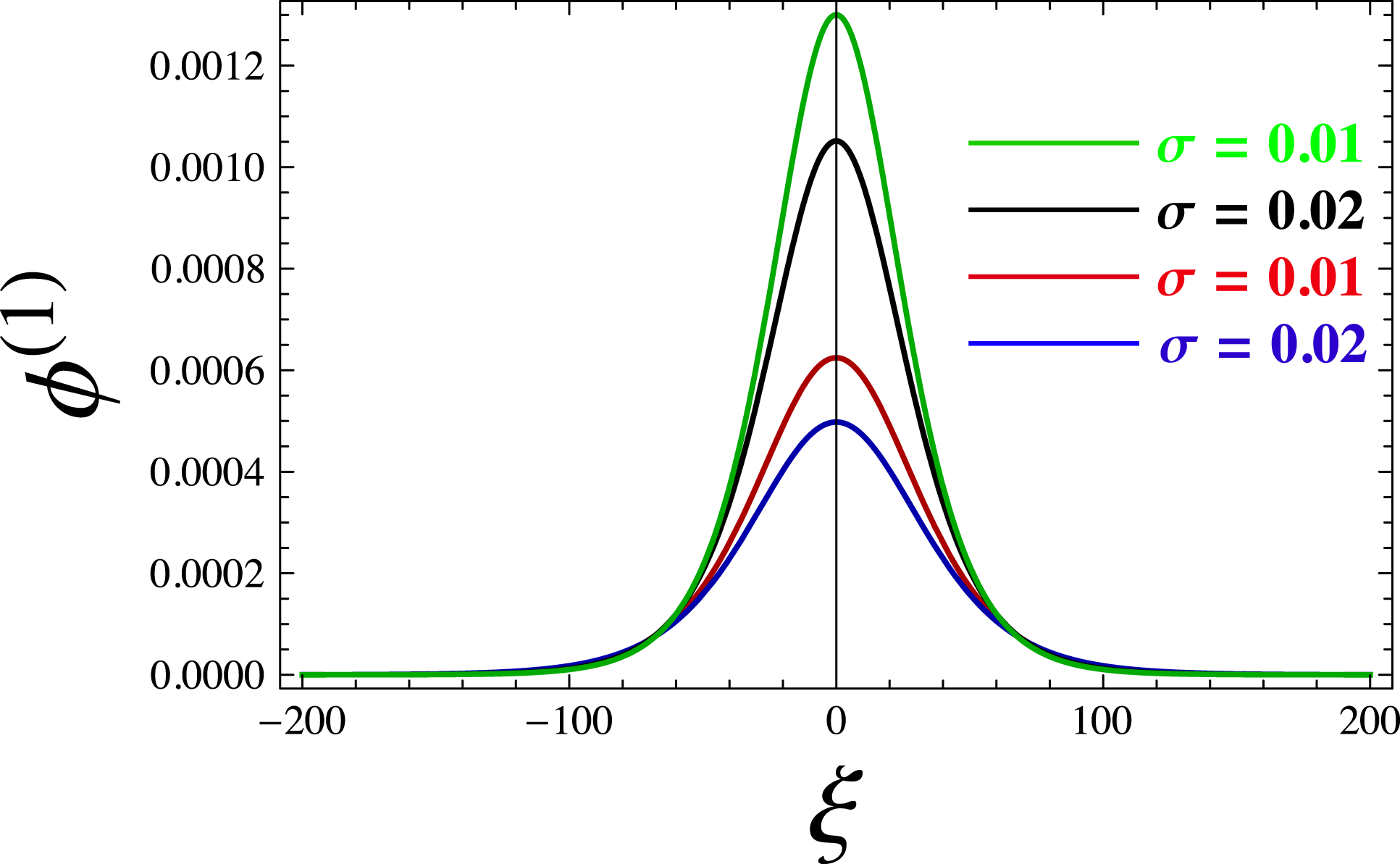
The variation of amplitude of PA K–dV solitons with
 ${\it\sigma}$
for
 $u_{0}=0.01$
and
 ${\it\beta}=0.15$
. The green and black solid lines represent the ultra-relativistic case and the red and blue solid lines represent the non-relativistic case.

6. Parametric investigations
The effects of the relativistic factor and the different intrinsic parameters of our model (namely, the electron to cold positron number density ratio
 ${\it\beta}$
and the hot to cold positron number density ratio
 ${\it\sigma}$
) on the nonlinear properties of PASW have been investigated in the following way.
Relativistic effect: The solitary wave characteristics have been influenced notably for the relativistic factors, namely, alpha
 $({\it\alpha})$
and gamma
 $({\it\gamma})$
. There are two relativistic limits called the non-relativistic (
 ${\it\alpha}={\it\gamma}=5/3$
) and ultra-relativistic (
 ${\it\alpha}=5/3$
;
 ${\it\gamma}=4/3$
) which significantly modify the solitary profiles. It has been found that the amplitude of solitary profiles is higher for the ultra-relativistic case than that for the non-relativistic case.
Effect of the electron to cold positron number density ratio
 $(\mathit{via}~{\it\beta}):$
the effect of the electron to cold positron number density ratio
 ${\it\beta}$
on the solitary profiles has been depicted in figures 1, 3, 4, 7 and 9 for both the non-relativistic and the ultra-relativistic limits. From the features of these figures we have found that the amplitude of solitary structures increases with an increasing value of
 ${\it\beta}$
. This happens because the nonlinearity coefficient A descreases.
Showing the variation of amplitude of PA K–dV solitons with
 ${\it\xi}$
for the different values of
 ${\it\beta}$
in case of non-relativistic limit.

Showing the variation of amplitude of PA K–dV solitons with
 ${\it\xi}$
for the different values of
 ${\it\beta}$
in case of ultra-relativistic limit.

The variation of amplitude of PA K–dV solitons with
 ${\it\xi}$
for the different values of
 ${\it\sigma}$
in case of non-relativistic limit.

The variation of amplitude of PA K–dV solitons with
 ${\it\xi}$
for the different values of
 ${\it\sigma}$
in case of ultra-relativistic limit.

Effect of the hot to cold positron number density ratio
 $(\mathit{via}~{\it\sigma}):$
figures 2, 5, 6 and 8 illustrate the effect of the hot to cold positron number density ratio (
 ${\it\sigma}$
) on the PA solitary profiles. It has been found that the amplitude of the solitary profiles decreases with an increasing value of
 ${\it\sigma}$
. This happens on the basis of the driving force of the PA wave, as the driving force for the PA wave is provided by the inertia of the positrons. An increase in positron concentration (depopulation of electrons) causes a decrease in the driving force which is provided by the positron inertia, and consequently forms a solitary wave.
Our present work deals with the properties of PASW in a relativistic degenerate plasma (containing non-relativistic cold positrons, both non-relativistic and ultra-relativistic degenerate electron and hot positron fluids and positively charged static ions). To study this plasma system we have derived the K–dV, mK–dV and fmK–dV equations. We have then analysed the basic properties of PASW. The PA waves are seen to be modified when cold positrons, hot positrons and electrons being non-relativistic degenerate (
 ${\it\alpha}={\it\gamma}=5/3$
) than hot positrons and electrons being ultra-relativistic degenerate (
 ${\it\alpha}=5/3$
;
 ${\it\gamma}=4/3$
). It is notable that if we compare the non-relativistic and ultra-relativistic cases then the amplitude is found distinctly higher for ultra-relativistic case than for non-relativistic case (see figures 1–8). The ranges
 ${\it\beta}=0.1{-}0.5$
and
 ${\it\sigma}=0.1{-}0.3$
, (Sahu Reference Sahu2010; El-Shamy et al.
Reference El-Shamy, El-Taibany, El-Shewy and El-Shorbagy2012) of plasma parameters used in this numerical analysis are very wide, and correspond to space and laboratory plasma situations.
The variation of amplitude of PA mK–dV solitons with
 ${\it\xi}$
for the different values of
 ${\it\beta}$
in case of non-relativistic limit.

The variation of amplitude of PA mK–dV solitons with
 ${\it\xi}$
for the different values of
 ${\it\sigma}$
in case of non-relativistic limit.

The variation of amplitude of PA fmK–dV solitons with
 ${\it\xi}$
for the different values of
 ${\it\beta}$
in case of non-relativistic limit.

7. Conclusion
A rigorous theoretical investigation of the nonlinear propagation of PASW in an unmagnetized, collisionless and degenerate quantum plasma (containing non-relativistic cold positrons, both non-relativistic and ultra-relativistic degenerate electron and hot positron fluids and positively charged static ions) has been studied. The positively charged static ions participate only in maintaining the quasi-neutrality condition at equilibrium. We have derived the K–dV, mK–dV and fmK–dV equations and then analysed the basic features of the solitary structures. Solitary waves are often formed in nature due to the balance between nonlinearity and dispersion. It is a unique phenomenon that the degree of nonlinearity is proportional to the potential of the plasma system as a highly nonlinear medium causes high electrostatic potential. It is observed that the amplitude of the solitary structures increases with an increasing value of fluid speed. Our results will be useful to understand the solitary wave properties in matter under extreme conditions e.g. interior of compact objects (where non-relativistic cold positrons, both non-relativistic and ultra-relativistic degenerate electron and hot positron fluids, positively charged static ions and degenerate plasma pressure are accountable) (Ali et al. Reference Ali, Moslem, Shukla and Schlickeiser2007; Roy et al. Reference Roy, Tasnim and Mamun2012; Akhter et al. Reference Akhter, Hossain and Mamun2013a ,Reference Akhter, Hossain and Mamun b ; Hossen et al. Reference Hossen, Nahar, Sultana and Mamun2014e , Reference Hossen, Ema and Mamun2015).
Acknowledgements
M.G.S. and M.R.H. are deeply grateful to the Ministry Of Science and Technology (MOST), Bangladesh for awarding the National Science and Technology (NST) fellowship.