Introduction
As a progressive neurodegenerative disorder, Parkinson’s disease (PD) comprises various motor and non-motor impairments that substantially impact a patient’s quality of life (Bergman & Deuschl, Reference Bergman and Deuschl2002; Schrag, Jahanshahi, & Quinn, Reference Schrag, Jahanshahi and Quinn2000; Truong, Bhidayasiri, & Wolters, Reference Truong, Bhidayasiri and Wolters2008). In daily clinical routine, both, patients and their caregivers, frequently complain about motor impairments which interfere with activities of daily living, such as drinking a glass of water or getting up from a chair. In contrast, some PD patients tend to neglect their motor impairment such as tremor or impaired posture, even if these symptoms are obvious to the social environment. Furthermore, when PD patients, but not caregivers, are asked specifically whether their motor symptoms worsened or interfere with their daily routine, many PD patients underestimate their deficits. This lack of awareness has been referred to as reduced or impaired self-awareness of motor symptoms (ISAm) and has lately attracted more attention (Amanzio et al., Reference Amanzio, Monteverdi, Giordano, Soliveri, Filippi and Geminiani2010; Jenkinson, Edelstyn, Stephens, & Ellis, Reference Jenkinson, Edelstyn, Stephens and Ellis2009; Leritz, Loftis, Crucian, Friedman, & Bowers, Reference Leritz, Loftis, Crucian, Friedman and Bowers2004; Maier et al., Reference Maier, Prigatano, Kalbe, Barbe, Eggers, Lewis and Timmermann2012; Pietracupa et al., Reference Pietracupa, Fasano, Fabbrini, Sarchioto, Bloise, Latorre and Berardelli2013; Sitek, Soltan, Wieczorek, Robowski, & Slawek, Reference Sitek, Soltan, Wieczorek, Robowski and Slawek2011; Vitale et al., Reference Vitale, Pellecchia, Grossi, Fragassi, Cuomo, Di Maio and Barone2001). So far, data suggest that the majority of PD patients suffer from ISAm for levodopa-induced hyperkinetic movements, i.e., dyskinesia (Amanzio et al., Reference Amanzio, Monteverdi, Giordano, Soliveri, Filippi and Geminiani2010; Jenkinson et al., Reference Jenkinson, Edelstyn, Stephens and Ellis2009; Pietracupa et al., Reference Pietracupa, Fasano, Fabbrini, Sarchioto, Bloise, Latorre and Berardelli2013; Vitale et al., Reference Vitale, Pellecchia, Grossi, Fragassi, Cuomo, Di Maio and Barone2001), although ISAm for hypokinetic symptoms, such as resting tremor or bradykinesia, has also been observed (Maier et al., Reference Maier, Prigatano, Kalbe, Barbe, Eggers, Lewis and Timmermann2012).
Pietracupa et al. (Pietracupa, Latorre, Berardelli, & Fabbrini, Reference Pietracupa, Latorre, Berardelli and Fabbrini2014) recently reviewed the influence of ISAm on PD patients and its relevance for clinical trials. The authors argue that ISAm for dyskinesia might lead to an increased or irregular intake of dopaminergic medication, leading to more severe dopamine-induced side-effects. Also, the usual documentation of movements using patient self-reported motor dairies within data collection of clinical studies has to be questioned. Besides, Pietracupa et al. also addressed a major concern relating to the current literature: Present findings of ISAm in PD rely on different methodological procedures and patient populations, limiting reliable and valid conclusions. For instance, one possibility to examine ISAm in PD is to let the patient perform a number of motor tasks and to simply ask afterwards whether he/she had difficulties performing the task due to motor impairments. Discrepancies between the patient’s assessment in case he/she presented motor deficits during task performance, and the examiner’s assessment might then be considered as ISAm in PD. This approach was first applied by Vitale et al. (Vitale et al., Reference Vitale, Pellecchia, Grossi, Fragassi, Cuomo, Di Maio and Barone2001), who examined ISAm for dyskinesia in 13 PD patients during four motor tasks (standing, gait, finger-tapping and hand pronation-supination). Each motor task was evaluated by the examiner and the patient concerning presence of dyskinesia, correctness of performance, and explanation for incorrect performance. Thereafter, outcomes were rated as full awareness, partial awareness or full unawareness. The same approach was applied by Jenkinson and colleagues (Jenkinson et al., Reference Jenkinson, Edelstyn, Stephens and Ellis2009) to measure ISAm for dyskinesia, and an extended modified version was used in our previous work (Maier et al., Reference Maier, Prigatano, Kalbe, Barbe, Eggers, Lewis and Timmermann2012) to assess ISAm for hyper- and hypokinesia. A related method was also chosen by Pietracupa et al. (Pietracupa et al., Reference Pietracupa, Fasano, Fabbrini, Sarchioto, Bloise, Latorre and Berardelli2013), who compared patient and examiner ratings on a neurological dyskinesia scale and complemented this procedure by patients rating their own video performances. Moreover, Amanzio and colleagues (Amanzio et al., Reference Amanzio, Monteverdi, Giordano, Soliveri, Filippi and Geminiani2010) measured ISAm of hyper- and hypokinesia using an adapted version of the Bisiach scale for anosognosia for hemiplegic stroke patients (Bisiach, Vallar, Perani, Papagno, & Berti, Reference Bisiach, Vallar, Perani, Papagno and Berti1986) as well as a dyskinesia and hypo-bradykinesia rating scale. In another approach, Leritz et al. (Leritz et al., Reference Leritz, Loftis, Crucian, Friedman and Bowers2004) and Sitek et al. (Sitek et al., Reference Sitek, Soltan, Wieczorek, Robowski and Slawek2011) both analysed differences in awareness of PD between patients versus their caregivers by comparing self-rated modified neurological questionnaires (Leritz et al., Reference Leritz, Loftis, Crucian, Friedman and Bowers2004) or ratings of movie-depicted symptoms in relation to the patient’s own severity of symptoms (Sitek et al., Reference Sitek, Soltan, Wieczorek, Robowski and Slawek2011).
Despite the topic’s clinical relevance, to date, none of these previously used instruments has been psychometrically evaluated or assessed in a larger sample of PD patients. Notably, numerous tests exist for the measurement of impaired self-awareness of hemiplegia in stroke patients, typically referred to as anosognosia. These scales, such as the Bisiach Scale (Bisiach et al., Reference Bisiach, Vallar, Perani, Papagno and Berti1986), the Anosognosia Questionnaire (Starkstein, Fedoroff, Price, Leiguarda, & Robinson, Reference Starkstein, Fedoroff, Price, Leiguarda and Robinson1992), or the Anosognosia for Hemiplegia Questionnaire (Feinberg, Roane, & Ali, Reference Feinberg, Roane and Ali2000), have been validated and frequently assessed (Orfei, Caltagirone, & Spalletta, Reference Orfei, Caltagirone and Spalletta2010). However, while unawareness of hemiplegia seems to be fairly obvious and hence comparatively easy to evaluate, ISAm in PD might be less distinct and relate to various aspects of motor dysfunction. Therefore, the co-occurrence of hyper- and hypokinetic movements as well as the influence of dopaminergic medication make it difficult to consider ISAm in PD as one entity and to draw definite conclusions concerning pathophysiological mechanisms, which are currently under debate and are associated with various hypotheses (Pietracupa et al., Reference Pietracupa, Latorre, Berardelli and Fabbrini2014), such as right hemisphere deficits (Leritz et al., Reference Leritz, Loftis, Crucian, Friedman and Bowers2004; Maier et al., Reference Maier, Prigatano, Kalbe, Barbe, Eggers, Lewis and Timmermann2012; Pietracupa et al., Reference Pietracupa, Fasano, Fabbrini, Sarchioto, Bloise, Latorre and Berardelli2013) or frontal-subcortical loop dysfunctions (Amanzio et al., Reference Amanzio, Monteverdi, Giordano, Soliveri, Filippi and Geminiani2010). Therefore, a valid and reliable instrument is needed to pursue research on ISAm in PD.
We here developed an instrument to measure ISAm in non-depressed, non-demented PD patients and defined its psychometric criteria by applying factor analysis and testing for reliability and validity. Referring to a frequently used approach as indicated above, the scale was developed on the basis of a direct comparison between a patient’s subjective perception of motor functioning and her/his motor performance rated by an examiner. We included both hyper- and hypokinetic motor symptoms. Additionally, to allow for clinical judgements of severity of ISAm in PD, the test was constructed in analogy to the Unified Parkinson’s disease rating scale (UPDRS). Finally, to gain knowledge about a PD patient’s ISAm of daily life, the test was performed during the regular medication on state and the ISAm severity score was correlated with disease specific characteristics.
Method
Patients
All patients were recruited from the Department of Neurology, University Hospital of Cologne. Included were right-handed patients (Oldfield, Reference Oldfield1971) with idiopathic PD (according to the Queen’s Square Brain Bank criteria (Hughes, Daniel, Blankson, & Lees, Reference Hughes, Daniel, Blankson and Lees1993)) and with normal or corrected to normal vision. Patients represented an average outpatient sample under the condition that ability to judge their own symptoms had to be given. Therefore, exclusion criteria were moderate or severe depression (Beck Depression Inventory-2 (BDI-2) score >19, (Beck, Steer, Ball, & Ranieri, Reference Beck, Steer, Ball and Ranieri1996; Hautzinger, Keller, & Kühner, Reference Hautzinger, Keller and Kühner2006)), dementia (Mini Mental State Exam (MMSE) score <27, (Folstein, Folstein, & McHugh, Reference Folstein, Folstein and McHugh1975; Kessler, Markowitsch, & Denzler, Reference Kessler, Markowitsch and Denzler2000)), treatment with deep brain stimulation or past neurosurgery, additional neurological or psychiatric disorders, and inability to perform motor tasks (Hoehn and Yahr disease stage 5, (Hoehn & Yahr, Reference Hoehn and Yahr1967)). The study was approved by the ethics committee of the University Hospital of Cologne (study number: 319–2011). All patients gave written informed consent before study participation. The research was completed in accordance with the Helsinki Declaration.
Clinical data and rating scales
The neurological examination contained all four parts of the Unified Parkinson’s Disease Rating Scale (UPDRS; (Fahn, Elton, & Committee, Reference Fahn, Elton and Committee1987)) and an assessment of the Hoehn and Yahr disease stage (Hoehn & Yahr, Reference Hoehn and Yahr1967). The UPDRS contains 42 items (total range 0–199; higher scores reflecting more impairment) in the dimensions I) mentation, behaviour, mood (4 questions, range 0–16), II) activities of daily living (ADLs, 13 questions, range 0–52), III) motor examination (14 items, range 0–108), and IV) complications of therapy (11 items, range 0–23). Concerning the UPDRS-III, 14 typical PD motor symptoms are clinician-rated for the left and right body side as well as axial symptoms separately on a scale from 0, no impairment, to 4, worst impairment.
The Hoehn and Yahr scale defines the PD disease stage from 1, unilateral involvement only, usually with minimal or no functional disability, to 5, confinement to bed or wheelchair unless aided. Moreover, the levodopa equivalent daily dose (LEDD) was determined according to the guidelines of the German Neurological Society (Diener & Putzki, Reference Diener and Putzki2008). All tests were assessed with the patient being on her/his regular medication (i.e., medication on).
Test construction
Item generation
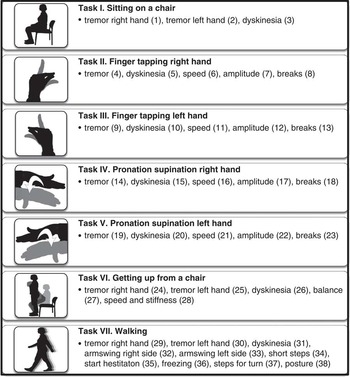
Primarily, items were generated taking into account typical PD motor symptoms, earlier reports of unrecognized motor deficits (Amanzio et al., Reference Amanzio, Monteverdi, Giordano, Soliveri, Filippi and Geminiani2010; Jenkinson et al., Reference Jenkinson, Edelstyn, Stephens and Ellis2009; Maier et al., Reference Maier, Prigatano, Kalbe, Barbe, Eggers, Lewis and Timmermann2012; Pietracupa et al., Reference Pietracupa, Fasano, Fabbrini, Sarchioto, Bloise, Latorre and Berardelli2013; Vitale et al., Reference Vitale, Pellecchia, Grossi, Fragassi, Cuomo, Di Maio and Barone2001), and previous versions of the test (Maier et al., Reference Maier, Prigatano, Kalbe, Barbe, Eggers, Lewis and Timmermann2012; Vitale et al., Reference Vitale, Pellecchia, Grossi, Fragassi, Cuomo, Di Maio and Barone2001), which were not psychometrically evaluated. Motor symptoms were discussed and screened in a collaboration of neuropsychologists (F.M., C.L., G.P.) and neurologists (C.E., L.T.), following the goal that patients had to be able to perceive the considered motor deficits. Whenever appropriate, symptoms were evaluated separately on the right and left body side. In this manner, 38 items were generated. These items were investigated in the context of seven motor tasks. Motor tasks and examined symptoms are depicted in Figure 1.
Motor tasks and evaluated motor symptoms.

Assessment procedure
For the assessment of ISAm, the test was embedded into a standardized PowerPoint presentation, which was shown to the patient on a computer. Instructions were displayed on the screen and read aloud (for detailed test instructions please see supplementary material). The seven motor tasks (including the 38 items) were presented to the patient as separate standardized video clips. In each video, a healthy subject demonstrated the task. After watching a video clip, the patient was asked to perform the task herself/himself. Thereafter, questions concerning the motor performance were asked by using a dichotomized answering profile (yes /no). Again, these questions were displayed on the screen and read aloud to the patient. Thirty-eight questions were asked resulting in each motor symptom being evaluated by the patient herself/himself. For each item patients were asked to classify whether or not they had noticed a motor impairment.
The original test instructions were in German. For a possible international use of the final test, instructions were forward-translated into English and back translated by a native speaker (C.L.) (Guillemin, Bombardier, & Beaton, Reference Guillemin, Bombardier and Beaton1993). Both versions of the instructions (i.e., German/English) are provided in the supplement.
Rating of ISAm
The entire assessment was videotaped. The patient videos were then evaluated by two independent trained raters (A.E. and F.M.), blinded to the patient’s answers. First, the experts registered whether a patient presented a motor deficit or not (dichotomized answering). Therefore, the number of motor symptoms for each patient could range between 0–38. Second, all 38 motor symptoms were evaluated by the two trained raters according to the UPDRS-III rating scale (range 0–4, 0=no symptom, 1=mild impairment, 2=moderate impairment, 3=severe impairment, 4=unable to perform). Third, patient and expert ratings were compared: A motor symptom that was not noticed by the patient but was rated at least as a mild symptom by the experts was taken as indicator of ISAm. Therefore, each unperceived motor symptom was rated concerning its severity by both experts (range per symptom 0–4, 0=no ISAm, 1=ISAm of a mild symptom, 2=ISAm of a moderate symptom, 3=ISAm of a severe symptom, 4=ISAm of a symptom with highest impairment).
Item reduction and testing of psychometric criteria
Item reduction and factor analysis
The ISAm severity rating (range 0 to 4 per item) for each of the 38 motor symptoms was used for further analyses (matrix 104 patients by 38 items). In a first step, principal component analysis (PCA, promax oblique rotation) was used to reduce the number of items (Matsunaga, Reference Matsunaga2010). Taking into account the sample size of 104 patients, a factor loading of greater than 0.512 has been suggested to be significant (Field, Reference Field2009; Stevens, Reference Stevens2002). Therefore, items that loaded <0.512 on a factor were excluded. Moreover, items that produced no meaningful factor and factors that contained less than three items were not considered. In a second step, the reduced number of items was factor analysed (principal axis analysis) applying oblique rotation (promax) (Costello & Osborne, Reference Costello and Osborne2005). The scree plot was used to identify the number of factors for the final instrument by analysing the break point in the eigenvalue graph. Additionally, the Kaiser-Meyer-Olkin (KMO) measure of sampling adequacy was determined (values above 0.5 seem acceptable) (Kaiser, Reference Kaiser1974).
Defining reliability and validity
After item reduction, interrater reliability for ISAm severity was assessed using the two-way mixed intraclass correlation (ICC; absolute agreement, average-measures) (Hallgren, Reference Hallgren2012; McGraw & Wong, Reference McGraw and Wong1996). Concerning internal consistency, Cronbach’s alpha was calculated for each created factor (subscale) and for the whole test instrument. Values between 0.7 and 0.95 are regarded as appropriate for a subscale, values between 0.6 and 0.7 are evaluated as marginally acceptable (Tavakol & Dennick, Reference Tavakol and Dennick2011). Corrected item-to-total correlations were determined for each item, with values of 0.30 or higher being accepted (Nunnally & Berstein, Reference Nunnally and Berstein1994). Furthermore, split-half reliability was examined using the Guttman split-half coefficient value for the whole instrument.
Construct validity was examined by assessing two additional measures of ISAm: the first test comprised a global clinical impression (GCI) visual analogue scale (VAS) of overall ISAm. On this scale, the examiner (A.E.) evaluated the overall motor awareness between 0% (complete ISAm) and 100% (complete motor awareness). The use of single-item VAS has been reported to be valid and reliable for clinical studies (de Boer et al., Reference de Boer, van Lanschot, Stalmeier, van Sandick, Hulscher, de Haes and Sprangers2004). As a second instrument, the Global Awareness of Movement (GAM) disorders scale was assessed (Amanzio et al., Reference Amanzio, Monteverdi, Giordano, Soliveri, Filippi and Geminiani2010). This test consists of four levels of awareness from 0 “good awareness” to 4 “no awareness of motor deficits”. Here, awareness levels are determined by the degree of spontaneity with which patients report their symptoms. Since, in this study, ISAm was only assessed in the medication on state, one overall rating per patient was conducted for hypo-/brady-, and hyperkinetic symptoms.
Statistical Analysis
Statistical procedures were performed using IBM SPSS version 22.0 (SPSS Corp, Chicago, Ill, USA). Level of significance was defined at 5%. The sample was characterized by calculating means, medians, standard deviations and ranges for demographic, clinical and ISAm data. Normal distribution assumptions were tested applying the Kolmogorov Smirnov test.
Concerning reliability, ICC, Cronbach’s alpha, corrected item-to-total correlation, and split-half reliability were determined. Construct validity was based on correlation analyses between the GCI score and the ISAm total severity score as well as the GAM scale score and the ISAm total severity score. Additionally, the effect size was considered according to Cohen (Cohen, Reference Cohen1988).
Results
Sample characteristics
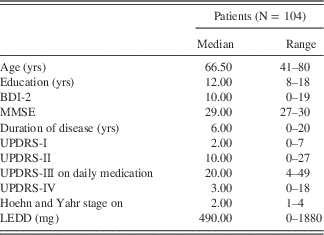
Table 1 provides demographic data and clinical characteristics of the 104 included PD patients. The sample consisted of 68 males (65.4%) and 36 females (34.6%). The median age was 66.5 years and median disease duration was six years. The ISAm-PD test was assessed in all patients without difficulties and missing data. All patients had motor impairments during task performance. While bradykinetic symptoms were present in all patients, dyskinesia and resting tremor were observed in approximately 20% of patients (for further information see supplement Table S1).
Sample characteristics.

yrs, years; BDI-2, Beck Depression Inventory-2; MMSE, Mini Mental State Examination; UPDRS, Unified Parkinson’s Disease Rating Scale; on, on medication; LEDD, levodopa equivalent daily dose.
Item reduction, final test results, and psychometric criteria
Item reduction and factor analysis
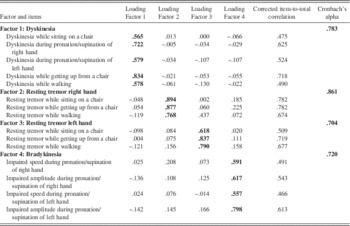
Results of the item reduction (PCA) showed that 15 items remained in the analysis. Detailed PCA results can be found in the supplement Table S2. Results of the principle axis factor analysis, including item loadings, are presented in Table 2. The KMO measure of sampling adequacy was 0.64 and therefore acceptable. The analyses led to a four factor solution (dyskinesia, resting tremor right hand, resting tremor left hand, bradykinesia) comprising 15 motor symptoms distributed across five motor tasks: sitting on a chair, pronation-supination movements of the right and left hand, getting up from a chair, and walking. Therefore, the tasks right and left hand finger tapping were excluded from the final instrument. As only 15 of the initial 38 motor symptoms remained and each symptom was rated between 0 (no ISAm) and 4 (ISAm of a symptom with highest impairment), the resulting ISAm total severity score can range from 0 (full motor awareness) to 60 (severe ISAm of for highest impairments in all 15 symptoms).
Results of the principal axis factoring (subscales, items, and loadings), corrected item-to-total correlations and Cronbach’s alpha.

Descriptive results of the final test
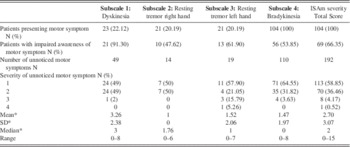
Descriptive results of the remaining five tasks and 15 symptoms are depicted in Table 3. A more detailed overview of all seven motor tasks and 38 motor symptoms can be found in the supplement (see supplement Table S1). Overall, 66% of the patients showed impairments in awareness of motor deficits with an average ISAm total severity score of 2.7 (SD 3.07, median 2, range 0–15), which was not normally distributed. As expected, ISAm for mild to moderate motor symptoms was most frequently observed (as rated with a 1 or 2, see Table 3). In fact, almost 60% of unnoticed motor deficits were considered as mild, about 36% were moderate and only 4% were rated as severe or highest impairment. Furthermore, while 192 of 533 (36%) presented motor symptoms were not perceived by patients, in only 42 cases (7,8%) a symptom was noted by the patient which was not registered by the clinical raters. The distribution of “over-reporting” was not bound to certain symptoms.
Descriptive data of factors and total score for the PD sample.

* values of patients who presented the motor symptom
Reliability and validity
Table 2 also reflects the corrected item-to-total correlations and the Cronbach’s alpha for each final subscale. We considered corrected item-to-total correlations above 0.30 as acceptable (Nunnally & Berstein, Reference Nunnally and Berstein1994). This was fulfilled by the results. Likewise, satisfactory values could be determined for internal consistency (Cronbach’s alpha). When Cronbach’s alpha was calculated for the ISAm total severity score consisting of all four subscales, a marginally acceptable value of 0.64 was obtained. Moreover, although the final instrument only consisted of 15 items, split-half reliability was satisfactory (Guttman split-half coefficient=0.74). Interrater reliability for ISAm severity as measured with the ICC was high (ICC=0.89).
Besides, for a putative future use of this test during medication off conditions, a second total score (10 items, range 0–40) was calculated consisting of resting tremor right hand and left hand as well as bradykinesia, which reached a Cronbach’s alpha of 0.70. Therefore, dyskinesia, which usually only appear in medication on state were excluded from this second total score.
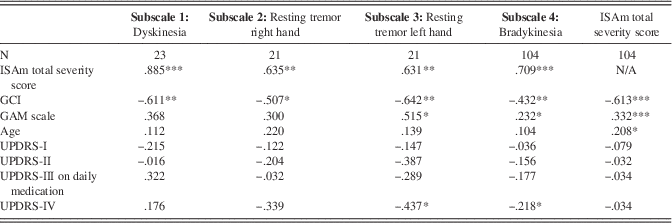
Since both GCI score and GAM scale were rated concerning overall ISAm in all PD patients, construct validity was analysed through Spearman correlations between these tests and the ISAm total severity score (see Table 4). A lower GCI score (equals less awareness) correlated significantly with a higher ISAm total severity score (r =−.613; p<.001; large effect size). Also, a higher GAM scale score (equals less awareness) was significantly associated with a higher ISAm severity total score (r=.322; p<.001; medium effect size). Additionally, all correlations between the GCI score and each of the four subscales were significant (see Table 4). The GAM scale score correlated significantly with subscale 3 “resting tremor left hand” and subscale 4 “bradykinesia”.
Spearman correlation analyses between the four subscales, the ISAm total severity score and clinical data for PD patients that demonstrated motor deficits.

P-values: *<.05, **<.01, ***<.001; effect size: absolute values of r, small r=0.1–0.29; medium r=0.3–0.49; large r=0.5 or above.
ISAm, impaired self-awareness of motor deficits; GCI, global clinical impression of self-awareness; GAM scale, global awareness of movement disorders scale, UPDRS, Unified Parkinson’s Disease Rating Scale.
Correlation of ISAm with Clinical data
Spearman correlation analyses between subscales, total score and clinical data are depicted in Table 4. A significant correlation but small effect size was found between a higher ISAm total severity score and older age. Moreover, the correlations between subscale 3 “resting tremor left hand” and UPDRS-IV (motor complications, medium effect size) as well as subscale 4 “bradykinesia” and UPDRS-IV (small effect size) were significant, implying that a higher ISAm severity of “resting tremor left hand” and “bradykinesia” was related to less impairment in UPDRS-IV. All other analyses did not reach statistical significance.
Discussion
Thus far, no reliable and valid instrument for the measurement of ISAm severity in PD which comprises both hyper- and hypokinetic movements exists. Here, we propose a scale to fill this gap, in order to allow for future analyses of the presence of ISAm in PD populations with different clinical characteristics, the pathophysiology underlying ISAm, to examine the impact of ISAm on clinical data acquisition and to register PD patient’s compliance of medication intake (Pietracupa et al., Reference Pietracupa, Latorre, Berardelli and Fabbrini2014).
By application of a PCA with promax oblique rotation, 15 of the initial 38 motor symptoms were selected for the final instrument which comprises five motor tasks (range 0–60). The four subscales assess dyskinesia (range 0–20), resting tremor right and left hand (range for each 0–12), and bradykinetic symptoms (range 0–16) in terms of reduced speed and amplitude of hand pronation supination movements. All subscales showed satisfactory corrected item-to-total correlations and a factor loading >0.512, reflecting the relevance of the remaining items.
Internal consistency of the subscales was acceptable or good with values >0.7 (Tavakol & Dennick, Reference Tavakol and Dennick2011). The ISAm total severity score had a Cronbach’s alpha of 0.64 which is marginally acceptable. As Tavakol and Dennick argue (Tavakol & Dennick, Reference Tavakol and Dennick2011), lower values of Cronbach’s alpha might be the result of a limited inter-correlation between the items of all subscales. This seems plausible for our cohort, since not all PD patients suffered from all examined motor symptoms and therefore could not be unaware of all motor symptoms. For example, a patient suffering from levodopa-induced dyskinesia does not show a hypodopaminergic resting tremor at the same time. Moreover, as ISAm is a multifaceted phenomenon (Orfei et al., Reference Orfei, Caltagirone and Spalletta2010), we cannot rule out different pathophysiologies that may underlie the unawareness of hyper- and hypokinesias. Hence, subscales may be used separately in future analysis, when, e.g., analyzing influencing factors such as dopaminergic medication. Also, the applicability of the ISAm total severity score should be verified in experimental studies. Nevertheless, despite only 15 items, split-half reliability was acceptable with a value of 0.74, supporting satisfactory reliability. Additionally, inter-rater reliability was high (0.89). With regards to construct validity, expected associations between higher ISAm total severity scores and lower GCI scores as well as higher GAM scales scores could be confirmed with medium and large effect sizes. However, both scales, the CGI and GAM, have not been validated so far. Therefore, the validation of the here developed instrument might be limited.
The descriptive results of the ISAm severity subscales (Table 3) show that highest ISAm existed for dyskinesia. These findings also reflect that mild or moderate symptoms are often unperceived while more severe deficits are adequately noticed. This result is consistent with Vitale et al. (Vitale et al., Reference Vitale, Pellecchia, Grossi, Fragassi, Cuomo, Di Maio and Barone2001), who reported higher ISAm levels of milder than of severe dyskinesias. They concluded that ISAm of mild dyskinesias might be due to motor tasks not reflecting abnormal movements, like they would probably do under more severe forms of dyskinesias (Vitale et al., Reference Vitale, Pellecchia, Grossi, Fragassi, Cuomo, Di Maio and Barone2001). In fact, this might be a possible contributing factor to ISAm of mild symptoms in our patients.
Concerning clinical characteristics (Table 4), older age correlated significantly with a higher ISAm total severity score, a finding which has also been reported in stroke patients, who showed anosognosia for their hemiparesis (Appelros, Karlsson, & Hennerdal, Reference Appelros, Karlsson and Hennerdal2007; Vossel et al., Reference Vossel, Weiss, Eschenbeck, Saliger, Karbe and Fink2012). Taken together, age and neurodegeneration may play an important role in ISAm in PD. No significant relationship was found between the ISAm total severity score and the four parts of the UPDRS. Again, this might be due to differential underlying mechanisms that relate to the four subscales which reflect specific motor impairments. For instance, though not significant, the subscale “dyskinesia” tended to be associated with higher UPDRS-III and UPDRS-IV scores while the subscales “resting tremor left hand” and “bradykinesia” tended to be related to lower UPDRS-III scores and were significantly correlated with lower UPDRS-IV scores. One reason for this differential effect is the fact that levodopa-induced dyskinesia usually appear after several years of disease and with higher doses of levodopa while resting tremor and bradykinetic symptoms often exist early on at disease onset (Bergman & Deuschl, Reference Bergman and Deuschl2002). Hence, inflating values of UPDRS-parts III and IV might be related to dyskinesia. In this context, one weakness of this study is the relatively small number of PD patients who suffered from dyskinesia or resting tremor, restricting the reliability and validity. Therefore, future research is needed to examine the validity of the ISAm total severity score and its subscales in larger patient cohorts.
Interestingly, axial motor symptoms such as balance or gait difficulties did not produce a single factor. One reason for this result might be the rather seldom presentation of symptoms such as freezing of gait or start hesitation in our cohort (for details see supplement), due to the exclusion of patients who were unable to perform all motor tasks. Additionally, these symptoms directly reflect patient’s inability to perform a motor task, e.g., falling backwards when getting up from a chair, so that this obvious failure might increase the patient’s perception of her/his motor difficulties. Although not examined in this validation study, this observation suggests that the attentional system may play an important role in the pathophysiology underlying ISAm in PD (Robertson, Reference Robertson2010).
Likewise, motor symptoms which are common features of PD but which were nevertheless unnoticed by >40% of our PD patients, e.g., reduced arm-swing or impaired posture, did not remain in the final test. This might be attributed to the statistical assumption that at least three items are needed to produce a meaningful factor (Costello & Osborne, Reference Costello and Osborne2005). Moreover, we cannot rule out different pathophysiological correlates which contribute to the impaired perception of these symptoms possibly leading to a low association with the ISAm total severity score.
Since this study was conducted while patients were on their regular daily medication, reliability and validity results are based on this clinical state. Hence, we recommend the use of this test during medication on. However, research on PD usually involves medical levodopa-challenge on and off states, leading to more pronounced hyper- and hypokinetic symptoms. Although, so far, this instrument has not been assessed in medication off, it seems plausible that the test may also be valid for this condition, since the same dimensions of motor deficits can occur, except for dyskinesia, which usually appear in the on state only. Nevertheless, future studies should apply confirmatory factor analyses to ensure the factor structure during medical off, to demonstrate reliability and validity also in this condition.
Finally, with respect to clinical implications, the results showed that about 66% of our patients had difficulties in perceiving their symptoms, a finding which is consistent with previous reports (Maier et al., Reference Maier, Prigatano, Kalbe, Barbe, Eggers, Lewis and Timmermann2012). Data suggest that it is important to examine patient’s awareness of PD motor symptoms in order to include disease perception and therapeutic compliance in the individual therapeutic regimen. Whether a patient with a 1- or 2-point ISAm total severity score should already be considered as showing ISAm remains, however, to be elucidated in future studies. A definition of cut-off scores might be a helpful approach to classify PD patients with different levels of awareness.
In conclusion, we have developed a new instrument that measures ISAm severity of hyper- and hypokinetic movements in right-handed, non-depressed and non-demented PD patients in the medication on state. Subscales can be used separately or together in order to form an ISAm total severity score. Future studies might prove the applicability of this test instrument during medication off and its use when assessing larger patient populations.
Acknowledgements
We gratefully acknowledge the valuable support and help by KaPe Schmidt whilst designing the figure and producing the video clips.
COMPETING INTERESTS
F. Maier reports no disclosures.
A.L. Ellereit reports no disclosures.
C. Eggers has received speaker’s honoraria from Medtronic Inc.
C.J. Lewis reports no disclosures.
E. A. Pelzer reports no disclosures.
E. Kalbe has received honoraria from Novartis and is consultant for Novartis.
N. Ernstmann reports no disclosures.
G.P. Prigatano reports no disclosures.
G.R. Fink serves as an editorial board member of Cortex, NeuroImage: Clinical, Zeitschrift für Neuropsychologie and Fortschritte der Neurologie Psychiatrie; receives royalties from the publication of the book Funktionelle MRT in Psychiatrie und Neurologie and Neurologische Differentialdiagnose; received honoraria for speaking engagements from Bayer, TEVA, GlaxoSmith-Kline, and Boehringer Ingelheim; and receives research support from the Bundesministerium für Bildung und Forschung, the Deutsche Forschungsgemeinschaft and the Marga- and Walter-Boll Foundation.
L. Timmermann is consultant for Medtronic Inc, Boston Scientific, Bayer Healthcare, UCB Schwarz Pharma, received honoraria in symposia sponsored by TEVA Pharma, Lundbeck Pharma, Bracco, Gianni PR, Medas Pharma, UCB Schwarz Pharma, Desitin Pharma, Boehringer Ingelheim, GlaxoSmithKline, Eumecom, Orion Pharma, Medtronic, Boston Scientific, Cephalon, Abott, GE Medical. The institution of Prof. Timmermann, not Prof. Timmermann himself, received funding by the German Research Foundation (DFG) via the Clinical Research Group 219, the German Ministry of Education and Research (BMBF), Manfred und Ursula Müller Stiftung, Klüh Stiftung, Hoffnungsbaum e. V., NBIA DISORDERS SOCIETY USA, the medical faculty of the University of Cologne via the “Köln Fortune program”, Medtronic Inc. and the German Parkinson Foundation (Deutsche Parkinson Vereinigung).
Supplementary material
To view Supplementary Materials for this article, please visit http://dx.doi.org/10.1017/S1355617715000107