Introduction
Frailty refers to a state of physiologic decline beyond the normal process of aging such that frail individuals are less able to respond to stressors.Reference Xue1 With approximately 25–40 per cent of patients with a head and neck cancer estimated to be frail, this clearly represents a significant cohort of the head and neck cancer patient population.Reference Cleere, Hintze, Doherty, Timon, Kinsella and Lennon2, Reference Yu, Hsu, Hsueh, Hung, Lu and Yeh3 In addition, the number of patients with a head and neck cancer who are frail is expected to grow given the increasing number of elderly patients diagnosed with a head and neck cancer expected in the coming years.Reference Chen and Sethi4
A growing body of evidence continues to demonstrate the negative impact of patient frailty on patient treatment related morbidity, survival outcomes and functional recovery following diagnosis with a head and neck cancer.Reference Hurtado-Oliva, van der Laan, de Vries, Steenbakkers, Halmos and Wegner5–Reference McCann, Hurley, McGovern, Knight, Rattray and Douglas9 The gold standard diagnosis of frailty remains Comprehensive Geriatric Assessment (CGA), a multidisciplinary, multimodal and time-consuming assessment of patients across a variety of domains.Reference Stuck and Iliffe10 CGA remains impractical to implement in clinical practice for many and as a result, a number of shorter frailty assessments have been developed, including attempts to derive a head and neck cancer specific frailty index.Reference Kwon, Kim, Roh, Lee, Kim and Choi11 In theory, detection of frailty in patients with a newly diagnosed head and neck cancer may support clinicians in determining patients fitness for certain interventions and guide shared clinical decision making by providing a marker increased risk of adverse outcomes among patients. However, despite this knowledge, internationally, frailty remains a rarely utilised metric in head and neck cancer practice.
Accordingly, this survey, which is the first of its kind, aims to assess the awareness of frailty among head and neck care providers. Additionally, it aims to establish what head and neck care providers thought of frailty as a metric, what they believed to be its potential utility or lack of utility in head and neck cancer and what current barriers existed in their practice to implementing frailty assessments into practice. To reflect the truly multidisciplinary nature of head and neck cancer care, responses were sought from all multidisciplinary specialists.
Methods
Study design
An online survey was developed by the authors examining health professionals’ awareness and understanding of frailty, their views regarding frailty and its utility in head and neck practice (Supplementary data 1). No validated examples exist for a survey of this kind, and a questionnaire was developed by the authors. A pragmatic design was adopted in the survey design with questions pertaining to health professionals knowledge of frailty designed and assessed within a positivism paradigm.Reference Park, Konge and Artino12 Conversely, the perceptions and views of participants pertaining to the role of frailty and its utility in head and neck care was analysed as part of a qualitative framework within an interpretivist paradigm.Reference Alharahsheh and Pius13 The survey was designed in a manner such that respondents could not return to amend prior answers which have been aided by subsequent questions.
Convenience sampling was performed with the survey distributed among the multidisciplinary members of the 8 head and neck units within the Republic of Ireland via email. This included surgeons, non-surgical physicians, speech and language therapists (SLT), physiotherapists (PT), occupational therapy (OT), dietician and specialist nursing staff. The total number of each speciality within each department is not publicly available and as such a sampling calculation was not feasible to perform. Data were anonymised at source and collected via a Google Forms. One month later, a follow-up email was sent to increase response rates. Consent was obtained from all participants to include their responses to the survey distributed.
Analysis
Anonymised survey data were collected and described descriptively. This is presented as total numbers and percentages. Where free text responses were collected, these were analysed manually by 2 authors (J.M.H. and N.vdB.) and disputes were settled by a third author EFC. Free text responses were grouped thematically. Answers with a common theme as agreed by the authors were grouped and theme-specific answers were then presented. Given this research was primarily hypothesis generating no quantitative statistical analysis was undertaken.
Health professionals’ ability to correctly define frailty and to list a valid frailty score were assessed as a binary outcome measure. Dichotomous groups were created for this analysis consisting of: (1) specialty groups – physician (Surgical or non-surgical) vs. allied health professionals (AHP), (2) years of clinical experience - less than 10 years vs greater than or equal to 10 years and (3) self-reported use or non-use of frailty assessment in clinical practice. Groups were compared using the chi-square test using Stata/BE (version 17). A p value of less than 0.05 was considered statistically significant.
Results
In total, 80 responses were received with the majority of participants identifying themselves as female (56 [70 per cent]). A mixture of multidisciplinary specialties was represented with surgeons being the largest group (29 [36 per cent]), followed by SLTs (22 [28 per cent]), specialist nurses (12 [15 per cent]), non-surgical physicians (10 [13 per cent]), while PT (1 per cent), OT (3 per cent) and dietetics (5 per cent) were less represented. There were varying levels of experience in clinical practice noted among the participants: less than 5 years (15 [19 per cent]), 5–10 years (22 [28 per cent]), 10–20 years (25 [31 per cent]) and more than 20 years (18 [23 per cent]). Half of the participants treated patients with head and neck cancer on a daily basis (40 [50 per cent]) and less than one-quarter (18 [23 per cent]) of respondents were utilising frailty assessments in their current practice (Table 1).
Participants demographics

Knowledge / awareness of frailty
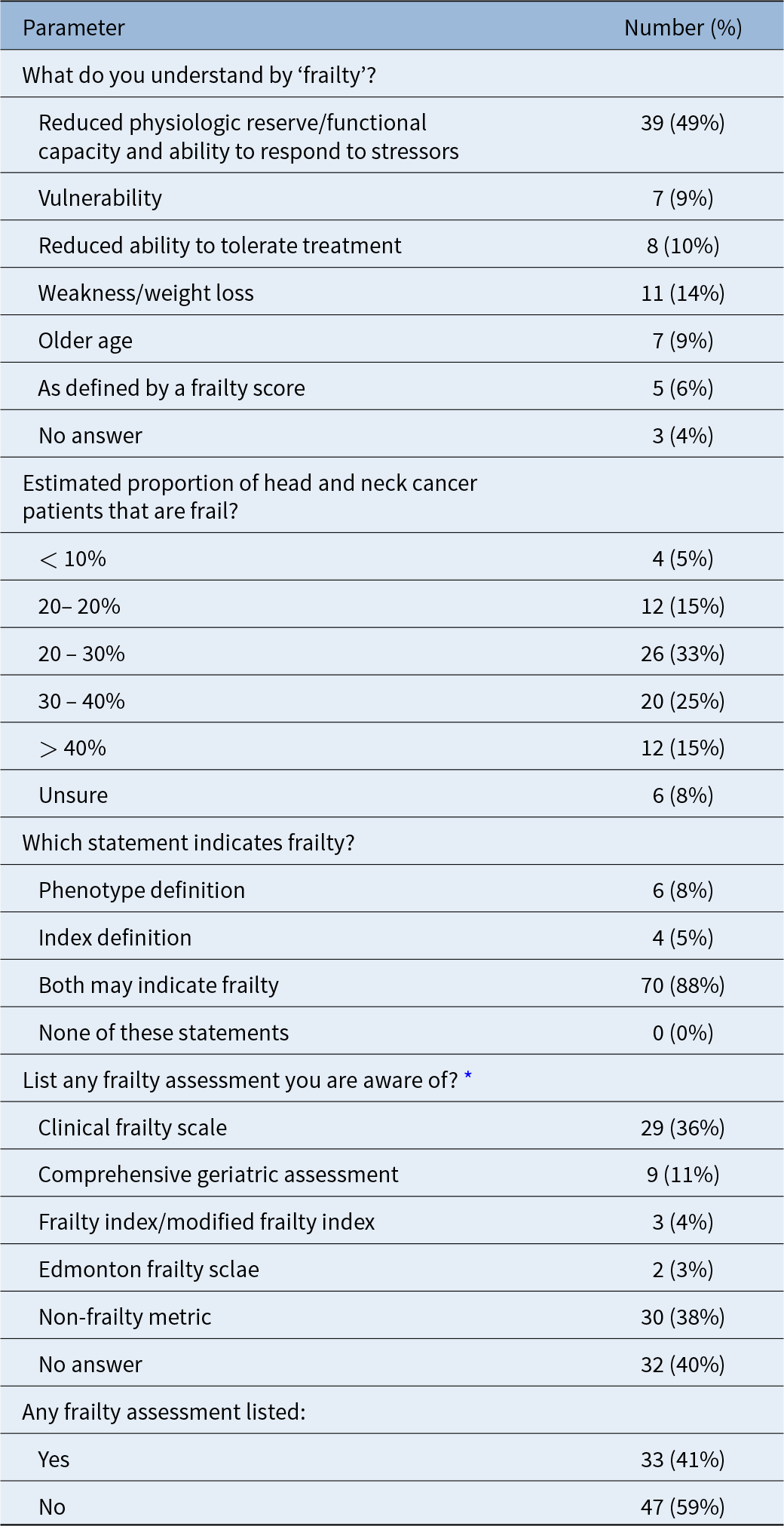
Seventy-three (91 per cent) participants indicated they had encountered frailty as a concept previously which was less than those who indicated having encountered multimorbidity (75 [94 per cent]) or malnutrition (74 [93 per cent]) concepts previously. When asked to describe what they personally understood by the term ‘frailty’, 39 respondents (49 per cent) described a reduced physiologic reserve or functional capacity and reduced ability to respond to stressors. Other answers described: a mixture of ‘vulnerability’ (7 [9 per cent]), reduced ability tolerate treatment (8 [10 per cent]), weakness / weight loss (11 [14 per cent]), older age (7 [9 per cent]) or ‘as defined by a frailty score’ (5 [6 per cent]). When provided with definitions of the frailty phenotype and index, 70 participants (88 per cent) identified both definitions may indicate patient frailty. No participant (0 per cent) responded that neither definition described frailty. Participants were asked to list any frailty assessments they were aware of. The Clinical Frailty Scale (CFS) was listed with the most frequency (29 [36 per cent]). Other frailty assessments listed were: CGA (9 [11 per cent]), Modified Frailty Index (3 [4 per cent]), Edmonton Frail Scale (2 [3 per cent]). Thirty items (38 per cent) listed indicated metrics unrelated to frailty, and 32 participants did not respond (40 per cent). The majority of participants (58 [73 per cent]) believed more than 20 per cent of head and neck cancer patients were frail in their practice (20–30 per cent: 26 [33 per cent]; 30–40 per cent: 20 [25 per cent]; greater than 40 per cent: 12 [15 per cent]) (Table 2).
Knowledge / awareness of frailty

* Multiple answers possible.
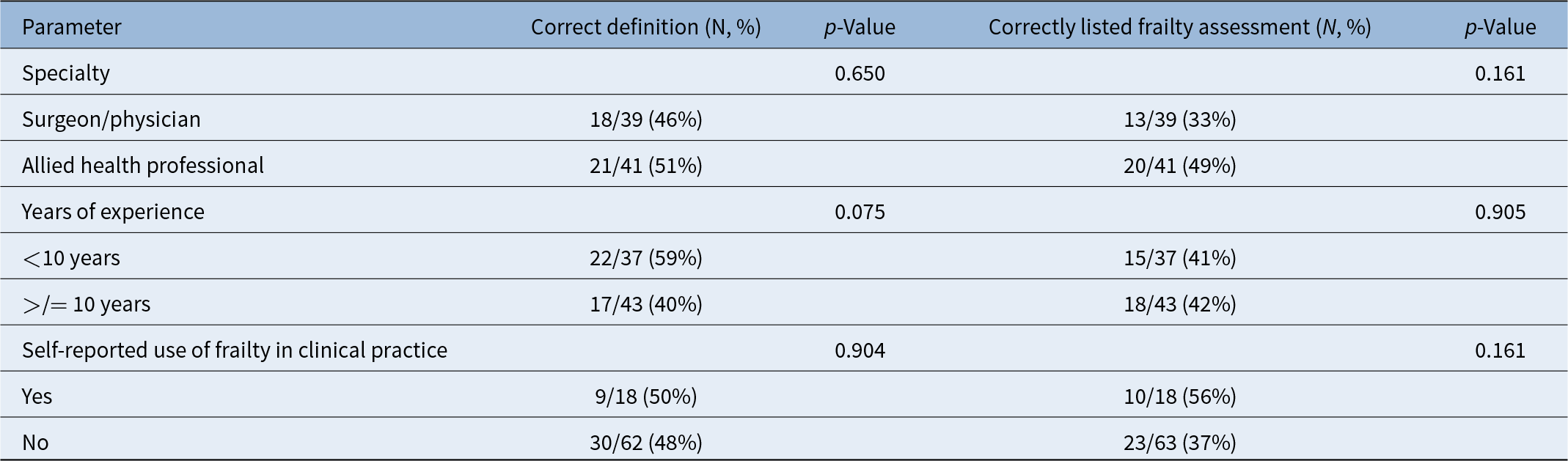
When compared by specialty (surgeon/physician vs. AHP) and years of clinical experience (less than vs. more than 10 years) there was no differences between groups ability to define frailty or list a valid frailty assessment (Table 3). Additionally, participants who self-reported use of a frailty assessment in clinical practice demonstrated a similar ability to define frailty or list a valid frailty assessment versus participants who did not self-report use of frailty assessment in clinical practice (Table 3).
Association of specialty and clinical experience with knowledge of frailty

Perceptions of frailty and its relevance in head and neck oncology care
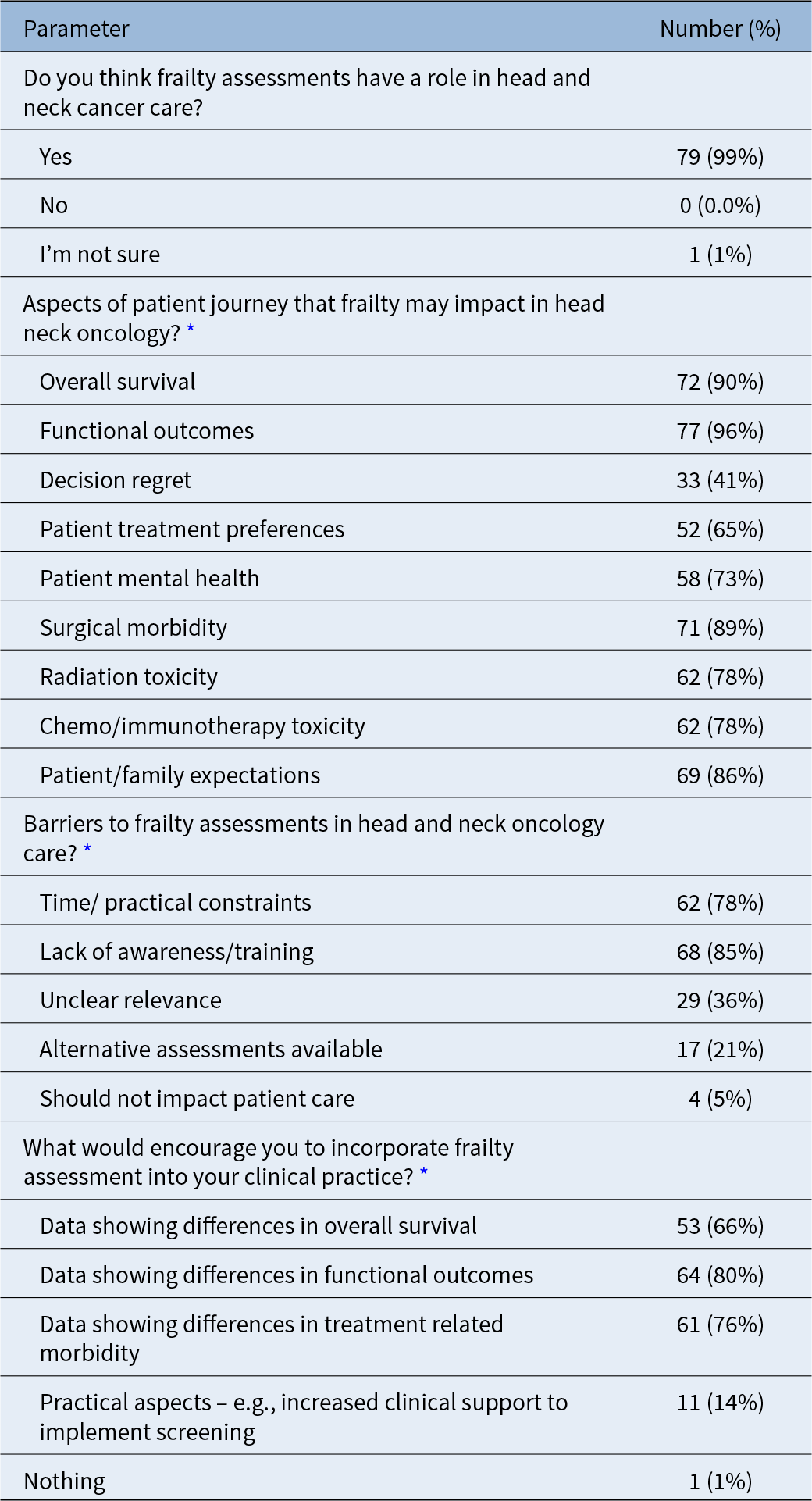
Seventy-nine (99 per cent) participants believed there was a role for frailty assessments in head and neck oncology care. Participants identified several aspects of the head and neck cancer journey which may be influenced by patient frailty. These included functional outcomes (77 [96 per cent]), overall survival (72 [90 per cent]) and setting patient and family expectations (69 [86 per cent]). More participants identified frailty as potentially impacting surgical morbidity (71 [89 per cent]) versus radiation toxicity (62 [78 per cent]) or chemo/immunotherapy toxicity (62 [78 per cent]). A lack of awareness or training regarding frailty was the number one barrier identified to incorporation of frailty assessments in head and neck oncology care (68 [85 per cent]). This was followed by time constraints (62 [78 per cent]) with other barriers identified being an unclear relevance (29 [36 per cent]), alternative assessment available (17 [21 per cent]) and a belief that frailty should not impact patient care (4 [5 per cent]). The most commonly identified theme identified that could encourage use of frailty assessment in head and neck oncology care was data demonstrating differences in functional outcomes (64 [80 per cent]) (Table 4).
Perceptions of frailty and its relevance in head and neck care

* Multiple answers possible.
Discussion
The most notable finding of the present study is that the overwhelming majority of multidisciplinary head and neck specialists surveyed believed frailty assessments may have a role in head and neck cancer care (79 [99 per cent]). Specifically, participants identified a variety of areas within a patient’s head and neck cancer journey that may be influenced by patient frailty such as treatment related toxicity, functional morbidity and overall survival which were well represented within participants answers (all >78 per cent). This may reflect participants’ awareness of the growing body of evidence within the literature to demonstrate the negative impact of frailty on these outcomes among patients diagnosed with a head and neck cancer.Reference Cleere, Hintze, Doherty, Timon, Kinsella and Lennon2, Reference Hurtado-Oliva, van der Laan, de Vries, Steenbakkers, Halmos and Wegner5, Reference Lu, Hung, Hsueh, Yeh, Hung and Chou14 Conversely, less than half of participants (33 [41 per cent]) believed patient decision-regret may be influenced by patient frailty. Approximately two-thirds believed patient treatment preferences may vary between frail and not frail patients (52 [65 per cent]) and most believed frailty may impact patient mental health (58 [73 per cent]). The present literature is more limited in the evaluation of frail patients’ treatment priorities and mental health. However, there is an indication that patients prioritise maintenance of independence as age advances and that frailty may be associated with post-operative depression after head and neck surgery.Reference Thomas, Sklar, Su, Xu, de Almeida and Gullane15, Reference Fahy, Cantwell, Patterson, Cherry, Rogers and Akpan16 Overall, these findings support that the multidisciplinary head and neck cancer specialists surveyed within this study believe frailty measurements to be of relevance across a variety of domains in head and neck cancer care. This is due to a belief that frailty will support a stratification of risk of adverse outcomes across various domains within the head and neck cancer patient pathway. It will be necessary for further work to develop a process to incorporate the assessment and knowledge of frailty into the shared-decision making process for patients with head and neck cancers.
Ninety-one percent of participants had awareness of frailty as a concept within medical care. However, when tasked with providing a definition of frailty only 39 participants (49 per cent) were able to provide an accurate definition (Table 2). Subsequent questioning demonstrated that participants were able to correctly identify that both a frailty ‘phenotype’ or frailty ‘index’ definition may indicate patient frailty. These findings may represent that many participants had a superficial awareness of frailty without a detailed knowledge of how it is defined, measured and what exactly constitutes a ‘frail’ patient. Further in support of this, 40 per cent of participants were unable to list any frailty assessment and less than 10 per cent listed CGA which is the gold-standard assessment of frailty. While not previously assessed in the context of head and neck professionals, prior studies have demonstrated varied awareness and knowledge of frailty in among health professionals.Reference Huang, Zhou, Feng, Li, Wang and Fang17, Reference Shafiee Hanjani, Fox, Hubbard, Gordon, Reid and Hilmer18 Interestingly, health professionals tended to overestimate their own knowledge and practical skills with regards to frailty.Reference Huang, Zhou, Feng, Li, Wang and Fang17 It is noteworthy that the most commonly identified frailty assessment was the clinical frailty scale developed by Rockwood et al.Reference Rockwood, Song, MacKnight, Bergman, Hogan and McDowell19 This may reflect an acceptance of healthcare professionals to use a simple and accessible metric in comparison to more lengthy, detailed and complex assessments, such as CGA.Reference Moreno-Ariño, Torrente Jiménez, Cartanyà Gutiérrez, Oliva Morera and Comet20 It appears from our findings that head and neck health professionals underlying knowledge regarding frailty and its assessment could be improved at present. This will be necessary prior to implementation of frailty assessments in clinical practice.
Only 18 (23 per cent) participants had prior experience of using frailty assessments in their practice. This indicates that, despite participants’ awareness of frailty and participants’ belief that a role exists for incorporation of frailty into head and neck care, there are current barriers to its use in clinical practice. Within our group of healthcare professionals, a lack of training / awareness of frailty (68 [85 per cent]) was the most cited barrier to the utilisation of frailty into clinical practice. This corresponds with previous data from non-head and neck cancer specific health professionals where a lack of previous experience and desire for further education has been highlighted.Reference Shafiee Hanjani, Fox, Hubbard, Gordon, Reid and Hilmer18, Reference Taylor, Fox, Shah, Ali, Hanley and Hyatt21 Our participants also frequently identified time or practical constraints (62 [78 per cent]) as a barrier to adding frailty assessments to patient care with comments such as “need a pathway to other services before implementation” “staffing concerns” and “oncological care is time sensitive” highlighted. Notably, only four (5 per cent) participants felt that a frailty assessment should not impact patient care which further supports that health professionals believe detecting frailty in head and neck cancer patients to be of relevance. It is evident that, in order to increase the number of healthcare professionals measuring and using frailty in their practice, education will need to be provided to healthcare professionals. Furthermore, healthcare pathways and services will need to be adapted to support both clinicians and patients to best use this additional risk stratification.
The main limitation of the present study is that the sample represents a convenience sample and may not be truly representative of the makeup of the multidisciplinary head and neck community. This comes with inherent potential bias and issues with generalisability outside either the local study area or a head and neck professional group.Reference Andrade22
Despite this limitation, this study is the first to evaluate head and neck health professionals’ knowledge and attitudes to frailty in their practice. Within this population, there appears to be a strong desire to include frailty assessments in clinical practice although its implementation in current practice is low with a lack of education and practical constraints limiting widespread usage. Future work should seek to establish how to educate clinicians regarding frailty. Additionally, it will be necessary to assess how clinicians wish to implement frailty into practice and potential methods to alter care pathways to support clinicians in implementing frailty assessment within head and neck oncologic care.
• Frailty has been demonstrated to be associated with worse outcomes in head and neck cancer
• This cross-sectional survey of multidisciplinary specialists evaluated understanding and perceptions of frailty in head and neck cancer care
• Head and neck health professionals are largely aware of frailty and believe it is of relevance in head and neck care
• Despite this, it is a rarely used metric in clinical practice (23 per cent of participants)
• Barriers to using frailty assessments in head and neck cancer care / decision making were practical constraints (78 per cent) and a lack of training (85 per cent)
Supplementary material
The supplementary material for this article can be found at https://doi.org/10.1017/S0022215126104307.
Data sharing statement
Data or code available on reasonable request from authors.
Funding
None.
Competing interests
None of the authors have any conflicts of interest to declare.