Background
Well-being has become a popular topic in recent years. Extensive research has been published on well-being and its determinants, focusing on a variety of groups, such as the general population across the life span and cultures (Carey, Reference Carey2013; Li & Fung, Reference Li and Fung2013), and people with various disorders including diabetes (Dimitraki & Karademas, Reference Dimitraki and Karademas2013), pain (Kratz et al. Reference Kratz, Hirsh, Ehde and Jensen2013) or HIV/AIDS (Earnshaw et al. Reference Earnshaw, Smith, Chaudoir, Amico and Copenhaver2013). In mental health research, the focus has often been on common mental disorders, such as burnout (Priebe & Reininghaus, Reference Priebe and Reininghaus2011), depression (Bellani et al. Reference Bellani, Nobile, Bianchi, Van Os and Brambilla2013; Lanfredi et al. Reference Lanfredi, Rossi, Rossi, Van Bortel, Thornicroft, Quinn, Zoppei and Lasalvia2013) or distress (Shepard & Sundermann, Reference Shepard and Sundermann2013). The importance of well-being for mental health research and practice is supported by research showing an association between well-being and improved functioning, increased resilience and life satisfaction (Fredrickson & Joiner, Reference Fredrickson and Joiner2002), and suggesting its protective value against the onset or re-occurrence of mental illness (Schueller & Parks, Reference Schueller and Parks2012).
Well-being is also important for people with serious mental illness, e.g. psychosis, especially in the context of recovery (Resnick & Rosenheck, Reference Resnick and Rosenheck2006; Slade, Reference Slade2010). In a systematic review of studies on psychosis, ‘well-being’ was used within a range of theoretical perspectives, with an unclear distinction from concepts such as health related quality of life, mental health, affect, life satisfaction, social adjustment and other psychological conceptualizations (Schrank et al. Reference Schrank, Bird, Tylee, Coggins, Rashid and Slade2013). Interventions to increase well-being in psychosis were highly diverse and not based on a coherent framework of well-being. The systematic review developed a static framework of well-being, based on the measurement of well-being in research involving people with psychosis. This static framework differentiates four domains of factors relevant to well-being: observable (visible behaviours and characteristics); non-observable (internal emotional and cognitive processes); proximal (factors under partial individual control in the immediate physical and social environment); and distal (factors beyond individual influence, in the more distant environment), as well as a separate rating of individual overall self-defined well-being.
The static framework offers an empirically defensible organizing structure for well-being research in psychosis, but does not illuminate the processes by which well-being is experienced or modified in this client group. This is an important omission, since understanding processes of change will identify the most promising target points for evidence-based interventions. The aims of the present qualitative study are (1) to validate the static framework of well-being by applying it to a second data source for triangulation and (2) to develop a dynamic framework of well-being to describe the process of changes involved in well-being.
Methods
Sample
A convenience sample of individuals with psychosis was recruited from community mental health teams in London in October and November 2012. We attempted to ensure diversity by recruiting individuals with a range of illness durations, gender and ethnic backgrounds. Recruitment was conducted with the goal of theoretical saturation, i.e. until additional interviews no longer led to the generation of additional categories (Willig, Reference Willig2008). Inclusion criteria were 18–65 years of age, a diagnosis of psychosis, using or having used mental health services, sufficient fluency in English and ability to give informed consent.
Procedures
Participants were recruited by a nurse at a depot clinic, and from research registers of two community mental health services. Diagnosis was identified from research registers or by the recruiting nurse and verified in person. One researcher (B.S.) conducted all interviews. The topic guide asked about the personal experience of well-being and its improvement. Follow-up prompts were used to stimulate in depth description of topics. The topic guide was iteratively adapted according to the concurrent analysis. Interviews lasted 20–70 min. All interviews were audio recorded, transcribed and anonymized. All participants were contacted and invited for a re-interview (conducted by B.S. and S.R.) to validate the emergent dynamic framework. These interviews lasted up to 20 min, and were recorded, repeatedly listened to, and relevant sections were transcribed for inclusion in the analysis.
Analysis
We began the analysis with theoretical assumptions about well-being based on a previous literature review conducted partly by the researchers involved in this analysis (Schrank et al. Reference Schrank, Bird, Tylee, Coggins, Rashid and Slade2013) but without an a priori hypothesis. The analysis followed three consecutive aims: (1) to identify a conceptual framework for the experience of well-being in people with psychosis, (2) to test the validity of current theory on well-being, in particular the static framework of well-being and (3) to then construct a refined and revised version of the conceptual framework identified in the current analysis.
Transcripts were coded using NVivo9, a computer software package that helps qualitative researchers to organize large volumes of data and facilitates deep levels of analysis in complex data. The analysis is not conducted by the software but remains done by the researchers. We applied thematic analysis used a combination of inductive and theoretically driven techniques (Braun & Clarke, Reference Braun and Clarke2006). The rigour of the analysis was enhanced by using techniques taken from grounded theory including iterative inductive coding, line-by-line coding, constant comparison, the use of memos throughout the analysis process, as well as the use of summary tables to organize clusters of topics for each participant (Willig, Reference Willig2008).
Themes from the first round of interviews were identified, coded and checked for fidelity in an inductive process. This process involved iterative coding following regular inspection of the data and discussion among researchers, leading to an increasingly refined organization of data into emerging thematic entities. The initial descriptive analysis stage was followed by an interpretative stage. To interpret and understand the meaning of participant's experience, we drew on a range of existing theoretical constructs. At this stage, we also deductively applied the static framework of well-being onto the data to establish its validity. Clusters of categories were named, partly using participants' own words and partly by introducing existing formulations on higher levels of analysis. As the aim of the study was to understand a process, a coding paradigm was introduced, i.e. the emergent framework was applied to each participant to test and optimize its validity. This involved the generation of summary tables capturing the interplay between the framework categories identified for each participant. Two raters (B.S. and V.B.) independently coded transcripts, and the analysis was regularly discussed among the research team. Alternative interpretations, groupings of categories and interrelations between them were discussed, consensus reached, and the emerging framework was adapted in an iterative process. The re-interviews were analysed in the same way to identify themes that confirm, contradict or extend the framework.
Results
Sample
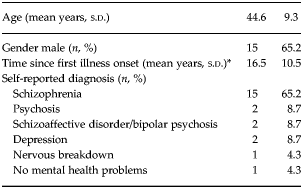
A total of 23 participants were interviewed, of whom 13 agreed to be re-interviewed. The respondent validation identified no changes to the results. Characteristics of participants are shown in Table 1.
Sociodemographic and clinical characteristics of participants (n = 23)

*Two participants excluded due to invalid response
Aim 1: Validation of the static framework of well-being
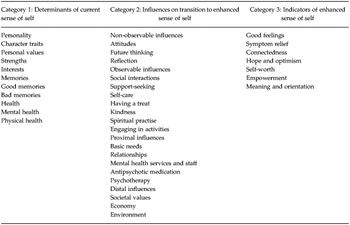
The coding framework for influences on transition to an enhanced sense of self is shown in column 2 of Table 2.
Coding framework for well-being

The four elements of the static framework (non-observable, observable, proximal and distal) provided an adequate organizing framework to allow full categorization of the influences on the transition to an enhanced sense of self identified by participants. This transition represents a process of enhancing well-being, providing independent validation of the static framework.
Aim 2: Development of a dynamic framework of well-being
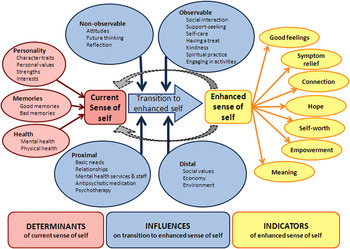
Participants described well-being as a desirable state, which needed active input to be achieved and also to be maintained. Well-being was tied to participants' sense of self and involved transition from a current sense of self, described as deficient at least in some of its aspects, towards an enhanced sense of self. The attainment of this enhanced sense of self was perceived as increased well-being, and attributed to the successful transition. This process followed a common pattern, which forms the dynamic framework of well-being. Three superordinate categories were identified in the coding framework: determinants of current sense of self (the participant's starting point at any given stage of development); influences on transition to enhanced sense of self (the change process involved in improving well-being); and indicators of enhanced sense of self (how well-being is experienced by participants). Specific factors identified as implicated in the transition – the determinants, influences, and indicators – varied across individuals both in quality and quantity. These factors were linked to personal values, and the values attached to specific factors differed between people and in an individual over time. Different areas of life were associated with a differing sense of self, i.e. rather advanced stages in a specific area could coexist with poor sense of self in other areas.
Figure 1 shows the dynamic framework of well-being, illustrating the direction of change and the relationship between the three superordinate categories. It illustrates the interplay of factors on a person's trajectory towards well-being and the dynamic nature of the process. As soon as an enhanced sense of self has been achieved, this becomes the new current sense of self allowing further development, e.g. in other aspects of the self that are perceived as deficient, to start from there. This makes the striving for well-being in individuals an iterative and ongoing process, which can also suffer setbacks, e.g. in case of a psychotic relapse, and may then have to be picked up a gain at a lower level than before.
Dynamic framework of well-being.

Category 1: Determinants of current sense of self
Personality
Personality was important for defining current sense of self. It also explained the nature of the desired enhanced sense of self and the perceived routes towards it. Personality was described as comprising character traits, personal values, strengths and interests. Values included things like having money, status symbols, a specific religious denomination, positivity, continuity or social responsibility. Acting on strengths and interests was generally perceived as rewarding.
‘I'm a writer, I'm an author, and I like it when people like my books. I feel very good when I'm writing. I like all things about that. Writing makes me feel good’. (#1)
Memories
Memories of personally important experiences shaped current sense of self. They included upbringing, country of origin, relationships, health care and activities. Good memories could provide hope or simply be an indulgence which yields positive feelings. Although negative memories may damage current sense of self, they could also yield increased motivation for change and achievement.
Health
Participants connected physical health with their current sense of self. Illness symptoms or pain had a negative impact. Obesity was a particularly prominent concern. Being connected to antipsychotic medication, obesity was perceived as frustrating, conveying a sense of powerlessness and a negative self-image. Accepting obesity required great personal effort and losing weight was among the most frequently mentioned wishes in order to attain enhanced sense of self.
‘The problem of obesity it puts me down sometimes, it's not good for my well-being. There is no way I can reduce my weight because I have to keep on with the medication, and it started making me feel very sad and disappointed.’ (#13)
Mental health symptoms could interfere with any important aspect of life and impair the current sense of self. They impeded transition to enhanced sense of self, e.g. by impairing concentration or motivation. Mental health symptoms were even defined as the opposite of well-being, especially suicidality, threatening delusions or serious substance abuse.
‘Because of the condition I just completely drop everything and I just give up and I lock myself inside for weeks and barely eat and forget to call my family, my parents, my kids, don't even look after myself properly. Sometimes I have passed weeks without showering and my house became a big mess.’ (#6)
However, one participant also reported goals of solving various world problems so as to enhance sense of self by providing meaning and self-worth.
Category 2: Influences on transition to enhanced sense of self
The change process involved in improving well-being represented a ‘transition to enhanced sense of self’. The factors influencing the transition occurred on the four levels of the static framework: non-observable, observable, proximal and distal.
Non-observable influences
Internal change processes pertained to attitudes, future thinking and reflection. Examples of adaptive changes in attitudes included assuming more positive thinking styles, revising self-expectations, learning to acknowledge own abilities, and engaging in downward rather than upward social comparison.
‘I know they say ‘compare to despair’ but the opposite is true as well. So it's ‘compare and be grateful for what you've got’.' (#21)
Future thinking (both realistic and unrealistic) can facilitate transition. Although goals provided a frame of references, an anchor for coping and achievement, dreams conveyed an imagined sense of normality and comfort, also leading to enhanced sense of self.
‘If I had a job, I'd work my hardest to get to the top and be the managing director of the company, if that was possible. For me it never was possible, so it's a dream. It's a dream that leaves me with hope. Once you got hope, you can keep the faith.’ (#4)
Reflection, for example through therapy, meditation, writing or chatting, was deemed indispensable for the transition to an enhanced sense of self. Positive effects included insight, new perspectives, orientation and motivation, and better problem solving. It also helped to appreciate achievements, embrace limitations and find forgiveness. Forgiveness was a particularly complex topic, susceptible to conceptual confusion and difficult to achieve, but it held the potential to relieve tension, be empowering and help to move on in life. It was deemed positive especially when construed as forgiving oneself.
Observable influences
This category comprises visible behaviours and activities, such as social interactions, support-seeking, self-care, having a treat, kindness and spiritual practise. Re-establishing connections was challenging but an important and ultimately rewarding task. Related processes included overcoming social anxiety, practising social skills and finding activities with other people. In particular, social interaction with non-service users seemed to facilitate transition. Proposed ways to receive support, feedback or acknowledgement were strongly tied to social contact and positive relationships, e.g. with family, mental health professionals, or in faith communities, voluntary work or other spare-time activities.
‘I get reassurance from family and the doctors and that keeps my well-being up, you know, I feel that I'm ok, so long as I get the reassurance from people.’ (#15)
Self-care included establishing a daily structure, personal hygiene, and eating regular healthy meals, but also resisting alcohol, drugs or nicotine or monitoring one's physical fitness and weight.
Having a treat went beyond self-care. For example, while healthy, regular eating was deemed part of self-care, indulging in the experience of good food may serve as a treat. It can be a ‘bonus’ to generate positive feelings, aid relaxation and enliven one's daily structure.
‘You can listen to a happy song, you can blast the radio on and have a nice shower and wash your hair with the radio on. You can put moisturizer on, that's important as well.’ (#9)
Kindness, involving doing something for others, was perceived as rewarding, satisfying and profoundly enhancing of sense of self. Kindness, attention and care could be addressed towards anyone, but family members such as parents, children and grandchildren seemed particularly important.
‘I look after my grandchildren, and I help other people. I always loved to help people.’ (#10)
Spiritual practice, such as church, mosque, private meditation or prayer, helped enhance sense of self through a number of pathways including the establishment of sympathetic social contact and feelings of comfort, security and orientation, improving insight and supporting personality development.
‘Going to church I get to mix with my brethren, find people to talk to, not being on my own, listen to the lovely sermon, singing, you know, that gives me comfort.’ (#23)
Activities, if they matched needs and interests, also had a range of positive effects from aiding daily structure to directly increasing self-worth. Leisure activities were perceived as particularly positive when coupled with social connection. Among the specific activities, having paid employment was most highly valued. However, most participants were long-term unemployed so volunteering was considered the second most rewarding activity.
‘I do voluntary work with older people. It makes me feel good that I'm doing something.’ (#22)
Proximal influences
This category comprises factors under limited personal control, including basic needs, relationships, antipsychotic medication, psychotherapy, and mental health services and staff. Having basic needs met, including a place to live, not being hungry, and having sufficient money, was deemed essential for any positive development.
Relationships were particularly important to all participants. Supportive, validating, reciprocal relationships were ascribed a multitude of positive effects. Good relationships with family were paramount as family gave unconditional support.
‘There's no substitution for family. Family do things that friends wouldn't do, sometimes friends initially also help you but family are always there and help you no matter what.’ (#5)
Identified sources of happiness included children and grandchildren and having a partner. An intimate life partner or sex life was intensely wished for, and often considered as something essential, potentially life-changing and boosting sense of self, both by those who had already experienced intimate partnerships as well as by those who had not.
There were conflicting views about antipsychotic medication. Participants talked about rejection, ambivalence, resignation and about a process of acceptance. Although medication could be vital for functioning and the basis for positive development, it may also have debilitating side effects; and being able to live without medication was among the main visions for an enhanced sense of self.
Psychotherapy facilitated a multitude of positive adaptations leading to enhanced sense of self. Group therapy or peer support in addition had the reassuring and identity enhancing effect of sharing problems with others who had similar experiences. Mental health services were perceived as a source of support despite possibly serious harmful effects on identity, e.g. of involuntary treatment. Specific staff members, especially those conveying a sense of connection and mutual understanding, were described as a supremely positive influence on personal development.
‘She just understands me and the way she talks to me is like, she doesn't seem like a therapist but more like a daughter. She talks to me very nicely and what I found with her, I just opened up; I never hold nothing back from her.’ (#11)
Distal influences
This category comprises factors beyond an individual's influence, including societal values, economy and environment. Society was described to facilitate the change process by providing options and opportunities, e.g. access to leisure activities or education.
‘It's having these opportunities to do things because when one is unwell one doesn't see the opportunities that there are.’ (#17)
More generally, societal values provided a frame of reference and a sense of order and security. The economy was especially challenging for participants, many of whom were unemployed and dependent on social welfare, e.g. disability allowance. The economic recession was mentioned as a source of insecurity. Experiencing the environment, e.g. sunshine, a walk in the park or even television programmes about the natural wonders of the planet, may impact positively on mood and even create a sense of serenity.
‘When I see all of the beauty of nature, it makes me feel calmer in the inside.’ (#20)
Category 3: Indicators of Enhanced sense of self
Seven indicators of an enhanced sense of self were identified, as shown in Fig. 1.
Good feelings or happiness in general were most frequently mentioned indicators of an enhanced sense of self. Naming specific positive emotions was often difficult, but participants mentioned comfort, solace, calmness, relaxation, peace of mind, contentment and serenity. Positive bodily feelings, such as feeling well after exercise or feeling attractive, also indicated improved well-being, as did having fun.
Symptom relief was discussed by all participants as profoundly tied to enhanced sense of self. It was often seen as the basis of well-being or even as a basis of life. If symptoms remained then improved coping was essential.
‘You're not letting the voices or paranoia control you, you're doing what you want to do. Well-being to me is, even if you're paranoid you still get on and do things.’ (#22)
Feeling connected with others, being a valued part of a relationship or group, and especially feelings of love amplified the sense of self.
‘When there are people asking for my service that makes me feel good, makes me feel worthwhile, and I get more connected with people from the project I am doing. These people need me and I have to provide for them. So there is this attachment, a strong bond which connects us.’ (#3)
Having hope and optimism was described as a further fundamental indicator of enhanced sense of self. Hope was not only an important outcome, but also a trigger for further positive developments, a force that kept people going despite potential setbacks.
‘If you have hope you know you have a future, and only then your life has value.’ (#19)
Self-worth was characterized as feeling whole, a positive self-image, self-acceptance, self-esteem, self-confidence, a sense of achievement, satisfaction and a sense of normality.
‘When you've done your best and you're happy with it and you have accepted who you are and where you are going in life.’ (#14)
Empowerment was described as a sense of self-determination, control and freedom, as having inner strength, agency and being able to do what is important in life.
‘Well-being for me means doing things as an autonomous individual.’ (#7)
Having meaning in life was described as having a frame of reference, e.g. a valued societal role or religion.
‘I'm a representative for the low support unit […] It makes me feel good doing it, I feel a sense of comfort and purpose when I'm doing it because I'm not only doing it for me, I'm doing it for other people. Other people who don't want to speak, I can speak on their behalf, I convey it back to the council and see if we can come up with some suggestions that might help. (#12)
Discussion
This study found that the process of improving well-being in people with psychosis was strongly tied to sense of self. Current sense of self was determined by three influences: personality, memories and health. Improving well-being was an ongoing process in which the current sense of self undergoes a transition towards an enhanced sense of self. Influences that impact on this transition could be categorized according to the domains of the static framework of well-being: observable, non-observable, proximal and distal (Schrank et al. Reference Schrank, Bird, Tylee, Coggins, Rashid and Slade2013). Participants described an enhanced sense of self as equivalent to improved well-being. The indicators of enhanced sense of self comprised good feelings, symptom relief, connection, hope, self-worth, empowerment and meaning. The enhanced sense of self may then facilitate transition in other areas in an iterative fashion. Factors involved in the process varied in quality and quantity, both across individuals and over time.
Aim 1: To validate the static framework of well-being
Factors influencing transition to enhanced sense of self were consistent with, and therefore validated, the static framework of well-being. The place of the static framework as an organizing structure for influences on the transition illustrates the previously identified challenge of defining the concept (Schrank et al. 2013a). The static framework is based on assessment measures for well-being. These tools often contained items that conflated factors that influence well-being and well-being itself. For example, the latest measure of population well-being developed by the Office of National Statistics in the UK includes wealth in combination with economic, social and environmental factors (Self et al. Reference Self, Thomas and Randall2012). Other recent concepts of well-being have combined what would be both influences on and indicators of well-being according to the results of our study, such as the PERMA model of individual well-being, which contains positive emotions, engagement, relationships, meaning and accomplishment (Seligman, Reference Seligman2011).
None of the existing measurement tools or interventions to improve well-being described in the literature span all possible influences on well-being (Schrank et al. Reference Schrank, Bird, Tylee, Coggins, Rashid and Slade2013). Interventions to improve well-being have been tested in various client groups. These have focused on one of the influences, such as neighbourhood economic status (Ludwig et al. Reference Ludwig, Duncan, Gennetian, Katz, Kessler, Kling and Sanbonmatsu2012), or physical exercise (Gademan et al. Reference Gademan, Deutekom, Hosper and Stronks2012), or on specific combinations of some influences such as physical and activity, health behaviour and social engagement (Clare et al. Reference Clare, Hindle, Jones, Thom, Nelis, Hounsome and Whitaker2012).
Aim 2: To develop a dynamic framework of well-being
The dynamic framework indicates that conducive circumstances and personal effort can lead to an upward spiral of positive development and continuously increased well-being. A similar upward spiral has been found for the beneficial effect of positive emotions and a broad thought-action repertoire, which may amplify each other to counteract the detrimental effects of negative emotions and contribute to resilience (Luthans et al. Reference Luthans, Avolio, Avey and Norman2007). While an upwards spiral is certainly not without a ceiling, especially given the likelihood of setbacks in the context of severe mental illness and the potential existence of areas resistant to positive change, the conceptualization of well-being in the dynamic framework provides a strength- and resource-oriented supplement to deficit-oriented approaches in mental health care. This places the framework in the context of resource oriented approaches and positive psychology (Waterman, Reference Waterman2013).
Substantial overlap exists between different positively oriented concepts (Caprara et al. Reference Caprara, Steca, Alessandri, Abela and Mcwhinnie2010). Conceptual overlaps exist between well-being and other concepts describing a good life, including quality of life, personal growth and self-actualization or life satisfaction (Schrank et al. 2013a). Similarly, different positively framed, i.e. resource oriented, therapy models utilize overlapping types of resources, such as social relationships, strengths, self-actualization techniques or recreational activities (Priebe et al. Reference Priebe, Omer, Giacco and Slade2013). In practise, using specific positive approaches may well have a spill-over effect on additional positive outcomes besides the explicitly targeted one (Schrank et al. Reference Schrank, Bird, Tylee, Coggins, Rashid and Slade2013). However, more conceptual work may be needed to analyse overlapping positive intervention models and their overlapping outcomes (Priebe et al. Reference Priebe, Omer, Giacco and Slade2013).
Most prominently, the concepts of well-being and recovery do overlap (Amering, Reference Amering2012). For example, recovery processes identified in a systematic review were connectedness, hope, identity, meaning and empowerment (Leamy et al. Reference Leamy, Bird, Le Boutillier, Williams and Slade2011). These recovery processes mirror the indicators of enhanced self. However, the indicators in the dynamic framework in addition include symptom relief and, most prominently, good feelings. Well-being is also frequently mentioned as an important goal of recovery orientation in service provision (Le Boutillier et al. Reference Le Boutillier, Leamy, Bird, Davidson, Williams and Slade2011; Slade et al. Reference Slade, Leamy, Bacon, Janosik, Le Boutillier, Williams and Bird2012). This suggests a conceptual convergence of recovery and well-being. The two approaches may ultimately coincide when both are applied effectively. If the aim of mental health services is to support recovery, then this may involve a re-orientation towards mainstream sources of well-being. From a recovery perspective, it has been argued that mainstream solutions should be preferred over specialist solutions to mainstream problems (Slade, Reference Slade2012). For example, supported exposure to social environments is preferable to social skills training for people who want more friends. By analogy, everyday sources of well-being – such as employment, friendship, exercise, sex or prayer – are as important for people experiencing psychosis as for any other group in society. This is consistent with the ‘Transcendent principle of personhood’ – ‘people with severe mental illness are people’ (Anthony, Reference Anthony2004). Emphasizing commonality in sources of well-being between people with and without psychosis may be more helpful than identifying diagnosis-specific sources of well-being.
Clinical implications
The four dimensions of influences on the transition can serve to identify targets for clinical interventions to improve well-being in people with psychosis. Distal influences, such as socio-economic status or green areas, have been shown to impact on well-being and mental health service use (Curtis, Reference Curtis2007; Losert et al. Reference Losert, Schmauss, Becker and Kilian2012), but they will be the focus of population level interventions rather than mental health services. Feasible interventions exist for the remaining three dimensions. Proximal influences may be addressed through promoting recovery orientation in care teams (Slade et al. Reference Slade, Bird, Le Boutillier, Williams, Mccrone and Leamy2011), systemic therapies focusing on family relations (Gottlieb et al. Reference Gottlieb, Mueser and Glynn2012), supporting social networks (Gayer-Anderson & Morgan, Reference Gayer-Anderson and Morgan2012; Sundermann et al. Reference Sundermann, Onwumere, Bebbington and Kuipers2012), or interventions to help meet basic needs (Fisher & Elnitsky, Reference Fisher and Elnitsky2012). Observable influences may be targeted using goal setting interventions (Le Boutillier et al. Reference Le Boutillier, Leamy, Bird, Davidson, Williams and Slade2011) or relaxation techniques (Vancampfort et al. Reference Vancampfort, Correll, Scheewe, Probst, De Herdt, Knapen and De Hert2013). Using interventions in a group format may further support the application of observable influences such as social interaction, mutual support or kindness. Non-observable influences may be addressed through cognitive behavioural and related therapeutic approach such as mindfulness (Langer et al. Reference Langer, Cangas, Salcedo and Fuentes2012), acceptance and commitment therapy (Pull, Reference Pull2009), or schema therapy (Masley et al. Reference Masley, Gillanders, Simpson and Taylor2012), as well as humanistic approaches which focus on finding meaning.
The fact that our purposive sampling strategy led to a heterogeneous sample of people with a long history and a large standard deviation of onset of illness, means that our results are likely generalizable to a diverse clinical population of people with psychosis. It also stresses the importance of acknowledging individual differences, as not all factors will equally apply to every client with psychosis. Our findings support the assumption that focusing on a specific set of influences is likely to be unsuitable for any heterogeneous groups of people (Purgato & Adams, Reference Purgato and Adams2012). More flexible, values- and interest-based interventions are most likely to be successful. The importance of attending to individual values in the treatment of people with mental disorders has been widely acknowledged (Barbui & Cipriani, Reference Barbui and Cipriani2011). Given the variability of individually important influences for well-being, a flexible approach focusing on strengths and positive experiences may be most promising.
An understanding of how adaptive processes unfold that lead to improved well-being is clinically important. This paper focused on the development of an overall framework to describe the dynamics of well-being in people with a diagnosis of psychosis. The next stage of research will involve the development of a detailed understanding of the identified change process. This will require qualitative research involving people who currently undergo or have recently undergone changes in well-being (Carey et al. Reference Carey, Carey, Stalker, Mullan, Murray and Spratt2007). Promising theoretical bases exist for understanding change processes, such as cognitive behavioural theory (Bandura, Reference Bandura1977) or Perceptual Control Theory (Carey, Reference Carey2011). Further investigation of change processes in relation to well-being may also be possible as part of the process evaluation of an intervention aiming to increase well-being in this client group.
Research implications
Interventions that target influences on the transition have been variably tested in people with psychosis. Currently, no structured intervention exists for this client group which is directed at a combination of influences and explicitly targets well-being. Positive psychotherapy (PPT) is an intervention, which simultaneously addresses a number of influences on the transition in order to improve well-being with promising results in healthy people and those with mild and common mental disorders (Rashid, Reference Rashid and Lopez2008). It focuses on individual strengths and positive experiences and provides a framework that allows for flexibility to work on individually relevant and valued influences on well-being. PPT may be a promising candidate intervention to also improve well-being in people with psychosis. The specific adaptation and evaluation of PPT in people with psychosis should be a target for future research.
This study provides an empirically defensible framework for understanding well-being in terms of determinants, influences and indicators. The influences are targets for interventions to improve well-being, and the indicators are outcome domains to assess the effectiveness of services in supporting well-being.
Financial Support
The study was funded by Guy's & St Thomas' Charity (Ref G101016). Mike Slade receives salary support from the National Institute for Health Research (NIHR) Biomedical Research Centre for Mental Health at South London and Maudsley NHS Foundation Trust and Institute of Psychiatry, King's College London. The views expressed are those of the author(s) and not necessarily those of the NHS, the NIHR or the Department of Health.
Conflict of Interest
The authors declare no conflict of interest.
Ethical Standards
The authors assert that all procedures contributing to this work comply with the ethical standards of the relevant national and institutional committees on human experimentation and with the Helsinki Declaration of 1975, as revised in 2008.