Introduction
Weeds are the most costly and damaging pest to crops in the United States (Oerke Reference Oerke2006). In recent years, herbicide-resistant weeds have made soybean [Glycine max (L.) Merr.] production more difficult. Currently the state of Indiana has 18 reported weed biotypes that are resistant to herbicides (Heap Reference Heap2020). Using an integrated approach to manage weeds will be necessary as resistance issues continue to increase, with problematic weeds, such as waterhemp, now having resistance to five site-of-action groups (Evans et al. Reference Evans, Strom, Riechers, Davis, Tranel and Hager2019). The failure of herbicides to control herbicide-resistant weeds has led to the development of genetically modified crops that are resistant to herbicides such as glyphosate, glufosinate, isoxaflutole, dicamba, and 2,4-D. Soybean varieties resistant to 2,4-D were commercialized in 2019, and it is anticipated that their acreage will grow rapidly due to high efficacy on glyphosate- and acetolactate synthase (ALS)-resistant broadleaf weed species, commonly found in soybean production.
The addition of 2,4-D to glufosinate has resulted in at least 94% control of both glyphosate-resistant and -susceptible waterhemp [Amaranthus tuberculatus (Moq.) Sauer] at heights up to 35 cm, demonstrating the usefulness of these Enlist E3® soybean varieties (Corteva Agrisciences, Indianapolis, IN), which confer resistance to both 2,4-D and glufosinate (Craigmyle et al. Reference Craigmyle, Ellis and Bradley2013). Glyphosate-resistant and 2,4-D-tolerant Palmer amaranth (Amaranthus palmeri S. Watson) was controlled better with glyphosate in combination with 2,4-D choline compared with 2,4-D amine or glyphosate alone, to which some Palmer amaranth biotypes have tolerance, demonstrating the benefit of Enlist E3® soybean for Palmer amaranth management (Spaunhorst and Johnson Reference Spaunhorst and Johnson2017). Chahal and Johnson (Reference Chahal and Johnson2012) and Kruger et al. (Reference Kruger, Davis, Weller and Johnson2010) documented that the addition of 2,4-D to glyphosate provided significant reductions in glyphosate-resistant horseweed [Conyza canadensis (L.) Cronquist] biomass, showing the advantage of using 2,4-D for horseweed control in soybean. Additionally, Robinson et al. (Reference Robinson, Simpson and Johnson2012) observed that applications of 2,4-D in combination with glyphosate provided 97% control of several problematic weeds in soybean, including velvetleaf (Abutilon theophrasti Medik), waterhemp, giant ragweed (Ambrosia trifida L.), and common lambsquarters (Chenopodium album L.).
However, buffer areas, which do not receive postemergence (POST) applications of 2,4-D, are required for 2,4-D-resistant soybean. Buffer areas of 9 m in length between downwind sensitive areas and areas sprayed with 2,4-D are required by the label (Anonymous 2017). Managing Group 5 (ALS), 9 (glyphosate), and 14 (PPO)-resistant weeds in these buffer areas, where 2,4-D applications are not permitted, will be challenging. Cover crops may be a useful method of weed suppression within these buffer areas. Cover crops used with appropriate herbicide strategies to control weeds have been studied by a number of other researchers (Loux et al. Reference Loux, Dobbels, Bradley, Johnson, Young, Spaunhorst, Norsworthy, Palhano and Steckel2017; Mock et al. Reference Mock, Creech, Ferris, Faghihi, Westphal, Santini and Johnson2012; Reeves et al. Reference Reeves, Price and Patterson2005; Yenish et al. Reference Yenish, Worsham and York1996). Loux et al. (Reference Loux, Dobbels, Bradley, Johnson, Young, Spaunhorst, Norsworthy, Palhano and Steckel2017) reported that cover crops without herbicides provided only 14% control of waterhemp compared to 83% control with a preemergence (PRE) followed by POST herbicide programs averaged across sites. Reddy (Reference Reddy2001) observed that cover crops used with a PRE-only herbicide resulted in lower cash crop yields compared to a no-cover crop conventional tillage system. However, when used in tandem with a POST herbicide application to control late-emerging weeds, negative impacts on yield were only observed when Italian ryegrass [Lolium perenne L. ssp. multiflorum (Lam.) Husnot] was used as a cover crop.
Davis et al. (Reference Davis, Gibson, Bauman, Weller and Johnson2007) reported that a winter wheat (Triticum aestivum L.) cover crop provided similar horseweed suppression 4 mo after in-crop applications compared to suppression following a spring- or fall-applied residual herbicide across two years. Christenson (Reference Christenson2015) reported that horseweed suppression with cereal rye (Secale cereale L.) was similar to that of all herbicide treatments. However, winter wheat and winter barley (Hordeum vulgare L.) were not as effective at suppressing horseweed. Cholette et al. (Reference Cholette, Soltani, Hooker, Robinson and Sikkema2018) reported correlations of cover crop ground cover and biomass with horseweed density (0.17 and 0.21, respectively) and biomass (0.30 and 0.40, respectively). Teasdale et al. (Reference Teasdale, Beste and Potts1991) also reported a correlation between cover crop biomass and weed density in Maryland of large crabgrass [Digitaria sanguinalis (L.) Scop.], goosegrass [Eleusine indica (L.) Gaertn.], stinkgrass [Eragrostis cilianensis (All.) Vign. ex Janchen], carpetweed (Mollugo verticillata L.), and common lambsquarters (r 2 = 0.75 at the 0.01 level). Weed suppression via cover crops can also reduce the selection pressure applied to weed species by reducing the number of weeds exposed to herbicide applications. Furthermore, cover crops are included in best management practices to reduce herbicide resistance, as described by Norsworthy et al. (Reference Norsworthy, Ward, Shaw, Llewellyn, Nichols, Webster, Bradley, Frisvold, Powles, Burgos, Witt and Barrett2012).
When implementing cover crops in a production system, it is important to manage appropriately, as corn yield reductions up to 36% have occurred after a rye cover crop (Johnson et al. Reference Johnson, Defelice and Helsel1993). Creech et al. (Reference Creech, Ferris, Faghihi, Westphal, Santini and Johnson2008) also observed 11% reductions in corn yield in Indiana when annual ryegrass (Lolium multiflorum Lam.) or winter wheat cover crops were used for winter annual weed control. Other researchers have reported increases in corn yield when legume species, such as white clover (Trifolium repens L.), red clover (Trifolium pratense L.), or barrel medic (Medicago truncatula Gaertn.), are used as cover crops in corn production (Hively and Cox Reference Hively and Cox2001).
If cover crops are to be grown on a large number of acres, it is important that they be used in addition to other technologies, such as 2,4-D-resistant soybean. This research was conducted to determine if cover crops can be used to enhance weed control in label-mandated buffer areas in 2,4-D-resistant soybean. The effectiveness of three cover crops, terminated at three timings, with three different herbicide strategies, was evaluated for their impact on both weed control and soybean yield at three locations in Indiana.
Materials and Methods
Site Description
Field trials were conducted at three locations in Indiana in 2018 and 2019 to evaluate weed suppression and the impact on yield provided by three cover crops, terminated at three different times, with three different herbicide strategies. Experiments were conducted at the Throckmorton Purdue Agricultural Center (TPAC), near Lafayette, IN (40.29°N, 86.91°W); the South East Purdue Agricultural Center (SEPAC), near Butlerville, IN (39.03°N, 85.53°W); and the Davis Purdue Agricultural Center (DPAC), near Farmland, IN (40.26°N, 85.16°W). The TPAC soil was primarily a Toronto-Millbrook complex that has historically been tilled. The soil at TPAC had an organic matter (OM) of 2.6% with a pH of 6.3 and a cation exchange capacity (CEC) of 10.6 meq 100 g−1. The SEPAC location was predominantly a Cobbsfork silt loam that was poorly drained. The SEPAC soil had an OM of 1.7%, a pH of 6.1, and a CEC of 5.6 meq 100 g−1 and is in no-till management. The DPAC location primarily had a Pewamo silty clay loam that was also in no-till management. The DPAC soil had an OM of 3.6%, a pH of 6.0, and a CEC of 15.8 meq 100 g−1.
Experimental Design and Herbicide Treatments
The experimental design was a split block with a factorial arrangement of treatments and four replications. The main blocks were the three cover crops, which included cereal rye, crimson clover (Trifolium incarnatum L.), and an 80:20 by weight mixture of the two that is hereinafter referred to as the mix. Crimson clover was seeded to provide a representative ground cover of winter annual broadleaf weeds and was used as a control treatment. Respective seeding rates for cereal rye, crimson clover, and the mix were 101 kg ha−1, 20 kg ha−1, and 78 kg ha−1. Planting dates for cover crops can be found in Table 1.
Date of cover crop planting, termination times, planting, POST application, and harvest at all three of the trial locations. a,b

a Abbreviations: AFP, after planting; BP, before planting; DPAC, Davis Purdue Agriculture Center (Farmland, IN); SEPAC, South East Purdue Agriculture Center (Butlerville, IN); TPAC, Throckmorton Purdue Agricultural Center (Lafayette, IN).
b The before-planting termination was much longer than originally intended due to adverse weather conditions in spring 2019 causing an extended delay in planting time.
c Cereal rye at SEPAC in 2019 was reseeded due to poor emergence, resulting in two cover crop planting dates.
Within each cover crop was a factorial treatment arrangement of three termination timings and three herbicide strategies to terminate the cover crops. The three termination timings that were implemented in this study were before soybean planting (BP), at soybean planting (ATP), and after soybean planting (AFP). Specific dates for these termination times in both years can be found in Table 1. The three herbicide strategies that were utilized in this experiment were glyphosate, a glyphosate in combination with 2,4-D, and a glyphosate plus 2,4-D, plus a residual herbicide. The residual herbicide changed with site and termination timing due to label restrictions and according to key weed species targeted at each location. The rates of each herbicide used can be found in Table 2. The glyphosate-only herbicide strategy was used to evaluate cover crop weed suppression within buffer areas, which are required by Enlist E3® soybean. These buffer areas are required to reduce off-target movement, which has become a concern as synthetic auxin-resistant soybean has been commercialized. The two herbicide strategies that utilize 2,4-D were used to simulate weed suppression across an entire field, or outside of buffer areas.
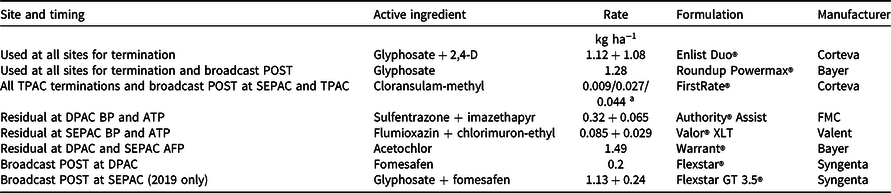
Herbicides used and rates that were applied for the three cover crop termination timings and the broadcast POST application. a,b,c

a Three different rates of cloransulam-methyl were used in this experiment. The 0.044 kg ha−1 was used at the two earliest terminations at TPAC, the 0.027 kg ha−1 rate was used as the broadcast POST application at SEPAC, and the 0.009 kg ha−1 rate was used at the late termination timing and the broadcast POST applications at TPAC. This was done to follow maximum use rates determined from the label.
b Fomesafen was added to the broadcast POST application in 2019 at the SEPAC location due to waterhemp being much more prevalent than in the previous year.
c Abbreviations: AFP, after planting; ATP, at planting; BP, before planting; DPAC, Davis Purdue Agriculture Center (Farmland, IN); SEPAC, South East Purdue Agriculture Center (Butlerville, IN); TPAC, Throckmorton Purdue Agricultural Center (Lafayette, IN).
All herbicide applications were made using a 3-m CO2-propelled backpack sprayer calibrated to deliver 140 L ha−1 at 143 kPa. Nozzles recommended by herbicide labels, AIXR 11015 (Teejet Technologies, Wheaton, IL), were used. The primary weed species at SEPAC were a wide variety of grasses and common waterhemp in 2019. At the TPAC location, giant ragweed, fall panicum (Panicum dichotomiflorum Michx.), and foxtail species (Setaria spp.) were the predominant weed species. The DPAC weed flora was primarily common waterhemp and a mix of grass species. Key species at each location are summarized in Table 3. A broadcast POST application was made after all cover crops had been terminated. The specific time of this broadcast POST application can be found in Table 1, and the herbicides used can be found in Table 2. The broadcast POST application was sprayed when average weed height across all plots was 10 to 15 cm.
Key weed species at each of the trial locations that were collected for biomass and recorded for density. a,b

a Abbreviations: DPAC, Davis Purdue Agriculture Center (Farmland, IN); SEPAC, South East Purdue Agriculture Center (Butlerville, IN); TPAC, Throckmorton Purdue Agricultural Center (Lafayette, IN).
b Grass species and approximate composition at the two sites were as follows: at TPAC, large crabgrass (Digitaria sanguinalis L.) (2%), smooth crabgrass [Digitaria ischaemum (Schreb.) Schreb. ex Muhl.] (3%), fall panicum (Panicum dichotomiflorum Michx.) (15%), barnyardgrass [Echinochloa crus-galli (L.) P. Beauv] (17%), and foxtail species (Setaria spp.) (67%); at SEPAC, barnyardgrass (2%), large crabgrass (2%), annual bluegrass (Poa annua L.) (8%), fall panicum (34%), and foxtail species (54%); at DPAC, smooth crabgrass (1%), large crabgrass (4%), foxtail species (18%), barnyardgrass (32%), and fall panicum (45%).
Data Collection
Just prior to the termination of cover crops, both cover crop and weed biomass were collected from a 0.25-m2 quadrant in each plot. This was done to evaluate early-season weed suppression by the three different cover crops and to observe the increase in cover crop biomass as termination time was delayed. Soybean was planted at a rate of 350,000 seeds ha−1; soybean planting dates can be found in Table 1. Prior POST application, densities of key weed species were recorded at each location. These densities were assessed from two quadrants in the front and back of each plot using either a 0.25-m2 or 1-m2 quadrant, which were averaged for a single value of plants m−2 for each plot. The plots were harvested using a small plot combine, and yields were adjusted to 13% moisture. The results reported in this article focus on weed densities prior to the broadcast POST application and are referred to as early summer weed densities.
Statistical Analysis
Correlations between cover crop biomass and weed biomass were done using SAS 9.4 PROC CORR procedure, and all other data were analyzed using the PROC GLIMMIX procedure in SAS 9.4 (SAS, Cary, NC). The densities and biomass collected were subjected to a log transformation to analyze data. However, for clarity purposes, untransformed data are presented. Analysis was similar to that described by Yang (Reference Yang2010) for balanced split-plot designs. Mean separations were identified using Tukey’s honest significant difference (HSD) test with an alpha equal to 0.05. The three locations were analyzed separately due to differences in soil types and key weed species present. Orthogonal contrasts were conducted on specific factors of interest and are presented in the appropriate section.
Results and Discussion
Cover Crop and Weed Biomass prior to Cover Crop Termination
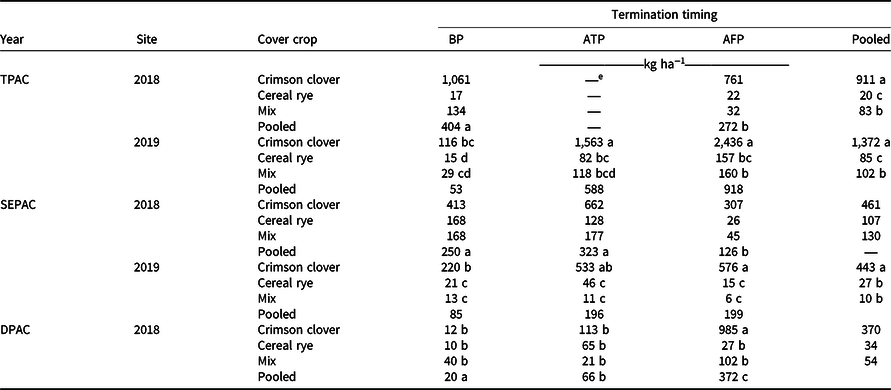
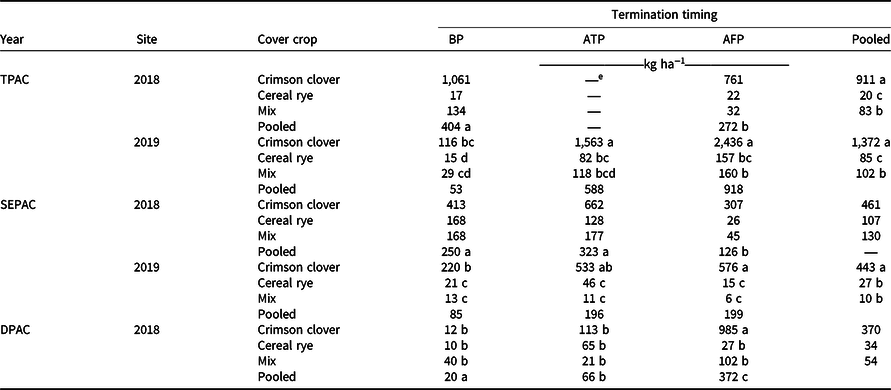
Termination timing and cover crop species influenced cover crop biomass. Two-way interactions occurred between cover crop and termination timing in both years at TPAC (P = 0.0433 and P < 0.0001, respectively) and in 2019 at SEPAC (P = 0.0183). In 2018, cover crop biomass was influenced by cover crop and termination timing at SEPAC (P < 0.0001 and P < 0.0001, respectively) and DPAC (P = 0.0039 and P < 0.0001, respectively). The control treatment resulted in half as much biomass as for cereal rye or the mix (Table 4). Terminating cover crops BP reduced cover crop biomass by one-half compared to later terminations. At both sites in 2019, cereal rye and the mix produced more biomass than the control treatment. At TPAC in 2019, delaying the termination of a cereal rye or the mix to at or after soybean planting resulted in 70% more cover crop biomass compared to all other treatments.
Influence of cover crop and termination timing on cover crop biomass prior to termination in the spring at three sites in Indiana. a,b,c

a Abbreviations: AFP, after planting; ATP, at planting; BP, before planting; DPAC, Davis Purdue Agriculture Center (Farmland, IN); SEPAC, South East Purdue Agriculture Center (Butlerville, IN); TPAC, Throckmorton Purdue Agricultural Center (Lafayette, IN).
b Data were log-transformed before analysis; however, untransformed mean values are presented based on the interpretation of the transformed data.
c Means followed by the same letter within site-year and pooled data are not different according to Tukey’s HSD test (P ≤ 0.05). No LSD letter separations are shown if the factor or interaction was not significant at the 0.05 level.
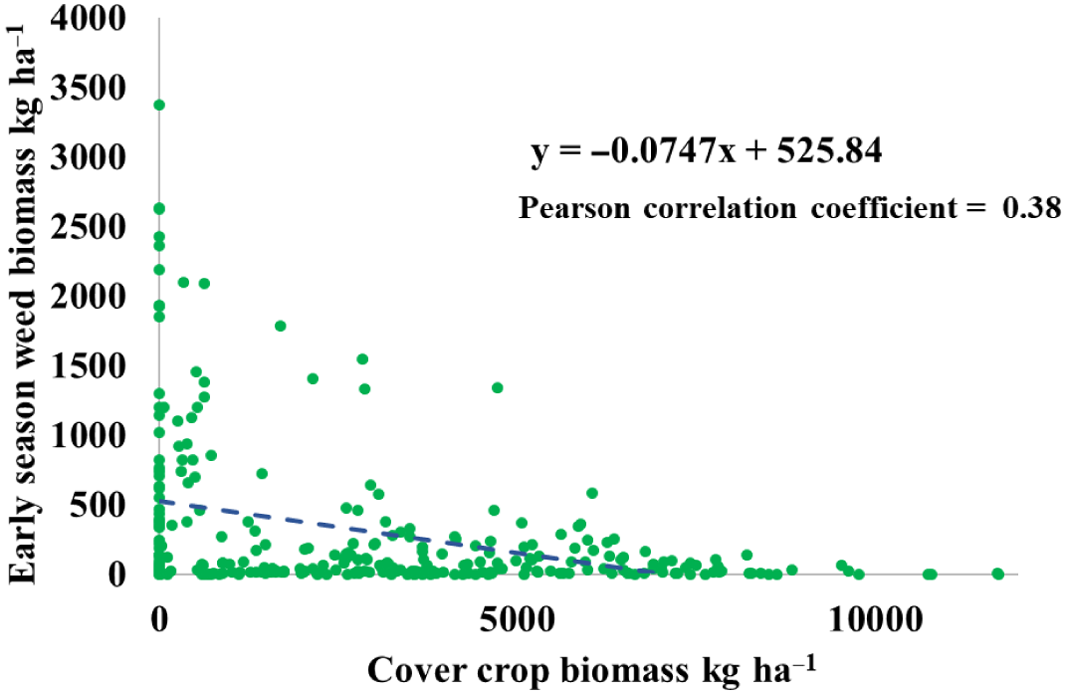
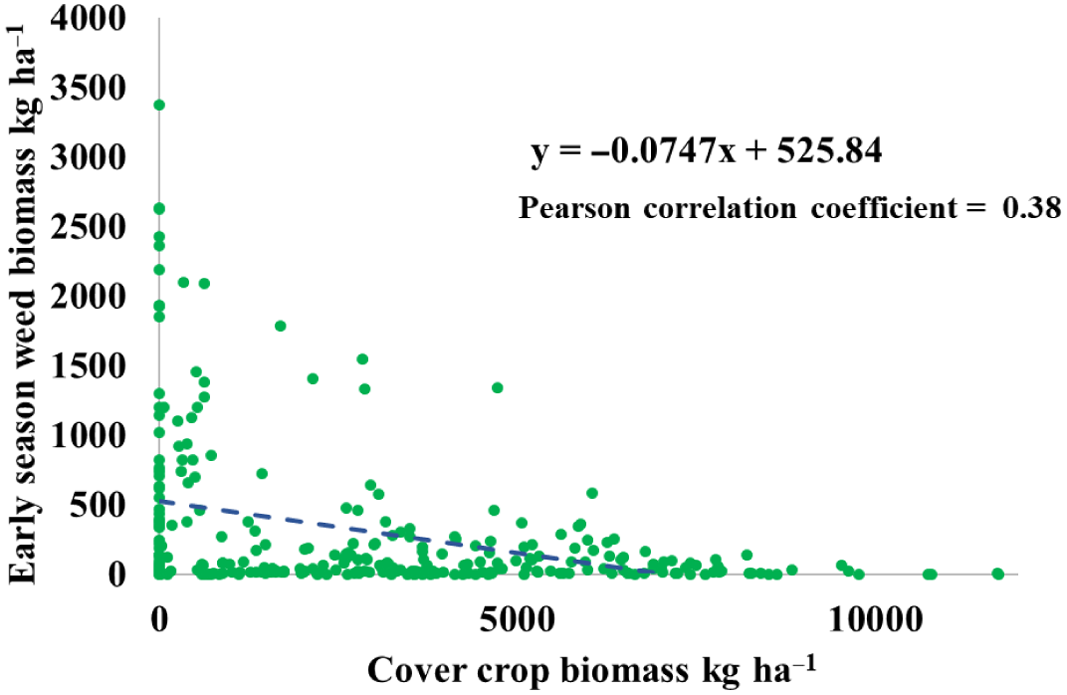
Correlations between cover crop biomass and early-season weed biomass provided a Pearson correlation coefficient of 0.38 (P < 0.0001). As cover crop biomass increased, the mass and variability of the early-season weed biomass decreased (Figure 1). Using cover crops with cereal rye terminated at or after planting provided higher cover crop biomass compared to the earliest-terminated cover crops or the control treatment. The relationship indicated that the increase in cover crop biomass would be beneficial in reducing the variability of early-season weed suppression.
Correlation of early-season (April and May) weed biomass by cover crop biomass across three sites in Indiana in 2018 and 2019. Sites included the Throckmorton Purdue Agricultural Center (TPAC, Lafayette, IN), the South East Purdue Agricultural Center (SEPAC, Butlerville, IN), and the Davis Purdue Agriculture Center (DPAC, Farmland, IN).
A two-way interaction between cover crop and termination timing affected the weed biomass prior to cover crop termination at DPAC in 2018 (P < 0.0001) and at both SEPAC and TPAC in 2019 (P = 0.0122 and P < 0.0001, respectively). Terminating the crimson clover control treatment after soybean planting resulted in the highest weed biomass (Table 5). In 2018, weed biomass at both SEPAC and TPAC was affected by termination timing (P = 0.0186 and P = 0.0186, respectively). Delaying termination from BP to after soybean planting reduced weed biomass by 33 and 50 percentage points, respectively, for TPAC and SEPAC. In 2018, the TPAC location weed biomass was also influenced by cover crop (P < 0.0001), with cereal rye and the mix reducing weed biomass by 98 and 91 percentage points, respectively, compared to the control treatment. Terminating the control treatment at or after soybean planting resulted in nearly double the weed biomass compared to treatments that utilized a cover crop that contained cereal rye at SEPAC and TPAC in 2019. Similarly, terminating cereal rye BP in 2019 at TPAC reduced weed biomass by at least 82 percentage points compared to all other treatments, except for the mix terminated before and at soybean planting. At SEPAC in 2019, terminating a cover crop containing cereal rye at any time reduced weed biomass by at least 79 percentage points compared to the crimson clover control treatment.
Influence of cover crop and termination timing on weed biomass prior to cover crop termination in the spring at three sites in Indiana. a,b,c,d,e
a Abbreviations: AFP, after planting; ATP, at planting; BP, before planting; DPAC, Davis Purdue Agriculture Center (Farmland, IN); SEPAC, South East Purdue Agriculture Center (Butlerville, IN); TPAC, Throckmorton Purdue Agricultural Center (Lafayette, IN).
b Data were log-transformed before analysis; however, untransformed mean values are presented based on the interpretation of the transformed data.
c Means followed by the same letter within site-year and pooled data are not different according to Tukey’s HSD test (P ≤ 0.05). No LSD letter separations are shown if the factor or interaction was not significant at the 0.05 level.
d Weeds that made up more than approximately 5% of the density combined for biomass measurements included the following: at TPAC, chickweed [Stellaria media (L.) Vill.] (50%), henbit (Lamium amplexicaule L.) (17%), giant ragweed (18%); at SEPAC, fall panicum (5%), cressleaf groundsel [Packera glabella (Poir.) C. Jeffrey] (6%), bittercrest (Cardamine hirsuta L.) (7%), horseweed (9%), field speedwell (Veronica agrestis L.) (15%), annual bluegrass (Poa annua L.) (30%); at DPAC, fall panicum (6%), field speedwell (11%), horseweed (28%), waterhemp (32%).
e Missing data from ATP timing at TPAC in 2018.
Delaying termination with cover crops containing cereal rye to at or after soybean planting resulted in a 25 percentage point increase in cover crop biomass compared to the control treatment. Weed biomass was variable, ranging from 6 to 2,436 kg ha−1. However, cover crops containing cereal rye never had weed biomass that exceeded 177 kg ha−1, while the control treatment terminated after soybean planting at TPAC in 2019 had weed biomass of 2,436 kg ha−1. Utilizing cover crops containing cereal rye reduced early-season weed biomass at four of six sites. Additionally, at four of six site-years, a cover crop terminated at the later timing had similar weed biomass to earlier timings. Reductions of weed biomass by cereal rye of 91% and higher have previously been documented by Werle et al. (Reference Werle, Burr and Blanco-Canqui2018) in Nebraska. Caution should be used when delaying cover crop termination due to possible negative impacts on cash crop yield and the possibility of seed production by cover crops producing volunteers that compete with the cash crop for resources (Keene et al. Reference Keene, Curran, Wallace, Ryan, Mirsky, VanGessel and Barbercheck2017).
Early Summer Grass Densities prior to Broadcast POST
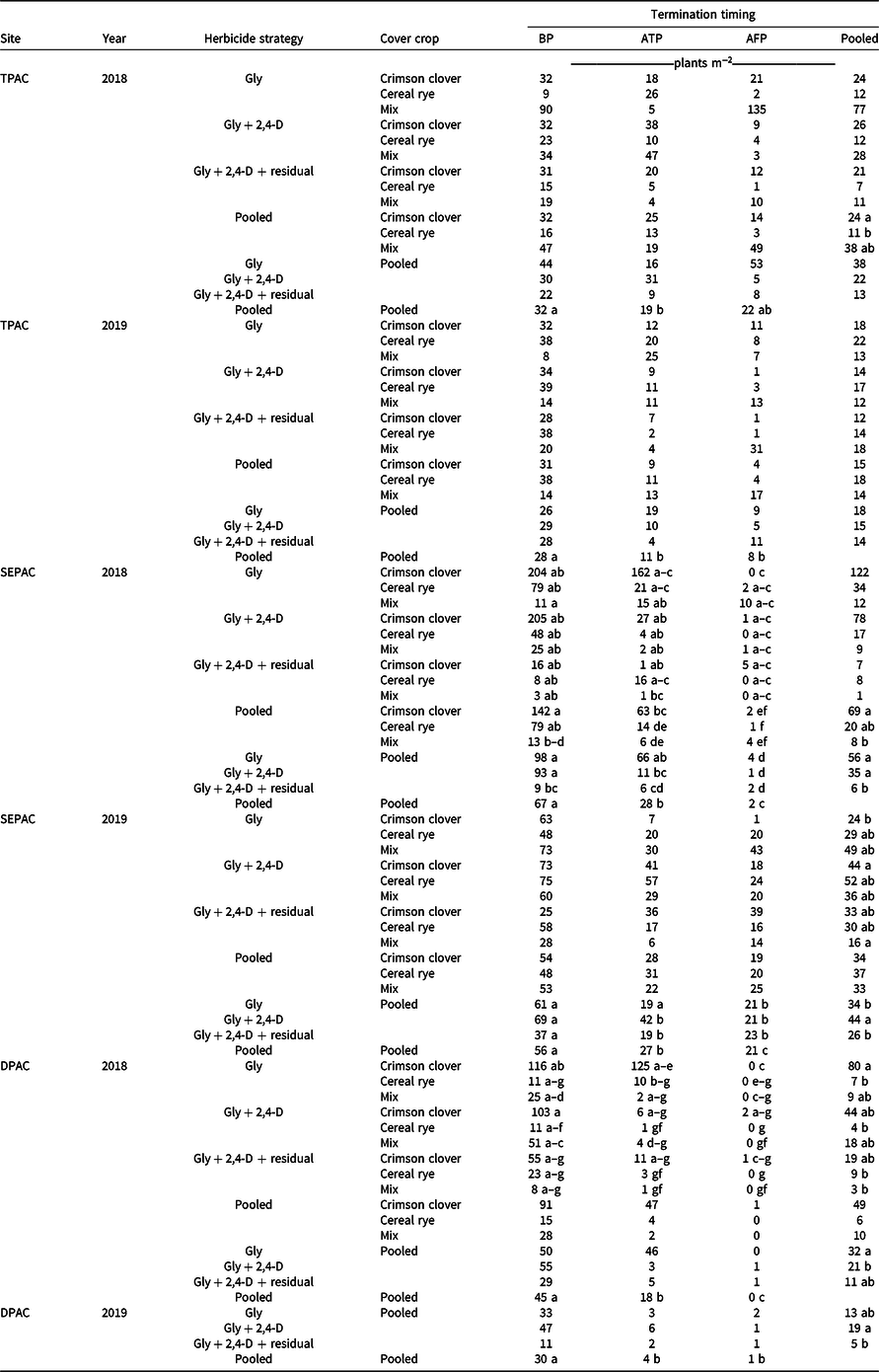
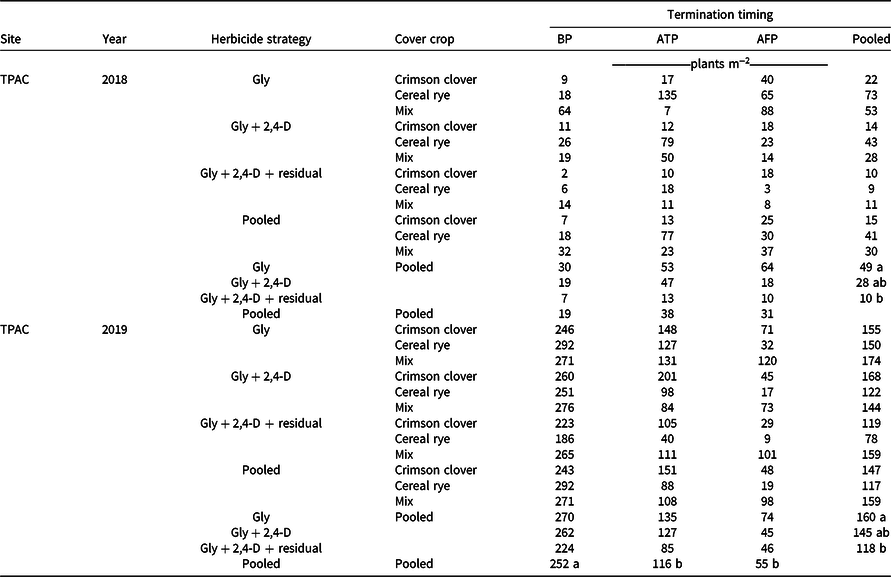
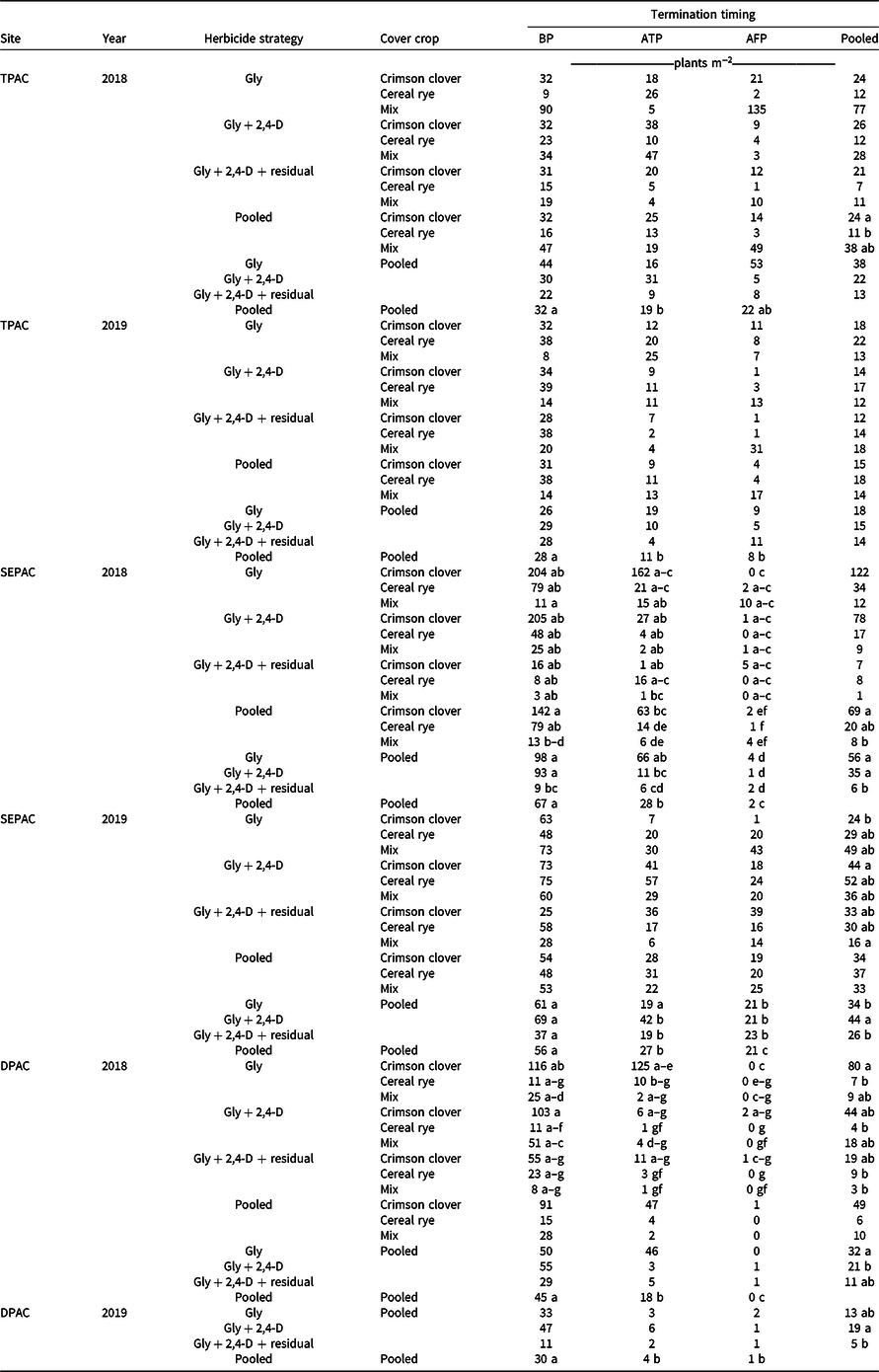
Grass control was evaluated at all six site-years. Delaying termination timing to after soybean planting reduced grass densities at all six site-years. Grass densities were reduced by cover crops at four out of six site-years. However, the amount by which grass densities were reduced was highly variable, ranging from 41 to 98 percentage points (Table 6). Three-way interactions between cover crop, termination timing, and herbicide strategy affected grass densities at both SEPAC (P = 0.0019) and DPAC (P = 0.019) in 2018 (Table 7).
Influence of cover crop, termination timing, and herbicide strategy on early summer grass density prior to a POST application at three sites in Indiana in 2018 and 2019. a,b,c,d
a Abbreviations: AFP, after planting; ATP, at planting; BP, before planting; DPAC, Davis Purdue Agriculture Center (Farmland, IN); SEPAC, South East Purdue Agriculture Center (Butlerville, IN); TPAC, Throckmorton Purdue Agricultural Center (Lafayette, IN).
b Data were log-transformed before analysis; however, untransformed mean values are presented based on the interpretation of the transformed data.
c Means followed by the same letter within site-year are not different according to Tukey’s HSD test (P ≤ 0.05), unless pooled. No LSD letter separations are shown if the factor or interaction was not significant at the 0.05 level.
d Grass species and approximate composition at the three sites were as follows: at TPAC, large crabgrass (2%), smooth crabgrass (3%), fall panicum (15%), barnyardgrass (17%), foxtail species (67%); at DPAC, smooth crabgrass (1%), large crabgrass (4%), foxtail species (18%), barnyardgrass (32%), fall panicum (45%); at SEPAC, barnyardgrass (2%), large crabgrass (2%), annual bluegrass (8%), fall panicum (34%), foxtail species (54%).
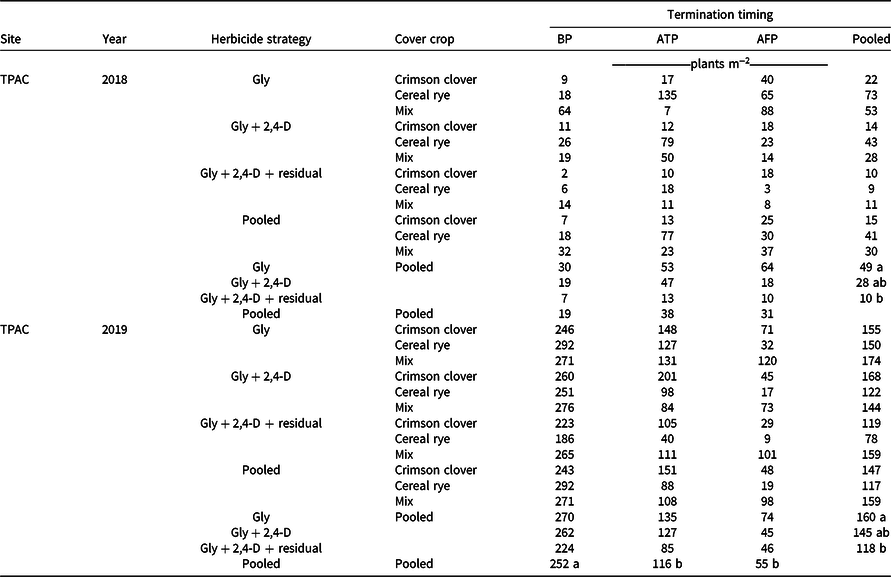
Influence of cover crop and termination timing on early summer giant ragweed density prior to application of a POST at the Throckmorton Purdue Agricultural Center, Lafayette, IN. a,b,c
a Abbreviations: AFP, after planting; ATP, at planting; BP, before planting; Gly, glyphosate.
b Data were log-transformed before analysis; however, untransformed mean values are presented based on the interpretation of the transformed data.
c Means followed by the same letter within year and factor are not different according to Tukey’s HSD test (P ≤ 0.05). No LSD letter separations are shown if the factor or interaction was not significant at the 0.05 level.
In both 2018 and 2019, TPAC grass densities were affected by termination timing (P = 0.0009 and P = 0.0001, respectively). In 2018, TPAC grass densities were reduced by at least 54 percentage points when a cereal rye cover crop was utilized compared to crimson clover (P = 0.0295; Table 6). When terminated after soybean planting, grass densities were reduced by 71 percentage points in 2019 compared to when termination was BP and were reduced by 41 percentage points when terminated at soybean planting compared to BP in 2018. In 2019, DPAC grass densities were at least 87% lower when termination was delayed to at or after soybean planting compared to before planting (P = 0.0128). Contrasts were conducted to determine if a glyphosate-only herbicide strategy provided similar grass suppression to a glyphosate plus 2,4-D herbicide strategy. At five of six site-years, the glyphosate-alone herbicide strategy resulted in similar grass densities to the glyphosate in combination with 2,4-D within the cereal rye cover crop at a 0.05 level of significance, supporting that cover crops would be valuable for weed suppression within buffer areas where 2,4-D is not permitted.
Norsworthy et al. (Reference Norsworthy, McClelland, Griffith, Bangarwa and Still2011) reported that a cereal rye cover crop provided 10 to 11 percentage points of additional goosegrass [Eleusine indica (L.) Gaertn.] control compared to fallow plots when glyphosate plus pyrithiobac was applied to one-leaf cotton (Gossypium hirsutum L.). Dhima et al. (Reference Dhima, Vasilakoglou, Eleftherohorinos and Lithourgidis2006) reported reductions in barnyardgrass [Echinochloa crus-galli (L.) P. Beauv.] and bristly foxtail [Setaria verticillata (L.) P. Beauv.] in Greece due to winter cereal cover crop mulches and attributed this to allelopathy.
Our research showed that termination timing reduced grass densities, but we did not evaluate allelopathic effects. Few researchers have assessed the effects of cover crop and termination timing on grass densities. To reduce grass densities within buffer areas, delay termination of cover crops containing cereal rye to at or after soybean planting, as this provided over 41% reduction in three of six site-years in this research.
Early Summer Giant Ragweed Densities prior to Broadcast POST
Giant ragweed was evaluated at two of six site-years. Delaying cover crop termination to at or after soybean planting reduced giant ragweed densities by 54 and 78 percentage points, respectively, compared to the earliest termination time in 2019 (P = 0.022); however, termination did not influence giant ragweed densities in 2018 (Table 7). Cover crops did not affect giant ragweed densities in either year. Utilizing glyphosate in combination with 2,4-D and a residual herbicide provided 80 and 26 percentage points more control than glyphosate alone in 2018 (P = 0.0073) and 2019 (P = 0.0018), respectively. Previous research on the influence of cover crops and termination time on giant ragweed is minimal. Bruin et al. (2005) reported that cereal rye reduced giant ragweed biomass but not density at one site-year in Minnesota. However, the influence of herbicide strategies on giant ragweed has been reported by several researchers. Ganie and Jhala (Reference Ganie and Jhala2017) reported that 2,4-D in combination with glufosinate provided at least 81% control of giant ragweed compared to a nontreated control but was similar to glufosinate applied alone. The use of 2,4-D as an additional mode of action will allow for better POST weed management practices, as described by Norsworthy et al. (Reference Norsworthy, Ward, Shaw, Llewellyn, Nichols, Webster, Bradley, Frisvold, Powles, Burgos, Witt and Barrett2012), as implementing multiple modes of action will likely extend the longevity of the 2,4-D-resistant technology.
Delaying termination of cover crops was beneficial in reducing giant ragweed densities in 2019. Termination timing did not influence giant ragweed densities in 2018. Giant ragweed densities in 2019 were reduced by later termination timings due to the delayed soybean planting as a result of a wet spring. The delay in soybean planting in 2019 allowed for giant ragweed to emerge without having to compete with a soybean crop or living cover crop for 5 wk between the first termination timing and the at-planting termination. Cover crops would not be effective for control of giant ragweed in buffer areas, as we report that herbicide strategies with 2,4-D were the only control method that reduced giant ragweed densities in both years. Contrasts conducted showed that the use of cereal rye provided similar suppression when terminated with glyphosate or glyphosate plus 2,4-D at a 0.05 level of significance. However, the use of a residual herbicide increased giant ragweed control.
Early Summer Waterhemp Densities prior to Broadcast POST
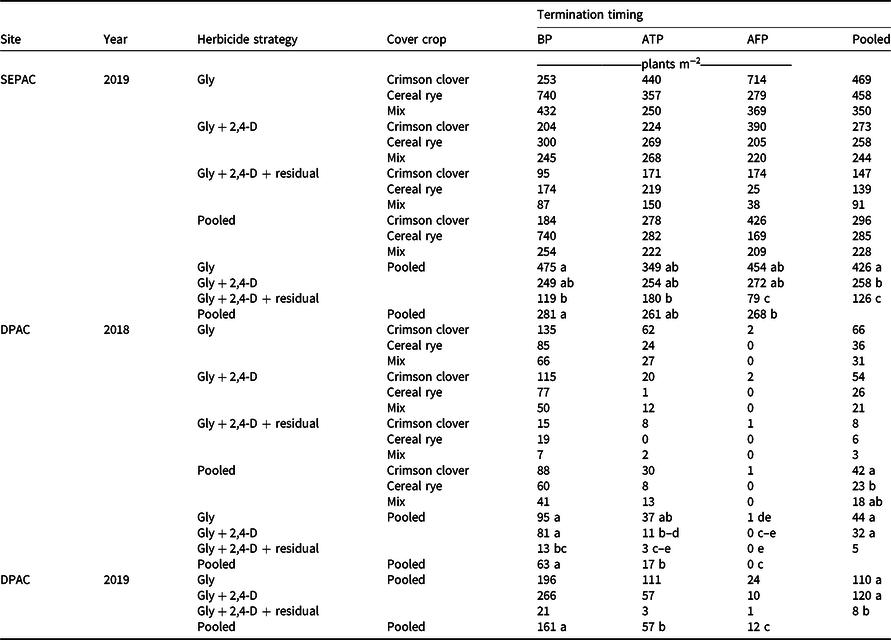
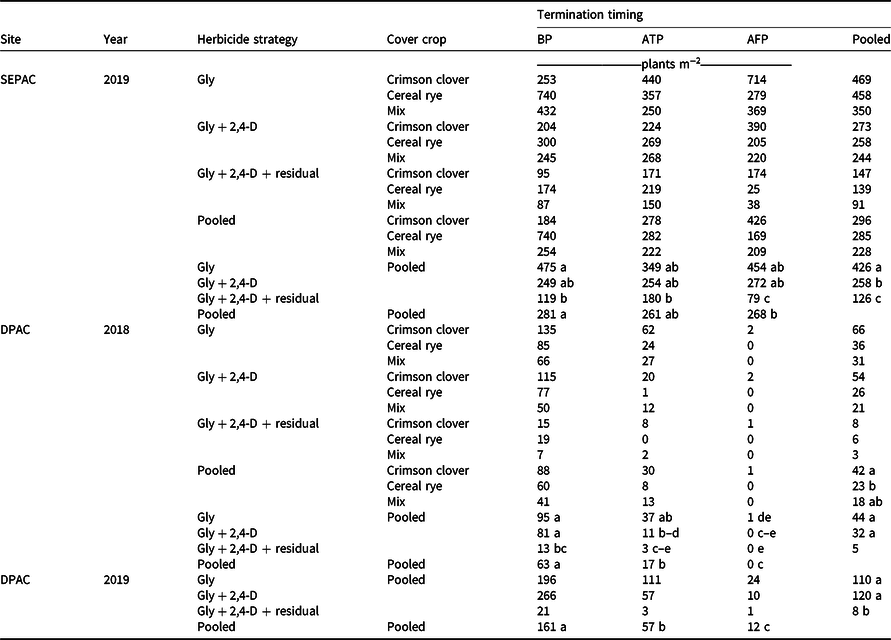
Waterhemp was evaluated at three of six site-years. Waterhemp densities at DPAC in 2018 and SEPAC in 2019 were affected by a herbicide strategy by termination timing interaction (P = 0.0063 and P = 0.0002, respectively; Table 8). Delaying termination to at or after planting and using glyphosate in combination with 2,4-D and a residual herbicide reduced waterhemp densities by at least 92% compared to glyphosate alone at the two earlier timings or glyphosate plus 2,4-D at the early timing at DPAC in 2018 (Table 8). At SEPAC, utilizing glyphosate plus 2,4-D plus a residual herbicide after soybean planting reduced waterhemp densities by at least 34% compared to all other treatments.
Influence of cover crop, termination time, and herbicide strategy on early summer waterhemp density prior to a POST application at two sites in Indiana. a,b,c
a Abbreviations: AFP, after planting; ATP, at planting; BP, before planting; DPAC, Davis Purdue Agriculture Center (Farmland, IN); Gly, glyphosate; SEPAC, South East Purdue Agriculture Center (Butlerville, IN); TPAC, Throckmorton Purdue Agricultural Center (Lafayette, IN).
b Data were log-transformed before analysis; however, untransformed mean values are presented based on the interpretation of the transformed data.
c Means followed by the same letter within site-year and pooled data are not different according to Tukey’s HSD test (P ≤ 0.05). No LSD letter separations are shown if the factor or interaction was not significant at the 0.05 level.
In 2018, DPAC waterhemp densities were reduced by 45% in cereal rye compared to the control treatment (P = 0.0364). However, in 2019, waterhemp densities at DPAC were only affected by termination time and herbicide strategy used (P < 0.0001 and P < 0.0001, respectively). Terminating at and after soybean planting reduced waterhemp densities by 65 and 93 percentage points, respectively, compared to the earliest timing. Additionally, using glyphosate in combination with 2,4-D and a residual herbicide reduced waterhemp densities by at least 93% compared to other herbicide strategies. Contrasts showed that cereal rye terminated with glyphosate alone only provided similar control as the glyphosate plus 2,4-D at DPAC in 2018 (P = 0.1478).
Steckel et al. (Reference Steckel, Sprague, Hager, Simmons and Bollero2003) evaluated waterhemp under various levels of shade and found that increased shade reduced waterhemp biomass and seed production, which would be beneficial in late-terminated cereal rye cover crops. Additionally, waterhemp under 99% shade had mortalities of 97% and 84%, respectively, in May and June. Hay et al. (Reference Hay, Marshall, Anita, Dallas, Hay, Dille and Peterson2019) reported that appropriate herbicide strategies resulted in 97% control of Amaranthus species in Kansas grain sorghum [Sorghum bicolor (L.) Moench] across six site-years, while a winter wheat cover crop provided only a 50 percentage point reduction in pigweed density and biomass at three out of six site-years. Similar results were found in this study, as one of the two sites with established cover crops had reductions of 45 percentage points when a cereal rye cover crop was utilized compared to the control treatment. Cornelius and Bradley (Reference Cornelius and Bradley2017) reported that cover crops reduced late-season waterhemp biomass from 21 to 40 percentage points, but this was less than the 97 percentage point reduction in late-season waterhemp emergence provided by a spring PRE residual herbicide. Norsworthy et al. (Reference Norsworthy, McClelland, Griffith, Bangarwa and Still2011) reported that cover crops could provide control of Palmer amaranth in cotton ranging from 0% to 91% with no herbicide, while in combination with herbicides, they provided 94% or greater control of Palmer amaranth. Cover crops will be a useful integrated weed management practice to aid in controlling waterhemp but need to be used in tandem with appropriate herbicide programs to achieve acceptable levels of control that will minimize seed production.
Soybean Yield
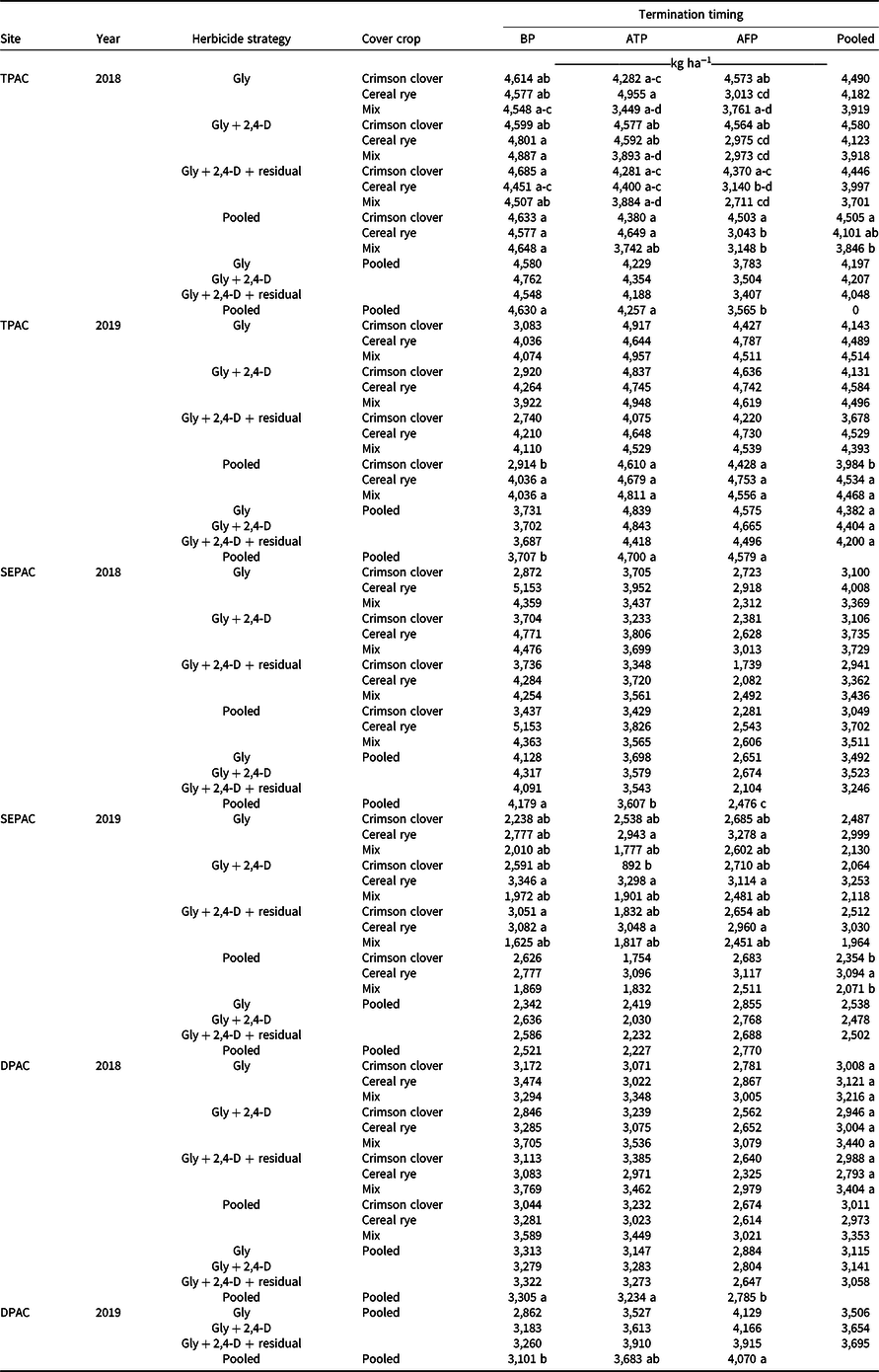
Soybean yield at TPAC in 2018 was influenced by a three-way interaction between cover crop, termination timing, and herbicide strategy (P = 0.008). Delaying termination of cover crop to the latest timing resulted in a 16% reduction in soybean yield compared to the earlier timings at TPAC in 2018 (Table 9). In 2019, soybean yield at TPAC was 28% lower in the early-terminated control treatment compared to all other treatments (P = 0.0311). Lower soybean yields in early-terminated plots in 2019 are likely a result of delayed soybean planting due to high spring precipitation, resulting in higher weed pressure in those plots, as evaluated by collecting the POST weed biomass.
Influence of cover crop, termination time and herbicide strategy on soybean yield at the at three sites in Indiana in 2018 and 2019. a,b
a Abbreviations: AFP, after planting; ATP, at planting; BP, before planting; DPAC, Davis Purdue Agriculture Center (Farmland, IN); Gly, glyphosate; SEPAC, South East Purdue Agriculture Center (Butlerville, IN); TPAC, Throckmorton Purdue Agricultural Center (Lafayette, IN).
b Means followed by the same letter within site-year and pooled data are not different according to Tukey’s HSD test (P ≤ 0.05). No LSD letter separations are shown if the factor or interaction was not significant at the 0.05 level.
In 2018, soybean yield at SEPAC was influenced by termination timing (P < 0.0001). Delaying termination to at or after soybean planting reduced soybean yields by 14% to 41% compared to the earliest timing (Table 9). Producer interest in delaying termination timing of cover crops to plant into a living cover crop has increased in recent years (WG Johnson, personal observation). However, reductions in soybean yield up to 41% can occur when termination of a cover crop is delayed, as observed in this study in 2018. Previous reductions in cash crop yield due to cover crops has been observed (Eckert Reference Eckert1988; Liebl et al. Reference Liebl, Simmons, Wax and Stoller1992). Reddy (Reference Reddy2001) reported yield reduction in soybean yield due to stand loss ranging from 2% to 20% when cover crops were terminated 2 to 3 wk prior to soybean planting. In response to yield reductions in 2018, nutrient analysis was conducted on cover crop biomass in 2019. We observed that carbon in the cover crop increased by at least 41% from the before-planting timing to termination timings at or after soybean planting (data not shown). Additionally, nitrogen taken up by the cover crop was higher at the TPAC location by at least 68 percentage points at the later termination timings (data not shown). Delayed cereal rye termination results in reproductive growth that leads to a wider carbon to nitrogen ratio in the cover crop biomass and less available nitrogen in the soil solution. Thus soil nitrogen immobilization is likely to occur, drastically reducing the portion of soil-derived nitrogen needed by the soybean for optimum production. In one of the six site-years, delayed termination increased soybean yield (DPAC in 2019); however, cover crops at this site were winter-killed. This research provides evidence that cover crops alone did not cause yield reductions; however, when used in combination with a delayed termination, they can result in yield reductions from 14% to 41%.
Haramoto and Pearce (Reference Haramoto and Pearce2019) reported similar results in Kentucky as cover crop composition, termination timing, and herbicide interactions were variable in suppressing weeds over four site-years. Haramoto and Pearce (Reference Haramoto and Pearce2019) demonstrated that residual herbicides are generally beneficial to use in cover crops to suppress weeds in summer annual cash crops. We provide additional evidence of the benefit of residual herbicides in cover crops and evaluate the effect of cover crops, termination timing, and herbicide strategy on a species level of three problematic broadleaf species and grasses as a whole. Cover crops were effective in reducing grass and waterhemp densities at more than one-half of the site-years. Termination timing and herbicide strategy were just as important as cover crops in reducing weed densities. Grass and waterhemp densities were reduced when termination was delayed to after planting at most of the site-years. In 2019, giant ragweed densities were reduced by 78 percentage points when termination was delayed to after soybean planting compared to before planting but were not reduced in 2018.
Caution should be used when delaying cover crop termination due to potential reductions in cash crop yield. We show that cereal rye with termination delayed to at or after planting would be beneficial within buffer areas for control of grass and waterhemp densities. However, yield reductions of up to 41% were observed when cover crop termination was delayed to after soybean planting. Use of cover crops within buffer areas, mandated by 2,4-D herbicide labels, has not previously been evaluated. We show that cover crops will be useful in suppressing grass and waterhemp densities within buffer areas but will not be effective in suppressing giant ragweed.
Residual herbicides along with 2,4-D should be used with cover crops whenever possible and can reduce the number of weeds exposed to POST applications of glyphosate and 2,4-D (Dewerff et al. Reference Dewerff, Conley, Colquhoun and Davis2015). We showed that the addition of 2,4-D and/or a residual provided 60 percentage points more control of horseweed and at least 26 percentage points more control of giant ragweed compared to glyphosate alone. Early summer weed biomass supports the assessments of reduced weed densities, as early summer weed biomass was also reduced by 36 percentage points compared to early termination of glyphosate or glyphosate plus 2,4-D when termination was delayed to after planting and glyphosate was used in combination with 2,4-D and a residual herbicide (data not shown).
Future research on weed control with cover crops should focus on the impact on soybean yield when terminated near or after planting in various environments. Additionally, interactions between cover crop and residual herbicide strategies used will have important implications when managing for problematic herbicide-resistant weed species.
Acknowledgments
This research received no specific grant from any funding agency or the commercial or not-for-profit sectors. No conflicts of interest have been declared.