In a 2015 policy, the American Academy of Pediatrics (AAP) wrote: “Because the majority of pediatric medical care is delivered in outpatient practice settings, pediatricians from these settings must be included and engaged in disaster preparedness and response efforts.”1 Disasters such as September 11th, the Sandy Hook Elementary School shooting, and Hurricane Florence had a direct and indirect impact on children and have reinforced the need for including pediatricians in disaster preparedness. Most preparedness and response efforts have focused on emergency medical services (EMS), including hospital-based services, and do not address the role of office-based pediatricians in triage or treatment.2 Past experiences, as well as evolving events, such as the current Zika crisis, and its impact on neonates and infants, demonstrate that children and families affected by disaster need long-term follow-up care and monitoring for physical and mental issues.Reference Russell, Oliver and Lewis3 In addition, chronic medical conditions that predate a disaster require ongoing care, often will be exacerbated by a crisis, and are one of the main reasons people seek medical care in the aftermath of a catastrophic event.Reference Jhung, Shehab and Rohr-Allegrini4 Office-based pediatricians address these needs and are the obvious venue for similar assessment and treatment during and after a disaster.
Primary care pediatricians and family physicians provide primary care to most of the US population and are the primary point of contact for most people using the health-care system.5,Reference Hing and Burt6 Using and expanding this pre-established care capability can increase community-wide surge capacity and reduce the burden on emergency departments and hospitals.Reference Needle7 Primary care pediatricians are an integral part of the mental health system for children and families, a capability which can be called upon after a crisis. In addition to acute and chronic medical problems, children are susceptible to emotional and psychological difficulties after experiencing trauma after disasters.Reference Bothe, Olness and Reyes8 Primary care pediatricians address these needs.Reference Schonfeld and Demaria9 Evidence suggests that even a single session aimed at providing training to address psychological problems in children have a positive impact on primary care pediatricians being able to respond more effectively to children who have experienced traumatic events.Reference Adams, Laraque and Chemtob10
To date, there have been no data specific to pediatricians’ office readiness for all-hazards disaster events, nor the characteristics associated with such preparedness. This study reports the results of a survey of pediatric practitioners regarding their readiness to respond to an emergency or disaster. This knowledge can help us to understand the ability of office-based practitioners to contribute to community preparedness and response efforts as well as to develop strategies to enhance the inclusion of office-based pediatricians in such efforts.
METHODS
A survey developed by the AAP was distributed to its members to assess the state of pediatric offices in readiness for disaster. Responses were requested from AAP physicians who see pediatric patients and work in a setting that provides primary care services. The survey was determined to be exempt by the AAP Institutional Review Board. The survey consisted of 28 questions and was initially distributed online in November 2013, with a reminder message sent in February 2014. A total of 165 individuals completed demographics for the survey, but only 122 responded to the survey questions and were included in the analyses.
All measures were self-reported. Six possible outcome measures were chosen to indicate preparedness: (1) answering yes to having a written disaster preparedness plan; (2) having plans to ensure viability of vaccines in case of disaster; (3) having a list of emergency supplies; (4) maintaining a stock of emergency supplies; (5) teaching disaster-related courses; and (6) attending disaster-related educational sessions. Respondents who answered “yes” to any of these 6 items were assigned to the “Prepared” group. To investigate previous professional disaster experience, and potential impact on preparedness, 3 outcomes measures were pooled: (1) volunteering to serve in disaster areas; (2) treating patients affected by disasters; and (3) signing up for organized disaster response efforts. Respondents who answered “yes” to any of these items were assigned to the “Responded” group. Potential predictor variables included community setting, primary employment setting, area of practice, and previous disaster experience. Initially, chi-square analysis was conducted to determine statistical significance of associations occurring among descriptive variables, predictors, and outcomes. To account for the small sample sizes and add to the robustness of those results, likelihood ratio chi-square analysis and 2-sided Fisher’s exact tests were subsequently conducted.
RESULTS
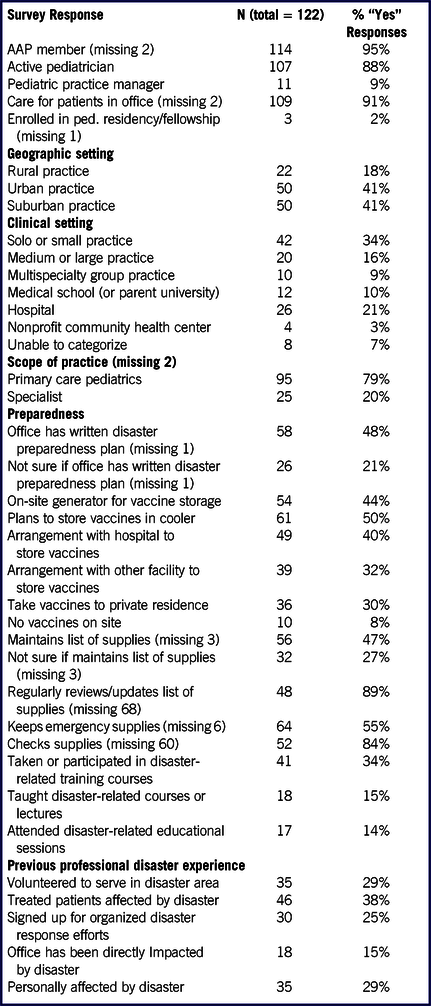
Ninety respondents (74%) were classified as “Prepared”, and 66 (54%) were classified as “Responded.” Among the “Prepared” group, approximately half of respondents (48%) had a written office disaster plan, and just over half (55%) maintained emergency supplies on the premises. Of those who had vaccines on site, most (94%) reported some sort of plan to ensure vaccine cold storage and viability in the event of prolonged power outage.
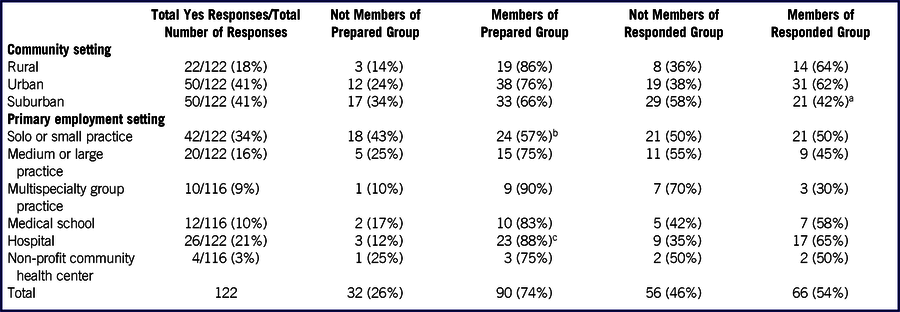
As shown in Table 1, most participants were practicing in urban or suburban areas; participants in suburban settings were less likely to be in the “Responded” group, and nonsignificantly trending toward less association with the “Prepared” group. The 3 most common practice settings were solo or small practice (34%), followed by hospital (21%), and medium or large group (16%) (Table 1). Working in a hospital was statistically associated with being in the “Prepared” group, whereas pediatricians in solo or small practice were less prepared (Table 2). There was no significant difference in response experience by employment setting.
Community Setting of Primary Practice/Position by Prepared and Responded

a Chi-square, likelihood ratio chi-square, and Fisher’s exact test P-value < 0.05 for Responded group.
b Chi-square, likelihood ratio chi-square, and Fisher’s exact test P-value < 0.01 for Prepared group.
c Likelihood ratio chi-square P-value < 0.05 for Prepared group.
Descriptive Statistics

Data are described as “missing” in these descriptive statistics to indicate the number of surveys in which the specific question was not answered
Most participants reported primary care as their field of practice (data not shown). Compared with primary care, specialists were more likely to be associated with belonging to the “Prepared” and “Responded” groups. Approximately half (49%) of those working in primary care pediatrics belonged to the “Responded” group (meaning that they had volunteered to respond, had treated patients during disasters, or had signed up for disaster response efforts); again, by comparison, a larger percentage (72%) of specialists had participated in disaster response (data not shown). Of note, 20/23 (87%) specialists reported being employed by a medical school or hospital. In contrast, 17/82 (21%) of primary care pediatricians worked at a medical school or hospital, whereas 42/82 (51%) worked in solo or small practice settings (chi-square and likelihood ratio chi-square P-value < 0.0001). All 6 questions were more likely to answered “yes” by the “Responded” group, but only 3 (“Attended education sessions,” “Taught Courses,” and “Take Courses”) were above 70% and statistically significant (data not shown).
Forty-four percent of respondents reported having a back-up generator on-site; 2 in 5 had an arrangement with a hospital to store vaccines; one-third had an arrangement with another facility; and slightly fewer than one-third reported plans to take office vaccines to a private residence.
DISCUSSION
The present study examined disaster preparedness among pediatricians from the criteria of having a written plan, a plan for preservation of vaccines, and training in disaster issues. There are no published reports that prove having a written plan or reporting knowledge of preparedness leads to more effective resiliency, practice viability, ability to care for patients, and minimization of losses after disaster. Pediatric practices that meet these measures are presumably more likely, but not guaranteed, to be resilient after a disaster; other factors likely have influence, including the scope of the disaster, the effectiveness of community response and recovery, and the resilience and resourcefulness of individual pediatricians and their staff. The inclusion criteria for placing respondents in the “Prepared” group was purposely set at a low level to acknowledge that practitioners who are aware of disaster issues, have taken basic preparedness steps, report some element of disaster-related knowledge, and would reasonably be expected to be better prepared and more able to effectively respond after an event. Even using this definition, approximately one-quarter of respondents were not considered prepared. Furthermore, only half of respondents had a written disaster plan for their practice.
Because vaccines are an important element of pediatric practice, as well as a major investment, pediatricians need to ensure they have robust primary and back-up plans to address prolonged power outage or loss of facility. The findings from this study regarding limited preparation for vaccine storage during an extended electricity outage is of concern because the majority of primary care doctors in the United States are employed in settings of 1 to 5 physicians.5,Reference Hing and Burt6 Our results suggest that pediatricians in suburban settings, as well as pediatricians in smaller or solo practices, may benefit from special outreach for targeted education and inclusion in community health-care coalitions. The greater preponderance of specialists being prepared, in comparison to primary care pediatricians, may represent specialists practicing more often in the hospital setting, which was independently and significantly associated with increased preparedness. Preparing for a disaster may increase the likelihood of interest in and serving in disaster; alternatively, practitioners with prior disaster experience may be more likely to translate those experiences into increased practice readiness. Because many practitioners are likely to respond during an actual event, it would be prudent to provide education and training on the best ways to do so before an event, as opposed to during or afterward.
While this study revealed a significant percentage of pediatric practices to be at least somewhat prepared for disaster, ideally, all practices would be ready for disruption of operations and community crisis, including increased need for mental health diagnoses and treatment. Pediatric office practitioners should view preparedness as an economic benefit, in terms of reduced operating and material losses, as well as a moral imperative, to be better able to serve families and communities in time of need. Nevertheless, there are legitimate reasons why more practices are not prepared. Pediatric physicians and office managers face numerous operational and regulatory demands that already consume a great deal of time, attention, and resources. Many pediatricians do not recognize the importance of preparedness, either believing that they risk of an event is too low to justify the effort, or that a disaster will be too overwhelming for preparedness to matter.
While organizations such as the AAP continue to promote the value and importance of preparedness to outpatient pediatric practices, more innovative efforts are needed that address the challenges noted above. Research is needed about the value and return of investment on various aspects of preparedness, as well as the potential costs of not preparing to help practices prioritize their efforts, as well as help view preparedness as a business investment analogous to insurance. More information is needed on appropriate disaster training for pediatric practices.
The results presented here have broad implications for pediatricians, public health personnel, and emergency planners as they consider the role of pediatricians in community disaster response and recovery, and how to enhance such capabilities. This study has some limitations that make it only a first step: the survey was voluntary and Internet-based, and enlisted a small number of respondents. The willingness of respondents to take the time to complete the survey could indicate greater interest in disasters, and concordant increased preparedness. It is also possible that participants exaggerated their preparedness capabilities due to social desirability bias; however, the survey was anonymous.
CONCLUSIONS
Pediatricians need to be prepared for disasters, as the impact of disasters can be particularly devastating for children. The results of the present study indicate that solo or small practices are less likely than hospitals to have a written plan, maintain a list of supplies, keep emergency supplies on hand, and/or participate in disaster-related educational courses. Practitioners in suburban community settings are less likely to have volunteered to serve in disaster areas, treated patients affected by disasters, and/or signed up for organized disaster response efforts. Specialists are more likely to be prepared and to have responded to disaster compared with primary care pediatricians.