Introduction
Terminally ill and chronic degenerative patients require multidisciplinary healthcare teams as well as multiple cares that include pain relief, symptoms control, fear management, and psychological and ethic support for end-of-life issues, which all may result as a challenging experience for coping strategies of health professionals involved (Uren and Graham, Reference Uren and Graham2013; Kamau et al., Reference Kamau, Medisauskaite and Lopes2014). Distinctive to this setting are also emotional demands for healthcare workers, consequent to contact with suffering and death, questioning of personal beliefs, confrontation with inability to cure, and secondary trauma (White et al., Reference White, Wilkes and Cooper2004; Rokach, Reference Rokach2005, Reference Rokach2017). Additionally, palliative care workers are not exempt from experiencing common psychosocial risk factors such as limited support from colleagues or supervisors, time constrain and irregular shift work, inadequate staffing, and exposure to aggressive behaviors from patients and/or caregivers (Graham et al., Reference Graham, Ramirez and Cull1996; Fillion et al., Reference Fillion, Saint-Laurent and Rousseau2003; Koh et al., Reference Koh, Chong and Neo2015).
All risk factors involved in providing palliative care concur in exposing workers to occupational stress, distressing emotions, and, in the long term, to burnout (Maslach and Schaufeli, Reference Maslach, Schaufeli, Schaufeli, Maslch and Marek1993; Maslach et al., Reference Maslach, Leiter and Fink2000). Burnout refers to a state of physical, emotional, and mental exhaustion that can be associated with feelings of cynicism, increased mental distance from the job, sense of ineffectiveness, and lack of personal accomplishment; it is a result of a prolonged exposure to chronic workplace stress that has not been successfully managed (Maslach and Leiter, Reference Maslach and Leiter2016). Burnout has been recently included in the 11th Revision of the International Classification of Diseases (ICD-11) as an occupational phenomenon influencing health status or contact with health services (World Health Organization, 2019). Indeed, this syndrome has been linked to severe psychological and physical outcomes such as cardiovascular diseases and depression (Salvagioni et al., Reference Salvagioni, Melanda and Mesas2017). In recent years, researchers have found burnout to be a common experience among palliative care professionals, affecting general health, job satisfaction, and quality of health care delivered (Vachon, Reference Vachon, Walsh, Caraceni and Fainsinger2008; Kearney et al., Reference Kearney, Weininger and Vachon2009; Martins Pereira et al., Reference Martins Pereira, Fonseca and Sofia Carvalho2011; Koh et al., Reference Koh, Chong and Neo2015; Abernethy et al., Reference Abernethy, Ast and Bull2016; Rizo-Baeza et al., Reference Rizo-Baeza, Mendiola-Infante and Sepehri2018).
Palliative assistance can be carried at patient's home in addition to inpatient hospice setting if family and home environment guarantee established requirements and safety standards (Hoare et al., Reference Hoare, Morris and Kelly2015). The tendency to provide palliative care at patients’ homes is rapidly increasing as it is often the preferred choice for both patients and caregivers, and it is usually more cost-efficient than long-term hospitalization. This trend could be probably boosted by the recent pandemic emergency in which inpatient hospice and other hospital-based settings experienced outbreaks of the Sars-Cov-2 epidemic, particularly severe among fragile or chronically ill patients. However, research of psychosocial risk factors and burnout among health professionals involved in home care palliative care is limited and workers’ perspectives are often overlooked (Danielsen, Reference Danielsen2018; Teruya et al., Reference Teruya, Sunagawa and Sunagawa2019).
Scientific research has recently expanded its focus on different palliative care contexts, finding higher risk of burnout among home care professionals compared to colleagues employed in inpatient hospice and hospital-based settings (Koh et al., Reference Koh, Chong and Neo2015; Parola et al., Reference Parola, Coelho and Cardoso2017). In delivering palliative care at home, workers may be exposed to similar or even higher levels of established psychological risk factors such as responsibility for a large number of patients, lack of support from colleagues and supervisors, isolation, insufficient time to deal with care complexity, fewer acute care resources, precarious and underpaid employment contracts, and threats to personal safety (Ganann et al., Reference Ganann, Weeres and Lam2019; Rabbetts et al., Reference Rabbetts, Harrington and Breaden2020). Additionally, home setting may deprive workers of common safety devices, thus increasing risks of musculoskeletal disorders and needlestick injury, and may expose home care staff to additional serious or life-threatening risks as unhygienic conditions, bloodborne pathogens, hostile animals, aggressive behaviors, or even weapons (NIOSH, 2010). Furthermore, availability and flexible working time may represent an additional demand for home care workers, as literature has shown work–home conflict to be strongly associated with emotional exhaustion among healthcare professionals (Peeters et al., Reference Peeters, Montgomery and Bakker2005; Camerino et al., Reference Camerino, Sandri and Sartori2010).
This study aims to investigate psychosocial risk factors and burnout in palliative care staff, comparing experiences and perceptions of different health professionals working in inpatient hospice and in home care settings.
Methods
Participants and procedures
A cross-sectional study was carried out between October and December 2019 in a single organization aiding the treatment of chronically and terminally ill patients in a large urban area of Northern Italy. Within the risk evaluation and health surveillance required by the Italian law (d.lgs 81/08), and in particular in the context of occupational stress evaluation, the Occupational Physician proposed all employees participate in a survey aimed at investigating psychological and emotional demands associated with providing palliative care. Workers' representatives were involved in the study definition and proposal. All data were analyzed with full respect to confidentiality. Results were presented only collectively and used large categories to protect individual information. Employees who agreed to participate read and signed a consent form. The study was conducted in compliance with all local legal and regulatory requirements and with the Declaration of Helsinki.
The study involved nurses, healthcare assistants, physiotherapists, and other non-medical health professionals (in detail, neuro- and psycho-motor therapists and psychologists) working exclusively in inpatient hospice settings or at patients’ homes. Since burnout derives from a prolonged exposure to occupational stress and to properly describe the current working situation, we decided to include workers with a minimum of 20 h of weekly work and at least 12 months of job seniority in the current position. All physicians were involved only as part-time employees or as consultants and were excluded from the study population, also because of the heterogeneity characterizing their activities and health departments.
Measures
Participants completed a self-administered questionnaire collecting socio-demographic and occupational data (age, gender, job title, job setting, and job seniority), psychosocial risk factors, and burnout scales.
Psychosocial Safety Climate (PSC) refers to employees’ shared perceptions regarding “policies, practices and procedures for the protection of worker psychological health and safety” (Dollard and Bakker, Reference Dollard and Bakker2010). PSC investigates workers’ perceptions on four domains: (1) management support and commitment for stress prevention; (2) management priority to psychological health and safety versus productivity goals; (3) organizational communication in relation to psychosocial risks; and (4) employees’ participation and involvement in stress prevention. Evidence suggests that PSC is a preeminent psychosocial risk factor, as it is associated with psychological distress via job demands and predicts engagement through its positive relationship with resources. Moreover, associations with emotional exhaustion were found among healthcare workers (Zadow et al., Reference Zadow, Dollard and Mclinton2017). To measure PSC, we adopted a recent 4-item version of the 5-point PSC scale (Dollard, Reference Dollard, Dollard, Dormann and Idris2019), ranging from 1 (strongly disagree) to 5 (strongly agree).
Exposure to workplace aggressions was investigated through the Conflict and Offensive Behavior Subscale from COPSOQ II (Pejtersen et al., Reference Pejtersen, Kristensen and Borg2010). Three single items asked participants about the frequency of threats of violence (“Have you been exposed to threats of violence?”), physical violence (“Have you been exposed to physical violence?”), and sexual harassment (“Have you been exposed to undesired sexual attention?”) at the workplace during the last 12 months; for each question, participants were asked to specify who was the perpetrator of such violence (“colleague,” “supervisor,” “patient,” “caregiver,” and “other”).
Work–family conflict was investigated by two perspectives. We adopted two items (“How often does it happen that you do not fully enjoy the company of your spouse/family/friends because you worry about your work?” and “How often does it happen that you find it difficult to fulfil your domestic obligations because you are constantly thinking about your work?”) from the Survey Work-Home Interaction-NijmeGen (SWING) Questionnaire (Geurts et al., Reference Geurts, Taris and Kompier2005) to assess how frequently work concerns spillover into private life domains, on a 4-point scale ranging from “Never” to “Always.” According to the SWING theoretical background, distress could arise when recovery opportunities (which occur, for instance, during leisure time with friends or family) are quantitative or qualitative insufficient and consequent cumulative demands may seriously affect workers’ health over time.
Additionally, participants were asked to assess on a 7-point Likert scale (from “Never” to “Often”) the frequency of communication with colleagues/supervisors and patients/caregivers during their time-off; since home care workers are often requested to be available for patients needs during holidays and weekends due to possible patients’ urgencies (i.e., “on-call duty”), they answered these questions by referring to both their time-off and their on-call duty. Items were adapted from the Work Life Boundaries Questionnaire (Wepfer et al., Reference Wepfer, Allen and Brauchli2018), aimed at investigating boundaries management between work and non-work domains.
Peer Support Subscale from the HSE Indicator Tool (Health and Safety Executive, 2004) evaluated support, encouragement, and resources provided by colleagues with four items. Respondents were asked about the frequency of support obtained from colleagues on a 5-point scale (1 = Never to 5 = Always).
Burnout was assessed with the Copenhagen Burnout Inventory (CBI). CBI was developed by Kristensen et al. (Reference Kristensen, Borritz and Villadsen2005) to measure personal burnout, work-related burnout, and client-related burnout with three different scales. In this research, we adapted the original scale to study aims by adjusting the client-related scale and removing personal burnout as not pertinent: the final questionnaire consisted of work-related burnout (6 items), patient-related burnout (6 items), and caregiver-related burnout (6 items) scales. We adopted the Italian version which showed reliability and good psychometric properties (Fiorilli et al., Reference Fiorilli, De Stasio and Benevene2015; Sestili et al., Reference Sestili, Scalingi and Cianfanelli2018). The answers to each item are “Always or to a very high degree,” “Often or to a high degree,” “Sometimes or somewhat,” “Seldom or to a low degree,” and “Never/almost never or to a very low degree,” with attributed scores of 100, 75, 50, 25, and 0, respectively (higher scores denoting higher fatigue and exhaustion); scores above 50 suggest a risk of burnout as recommended by the authors.
Data analysis
We computed means and standard deviations or absolute and relative frequencies for continuous and categorical variables, respectively. Differences between inpatient hospice and home care staff were evaluated using unpaired Student's t-tests for normally distributed variables (e.g., age), χ 2 analyses for relative frequencies (female gender), and nonparametric tests (Kruskal–Wallis equality-of-population rank test) for non-normally distributed psychological scales. Comparisons across jobs (nurses, health assistants, physiotherapists, and others) were performed by the one-way analysis of variance for continuous variables and by the χ 2 test for categorical variables. Correlation between continuous psychosocial risk factors scales and burnout subscales was calculated by the Spearman correlation coefficient. A p-value equal to or lower than 0.05 was retained as statistically significant.
Analyses were conducted with STATA Software (Version 14.2 Stata Corp, Austin, TX, USA).
Results
Sample characteristics
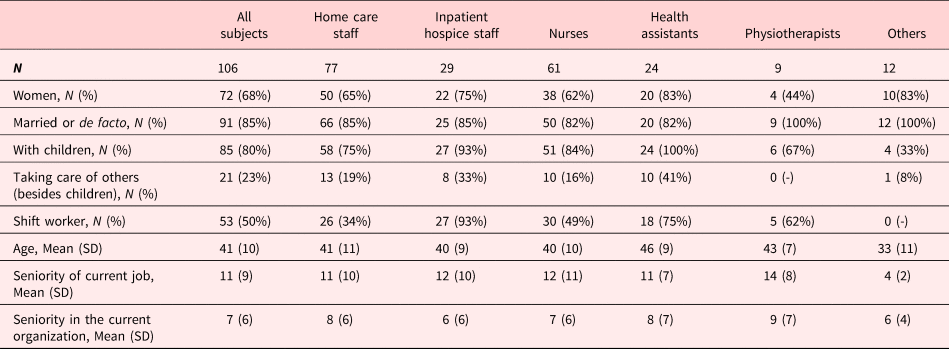
Socio-demographic characteristics of the study population are summarized in Table 1. The study sample included 106 workers, 95% of the overall eligible working population (6 workers did not accept to participate); 61 were nurses, 24 health assistants, 9 physiotherapists, and 12 other non-medical health professionals. We observed a prevalence of female gender in the whole study population (68%) and across different jobs. Mean age was 41 years, and mean job seniority was 11 years (7 years in the current job position).
General and occupational characteristics of study subjects across different working settings and roles

Compared to home care colleagues, inpatient hospice professionals were predominantly shift workers (93% vs. 34%) and resulted more frequently involved in providing care for their own relatives and family members (33% vs. 19%, p < 0.05). No significant differences were observed in gender distribution, age, and job seniority.
Psychosocial risk scales
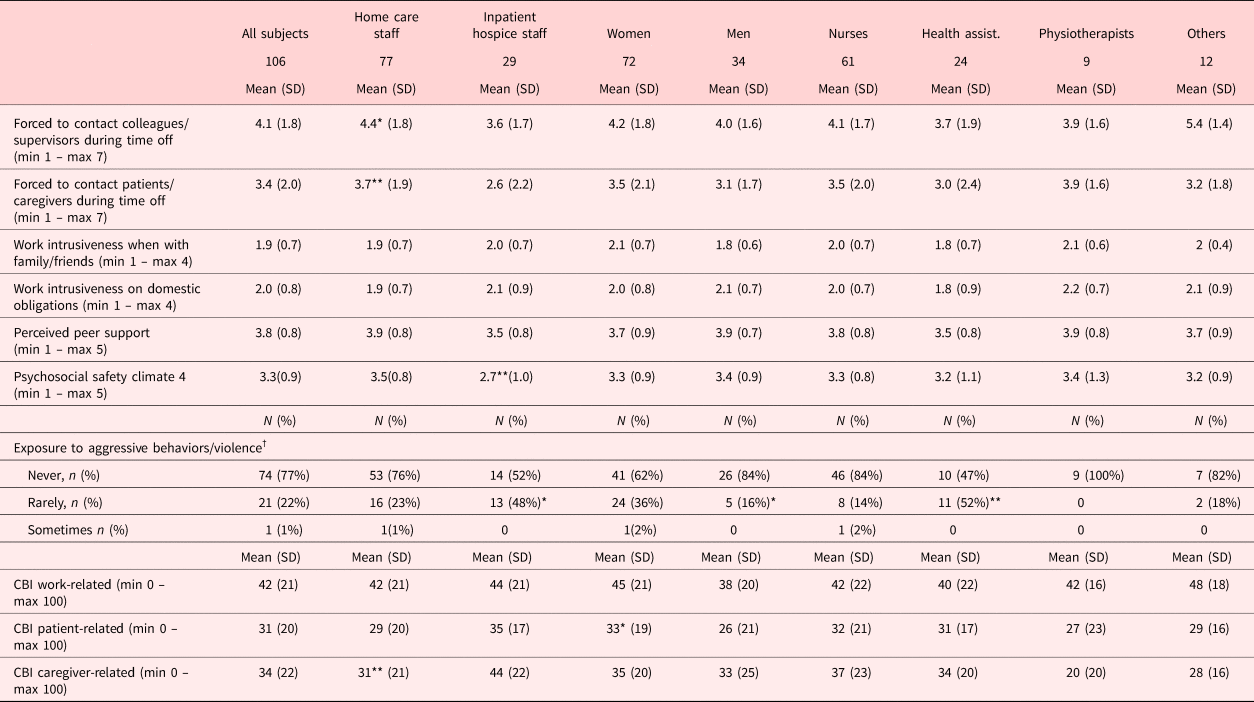
Table 2 shows the mean scores and frequencies of all psychosocial risk factors for the whole sample and across work settings, gender, and different professionals involved in the study.
Psychosocial risk factors and burnout scales in enrolled workers

Results are stratified by job setting (home care vs. inpatient hospice workers), gender and job title, and expressed as means and standard deviations or absolute and relative frequencies (continuous and categorical variables, respectively).
† Percentages refer to the number of the valued case for each variable.
* p≤0.05; **p < 0.01; p-values represent confidence levels of χ 2 for categorical variables, t-test and Kruskal–Wallis for continuous variables.
Overall, results showed medium scores on perceived peer support and PSC. The previous experience of aggressive behaviors was very rare, with only one subject reporting a frequency higher than “rarely.”
Home care workers reported more frequent communications with colleagues (p = 0.03) and patients/caregivers (p = 0.01) in their spare time compared to inpatient hospice staff, while there were no differences in the perception of work intrusiveness in private life; inpatient hospice workers showed the perception of lower peer support (p = 0.08) and lower PSC (2.7 vs. 3.5; p = 0.001) than home care colleagues.
Women reported higher mean scores in all considered risk factor scales and lower perception of support compared to men. The experience of aggressive behavior was relatively more frequent among inpatient hospice, female workers, and health assistants.
Burnout scales
Among CBI scales, work-related fatigue and exhaustion had the highest mean value (42) compared to patient (31) and caregiver subscales (34) (Table 2). Considering the proportion of subjects with a CBI scale higher than 50 (suggested by authors as a cut-off of risk), 55 workers (52%) reported at least one burnout scale above the cut-off, and the percentage was higher among inpatient hospice workers (66%) than among home-based palliative care workers (47%). The number of subjects at risk for burnout was higher across work-related scales (n = 42) than for caregiver- (n = 29) and patient-related scales (n = 16). The proportion of subjects with work-related scale above the cut-off was similar among inpatient hospice workers and home care workers (45% vs. 38%, p = 0.50). Regarding caregiver-related scale, inpatient hospice workers showed higher scores (p = 0.008) and a higher proportion of subjects over the cut-off (41% vs. 22%, p = 0.047) compared to home care colleagues. We found significant gender differences only for patient-related burnout scale (women = 33 vs. men = 26, p = 0.05).
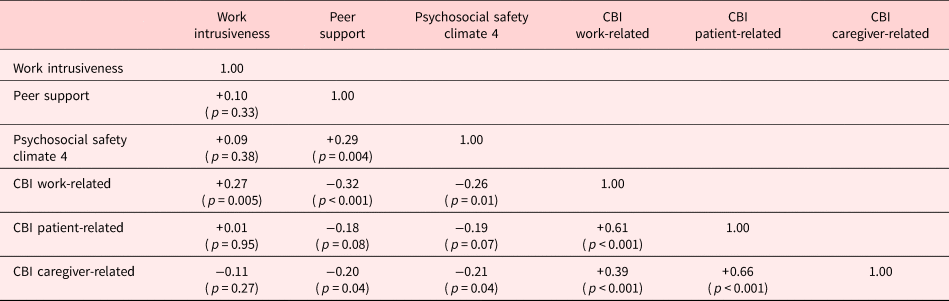
Considering psychosocial risk factors and burnout scales (Table 3), we observed a positive correlation between PSC and peer support (p = 0.004) and a strong inter-correlation between all burnout subscales (p < 0.001). Work-related burnout resulted associated with work intrusiveness (p = 0.005) and negatively associated with peer support and PSC (p = 0.001 and 0.01, respectively). We also found a negative association between caregiver-related burnout and both PSC and perceived support (p = 0.04).
Spearman's correlation coefficient with relative p-value between psychosocial risk factors and burnout scales in the entire study population (n = 106)

All burnout scales resulted higher among workers reporting a previous exposure to aggressive behaviors (work-related burnout: 15 vs. 14; patient-related burnout: 12 vs. 11; caregiver-related 14 vs. 12); however, observed differences did not reach statistical significance due to small sample size of exposed workers (n = 28).
Discussion
We investigated psychosocial risks and burnout among palliative care staff, comparing inpatient hospice and home care services workers, with a cross-sectional survey involving all non-medical health professionals employed in a single, quite large, health organization. Although home-based palliative care is nowadays widespread, research specifically focused on workers’ well-being is still limited, and, to our knowledge, this is one of the first studies investigating the Italian context.
Overall, participants reported moderate support from peers as well as the moderate perception of organizational involvement to protect workers’ psychological health and safety. These results are relevant as early evidence from home healthcare settings suggests a positive association between supportive teamwork and patients’ safety and satisfaction (Feldman et al., Reference Feldman, Bridges and Peng2005; Kroposki and Alexander, Reference Kroposki and Alexander2006). In this respect, inpatient hospice workers and healthcare assistants reported relatively lower peer support levels: this result could require specific attention and dedicated training strategies as supportive mentoring from peers and managers are essentials to provide quality care (Danielsen, Reference Danielsen2018).
Our findings also showed a medium level of PSC in study population, similarly to previous research among healthcare workers (Idris et al., Reference Idris, Dollard and Coward2012; Zadow et al., Reference Zadow, Dollard and Mclinton2017; Dollard, Reference Dollard, Dollard, Dormann and Idris2019); this result is relevant as the perception of sufficient PSC may improve safety behaviors and limit emotional fatigue and exhaustion, work injuries, and injury underreporting (Zadow et al., Reference Zadow, Dollard and Mclinton2017). However, inpatient hospice workers reported significantly lower scores on the PSC scale compared to home care colleagues, denoting a shared perception of lower management commitment to stress prevention: according to the PSC theory framework, inpatient hospice staff may be exposed to more effort–reward imbalance and health impairment (Law et al., Reference Law, Dollard and Tuckey2011; Owen et al., Reference Owen, Bailey and Dollard2016).
Since home care providers are often requested to be available for patients needs during holidays and weekends due to possible patient urgencies, we investigated communications frequency and perception of intrusiveness among study subjects as a request for constant availability and recurring communication from workplace during time-off may cause employees feelings of overwhelm and overload (Derks et al., Reference Derks, van Duin and Tims2015). Coherently to our expectations, we found home care staff to report a significantly higher frequency of communication during time-off with colleagues, managers, patients, and caregivers, also explained by the fact that they answered these questions by referring to both their time-off and their on-call duty; nevertheless, this demand was not perceived as overwhelming by professionals, as work “spillover” into private life domains resulted similar in both groups. Consistent with work-life boundary theories (Ashforth et al., Reference Ashforth, Kreiner and Fugate2000; Clark, Reference Clark2000), contemporaneous requests between work- and private life can be better managed giving to workers the highest possible flexibility to choose between a suppleness or a strictly separated way according to their own preferences and needs. In home-based palliative care, workers may compensate for the increased off-work availability with a greater flexibility in working hours.
Differently from literature, which found one-third of nurses worldwide being exposed to physical violence, a quarter exposed to sexual harassment, and around two-thirds exposed to nonphysical violence (Spector et al., Reference Spector, Zhou and Che2014), the majority of subjects of our study reported no or rare episodes of aggressive behaviors; we also found inpatient hospice workers to report a higher frequency of aggressive behaviors compared to colleagues employed in home care settings, although previous studies suggest verbal and physical abuse to be a primary stressor for home care workers (Ganann et al., Reference Ganann, Weeres and Lam2019). Notwithstanding all the above, violence appears to be more common among health assistants, women, and impatient staff, thus suggesting specific preventive interventions.
Overall, scorings on patient- and caregiver-related burnout scales were similar to normative values for client-related scales (derived from a large survey among human service professionals), while work-related burnout showed higher scores among all different working groups and settings (Borritz and Kristensen, Reference Borritz and Kristensen2004). Our findings showed that work demands caused a greater psychological and physical fatigue and exhaustion than relationships with patients and caregivers, suggesting required interventions to reduce job demands and increase job resources.
Interestingly, caregiver-related fatigue resulted higher in the inpatient hospice context. Although “therapeutic alliance” between health professionals and caregivers is essential for a successful home-based care, even inpatient hospice assistance requires healthcare workers to establish a close collaboration and dialogue with caregivers and this goal should not be neglected.
Comparison with previous research on burnout in palliative setting is limited by heterogeneity in study methods and measurements (O'Connor et al., Reference O'Connor, Neff and Pitman2018; Rotenstein et al., Reference Rotenstein, Torre and Ramos2018). A recent review on health professionals working in palliative care (Parola et al., Reference Parola, Coelho and Cardoso2017) revealed a prevalence of burnout of 17.3%, with higher prevalence among healthcare assistants; differently from our results, they also showed the highest prevalence of burnout in the palliative home care context (19.6%) compared to the inpatient hospice context (14.2%). However, contrary to our findings, home care workers involved in that study reported less support compared to inpatient hospice or hospital-based colleagues (Koh et al., Reference Koh, Chong and Neo2015).
Furthermore, most research reports home-based workers to be more prone to experience inadequate compensation, precarious employment, and lack of training compared to hospital-based colleagues (Denton et al., Reference Denton, Zeytinoğlu and Davies2002; Spetz et al., Reference Spetz, Stone and Chapman2019), while the specific work context we investigated provides similar working conditions and benefits for both groups. Additionally, home care professionals in our study population were predominately non-shift workers, and the literature shows irregular and unstable work hours as a major source of occupational stress for home-based staff: this may decrease the generalizability of our findings.
Although the cross-sectional design of our study hampered a formal analysis to investigate causality between different variables of interest (e.g., linking psychological risk factors to burnout scales), we did find a negative correlation between PSC, peer support, and all CBI scales (as expected).
We are also aware that inpatient hospice workers may be also exposed to other psychosocial risk factors such as long working hours, shiftwork, lack of resources, and poor communication and leadership that could partially explain observed differences in burnout levels when compared to home-based care workers. However, we chose to investigate a single, quite large, health organization, to minimize possible differences in employers’ strategies and in general safety standards and requirements, to better compare specific demands in nurses and healthcare assistants involved in home care or in inpatient hospice palliative care.
The two working contexts we compared have specific and different challenges. Within the Italian context, home care is implemented only if there is an available caregiver and if environmental standards make it feasible. As such, those requirements could entail that patients in better conditions are more frequently maintained at home, and this could partially decrease the burden for home-based care workers. A better caregiver assistance and a higher decision latitude for home-based care workers could also increase workers' resources and well-being.
For these reasons, and for the limited sample size of our population, we are cautious in interpreting our results or claiming their generalizability.
Nonetheless, we did find evidence that could be noteworthy for palliative care workers: our study confirms the presence of psychological and physical fatigue in both home-based and inpatient hospice palliative care, with the former not being necessarily associated with a higher psychological burden.
Opportunity to receive healthcare at home is gaining interest from patients, and recent studies are supporting its positive implications in symptom management and safety issues (Ellenbecker et al., Reference Ellenbecker, Samia, Cushman and Hughes2008). Additionally, a comfortable and familiar environment can improve patients’ satisfaction and caregivers’ serenity and, in turn, facilitate workers’ experience.
Given the general tendency to increase home-based care in our aging population, it is essential to broaden the knowledge of psychosocial risks in this specific context to properly protect workers’ health.
Financial support
This research received no specific grant from any funding agency, commercial, or not-for-profit sectors.
Conflict of interest
There are no conflicts of interest.