1. Introduction
Once heavily stigmatized and often dismissed, the prevalence and consequences of mental illness are becoming more important in the eyes of policymakers, educators, employers and health care administrators. Research has calculated a national loss of earnings in excess of $193.2 billion (Kessler et al., Reference Kessler, Heeringa, Lakoma, Petukhova, Rupp, Schoenbaum, Wang and Zaslavsky2008) and economic burden in excess of $317 billion attributable to mental illness (Insel, Reference Insel2008), while other work documents multiple harms for individuals dealing with mental disorders – such as greater mortality risk (Druss et al., Reference Druss, Zhao, Von Esenwein, Morrato and Marcus2011; Björkenstam et al., Reference Björkenstam, Ljung, Burström, Mittendorfer-Rutz, Hallqvist and Ringbäck Weitoft2012; Cai and Li, Reference Cai and Li2013), higher propensity for unhealthy behaviors (e.g. tobacco use), and lower quality encounters with health care providers (Anda et al., Reference Anda, Williamson, Escobedo, Mast, Giovino and Remington1990; Glassman et al., Reference Glassman, Helzer, Covey, Cottler, Stetner, Tipp and Johnson1990; Breslau et al., Reference Breslau, Peterson, Schultz, Chilcoat and Andreski1998; Glassman et al., Reference Glassman, Covey, Stetner and Rivelli2001; Desai et al., Reference Desai, Rosenheck, Druss and Perlin2002; Druss et al., Reference Druss, Rosenheck, Desai and Perlin2002; Atzerma et al., Reference Atzerma, Schull and Tu2011). For these reasons and other related concerns, many advocate for better integration of physical and mental health services within contemporary delivery models (Druss et al., Reference Druss, Rohrbaugh, Levinson and Rosenheck2001; Bartels, Reference Bartels2004; Horvitz-Lennon et al., Reference Horvitz-Lennon, Kilbourne and Pincus2006; Druss and Newcomber, Reference Druss and Newcomber2007; Lawrence and Kisely, Reference Lawrence and Kisely2010). However, clinical services within these two domains are often treated unequally in terms of insurance benefit design. Disparate coverage levels for mental health care can pose challenges for patients and providers when trying to address growing mental health needs.
Despite an increasingly insured population, over much of the last half century many US citizens have had limited or no mental health benefits. Issuers cite such concerns as adverse selection (i.e. hidden information) and moral hazard (i.e. hidden behavior) when justifying these coverage exclusions; however, many argue that these challenges are manageable and removing them could substantively benefit patients (Frank et al., Reference Frank, Koyanagi and McGuire1997; Barry and Busch, Reference Barry and Busch2007; Frank and Garfield, Reference Frank and Garfield2007; Barry and Ridgely, Reference Barry and Ridgely2008; Barry et al., Reference Barry, Huskamp and Goldman2010). This has led to a series of policy movements at both the state and federal levels to push for access equality among service types. Legislative drafters and supporters typically seek coverage mandates and comparable generosity for mental health care to improve public health and protect against the consequences of mental illness. Federal laws have since been passed, in 1998 and 2008, and many individual states have gone on to enact their own insurance reforms (Barry et al., Reference Barry, Huskamp and Goldman2010). For instance, between 2001 and the passage of federal parity, 14 states passed mental health parity laws affecting the large employer market (AL and MA in 2001; IL, KS, MS, RI and WV in 2002; TX in 2005; IA and WA in 2006; NY, OR and OH in 2007; NC in 2008; NCSL, SAMHSA).Footnote 1
Following the advent of these parity laws, a broad literature has evaluated their implications for both patients and families (Harris et al., Reference Harris, Carpenter and Bao2006; Azrin et al., Reference Azrin, Huskamp, Azzone, Goldman, Frank, Burnam, Normand, Ridgely, Young, Barry, Busch and Moran2007; Barry and Busch, Reference Barry and Busch2007; Busch and Barry, Reference Busch and Barry2008; Dave and Mukerjee, Reference Dave and Mukerjee2011; Busch et al., Reference Busch, Yoon, Barry, Azzone, Normand, Goldman and Huskamp2013; Lang, Reference Lang2013; McConnell, Reference McConnell2013; Wen et al., Reference Wen, Cummings, Hockenberry, Gaydos and Druss2013), but the findings across studies are decidedly mixed. Some work has found better financial protection against patient out-of-pocket spending (Azrin et al., Reference Azrin, Huskamp, Azzone, Goldman, Frank, Burnam, Normand, Ridgely, Young, Barry, Busch and Moran2007; Barry and Busch, Reference Barry and Busch2007; Busch and Barry, Reference Busch and Barry2008; Busch et al., Reference Busch, Yoon, Barry, Azzone, Normand, Goldman and Huskamp2013), with some recent research showing improvements in treatment access and coverage post-parity, especially for substance abuse care (Dave and Mukerjee, Reference Dave and Mukerjee2011; McConnell et al., Reference McConnell, Ridgely and McCarty2012; McConnell, Reference McConnell2013; Wen et al., Reference Wen, Cummings, Hockenberry, Gaydos and Druss2013). Yet, other studies fail to detect clear benefits from these regulations (Pacula and Sturm, Reference Pacula and Sturm2000; Bao and Sturm, Reference Bao and Sturm2004; Busch et al., Reference Busch, Epstein, Harhay, Fiellin, Un, Leader and Barry2014) or find opposing effects for different subpopulations (Andersen, Reference Andersen2015). The inconsistencies in the policy estimates – as well as modest to small effect sizes more generally – are often attributed to insufficient consumer awareness (Mickus et al., Reference Mickus, Colenda and Hogan2000; Oziransky et al., Reference Oziransky, Jaksa and Janopaul-Naylor2011; Reisinger Walker et al., Reference Reisinger Walker, Cummings, Hockenberry and Druss2015) and/or regulation avoidance by employers. The latter is legally accomplished via the Employee Retirement Income Security Act (ERISA), which grants employers with self-insured plans immunity from state-based laws (Buchmueller et al., Reference Buchmueller, Cooper, Jacobson and Zuvekas2007). As of 2011, 58% of US workers held coverage through self-insured plans (Fronstin, Reference Fronstin2012) – putting large swaths of enrollees outside of state parity laws’ reach. This can undermine a given policy’s intent, as well as complicate any empirical evaluation.
In this paper, I specifically focus on this issue by investigating if more employers opt for self-insured plans [i.e. ‘administrative services only’ (ASO) plans] with the arrival of a parity law. I then connect this to actual patient use of mental health services before and after the law’s implementation. To do so, I leverage the ERISA statute to precisely define employers subject to (i.e. the ‘treatment’ group) and exempt from (the self-insured, i.e. the ‘control’ group) the parity law within two states [Oregon (OR) and New York (NY)). Being able to distinguish self-insured plans is a unique feature of the data. I focus on NY and OR specifically as they both implemented parity in the same year (2007), because I observe both a pre- and a post-state parity passage period in both states prior to the Mental Health Parity and Addiction Equity Act (MHPAEA), and, critically, because the two states vary on one key parity feature – non-quantitative treatment limitations (NQTLs). As detailed in the Appendix, OR and NY’s parity laws were largely typical of other parity laws passed during the period, with the exception of OR’s NQTL provisions. In addition, I note that the large insurer from which my data are derived had similar market presence across these states.Footnote 2
I observe mental health patients’ utilization in each group in each state before and after the law went into effect. This difference-in-difference (DD) approach allows me to isolate the effects of mental health parity on the patient population directly exposed to the policy change within a state. I additionally examine the effect of Federal mental health parity on the mental health patient population in each state.
2. Parity law background
2.1 NY and OR state-based laws
I focus on two states with relatively recent parity law changes that became active at the same time (January 2007) – NY and OR. NY’s parity law (called ‘Timothy’s Law’) was the result of an invigorated advocacy movement following a child’s tragic suicide. After the child’s untimely death, there was a concerted push to strengthen mental health parity protections within the state. It culminated in new legislation being passed in September 2006 and taking effect on 1 January 2007 (Busching and Kapochunas, Reference Busching and Kapochunas2009). It stipulated a baseline of 20 outpatient visits and 30 inpatient days for all regulated health plans in the state (i.e. irrespective of firm size). Firms with more than 50 employees were further required to have equal coverage generosity and cost-sharing elements for mental health care relative to medical and surgical care, which applied to a fairly large set of biologically based mental illnesses and children’s emotional disorders (Oziransky et al., Reference Oziransky, Jaksa and Janopaul-Naylor2011). Oziransky et al. (Reference Oziransky, Jaksa and Janopaul-Naylor2011) provide the lone NY parity study that I am aware of. Using a small-scale qualitative research design, the authors uncover some consumer informational gaps regarding coverage changes post-parity and recommend stronger educational efforts.
OR is my second state of interest, having passed its own law in late 2005 that was then implemented in January 2007, the same time that NY’s went into effect. OR’s parity regulations are noteworthy for the ban on ‘NQTLs’, which prohibits insurers from applying more restrictive scope or duration of benefits to mental health services relative to physical health services (e.g. using more onerous prior authorization or utilization review techniques for mental health care). Thus, the OR law is distinguishable from the coverage requirements and cost-sharing equality contained in the NY law by also banning NQTLs, essentially stipulating that all managed care practices have to be even across the two care domains. Attaching this element to its parity law makes OR unique among all states (McConnell et al., Reference McConnell, Ridgely and McCarty2012; McConnell, Reference McConnell2013) and plausibly reduces the incentives for insurers to use ‘carve out’ plans – third-party mental health benefit firms – when designing their health insurance products.Footnote 3 Recent empirical work has found the OR policy to increase uptake in alcohol abuse treatment and broader behavioral health services – without exposing patients to larger out-of-pocket costs (McConnell et al., Reference McConnell, Ridgely and McCarty2012; McConnell, Reference McConnell2013).
Of note, the percentage of workers within self-insured employer-sponsored plans ranges from 30 to 70% across US states. NY and OR both fall in the middle, with roughly half of their working populations within what are called ‘ASO’ health insurance products (Fronstin, Reference Fronstin2012). ASO plans are those in which an employer utilizes a third party (typically an insurer) to provide health-related administrative services, including billing and claims processing, while the employer directly bears the financial costs and risk for its employees’ health care.
As mentioned above, a third option is the use of carve-out plans in which the employer contracts with a third party organization to manage particular health benefits, and employers may do so irrespective of their self-insurance status (ASO or Non-ASO). These managed care organizations position themselves as care domain experts, with the ability to manage utilization and costs, doing so through such techniques as case management and prior authorization, as well as supply-side techniques that include the use of specialty provider networks and negotiated payment rates (Barry et al., Reference Barry, Gabel, Frank, Hawkins, Whitmore and Pickreign2003; Barry et al., Reference Barry, Frank and McGuire2006). Such carve-outs have grown in popularity over the last several decades, particularly in the mental health space (Barry et al., Reference Barry, Gabel, Frank, Hawkins, Whitmore and Pickreign2003), but have also been applied to a wide array of benefits (e.g. dialysis treatment; pharmacy benefits). While research has indicated that behavioral health carve-outs can reduce employer costs without undermining access, their impact on quality of care is ambiguous (Barry et al., Reference Barry, Gabel, Frank, Hawkins, Whitmore and Pickreign2003; Frank and Garfield, Reference Frank and Garfield2007), with some evidence of worse impact for individuals with severe psychiatric disorders (Busch et al., Reference Busch, Frank and Lehman2004; Busch et al., Reference Busch, Frank, Lehman and Greenfield2006). As relates to the state mental health parity laws examined in this study, due to the ERISA exemption self-insured employers should have no additional need to manage mental health care costs through the use of carve-outs post-parity implementation. State parity laws could increase the demand for carve-out arrangements for employers offering full insurance, although the NQTL provisions in OR’s law eliminate the advantage of using managed care techniques as such techniques would have to be applied equally to both mental and physical care.
2.2 Federal parity law
The most recent Federal law, known as the Paul Wellstone and Pete Domenici Mental Health Parity and Addiction Equity Act, was passed in 2008 and was effective for plan years that started after 3 October 2009 (Federal Register, 2013). The Act specifically targeted large group health insurance products (≥51 employees) for new parity regulations, introducing coverage mandates for services and required associated cost-sharing to be on par with that of medical and surgical care. It also restricted NQTLs for insurers – paralleling what was already present in OR’s law (McConnell, Reference McConnell2013). Importantly, MHPAEA rendered the ERISA exemption pointless, as the federal act applied to both mental health benefits available through self-insured and non-self-insured employer plans. Some estimate that as many as 140 million individuals across the United States are impacted by the law – with the number likely increasing with recent health reforms (Barry et al., Reference Barry, Huskamp and Goldman2010; Beronio et al., Reference Beronio, Glied, Po and Skopec2013).
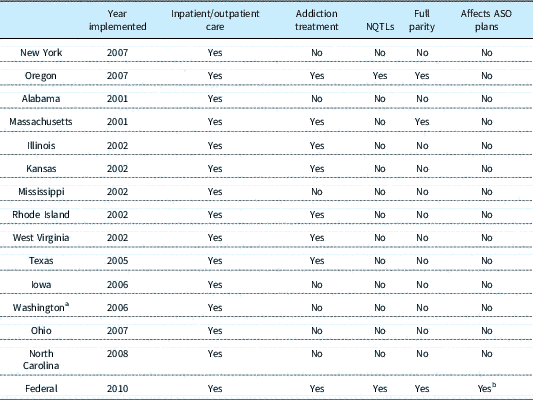
However, the legislation only applies to insurance products that contain an existing mental health coverage component (i.e. it only requires equitable mental health coverage conditional on some level of benefits already being in place). For this reason, ‘grandfathered’ plans with no mental health component were not affected. The Federal law does have the ability to move states with a ‘partial’ parity status (i.e. mandating some benefits) to ‘full’ parity status (i.e. no disparate treatment of mental health benefits within insurance products). Additionally, the replacement of outdated health plans with newer products implies that grandfathered plans will be replaced over time. Between 2011 and 2017 the proportion of employees enrolled in employer-sponsored grandfathered plans reduced 70%, from 56 to 17% (Kaiser Family Foundation, 2017). Barry et al.’s (Reference Barry, Huskamp and Goldman2010) work offers additional detail about MHPAEA and the law’s accompanying political narrative. For quick reference, Table A1 provides a summary of key attributes of NY and OR’s state laws, additional state parity laws passed prior to MHPAEA, and the Federal law.
2.3 Current study
My study extends previous work by examining two states that enacted parity laws simultaneously but differed in their ‘bite’; both states included coverage requirements and cost-sharing restrictions, while only OR used NQTL rules to minimize differences in managed practices across the physical and mental health care domains. This research also incorporates more years of data than previous work and covers a broader range of potential policy effects than what has been previously attempted – in particular, employer switching to ASO products.Footnote 4 Finally, observing the arrival of MHPAEA allows me to estimate the impact of Federal parity on two states that already mandated meaningful levels of mental health coverage, and thereby had existing insurance products subject to the Federal law. With the advent of federal parity, NY was likely shifted from ‘partial’ parity status to ‘full’ parity status, at least among fully insured plans.Footnote 5 With NQTL’s already in place, OR was likely already far closer to ‘full’ parity than NY. I believe this multidimensional approach can generate better insights into how different parity law designs influence patient outcomes and the degree to which affected insurance providers engage in regulation avoidance.
Moreover, such insights have broad relevance to the mental health, as well as other health, domains, even after the implementation of federal parity and its expansion under the Patient Protection and Affordable Care Act (ACA). As described above, federal parity was not universally applied. MHPAEA eliminated the ERISA exemption for ASO plans in the large employer-sponsored market. However, mental health parity was only extended to the small group (50 or fewer employees) and individual markets in 2014 under the implementation of the ACA. In addition, though the proportion of employees covered under grandfathered plans has reduced over time (as discussed above), more than seven years after MHPAEA’s implementation and more than three years after the ACA expansion, 17% of employees remained exempt from federal parity under these plans (Kaiser Family Foundation, 2017).
While a majority of individual and employer-sponsored health plans are subject to federal parity regulations, potential gaps and heterogeneity in coverage across states remain. The ACA mandates a set of 10 broadly defined essential health benefits (EHBs), including mental health parity, but states retain great discretion over the specifics of these benefits. Each state has its own designated in-state health plan that serves as the benchmark for specifying the minute details of the EHBs (Center for Consumer Information & Insurance Oversight, 2018). For instance, BlueCross BlueShield of Alabama’s 320 Plan is the state’s benchmark for 2017, and Keystone Health Plan East’s Gold Premier HMO serves as the benchmark for Pennsylvania. Alabama’s benchmark includes specific habilitative services (i.e. services geared toward maintaining or improving daily living skills), one of the 10 EHBs, but Pennsylvania’s benchmark does not, therefore allowing Pennsylvanian plans greater discretion in designating which habilitative services to cover (45 CFR §156.110(f)). In addition, states have great latitude to specify formulary selection beyond a set minimum of at least one prescription drug per United States Pharmacopeia category/class (45 CFR §156.122; National Conference of State Legislatures, 2017).
States may also mandate their own set of required benefits, such as minimum maternity stay, services for autism spectrum disorder, cancer screenings and infertility treatment, though here too there is potential for large variation in coverage generosity. State-mandated benefits may be crafted such that they apply only to certain markets (e.g. individual, small group and/or large groups), exclude certain plan types (e.g. Pennsylvania excludes large group HMOs from mandated chemotherapy coverage), and, by definition, must vary across states. Through ERISA, employers also retain the ability to avoid state mandates by self-insuring.
As a final note on the ongoing relevancy of the applicability of the insights of this work into insurer behavior and enrollee utilization, the federal executive branch has proposed an expansion of short-term limited-duration insurance from a maximum term of three months to a maximum of less than 12 months, possibly including the ability to renew across years (Federal Register, 2018). If implemented, many plans purchased in the individual market would be exempt from the ACA, including mental health parity, other EHBs, and the exclusion on preexisting conditions. While this research focuses on the impact of mental health policy changes to employers and consumers in the large employer market, there continues to be a large variety of health policy settings to which my potential insights are likely to relate.
3. Data and methods
3.1 Data
The data are derived from the Clinformatics™ Data Mart Database (OptumInsight, Eden Prairie, MN, USA), which consists of US health care claims from a large nationally representative private insurance carrier. The data include claims history, pharmacy information and laboratory results of more than 55 million unique members enrolled at some point between May 2000 and June 2013. The data also describe whether the patient was enrolled in a fully insured plan (Non-ASO) or an ASO plan. As described, the issuer is the primary financial risk bearer in the former set of plans, whereas the employer holds the risk in the latter group of insurance products.
I restrict my attention to two states because my data capture fully insured and self-insured enrollees, allowing me to construct policy treatment and control groups within a state, thereby removing the need to select (somewhat arbitrarily) a comparison patient population from another state or collection of states. Doing so also ensures that my treatment and control groups are exposed to the same within-state policy environments beyond parity laws, which adds credence to the identification strategy. I can also better capture and explore the nuances of a given state’s insurance regulations, rather than pool many states and assume their laws (and effects) are sufficiently similar. McConnell (Reference McConnell2013) and McConnell et al. (Reference McConnell, Ridgely and McCarty2012) also narrowed their analyses in a comparable manner for the same empirical rationale.
My utilization measures consist of office-based claims for enrollees in OR and NY from 2004 through 2012. Mental health claims are defined as all claims in the data with an International Classification of Disease 9th Revision code of 290xx-319xx.Footnote 6 Unique office visits are defined at the day level so that multiple office claims on the same day only count as one office visit. I further restrict the counts of office visit claims to those associated with a relevant provider. To be included as a valid mental health office visit, the listed provider must be a mental health care provider, which is typically a psychologist or psychiatrist in the data. I view office-based visits with a mental health provider as my best measure of utilization and the place of service where consumers are likely to exercise the most discretion when faced with more generous coverage.
I also include an ancillary measure, the number of unique individuals that have at least one mental health visit in a given month. This complements the prior utilization measures by revealing if new individuals are taking advantage of new benefits as opposed to the same individuals using services more or less intensely (e.g. two visits per month instead of one). All outcome measures are at the monthly level.
3.2 Empirical strategy
3.2.1 Enrollment patterns over time
Before exploring the evolution of mental health care use in these two states, I graphically display the total enrollment (i.e. independent of claims history) patterns for each product (ASO and Non-ASO) within each state.Footnote 7 Doing so highlights the context in which the parity laws were implemented and can highlight strategic responses (i.e. regulation avoidance) by employers or insurers. Employers may switch into ASO products prior to the law change in order to circumvent parity law requirements, and issuers may alter their presence in the market if the expected profitability is perceived to be higher or lower post-parity. Any such behavior belonging to insurance providers (employers or commercial issuers) can enhance or blunt the effects of a parity law on consumers.
3.2.2 Aggregate utilization
My mental health care consumption analyses begin with a descriptive overview of mental health utilization behavior in NY and OR during the study period. I stratify the sample by ASO status within each state in order to observe and compare the trends in my treatment (Non-ASO) and control (ASO) product groups before and after the parity law changes (Figures 3–6). Recall, insurance enrollees in self-insured (ASO) plans were not subject to the state regulations. I exploit this policy fact in a DD framework for both OR and NY. Additionally, the corresponding figures for mental health care use provide evidence in favor of or against the DD strategy according to its key underlying assumption of parallel pre-treatment trends in outcomes.
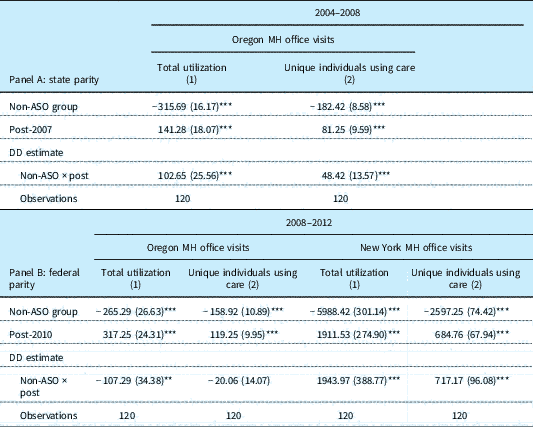
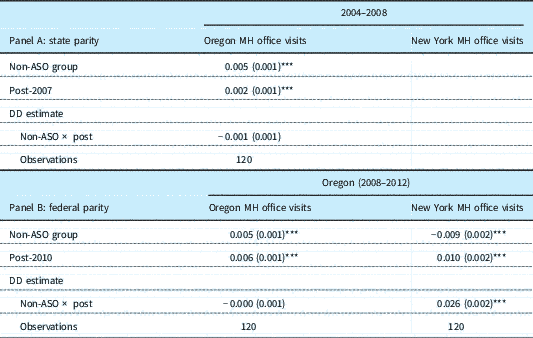
In my corresponding regressions, I first analyze the 2004–2008 period, with January 2007 marking the post-period for state parity. I then move to the 2008–2012 period that uses the arrival of Federal parity for identification (see Table 2). Both analytic samples rely on an identical specification:
 $$Y_{{gt}} {\equals}\alpha {\plus}\beta \left( {{\rm Non{\hbox-}ASO}} \right)_{g} {\plus}\gamma \left( {{\rm Post}} \right)_{{gt}} {\plus}\delta \left( {{\rm Non{\hbox-}ASO}{\times}{\rm Post}} \right)_{{gt}} {\plus}{\varepsilon}_{{gt}},$$
Y represents the level of utilization for insurance group ‘g’ at month ‘t’, where there are two possible groups based on ASO status. Thus, ‘Non-ASO’ is a binary variable equal to one for plans that are not self-insured and hence exposed to state regulations. The ‘Post’ variable is equal to one for all analytic months after the relevant law change. The delta parameter is the DD coefficient of interest and captures if mental health care utilization is statistically different among the fully insured (Non-ASO) treatment group relative to the self-insured (ASO) control group after parity.
To add helpful nuance to the above empirics, I re-estimate the aggregate utilization regressions using an enrollment-adjusted measure (Table A3). I simply divide the total volume of services used in a given month by the total enrollment in that same month. The specifications are otherwise identical, and the subsequent results shed light on how much changes in utilization are influenced by changes in enrollment within my treatment and control groups.
3.2.3 Individual-level analyses among the continuously enrolled
I conclude my empirics with an individual-level set of analyses (Table 3). Doing so allows me to further disentangle changes in mental health care utilization from changes in enrollment. For the state parity laws, I select individuals who are continuously enrolled from 1 July 2005 to 30 June 2008 (36 months) and consistently within one of the insurance product types (ASO or Non-ASO). For the MHPAEA policy analysis, I do likewise, except that the continuous enrollment period is from 1 July 2008 to 30 June 2011 (36 months).Footnote 8 As my knowledge of individuals’ health histories stems from claims behavior, I further restrict my analytic sample to continuously enrolled individuals with at least one mental health care claim during the relevant analytic period. I create an extensive and intensive measure of utilization for office visits. The extensive margin is measured as a binary indicator of whether a patient had any office visit in a given month. The intensive margin is calculated as the number of office visits in a given month to capture intensity of use. The data lack credible individual time-varying characteristics (aside from age) so the model specification is very similar to equation (1) – with the addition of individual fixed effects.
 $$Y_{{it}} {\equals}\alpha {\plus}\beta \left( {{\rm Non{\hbox-}ASO}} \right)_{i} {\plus}\gamma \left( {{\rm Post}} \right)_{{it}} {\plus}\delta \left( {{\rm Non{\hbox-}ASO}{\times}{\rm Post}} \right)_{{it}} {\plus}\eta _{i} {\plus}{\varepsilon}_{{it,}} $$
The individual fixed effect parameter (η) controls for all time-invariant characteristics and allows me to observe changes in utilization behavior within individuals. Because of the model specification, the parameter for ‘Non-ASO’ status is not identified; however, my key coefficient of interest (the DD parameter) is appropriately captured. As a supplementary analysis, I re-estimate the above specification for only those individuals with at least one mental health claim in the pre-policy period (Table A4). This subgroup can be thought of as the set of ‘baseline’ users among the continuously enrolled patient population. I can then compare the effect sizes across the two analytic samples.
Following the individual-level regression analyses, I describe the number of continuously enrolled individuals relying on mental health services that were also switched from a Non-ASO plan to an ASO plan in each state over time (Figures 7 and 8). This complements the prior results on total enrollment across plan types and offers additional insights into strategic behavior on the part of employers once new regulations are introduced.
4. Results
4.1 Enrollment dynamics across two product types
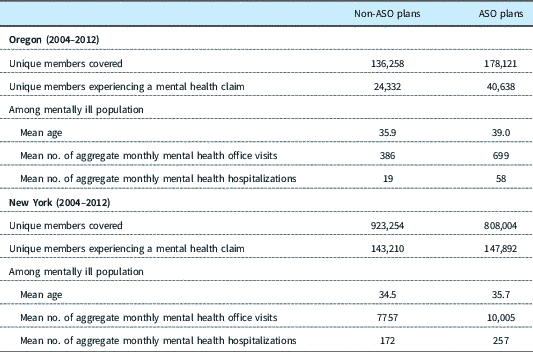
Table 1 provides descriptive statistics for my two states for the 2004–2012 study period. The NY sample is considerably larger than OR, with 1,731,258 vs 314,379 unique insured lives. This is also true among the subgroup with at least one mental health claim during the nine-year window. In OR, total enrollment and quantity of mental health services per month are tilted toward the ASO (self-insured) group. The average age of an enrollee within the OR ASO group is three years older than the Non-ASO group (fully insured). The NY sample is more balanced, although the ASO group still averages a greater level of absolute mental health utilization across the time period.
Summary statistics for each insurance group and state over the 2004–2012 period

Note: ASO=administrative services only.
Utilization measures capture the aggregate totals for each insurance group on a monthly basis over our study period.
Individuals and associated utilization related to mental health problems are identified by the accompanying diagnostic codes.
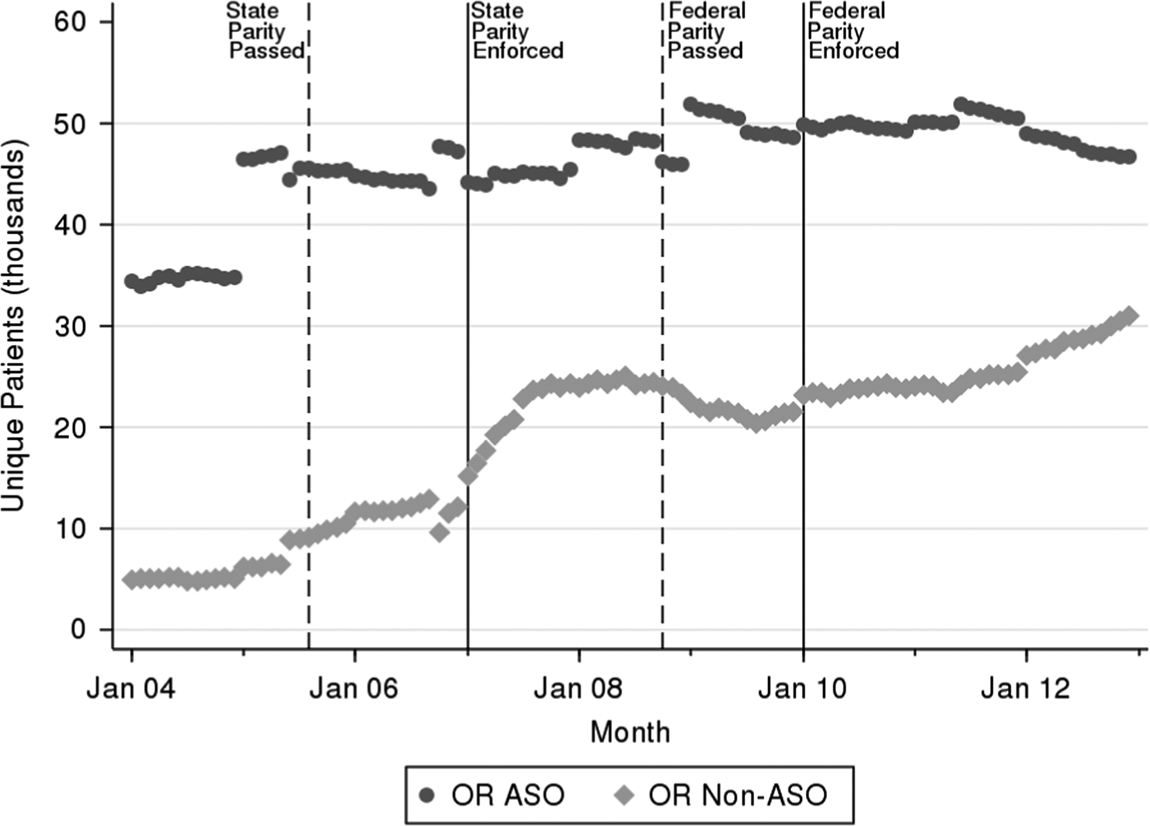
Figure 1 captures total enrollment by product type (self-insured and fully insured) in OR over time. Each dot represents a single month of coverage. I notice a sharp increase in ASO enrollees (roughly 10,000 more patients) during the lead up to the OR legislature passing state parity, an approximately 30% increase from earlier levels. The size of the ASO patient group largely levels out for the remaining time period of interest, including around the implementation of federal parity. At the same time, enrollment in the Non-ASO group grows from late 2006 through 2007 in OR, with the number of insured lives among fully insured products nearly doubling. This is likely due to the large private insurance carrier’s acquiring a regional player in late 2005, and then shifting newly acquired enrollees onto their insurance plans over subsequent enrollment periods (Department of Consumer & Business Services Annual Reports 2007–2013; NAIC 2004–2014).Footnote 9
Total enrollment trends across insurance product types in Oregon (OR), 2004–2012. Note: ASO=administrative services only insurance products (self-insured plans); non-ASO products are the fully insured plans.

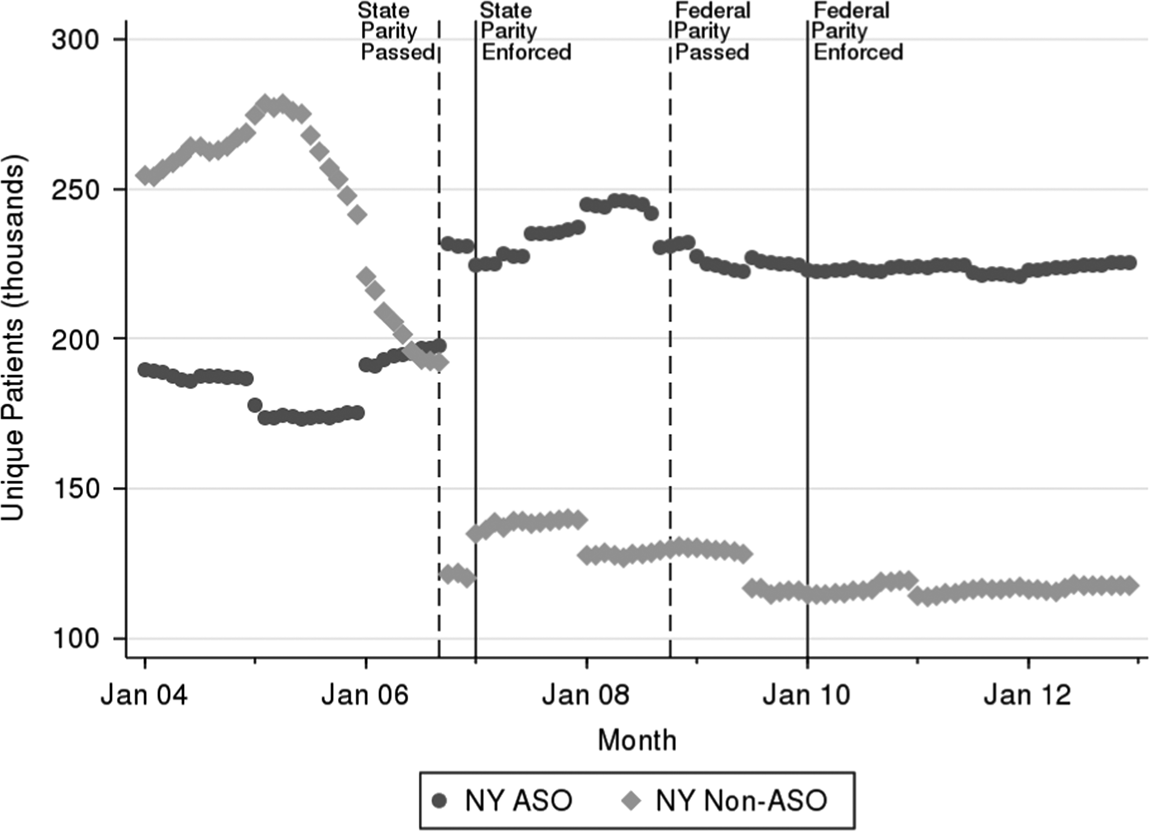
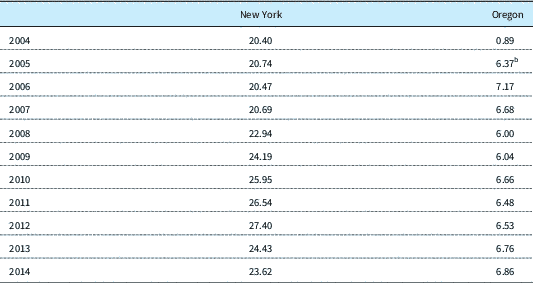
The NY data (Figure 2) also show greater demand for ASO products at the time of NY parity law’s passage, and continuing during the 2007 calendar year. Once the law is passed, there is a discontinuous jump in ASO enrollment by roughly 30,000 patients (a 15% increase). Unlike in OR, however, there is also a 50–60,000 drop in insured lives among the Non-ASO product line during the same time interval. This downward trend among the NY Non-ASO enrollment begins well in advance of the law being passed, and, in total, results in the insurer shedding around 100,000 individuals from its Non-ASO ranks (a 40% enrollment decline) in the lead up to the passage of NY’s parity law. The advanced onset of the decline may reflect some level of employer/insurer anticipatory awareness of building political momentum in support of parity. The magnitude of the Non-ASO disenrollment is also far larger than the increase in the ASO population (i.e. replacement is not one-for-one). Because the insurer’s market share remained approximately 20.5% from 2004 through 2007,Footnote 10 this suggests that some enrollees may have been transitioned to mental health carve-out plans.
Total enrollment trends across insurance product types in New York (NY), 2004–2012. Note: ASO=administrative services only insurance products (self-insured plans); non-ASO products are the fully insured plans.

4.2 Aggregate utilization among self-insured and fully insured groups
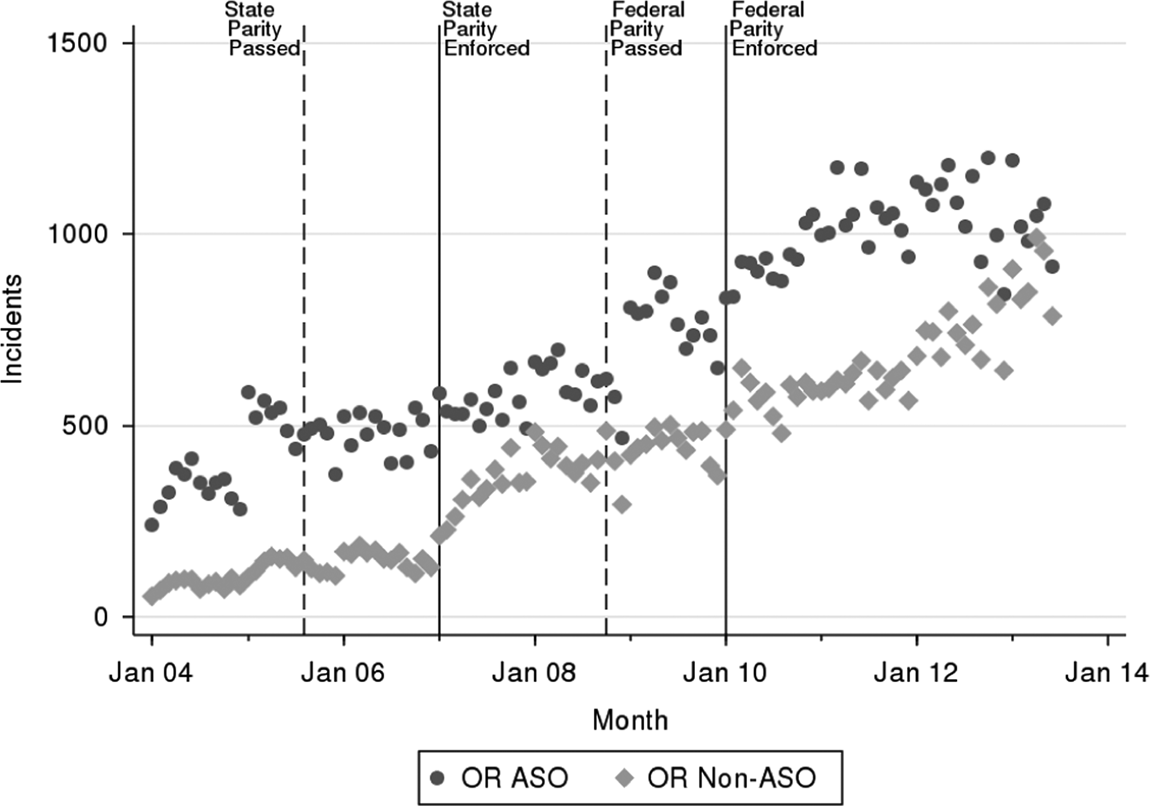
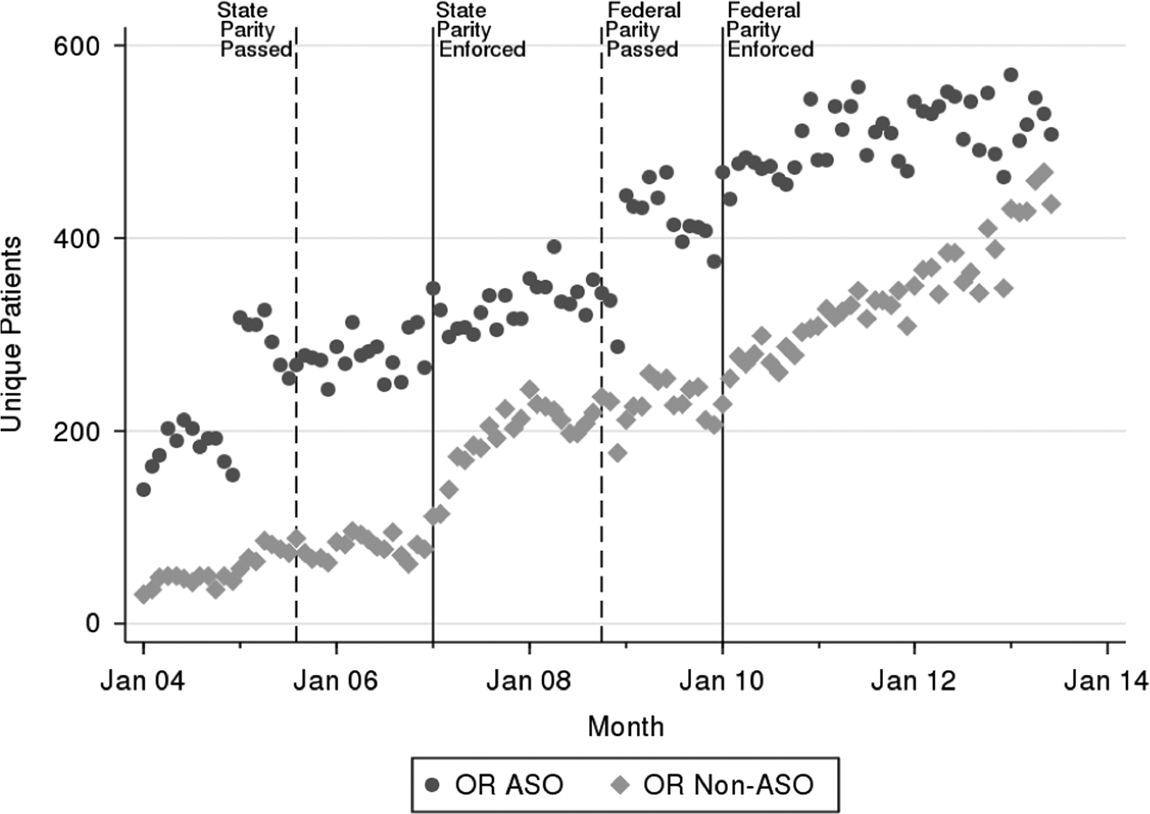
Figures 3 and 4 detail the number of mental health office visits in OR. The former captures the total number of incidents, whereas the latter reflects unique individuals consuming outpatient office mental health services.Footnote 11 The patterns are identical across the two measures. The ASO (control) group that is exempt from the OR parity law demonstrates a fairly constant and positive trajectory over time. However, the Non-ASO (treatment) group experiences an upward shift following the implementation of OR’s parity law in 2007. The quantity of Non-ASO mental health office visits in a given month (Figure 3) nearly doubles by the end of 2007 when compared to pre-parity implementation levels, paralleling the changes seen in Non-ASO enrollment (Figure 1). The same proportional increase is also evident among the number of unique individuals receiving this type of care (Figure 4). The aggregate trends for both groups (ASO and Non-ASO) are smooth around the implementation of the Federal law.
Quantities of mental health office visits consumed in Oregon (OR) from 2004 to 2012. Note: ASO-=administrative services only insurance products (self-insured plans); non-ASO products are the fully insured plans.

Unique patients consuming mental health office visits in Oregon (OR) from 2004 to 2012. Note: Measure reflects all uniquely identified individuals with at least one relevant claim in a given month. ASO=administrative services only insurance products (self-insured plans); non-ASO products are the fully insured plans.

Table 2 presents the results from statistically testing these trend changes in the aggregate measures for each of my policy windows. The first panel (Panel A) concerns the OR parity law, with the analytic sample spanning January 2004 to December 2008. The second analysis (Panel B) uses the January 2008 to December 2012 data to examine population-level effects of MHPAEA for both OR and NY. My key assumption is the presence of parallel trends in outcomes for my treatment and control groups prior to the policy’s start, which is why an NY aggregate analysis is excluded for the 2004–2008 time period. Overall, the estimates within Table 2 reinforce the descriptive figures. The treatment group (Non-ASO plans) consumes 102 more office visits per month on average after the state law comes into effect (Panel A). The control group (ASO) consumes more office visits after state parity implementation as well. There are also nearly 50 more individuals using office-based mental health care post-parity in non-ASO plans. Table A3 provides the analogous estimates using the enrollment-adjusted utilization measure. The coefficients are expectedly small – given the measure’s denominator – but I am most interested in the sign and significance of the DD coefficients with the alternative outcome. For OR, the positive treatment effects post-state parity implementation disappear, which suggests that the findings were likely driven by the greater market presence of the insurer after the parity law was passed (as seen in Figure 1). Also, the sign of the ‘Non-ASO’ coefficient flips for office visits – indicating that beneficiaries in these products are slightly more likely to use mental health care at baseline relative to ASO enrollees (once adjusting for differences in enrollment across each insurance group). This is consistent with ASO firms’ noted ability to oversee the health care utilization of their employees. Meanwhile, the enrollment-adjusted utilization results in Panel B of Table A3 indicate that the Federal parity law also does not demonstrate any differential increases for the Non-ASO group among these aggregate utilization measures in OR.
Difference-in-difference (DD) models for parity effects on mental health (MH) care utilization

Note: ASO=administrative services only.
Total utilization captures the number of care episodes in a given month.
Unique individuals using care only allows a unique person’s utilization to count a single time (i.e. regardless of the individual’s intensity of use).
***, **, *p value <0.001, <0.01, <0.05, respectively.
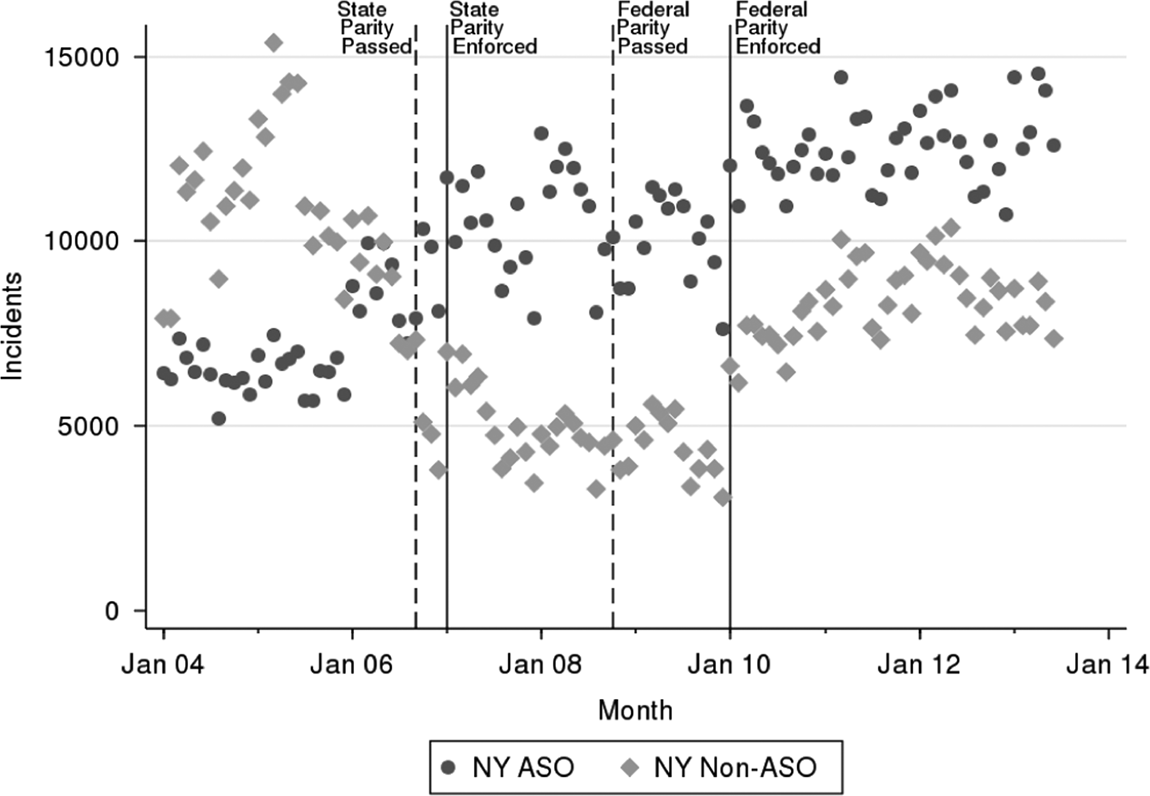
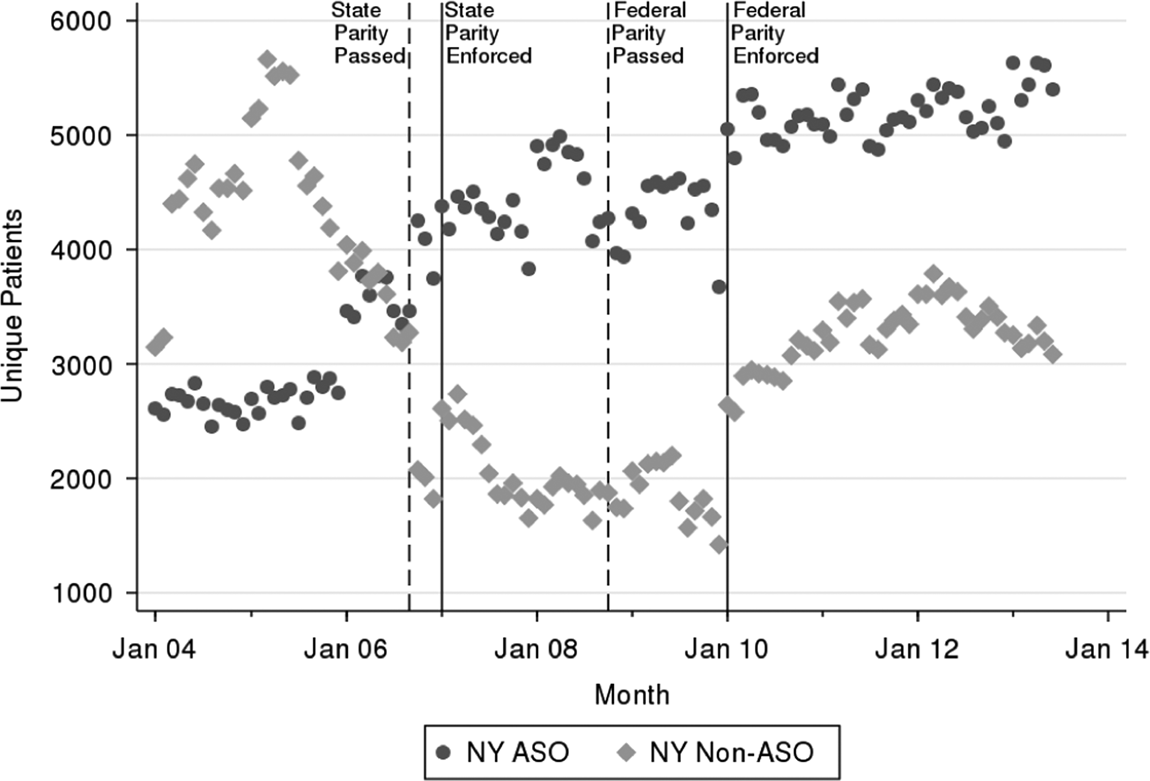
For NY, while there is positive linear growth in mental health utilization among ASO (control) enrollees, the Non-ASO group has a sharp decline in care use preceding state law implementation and continuing in the subsequent post-policy months (Figures 5 and 6). From the pre-policy peak to the post-policy nadir, the volume of mental health care and number of unique patients for Non-ASO enrollees in NY plummets by 50–60% among mental health office visits. Mental health office visits rebound after the Federal law is active, which is consistent with moving Non-ASO NY plans from their ‘partial’ parity to a ‘full’ parity status.
Quantities of mental health office visits consumed in New York (NY) from 2004 to 2012. Note: ASO=administrative services only insurance products (self-insured plans); non-ASO products are the fully insured plans.

Unique patients consuming mental health office visits in New York (NY) from 2004 to 2012. Note: Measure reflects all uniquely identified individuals with at least one relevant claim in a given month. ASO=administrative services only insurance products (self-insured plans); non-ASO products are the fully insured plans.

As mentioned, I do not test the NY (2007) policy in a DD framework since there is clear evidence of anticipatory behavior and violations of the parallel trends assumption, but I do implement a DD analysis for Federal parity in NY (Table 2, Panel B). The estimates map very closely to what is observed in the figures. Non-ASO enrollees show substantive and larger increases in mental health care use after MHPAEA than ASO enrollees. The DD estimates for mental health outpatient care are also very precise within Table 2.Footnote 12 Using the enrollment-adjusted outcome (Table A3) does not change the pattern of results. The positive increase in NY mental health care consumption after the Federal law was passed appears to be a robust effect.
4.3 Individual-level analyses among continuously enrolled
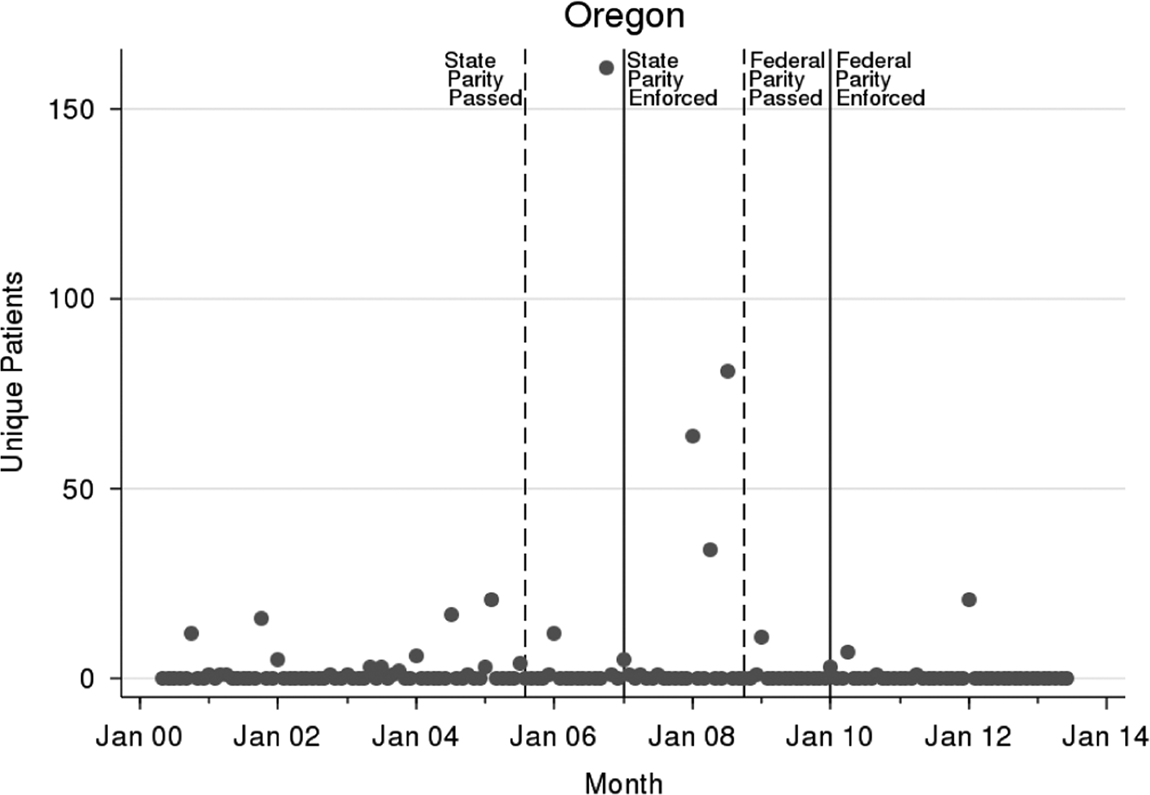
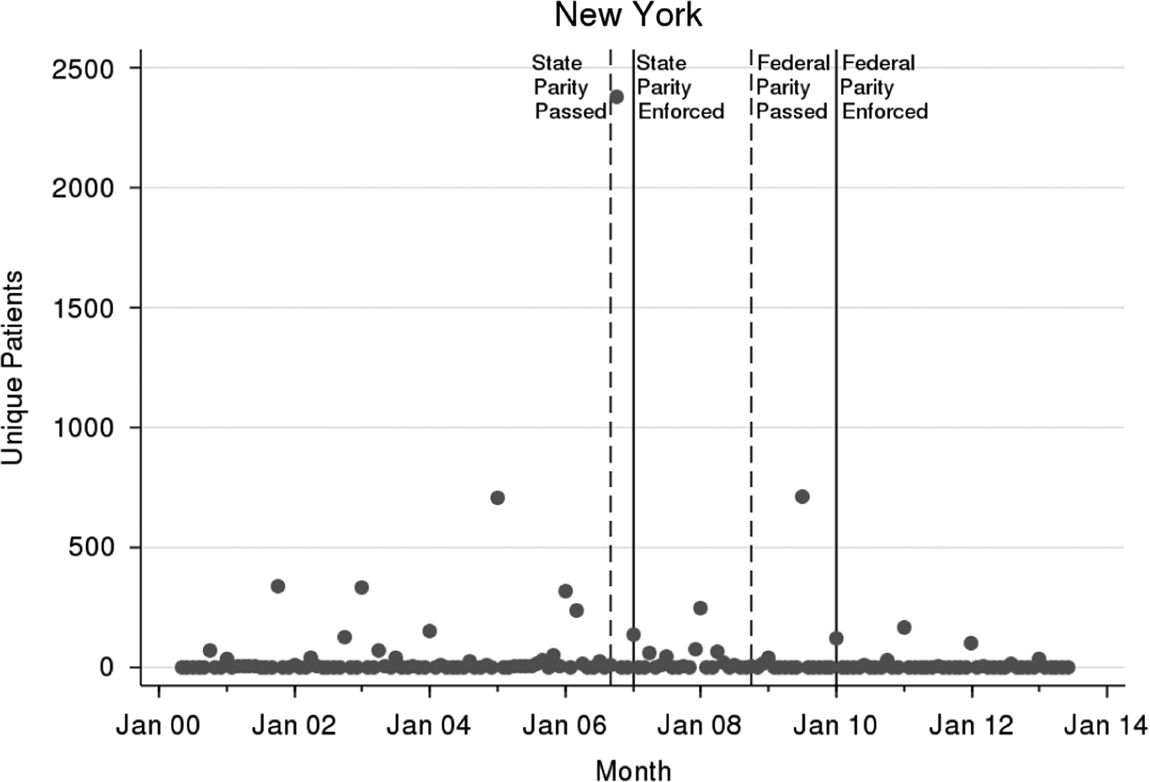
In Figures 7 and 8, I display the number of individuals within my continuously enrolled subsamples that are switched from a fully insured to a self-insured plan during the 2004–2012 period. Both OR and NY demonstrate a modest level of switching that typically occurs at the start of a calendar year (i.e. when new benefit periods often begin). However, both states have a clear spike in product type switching just before the state parity laws were enforced. The shift represents a 300–500% increase in the movement of continuously enrolled individuals with existing mental health care from Non-ASO plans to ASO plans within the same insurer. There are also some indications (both in the aggregate enrollment figures and Figures 7 and 8) of additional movement toward ASO products during the time just after state parity has been implemented (especially in OR) – perhaps reflecting the expiration of pre-parity contracts (and benefits) occurring later in 2007. This switching behavior is also consistent with regulation avoidance on the part of employers.
Number of continuously enrolled individuals switched into an administrative services only (self-insured) plan in Oregon, 2000–2013

Number of continuously enrolled individuals switched into an administrative services only (self-insured) plan in New York, 2000–2013

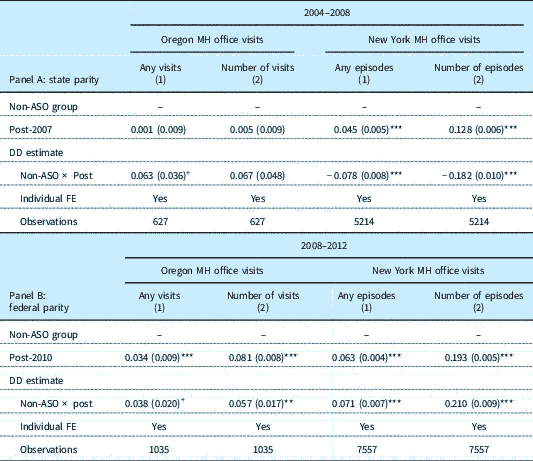
Given the substantive shifts in self-insured and fully insured enrollments seen around the time of parity implementation, I use a continuously enrolled sub-sample with stable group assignment for my final analyses. I again use separate time windows and analytic samples for the two parity law versions (state and federal). Table 3 displays the results.
Parity effects on mental health (MH) care utilization among continuously enrolled with individual fixed effects (FE)

Note: ASO=administrative services only; DD=difference-in-differences.
All models use individual fixed effects and restrict to those continuously enrolled six months before the policy change and 12 months after the change.
***, **, *, +p value <0.001, <0.01, <0.05, <0.1, respectively, robust standard errors used for extensive margin (i.e. any use) binary outcome.
For OR’s state law (Panel A) for office-based mental health care, the DD estimates are positive and relatively large. Post-parity, those in Non-ASO plans are 3.7 percentage points more likely to have at least one visit and have 0.04 of a visit more in total volume per month, on average. Given the respective means of the outcomes, the DD magnitudes are important and significant, though they reduce to marginal significance when using robust standard errors (t statistics are 1.76 and 1.86, respectively). Conversely, after OR’s parity law, there does not seem to be any real change in office-based mental health care use among those in ASO plans (neither of the post-2007 coefficients are significant).
Both ASO and Non-ASO enrollees see a positive and substantive uptick in office visits after the Federal law becomes active (Panel B), with the Non-ASO group seeing a larger increase as described by the DD estimate. These MHPAEA coefficients for OR are also fairly tightly estimated. I then restrict the sample to enrollees that demonstrate baseline (pre-policy) mental health utilization in Table A4. The estimates for this subpopulation show similar results, with occasionally larger coefficients.
The individual-level results for NY (Table 3) map well to my previous findings using the aggregate utilization measures for the state. At the time of the state-based law, I see strong negative policy effects for the Non-ASO (treatment) group. Importantly, a negative coefficient is consistent with companies transitioning these individuals to mental health carve-out plans – leaving their benefits to be managed by an outside party.Footnote 13
The arrival of federal parity has the opposite effect, with Non-ASO enrollees increasing utilization more than those within ASO plans (Panel B). After federal parity, Non-ASO patients in NY are 5.6 percentage points more likely to have at least one mental health office visit and average almost two-tenths of a visit more in total volume per month. Both DD estimates are highly significant. The results for baseline care users (Table A4) are largely the same as those found in Table 3.
5. Discussion
My data are limited to the experiences of a single very large insurer, which restricts the potential generalizability of my findings, particularly for insurers with smaller market presence in these or other states. However, the large insurer is consistently one of the major players within state health insurance markets in which it has a presence, which implies that its decisions have large and tangible impacts for a large segment of enrollees across the country (NAIC, 2004–2014). Additionally, I benefit from the ability to explore a wide range of potential parity effects. My results indicate that this broader gaze is necessary to fully understand patterns in subsequent utilization behavior. As seen in OR and NY, individual insurers may alter their presence in a market once learning of new coverage mandates, and, more importantly, employers seem very sensitive to regulations affecting their workplace benefits. The ERISA legislation provides a clear path to avoid parity compliance for firms in a position to do so, and my data suggest that employers in both OR and NY took advantage of this option. This behavior also reinforces the concerns previously voiced by others (e.g. Buchmueller et al., Reference Buchmueller, Cooper, Jacobson and Zuvekas2007). Taken together, the strategic responses of benefit intermediaries (i.e. the actors standing between the policy and the patients it aims to affect) shape the level and nature of coverage ultimately reaching consumers.
In settings where the regulations bind, I see clear upticks in mental health care quantities consumed. This is especially the case within office-based care, which involves greater consumer discretion and is well measured in my data. These patterns are partly evident during OR’s state parity law implementation – though the individual-level DD effects are less tightly estimated.Footnote 14 Non-ASO enrollees are more likely than ASO enrollees to have a mental health office visit after the implementation of OR’s parity law, which implies the regulation was effective in increasing utilization for individuals insured by plans subject to the law. In NY, the opposite occurs after state parity implementation. Non-ASO enrollees are far less likely to have a mental health office visit and have fewer visits, on average, than ASO enrollees. While OR’s parity law included NQTL measures, which likely limit the value of employers using third-party carve-outs, NY’s law included no provisions to limit the use of such onerous techniques as prior authorization and utilization review.
The strongest results are for NY during Federal parity implementation. I see substantive, upward shifts in utilization for the Non-ASO group after the Federal law went into effect. The pattern of findings is present in the individual-level analyses and in the aggregate (even after adjusting for changes in enrollment). My NY empirical observations are consistent with Non-ASO plans being transitioned from a ‘partial parity’ classification to ‘full parity’ after January 2010. Employers’ switching to an ASO product to avoid compliance would have required dropping mental health coverage to avoid MHPAEA regulations, which may have been unpopular with employees and risked a morale or financial backlash. Additionally, the NQTL restrictions in the Federal law (similar to those in OR’s state law) likely reduce the value of utilizing carve-outs. Thus, NY patients belonging to a Non-ASO product likely received new mental health coverage and/or less aggressive utilization management following Federal parity.
While the largest increase in the likelihood of, and number of, office visits post-federal parity is observed for non-ASO enrollees in NY, ASO enrollees in NY also increased utilization along both measures. Enrollees in both product types in OR did as well. That the magnitude of the federal parity gains is larger in NY (regardless of insurance status) indicates that individuals in NY were to a greater extent underutilizing mental health care services prior to MHPAEA. Because non-ASO and ASO enrollees in OR experience similar gains post-federal parity, this also supports the interpretation that there was more equivalence after state parity in OR than in NY.
Put together, the data provide a clear indication of employer regulatory avoidance prior to state parity passage in both OR and NY. The results suggest that OR’s law, with its additional ban on ‘non-quantitative’ treatment limitations, was more effective than NY’s in increasing access to, and utilization of, mental health services, and that federal parity widely enhanced access and utilization to mental health services across both states.
I acknowledge some constraints these particular data place on my research, e.g. inability to conduct heterogeneity analyses, observe all market participants, including mental health benefits management firms (i.e. ‘carve-out’ plans), and the potential for unobserved factors across states (including differences in market power of the insurer and additional characteristics of the patient populations). Moreover, while the switching behavior from Non-ASO to ASO plans I observe is consistent with regulation avoidance on the part of employers, as I do not observe carve-out information I cannot speak to the extent to which employers used this additional option nor their reasons for doing so – to provide high-quality treatment, reduce costs, or as another avenue for regulation avoidance. However, my empirical results are consistent with the NQTL provisions in the OR and Federal laws likely reducing the incentive for employers to use carve-outs, if their desire to do so is driven by regulatory avoidance.
In addition, public opinion has been shown to influence policy decisions (Page and Shapiro, Reference Page and Shapiro1983; Burstein, Reference Burstein2003), including in the public health domain (e.g. anti-smoking legislation; Pacheco, Reference Pacheco2012). There is some evidence that suggests that attitudes toward mental health utilization have improved and social stigma associated with seeking care has decreased in recent years (Quartana et al., Reference Quartana, Wilk, Thomas, Bray, Rae Olmsted, Brown, Williams, Kim, Clarke-Walper and Hoge2014). I do not observe the extent to which changing public perception to mental health care influenced the passage of state parity or consumer utilization of health care services after implementation. Such attitudes would equally apply to enrollees of both types of insurance plans in my data and, as such, should not bias the results in a particular direction.
6. Conclusion
While recognizing the above limitations, the data have provided an opportunity to examine two states side-by-side with an identification strategy that is valid within state. My findings highlight the importance of policy heterogeneity and the substantive roles of other moving parts, which then spillover onto the consumer experience and outcomes. Empiricists and policy experts should be mindful of unique experiences that can easily materialize in different states passing a seemingly similar insurance regulation.
In a broader and timely context, my findings may bode well for individuals receiving coverage through the ACA’s health insurance exchanges. A condition of exchange participation for issuers is compliance with mental health coverage requirements as outlined in the EHBs (Beronio et al., Reference Beronio, Glied, Po and Skopec2013; Berry et al., Reference Berry, Huskamp, Goldman and Barry2015; Reisinger Walker et al., Reference Reisinger Walker, Cummings, Hockenberry and Druss2015), and tens of millions of Americans have already obtained new or improved mental health treatment benefits courtesy of the ACA. Due to the NQTL provisions in the ACA, the benefits to one key strategic response (i.e. carve-outs) option by employers and insurers are likely minimized. It therefore seems more likely that the legislated benefits will actually accrue to patients.
And yet, loopholes in mental health coverage remain. In 2017, 17% of employer-sponsored plan enrollees remained under grandfathered plans exempt from federal parity regulations (Kaiser Family Foundation, 2017). State discretion over the ACA’s EHBs and the minimum coverage requirements of one prescription drug per Pharmacopeia category/class allows for enormous control over formulary benefit design, which may be particularly salient for mental health and substance abuse patients attempting to optimize their medication regimen. The same is true for the other EHBs and the ACA’s contraceptive mandate.
More broadly, my findings of employer regulatory avoidance and increased utilization in situations in which regulations bind are relevant to other populations, health settings, and public policy domains. For instance, states may enroll adult Medicaid recipients with disabilities into traditional fee-for-service plans, which are exempt from MHPAEA. The implications of this exemption are quite large, as one-third of this population has a mental illness (Burns, Reference Burns2015). States may mandate their own required health benefits, including services for lifelong conditions such as autism spectrum disorder and coverage of expensive treatments, including infertility treatment. Yet neither MHPAEA nor the ACA removed employers’ ability to avoid state mandates by self-insuring.
Last, my findings have broad relevance to the current debate over short-term limited-duration insurance in the individual market. The federal executive branch has proposed the expansion of these offerings from a maximum of three months to a maximum of less than 12 months, with potentially including the capability of annual renewal. These plans would not be subject to federal parity requirements or the ACA’s set of EHBs. The federal government anticipates a demand-side response in which a portion of unsubsidized enrollees in the individual market switches to short-term plans (Federal Register, 2018). These plans are expected to have lower premiums than those offered through the ACA, largely due to a slimmer set of covered benefits. Individuals choosing such plans may be willing to make this tradeoff, but without parity protections, the set of EHBs, and the ban on NQTLs, my findings suggest that these enrollees could plausibly find themselves with inadequate benefits and more onerous coverage techniques upon experiencing an unexpected health shock.
Acknowledgments
The author is grateful to OptumInsight for providing excellent data resources. The author thanks Michael Richards in particular for his irreplaceable insight and feedback, as well as the Leonard Davis Institute of Health Economics for sponsoring access to the data, the Health Services Research Data Center for hosting the data, Sean Hennessy, and the University of Pennsylvania for making the data accessible. The author is grateful to Susan Busch and Daniel Polsky for helpful comments on earlier versions of this work. Any expressed views and errors are solely the responsibility of the author.
Appendix
Brief policy descriptions of parity laws affecting large employers, 2001–2008

Health insurer market share (%) by yearFootnote a

Difference-in-difference (DD) models for parity effects on mental health (MH) care enrollment-adjusted utilization

Parity effects on mental health (MH) care utilization among continuously enrolled with pre-policy utilization and individual fixed effects (FE)