Introduction
Dantig is a remote valley, accessible only on foot, located at the fringes of the Tibetan cultural area in the modern Chinese province of Qinghai. It is one of the major religious locations in Tibet, a pilgrimage site that is also home to a monastery and a series of cave temples built into the valley's sides. Dantig plays a key role in Tibetan history, as the place where the Buddhist ordination lineage was preserved during Tibet's “dark period” in the late ninth to late tenth centuries. Yet the name Dantig itself has remained something of a mystery. There is no clear etymology for it in Tibetan, and in modern Chinese it is transliterated from the Tibetan in a variety of different ways. Where then did the name Dantig come from? In this article we argue that the name is linked with a Buddhist myth of exile and return, the legend of Prince Sudāna, a story that must have resonated with the exile community of Tibetan monks which settled in the region.Footnote 1
Traditional Tibetan histories of Buddhism tell of a catastrophic persecution of monastic Buddhism by the last great Tibetan emperor, Glang Darma (known in earlier sources as Dar ma U'i dun brtan) in the 840s. According to one of the most popular versions of the story, given in the late fifteenth-century Blue Annals, Darma closed the monasteries and ordered all monks to disrobe. At this time a few monks (three in most versions of the stories), loaded their manuscripts on to pack animals and set out towards Central Asia. After wandering for some time, they settled in Amdo, in the area to the east of Lake Kokonor. In Amdo the refugee monks gained a disciple, a local boy who they agreed to ordain as a monk. The ordination was carried out by the three Tibetans and two Chinese monks, and the boy was given the religious name of Dge ba rab gsal. This figure, also known as Dgongs pa rab gsal, is given the dates of 892–975 in the Blue Annals.Footnote 2 Dge ba rab gsal settled in Dantig, where he taught and became famous in the area. When a group of travellers arrived from Central Tibet, hoping to learn about Buddhism and receive monastic ordination, they heard of Dge ba rab gsal and travelled to Dantig. There they received ordination and studied, and when their education was complete, they returned to Central Tibet, arriving back between 978 and 988.Footnote 3 Thus began the revival of monastic Buddhism in Tibet.Footnote 4
In any case, the narrative of the refugee monks, their ordination of Dge ba rab gsal, and the latter's training of the men from Central Tibet, became an essential part of the Tibetans' image of “the era of fragmentation” (sil bu'i dus). If the details of the story are hard to substantiate, the broad outlines are generally accepted by contemporary scholarship: there was indeed a catastrophic collapse of the Tibetan empire in the second half of the ninth century, and by the early tenth century the Tibetan royal succession had fragmented into numerous petty principalities. Furthermore, we can now say that the story of the refugee monks and Dge ba rab gsal is true at least to the extent that there was a thriving Buddhist community in the Amdo region in the tenth century, thanks to the survival of a series of letters of passage written for a Chinese pilgrim who was passing through on his way to India. We now turn to these.
The pilgrim's letters of passage
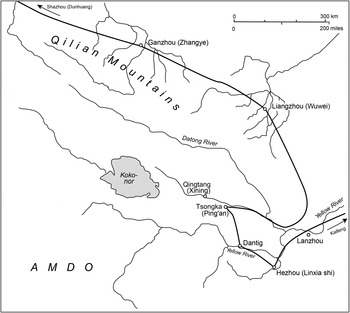
Our best evidence of the presence of a network of Tibetan Buddhist monasteries to the east of Lake Kokonor is found in a document from the Dunhuang 敦煌 library cave. This is IOL Tib J 754, a manuscript in three parts, the first part of which contains copies of a Chinese pilgrim's letters of passage, written in Tibetan. One of the letters gives the monk's itinerary through Amdo, which includes the sites of Hezhou 河州, Dantig, Tsongka and Liangzhou 涼州 (see Figure 1). The manuscript was originally acquired as a long sheet of paper rolled up in a scroll, with a portion of a Buddhist sūtra in Chinese on one side and a mixture of Tibetan and Chinese writings on the other. During conservation it became clear that the item actually consists of three parts that had been joined together by pasting two smaller manuscripts onto the back of a Chinese sūtra scroll.Footnote 5
• Manuscript A: A series of Tibetan letters with Chinese notes in between. The verso is blank.
• Manuscript B: The longest item, containing a portion of the Baoenjing 報恩經 on the recto and Tibetan tantric texts on the verso.
• Manuscript C: A short item consisting of a single sheet of paper, with a short text about rebuilding the Gantong monastery 感通寺 in Liangzhou. The verso is blank.
Map of the Chinese pilgrim's route through Amdo

Manuscript A
The recto of this scroll, the only side with any writing, was on the outside when the scroll was pasted to Manuscript B. It contains four letters written in Tibetan with sporadic Chinese notes in between, including phonetic transcriptions of some of the names and titles from the Tibetan letters. The Tibetan text consists of letters of introduction recommending a travelling Chinese monk to the abbots of monasteries along his way. The pilgrim was going from Wutaishan 五臺山 to India to see the relics of the Buddha, passing through Hezhou (Ga cu), Dantig Shan, Tsongka, Liangzhou (Leng cu), Ganzhou 甘州 (Kam cu), and Shazhou 沙州 (Sha cu). The fact that these letters were discovered in Dunhuang suggests that he arrived there but either left the scroll behind or ended his journey without going further.
Manuscript B
When this scroll was pasted to Manuscript A, the side that was exposed was the recto, containing part of juan 3 of the Baoenjing 報恩經 (i.e. Dafangbian Fo baoenjing 大方便佛報恩經; T0156, 3) written in Chinese. The text of the sūtra follows its standard transmitted version, only occasionally omitting or substituting individual characters. The verso side of Manuscript B, which was hidden before the separation, has four Mahāyoga sādhana written in Tibetan. Detailed discussions of these texts can be found in Dalton and van Schaik (Reference Dalton and van Schaik2006: 323–5). Thus far, several manuscripts of Tibetan Mahāyoga texts have been dated to the late tenth century (Takeuchi Reference Takeuchi and Scherrer-Schaub2012), and it is likely that most of the manuscripts with such content were written in this period.
Manuscript C
This single sheet of paper contains a short text on the recto that appears to be a copy of an earlier stele inscription commemorating the building of the Gantong monastery near Liangzhou. A colophon at the end says, “Recorded by the monk Daozhao on the 26th day of the 6th month of the 6th year of the Qiande era (968)” 乾德六年六月廿二日僧道昭記之耳. If we compare the handwriting of the Chinese notes in Manuscript A with those used in the copy of the Gantong monastery inscription in Manuscript C, we can see that they were probably written by the same hand. The significance of this lies in that the date 968 found in the colophon is also valid for the pilgrim's trip.Footnote 6
This date is also interesting because if Dge ba rab gsal's dates, as given in the Blue Annals (892–975), are correct then the central figure in the preservation of the Tibetan monastic vinaya could have been in Dantig when our pilgrim visited the monastery. In any case, this manuscript is a first-hand witness to a period in the history of Tibetan Buddhism for which we have little other evidence. The presence of many Tibetan monastics of various ranks mentioned in the letters of passage in IOL Tib J 754 shows that something akin to the vibrant monastic scene described by the later histories must have drawn the pilgrim to take the roundabout route that led through this Tibetan region.
The etymology of the name Dantig
It is in the second of the letters of passage contained in Manuscript A that we find a brief account of the pilgrim monk's journey.
This is a petition from the patron Ngogs Lu zhi nam ka. A Chinese monk from China who is unequalled as a great ascetic, a great scholar and a great upholder of virtue is going to India to see the sites of Śākyamuni. His route is as follows: proceeding from Wutaishan he arrived at the gold and turquoise halls of Hezhou;Footnote 7 after that he arrived at the mountain of Dantig Shan; after that he arrived at the gold and turquoise halls of Tsongka; after that he will arrive at the palace of Liangzhou; after that he will arrive at the castle [fort?] of Ganzhou; after that he will arrive at Shazhou. After that he will certainly go to see the great teachers of Śrī Nālandā and the relics of Śākyamuni at the Vulture's Peak in India.Footnote 8
This is the earliest dated occurrence (in or around the year 968, as we saw in the previous section) of Dantig as the name for the valley in Amdo.
We also find Dantig as the name of a Tibetan monastery in a number of Tibetan lists of monasteries founded by the emperor Khri gtsug lde btsan (r. 815–841).Footnote 9 Yet while they purport to describe the events of the Tibetan imperial period, these histories date from the twelfth century and later, and cannot therefore be taken as accurate accounts of the period of Tri Tsugdetsen. Indeed, the lists contain monasteries like Bsam yas that were well known to have been established before the reign of Khri gtsug lde btsan. These lists nevertheless give us the name of Dantig, as it was known to the historians of this period, two to three centuries after the letter quoted above. The versions of the name in the three histories in which this list of monasteries is found are as follows:Footnote 10
1. Dan tig dpal gyi yang dben
2. Dan ti shan
3. Dan tig shan
Apart from the first source, which appends what is either the name of the valley's monastery or an epithet for the valley itself (Dpal gyi yang dben, “glorious retreat”), the name is very similar to what we see in the letter in Manuscript A. However, none of these sources explains the etymology of the name Dantig. Only in a much later Tibetan work, a history of the Amdo region written in the nineteenth century, do we find a clue.Footnote 11 The author of this history, probably drawing on a local tradition, associates the valley with the story of Prince Sudāna as told in the Rgyal bu don grub kyi mdo. This text (which we will henceforth refer to as the Sudāna Sūtra) is a translation from a Chinese version of a sūtra that tells the story of the prince's exile to Mount Dantig, his subsequent trials and his eventual return to the kingdom. Similar stories appear in other Buddhist texts, the most famous being that of Prince Viśvantara (Pali Vessantara).Footnote 12 However, it is only in the Tibetan version of the Sudāna Sūtra that we find the name of the mountain to which the exiled prince retreats given as Dantig.
The Sudāna Sūtra is found among the Dunhuang manuscripts in both Chinese and Tibetan versions. The Chinese version is called Taizi Xudana jing 太子須大拏經 (T03.0171), translated by the śramaṇa Shengjian 聖堅 of the Western Qin 西秦 dynasty (385–431). There is no biography of Shengjian, his name occurs for the first time in the Lidai sanbao ji 歷代三寶記 written by Fei Changfang 費長房 of the Sui 隋 dynasty (589–618), where he is described as having been entrusted with translating Buddhist works by Qifu Guoren 乞伏國仁 (d. 388), founder of the Western Qin. The same work also states that Shengjian worked for Qifu Guoren during the reign of Emperor Xiaowu of Jin 晉孝武帝 (r. 372–396).Footnote 13 Accordingly, he must have completed the translation of the Sudāna Sūtra sometime in the late fourth century. In his version we find the place of Prince Sudāna's exile given as Tante shan 檀特山.
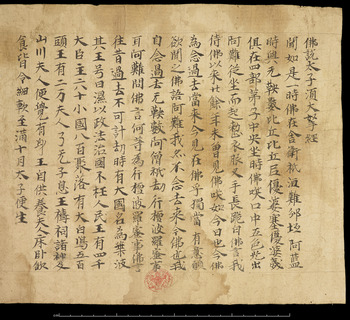
There are two copies of the Chinese sūtra among the Dunhuang manuscripts, both undated. The first is Or.8210/S.2096, an interrupted fragment with only the first fifteen lines of the sūtra (see Figure 2).Footnote 14 The other is Pelliot chinois 2166 at the Bibliothèque nationale de France, a complete version glued together from two originally separate pieces.Footnote 15 In addition, there are also smaller fragments in the Institute of Oriental Manuscripts at St Petersburg of a bianwen-type text (TH-285 I-III) which shows a close similarity to the Sudāna Sūtra.Footnote 16 The story of the prince's exile to Mount Dantaloka (Daṇḍaka) was also one of the most popular themes in medieval Chinese art. We have scenes from it in the Buddhist art in both Longmen 龍門 and Dunhuang.Footnote 17 In Dunhuang, Sudāna's story is depicted in Cave 428 from the Northern Zhou dynasty (557–581), and in Caves 419, 423 and 427 from the Sui dynasty (581–618).Footnote 18
A partial copy of the Sudāna Sūtra in Or.8210/S.2096

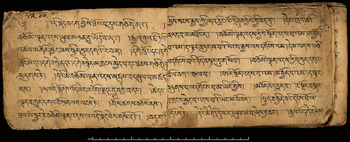
The Tibetan translation of the Sudāna Sūtra was preserved in the canonical collections of scriptural texts (bka’ ’gyur), under the title ‘Phags pa rgyal bu don grub kyi mdo. The Sanskrit title given for this text – Jinaputra-arthasiddhi-sūtra – appears to be no more than a reconstruction from the Tibetan title.Footnote 19 The colophon provides no information about the translator(s), stating only that the text “contains archaic orthography and was translated from the Chinese”.Footnote 20 This information was clearly added long after the translation was carried out. Thus it seems the text was not included in the revision of translation terminology that occurred in the early ninth century, and by the time the canon was compiled, all that was known about its provenance was that it had been translated from a Chinese model. Among the Dunhuang collections the Tibetan version of the sūtra survives in a single manuscript, IOL Tib J 76 (see Figure 3). This manuscript is a codex, a book form usually dated to after the ninth century; thus this copy of the sūtra is not far removed in time from the pilgrim's letters. The existence of this sūtra in a Tibetan manuscript from Dunhuang shows that the story, and the occurrence of the name of Dantig within it, was known among Tibetophone Buddhists of the time.Footnote 21
A copy of the Tibetan translation of the Sūdhana Sūtra in IOL Tib J 76

A comparison of the Chinese and Tibetan versions of the Sudāna Sūtra shows how the name of Dantig evolved. The name of the mountain retreat in the story of the exiled prince appears in Chinese sources in different transliterations, including Tante 檀特 /壇特 (MC: dân dǝk), Tantuoke 檀陀柯 (MC: dân dâ kâ), Tannajia 檀拏迦 (MC: dân ṇa ka), Tanzhaijia 彈宅迦 (MC: dân ḍɐk ka), Tantuo 檀陀 (MC: dân dâ), Shante 善特 (MC: źjänB dǝk), Daze 大澤 (MC: dâiC ḍɐk), and Danduoluojia 彈多落迦 (MC: dân tâ lâk ka) / 單多囉迦 (MC: dān tâ lâ ka).Footnote 22 The “spelling” Danduoluojia 彈多落迦 appears in Xuanzang's 玄奘 travelogue, with a note in the commentary saying that formerly the name of the mountain had also been written, incorrectly, as Mount Tante 檀特山 (MC: dân dǝk).Footnote 23 Although there is no consensus regarding the exact geographical location of the mountain, it is nevertheless clear that it was generally considered to be located in the Gandhāra region.Footnote 24 There is no Chinese tradition that identifies this place with the Dantig valley in Amdo.
The Tibetan name Dantig is very unlikely to be derived directly from the Indic versions Dantaloka or Daṇḍaka. Instead, it closely matches the Chinese transliteration Tante 檀特 (pronounced dân dǝk in medieval times) found in Shengjian's translation of the Sudāna Sūtra. And it is much closer to this than to later transliterations such as the Pali-based Danduoluojia 彈多落迦 (MC: dân tâ lâk ka). Thus it was clearly Shengjian's Chinese translation that formed the basis for the Tibetan translation of the sūtra. While the later Tibetan tradition, as we have seen, retained the link between the Dantig valley and the Sudāna Sūtra, in Chinese this connection was lost and the name of the monastery was transliterated anew as if it were a purely Tibetan name with no Chinese precedent. Thus instead of calling the monastery Tante 檀特 (MC: dân dǝk), Chinese sources tried to approximate the Tibetan name using transliterations such as Dandi 丹笛 (MC: tân diek), Dandi 丹底 (MC: tân tieiB), Dandou 旦斗 (MC: tânCtǝuB), Dandou 丹豆 (MC: tân dǝuC), or Dandou 旦兜 (MC: tânC tǝu).
Based on the above, we can now trace the etymology of the name from the Sanskrit Daṇḍaka to the modern Chinese designation of the monastery in Amdo in several stages: 1) Sanskrit Daṇḍaka; 2) Chinese Tante 檀特; 3) Tibetan Dantig; 4) Modern Chinese Dandi 丹笛 or Dandou 旦斗. It appears that every time the name of the valley was transcribed into another language, it was done only from the previous source language, disregarding older layers and languages in its etymology.
The story of the exiled prince
We can now trace the origin of the name of the Dantig valley, which is closely connected to the Sudāna Sūtra. But we have not seen why the name of a site in the story of Prince Sudāna should have been applied to the valley in Amdo. Is there anything in the sūtra itself that would suggest such a connection? One thing that links the traditional Tibetan narratives of the refugee monks who settled in Dantig with the narrative of the Sudāna Sūtra is the powerful theme of exile, renewal in a distant place, and eventual return. Let us look briefly at the story told in the Sudāna Sūtra, which begins with Buddha sitting among his disciples in the Jetavana Garden and, in response to Ānanda's question about dāna pāramitā, retelling the jātaka of Prince Sudāna.
According to the story, the prince is so fond of practising the act of giving that this begins to create problems for his father's kingdom. This comes to a head when the king of the enemy state asks Sudāna for his father's white elephant, and the prince gives it to him without hesitation. This results in a scandal at the court; the king, acquiescing to the demands of his ministers, sends his son Sudāna into exile to Mount Daṇḍaka (Tante shan in the Chinese version, Dantig in the Tibetan) for twelve years.
This is a key moment in the story. Although from the point of view of the narrative the prince has done nothing wrong, he is no longer welcome in his own country and has no choice but to leave. Accordingly, he takes his wife and two children, a son and a daughter, and leaves his father's kingdom. The harshness of the prospect of living in the wilderness is described by the prince himself who at first tries to dissuade his wife from following him there. He contrasts this fate with his wife's carefree life in the palace and says that living among fearsome wild beasts and in rough conditions would be too harsh for her. His wife, however, insists that her place is always beside him and they all go off together. Along the way, the prince is forced to give away his horse and carriage, and finally his clothes, to brahmins whom they encounter and who ask for these things. Eventually they reach Daṇḍaka on foot with no possessions, yet joyous at heart. In contrast to the image depicted earlier by the prince, the mountain at this point is described as an earthly paradise:Footnote 25
前到檀特山中。太子見山嶔崟嵯峨, 樹木繁茂百鳥悲鳴, 流泉清池美水甘果, 鳧鴈鵁鶄翡翠鴛鴦異類甚眾。太子語妃﹕「觀是山中樹木參天無折傷者。飲此美泉噉是甘果。而此山中亦有學道者。」太子入山, 山中禽獸皆大歡喜, 來迎太子。
Ahead of them they reached Mount Daṇḍaka. The prince saw that the mountain was high and steep, with dense forests and the cries of many birds. But there were flowing springs and clear ponds, good water and sweet fruit. Wild ducks and geese, egrets, kingfishers and mandarin ducks abounded in all varieties. The prince said to the consort, “Look how tall the trees are in this mountain, never having been cut or damaged. Have a drink from this beautiful spring, take a bite of these sweet fruits. In addition, in this mountain there are also those who study the true way.” As the prince entered the mountain, the birds and beasts in the mountain all rejoiced and came to greet the prince.Footnote 26
At this point, they encounter a holy man who has lived in the mountain for hundreds of years, the monk Acyuta. The fact that he dwells here establishes the spiritual character of the forest, which makes it a perfect site for withdrawal and self-cultivation. The holy man confirms this by claiming that the entire mountain is blessed:
山上有一道人名阿州陀, 年五百歲有絕妙之德。太子作禮却住白言﹕「今在山中何所有好甘果泉水可止處耶﹖」阿州陀言﹕「是山中者普是福地所在可止耳。」道人即言﹕「今此山中清淨之處, 卿云何然妻子來而欲學道乎﹖」
On the top of the mountain, there was a holy man by the name of Acyuta, who was five-hundred years old and possessed extraordinary merits. The prince saluted him with respect, stepped back and said, “Now where on this mountain is a place suitable to stay, with fine sweet fruit and spring water?” Acyuta said, “All of this mountain is blessed land and a suitable place to stay”. The holy man then continued, “This mountain is a pure and tranquil place. Why did you come here with your wife and children to study the way?”Footnote 27
The prince tells Acyuta that he is in fact Prince Sudāna who has practised giving in the kingdom of his father. Acyuta confirms that he had heard of him many times and raises another a question about the prince's spiritual goal:
「所求何等﹖」太子答言﹕「欲求摩訶衍道。」道人言﹕「太子功德乃爾, 今得摩訶衍道不久也, 太子得無上正真道時, 我當作第一神足弟子。」
“What is it that you are looking for?” The prince replied, “I want to seek the way of the Mahāyāna”. The holy man said, “Your merits are such that it will not take very long for you to attain the way of the Mahāyāna. When you attain the peerless correct true enlightenment (anuttarā-samyak-saṃbodhi), I will be your first disciple endowed with supernatural powers (ṛddhi-sākṣātkriyā).”Footnote 28
Thus the prince and his family begin their life in the mountains. The prince meditates and his wife gathers fruits to feed him and the children. This idyllic atmosphere is disrupted by the arrival of a brahmin from another kingdom, who asks for the prince's children because he needs servants. The prince gives his children away to the brahmin without hesitation and, although the children are frightened, forces them to follow him. In the story's most emotional scenes, Sudāna actually helps to tie his own children's hands to prevent them from running away. His wife is away gathering fruits for them while this happens. When she comes back, she is naturally sorrow-stricken, but the prince tells the story of their earlier incarnation, when she had vowed always to follow his intentions so that she could be his wife in all their future lives.
At this time the god Śakra decides to test the prince further by appearing in front of him in the form of another brahmin and asking for his wife. After receiving her from the prince, however, the god reveals himself and grants three wishes to both of them. The wife asks, first, that the brahmin who took their children will sell them back in the country of the prince's father; second, that the children will suffer no hardship; and third, that she and the prince can return home before their twelve years of exile are over. The prince, however, only wishes that all sentient beings attain salvation, and never have to experience the suffering of birth, old age, illness and death. When Śakra claims that this is beyond his powers, the prince wishes that his father and the ministers would all be happy to see him again, and he could be rich again so as to continue giving. Śakra grants these wishes and consequently the father king is able to buy back his grandchildren from the brahmin, and sends a messenger to ask the prince to come back home. The return of the prince and his wife is glorious in every way. The king comes out on an elephant to greet them, and all the people rejoice, scattering flowers, burning incense and sprinkling fragrant water on the ground before them. At home once again, the prince continues to practise giving until he himself attains Buddhahood.Footnote 29
The relevance of this story of Prince Sudāna for Tibetan monks who left Central Tibet for the distant region of Amdo is clear. It is a story of unjust exile, of refuge and religious cultivation in an idyllic retreat, and of an eventual triumphant return. And while Sudāna's exile parallels the renunciation of Śākyamuni, it is more relevant in that it is involuntary and the final outcome is a return to the kingdom.Footnote 30 Thus it seems quite possible that the name of the Buddhist site of Dantig Shan (a name that we now know, thanks to IOL Tib J 754, was widely used by the mid-tenth century) could have been connected to the presence of Central Tibetan monks in the area.
There are various ways in which this might have happened. The valley may have been known by the name Dantig during the Tibetan empire, and only later connected with the story of the refugee monks. Or the valley and the monastery established there could have been given the name Dantig after the fall of the Tibetan empire, in the late ninth or early tenth centuries (as we know from the pilgrim's letters, it was in general use by the 960s). As we have seen, the letter in IOL Tib J 754 refers to the valley as dan tig shan rather than the fully Tibetan form ri dan tig. This suggests that the naming of Dantig evolved in a community that was familiar with both the Tibetan and Chinese versions of the name, i.e. in the Sino-Tibetan borderlands of north-eastern Amdo. In either case, the connotations of the name Dantig would have made it possible for Tibetan monks in the tenth century to view a settlement in this remote valley not as an inglorious retreat from the decline of Tibetan monastic Buddhism, but as a place of religious cultivation in preparation for a triumphant renewal.
A final clue linking the Dantig valley to the Sudāna Sūtra and at least partially corroborating the above scenarios is a cave in Dantig which exists to this day. When the authors enquired about it during their visit to the monastery in 2010, local monks explained that it is dedicated to “Gelong Atsuda” who is represented in the cave by a statue of an old sage.Footnote 31 This is clearly the Monk Acyuta from the Sudāna Sūtra, who met the prince when he arrived at the place of his exile.Footnote 32 While the statue in the cave is clearly a relatively modern artefact, the cave itself and its association with Acyuta may be significantly older. The presence of this otherwise obscure figure of the Sino-Tibetan Buddhist pantheon in Dantig represents a clear and explicit link to the narrative of Prince Sudāna's exile and return, in parallel with the story of the Tibetan monks who found refuge here during Tibet's “dark period”.
Conclusion
Hitherto unnoticed, the first mention of the Dantig valley appears in a Tibetan letter of passage in the Dunhuang manuscript IOL Tib J 754, demonstrating that when the pilgrim carrying this manuscript passed through the Amdo region on his way to India in the late 960s the place was already known by that name. Moreover, the letters show that the Hezhou–Dantig–Tsongka route was significant enough to warrant a lengthy detour for pilgrims, who could have taken a more direct route from Lanzhou to Liangzhou and Dunhuang. In addition, IOL Tib J 754 is unique because it not only mentions the name of Dantig but is itself the very manuscript carried by a visitor to the region and its monasteries. In other words, it is an archival record linked directly to the Tibetan Buddhist monastery at Dantig, providing documentation of its social connections and religious significance. The document also raises the intriguing possibility that the time of the pilgrim's visit to the valley coincided with the residence there of the monk credited with preserving the Tibetan monastic lineage, Dge ba rab gsal.
As for the name Dantig, we have seen that it can be traced back to the Tibetan translation of the Chinese Taizi Xudana jing, itself a translation by Shengjian at the end of the fourth century. Although versions of the story of Prince Sudāna appeared in a number of scriptures, the name of Dantig Shan comes specifically from the Tibetan transcription of the Chinese Tante (MC: dân dǝk), which was Shengjian's rendition of the Sanskrit name Daṇḍaka. This connection with Mount Daṇḍaka has been retained in the local Tibetan tradition which still associates the Dantig valley in Amdo with Prince Sudāna's place of exile. In Chinese, however, the name of the valley and the monastery located therein was not linked back to Shengjian's Taizi Xudana jing but was transliterated anew from the Tibetan. Thus in the Chinese tradition the monastery's connection with the sūtra was forgotten.
The Vessantara narrative, represented here in the story of Prince Sudāna, implies that conflicts should be resolved not on the battlefield but in the realm of religious cultivation, through meritorious acts of giving, and through meditation. The narrative bestows on the bare fact of exile a sense of mission, compensating for the negative aspects of life in a distant land by presenting it as a religious opportunity. Furthermore, the narrative's myth of exile and return promises that fleeing one's own country and hiding in a remote location will eventually lead to return and renewal. In the Sudāna Sūtra, exile becomes a solution, by escalating events to a crisis that in retrospect turns out to be a hidden opportunity, the very means to resolve the original conflict.
The fact that the name Dantig was used for this valley in Amdo by the local Tibetan monks, as shown by the presence of this name in IOL Tib J 754 around 968 (and its absence from all contemporary Chinese records), strongly suggests an awareness of the themes of exile and religious cultivation in the Prince Sudāna narrative in the Tibetan community of Amdo at the time. When a Chinese pilgrim visited the valley of Dantig in the 960s, the revival of monastic Buddhism in Central Tibet was yet to take place. Yet an aspiration towards that revival was certainly implicit in the valley's name.