Introduction
In Brazil, a considerable number of studies regarding the parasitism of lizards by nematodes in restinga habitats (coastal sand-dune habitats of the Atlantic Rainforest Biome) have been published in the past two decades (e.g. Ribas et al., Reference Ribas, Rocha, Teixeira-Filho and Vicente1995, Reference Ribas, Rocha, Teixeira-Filho and Vicente1998a, b; Rocha, Reference Rocha1995; Van Sluys et al., Reference Van Sluys, Rocha, Bergallo, Vrcibradic and Ribas1997; Vrcibradic et al., Reference Vrcibradic, Cunha-Barros, Vicente, Galdino, Hatano, Van Sluys and Rocha2000, Reference Vrcibradic, Rocha, Bursey and Vicente2002a, Reference Vrcibradic, Rocha, Bursey and Vicenteb; Rocha & Vrcibradic, Reference Rocha and Vrcibradic2003; Menezes et al., Reference Menezes, Vrcibradic, Vicente, Dutra and Rocha2004; Dias et al., Reference Dias, Vrcibradic and Rocha2005). Although restinga habitats are spread along approximately 6000 km of Brazilian coast, the data on parasitic nematodes infecting lizards in restingas is restricted to only nine species: the liolaemid Liolaemus lutzae (Rocha, Reference Rocha1995), the tropidurid Tropidurus torquatus (Van Sluys et al., Reference Van Sluys, Rocha, Bergallo, Vrcibradic and Ribas1997; Ribas et al., Reference Ribas, Rocha, Teixeira-Filho and Vicente1998a; Vrcibradic et al., Reference Vrcibradic, Cunha-Barros, Vicente, Galdino, Hatano, Van Sluys and Rocha2000), the scincids Mabuya agilis (sensu Karin et al., 2016) (Vrcibradic et al., Reference Vrcibradic, Rocha, Bursey and Vicente2002a, Reference Vrcibradic, Rocha, Bursey and Vicenteb; Rocha & Vrcibradic, Reference Rocha and Vrcibradic2003) and Mabuya macrorhyncha (sensu Karin et al., 2016) (Vrcibradic et al., Reference Vrcibradic, Rocha, Bursey and Vicente2002b; Rocha & Vrcibradic, Reference Rocha and Vrcibradic2003) and the teiids Ameiva ameiva (Ribas et al., Reference Ribas, Rocha, Teixeira-Filho and Vicente1998a; Vrcibradic et al., Reference Vrcibradic, Cunha-Barros, Vicente, Galdino, Hatano, Van Sluys and Rocha2000), Glaucomastix littoralis (Ribas et al., Reference Ribas, Rocha, Teixeira-Filho and Vicente1995 – as Cnemidophorus ocellifer; Vrcibradic et al., Reference Vrcibradic, Cunha-Barros, Vicente, Galdino, Hatano, Van Sluys and Rocha2000), Ameivula nativo (Van Sluys et al., Reference Van Sluys, Rocha, Bergallo, Vrcibradic and Ribas1997; Menezes et al., Reference Menezes, Vrcibradic, Vicente, Dutra and Rocha2004), Glaucomastix abaetensis (Dias et al., Reference Dias, Vrcibradic and Rocha2005) and Ameivula ocellifera (Dias et al., Reference Dias, Vrcibradic and Rocha2005).
Considering whiptail lizards from restinga habitats, the available knowledge consists mainly of data on prevalence and intensity of infection, the relationship between host body size and infection intensity, or inter-sexual comparisons of rates of infection (Ribas et al., Reference Ribas, Rocha, Teixeira-Filho and Vicente1995; Vrcibradic et al., Reference Vrcibradic, Cunha-Barros, Vicente, Galdino, Hatano, Van Sluys and Rocha2000; Menezes et al., Reference Menezes, Vrcibradic, Vicente, Dutra and Rocha2004; Dias et al., Reference Dias, Vrcibradic and Rocha2005). The data available among species or populations of those lizards showed that there was considerable variation in overall prevalence of infection (from 0 to 86%) and in overall mean intensity of infection (from 0 up to 13 worms per host) (e.g. Ribas et al., Reference Ribas, Rocha, Teixeira-Filho and Vicente1995; Van Sluys et al., Reference Van Sluys, Rocha, Bergallo, Vrcibradic and Ribas1997; Vrcibradic et al., Reference Vrcibradic, Cunha-Barros, Vicente, Galdino, Hatano, Van Sluys and Rocha2000; Menezes et al., Reference Menezes, Vrcibradic, Vicente, Dutra and Rocha2004), with usually no differences in infection rates among sexes (Ribas et al., Reference Ribas, Rocha, Teixeira-Filho and Vicente1995; Dias et al., Reference Dias, Vrcibradic and Rocha2005) and, in general, no effect of body size on rates of infection (Menezes et al., Reference Menezes, Vrcibradic, Vicente, Dutra and Rocha2004) except for one population of G. littoralis (referred formerly as C. ocellifer; Ribas et al., Reference Ribas, Rocha, Teixeira-Filho and Vicente1995). Interestingly, data for the only unisexual species of the group known from restingas, A. nativo, indicated an intermediate rate of infection in terms of prevalence (35%) and a low overall mean intensity (about two helminths per host) for the studied population in the restinga of Guaratiba, in Bahia State (Menezes et al., Reference Menezes, Vrcibradic, Vicente, Dutra and Rocha2004), and no infected individuals in a sample of a population in Linhares, in Espirito Santo State (Van Sluys et al., Reference Van Sluys, Rocha, Bergallo, Vrcibradic and Ribas1997). These figures still do not allow a more comprehensive view of how populations of this unisexual lizard species are infected by nematodes along its distributional range and whether the trend in low prevalence of infection in parthenogenetic lizard populations tends to be a pattern (e.g. Roca et al., Reference Roca, Jorge, Ilgaz, Kumluta, Durmu and Carretero2015).
The lizard A. nativo is a parthenogenetic species endemic to restinga habitats of south-eastern and north-eastern Brazil that is presently categorized as threatened with extinction (MMA, 2014). Its known distribution ranges from Setiba in the state of Espírito Santo (20°34′S; 40°27′W) northwards to Camamu in the State of Bahia (13°55′S, 39°00′W) (Rocha et al., Reference Rocha, Menezes and Dutra1999; Vrcibradic et al., Reference Vrcibradic, Rocha and Teixeira2002c; Menezes & Rocha, Reference Menezes and Rocha2013, Reference Menezes and Rocha2014). In the present study we compared the nematode assemblages associated with A. nativo in six areas of restinga habitats in the states of Espírito Santo and southern Bahia, covering the whole known distribution range of the species. Specifically, (1) to identify which species of parasitic nematodes are associated with each population of A. nativo; (2) to estimate the prevalence and intensity of infection by nematodes in the six populations studied; (3) to determine whether the body size of lizards affects the intensity of infection by nematodes, and if the latter affects the body condition of lizards (i.e. by causing reduction in their body mass); (4) to assess to what extent the composition and structure of nematode communities infecting A. nativo vary among localities; and (5) to determine whether the previously observed trend of low prevalence rate of infections tends to occur as a pattern in populations along the distributional range of this parthenogenetic species.
Materials and methods
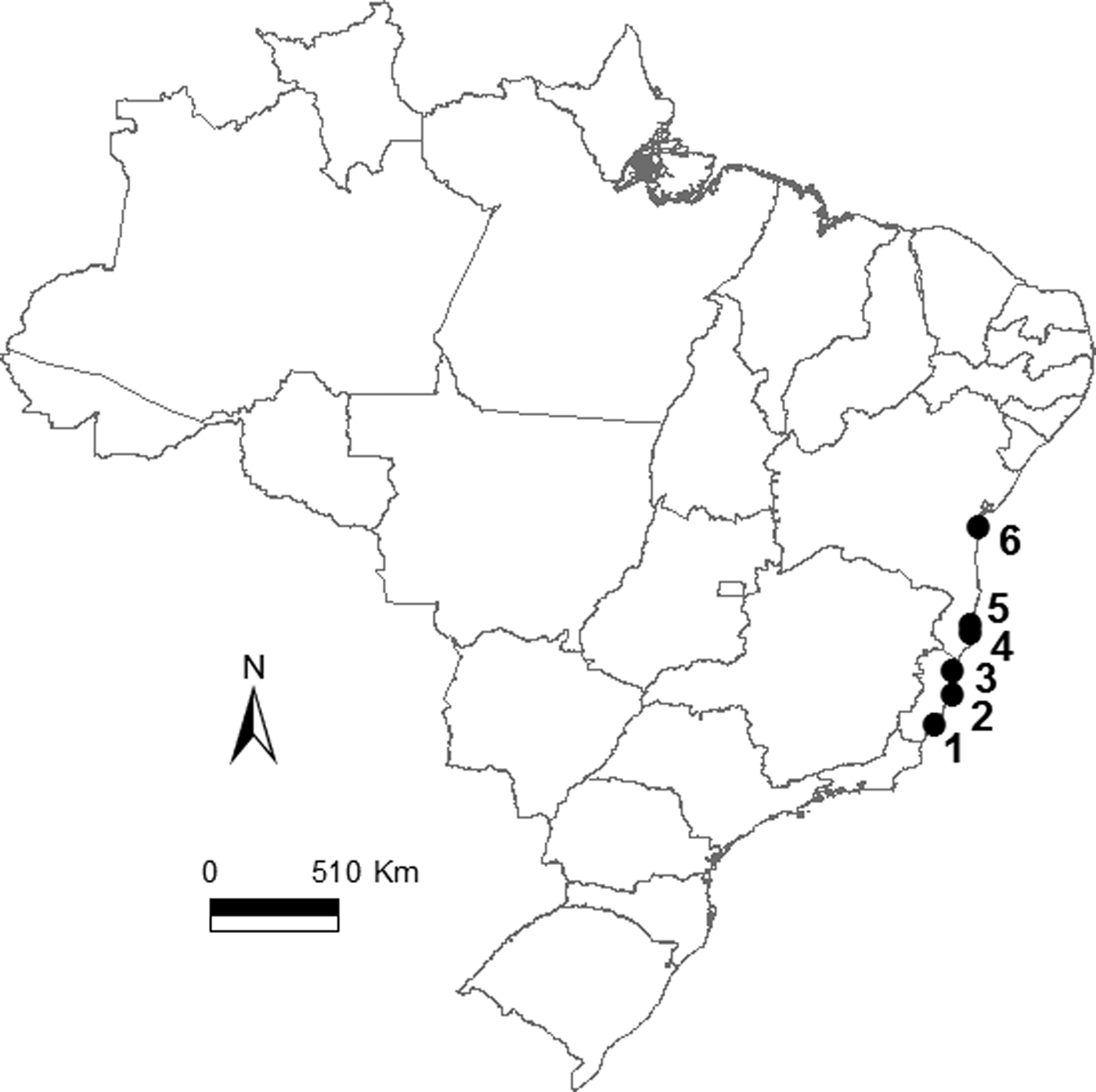
Lizards were collected in six restinga habitats along the eastern Brazilian coast (fig. 1). Restinga habitats are characterized by white, sandy soils covered with herbaceous and shrubby vegetation (Cogliatti-Carvalho et al., Reference Cogliatti-Carvalho, Freitas, Rocha and Van Sluys2001; Rocha et al., Reference Rocha, Cogliatti-Carvalho, Nunes-Freitas, Rocha-Pessôa, Dias, Ariani and Morgado2004). Three collecting sites were in Espírito Santo (ES) state (Setiba, Guarapari Municipality – 20°34′S, 40°27′W; Comboios, Linhares Municipality – 19°42′S, 39°57′W; Guriri, São Mateus Municipality – 18°41′S, 39°45′W) and three in Bahia (BA) state (Guaratiba, Prado Municipality – 17°25′S, 39°12′W; Prado, Prado Municipality –17°18′S, 39°13′W; Maraú, Barra Grande Municipality – 13°58′S, 38°56′W). Data from the Guaratiba population has been published previously by Menezes et al. (Reference Menezes, Vrcibradic, Vicente, Dutra and Rocha2004).
Location of sampled populations of Ameivula nativo in restinga habitats along the states of Espírito Santo (1, Setiba; 2, Comboios; 3, Guriri) and Bahia (4, Guaratiba; 5, Prado; 6, Maraú).

Lizards were collected with rubber bands or pellet rifles. Animals not killed immediately during capture were euthanized with ether. All lizard specimens were fixed in 10% formalin for 48 h and stored in 70% ethanol. For each individual collected, its snout–vent length (SVL) was measured with a Vernier caliper (accuracy of 0.1 mm) and its body mass was registered with an electronic balance (precision of 0.01 g). Lizards were collected between March 1997 and February 1998 in Guaratiba, in November 1999 in Prado, and in various months of the rainy season (October–May) between 2004 and 2006, in the remaining areas.
In the laboratory, lizards were dissected and had their gastrointestinal tracts, livers and lungs removed for examination under a stereomicroscope. The body cavity of lizards was also examined. All nematodes found were preserved in 70% ethanol and later cleared with lactophenol and prepared on slides for identification under the microscope. Nematodes were identified to species level, whenever possible. Small, immature nematodes were classified as ‘unidentified’.
The specific and overall prevalences (number of hosts infected with one or more parasites divided by the number of examined hosts) and mean infection intensities (mean number of parasites found in infected hosts) were calculated for each species of helminth in all populations of A. nativo studied. The relationship between overall intensity of infection and host size (SVL) was tested by Spearman's rank correlation (Zar, Reference Zar1999) for each population and for pooled populations. The relationship between the number of nematodes and lizard body mass (to estimate the effect of infection intensity on host body condition), after removing the effect of SVL (residuals), was also tested by Spearman's rank correlation. Females with eggs or well-developed vitellogenic follicles were not used for the latter analysis, as the mass of eggs and follicles could influence the results.
Differences in overall nematode prevalence between juveniles and adults were tested by the chi-squared test. Differences in overall intensity of infection among different populations of A. nativo were tested by the Kruskal–Wallis test (Zar, Reference Zar1999). To compare species-specific nematode prevalence among host populations, we used chi-squared tests. The similarity among host populations in terms of composition of nematode assemblages was calculated using the Pearson method (Zar, Reference Zar1999) expressed as a dendrogram of similarity. Descriptive statistics are presented throughout the text as mean ± standard deviation. Data normality was tested prior to each statistical analysis according to the Kolmogorov–Smirnov (Lilliefors' correction) test. Voucher specimens of lizards were deposited at the reptile collection of Museu Nacional, Universidade Federal do Rio de Janeiro (MNRJ13910–14003), and voucher specimens of nematodes were deposited at the parasite collection of Instituto Oswaldo Cruz, Rio de Janeiro (CHIOC 34888–91).
Results
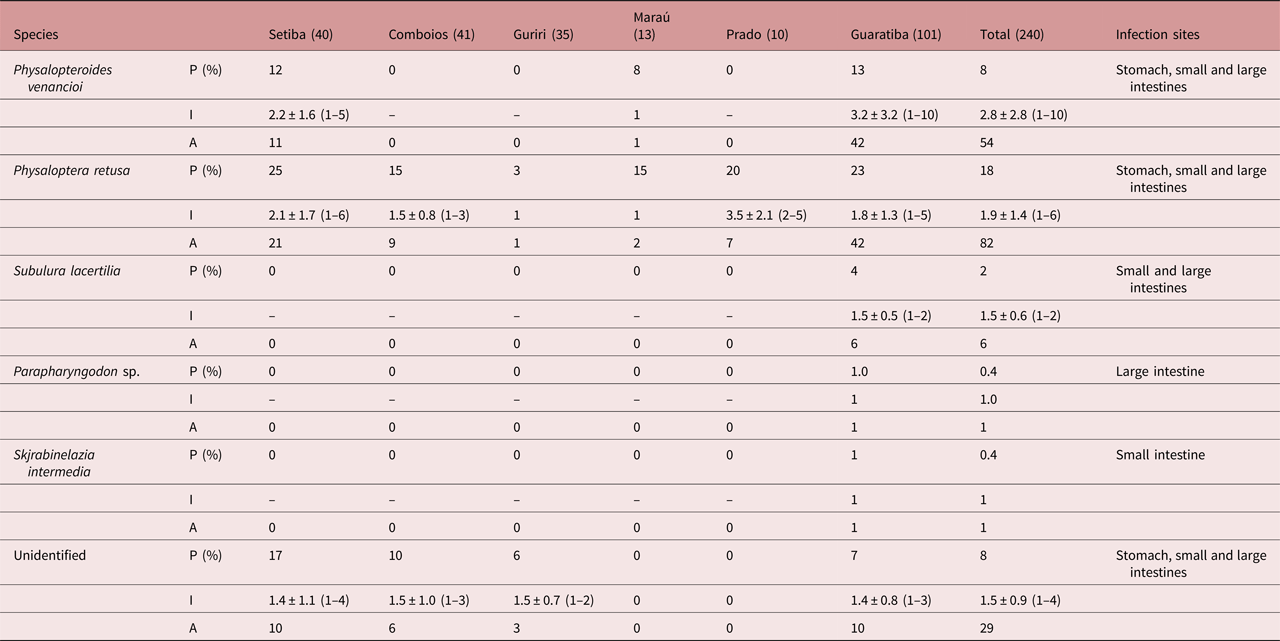
We recorded five different nematode species associated with A. nativo (table 1): Physaloptera retusa Rudolphi, 1819, Physalopteroides venancioi Lent et al., 1946, Subulura lacertilia Vicente et al., 2000, Parapharyngodon sp. and Skjrabinelazia intermedia Freitas, 1941. Of the 240 lizards examined, 67 were infected with at least one individual nematode (i.e. an overall prevalence of 28%). The nematode species with the highest prevalence (%) and mean intensity were P. retusa (18%; 1.9 ± 1.4, N = 44) and P. venancioi (8%; 2.8 ± 2.8, N = 19) (table 1). Unidentified nematodes had a prevalence of 8% (20/240) and overall intensity 1.5 ± 0.9 (1–4, N = 20) (table 1).
Prevalence (P, number of lizards infected/total number of lizards examined), mean infection intensity (I, with range in parentheses) and abundance (A, total number of individuals) of nematode parasites infecting Ameivula nativo (n = 240) in each locality studied along the eastern coast of Brazil.

Physaloptera retusa occurred in all populations studied and in three of them (Setiba, Maraú and Guaratiba) it co-occurred with P. venancioi, whereas S. lacertilia, Parapharyngodon sp. and S. intermedia occurred only in the host population from Guaratiba (Menezes et al., Reference Menezes, Vrcibradic, Vicente, Dutra and Rocha2004) (table 1). The site of infection most frequently used by P. retusa was the stomach (52%), followed by the anterior (2%) and posterior (2%) intestines. Physalopteroides venancioi also occurred preferentially in the stomach (29%), and less frequently in the anterior (8%) and posterior (1%) intestines. Subulura lacertilia was found only in the intestines, and more often in the anterior intestine (3%). Parapharyngodon sp. occurred only in the posterior intestine (1%) and S. intermedia only in the anterior intestine (1%).
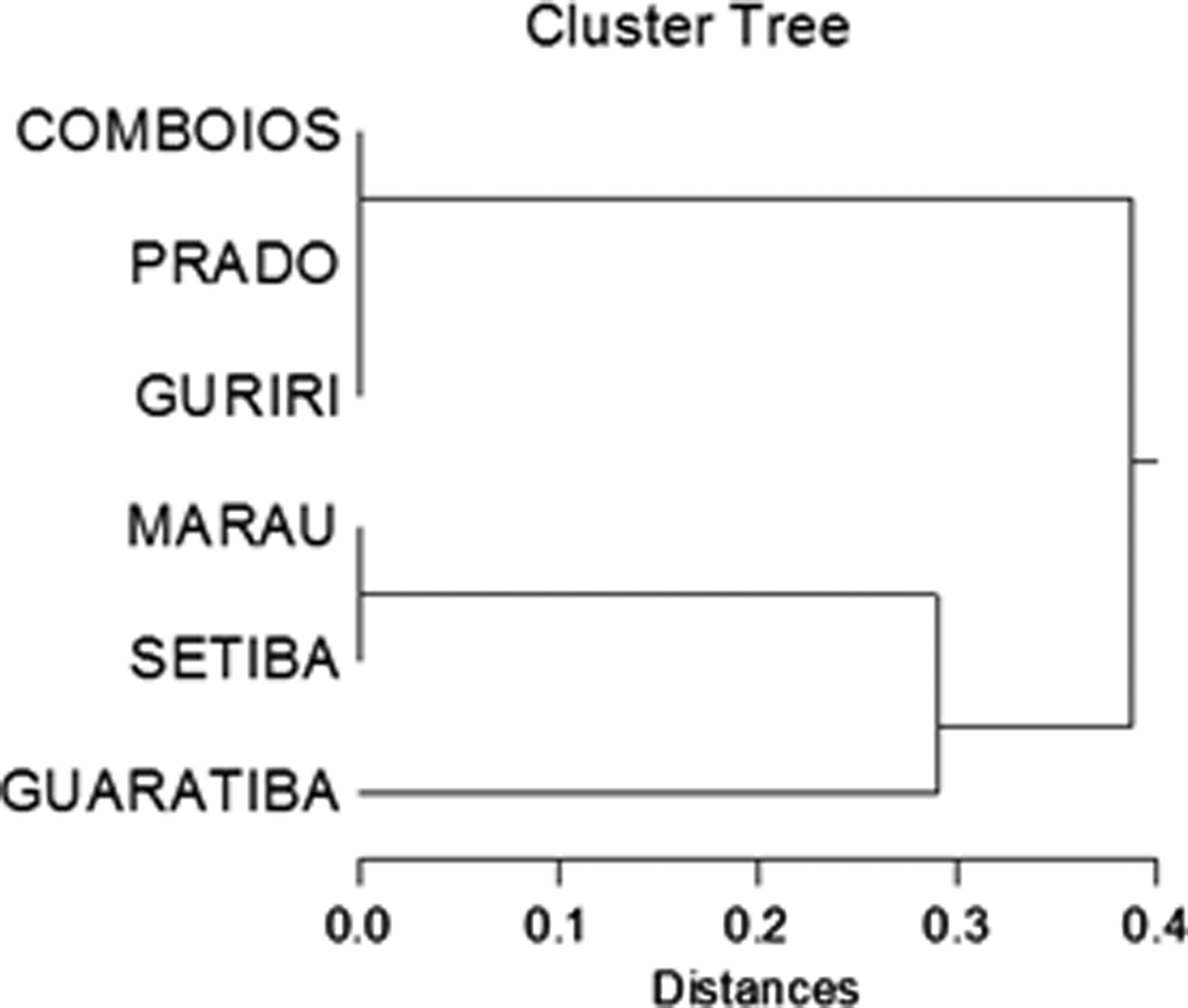
Overall intensity of infection varied significantly among the A. nativo populations studied along restingas (Kruskal–Wallis: H = 15.544, df = 5, P < 0.01) (tables 1 and 2). There were also significant differences in overall prevalence among populations (χ2 = 39.751, df = 25, P < 0.05) (tables 1 and 2). In terms of similarity in the composition of nematode species, we identified the occurrence of two major groups: one composed of populations from Guaratiba (Bahia state), Maraú (Bahia state) and Setiba (Espírito Santo state), and another of populations from Prado (Bahia state), Guriri (Espírito Santo state) and Comboios (Espírito Santo state) (fig. 2); thus, similarity among nematode faunas of A. nativo was not related to geographical distance among areas.
Nematode composition similarity among six populations of Ameivula nativo in restinga habitats of the states of Espírito Santo and Bahia, Brazil.

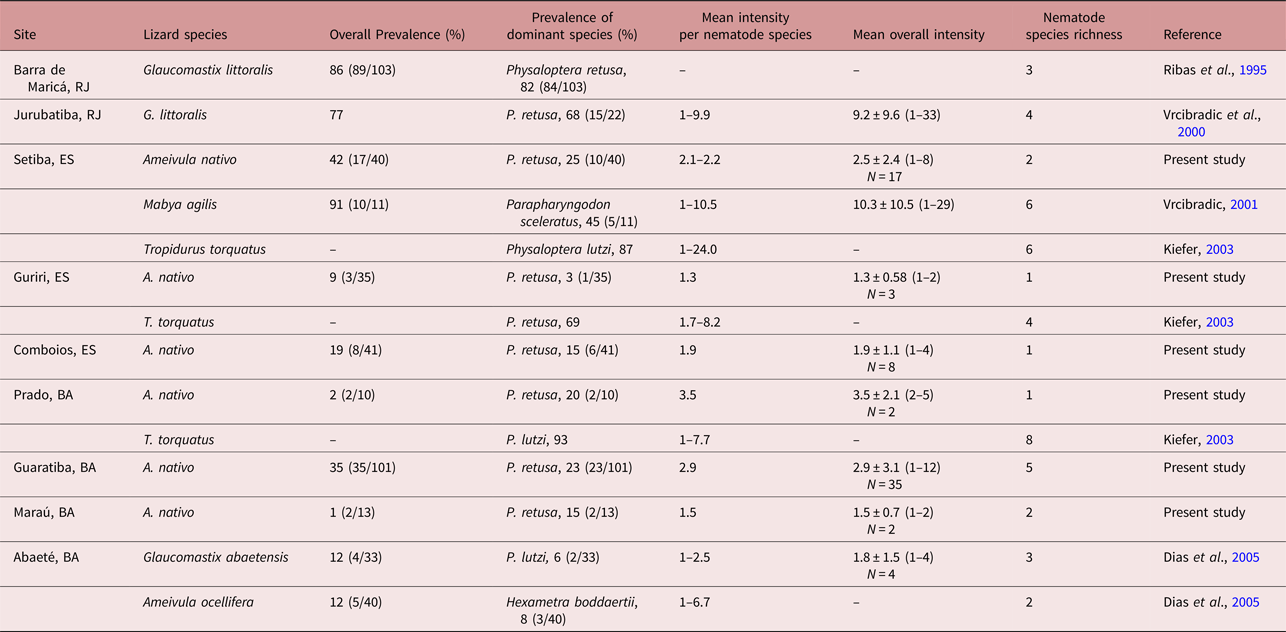
Overall prevalence (number of lizards infected/total number of lizards examined), prevalence of dominant species, mean infection intensity per species, mean overall infection intensity (with range in parentheses) and species richness of nematodes infecting Ameivula nativo and other sympatric lizard species surveyed in each locality studied, and other allopatric whiptail species occurring in restinga habitats along the eastern coast of Brazil

There was no significant relationship between overall parasite intensity and lizard SVL, considering pooled data for all populations (Spearman rank correlation: r s = 0.045, n = 67, P = 0.719). Overall infection intensity did not affect the body mass of the lizards, after removing the effect of SVL (r s = 0.147, n = 63, P = 0.251, pooled data). Overall prevalence differed significantly between juveniles (42%; 101/240) and adults (58%; 139/240) (χ2 = 29.086; df = 5; P < 0.001).
Discussion
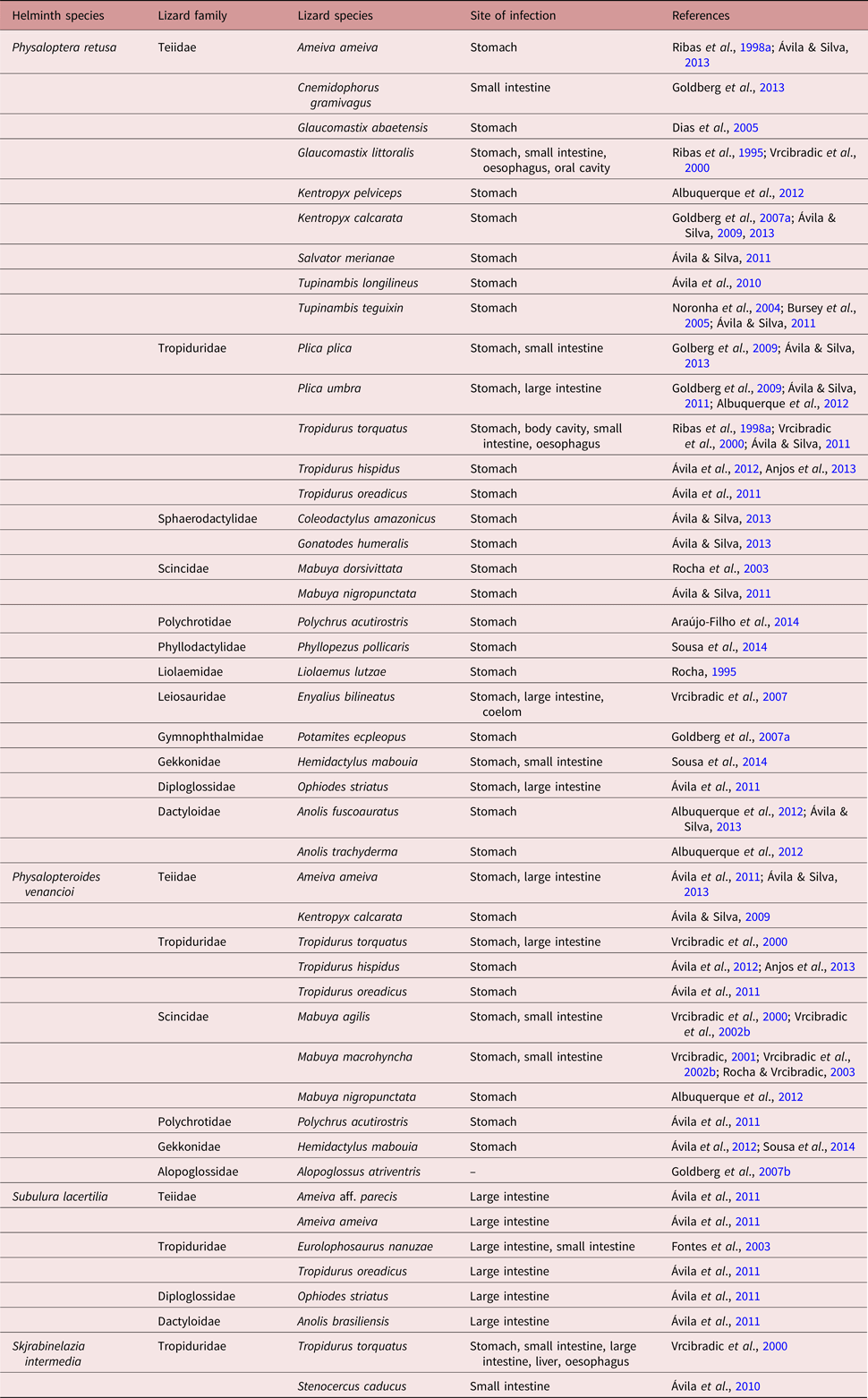
The general richness of nematode species (five) found associated with A. nativo was similar to those reported for other Brazilian cnemidophorines, but overall prevalence (1–42%) and overall mean intensity (1.3–3.5) were, in general, intermediate to low when compared to bisexual cnemidophorines and to other sympatric lizards in restinga habitats (table 2). Such low rates of infection compared to other sympatric lizard species could be explained by the preferential use of different microhabitats by lizards (Ribas et al., Reference Ribas, Rocha, Teixeira-Filho, Vicente and Santos1998b; Vrcibradic et al., Reference Vrcibradic, Rocha, Bursey and Vicente2002b) and/or by differences in diet composition, since some parasite species (such as physalopterids) are acquired by the ingestion of infected intermediate hosts (e.g. arthropods). According to Aho (Reference Aho, Esch, Bush and Aho1990), wide-foraging lizards tend to harbour a more diverse and complex helminth fauna than do sit-and-wait lizard species, but A. nativo seems to act as a peripheral species in all localities studied. The same trend was observed for the wide-foraging lizard A. ameiva by Ribas et al. (Reference Ribas, Rocha, Teixeira-Filho and Vicente1998a) in Barra de Maricá, Rio de Janeiro state. The overall prevalences observed in the six populations of A. nativo were also similar to those reported for various species, both bisexual and unisexual, of North American whiptails (Aspidoscelis spp.) (see Menezes et al., Reference Menezes, Vrcibradic, Vicente, Dutra and Rocha2004 and references therein). This indicates that low infection rates are apparently common among whiptails, both in the Neotropical and the Neartic realms. The nematode species found associated with A. nativo in this study have all been recorded previously, parasitizing other lizard species of various families (e.g. Ribas et al., Reference Ribas, Rocha, Teixeira-Filho and Vicente1995; Fontes et al., Reference Fontes, Vicente, Kiefer and Van Sluys2003; Ávila and Silva, Reference Ávila and Silva2009, Reference Ávila and Silva2010), which suggests that they are host-generalists (table 3).
Nematode species found in Ameivula nativo and their respective hosts and sites of infection in Brazil.

There was interpopulational variation in the patterns of parasitism by nematodes in A. nativo along the eastern Brazilian coast. The Guaratiba population of A. nativo had the highest nematode species richness (five), while the Prado population had the lowest (one). However, the sample size for Guaratiba was much greater than those of the other areas, which may possibly account for the presence of three rare species (S. lacertilia, Parapharyngodon sp. and S. intermedia) not found in the other areas, since the probability of rare species being recorded tends to increase with sample size. Nevertheless, P. retusa occurred in association with A. nativo in all six localities. Setiba was the locality with the highest overall prevalence (42%), whereas Prado had the highest overall mean intensity (3.5 ± 2.1, N = 2) (table 2). Maraú had the lowest overall prevalence (1%) and Guriri the lowest overall mean intensity (1.3 ± 0.58, N = 3). Vrcibradic (Reference Vrcibradic2001) also reported a significant variation in overall prevalence (ranging from 7 to 100%) and mean overall intensity (range 1–10.1) of nematode infection among 12 populations of five species of mabuyine skinks in south-eastern Brazil (Espírito Santo state: Santa Teresa, Setiba, Praia das Neves; Rio de Janeiro state: Barra de Maricá, Grumari, Grussaí, Praia do Sul-Ilha Grande, Jurubatiba, Itatiaia; and São Paulo state: Caraguatatuba, Ilha da Queimada Grande, Itirapina, Valinhos). In the same study it was observed that the quantitative similarity among nematode assemblages associated with those lizards was generally higher among coastal populations, regardless of proximity between them, stressing the importance of habitat type, rather than geographical location of host populations. On the other hand, Kiefer (Reference Kiefer2003) found a less extensive variation in the overall prevalence (71–100%) of helminths infecting populations of the iguanian lizard T. torquatus from restingas along the eastern Brazilian coast (Rio de Janeiro State: Grussaí, Barra de Maricá, Grumari, Massambaba; Espírito Santo State: Praia das Neves, Setiba, Guriri; Bahia: Trancoso and Prado), although the mean overall infection intensity had a greater variation, ranging from 5.4 ± 6.0 to 36.1 ± 22.3 helminths per host. Physaloptera retusa and P. venancioi were the two most common parasites infecting A. nativo, and occurred mainly in the stomach, as reported for other lizard hosts from different localities and/or biomes (e.g. Albuquerque et al., Reference Albuquerque, Ávila and Bernarde2012; Ávila et al., Reference Ávila, Anjos, Ribeiro, Morais, Silva and Almeida2012; Sousa et al., Reference Sousa, Brito, Ávila, Teles, Araujo-Filho, Teixeira, Anjos and Almeida2014). Subulura lacertilia, S. intermedia and Parapharyngodon sp. were found only in the intestines of A. nativo, also agreeing with previous studies on other hosts (e.g. Vrcibradic et al., Reference Vrcibradic, Cunha-Barros, Vicente, Galdino, Hatano, Van Sluys and Rocha2000; Fontes et al., Reference Fontes, Vicente, Kiefer and Van Sluys2003; Kiefer, Reference Kiefer2003; Ávila et al., Reference Ávila, Cardoso, Oda and Silva2011, Reference Ávila, Anjos, Ribeiro, Morais, Silva and Almeida2012). However, they were found in only one population of A. nativo, and with low prevalences, indicating that this lizard species only rarely harbours intestinal nematodes, which seems to be common among small-sized Neotropical cnemidophorines (Ribas et al., Reference Ribas, Rocha, Teixeira-Filho and Vicente1995; Vrcibradic et al., Reference Vrcibradic, Cunha-Barros, Vicente, Galdino, Hatano, Van Sluys and Rocha2000; Dias et al., Reference Dias, Vrcibradic and Rocha2005).
In the present study, P. retusa and P. venancioi occurred together in the restingas of Setiba (ES), Maraú (BA) and Guaratiba (BA). About 6% (4/67) of infected individuals in these areas (pooled samples) contained both species (P. retusa and P. venancioi). Physaloptera retusa alone was recorded in populations of Comboios (ES), Prado (BA) and Guriri (ES). Kiefer (Reference Kiefer2003) also recorded the occurrence of these two species of nematodes together in four of nine coastal populations of T. torquatus (Espírito Santo state: Setiba and Praia das Neves; Bahia state: Trancoso and Prado). In the present study S. intermedia and S. lacertilia were found only in the restinga of Guaratiba (BA). However, Kiefer (Reference Kiefer2003) found these same species infecting T. torquatus in the restingas of Setiba (S. intermedia), Prado (S. lacertilia), Guriri (S. lacertilia) and Trancoso (S. intermedia), where A. nativo also occurs.
According to Poulin (Reference Poulin2003), as the geographical distance between populations of a given host species increases, the similarity in species composition among parasite assemblages associated with those host populations tends to decrease. However, our results were not consistent with this idea. The restingas of Maraú (BA) and Setiba (ES), which had the greatest geographic distance among the populations studied, had greater similarity, due to the occurrence of the nematodes P. retusa and P. venancioi in both localities. Guaratiba (BA) grouped with Maraú (BA) and Setiba (ES), but was isolated due to the occurrence of three other species of nematodes. The populations of Comboios (ES), Guriri (ES) and Prado (BA) were grouped together due to the occurrence of only one species of nematode, P. retusa.
Adult lizards tend to have a higher probability of infection with parasites in comparison to juveniles, due to their longer exposure time and greater physical space for harbouring parasites, with larger lizards often having higher intensities and/or prevalences of helminth infections than smaller, immature ones (e.g. Ribas et al., Reference Ribas, Rocha, Teixeira-Filho and Vicente1995, Reference Ribas, Rocha, Teixeira-Filho and Vicente1998a; Rocha, Reference Rocha1995; Vrcibradic et al., Reference Vrcibradic, Cunha-Barros, Vicente, Galdino, Hatano, Van Sluys and Rocha2000; Amo et al., Reference Amo, Fargallo, Martinez-Padilla, Millán, López and Martin2005; Pereira et al., Reference Pereira, Sousa and Lima2012). Juveniles and adults differed consistently in parasite prevalence, with adults having higher prevalences, as also reported by Rocha (Reference Rocha1995) for the liolaemid Liolaemus lutzae and by Fontes et al. (Reference Fontes, Vicente, Kiefer and Van Sluys2003) for the tropidurid Eurolophosaurus nanuzae. However, larger body size in individuals of A. nativo did not explain higher parasite intensity. Our data suggest that parasite intensity does not affect the body condition of lizards. The lack of influence of parasites on the condition of the lizards has been shown to occur in other lizard species in different localities (e.g. Kiefer, Reference Kiefer2003; Barreto-Lima et al., Reference Barreto-Lima, Toledo and Anjos2012).
Our data indicated that A. nativo tends to harbour poor nematode assemblages, as most of the six populations we examined, spanning all the known latitudinal distribution of the species, harboured just one or two nematode species (even though host sample sizes were ≥35 for four of the six local samples). Moreover, no nematode species attained core status (i.e. prevalence of 50% or more; see Aho, Reference Aho, Esch, Bush and Aho1990) in any of the host populations. The fact that a previous study on yet another area failed to record any nematode in a sample of 15 A. nativo (Van Sluys et al., Reference Van Sluys, Rocha, Bergallo, Vrcibradic and Ribas1997) provides further evidence of the low rates of helminth parasitism usually exhibited by this host species. The relatively narrow geographic distribution of A. nativo (Menezes & Rocha, Reference Menezes and Rocha2013) and the fact that it is practically restricted to one type of habitat (restinga) may account, at least partially, for its depauperate nematode assemblages, since helminth richness tends to be influenced positively by the host's distribution range (Poulin & Morand, Reference Poulin and Morand2004). The richness of the nematode assemblages of A. nativo was equally low at both local and regional levels, reflecting the strong relationship between these two parameters in helminth communities of reptiles and amphibians (Aho, Reference Aho, Esch, Bush and Aho1990).
Acknowledgements
We would like to thank Angélica F. Fontes, Monique Van Sluys, Eduardo R. Dias, Mara C. Kiefer, Conrado A. Galdino and Mônica C. Barros, who provided support on field trips. We are also grateful to J.J. Vicente, who helped with the identification of some nematode species.
Financial support
This study was supported by the Fundação Carlos Chagas Filho de Amparo à Pesquisa do Estado do Rio de Janeiro – FAPERJ (C.F.D.R., grant numbers E-26/102.765.2012, E-26/010.001639.2014, E-26/202.920.2015); and by the Conselho Nacional de Desenvolvimento Científico e Tecnológico – CNPq (C.F.D.R., grant numbers 304791/2010-5, 470265/2010-8, 302974/2015-6, 424473/2016-0). V.A.M. is associated with the Programa de Pós-Graduação em Ecologia from Universidade do Estado do Rio de Janeiro and receives a Visiting Professor Grant from FAPERJ/UERJ.
Conflict of interest
None.