Introduction
Advanced paternal age (at childbirth) is associated with an increased risk of offspring having schizophrenia and psychotic disorders (Malaspina et al. Reference Malaspina, Harlap, Fennig, Heiman, Nahon, Feldman and Susser2001; Buizer-Voskamp et al. Reference Buizer-Voskamp, Laan, Staal, Hennekam, Aukes, Termorshuizen, Kahn, Boks and Ophoff2011; D'Onofrio et al. Reference D'Onofrio, Rickert, Frans, Kuja-Halkola, Almqvist, Sjölander, Larsson and Lichtenstein2014; McGrath et al. Reference McGrath, Petersen, Agerbo, Mors, Mortensen and Pedersen2014), autism (Buizer-Voskamp et al. Reference Buizer-Voskamp, Laan, Staal, Hennekam, Aukes, Termorshuizen, Kahn, Boks and Ophoff2011; Hultman et al. Reference Hultman, Sandin, Levine, Lichtenstein and Reichenberg2011; Rahbar et al. Reference Rahbar, Samms-Vaughan, Loveland, Pearson, Bressler, Chen, Ardjomand-Hessabi, Shakespeare-Pellington, Grove, Beecher, Bloom and Boerwinkle2012; D'Onofrio et al. Reference D'Onofrio, Rickert, Frans, Kuja-Halkola, Almqvist, Sjölander, Larsson and Lichtenstein2014; McGrath et al. Reference McGrath, Petersen, Agerbo, Mors, Mortensen and Pedersen2014), bipolar disorder (Frans et al. Reference Frans, Sandin, Reichenberg, Lichtenstein, Langstrom and Hultman2008; Menezes et al. Reference Menezes, Lewis, Rasmussen, Zammit, Sipos, Harrison, Tynelius and Gunnell2010; D'Onofrio et al. Reference D'Onofrio, Rickert, Frans, Kuja-Halkola, Almqvist, Sjölander, Larsson and Lichtenstein2014; McGrath et al. Reference McGrath, Petersen, Agerbo, Mors, Mortensen and Pedersen2014) and numerous other psychiatric disorders (D'Onofrio et al. Reference D'Onofrio, Rickert, Frans, Kuja-Halkola, Almqvist, Sjölander, Larsson and Lichtenstein2014; McGrath et al. Reference McGrath, Petersen, Agerbo, Mors, Mortensen and Pedersen2014). However, few studies have investigated whether advanced paternal age is associated with eating disorders. A case study of hospitalized individuals with anorexia nervosa (AN) defined by the Feighner research criteria (Feighner et al. Reference Feighner, Robins, Guze, Woodruff, Winokur and Munoz1972) found that these individuals typically had older fathers (and mothers) than general population controls (Halmi, Reference Halmi1974). Similarly, two population-based studies reported positive associations between paternal age and offspring eating disorders. In a population-based cohort from Western Australia, paternal age at birth was positively associated with meeting full or partial criteria for Diagnostic and Statistical Manual of Mental Disorders, fourth edition (DSM-IV) eating disorders, albeit only at a trend level once other predictors were included in the model (Allen et al. Reference Allen, Byrne, Forbes and Oddy2009). In a population-based study of US twins age 8–17 years and in mid-puberty or beyond, paternal age at birth was associated with a lifetime history of an eating disorder and with current eating disorder symptoms, even after adjustment for maternal age at birth, fertility treatment, parental psychiatric history, familial socio-economic status, and participant body mass index (Racine et al. Reference Racine, Culbert, Burt and Klump2014). In contrast to the aforementioned studies, a large Danish register-based study did not find a strong association between advanced paternal age and AN or between advanced paternal age and all eating disorders (AED), either before or after adjustment for maternal age, urbanization at the place of birth, or parental and sibling history of mental disorders (McGrath et al. Reference McGrath, Petersen, Agerbo, Mors, Mortensen and Pedersen2014).
To extend and clarify the literature on paternal age and offspring eating disorders, we examined the association between paternal age at birth and the incidence of AN or AED, in a sample of over two million individuals included in the Swedish population and healthcare registers. Further, we examined whether the association remained after adjustment for covariates (e.g. birth order), including potential confounders that may be related to late or early selection into fatherhood (e.g. paternal education level).
Method
Procedure
Using the unique personal identification number assigned to all Swedish residents at birth, we linked data from multiple population-based registers and healthcare registers, including: (1) the Medical Birth Register, which has detailed information on more than 99% of pregnancies in Sweden since 1973; (2) the National Patient Register (NPR), which provides national coverage of Swedish public and private hospital in-patient admissions beginning in 1973 (full coverage from 1986 on) and out-patient specialist care beginning in 2001; (3) the Riksät National Quality Register for Eating Disorders Treatment (Swedish Association of Local Authorities and Regions, 2007) and the Stepwise quality assurance register for eating disorders (Birgegård et al. Reference Birgegård, Björck and Clinton2010), which first entered patient information in 1999 and 2005, respectively, and currently include information from almost all specialized eating disorder units in Sweden (about 90% as of 2009) and many non-specialized general psychiatric units; (4) the Multi-Generation Register, which can be used to determine biological and adoptive relationships for all individuals living in Sweden since 1932; (5) the Migration Register, which records information on emigration from or immigration to Sweden since 1901; (6) the Cause of Death Register, which contains the date and principal and contributing cause(s) of deaths occurring since 1952; (7) the National Crime Register, which includes detailed information about all criminal convictions since 1973; and (8) the Education Register, which contains information on the highest level of completed formal education to 2008. Additional information about the registers and variables derived from them is provided elsewhere (D'Onofrio et al. Reference D'Onofrio, Class, Rickert, Larsson, Långström and Lichtenstein2013a ; Javaras et al. Reference Javaras, Runfola, Thornton, Agerbo, Birgegård, Norring, Yao, Råstam, Larsson, Lichtenstein and Bulik2015).
Sample
Our population cohort included individuals who were born in Sweden between 1 January 1979 and 31 December 2001 and had relevant data available. We used the Medical Birth Register to identify live-born offspring born in this time-frame, but retained data only for 2 295 947 individuals with a valid maternal identifier, valid (non-zero) birth order, and non-missing data for sex, gestational age and birth weight. Following linkage with the Multi-Generation Register, we further excluded 16 299 individuals with missing paternal identifiers and 2839 individuals with undetermined paternal birthdate. The resulting sample of n = 2 276 809 offspring included 110 385 individuals with at least one emigration and 17 684 individuals with date of death prior to the end of the study (31 December 2009), who were retained and treated as right-censored in analyses. This cohort of offspring was born to 1 226 801 distinct biological fathers and 1 221 979 distinct biological mothers.
Inclusion in the Swedish registers does not require informed consent. However, patients included in the Stepwise Register must give informed consent (via an opt-out procedure) for those data to be used for research purposes; if patients decline, their data are excluded from research use only (Birgegård et al. Reference Birgegård, Björck and Clinton2010; Runfola et al. Reference Runfola, Thornton, Pisetsky, Bulik and Birgegård2014). The Regional Ethical Review Board in Stockholm, Sweden, the University of North Carolina Biomedical Institutional Review Board, and the Indiana University Institutional Review Board all approved this study.
Eating disorder outcomes
We examined two outcomes: the age at first diagnosis of AN and the age at first diagnosis of AED, based on diagnoses appearing in any of the healthcare registers (NPR, Riksät and Stepwise) between 1 January 1987 and 31 December 2009. Diagnoses in the NPR were made by physicians at hospital discharge, using the World Health Organization International Classification of Diseases, ninth revision (ICD-9; 1987–1996) (World Health Organization, 1978) and ICD-tenth revision (ICD-10; 1997–2009) (World Health Organization, 1992). Diagnoses in Riksät and Stepwise were made by clinicians once intent to treat was established, using the DSM-IV, with criteria frequently assessed via structured interview (American Psychiatric Association, 2013). For the outcomes used here, AN diagnoses included AN (e.g. ICD-9 307B, ICD-10 F50.0, and DSM-IV AN) and atypical AN [e.g. ICD-10 F50.1 and DSM-IV eating disorder not otherwise specified (EDNOS) with subthreshold AN symptoms]. AED diagnoses included the AN diagnoses, as well as bulimia nervosa (BN) (e.g. ICD-10 F50.2 and DSM-IV BN), atypical BN (e.g. ICD-10 F50.3 and DSM-IV EDNOS with subthreshold BN symptoms), ‘other eating disorders’ (ICD-9 307F), ‘eating disorder, unspecified’ (ICD-10 F50.9) and EDNOS other than atypical AN and BN. To avoid diagnostic misclassification (i.e. with feeding difficulties of childhood), we examined only AN and AED diagnoses occurring at age 8 years or older.
Statistical analysis
Models for the relationship between paternal age and offspring eating disorders were fit to the overall (combined-sex) sample. Although we did not have sufficient power to test for a sex × paternal age interaction, we also performed analyses stratified by sex to examine the sex-specific associations between paternal age and offspring eating disorders.
More specifically, we used PROC PHREG in SAS 9.3 (SAS Institute, USA) to fit Cox proportional hazards models for the effect of paternal age on the offspring's age at first diagnosis of AN or (separately) AED, after adjusting for covariates. Individuals who did not receive an eating disorder diagnosis during the calendar years included in our analyses (1 January 1987 and 31 December 2009) were censored at their earliest age of emigration, death, or end-of-study period (i.e. 31 December 2009). Age was measured in years rounded to the nearest 0.001. Paternal age was treated as categorical because models that treated it as continuous did not support a linear relationship between paternal age and the log-hazards of offspring eating disorder risk (see Supplementary Appendix A in the online Supplementary material). The paternal age categories included <20, 20–24, 25–29, 30–34, 35–39, 40–44 and 45+ years, with 25–29 years selected as the reference category for comparability with existing studies (McGrath et al. Reference McGrath, Petersen, Agerbo, Mors, Mortensen and Pedersen2014).
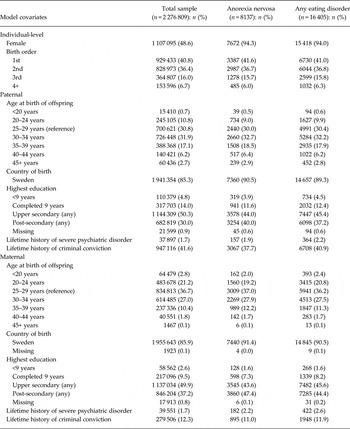
In addition to the predictor of interest (i.e. paternal age), models also included covariates, which were treated as categorical variables unless noted otherwise below. (See Table 1 for the categories and corresponding frequencies for each covariate.) All models were adjusted for participant sex. In addition, all models were adjusted for calendar year (treated as a continuous, time-varying covariate, and measured in units of years rounded to the nearest digit), because prior research reveals that incidence rates for AN and AED increase dramatically after 2000 due to expanded coverage of the healthcare registers to psychiatric out-patient settings (Javaras et al. Reference Javaras, Runfola, Thornton, Agerbo, Birgegård, Norring, Yao, Råstam, Larsson, Lichtenstein and Bulik2015). To examine the effects of adjusting for potential confounders (of the relationship between paternal age and offspring eating disorders), we fit a series of models with the following additional covariates: model A (the ‘baseline model’) included only participant sex and calendar year; model B included all model A covariates and participant birth order; model C included all model B covariates and maternal age; and model D (the ‘fully adjusted model’) included all model C covariates and several fixed maternal and paternal covariates [country of birth (Sweden or other country); highest level of education attained; lifetime history of severe psychiatric disorders (i.e. ICD diagnoses for schizophrenia or bipolar disorder); and lifetime criminality (i.e. conviction for any crime at 15 years or older)]. We chose to include these particular parental variables as covariates because they fulfill criteria for being potential confounders: (i) the variable might be associated with late (or early) selection into parenthood, based on past research; and (ii) the variable might be associated with a higher risk of eating disorders in offspring, based on past research that found an association between the parental variable and eating disorders in offspring or eating disorders in the parent himself/herself (which, since eating disorders are familial, translates into a higher risk of eating disorders in offspring) (Smith et al. Reference Smith, Brandt and Jimerson1989; Striegel-Moore & Bulik, Reference Striegel-Moore and Bulik2007; Hudson et al. Reference Hudson, Javaras, Laird, VanderWeele, Pope and Hernan2008; Mustelin et al. Reference Mustelin, Thornton, Keski-Rahkonen, Cantor-Graae, Mortensen, Pedersen and Bulik2016; Yao et al. Reference Yao, Kuja-Halkola, Thornton, Birgegård, Norring, Bulik and Larsson2016). For example, individuals with bipolar disorder who have children are more likely to fall into the very early parenthood category (i.e. <20 years) compared with ‘control’ individuals with children (Laursen & Munk-Olsen, Reference Laursen and Munk-Olsen2010), and parents with bipolar disorder are also more likely to have offspring with eating disorders because bipolar disorder and eating disorders co-aggregate in families (Smith et al. Reference Smith, Brandt and Jimerson1989; Hudson et al. Reference Hudson, Javaras, Laird, VanderWeele, Pope and Hernan2008). Thus, even in the absence of any true causal effect of paternal age, failing to adjust for severe parental psychiatric disorders could lead to a spurious association between early paternal age and eating disorder risk in offspring.
Descriptive statistics for n = 2 276 809 live-born individuals born between 1 January 1979 and 31 December 2001

To determine the effect of each paternal age category on AN and AED incidence, we examined the categories’ hazard ratio estimates and confidence intervals (CIs) in models A–D. Further, to determine the overall effect of paternal age, we compared the Akaike information criterion (AIC; Akaike, Reference Akaike1974) values for the fully adjusted model with paternal age and the fully adjusted model without paternal age.
Ethical standards
All procedures contributing to this work comply with the ethical standards of the relevant national and institutional committees on human experimentation.
Results
Table 1 presents frequencies and percentages for the paternal age categories and the covariate categories for the total sample (n = 2 276 809) and for those participants with diagnoses of AN (n = 8137) or AED (n = 16 405).
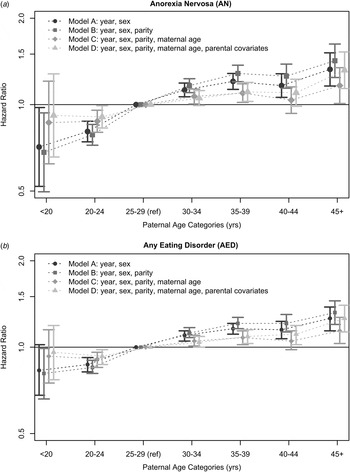
Fig. 1 presents hazard ratios for AN (Fig. 1a ) and AED (Fig. 1b ). (The results for AN and AED are also presented in table form in Supplementary Appendix B in the online Supplementary material.) For both AN and AED, the AIC values for the fully adjusted model with paternal age (219 049 for AN; 438 653 for AED) are smaller than the analogous values for the fully adjusted model without paternal age (219 060 for AN; 438 673 for AED), suggesting that paternal age has significant explanatory power, even above the contributions of calendar year, sex, birth order, maternal age and parental covariates. For both AN and AED, the hazard ratio estimates generally increase for successively older paternal age categories, with the exception of the 40–44 years category, where the estimate is similar to (or even slightly smaller than) the estimate for the 35–39 years category. Adjusting for birth order and fixed parental covariates has relatively little effect, with the hazard ratio estimates for the paternal age categories becoming (if anything) slightly larger in magnitude and more significant. In contrast, adjusting for maternal age at birth substantially attenuates the hazard ratio estimates for paternal age, not surprisingly given the high correlation (0.69) between paternal and maternal age at birth and the positive association between maternal age and offspring eating disorder risk in our sample. (The results for maternal age are presented in Supplementary Appendix C in the online Supplementary material.) However, in all AN and AED models, including those adjusted for maternal age, the hazard ratio for the 45+ years category (v. the 25–29 years category) is significantly greater than 1, and the hazard ratio estimates for the <20 and 20–24 years categories (relative to the 25–29 years category) are less than 1, significantly so for the 20–24 years category.
Hazard ratios for first incidence of anorexia nervosa or any eating disorder as a function of paternal age, with adjustment for covariates. Members of the cohort were born in Sweden between 1 January 1979 and 31 December 2001 and followed up from 1 January 1987 to 31 December 2009 (or emigration or death). Filled shapes represent estimates of the hazard ratio for the paternal age categories [relative to the reference (ref) category of 25–29 years (yrs)], and crossbars represent bounds of the 95% confidence intervals for the hazard ratio. Hazard ratios for models A–D (represented by different symbols) are adjusted for the covariates described in the key. (a) Anorexia nervosa, which includes diagnoses for anorexia nervosa [World Health Organization International Classification of Diseases, ninth revision (ICD-9) 307B; ICD-tenth revision (ICD-10) 50.0; Diagnostic and Statistical Manual of Mental Disorders, fourth edition (DSM-IV) 307.1] and atypical anorexia nervosa (ICD-10 50.1). (b) Any eating disorder, which includes diagnoses for anorexia nervosa (ICD-9 307B; ICD-10 50.0; DSM-IV 307.1), atypical anorexia nervosa (ICD-10 50.1), bulimia nervosa (ICD-10 50.2; DSM-IV 307.51), atypical bulimia nervosa (ICD-10 50.3), ‘other eating disorders’ (ICD-9 307F), ‘eating disorder, unspecified’ (ICD-10 50.9) and eating disorder not otherwise specified (DSM-IV 307.50).

Sex-specific results for AN and AED are presented in Supplementary Appendix D (Supplementary Tables D.1 and D.2, respectively) in the online Supplementary material. For females, results follow a similar pattern to those described above for the overall (combined-sex) sample, not surprisingly, given that the vast majority of participants diagnosed with eating disorders in our sample are women. For males, the older paternal age categories exhibit similar, albeit stronger, positive associations with AN and AED risk, compared with the associations in the overall and female samples. However, for males, hazard ratio estimates for the youngest paternal age categories are greater than 1 and not significant, in contrast to the overall sample and female subsample, where hazard ratios for the two youngest paternal age categories are less than 1 and, in some cases, significantly so.
Discussion
In a large, population-based cohort born in Sweden between 1979 and 2001, individuals with older fathers were at increased risk for the onset of eating disorders occurring between the ages of 8 and 30 years. Further, this increased risk remained even after adjustment for numerous potential confounders including birth order, maternal age at birth, and maternal and paternal country of birth, education, lifetime psychiatric hospitalization, and lifetime criminality. For example, in the fully adjusted model, the estimated hazard ratio for the 45+ years paternal age category (relative to the 25–29 years reference category) was 1.32 (95% CI 1.14–1.53) for AN and 1.26 (95% CI 1.13–1.40) for AED. The increased risk of eating disorders among offspring of older fathers was present for both male and female offspring, with some suggestion that the association was especially strong for male offspring.
Previous population-based studies have found that advancing paternal age is associated with increased risk of eating disorders (Allen et al. Reference Allen, Byrne, Forbes and Oddy2009; Racine et al. Reference Racine, Culbert, Burt and Klump2014). In contrast, a recent Danish register-based study did not find a clear pattern of increasing risk with advanced paternal age for either AN or AED, in contrast to findings for the other psychiatric disorders examined (McGrath et al. Reference McGrath, Petersen, Agerbo, Mors, Mortensen and Pedersen2014). Although the Danish study is similar to the present study in many ways, a large proportion of the Danish cohort was not observed until after adolescence and young adulthood, missing the peak period of risk for eating disorders. In contrast, all cases in our study occurred prior to age 30 years (inclusive). Also, the Danish study included all ICD-10 codes relevant to problems of eating (e.g. F50.5, ‘vomiting associated with other psychological disturbances’) for the AED outcome, whereas our study included only ICD-10 codes representing AN, BN and EDNOS (including binge-eating disorder), disorders typically characterized by a desire to control weight, shape or eating (Fairburn et al. Reference Fairburn, Cooper and Shafran2003). Thus, the association between advanced paternal age and eating disorder incidence would be expected to be stronger in our study if advanced paternal age were most strongly associated with what we consider to be the prototypic eating disorders occurring during adolescence and young adulthood. Although it is difficult to compare numerical values across studies due to differences in methodology, this pattern of association (between advanced paternal age and risk of eating disorders in offspring) has also been found for numerous other psychiatric disorders in offspring, including schizophrenia and psychotic disorders (Malaspina et al. Reference Malaspina, Harlap, Fennig, Heiman, Nahon, Feldman and Susser2001; Buizer-Voskamp et al. Reference Buizer-Voskamp, Laan, Staal, Hennekam, Aukes, Termorshuizen, Kahn, Boks and Ophoff2011; D'Onofrio et al. Reference D'Onofrio, Rickert, Frans, Kuja-Halkola, Almqvist, Sjölander, Larsson and Lichtenstein2014; McGrath et al. Reference McGrath, Petersen, Agerbo, Mors, Mortensen and Pedersen2014), autism (Buizer-Voskamp et al. Reference Buizer-Voskamp, Laan, Staal, Hennekam, Aukes, Termorshuizen, Kahn, Boks and Ophoff2011; Hultman et al. Reference Hultman, Sandin, Levine, Lichtenstein and Reichenberg2011; Rahbar et al. Reference Rahbar, Samms-Vaughan, Loveland, Pearson, Bressler, Chen, Ardjomand-Hessabi, Shakespeare-Pellington, Grove, Beecher, Bloom and Boerwinkle2012; D'Onofrio et al. Reference D'Onofrio, Rickert, Frans, Kuja-Halkola, Almqvist, Sjölander, Larsson and Lichtenstein2014; McGrath et al. Reference McGrath, Petersen, Agerbo, Mors, Mortensen and Pedersen2014), bipolar disorder (Frans et al. Reference Frans, Sandin, Reichenberg, Lichtenstein, Langstrom and Hultman2008; Menezes et al. Reference Menezes, Lewis, Rasmussen, Zammit, Sipos, Harrison, Tynelius and Gunnell2010; D'Onofrio et al. Reference D'Onofrio, Rickert, Frans, Kuja-Halkola, Almqvist, Sjölander, Larsson and Lichtenstein2014; McGrath et al. Reference McGrath, Petersen, Agerbo, Mors, Mortensen and Pedersen2014) and childhood behavioral and emotional disorders (McGrath et al. Reference McGrath, Petersen, Agerbo, Mors, Mortensen and Pedersen2014).
Our results also suggest that, conversely, younger paternal age at birth (<20 and 20–24 years) is associated with slightly reduced risk of AN and AED, at least in females. For example, in the fully adjusted model, the estimated hazard ratio for the 20–24 years paternal age category (relative to the 25–29 years reference category) was 0.91 (95% CI 0.83–0.99) for AN and 0.93 (95% CI 0.87–0.98) for AED, with similar estimates for the <20 years paternal age category. Interestingly, our sex-specific results suggest that this ‘protective’ effect of younger paternal age may be present only for female, and not for male, offspring. Only one other study, the Danish study, has examined the effect of younger (v. typical) paternal age categories on eating disorder risk in offspring. The results of the Danish study are partially consistent with ours since risk ratios for the youngest paternal age categories were less than 1 (albeit not significantly so) for AN, but not for AED (McGrath et al. Reference McGrath, Petersen, Agerbo, Mors, Mortensen and Pedersen2014). Interestingly, this pattern of reduced risk for younger paternal age categories has generally not been found for other psychiatric disorders, with the exception of autism (Buizer-Voskamp et al. Reference Buizer-Voskamp, Laan, Staal, Hennekam, Aukes, Termorshuizen, Kahn, Boks and Ophoff2011; McGrath et al. Reference McGrath, Petersen, Agerbo, Mors, Mortensen and Pedersen2014).
The present study has significant strengths. The sample is a large, national cohort of all individuals born in Sweden during a two-decade period, making our study the largest investigation of paternal age and prototypic eating disorders to date. Further, thanks to the availability of rich datasets with national coverage, measures of paternal age and important potential confounders are from public records rather than (retrospective) self-report or other-report.
The study has several limitations that may diminish the generalizability of findings. For one, outcomes included only healthcare-system-detected and healthcare-register-recorded eating disorders. However, the registers detect eating disorder diagnoses made in multiple contexts (e.g. in the emergency room), not only in the context of eating disorder or psychiatric treatment. Further, given the relatively low incidence of eating disorders in Sweden (Javaras et al. Reference Javaras, Runfola, Thornton, Agerbo, Birgegård, Norring, Yao, Råstam, Larsson, Lichtenstein and Bulik2015), it is likely that only a small proportion of the cohort had an eating disorder that was not detected or recorded. Second, we could not examine the association between paternal age and incidence of specific eating disorders other than AN (e.g. BN) because ICD-9 in Sweden included them under a single diagnostic code. Third, although we presented sex-specific results for the relationship between paternal age and eating disorders in offspring, the relatively small number of male participants with eating disorders, especially in the less common paternal age categories, limited power and precluded formal tests of sex × paternal age interactions. Thus, our sex-specific results should be interpreted with caution.
Finally, the observational nature of our study precludes causal interpretation of findings: it is possible that factors associated with advanced paternal age are responsible for its positive relationship with eating disorder incidence, and, likewise, that factors associated with younger paternal age are responsible for its negative relationship with eating disorder incidence in females with eating disorders. Although we were able to adjust for several such factors (birth order, maternal age at birth, and parental educational, psychiatric, and criminal history) in our analyses, there may be other factors that were not measured or included in analyses (e.g. familial traits that predispose individuals toward later fatherhood and toward eating disorders). Previous studies have sought to eliminate the effects of factors associated with late (or early) selection into fatherhood by focusing on second- and later-born offspring and adjusting for ‘paternal age at the birth of first offspring’ (Petersen et al. Reference Petersen, Mortensen and Pedersen2011). However, we did not employ this approach because it can introduce collider stratification bias (Hernán et al. Reference Hernán, Hernández-Díaz and Robins2004) into estimates of the effects of paternal age on disease risk. Further, because eating disorder incidence increases dramatically with calendar year in our data (Javaras et al. Reference Javaras, Runfola, Thornton, Agerbo, Birgegård, Norring, Yao, Råstam, Larsson, Lichtenstein and Bulik2015), we were unable to use a sibling design, which can eliminate the influence of confounding factors shared among offspring (Rutter, Reference Rutter2007; D'Onofrio et al. Reference D'Onofrio, Lahey, Turkheimer and Lichtenstein2013b ), including factors associated with late (or early) selection into fatherhood. Because paternal age and calendar year are highly correlated within paternal sibling groups (i.e. siblings born when the father is older pass through the period of risk for disease incidence during later calendar years), sibling designs can produce biased estimates (of the effects of paternal age on disease risk) in samples, like ours, where disease incidence varies systematically with calendar year. However, the population-based associations between advanced paternal age and offspring eating disorders found in our study are similar in pattern to the population-based associations for autism and bipolar disorder found in another Swedish register-based study (D'Onofrio et al. Reference D'Onofrio, Rickert, Frans, Kuja-Halkola, Almqvist, Sjölander, Larsson and Lichtenstein2014) where sibling-based associations were even larger than population-based associations for both disorders.
Future studies should use sibling and other extended family designs (Rutter, Reference Rutter2007; D'Onofrio et al. Reference D'Onofrio, Lahey, Turkheimer and Lichtenstein2013b ) to shed additional light on whether paternal age has a causal effect on the incidence of eating disorders in offspring, or if late (or early) selection into fatherhood accounts for the association (Petersen et al. Reference Petersen, Mortensen and Pedersen2011; D'Onofrio et al. Reference D'Onofrio, Rickert, Frans, Kuja-Halkola, Almqvist, Sjölander, Larsson and Lichtenstein2014; Jaffe et al. Reference Jaffe, Eaton, Straub, Marenco and Weinberger2014; Gratten et al. Reference Gratten, Wray, Peyrot, McGrath, Visscher and Goddard2016). If the association does appear to be causal, it will be important for future research to explore the mechanisms by which advanced paternal age confers increased risk for offspring eating disorders. One frequently posited mechanism is de novo mutations in the paternal germline (Malaspina et al. Reference Malaspina, Harlap, Fennig, Heiman, Nahon, Feldman and Susser2001; Frans et al. Reference Frans, Sandin, Reichenberg, Lichtenstein, Langstrom and Hultman2008; Buizer-Voskamp et al. Reference Buizer-Voskamp, Laan, Staal, Hennekam, Aukes, Termorshuizen, Kahn, Boks and Ophoff2011; Hultman et al. Reference Hultman, Sandin, Levine, Lichtenstein and Reichenberg2011), which increase in frequency with paternal age at conception (Kong et al. Reference Kong, Frigge, Masson, Besenbacher, Sulem, Magnusson, Gudjonsson, Sigurdsson, Jonasdottir, Jonasdottir, Wong, Sigurdsson, Walters, Steinberg, Helgason, Thorleifsson, Gudbjartsson, Helgason, Magnusson, Thorsteinsdottir and Stefansson2012) and have been associated with psychiatric disorders including schizophrenia and autism (Kong et al. Reference Kong, Frigge, Masson, Besenbacher, Sulem, Magnusson, Gudjonsson, Sigurdsson, Jonasdottir, Jonasdottir, Wong, Sigurdsson, Walters, Steinberg, Helgason, Thorleifsson, Gudbjartsson, Helgason, Magnusson, Thorsteinsdottir and Stefansson2012; Ronemus et al. Reference Ronemus, Iossifov, Levy and Wigler2014). However, no study has directly examined the role of (measured) de novo mutations in eating disorders, and recent simulations do not support a role for de novo mutations in the association between paternal age and other psychiatric disorders in offspring (Gratten et al. Reference Gratten, Wray, Peyrot, McGrath, Visscher and Goddard2016). Other potential mechanisms include alternative biological mechanisms, such as increased epigenetic dysfunction with advanced paternal age (Hultman et al. Reference Hultman, Sandin, Levine, Lichtenstein and Reichenberg2011), as well as various social mechanisms (Schmidt et al. Reference Schmidt, Sobotka, Bentzen and Nyboe Andersen2012; Racine et al. Reference Racine, Culbert, Burt and Klump2014).
In summary, in the present study, advanced paternal age at childbirth is associated with an increased risk of eating disorders in offspring during adolescence and young adulthood. Future research should further explore the causal nature and potential mechanisms of this association.
Supplementary material
The supplementary material for this article can be found at https://doi.org/10.1017/S0033291716002610
Acknowledgements
This research was supported by the American Foundation for Suicide Prevention (principal investigator: C.M.B.); the National Institutes of Health (K.N.J., C.M.P., J.H.B. and C.M.B., principal investigator: C.M.B., grant number T32MH076694; B.M.D'O. and P.L., principal investigator: B.M.D'O./P.L., grant number R01HD061817); the Anorexia Nervosa Genetics Initiative (ANGI), an initiative of the Klarman Family Foundation; and the Swedish Research Council (Vetenskapsrådet; VR) through the Swedish Initiative for Research on Microdata in the Social and Medical Sciences (SIMSAM) framework grant no. 340-2013-5867. C.M.B. and P.L. also acknowledge support from the Swedish Research Council (C.M.B., VR dnr 538-2013-8864; P.L., VR dnr 2012-1678 and 2011-2492). The Riksät quality register is financially supported by the Swedish State and the Swedish Association of Local Authorities and Regions, and the Stepwise database is financially supported by Stockholm County Council.
Declaration of interest
C.M.B. is a consultant for and research grant recipient from Shire Pharmaceuticals and has consulted for Ironshore. H.L. has served as a speaker for Eli Lilly and Shire and has received a research grant from Shire. M.L. has received lecture honoraria from Medivir, Sweden. C.N. is a consultant on a research grant from Shire. K.N.J., M.E.R., L.M.T., C.M.P., J.H.B., A.B., C.A., P.L. and B.M.D'O. report no competing interests.