1. Introduction
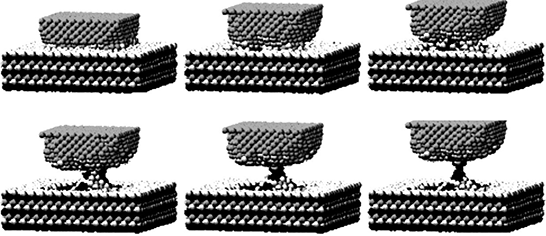
A wide variety of simulations are employed in nanoscience as well as in other branches of science. Let me begin with two examples that illustrate some important properties and problems of simulations—particularly with regard to nanoscience. Both examples stem from Uzi Landman, the director of Georgia Tech's Center for Computational Materials Science. In a landmark Science paper in 1990, Landman and his coworkers reported on the use of large-scale molecular dynamics simulations. They showed that when a nickel tip is brought into close proximity to a sheet of gold, gold atoms jump from the sheet to the probe (Landman et al. Reference Landman1990).
Figure 1 consists of six (simulated) snapshots. On the upper left, a nickel tip has crushed into a gold surface. On the following slides, the tip is removed slowly, and a thin wire of gold atoms is generated. Landman's images used artificial coloring to facilitate visualization. Figure 1 is adapted to black-and-white print.
A nanowire of gold atoms emerges between a nickel tip and a sheet of gold (from Landman et al. Reference Landman1990, courtesy of U. Landman).

Landman describes his own situation as being very similar to that of an experimenter who is watching the outcome of a complicated experimental setup. I quote him from an interview:
To our amazement, we found the gold atoms jumping to contact the nickel probe at short distances. Then we did simulations in which we withdrew the tip after contact and found that a nanometer-sized wire made of gold was created. That gold would deform in this manner amazed us, because gold is not supposed to do this.
This “amazement” is also theoretically amazing because well-known physical laws at the atomic level served as the basis of the simulation that, in turn, showed unexpected behavior at the nanoscale. The formation of a nanowire was, at that time, a prediction that would be confirmed only some years later by atomic force microscopy.
The second example concerns lubrication and the properties of lubricants that are confined to very small, that is, nanoscaled, spaces. Already Feynman had suggested in his famous lecture (1960) that lubrication would have to deal with entirely new phenomena at the nanoscale. Landman has contributed a simulation study (Reference Landman2002) revealing one such new phenomenon. When confined to tight spaces, long-chain lubricant molecules seem to act more like “soft solids” than fluids.
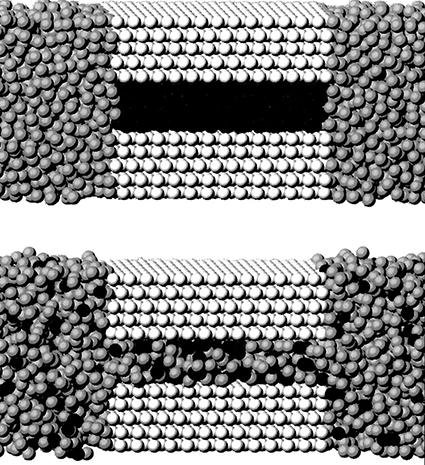
The outcome of a numerical experiment in which two surfaces (light-colored, originally yellow) are sliding one against the other is shown in Figure 2. Lubricant molecules are in the small, nanosized gap between the surfaces as well as in the bulk outside. The upper part of the picture shows a snapshot: The molecules of the lubricant are forming ordered layers that significantly influence the movement of sliding surfaces as friction increases. The molecules confined between the surfaces are colored dark (the coloring of the original visualization on the computer screen is much more vivid). Landman and his colleagues also tried to “overcome the problem” of high friction in their simulation study. When continuing their molecular dynamics simulations, they manipulated the movement of the slides. The simulation shows how oscillating the gap between the two sliding surfaces reduces the order of thin-film lubricant molecules, thus lowering friction. In the lower part of the image, molecules that had been confined within the surface, which were marked red after the first snapshot, have moved out into the bulk lubricant and are no longer confined, and molecules from the bulk areas have moved into the gap (admittedly, this is harder to recognize without colors). These “soft-solid” properties are unexpected in light of the normal behavior of fluids. Again quoting Landman:
We are accumulating more and more evidence that such confined fluids behave in ways that are very different from bulk ones, and there is no way to extrapolate the behavior from the large scale to the very small. (Reference Landman2001)
Ordered high-friction state (upper image) and oscillation-induced disordered low-friction state (from Landman Reference Landman2002, courtesy of U. Landman).

Many researchers have pointed out that, although the fundamental laws (namely quantum theory) are well known, surprising behavior is a typical observation in the nanoworld. This assertion is one reason why nanoscience currently attracts so much attention and may even be encouraging utopian expectations.
The coincidence of surprising behavior both in matter and in simulation models is the starting point of the present paper. I shall argue that the simulation approach opens up a new mode of scientific understanding based on the deployment of epistemically opaque models whose behavior is made assessable by simulation. Simulation amalgamates control and understanding, providing a kind of “understanding by control” oriented toward design rules and predictions rather than theory-based explanations. Thus, the investigation of simulation in nanoscience reveals how science, and, in particular, the “subjective” concept of understanding, is adapting to a new instrument: computer simulation (for a preliminary consideration of this theme, see Lenhard [Reference Lenhard, Baird, Nordmann and Schummer2004]).
2. Building Devices—Controlling Phenomena
The quotation from Landman raises two important aspects: the evidence produced by observing simulations and the impossibility of extrapolation due to what I shall call the “complexity barrier.” The first aspect has been touched on already in Fritz Rohrlich's contribution to PSA 1990 in which he mentioned Landman's presentation of the wire. He pointed to the general importance of visualization for the simulation method, and particularly to the character of simulations as “dynamically anschaulich” (Rohrlich Reference Rohrlich, Fine, Forbes and Wessels1991)—something that unfortunately is partly lost in the transformation from screen to paper. I dare to use the same case again because it communicates a key aspect of computer simulation in a palpable manner. It opens up a new experimental approach that transforms the conception and practices of modeling. Simulation experiments—also called computational or numerical experiments—constitute a special kind of experiment whose status has given rise to some philosophical debate. This kind of experimentation forms a major issue in the philosophical discussion about simulation, beginning with Paul Humphreys’ (Reference Humphreys, Fine, Forbes and Wessels1991) and Rohrlich's (Reference Rohrlich, Fine, Forbes and Wessels1991) contributions to PSA and extending up to recent papers by Evelyn Fox Keller (Reference Fox Keller and Radder2003), Mary Morgan (Reference Morgan and Radder2003), or Eric Winsberg (Reference Winsberg2003).
I agree with these authors that the analysis of simulation and simulation practices will bring about a series of remarkable changes, and that experimentation is definitely affected by these changes. The explorative use of simulation experiments that led to the above-mentioned surprises for Landman seems to be a particularly interesting part of simulation methodology. He was able to explore phenomena as well as the impacts of manipulations at the nanoscale. As I have said above, I argue that this approach opens up a new mode of scientific understanding. I even consider that it is obliged to do so, because theory-based insight, the common road to understanding, is blocked by what I have called a complexity barrier, the second aspect of Landman's quote.
One of the main characteristics of nanoscience is its location on a certain scale between the quantum and the macroscale. That is, quantum effects are not ruled out completely by laws of large numbers (see also Paul Humphreys’ account of scale and nanoscience [Reference Humphreys2006, in this issue]). Michael Roukes, professor of physics at Caltech, called this the mesoscale:
This new science concerns the properties and behavior of aggregates of atoms and molecules, at a scale not yet large enough to be considered macroscopic but far beyond what can be called microscopic. It is the science of the mesoscale, and until we understand it, practical devices will be difficult to realize. (Reference Roukes2001, 43)
Eric Winsberg's contribution to this symposium (Reference Winsberg2006, in this issue) vividly illustrates the difficulties of “crossing the scales,” that is, simulating phenomena on the basis of the interaction of different scales each modeled according to different theoretical assumptions. And the simulation examples from Landman depicted here illustrate the unforeseen properties that may emerge. Whereas this observation may count as typical for nanoscience, it also applies to complex situations in a more general sense. For instance, Dirac has stated that knowledge of guiding laws does not lead to an understanding of behavior in complex situations simply because the pertinent equations are too difficult to solve. I would like to call this the “complexity barrier” of understanding that prohibits the extrapolation of behavior from knowledge of guiding laws.
The last phrase of the quotation from Roukes expresses the significance of understanding: It is needed to build practical devices. I shall call the view that takes this ability as the criterion of understanding the pragmatic account of understanding. In the case of the golden nanowire, created by withdrawing a nickel tip, amazing behavior was observed in simulation experiments, and this could be validated subsequently by an atomic force microscope. However, the simulation does not offer an explanation in the usual sense. Clearly, the laws implemented in the simulation model produce the behavior. In view of the complicated process of building, encoding, and implementing models of these laws into a concrete machine, however, they form only one important factor in producing this behavior. The relation between the general Schrödinger equation and the golden wire remains opaque. Despite obviously being theory based, the simulation does not offer something like a theory-based insight into behavior. What is possible, nonetheless, is control of phenomena, that is, understanding in the pragmatic sense.
The relation to building devices is illustrated succinctly by the report of a recent Department of Energy (DOE) workshop on “Theory and Modeling in Nanoscience.” This has identified the missing “quantitative understanding of matter at the nanoscale” as the “central challenge” in nanoscience (DOE 2002, 5). The report mentions a paradigm for successful nanotechnology: the so-called giant magnetoresistance (GMR) that has led to miniaturized hard disks in the few years since the discovery of this rather obscure effect. The key for this extraordinarily rapid development from the first observation of a surprising phenomenon to reliable practical nanotechnological devices was a simulation-based approach: so-called density functional theory (DFT).
DFT is a widely used theoretical instrument in computational chemistry (and nanoscience)—a so-called ab initiomethod. It is especially useful when dealing with the properties of larger molecules with many interacting electrons. In principle, the properties should derive from the Schrödinger equations, but the number of electrons involved makes a solution practically impossible for complexity reasons. The point of DFT is to replace the many interacting electrons with a kind of average: the electron density.
The essence of the theory was already developed by Walter Kohn in the late 1960s. The fundamental Kohn-Sham equation expresses the interaction of electrons by the effective density functional. Whereas this equation is valid, for in principle, in most cases, the functional cannot be determined exactly. DFT has become applicable in a wider range of problems only since the availability of simulation programs that include an experimental determination of the density functional, that is, an adjustment of parameters on the basis of numerical experiments. Alexander Pople has written extensive simulation programs that implement DFT effectively, thus ensuring its widespread use. As a result, the 1998 Nobel Prize for chemistry was divided equally between Kohn and Pople. The remarkable fact that simulation modeling has become eligible for a Nobel Prize underlines both the theoretical and instrumental character of simulation.
The example of DFT is instructive here, because the DOE report heralded it as a paradigm of quantitative understanding in line with what I have called here the pragmatic account: To be successful in applications, one has to look for suitable instruments—including simulations—that scientists can work with effectively and that permit a kind of understanding that makes manipulation possible. What is at stake is the potential for controlled intervention! And, in this respect, simulations seem to provide that “quantitative understanding” that is wanted. In the case of the moving slides, for instance, the manipulation of the movement from a flat to a slightly oscillating one restored the desired properties of the (simulated) lubricant.
Thus, to summarize, simulation can provide understanding in the pragmatic sense. The goal is not theory-based insight, as elaborated in the philosophical literature on scientific explanation. Rather, it is stable design rules that will be sufficient to build reliable technological artifacts.
Up to now, we have a fit between nanoscience, simulation as an instrument, and the pragmatic account of understanding. This fit, however, raises some problems: Simulation appears to be an instrument akin to technology and prediction. But, is that not directly opposed to understanding? Control and understanding are commonly discussed as opposites. Therefore, the proposed pragmatic account of understanding deviates somewhat from common use, as the next section will show.
3. Epistemic Opacity and Simulation
The term “understanding” usually occurs within the context of explanation (if it occurs at all in the philosophy of science), whereas explanation is specified in the framework of a theory T: What does it mean when we say that T provides an explanation for phenomenon P? There is a lively and sophisticated debate about explanation in the philosophy of science, and it is accompanied by a great deal of literature. The nature of scientific explanation is the subject of a famous controversy between proponents of a causal account of explanations, such as Salmon or Humphreys, and those who prefer a unifying conception, such as Friedman or Kitcher (cf., e.g., the edited volume of Kitcher and Salmon [Reference Kitcher and Salmon1989]). Both accounts, however, share common ground, because they start from a theory T that provides scientific explanations and thereby understanding, thus ascribing understanding a status derived from theory. Moreover, some philosophers (such as Hempel or van Fraassen) have pointed out that understanding, due to its subjective nature, is relevant only to those aspects of explanation that are not epistemically relevant. I do not take this stance, but follow de Regt and Dieks (Reference de Regt and Dieks2005) in their outline of a pragmatic and contextual account of understanding. For them, the crucial criterion for understanding is the ability to apply a theory:
But possessing a theory is not enough: in addition one should be able to use the theory to derive predictions or descriptions of the phenomenon. And this implies that not only knowledge of laws and theories (and background conditions) but also particular skills of the user of this knowledge are involved in achieving the epistemic aim of science. (Reference de Regt and Dieks2005, 144)
I agree that understanding, despite its subjective properties, is epistemically relevant. De Regt and Dieks retain the framework of a theory T but emphasize that additional features are relevant and necessary. My aim is not to delve into the details of the intricate discussion about explanation and understanding, but rather to point out an important link: de Regt and Dieks state that the ability to derive predictions is a necessary criterion for understanding and that a theory is not sufficient to fulfill that criterion. However, this is exactly what simulations may provide: predictions and control of phenomena; hence, a kind of surrogate for understanding in the established sense. Although simulations may offer pragmatic understanding and potential for intervention, they still seem to fall beneath the standards of theoretical explanation. A theory is, of course, highly useful when considering the behavior of a model under changing conditions. However, the theory-based view of explanation is valid but not fully applicable in nanoscience, because of what has been called the complexity barrier above.
The examples have shown how the iterated use of explorative experimentation and the visualization of results during the modeling process offer a methodological path that may circumvent the complexity barrier. A crucial point is that this methodology works with a concept of modeling that deviates in (at least) one important respect from the usual concept: The models often remain epistemically opaque!
Instead of creating a comprehensible, though highly idealized, model world, simulations squeeze out the consequences in an often unintelligible and opaque way. This introduces a remarkable feature of simulation modeling: The pragmatic interpretation of understanding is accompanied by epistemic opacity and is in conflict with the traditional view in philosophy of science, as well as in the sciences themselves, that relates understanding intimately to intelligibility. According to this pragmatic interpretation, it is possible to understand how a theory works without being able to perform precise calculations with it. This can be called the intelligibility view or insight view of understanding. Feynman, referring positively to Dirac, formulated a classic account of this insight view:
“I understand what an equation means if I have a way of figuring out the characteristics of its solution without actually solving it.” So if we have a way of knowing what should happen in given circumstances without actually solving the equations, then we “understand” the equations, as applied to these circumstances. (Reference Feynman, Leighton and Sands1965, Volume 2, 2-1)
So, do simulations provide understanding at all? Philosophers have often complained about the growing unintelligibility that comes with computational methods even in highbrow theories. Paul Humphreys, from whom I have adopted the term “epistemic opacity,” also ascribes this property to simulations and even goes on to argue that this would run counter to understanding:
This opacity can result in a loss of understanding because in most traditional static models our understanding is based upon the ability to decompose the process between model inputs and outputs into modular steps, each of which is methodologically acceptable both individually and in combination with the others. (Reference Humphreys2004, 148)
Humphreys suggests that this decomposition is not possible in simulations. I would like to make two additional comments here: First, simulation modeling uses a highly modular architecture for the algorithmic model. Thus, it seems likely that the above-mentioned process actually can be decomposed in a methodologically acceptable way. However, and this is an essential addition, acceptability is judged according to the model's overall behavior, that is, on the basis of simulation experiments and the visualizations of their results. Hence, simulation modeling is a process whose result is accepted as a whole; for example, the joint calibration of parameters gives a reasonable description of a nickel tip's interaction with a gold surface. It is not accepted on a stepwise basis. In this respect, the methodology of simulation modeling differs from traditional modeling, in terms of the criteria of acceptability as well.
My second comment on Humphreys’ argument concerns the “loss of understanding.” I agree fully with him, if the insight view of understanding à la Feynman is taken as the standard. Obviously, without actual calculation, simulation models remain incomprehensible. I should like to argue, however, that simulation modeling introduces a change in the conception of understanding that turns Humphreys’ negative diagnosis into a positive one: Simulation can result in the ability to control phenomena, to gain power to perform interventions, and thus to gain pragmatic understanding. Admittedly, lurking in the background is the objection that this is not understanding in the strict sense, perhaps a somewhat comparable objection to the one that tacit knowledge is not knowledge at all.
The basis of this pragmatic account is the new instrumental access that simulations offer. Now, calculations may be possible—qua simulations—that do not rest on the intelligibility of a theory. Calculations and their variation, by means of explorative numerical experimentation and visualization, can give a feeling for a model's behavior, even if the model itself remains epistemically opaque. For example, Landman can vary the parameters of the sliding surfaces to explore the circumstances under which friction will be reduced. Thus Feynman's account has been turned upside down: His “a feeling for the consequences” may be developed, and a researcher can acquire a kind of orientation within the model that is based on experience of the model's behavior (although that experience is mediated by the calculating machine), whereas the model itself remains epistemically opaque.
4. Conclusion: A New Mode of Scientific Understanding? or “If You Can't Be with the One You Love, Love the One You're With.”
The epistemology of the sciences has reasoned for long about the opacity of nature and natural phenomena as well as their accessibility for humans and human science. In the present context of simulation modeling, epistemic opacity is given a new twist: The models themselves, our own constructions, are epistemically opaque!
In this respect, computer simulation is not without parallels. As Alfred Nordmann pointed out in a discussion, the organisms of animals in medical research imitate, or “simulate,” their human counterpart. I like this analogy: Experiments with animals are often significant for the treatment of humans, and this research tradition has acquired much experience on how to conduct meaningful experiments. The model itself, that is, the animal organism and the way it works, however, remains opaque in important respects. In short, animal experiments can be viewed as a method with which to circumvent a complexity barrier. Simulation models fulfill a methodologically similar task. Of course, the analogy is not complete, because simulation models are constructed from scratch. Thus, they present an extreme case: Mathematical modeling, the paradigm of epistemic lucidity, contributes to a mode of epistemic opacity!
Through epistemic opacity and the pragmatic account of understanding, the validity issue becomes a major problem for a philosophy of simulation. The spectacular and surprising prediction of the emerging nanowire then becomes a philosophical riddle. Notably, it is not insight into the behavior of nanowires that is involved, but rather understanding in the sense of dealing with the possibilities and options for intervening and building technology. Given that simulation is, at least in some cases, highly successful, what is the basis for its validity? Are there systematic and methodological reasons to expect valid knowledge from simulations?
In medicine, results from animal experiments will be validated by clinical tests. In aircraft construction, new planes are planned and built on the basis of simulations, but, in the end, real-world prototypes will be checked carefully. Hence an easy and in no way misleading answer is to state that additional experience with the real world is pivotal when judging the validity of simulations. Nanoscience, however, presents a special and extreme case: Landman, for example, suggested that simulations are often the only way to explore properties at the nanoscale. Whether there might be a more specific theoretical approach is an open question—up to now. Perhaps, in this field of complex interactions, there is simply no alternative to simulation as an instrument of investigation. Computer simulations offer a pragmatic mode of understanding, and thereby power for manipulation, that seems to be tailor-made for nanoscience and, in particular, nanotechnology. In this way, simulation establishes a philosophical bond between nanoscience and nanotechnology.
To conclude, I would like to stress that simulation does not simply fall below established standards. It introduces and brings about new elements of methodology and epistemology, thereby cultivating a new kind of modeling: simulation modeling. This development has consequences on the general level for how human (scientific) endeavors are conceptualized: By decoupling understanding and insight, the technology of simulation changes the very meaning of “understanding.” I do not question the superior quality of theory-based explanations, but maybe they are out of reach in many fields of nanoscience in which theory is often silent or only whispers about behavior.
Whereas traditional modeling can be conceived as an instrument for gaining insight (though in a highly idealized model world), simulation modeling presents an instrument for gaining control over model behavior by becoming acquainted with the model and developing an orientation within it. Hence, (pragmatic) understanding is acquired through control. In my view, nanoscience shows us how the subjective concept of understanding is engaged in adapting to technology.