Introduction
When parasitic worms share a host with conspecifics, crowding is common (Read, Reference Read1951; Holmes, Reference Holmes1961; Heins et al., Reference Heins, Baker and Martin2002; Fredensborg & Poulin, Reference Fredensborg and Poulin2005). Crowding is negative density-dependent growth; when there are more worms in a host, those worms are smaller-sized on average. The most common explanation for crowding is resource competition (Parker et al., Reference Parker, Chubb, Roberts, Michaud and Milinski2003), although other explanations are possible, such as interference competition or a host response that is density-dependent (Roberts, Reference Roberts2000). Evidence in favour of resource limitations causing crowding includes more severe crowding under food restriction (Roberts, Reference Roberts1966; Shostak et al., Reference Shostak, Walsh and Wong2008) and an absence of crowding when the host is large relative to the parasite (Weinersmith et al., Reference Weinersmith, Warinner, Tan, Harris, Mora, Kuris, Lafferty and Hechinger2014). Assuming limited resources causes crowding, one may expect worms in multiple infections to be in worse condition and have lower fitness.
Crowding has often been documented for worms in their intermediate hosts (reviewed by Benesh, Reference Benesh2011). Larval worms in high-intensity infections may be at a disadvantage because (1) the intermediate host is less likely to survive; and (2) resource competition leaves worms smaller and in poorer condition. The evidence for intensity-dependent host mortality is weaker than one might expect (Benesh, Reference Benesh2011), and few studies have examined whether larval crowding has fitness consequences beyond the current host (Brown et al., Reference Brown, De Lorgeril, Joly and Thomas2003; Fredensborg & Poulin, Reference Fredensborg and Poulin2005; Dörücü et al., Reference Dörücü, Wilson and Barber2007; reviewed by Benesh, Reference Benesh2016). One way larval crowding may be costly is if it reduces establishment probability in the next host. Some studies have found this (Rosen & Dick, Reference Rosen and Dick1983; Steinauer & Nickol, Reference Steinauer and Nickol2003), but others have not (Keymer, Reference Keymer1981; Janwan et al., Reference Janwan, Intapan, Sanpool, Sadaow, Thanchomnang and Maleewong2011). This inconsistency indicates that larval crowding cannot be assumed to have negative consequences and, more generally, that larval size may not be as strong a fitness indicator as implied by life-history models (e.g. De Block & Stoks, Reference De Block and Stoks2005; Benesh et al., Reference Benesh, Weinreich and Kalbe2012). Caddigan et al. (Reference Caddigan, Pfenning and Sparkes2017) observed energy content, but not larval size, to decrease with intensity in an acanthocephalan, suggesting that size and condition are decoupled, and that sharing an intermediate host may be costly, even without crowding. A cost to host sharing (or lack thereof) would likely affect how parasites in multiple infections strategically allocate their resources into growth, manipulation or immune evasion (Poulin, Reference Poulin1994; Poulin et al., Reference Poulin, Nichol and Latham2003; Vickery & Poulin, Reference Vickery and Poulin2010; Cornet, Reference Cornet2011; Hafer & Benesh, Reference Hafer and Benesh2015). Moreover, parasite population dynamics will be affected if parasites from high-intensity larval infections are less likely to infect the next host (Janovy & Kutish, Reference Janovy and Kutish1988; Lotz et al., Reference Lotz, Bush and Font1995).
Here, the results of two experiments are reported, one with the nematode Camallanus lacustris and one with the cestode Schistocephalus solidus. My goal was to test whether crowding in an intermediate host reduces parasite establishment success in the next host.
Materials and methods
Systems
Both C. lacustris and S. solidus infect copepods as first intermediate host. Camallanus lacustris is transmitted from copepods to either a fish paratenic second host or a fish definitive host, commonly perch Perca fluviatilis (Moravec, Reference Moravec1969). Schistocephalus solidus infects sticklebacks as an obligate second intermediate host, before reproducing in piscivorous birds (Clarke, Reference Clarke1954). In this experiment, copepods (Macrocyclops albidus) were infected and then fed to three-spined sticklebacks (Gasterosteus aculeatus).
Single infections are the rule for helminths in copepods (Zander et al., Reference Zander, Groenewold and Strohbach1994; Rusinek et al., Reference Rusinek, Bakina and Nikolskii1996; Hanzelova et al., Reference Hanzelova, Scholz, Gerdeaux and Kuchta2002) so, unsurprisingly, when multiple infections are generated in lab infections, crowding is common (e.g. Valkounova, Reference Valkounova1980; Rosen & Dick, Reference Rosen and Dick1983; Dupont & Gabrion, Reference Dupont and Gabrion1987; Wedekind, Reference Wedekind1997). In the present experiments, intensities were low, up to three worms per copepod, and thus not a large deviation from natural circumstances. Even at these modest intensities, crowding has been reported for both C. lacustris (Benesh, Reference Benesh2011) and S. solidus (Michaud et al., Reference Michaud, Milinski, Parker and Chubb2006).
Copepod and fish maintenance
Copepods were maintained in lab culture at 18°C and a 16:8 h light:dark cycle. They were fed with cultured paramecia. Lab-bred sticklebacks originating from the lake Großer Plöner See (GPS, 54°09′N, 10°25′E) were kept in groups under the same temperature and light conditions. They were fed frozen chironomid larvae.
Camallanus lacustris experiment
Gravid C. lacustris females were collected from the intestines of perch caught from the lake Großer Plöner See. L1 larvae were dissected out of multiple females and mixed thoroughly. Copepods were mass exposed as part of a separate experiment (Eizaguirre et al., Reference Eizaguirre, Lenz, Kalbe and Milinski2012). Groups of 100 copepods received 800 nematode larvae. All copepod stages were exposed, but adult males and females were mostly used for fish infections. Copepods were checked for infection 2 weeks post exposure (pe) by light microscopy and were then used to infect fish 3 weeks pe. By 3 weeks pe, worms are infective, as they complete their development in about 2 weeks (Moravec, Reference Moravec1969), and their growth approaches an asymptote. The mean asymptotic size of C. lacustris decreases 10–28% from single to triple infections (Benesh, Reference Benesh2011), which is the range of intensities used in this experiment.
Fish were individually isolated in small tanks (18 × 13 × 11 cm) a day before infection and starved. All fish were exposed to six C. lacustris larvae, but the larvae differed in the infection intensity experienced in the intermediate host. There were three treatments: (1) six copepods with one worm each; (2) three copepods with two worms each; and (3) two copepods with three worms each. In the two- and three-worm treatments, fish were also given uninfected copepods, so that all fish received six copepods in total. A day after exposure, the water was filtered to ensure that all copepods had been consumed. Fish infections were conducted in two blocks, about 2 months apart, based on the availability of infected copepods (n = 23 and 12, in the two blocks). The second block only included the crowded treatments, as there were not enough singly infected copepods available for infections. Fish were dissected 8 days pe.
Schistocephalus solidus experiment
Two full-sib S. solidus clutches were produced by breeding worm pairs in vitro (Smyth, Reference Smyth1946). They were collected from wild-caught three-spined sticklebacks from the lake Skogseidvatnet, Norway (60°14′N, 5°55′E). Tapeworm eggs were incubated at 20°C for 3 weeks in the dark and then exposed to light 1 day before use, to induce hatching. Adult male copepods were individually isolated in the wells of a 24-well micro-titre plate (~1.5 ml per well) and exposed to two recently hatched coracidia. Copepods were checked for infection at ~8 days pe and used to infect fish 20 days pe. By this time, worms are infective, as they complete their development in about 2 weeks (Dubinina, Reference Dubinina1980). Growth has levelled off by 20 days pe, and the mean asymptotic size of S. solidus decreases by 42% from single to double infections (Michaud et al., Reference Michaud, Milinski, Parker and Chubb2006), which were the intensities used in this experiment.
Fish were individually isolated in small tanks (18 × 13 × 11 cm) and starved for a day before infection. All fish received two S. solidus procercoid larvae. There were two treatments: (1) two copepods with one worm each; and (2) one copepod with two worms, plus an uninfected copepod. After exposure, a subsample of ten tanks were filtered for uneaten copepods. None were found. Most exposed fish were dissected ~100 days pe (n = 42), but a few were dissected later (n = 4) and some fish died during the experiment (n = 11). These fish died several months after exposure, when S. solidus weighs tens of milligrams, so their infection status could still be confidently determined. The variation in time to dissection presumably does not affect infection rates, because sticklebacks only seem able to clear S. solidus during the first week of infection (Scharsack et al., Reference Scharsack, Koch and Hammerschmidt2007).
Fish in both experiments were weighed, measured and sexed at dissection.
Statistical analyses
All analyses were conducted in R 3.3.2 (R Development Core Team, Vienna, Austria). The two species were analysed separately. In both cases, the response variable was infection rate, so logistic regression was used to test treatment effects. The importance of other variables besides treatment, such as experimental block, fish size, sex or family, was explored. The results from simple models (just treatment) and more complex models were comparable, so just the treatment-only models are reported. Logistic regression assumes a binomial error distribution, but commonly there is more variation than expected under this assumption (i.e. overdispersion). Overdispersion was accounted for by using a ‘quasi-binomial’ error distribution, which inflates standard errors and makes tests more conservative. A plausible source of overdispersion is the non-independence of multiple worms in the same intermediate host. If worms within a copepod share an elevated or suppressed probability to infect the next host, it would result in a wider-than-expected spread of infection rates. Thus, chi-square tests were also used to compare infection rate distributions among treatments. The data, scripts and analyses, including additional logistic regression models, can be found at https://github.com/dbenesh82/intensity_infectivity_experiments.
Results
Crowding does not depress establishment probability
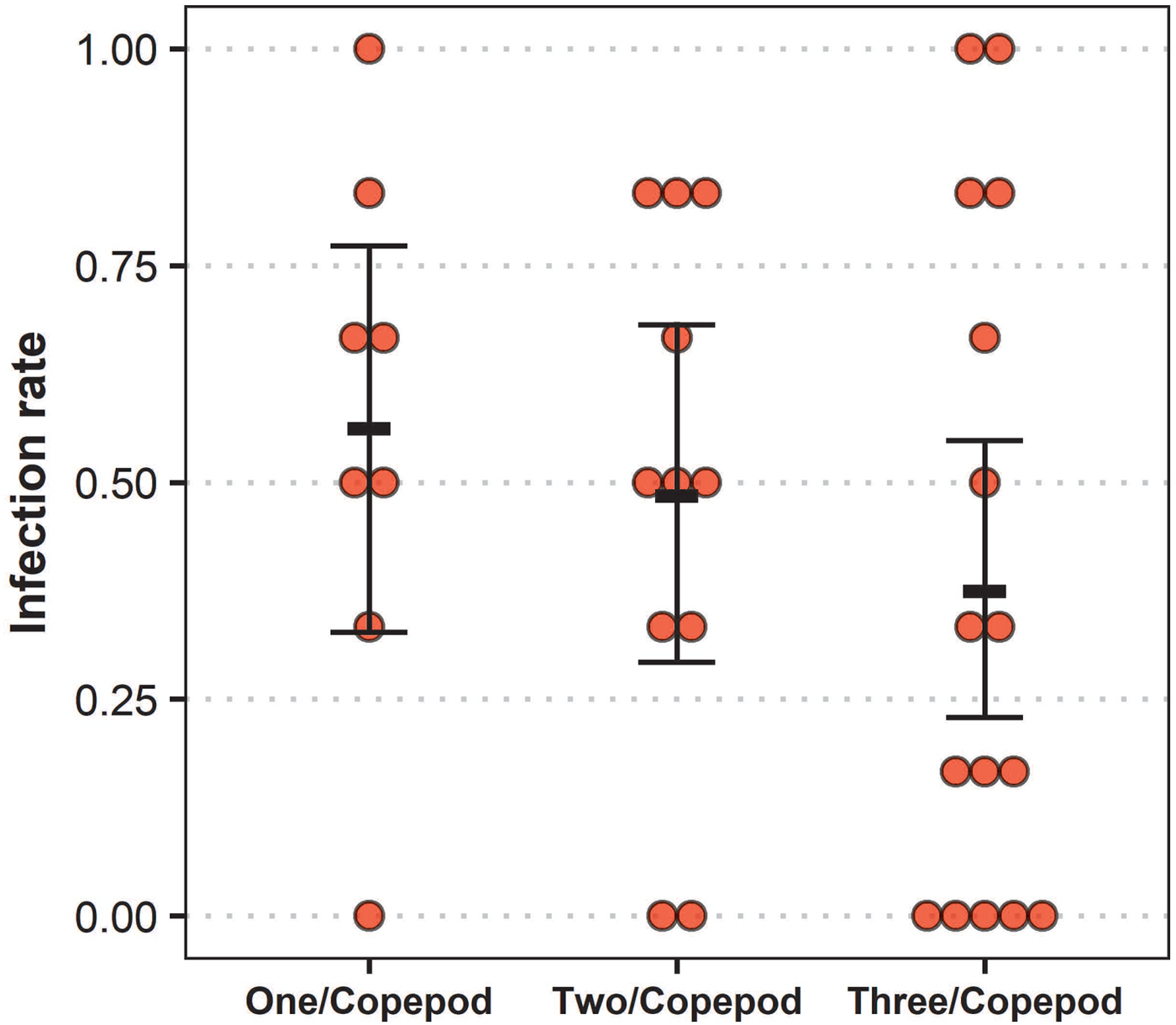
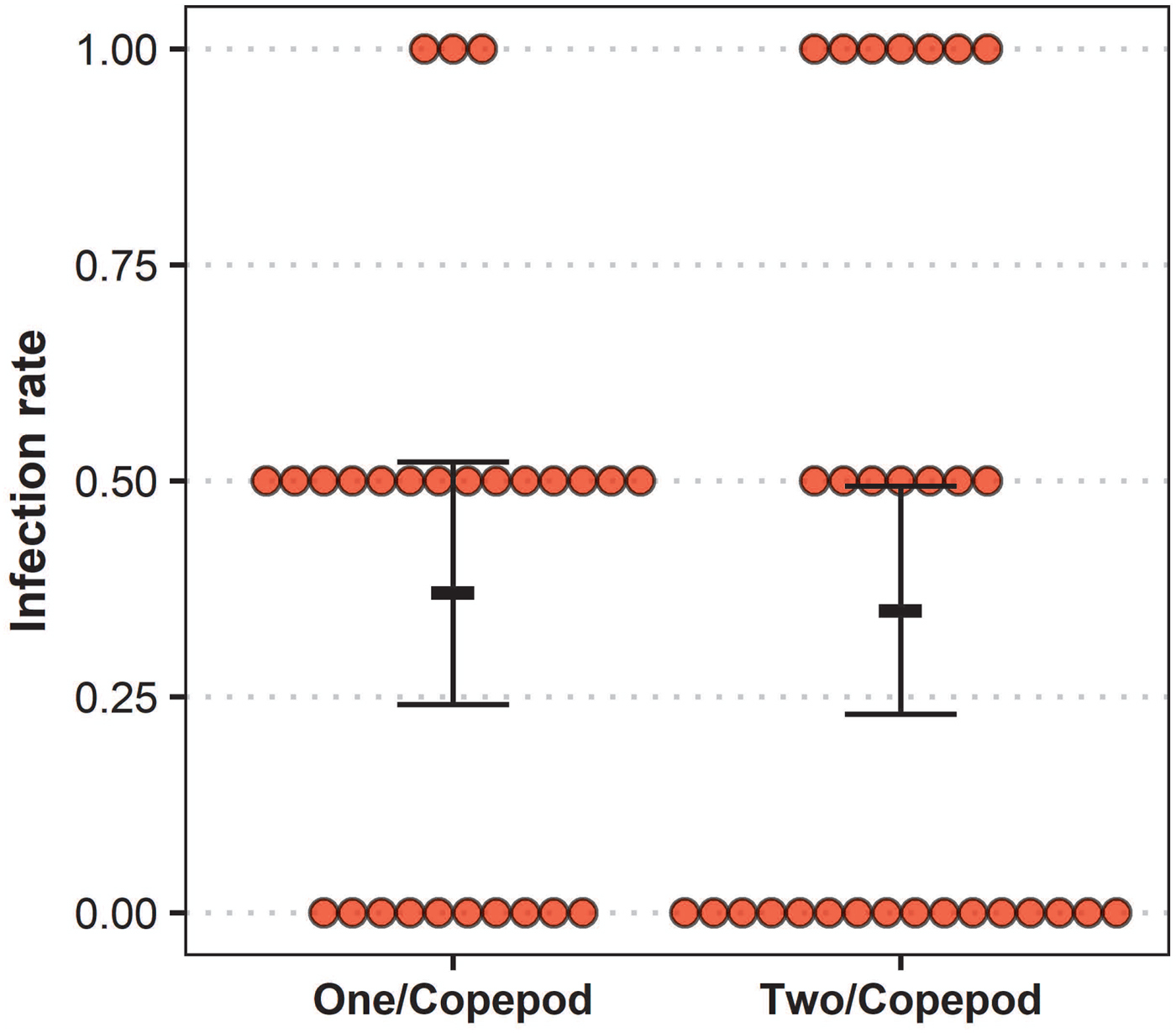
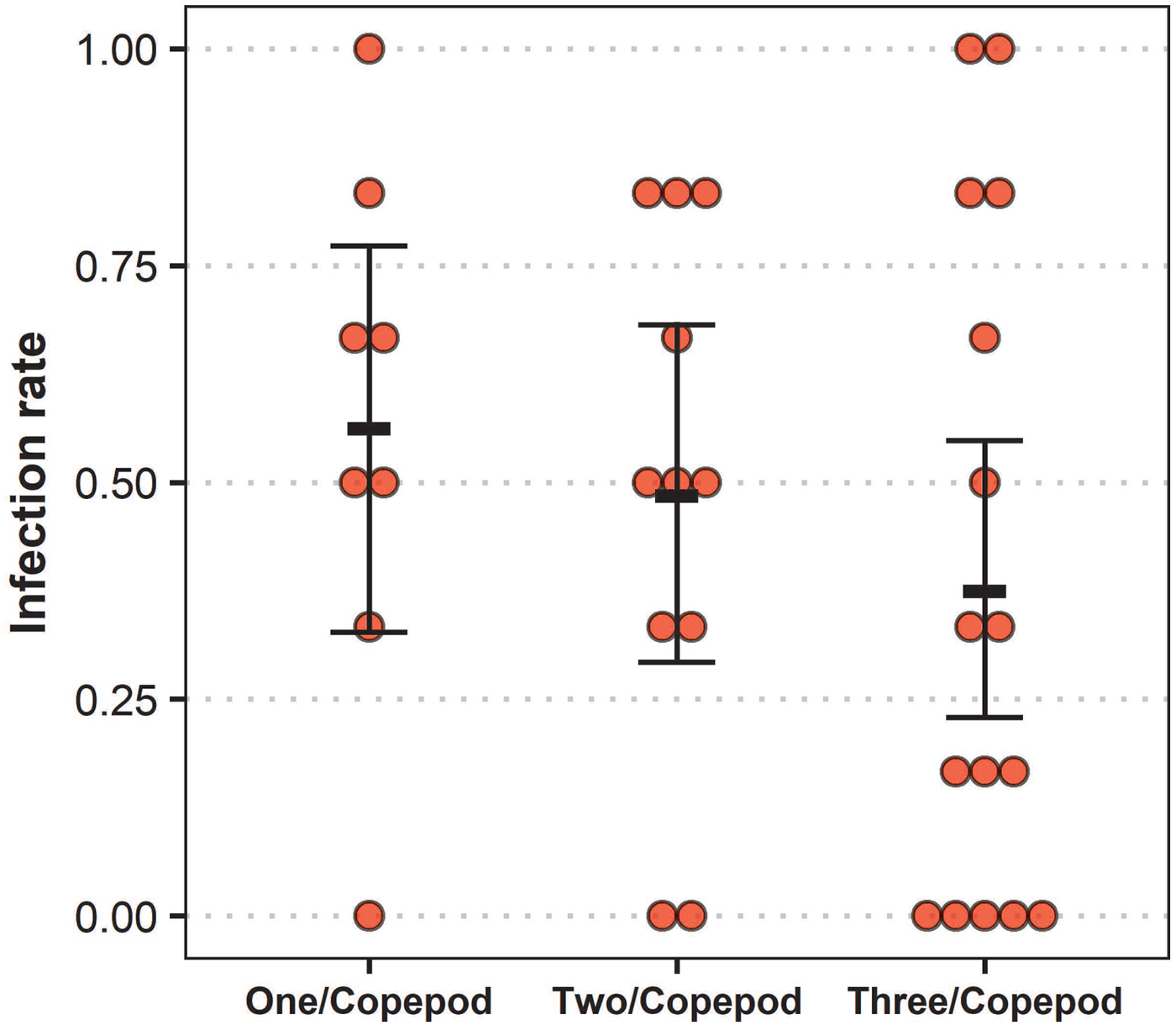
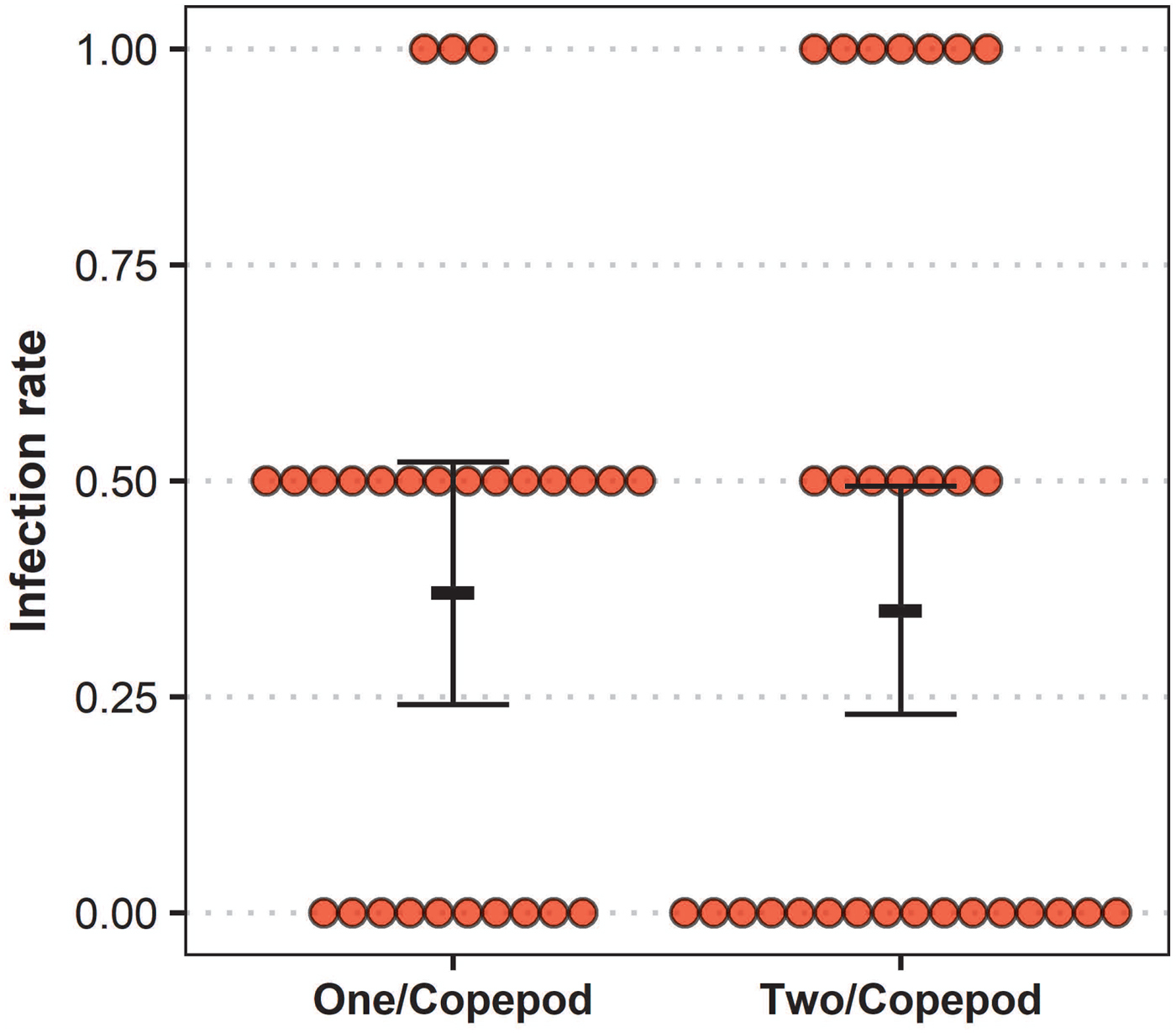
Camallanus lacustris from higher-intensity copepod infections did not have significantly lower establishment probabilities in sticklebacks (logistic regression, F 2,32 = 0.86, P = 0.43), although the trend was in the expected direction (fig. 1). Schistocephalus solidus from uncrowded and crowded copepod infections had a comparable establishment probability in sticklebacks (logistic regression, F 1,55 = 0.04, P = 0.84) (fig. 2).
Infection rate of Camallanus lacustris in sticklebacks. All fish received six nematode larvae by feeding them copepods. The copepods had three different infection intensities: one, two or three worms per copepod. Bars represent means and 95% confidence intervals, and each point is an individual fish.
Infection rate of Schistocephalus solidus in sticklebacks. All fish received two cestode larvae by feeding them copepods. The copepods were either singly or doubly infected. Bars represent means and 95% confidence intervals, and each point is an individual fish.
A shared fate for worms in the same copepod?
Overdispersion was noted in both logistic regression models (the ratio of residual deviance to residual degrees of freedom was about 3 and 1.6 for the nematode and cestode, respectively). Relative to the group means, cases where all worms either succeeded or failed to infect appear common, especially in the more crowded treatments (figs 1 and 2). However, the distribution of infection rates did not significantly differ among treatments for C. lacustris (χ2 = 10.81, df = 12, P = 0.55) and was only marginally significant for S. solidus (χ2 = 5.17, df = 2, P = 0.075).
Discussion
Crowding in intermediate hosts is common in helminths (Benesh, Reference Benesh2011). Reduced growth is presumably caused by limited host resources being split among many parasite individuals and, with fewer resources, one might expect parasites to be less able to infect their next host. In the present experiments, worms from higher-intensity copepod infections did not have significantly lower establishment probability in fish. Still, treatment effects were in the expected direction, but they were too small and variable to be significant. Perhaps crowding was not severe enough. The intensities used here were only slightly higher than natural intensities, whereas Rosen & Dick (Reference Rosen and Dick1983) used more extreme intensities and found cestodes from crowded copepod infections to have reduced infection rates in fish. In the present experiments, the expected reduction in worm size was 10–42%, depending on the species (Michaud et al., Reference Michaud, Milinski, Parker and Chubb2006; Benesh, Reference Benesh2011). But even stronger crowding has not affected parasite establishment in other studies, such as a ~50% reduction in nematode volume as intensity increased from 1 to 13 in copepods (Janwan et al., Reference Janwan, Intapan, Sanpool, Sadaow, Thanchomnang and Maleewong2011) or a ~66% reduction in cestode length as intensity goes from 1 to 60 in beetles (Keymer, Reference Keymer1981).
Besides crowding severity, experimental factors could have muddled the relationship between intensity and establishment. For example, worms in the present experiments were given to fish about a week after larval development was completed. While this ensured that all worms had developed to the infective stage, it also potentially gave them time to compensate for any deficiencies due to crowding. Other factors could have increased the variation in infection rates. Fish genetics affects susceptibility to both parasites (Kurtz et al., Reference Kurtz, Kalbe, Aeschlimann, Häberli, Wegner, Reusch and Milinski2004; Eizaguirre et al., Reference Eizaguirre, Lenz, Kalbe and Milinski2012), but the full-sib fish families used were randomized across treatments. Copepod stage varied in the C. lacustris infection, which might matter because crowding is more pronounced in smaller copepods (Benesh, Reference Benesh2011), but this effect is also expected to be randomized. Copepod susceptibility varied too, as copepods with the same infection intensity may have consumed different numbers of worm larvae, especially in the uncontrolled, mass C. lacustris exposure. However, variation in susceptibility need not correlate with quality, as copepod susceptibility did not affect C. lacustris growth in a previous experiment (Benesh, Reference Benesh2011). These factors may increase variation, but they are not obvious sources of bias between treatments. However, one thing that is intrinsic to the treatment and that could affect infection rates is the non-independence of worms within a copepod.
Worms sharing a copepod host might have a shared fate, being more likely to either all establish or all perish. Consistent with this, the infection rate distribution looks more hourglass-shaped at higher intensities, with an overabundance of low and high infection rates (figs 1 and 2). However, these distributional differences among treatments were not significant for C. lacustris and only marginally so for S. solidus. Thus, these data are suggestive, but not conclusive, that host sharing can affect a parasite's transmission probability, even if the average infection rate does not decrease. Larger sample sizes are needed, but if confirmed, this pattern has population-level consequences. When larval worms in high-intensity infections tend to fail or succeed to be transmitted as a group, it will exacerbate the aggregated distribution of parasites in the next host (Janovy & Kutish, Reference Janovy and Kutish1988; Lotz et al., Reference Lotz, Bush and Font1995).
Is it good or bad to share an intermediate host with conspecifics? Host sharing is usually considered costly, because crowding effects are common. However, a smaller parasite size need not reflect lower condition, and this study shows that crowding in intermediate hosts cannot be assumed to reduce infection probabilities in the next host. Crowding could have other negative effects, such as reduced growth or reproduction in the next host, a possibility not examined here (i.e. carryover effects; Benesh, Reference Benesh2016). Nonetheless, the lack of a reduction in establishment success increases the chances that host sharing may have a net benefit, e.g. if worms split any costs of immune evasion or manipulation. Cooperative host manipulation is possible, as two infective S. solidus modify a copepod's behaviour more than a single worm does (Hafer & Milinski, Reference Hafer and Milinski2015), but intensity does not affect manipulation by uninfective larvae of either species (Weinreich et al., Reference Weinreich, Benesh and Milinski2013; Hafer & Milinski, Reference Hafer and Milinski2015), nor is it clear that cost sharing occurs. Thus, it would be premature to conclude that larval worms benefit from co-infection, even though the present experiments suggest that host sharing may not be as detrimental as expected.
Financial support
The Max Planck Gesellschaft and a DFG fellowship (BE 5336/2-1) supported this work.
Conflict of interest
None.
Ethical standards
All procedures contributing to this work complied with the ethical standards of the relevant national and institutional guides on the care and use of laboratory animals.