US Army suicide rates increased sharply during the wars in Iraq and Afghanistan and have remained elevated (Black, Gallaway, Bell, & Ritchie, Reference Black, Gallaway, Bell and Ritchie2011; Gibson, Corrigan, Kateley, Youmans Watkins, & Pecko, Reference Gibson, Corrigan, Kateley, Youmans Watkins and Pecko2017; Pruitt et al., Reference Pruitt, Smolenski, Tucker, Issa, Chodacki, McGraw and Kennedy2018; Tucker, Smolenski, & Kennedy, Reference Tucker, Smolenski and Kennedy2019). There was a similar increase in non-fatal suicide attempts (SAs) during the same period (Ursano et al., Reference Ursano, Kessler, Heeringa, Cox, Naifeh, Fullerton and Stein2015b). Identifying those at risk of attempting suicide is a difficult challenge (Franklin et al., Reference Franklin, Ribeiro, Fox, Bentley, Kleinman, Huang and Nock2017). Substantial proportions of soldiers entering service have a pre-enlistment history of mental disorder or suicidal thoughts and behaviors (Rosellini et al., Reference Rosellini, Heeringa, Stein, Ursano, Chiu, Colpe and Kessler2015; Ursano et al., Reference Ursano, Heeringa, Stein, Jain, Raman, Sun and Kessler2015a). Knowledge of these histories can help identify soldiers at risk of attempting suicide during service (Naifeh et al., Reference Naifeh, Ursano, Stein, Herberman Mash, Aliaga, Fullerton and Kessler2022b). Transdiagnostic dimensions, such as emotion reactivity and risk behaviors (ERRB), may also help identify risk for future suicidal behavior.
Emotion reactivity, impulsivity, and risk-taking are three ERRB dimensions that have been conceptualized and measured in a variety of ways (Becerra & Campitelli, Reference Becerra and Campitelli2013; Lynam & Miller, Reference Lynam and Miller2004). Emotion reactivity has been defined as the degree to which an individual's emotional responses tend to be intense, prolonged, and elicited by a broad range of stimuli (Nock, Wedig, Holmberg, & Hooley, Reference Nock, Wedig, Holmberg and Hooley2008). Elevated emotion reactivity is associated with increased risk for suicidal thoughts and behaviors (DeCou & Lynch, Reference DeCou and Lynch2019; Dour, Cha, & Nock, Reference Dour, Cha and Nock2011; Najmi, Wegner, & Nock, Reference Najmi, Wegner and Nock2007; Nezu et al., Reference Nezu, Nezu, Stern, Greenfield, Diaz and Hays2017; Nock et al., Reference Nock, Wedig, Holmberg and Hooley2008; Polanco-Roman, Moore, Tsypes, Jacobson, & Miranda, Reference Polanco-Roman, Moore, Tsypes, Jacobson and Miranda2018), including among active-duty soldiers (Naifeh et al., Reference Naifeh, Nock, Dempsey, Georg, Aliaga, Dinh and Ursano2022a). Impulsivity has played a prominent role in some conceptualizations of suicidal behavior (Baumeister, Reference Baumeister1990; Mann, Waternaux, Haas, & Malone, Reference Mann, Waternaux, Haas and Malone1999). A meta-analysis found a significant but modest relationship between trait impulsivity and suicidal behavior (Anestis, Soberay, Gutierrez, Hernandez, & Joiner, Reference Anestis, Soberay, Gutierrez, Hernandez and Joiner2014). Risk-taking was associated with a history of non-fatal SAs among decedents (Athey et al., Reference Athey, Overholser, Bagge, Dieter, Vallender and Stockmeier2018). A representative survey of US Army soldiers found that extreme risk-taking predicted the transition from suicide ideation to SA (Nock et al., Reference Nock, Millner, Joiner, Gutierrez, Han, Hwang and Kessler2018). While these dimensions are individually associated with risk of SA to varying degrees, far less is known about the patterns of co-occurrence of these dimensions and how those patterns of ERRB may prospectively predict SA risk.
Here, we use data from the Army Study to Assess Risk and Resilience in Servicemembers (Army STARRS) New Soldier Study (NSS) (Ursano et al., Reference Ursano, Colpe, Heeringa, Kessler, Schoenbaum and Stein2014) to prospectively examine patterns of ERRB as predictors of risk for SA during the first 4 years of service in the US Army. The first 4 years of service is generally equivalent to soldiers' first term of enlistment and is the Army career phase associated with the highest risk of SA (Ursano et al., Reference Ursano, Kessler, Stein, Naifeh, Aliaga, Fullerton and Heeringa2015c). Using a representative survey of soldiers in their first week of Army service, we identify latent subgroups (classes) of soldiers based on ERRB dimensions. We then examine the prospective association of those classes with first medically documented SA during service, before and after adjusting for important socio-demographic and service-related characteristics. Identifying risk factors for SA in those who are unknown to the mental healthcare system is a particularly important challenge for suicide prevention (Britton et al., Reference Britton, Ilgen, Valenstein, Knox, Claassen and Conner2012; Naifeh et al., Reference Naifeh, Ursano, Stein, Herberman Mash, Aliaga, Fullerton and Kessler2022b; Ursano et al., Reference Ursano, Kessler, Naifeh, Herberman Mash, Nock, Aliaga and Stein2018). Roughly one-third of US Army suicide attempters do not receive a mental health diagnosis prior to their first SA (Naifeh et al., Reference Naifeh, Ursano, Stein, Herberman Mash, Aliaga, Fullerton and Kessler2022b; Ursano et al., Reference Ursano, Kessler, Naifeh, Herberman Mash, Nock, Aliaga and Stein2018). Therefore, we also examine whether ERRB classes differentially predict SAs among those who do and do not receive a mental health diagnosis prior to their SA.
Method
Sample
The NSS was administered to representative samples of US Army soldiers beginning Basic Combat Training (BCT) at Fort Benning, GA, Fort Jackson, SC, and Fort Leonard Wood, MO between April 2011 and November 2012. Recruitment began by selecting weekly samples of 200–300 new soldiers at each BCT installation. Soldiers attended an informed consent presentation within 48 h of reporting for duty. The presentations explained study purposes, confidentiality, and voluntary participation, then answered all attendee questions before seeking written informed consent to give a computerized self-administered questionnaire (SAQ) and neurocognitive tests, and to link these data prospectively to the soldier's administrative records. Study recruitment and consent procedures were approved by the Human Subjects Committees of Army STARRS collaborating organizations.
The 21 772 NSS respondents considered here represent all Regular Army enlisted soldiers who completed the SAQ and agreed to administrative data linkage (77.1% response rate). Data were doubly-weighted to adjust for differences in survey responses among the respondents who did v. did not agree to administrative record linkage, and differences in administrative data profiles between the latter subsample and the population of all new soldiers. Specifically, we obtained de-identified administrative data for the entire Army and for survey respondents who agreed to administrative data linkage, allowing two weights to be created to adjust for non-response bias (i.e. discrepancies between the analytic sample and target population). Each weight was constructed based on an iterative process of stepwise logistic regression analysis designed to arrive at a stable weighting solution. Weight 1 (W1) adjusted for discrepancies between survey completers with and without administrative record linkage based on a prediction equation that used SAQ responses as predictors: W1 = 1/p1, where p1 is the probability of consenting to administrative data linkage. Weight 2 (W2) adjusted for discrepancies between weighted (W1) survey completers with record linkage and the target population based on a prediction equation that used a small set of administrative variables as predictors (e.g. age, sex, rank): W2 = 1/p2, where p2 is the probability of survey completion. These doubly-weighted (W1 × W2) data were used in all of the current study's analyses. More details on NSS clustering and weighting are reported elsewhere (Kessler et al., Reference Kessler, Heeringa, Colpe, Fullerton, Gebler, Hwang and Ursano2013).
Using the survey-linked administrative data, person-month records were created by coding each month of a soldier's career separately for each administrative variable and allowing values to change over time (Singer & Willett, Reference Singer and Willett2003; Willett & Singer, Reference Willett and Singer1993). Respondents were followed via administrative data for up to 48 months, which is commonly the length of the first term of enlistment. The actual number of administrative person-months available for NSS respondents varied because of attrition.
Measures
Outcome variable
Suicide attempt. Non-fatal SAs were identified using administrative records from: the DoD Suicide Event Report (DoDSER) (Gahm et al., Reference Gahm, Reger, Kinn, Luxton, Skopp and Bush2012), a DoD-wide surveillance mechanism that aggregates information on suicidal behavior via a standardized form completed by medical providers; and codes from ICD-9-CM (E950–E958; indicating self-inflicted poisoning or injury with suicidal intent) (Centers for Disease Control and Prevention, 2013) and ICD-10-CM (X71–X83, indicating intentional self-harm; T36–T65 and T71, where the 5th or 6th character indicates intentional self-harm; and T14.91, indicating SA not otherwise specified) (Centers for Disease Control and Prevention, 2019; Hedegaard et al., Reference Hedegaard, Schoenbaum, Claassen, Crosby, Holland and Proescholdbell2018) in the Military Health System Data Repository (MDR), Theater Medical Data Store (TMDS), and TRANSCOM (Transportation Command) Regulating and Command and Control Evacuating System (TRAC2ES), which together provide healthcare encounter information from military and civilian treatment facilities, combat operations, and aeromedical evacuations (online Supplementary eTable 1).
Predictor variables
Administrative variables. Administrative personnel records (online Supplementary eTable 1) were used to identify time-varying and time-invariant socio-demographic (gender, current age, race, education, marital status) and service-related [rank, deployment status (never deployed, currently deployed, previously deployed)] characteristics. Administrative medical records were used to create an indicator variable for mental health diagnosis during Army service based on ICD-9-CM and ICD-10-CM mental health diagnostic codes and mental health-related V-codes and Z-codes (e.g. stressors/adversities, marital problems), excluding postconcussion syndrome and tobacco use disorder (online Supplementary eTable 2). Person-months were coded such that once a mental health diagnosis was recorded in an individual's records, that month and all subsequent months were coded as positive for previous mental health diagnosis.
Self-reported baseline survey variables. SAQ items assessing dimensions of ERRB were used to construct time-invariant baseline predictors. Items were prefaced with: How well does each of the following statements describe you? Response options ranged from 0 (Not at all like me) to 4 (Exactly like me). Emotion reactivity was assessed with two items (I am a very emotional person; and I have very strong emotional reactions to things) adapted from the Emotion Reactivity Scale (Nock et al., Reference Nock, Wedig, Holmberg and Hooley2008). Impulsivity was assessed using two items adapted from the Negative Urgency subscale (When I am upset I often act without thinking; and It is hard for me to resist acting on my feelings) and two items adapted from the Sensation Seeking subscale (I enjoy taking risks; and I sometimes like doing things just because they are dangerous) of the UPPS Impulsive Behavior Scale (Magid & Colder, Reference Magid and Colder2007; Whiteside & Lynam, Reference Whiteside and Lynam2001). Risk-taking that may harm others was assessed with one item (I sometimes do things that might indirectly harm other people, like driving when I am drunk/high or not using protection when having sex with someone I don't know well) adapted from the Structured Clinical Interview for DSM-IV-TR Axis II Personality Disorders (First, Gibbon, Spitzer, Williams, & Benjamin, Reference First, Gibbon, Spitzer, Williams and Benjamin1997).
Analysis methods
Missing data on a given ERRB item (⩽7.8%) were imputed using the sample-wide median for that item. All seven baseline survey items assessing ERRB were standardized to have a mean of 0 and standard deviation of 1. To characterize the co-occurrence of these dimensions, we conducted a latent profile analysis (LPA) in Mplus 7.3 (Muthén & Muthén, Reference Muthén and Muthén1998–2012). Competing solutions were compared on model fit and conceptual interpretability of derived classes. Model fit was evaluated based on the log-likelihood, Akaike information criterion, Bayesian information criterion (BIC), entropy, and Lo–Mendell–Rubin (LMR) adjusted likelihood ratio test. Priority was given to BIC and LMR based on evidence that they are the most robust measures of model fit (Nylund, Asparouhov, & Muthén, Reference Nylund, Asparouhov and Muthén2007).
A variable indicating class membership was constructed for use as a predictor of SA in subsequent analyses, all of which were performed in SAS version 9.4 (SAS Institute Inc., 2013). Person-month data were analyzed using discrete-time survival analysis with a logistic link function (Singer & Willett, Reference Singer and Willett2003; Willett & Singer, Reference Willett and Singer1993). Logistic regression analyses examined the association of class membership with first documented SA during the first 4 years of Army service, before and after adjusting for socio-demographic variables, service-related variables, and administrative mental health diagnosis. A two-way interaction examined whether the association of class membership with SA differed for those with v. without an administrative mental health diagnosis. All models accounted for changes in SA risk across time in service using splines (piecewise linear functions) that were identified in previous analyses of these data (see online Supplementary eFig. 1) (Naifeh et al., Reference Naifeh, Ursano, Stein, Herberman Mash, Aliaga, Fullerton and Kessler2022b).
Logistic regression coefficients and their confidence limits were exponentiated to obtain estimated odds ratios (OR) and 95% confidence intervals (95% CI). Standard errors were estimated using the Taylor series method (Wolter, Reference Wolter1985) to adjust for the weighting and clustering of the NSS data. Multivariable significance tests in the logistic regression analyses were made using Wald χ2 tests based on coefficient variance–covariance matrices that were adjusted for design effects using the Taylor series method. Statistical significance was evaluated using two-sided design-based tests and the 0.05 level of significance. Within ERRB classes, χ2 tests were used to examine differences in SA rates by year of service.
Results
Sample characteristics
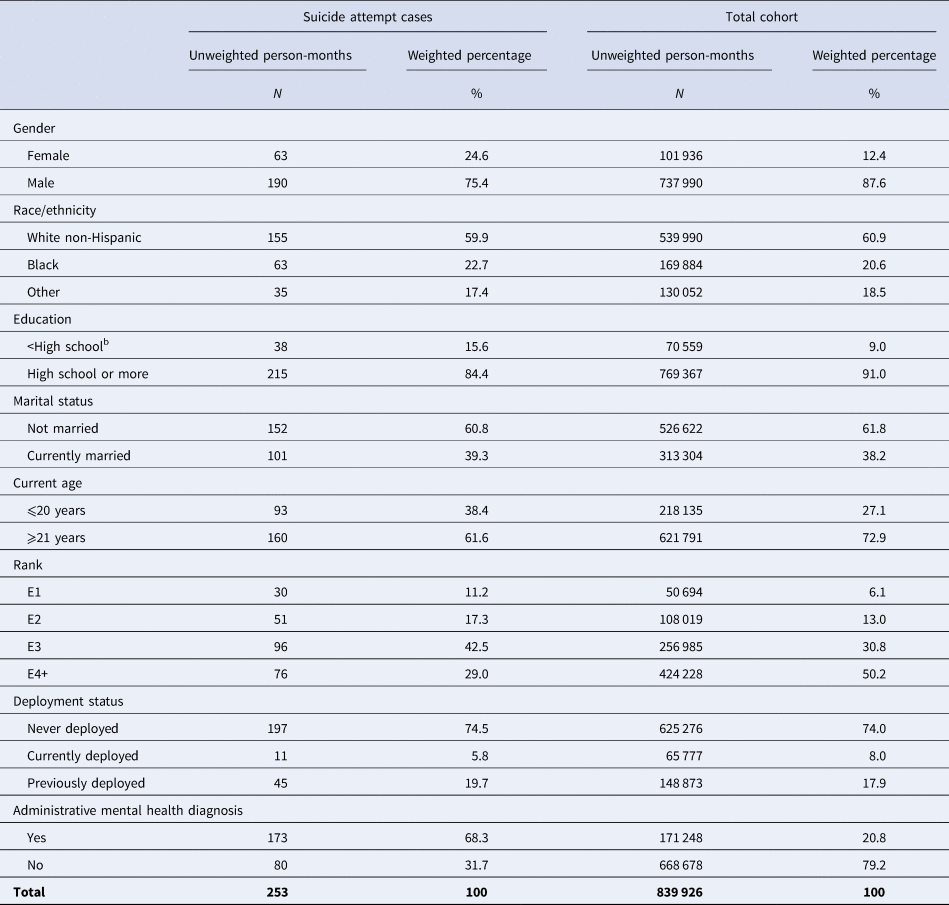
In the total cohort, weighted person-months were mostly male (87.6%), White Non-Hispanic (60.9%), had at least a high school education (91.0%), not married (61.8%), at least 21-years-old (72.9%), E4 or higher rank (50.2%), and never deployed (74.0%). Person-months in which a SA occurred (n = 253) were mostly male (75.4%), White Non-Hispanic (59.9%), at least high school educated (84.4%), not married (60.8%), age 21 years or older (61.6%), E3 or lower rank (71.0%), and never deployed (74.5%) (Table 1).
Distribution of sample characteristics among a cohort of Regular Army enlisted soldiers over their first 4 years of servicea

a The survey respondents considered here were Regular Army enlisted soldiers (n = 21 772). Survey-linked administrative person-month records were examined through 48 months of service. The number of available person-month records for a given soldier varied because of attrition from service.
b <High School includes: General Educational Development credential (GED), home study diploma, occupational program certificate, correspondence school diploma, high school certificate of attendance, adult education diploma, and other non-traditional high school credentials.
LPA of the ERRB dimensions
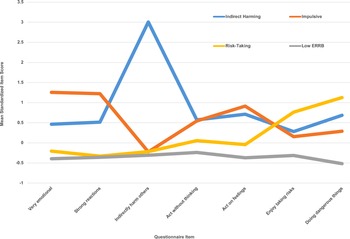
LPA of the seven standardized items assessing dimensions of emotional and behavioral functioning tested 2–6 classes, all of which converged (online Supplementary eTable 3). The four-class solution was selected because it was interpretable and demonstrated improved fit relative to the three-class solution, including a lower BIC (398 409.3 v. 401 002.0) and significant LMR (p < 0.0001). Although the five-class solution had a lower BIC (384 567.4), LMR was non-significant (p = 0.99). We examined the pattern of mean scores within each class in the four-class solution and named the ERRB classes with consideration of their highest scoring dimension(s): ‘Indirect Harming’ (8.9% of soldiers), ‘Impulsive’ (19.3%), ‘Risk-Taking’ (16.3%), and ‘Low ERRB’ (55.6%) (Fig. 1).
A latent profile analysis of emotion reactivity and risk behavior (ERRB) items among 21 772 Regular Army enlisted soldiers resulted in the following four-class solution: Indirect Harming = 8.9%; Impulsive = 19.3%; Risk-Taking = 16.3%; Low ERRB = 55.6%.

Association of class membership with SA
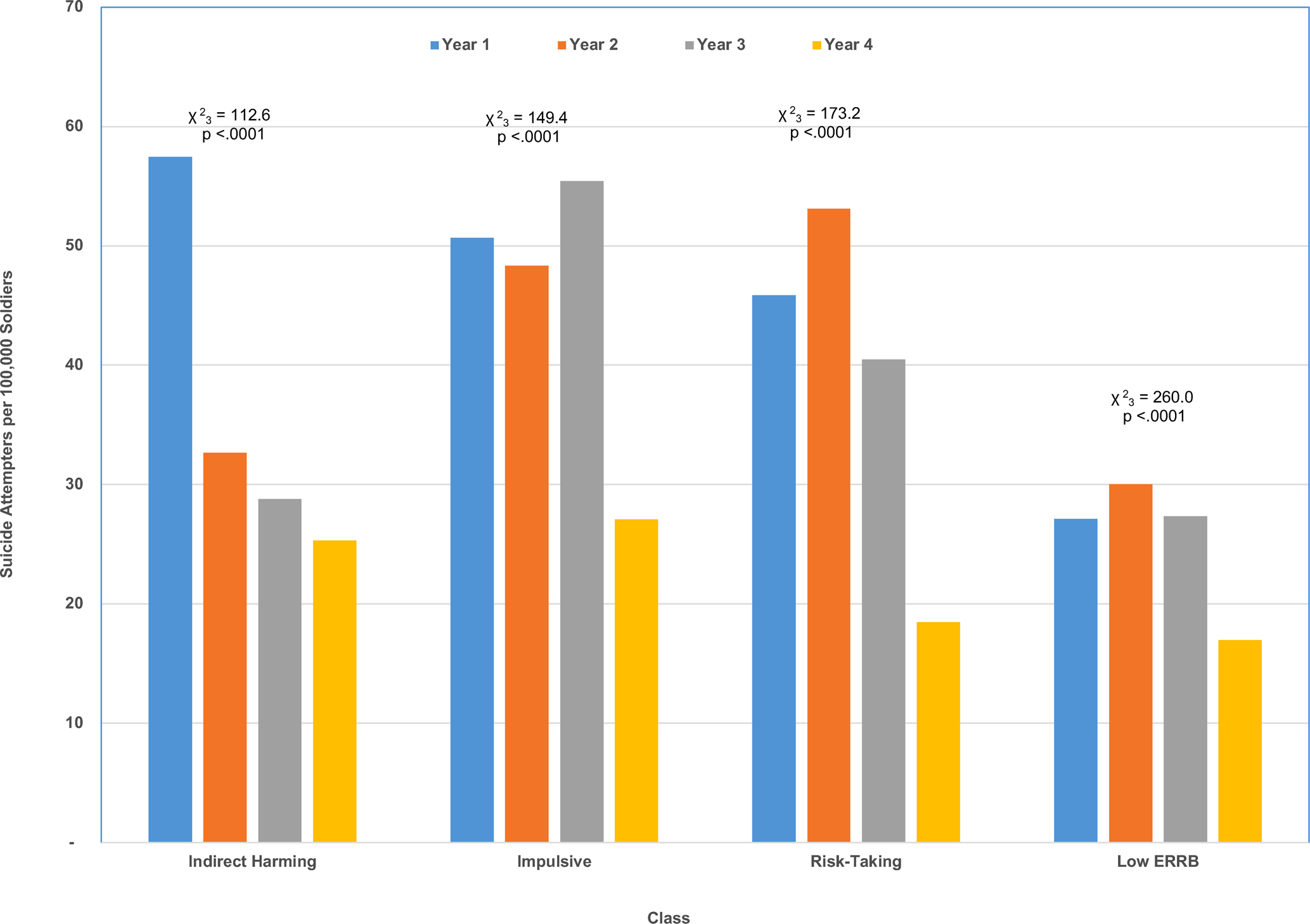
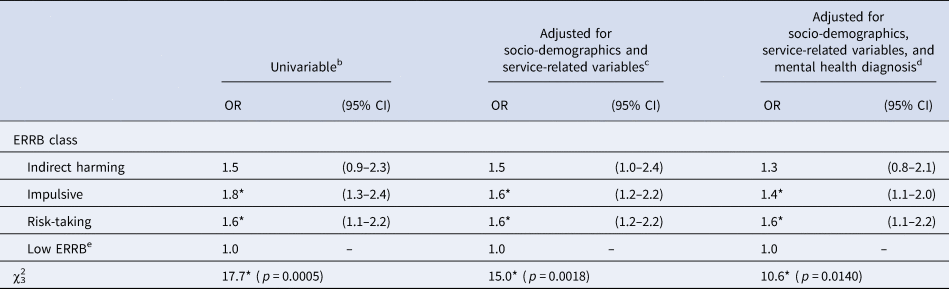
In a model that adjusted only for time in service, class membership was significantly associated with subsequent SA (χ23 = 17.7, p = 0.0005), with soldiers in the Impulsive [OR 1.8 (95% CI 1.3–2.4)] and Risk-Taking [OR 1.6 (95% CI 1.1–2.2)] classes having significantly higher odds relative to those in the Low ERRB class. These associations persisted after adjusting for socio-demographic and service-related variables, and mental health diagnosis (Table 2). The two-way interaction between class membership and mental health diagnosis was non-significant. Within each of the four classes, SA rates differed across the 4 years of service (χ23 = 112.6–260.0, all p's < 0.0001) (Fig. 2).
Rate of suicide attempt by year of service for each emotion reactivity and risk behavior (ERRB) class.

Univariable and multivariable associations of ERRB class membership with documented suicide attempts among a cohort of Regular Army enlisted soldiers over their first 4 years of servicea

ERRB, emotion reactivity and risk behaviors.
a The survey respondents considered here were Regular Army enlisted soldiers (n = 21 772). Survey-linked administrative person-month records were examined through 48 months of service. The number of available person-month records for a given soldier varied because of attrition from service.
b Adjusted only for time in service (spline variables).
c Adjusted for time in service (spline variables), socio-demographic variables (gender, race/ethnicity, education, marital status), and service-related variables (rank, deployment status).
d Adjusted for time in service (spline variables), socio-demographic variables (gender, race/ethnicity, education, marital status), service-related variables (rank, deployment status), and administratively documented mental health diagnosis.
e Low ERRB, low scores on all items assessing dimensions of emotion reactivity and risk behaviors (ERRB).
*p < 0.05.
Discussion
Using a representative sample soldiers surveyed upon entering the Army and followed for 48 months through administrative records, we identified four classes of ERRB and their association with future SA. Nearly one-fifth of soldiers fell into the Impulsive class, characterized by heightened emotion reactivity and a tendency to act rashly when distressed (‘negative urgency’). More than 16% were in the Risk-Taking class, characterized by heightened levels of sensation seeking but low levels on all other dimensions. Approximately 9% fell into the Indirect Harming class, differentiated by the tendency to engage in risky behaviors that may harm others. The remaining soldiers, more than half of those entering Army service, were in the low overall ERRB class, characterized by low levels on all dimensions. Soldiers who were Impulsive and those who were Risk-Taking were significantly more likely to attempt suicide during service than those in the low ERRB class. These associations persisted even after adjusting for socio-demographic and service-related characteristics and mental health diagnosis. The association of class membership with SA did not differ for those with v. without a mental health diagnosis, suggesting that impulsive and risk-taking characteristics may help identify SA risk even in soldiers who are unknown to the mental healthcare system. Overall, the findings indicate that knowledge of ERRB may assist in detecting future SA risk among soldiers. It would be valuable for future research to specifically determine whether ERRB-related behaviors that are observable by peers and leaders during service are associated with these ERRB classes. This would aid in peers, leaders, and family members identifying soldiers at risk and enable the opportunity for intervention or referral for care.
Soldiers in the Impulsive class, a group at increased risk of attempting suicide, report a tendency to have strong emotional reactions and to act without thinking when upset. These characteristics suggest that those soldiers may be more likely than soldiers in the other classes to rapidly transition from suicide ideation to SA, perhaps making an unplanned attempt (Chaudhury et al., Reference Chaudhury, Singh, Burke, Stanley, Mann, Grunebaum and Oquendo2016) following exposure to a stressor (Bagge, Glenn, & Lee, Reference Bagge, Glenn and Lee2013). Given the potential challenges of preventing rapid transitions and unplanned SAs, it would be valuable to investigate the prevalence and predictors of unplanned attempts among solders in this Impulsive group.
It is noteworthy that we identified a distinct Risk-Taking group of soldiers at increased risk of SA. These soldiers are characterized by elevations only on the sensation-seeking items. Although some conceptualizations suggest that sensation seeking may be a component of impulsivity (Whiteside & Lynam, Reference Whiteside and Lynam2001), our findings support evidence that these are separate constructs (Harden & Tucker-Drob, Reference Harden and Tucker-Drob2011; Smith et al., Reference Smith, Fischer, Cyders, Annus, Spillane and McCarthy2007; Steinberg et al., Reference Steinberg, Albert, Cauffman, Banich, Graham and Woolard2008), and therefore may represent distinct pathways to SA.
Although we did not find a significant association between SA risk and the Indirect Harming group, this pattern of ERRB was distinct from the other classes. The Indirect Harming group involves recklessness or disregard for others that is not present in the other classes of soldiers. This is a potentially important distinction that warrants consideration in future research on other negative outcomes associated with risk-taking behavior, particularly those where other people may be injured in addition to the identified soldier, such as motor vehicle accidents.
The risk of SA for both the Impulsive and Risk-Taking classes varied across the first 4 years of service. This suggests that these types of behaviors interact with the stressors and life events occurring within particular Army career phases. Better understanding these specific career and life phase-related stressors can inform the targeting of interventions.
The findings of this study should be interpreted in light of the following limitations: First, administrative data may be incomplete and/or inaccurate. Medical records, which are subject to errors in clinician diagnosis and coding, are unlikely to capture all SAs and mental disorders. Second, we used abbreviated measures of emotion reactivity, negative urgency/impulsivity, and sensation seeking, which may not fully represent the constructs captured in the larger instruments from which they were adapted. Third, our outcome was limited to first documented SA during service. It is unknown if risk for repeated SAs would be similarly associated with these ERRB classes. Fourth, results are specific to enlisted soldiers in their first 4 years of service and to soldiers entering service during the study period. Therefore, the findings may not generalize to other service members or military eras, or to non-military populations.
With those limitations in mind, our findings indicate that certain ERRB patterns, assessed during the first week of Army service, are associated with future SAs. Specifically, soldiers classified as either Impulsive or Risk-Taking upon entering service had elevated risk of subsequently attempting suicide during their first 4 years in the Army, associations that persisted after controlling for socio-demographic, service-related, and mental health variables. Importantly, class membership was associated with risk in soldiers who had never received a mental health diagnosis, and therefore had not been identified by the Army mental healthcare system prior to their SA. There is a need for research examining whether behaviors related to impulsivity and risk-taking that are observable by peers, family members, and military leaders, can be used in place of self-report data to further aid in identifying soldiers at risk of attempting suicide. To assist clinicians assessing suicide risk, it will be important for future prospective research to examine whether soldiers in the Impulsive or Risk-Taking classes who have suicide ideation are more likely to rapidly transition to SA or have unplanned attempts as suggested in previous cross-sectional research (Naifeh et al., Reference Naifeh, Nock, Dempsey, Georg, Aliaga, Dinh and Ursano2022a; Nock et al., Reference Nock, Millner, Joiner, Gutierrez, Han, Hwang and Kessler2018).
Supplementary material
The supplementary material for this article can be found at https://doi.org/10.1017/S0033291722003300
Financial support
Army STARRS was sponsored by the Department of the Army and funded under cooperative agreement number U01MH087981 with the US Department of Health and Human Services, National Institutes of Health, National Institute of Mental Health (NIH/NIMH). Subsequently, STARRS-LS was sponsored and funded by the Department of Defense (USUHS grant numbers HU00011520004 and HU0001202003). The grants were administered by the Henry M. Jackson Foundation for the Advancement of Military Medicine Inc. (HJF).
Conflict of interest
In the past 3 years, Dr Kessler was a consultant for Datastat, Inc., Holmusk, RallyPoint Networks, Inc., and Sage Therapeutics. He has stock options in Mirah, PYM, and Roga Sciences. In the past 3 years Dr Stein received consulting income from Actelion, Acadia Pharmaceuticals, Aptinyx, atai Life Sciences, Boehringer Ingelheim, Bionomics, BioXcel Therapeutics, Clexio, EmpowerPharm, Engrail Therapeutics, GW Pharmaceuticals, Janssen, Jazz Pharmaceuticals, and Roche/Genentech. Dr Stein has stock options in Oxeia Biopharmaceuticals and EpiVario. He is paid for his editorial work on Depression and Anxiety (Editor-in-Chief), Biological Psychiatry (Deputy Editor), and UpToDate (Co-Editor-in-Chief for Psychiatry).
Disclaimers
The contents are solely the responsibility of the authors and do not necessarily represent the views of the Department of Health and Human Services, NIMH, or the Department of the Army. The opinions and assertions expressed herein are those of the author(s) and do not reflect the official policy or position of the Uniformed Services University of the Health Sciences or the Department of Defense. The contents of this publication are the sole responsibility of the author(s) and do not necessarily reflect the views, opinions, or policies of The Henry M. Jackson Foundation for the Advancement of Military Medicine, Inc. Mention of trade names, commercial products, or organizations does not imply endorsement by the US Government.
The Army STARRS Team members
The Army STARRS Team consists of Co-Principal Investigators: Robert J. Ursano, MD (Uniformed Services University) and Murray B. Stein, MD, MPH (University of California San Diego and VA San Diego Healthcare System). Site Principal Investigators: James Wagner, PhD (University of Michigan) and Ronald C. Kessler, PhD (Harvard Medical School). Army scientific consultant/liaison: Kenneth Cox, MD, MPH [Office of the Assistant Secretary of the Army (Manpower and Reserve Affairs)]. Other team members: Pablo A. Aliaga, MA (Uniformed Services University); David M. Benedek, MD (Uniformed Services University); Laura Campbell-Sills, PhD (University of California San Diego); Carol S. Fullerton, PhD (Uniformed Services University); Nancy Gebler, MA (University of Michigan); Meredith House, BA (University of Michigan); Paul E. Hurwitz, MPH (Uniformed Services University); Sonia Jain, PhD (University of California San Diego); Tzu-Cheg Kao, PhD (Uniformed Services University); Lisa Lewandowski-Romps, PhD (University of Michigan); Alex Luedtke, PhD (University of Washington and Fred Hutchinson Cancer Research Center); Holly Herberman Mash, PhD (Uniformed Services University); James A. Naifeh, PhD (Uniformed Services University); Matthew K. Nock, PhD (Harvard University); Victor Puac-Polanco, MD, DrPH (Harvard Medical School); Nancy A. Sampson, BA (Harvard Medical School); and Alan M. Zaslavsky, PhD (Harvard Medical School).