Introduction
In developing countries, the trends of increased urbanization, higher income and the ever-increasing population have generated a greater demand for animal products as a major source of protein (Seré et al., Reference Seré, van der Zijpp, Persley and Rege2008). Currently, Africa has a deficit in animal products and the situation is projected to worsen because of the increasing gap between supply and demand (World Bank, 2008). To reduce this gap, there needs to be a change in both the manner in which livestock are reared and the productivity of individual animals raised on the African continent.
Kenya, in its Vision 2030, aims at reducing poverty and hunger, and making the country globally competitive and prosperous by the year 2030 (GOK, 2008). Part of this envisioned prosperity is ensuring national food security. Consequently, the government intends to boost growth in agriculture and livestock production by 6–8 percent per year through various measures. This implies the future of the country's economic progress, and stability would significantly depend on livestock production. Pragmatic efforts and approaches should therefore be made to improve performance in livestock production. Areas to constantly focus on are animal health care and welfare, nutrition, sustained genetic improvement, appropriate policies, and value addition of animal products and services (Kosgey and Okeyo, Reference Kosgey and Okeyo2007).
The growth in agriculture and livestock production has a significant and direct impact on reducing overall poverty in developing countries (Delgado et al., Reference Delgado, Rosengrant, Steinfeld, Ehui and Courbis1999; Costales, Gerber and Steinfeld, Reference Costales, Gerber and Steinfeld2006). While genetic improvement might seem relatively slow (range about 0.5–3 percent per year for within-breed selection), it is steady, cumulative and permanent (Smith, Reference Smith1984). Consequently, substantial improvements can be achieved during a 10–20-year period. To facilitate progress, adequate performance data and consistently kept pedigree records for use in the estimation of breeding values of the animals to be selected for improvement are required. Individual records also support routine farm management decisions, notably for improved animal productivity and profitability (ICAR, Reference Mäki-Hokkonen, Vares and Zjalic2002, Reference Pauw, Mack and Maki-Hokkonen2004). However, livestock pedigree and performance recording presents a huge challenge for developing countries where low-input and low-output production systems are practised, and where few poorly funded and inconsistent government support services are provided (Holst, Reference Holst1999; Kosgey and Okeyo, Reference Kosgey and Okeyo2007).
To facilitate improvements in livestock recording practices in developing countries, documentation and analysis of past efforts and current status of livestock recording are required. While overviews on various aspects of livestock production in Kenya have been presented by various authors (Mukisira, Reference Mukisira and Trivedi2002; Okeyo et al., in press), this paper presents a detailed analysis of the historical developments, and the current scenario of dairy and beef recording in the country. The paper also contextualizes the state of recording in relation to the potential for future development plans for genetic improvement of dairy and beef cattle in the country.
Dairy and beef production systems in Kenya
Dairy and beef cattle in Kenya are raised in different production systems that vary according to the agro-ecological potential of the area, breeds kept and sociocultural values of the livestock keepers.
Dairy cattle production
Dairy cattle production in Kenya is the second largest contributor to the agricultural gross domestic product (GDP) (Muriuki, Reference Muriuki2009). Dairying in the country started at the beginning of the twentieth century when European settlers introduced exotic high milk-producing cattle breeds and other exotic forms of agriculture from their native countries in Europe. However, improved cattle production was not undertaken by the indigenous people until after 1955 when the Swynnerton Plan of 1954 allowed them to take on commercial agriculture (Connelly, Reference Connelly1998). At Kenya's independence from the British rule in 1963, the dairy herd had grown to 400 000 head of exotic cattle largely owned by the settlers (Muriuki, Reference Muriuki2009). The government subsequently introduced highly subsidized input services for animal health care, production, artificial insemination (AI) and bull schemes, dipping to control ticks and other ecto-parasites, and training of livestock specialists. However, Structural Adjustment Programmes (SAP) (GOK, 1986) instituted in 1992 led to an abrupt withdrawal of all government subsidies in these areas. The impact of this on the livestock improvement programmes is covered later in this paper.
Kenya's dairy production is largely undertaken in the highlands (high-potential areas) because of the favourable agroclimate, infrastructure and market access. These areas experience an annual rainfall of more than 750 mm, and spread from central Kenya through the Rift Valley to the western part of the country and the coastal strip (Muriuki, Reference Muriuki2009). The animals are raised in a variety of production systems, namely intensive smallholder systems with 1–2 pure-bred exotic or mixed-bred animals and less than 1 acre of land (animals are often zero-grazed, i.e. stall-feeding with fodder cut and carried to them); semi-intensive systems comprising medium- and smallholder farms with 5–20 pure exotic or mixed-bred cows; and large-scale commercial systems with more than 20 pure exotic cows and more than 20 acres of land (Ojango, Reference Ojango2000). The medium- and small-scale producers own over 70 percent of the existing 3.5 million dairy cows and produce about 56 percent of the total milk; this comprises approximately 80 percent of the marketed milk in the country (Muriuki, Reference Muriuki2009).
The dairy herd is mainly composed of Holstein–Friesian, Ayrshire, Guernsey and Jersey animals and their crosses. Crosses constitute over 50 percent of the total herd while the Holstein–Friesian and Ayrshire dominate the pure breeds (Muriuki, Reference Muriuki2009). One of the constraints to dairy cattle improvement in Kenya is that most of the small-scale farmers lack the most basic skills in breeding management of animals and do not keep records of their animals’ production and reproductive performance.
Beef cattle production
In the livestock sub-sector of Kenya, the beef industry is the largest contributor to the agricultural GDP and significantly contributes to food security (MLD, 2008). Beef is acceptable to a majority of consumers and its production is a major economic activity among the pastoral and agropastoral communities. Beef cattle also contribute to milk production, draught power, hides and skins, blood for human consumption, fuel (i.e. dry dung) and manure for use to improve soil fertility, as well as intangible benefits, e.g. serve as capital assets and an insurance against emergencies, and use for sociocultural or ceremonial purposes (Kosgey, Reference Kosgey2004).
The genotypes kept comprise the indigenous Bos indicus breeds (70 percent), pure-bred exotic and crosses (30 percent) (MLFD, 2004). These together contribute 70 percent of the beef produced. About 30 percent of the beef emanates from dairy herds in the form of bull calves not used for breeding, culled heifers, cows and bulls (MLFD, 2004). The important indigenous genotypes kept are the East Africa Short Horned Zebu (EASHZ) and the Kenya Boran. The common exotic breeds reared are the Hereford, Simmental, Charolais, Aberdeen Angus, Limousin, Red Poll, Santa Getrudis and Dexter. The dual-purpose breeds include the Sahiwal and Brown Swiss, and their crosses (MLFD, 2004; Rewe et al., Reference Rewe, Indetie, Ojango and Kahi2006; NABP, 2009).
Beef cattle in Kenya are largely reared in low- to medium-potential areas (i.e. the rangelands with <625–750 mm of rain annually and a high evapotranspiration rate). These areas are located in central and eastern parts of the country, parts of the Rift Valley and the areas neighbouring the coastal strip. The low-potential areas have an annual rainfall of less than 625 mm and stretch from north and northeastern Kenya to the southern parts bordering Tanzania (Muriuki, Reference Muriuki2009). The animals are largely kept by the pastoralists in agropastoral or nomadic systems as an integral part of their sociocultural life, and by large-scale commercial ranchers; the pastoralists mainly keep the EASHZ while the ranchers keep the exotics and the Kenya Boran (Kilung'o and Mghenyi, Reference Kilung'o and Mghenyi2001). Indigenous cattle are also kept for beef in some mixed crop–livestock farming systems.
A feedlot system was practised in Kenya in the 1970s to early 1980s under the Kenya Beef Industry Development Project funded by the United Nations Development Programme. This system aimed at strategically reducing the number of animals supported on the rangelands during dry spells, and improving the carcass quality for the market by “finishing” animals in feedlots (Creek, Reference Creek1972). However, this proved uneconomical because of high competition for maize grain from the increasing human population, and a low turnover of steers.
State-owned farms reclaimed from European settler farmers who left Kenya at independence in 1965 were placed under the Settlement Trustee and the Agricultural Development Corporation (ADC), the latter being a government parastatal. A key responsibility of the ADC was to multiply livestock breeding stock to ensure that a continuous supply of various breeds was available to Kenyan farmers at affordable prices. Additionally, three research centres for beef cattle breeding and improvement were established at Kiboko, Lanet and Naivasha. These institutional farms, together with private commercial ranchers, actively participated in beef recording programmes until the early 1990s. The implementation of the SAP of 1992, however, resulted in a rapid decline in beef cattle recording in the country.
Livestock recording in Kenya
Livestock recording has several important objectives: to help individual farmers make routine management decisions in order to produce products (e.g. meat or milk) more economically and to provide data for government administration, research, breeding and extension services (Lindström, Reference Lindström1976). Extensive guidelines on livestock recording and types of records to maintain are provided by the International Committee on Animal Recording (ICAR, Reference Mäki-Hokkonen, Vares and Zjalic2002, Reference Pauw, Mack and Maki-Hokkonen2004).
Organizations and bodies undertaking animal recording have existed in Kenya since 1963. However, numbers of livestock producers registering animals and recording their production have remained low, with less than 5 000 animals registered per year (Kenya Livestock Breeders Organization [KLBO] records) from an estimated cattle population of 11.5 million (FAO, 2005). The organizations that have been responsible for development and running of dairy and beef improvement in the country are discussed in the following sections.
Institutions and organizations for recording and genetic improvement
Since the year 1920, various organizations in Kenya have played different roles in supporting genetic improvement of dairy and beef cattle (Mosi, Reference Mosi1984; C.B. Chirchir, personal communication, 2009). The initial schemes were the East African Stud Book established in 1920 and the East Africa Milk Recording Service (1949), under the patronage of the Royal Agricultural Society of East Africa. Their operations and provision of information for management were confined to large herds owned by settler farmers. Following the initial breakdown of the East African Community, the Kenya Stud Book (KSB) was set up in 1963, and later in 1970 Kenya Milk Records (KMR) (Mosi, Reference Mosi1984). While the KSB initially remained a closed herd-book register with rules defined by various breed societies, the KMR was taken up as a government service under the Ministry of Livestock and Fisheries Development (MLFD). KMR was responsible for carrying out official milk recording and butterfat testing for all farmers within the country (KSB reports, unpublished, 1985–1990). Data collated by the KMR were to be made available to the Bull Purchasing Committee (BPC) and the Central Artificial Insemination Station (CAIS) for use in the selection of candidate bull-dams and sires to use in a contract mating scheme through which improved young sires were to be produced, acquired and selected for AI in the country (CAIS, 1990–2004; Okeyo et al., Reference Okeyo, Kajume, Mosi, Okila, Gathuma, Kiere, Agumbah, Kuria and Chema2000).
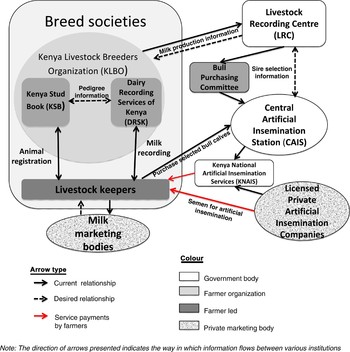
A critical review of the structure and recording system was carried out by Philipsson et al. (Reference Philipsson, Mosi, Mwangi and Rege1988), and another on the support for provision of AI services by Israelsson and Oscarsson (Reference Israelsson and Oscarsson1991). Recommendations from these reports were for the government to strategically support a reduction in the number of organizations supporting recording, and to increase farmer participation in making decisions concerning data collation and feedback mechanisms. However, these were not fully implemented because, after the SAP of 1992, the government withdrew direct management of livestock recording and provision of free support services to farmers. In 1994, the Dairy Recording Services of Kenya (DRSK) was set up by livestock farmers who were running the KSB, with some support from the MLFD, to maintain performance records on animals in the country (Ojango, Reference Ojango2000). The current structure and interrelationships among the organizations supporting livestock recording are illustrated in Figure 1.
Organizations involved in livestock recording and dissemination of improvement in Kenya, and their interrelationships.

All the organizations presented have vital and complementary functions in the implementation of genetic improvement programmes and have the same goal of improving livestock productivity. Detailed information on the characteristics and mandates of the various institutions is available in various publications (Mosi, Reference Mosi1984; MoA, 1998; Omore et al., Reference Omore, Muriuki, Kenyanjui, Owango and Staal1999; Ojango, Reference Ojango2000; Okeyo et al., Reference Okeyo, Kajume, Mosi, Okila, Gathuma, Kiere, Agumbah, Kuria and Chema2000; Mosi and Inyangala, Reference Mosi and Inyangala2003; MLFD, 2004; MLD, 2008). Briefly, the KLBO is an independent farmer organization formed under the auspices of the Agricultural Society of Kenya. It is responsible for the collection, collation and maintenance of livestock pedigree and performance data from farmers, and its subsequent authentication. Under the leadership of the KLBO, livestock breeders in the country organize annual exhibitions, trade fairs and breeding stock sales as a combined effort of all livestock breed societies to promote Kenya's livestock industry nationally and internationally. The KLBO also serves as a lobby organization through which participating farmers engage the various government institutions, and to a small extent the private sector and international institutions, on issues that affect them.
To achieve its objectives, the KLBO operates the KSB under the mandate of various breed societies and the DRSK. The KSB carries out livestock registration, and maintains authentic ancestral and identification registers, with animals classified by breed in different groups, namely foundation, intermediate, appendix and pedigree, depending on the breed standards set by each breed society according to rules inherited from the white settler farmers under the colonial government (Mosi, Reference Mosi1984).
The DRSK carries out all the official milk recording and collation of butterfat test results from farmers who raise animals for milk. From the data collected, individual lactation certificates are produced for milking animals and, for each farm, herd average information on milk production is provided. The data were then available to the Livestock Recording Centre (LRC) whose mandate is to undertake genetic evaluation of the animals and provide feedback to the BPC. Information from the BPC is used to determine which bulls should be retained at the CAIS and which bull-dams should be used in contract mating to produce young bulls.
As a government department, the LRC falls under the Director of Animal Production, in the renamed Ministry of Livestock Development (MLD), with operational funds from the exchequer. Its mandate includes supporting the National Dairy Cattle Breeding Programme objectives through the planning and execution of the progeny testing programme, and contract mating schemes for AI bulls, and support of the services offered by the KLBO. The LRC also provides support for beef recording through maintaining data on growth performance of the Boran cattle, a role undertaken on request from the Boran Breed Society. Pedigree data are, however, maintained by the KSB. The initial design of the breeding programmes and the LRC's operations were developed with support from the German Government. The breeding programme was, however, jeopardized by its complexity and its dependence on separate departments within the MLD. A recent overview of the background and status of AI provision in Kenya is given by Okeyo et al. (in press).
The CAIS, also a government body, operates under the auspices of the Director of Veterinary Services in the MLD, with operational funds from the exchequer. The station is currently exploring options for provision of ex situ conservation (cryopreservation of embryos and gametes) facilities to conserve the country's animal genetic resources (AnGR), and has recently acquired a high-capacity distiller to produce liquid nitrogen for use in the station and also to sell to AI providers in the country (CAIS, 2008). The station has also recently established a high-technology laboratory with the support of the International Atomic Energy Agency, to test pregnancy/infertility in dairy animals as a service to the farmers. Presently, opportunities for decentralization of the CAIS services through establishing satellite bull stations in other regions of the country are being explored.
Linking the CAIS with the farmers is the Kenya National Artificial Insemination Services (KNAIS) (Figure 1), an extension service department of the MLD under the Director of Veterinary Services, set up in the 1960s with support from the Swedish Government to distribute semen from the CAIS to farmers, and provide support services such as the control of ticks and tick borne diseases, particularly the dreaded East Coast Fever (Duncanson, Reference Duncanson1975; Mukisira, Reference Mukisira and Trivedi2002).
Numbers of livestock recorded and the trend since 1995
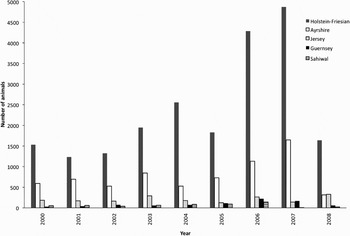
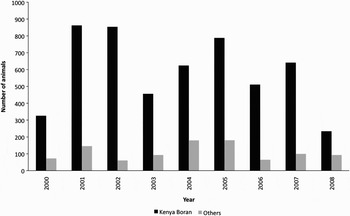
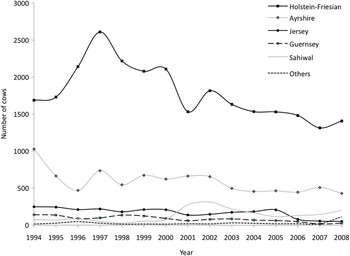
The numbers of animals registered annually by the KSB from 2000 to 2008 are presented in Figures 2 and 3, while numbers of animals with records on milk production by breed at the DRSK are presented in Figure 4.
Number of dairy cattle per breed registered by the KSB (2000–2008).

Number of beef cattle per breed registered by the KSB (2000–2008).

Number of dairy animals per breed with milk records at the DRSK (1990–2008).

Despite the large population of dairy and beef cattle in the country, a very small proportion is registered, and, from 2000 to 2008, there was a decline in registrations for most beef breeds. The EASHZ, indigenous to the country, have records neither in the KSB nor in the DRSK. Differences in numbers of animals registered and recorded for the different breeds illustrate the differences in the existing population structure of the breeds within the country. Reports on livestock raised within the country (Ojango, Reference Ojango2000; MLD, 2008; Muriuki, Reference Muriuki2009) indicate that among the dairy breeds, the Holstein–Friesian is the most popular, while among beef breeds, the Kenya Boran is most popular.
Challenges and opportunities for improved livestock recording in Kenya
The SAP (GOK, 1986) that led to liberalization and cost sharing in provision of services within the livestock sector resulted in great challenges in securing adequate resources, developing strategic interventions for improvement, and drafting supportive policies for the industry. Despite the existence of a large number of institutions to implement livestock recording (Figure 1), numbers of livestock producers registering animals and recording their productivity remains low. Carrying out measurements and recording performance of animals cost time, personnel and other resources.
Identified challenges to the process of recording, including a limited amount of feedback received by livestock producers as pointed out by Philipsson et al. (Reference Philipsson, Mosi, Mwangi and Rege1988), still remain a problem (KLBO, 2008). The perceived benefits from recording by livestock keepers are also few, and little time and resources are allocated for acquiring technical skills related to livestock genetic improvement. The lack of integration between the various services regarding pedigree and performance recording with the AI, genetic evaluation and selection activities (Figure 1) is a serious obstacle for value-added services and feedback to livestock keepers. This has hindered the potential genetic gains that could have been realized had such integration existed.
Improved communication between countries, expanded markets for livestock products and changes in consumer demands on quality of livestock products have resulted in a shift in national perceptions of the importance of livestock recording and its integration with other necessary activities. The livestock keepers in Kenya are beginning to demand better services and structures within the industry. There is also an increased awareness at the government level of the need for information on livestock numbers and productivity at the national level resulting from the process of developing the country reports on the State of the World Animal Genetic Resources in 2007 (FAO, Reference Richkowsky and Pilling2007).
Low numbers of technically skilled individuals in the field of AnGR pose an additional challenge. This is further compounded by national extension services to farmers, which tend to limit their activities to promoting crop production, the treatment of livestock diseases and cross-breeding programmes. In response to this challenge, existing higher education training institutions are increasingly collaborating with the government and the public sector, and are incorporating training skills demanded by the industry within their programmes. Capacity development and strengthening efforts for the sustainable use of AnGR in developing countries need to be supported in order to build critical numbers of specialists to support positive changes (Ojango et al., Reference Ojango, Malmfors, Okeyo and Philipsson2009).
Recording the entire livestock population is an unattainable objective with the large numbers of livestock in the country. However, more livestock keepers need to be mobilized to keep production records in order to obtain a representative number of animals as an information base. Rapid developments and changes in computing facilities and the availability of fast Internet connections provide new opportunities for the KLBO to enhance data collation, communication and feedback to farmers.
Increasing the levels of recording on beef-producing animals poses an even greater challenge as a large number of these animals are reared by pastoral communities in the arid and semi-arid lands (ASALs). Targeted awareness campaigns and the development of extension packages that take into account the peculiarity of these systems by players in both the public and the private sectors are required if any recording is to be carried out among the pastoral communities. The need to produce “safe” animal products free from diseases in order for the country to be able to export livestock and livestock products (GOK, 1994) and the increasing global demand for traceability programmes to be put in place are opportune drivers for the MLD to expand animal identification and recording within the ASALs (Kiptarus, Kamau, and Kimemia, Reference Kiptarus, Kamau and Kimemia2002).
Other challenges include inconsistent legal frameworks, lack of supporting policies to implement livestock recording programmes (FAO, 2005) and political-related changes, especially with regard to relative departmental mandates for the ministries that have been responsible for livestock development over the years. The large number of players (Figure 1) and their “fragmentation” both in terms of service provision, linkages and location further reduce the efficiency of implementing recording within the country. Besides, a strong thrust of propaganda/lobbies to sell semen and live animals (bulls or cows) detracts attention from the pursuance of locally suitable solutions to animal recording and selection in developing countries (Madalena, Reference Madalena and Trivedi2002).
General discussion
Strategies for improvement
Improvement in the productivity of animals could increase incomes of farmers, create employment both on and off farm, and have massive economic spin-offs for other stakeholders. Besides, improved productivity is necessary given the increased pressure on the limited natural resource base on which dairy and beef cattle depend, especially in light of the predicted negative effects of climate change.
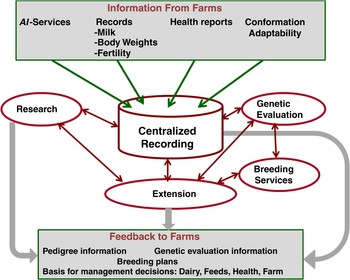
Integrated breeding programmes should be designed with long-term genetic improvement strategies in mind. In such systems, a harmonized decision-making process, where both government and private sector players actively engage the livestock keepers as custodians of the AnGR, needs to be developed. Such programmes should be supported by adequate extension services and an efficient genetic evaluation system incorporating optimal use of pedigree information to keep inbreeding levels under check, while allowing for the desired improvement within the populations. Ideally, the traits of interest identified by the livestock keepers should be objectively assessed. With supportive extension services, breeding goals, selection criteria and practices guided by existing operational conditions would evolve in response to changing market demands, rather than the current blind adoption of standards from other environments that favour different characteristics in animals (Philipsson, Rege and Okeyo, Reference Philipsson, Rege, Okeyo, Ojango, Malmfors and Okeyo2006). Key components for integrating livestock records from various sources, and how these could be used to produce results that are of practical use and benefit to both farmers and policy-makers are presented in Figure 5.
Interactive parts of a livestock breeding programme.

The number of institutions involved in a breeding programme depends on the role of each institution (illustrated in Figure 5), rather than adopting several fragmented organizations as is the case in Figure 1. Deliberate concerted efforts are required to restructure the organizational frameworks for livestock recording in the country.
Production levels and market linkages must be incorporated into the framework when defining the breeding objectives (Kosgey et al., Reference Kosgey, Baker, Udo and van Arendonk2006). It is noteworthy that the apparent success in the Kenyan dairy sector was set many years back through substantial investment and support from the government. A national dairy master plan is currently being developed that will support new initiatives to enhance animal recording.
Little has been done to develop suitable recording procedures for smallholder and pastoral production systems that can generate objective data for use in breed improvement within these systems. Extension to support livestock improvement and infrastructure development involving farmers, extension agents, market agents and various service providers is vital. Simple and standardized recording systems for smallholders and pastoralists need to be developed, tested and validated by extension agents in collaboration with relevant researchers. It is also prudent to learn from successful cases, such as the milk recording systems developed in India for small-scale farmers that were initiated for the genetic improvement of indigenous animals and cross-bred populations (Trivedi, Reference Trivedi and K.R.2002). Improvement could be achieved through the initial use of nucleus breeding schemes, or a young bull programme that uses superior local cows and imported semen from selected sires to produce bulls for national use, with a quick turnover of bulls rather than a complex progeny testing scheme (Philipsson, Rege and Okeyo, Reference Philipsson, Rege, Okeyo, Ojango, Malmfors and Okeyo2006).
Organizational adaptations and resources for sustainable recording
Kenya needs to consider implementing changes in the organizational and institutional frameworks seriously to support livestock recording. Coherence in the design and implementation of genetic improvement programmes, and promoting the value chain linkage are vital. Recording activities need to be linked to breed improvement and other input and market services as part of the integrated value chain. Learning through forums that facilitate information exchange with countries that have developed strong institutions and more flexible recording procedures is critical.
As recording can involve substantial costs and logistics, the system adopted must be simple to understand and implement, reliable and inexpensive. Sustainable recording should depend on the farmers with support from the beneficiaries, including national governments (ICAR, Reference Mäki-Hokkonen, Vares and Zjalic2002, Reference Pauw, Mack and Maki-Hokkonen2004).
Organizations involved in collecting and processing records should be centrally linked to a hub, preferably a neutral institution (e.g. a university or a research institute) with requisite expertise and sustained capacity to analyse data, interpret the findings and provide feedback information immediately for use by the farmers through research and extension activities (as illustrated in Figure 5). In Brazil, for instance, a milk recording programme has been running as an extension activity of an agricultural school (Madalena, Reference Madalena and Trivedi2002). Strong inbuilt feedback mechanisms among all the players are vital for success. At the onset, it is more important to interest the farmers in the recording than to make the scheme self-financing (Lindström, Reference Lindström1976). Options for obtaining additional feedback through international bodies such as the INTERBULL (www.interbull.org), which carries out evaluations of bulls on a global scale, would add value to such a scheme and could boost animal recording.
Mobilization of adequate finances and support services to run a recording scheme is necessary. Funds to support recording could be accumulated through levies on milk and meat sold, but this will only be feasible if sustainable value addition and feedback on desired product qualities by the processing organizations could be incorporated in the design of breed improvement programmes. New measures must be taken by the government, in collaboration with key stakeholders, to enhance the quality of extension services to support livestock production, notably in the context of using information generated on livestock to improve their productivity within different production systems.
Regular evaluation of the programme implemented with a view to monitoring progress is vital. All stakeholders have a critical role to play. Consequently, widespread campaigns to sensitize all players and stakeholders on the importance and benefits of recording in dairy and beef cattle improvement and national development are necessary.
Conclusions and recommendations
Kenya has in place a dairy and beef recording scheme, but, led by the MLD, the country needs to re-evaluate and restructure the existing fragmented institutional framework for livestock genetic improvement. Fewer organizations working collaboratively rather than competitively, with clear mandates and a good understanding of their linkages and synergies, are required. An initial step in this process requires a comprehensive mapping of all the stakeholders and their respective interests.
Recent international regulations on the traceability of livestock products sold within different countries mean that unless Kenya implements a robust animal registration programme, the country will be locked out of markets for its livestock products. Adequate resources must be allocated to support breeding programmes and the inherent animal recording. Resources also need to be allocated to the processing of information from the livestock producers and the provision of feedback that would facilitate change in response to changing market demands for livestock products. For these services to become self-sustaining, initial “external” investments with supportive government policies are necessary. The quality of extension services provided must be improved in order to holistically support livestock production.
The country should also establish regulations to ensure that sires whose semen is made available for use in AI schemes in the country are registered. This will provide national data for comparative performance of sires and could serve as a catalyst to greater involvement of diverse groups of farmers in recording their animal productivity in order to be able to make better selection decisions on AI sires.
Acknowledgements
We wish to thank Egerton University, Njoro, Kenya; the International Livestock Research Institute (ILRI), Nairobi, Kenya; the Swedish University of Agricultural Sciences (SLU), Uppsala, Sweden (as a part of the lecturer exchange programme in the European Erasmus Mundus Masters programme in Animal Breeding and Genetics); and the Kenya Agricultural Research Institute, for provision of facilities and support to undertake the study. The highlights from Mr Christopher K. Chirchir on the organization of dairy and beef cattle recording in Kenya are greatly acknowledged.