Introduction
Mental disorders are a leading cause of morbidity and their prevention/treatment is a priority for population health and primary care (Leahy et al. Reference Leahy, Schaffalitzky, Armstrong, Bury, Cussen-Murphy, Davis, Dooley, Gavin, Keane, Keenan, Latham, Meagher, McGorry, McNicholas, O’Connor, O’Dea, O’Keane, O’Toole, Reilly, Ryan, Sanci, Smyth and Cullen2013). Globally, they account for five of ten leading causes of disability and are associated with adverse health, social and economic outcomes (Murray & Lopez, Reference Murray and Lopez1996). Furthermore, this burden is growing due to their high prevalence (Toft et al. Reference Toft, Fink, Oernboel, Christensen, Frostholm and Olesen2005; Serrano-Blanco et al. Reference Serrano-Blanco, Haro, Palao, Luciano, Pinto-Meza, Luján, Fernández, Roura, Bertsch and Mercader2010), delayed diagnosis/treatment (Roca et al. Reference Roca, Gili, Garcia-Garcia, Salva, Vives, Garcia Campayo and Comas2009) and the high prevalence of associated chronic illness (Gunn et al. Reference Gunn, Ayton, Densley, Pallant, Chondros, Herrman and Dowrick2012).
With most mental disorders managed in this setting, primary care is well placed to address these issues. While ∼50% of mental disorders are recognised in primary care, rates vary considerably. A meta-analysis of detection of depressive illness in primary care found that GPs correctly identified depression in 45% of cases, with detection rates ranging from 6% to 78% across studies and under-detection linked to suboptimal treatment and outcomes (Mitchell et al. Reference Mitchell, Vaze and Rao2009).
In Ireland, mental disorders are a major challenge for primary care (Connolly et al. Reference Connolly, Leahy, Bury, Gavin, McNicholas, Meagher, O'Kelly, Wiehe and Cullen2012; Healy et al. Reference Healy, Naqvi, Meagher, Cullen and Dunne2013; Power et al. Reference Power, O’Connor, Dunne, Finucane, Cullen and Dunne2013). Community-based studies consistently estimate that mental health problems occur in 21–27% of young adults (Lawlor & James, Reference Lawlor and James2000; Sullivan et al. Reference Sullivan, Arensman, Keeley, Corcoran and Perry2004; Martin et al. Reference Martin, Carr, Burke, Carroll and Byrne2006; Cleary et al. Reference Cleary, Nixon and Fitzgerald2007; National Youth Council of Ireland, 2009), 12% of adults aged 18 and over are at risk of psychological distress (Tedstone-Doherty et al. Reference Tedstone-Doherty, Moran, Kartalova-O’Doherty and Walsh2007) and ∼25–33% of people attending primary care have mental health problems (Copty & Whitford, Reference Copty and Whitford2005; Hughes & Byrne, Reference Hughes and Byrne2010). Ireland’s mental health service reforms and especially their intent to deliver ‘more care in the community’ (The Stationery Office, 2006), provide an ideal opportunity to develop services that are more accessible and responsive to the mental health needs of the population, with accurate information on prevalence, and care processes/outcomes a key enabler for reform (Health Information & Quality Authority, 2012).
Internationally, mental health services researchers have looked to electronic medical records (EMRs) to answer questions regarding diagnostic and prescribing patterns (Kramer et al. Reference Kramer, Owen, Cannon, Sloan, Thrush, Williams and Austen2003; Seyfried et al. Reference Seyfried, Hanauer, Nease, Albeiruti, Kavanagh and Kales2009) although the importance of first determining the accuracy of such data when using them for research purposes has been highlighted (Trinh et al. Reference Trinh, Youn, Sousa, Regan, Bedoya, Chang, Fava and Yeung2011). In Ireland, primary care-based health information systems have historically been poorly developed. Although clinical records have been computerised for some time (Meade et al. Reference Meade, Buckley and Boland2009), there is variable standardisation of data collected via diagnostic coding and the infrastructure required for collecting this data remains fragmented (Collins & Janssens, Reference Collins and Janssens2012). With a recognition among regulatory authorities that effective health care services are based on sound evidence and reliable information (Health Information & Quality Authority, 2012), the introduction of mandatory clinical audit as part of competence assurance procedures for GPs and the establishment of a national primary care research network (‘Irish Primary Care Research Network; www.ipcrn.ie’), the environment is now more conducive than ever to the establishment of electronic primary care-based health research information systems in Ireland. In view of their considerable associated health, social and economic costs, data on mental disorders in primary care should be a key component of these systems.
The overarching aims of this study were to examine identification, prevalence and management of mental disorders from EMRs. Specific objectives were
-
∙ to determine the prevalence of documented mental disorders among patients attending general practice and their management in practice;
-
∙ to examine how mental disorders are documented in clinical records;
-
∙ to develop and pilot a study instrument that enables research on mental disorders in general practice.
Method
Overview
A retrospective cross-sectional study of patients attending seven general practices affiliated with the Graduate Entry Medical School at University of Limerick (UL-GEMS) involving clinical records review and extraction of practice level consultation data.
Setting
All GPs who were affiliated with UL-GEMS at the time of the study (n=84) were invited to participate in the study (Cullen et al. Reference Cullen, Burns, Culhane, Davoren and Fahey2012). Practices were eligible to participate if
-
∙ GP principal volunteered to participate in the study;
-
∙ The practice had been using the same practice EMR system consistently for at least the previous 6 months.
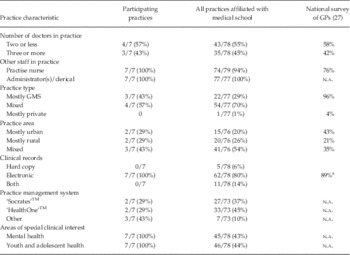
Seven practices indicated their interest in participating and met the eligibility criteria. These participating practices were reflective of those invited and of all GPs in Ireland in terms of practice size, other practice staff, rurality and choice of GP software system (see Table 1; O’Dowd et al. Reference O’Dowd, O’Kelly and O’Kelly2005). Participating practices differed to those invited and GPs nationally in that they were more likely to have a special interest in mental health, to have a patient profile that was mostly GMS-eligible and to use electronic clinical records. We decided to base this study at small number of practices because of their interest in the topic and our experience would indicate it is better to base exploratory work at practices that are conducive to research and that can thus inform methodology (Smith et al. Reference Smith, Ferede and O’Dowd2008; Cullen et al. Reference Cullen, O’Brien, O’Carroll, O’Kelly and Bury2009).
Characteristics of participating practices and comparison with all practices affiliated with medical school and national sample

a A total of 89% ‘used computers in their practice’.
Study population
We searched each practice’s EMR system (database) to identify ‘active’ patients aged 18 years or over and randomly sampled 100 patients from the list using data analysis tools in Microsoft Excel. The EMR of each individual identified by this search was reviewed to exclude those who had not attended the practice in the preceding 24 months.
Data collection
Clinical records were retrospectively reviewed for a 2-year time period from the date of data collection. The study instrument was based on one previously used in morbidity surveys in primary care in Ireland (Cullen et al. Reference Cullen, O’Brien, O’Carroll, O’Kelly and Bury2009) and mental disorders among young adults (Connolly et al. Reference Connolly, Leahy, Bury, Gavin, McNicholas, Meagher, O'Kelly, Wiehe and Cullen2012) and included:
-
∙ Documented mental disorders prevalence and treatment (i.e. referrals, psychological interventions and prescribing) in respect of
-
º Depression, including major depression, low mood, postnatal depression, seasonal affective disorder.
-
º Psychosis, including psychosis, mania, bipolar disorder, schizophrenia, schizoaffective disorder.
-
º Problem alcohol use, including harmful or dependant drinking.
-
º Problem substance use, including drug addiction and use of illicit substances.
-
º Stress/anxiety, including anxiety attacks, generalised anxiety disorder, post-traumatic stress disorder, stress, acute stress reaction, social phobia, obsessive compulsive disorder, panic attacks.
-
º Dementia and related problems, including agitation, behavioural difficulty.
-
-
∙ Socio-demographic characteristics (age, gender, GMS status).
-
∙ Primary/secondary care service utilisation.
A two-stage approach to data collection was adopted. In the first instance, senior medical students on clinical placement at three participating practices collected data in collaboration with the GP principal, supervised by two experienced researchers (A.H., W.C.). To ensure consistency in data collection, issues and problems were reviewed at regular meetings of the research team during this stage and resulted in further development of the study instrument (see Appendix 1). Subsequently, one senior medical student (M.G.) collected data from a further four practices, again in collaboration with the respective GP principal and supervised by two experienced researchers (A.H., W.C.).
Anonymised data were entered to an Excel database by the research team and imported to PASW 18 for statistical analyses. Descriptive analytics were carried out on the key study measures, specifically: psychological morbidity, its treatment, referral to secondary care and other agencies, health service utilisation and how mental and substance use diagnoses were recorded in clinical records. Further statistical analyses included Pearson’s χ 2-test to determine the significance of associations between categorical variables and Student’s t-test to compare means of continuous variables.
Ethical considerations
All data were anonymous, with identifying patient details removed at time of data collection. Data were collected from clinical records by a member of the research team and entered to an electronic database and stored on a password protected computer at the host institution. The researcher involved in data collection was nominated as an agent of each practice and GPs were involved in data collection to ensure that any issues requiring clinical follow up were reviewed by the GP with clinical responsibility for the patient’s ongoing care and to minimise potential bias resulting from coding and interpretation of clinical problems. The study was reviewed and approved by the Irish College of General Practitioners Research Ethics Committee (9 August 2012).
Results
Population characteristics and prevalence of mental disorders
Data were collected on 690 patients attending general practice (mean age 47 years, range 18–95), of whom 355 (52%) were male, 357 (52%) were GMS-eligible (Ireland’s means-tested free general practice system) and 443 (64%) had been referred to or attended secondary care in the past year.
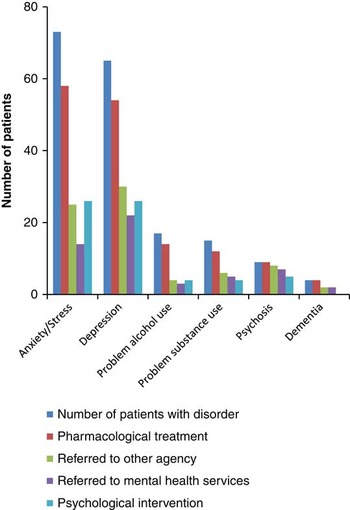
A total of 139 people had a documented mental disorder in the previous 2 years (20% prevalence, 95% confidence interval 17–23%), with 37 (27%) of the 139 patients having two or more disorders, and 88 (63%) consulting more than once with a mental disorder. The most common disorder identified was stress/anxiety (73 cases), followed by depression (65 cases), problem alcohol use (17 cases), problem drug use (15 cases), psychosis (nine cases) and dementia/related problems (four cases).
Treatment of mental disorders
There existed considerable variation in approaches to management for each of the six common disorders. Except in the case of psychosis, psychological interventions were accessed by a minority of patients, for example, 26/73 patients with anxiety, 26/65 patients with depression and 4/17 with problem alcohol use received a psychological intervention (see Fig. 1). In addition, referral rates to other services were low, for example, 25/73 patients with anxiety/stress, 30/65 with depression and 4/17 with problem alcohol use were referred to another agency.
Treatment of mental and substances use disorders.

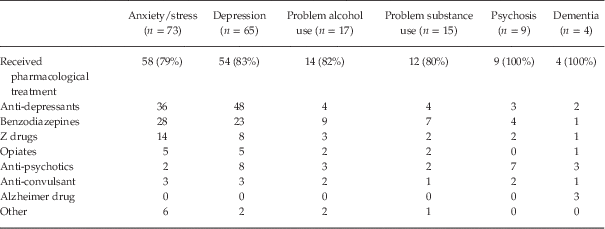
There also existed considerable variation in prescribing practices between disorders (see Table 2). Antidepressants and benzodiazepine were the two categories of drug most commonly prescribed and for stress/anxiety, depression and problem alcohol use, more patients had been prescribed a medication than had received a psychological intervention.
Pharmacological treatment of mental disorders

Health service utilisation and psychological morbidity
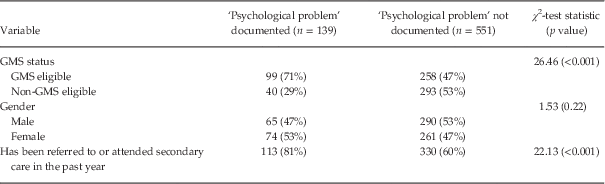
Patients with a mental disorder consulted significantly more frequently in the previous year (mean 7.3 compared with 3.9 consultations, t-statistic 5.8, p<0.001). While they also had significantly more GP consultations (mean 6.7 compared with 2.9, t-statistic 7.7, p<0.001), there was no significant difference in practice nurse consultation rates (mean 1.2 compared with 0.9, t-statistic 1.0, p=0.30). Patients with a disorder were significantly more likely to be GMS-eligible and to have been referred to or attended secondary care in the past year (see Table 3).
Key population, general practice/health service utilisation and morbidity data and their association with a documented psychological issue

Diagnosis, coding and feasibility
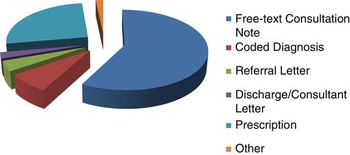
Of the diagnoses (n=119) examined to determine how mental disorders were documented, 69 (58%) were identified from free text consultation notes in the electronic clinical records, 31 (26%) were identified from prescribing records, nine (8%) were identified from a diagnostic code, five (4%) were identified from a referral letter, three (3%) were identified from a hospital discharge letter and two were identified through other means (see Fig. 2).
How were mental and substances use disorders identified in clinical records?

Discussion
Key findings
This first study to examine mental disorders and their management in routine general practice in Ireland highlights that documented mental disorders (especially stress/anxiety, depression and problem alcohol use) are common (20% prevalence) and associated with increased GP consultations, referrals to and attendance at secondary care. While the proportion referred to other agencies or who received psychological interventions for mental disorders was low, antidepressants and benzodiazepines were commonly prescribed. The research also highlights the limitations of EMRs (especially diagnostic coding) in identifying patients with psychological morbidity; reliance on diagnostic coding alone would have failed to identify 92% of cases.
How this relates to other research
That 20% of patients had a documented mental disorder is consistent with other work involving administrative data, which estimated 19% of patients attending GPs in Canada did so for the care of mental health issues (Palin et al. Reference Palin, Goldner, Koehoorn and Hertzman2012). However, our estimate is considerably lower than that reported in studies, which involved standardised screening measures. A review of such studies estimated 29% of patients attending general practice had a mental disorder (King et al. Reference King, Nazareth, Levy, Walker, Morris, Weich, Bellón-Saameño, Moreno, S̆vab and Rotar2008). Depression and stress/anxiety were the most commonly identified issues in this study and these findings were consistent with work in other settings (Linzer et al. Reference Linzer, Spitzer, Kroenke, Williams, Hahn, Brody and deGruy1996; Ansseau et al. Reference Ansseau, Dierick, Buntinkx, Cnockaert, De Smedt, Van Den Haute and Vander Mijnsbrugge2004; Broers et al. Reference Broers, Hodgetts, Batić-Mujanović, Petrović, Hasanagić and Godwin2006).
That only 3% were identified to have problem alcohol use is a concern. Primary care is the first point of contact for patients with problem alcohol use and clinical encounters should involve routine discussion of alcohol use (Kaner et al. Reference Kaner, Bland, Cassidy, Coulton, Deluca, Drummond, Gilvarry, Godfrey, Heather and Myles2009). Problem alcohol use is also common among patients attending general practice. A recently published pragmatic trial of screening for problem alcohol use in primary care reported that 900/2991 (30%) screened positive for hazardous or harmful drinking, 10 times higher than we observed (Kaner et al. Reference Kaner, Bland, Cassidy, Coulton, Dale, Deluca, Gilvarry, Godfrey, Heather, Myles, Newbury-Birch, Oyefeso, Parrott, Perryman, Phillips, Shepherd and Drummond2013).
The increased health service utilisation we observed among patients with a disorder is also consistent with other research, which may reflect an increased tendency towards undiagnosed coexisting somatoform disorders and chronic medical illnesses among patients with mental disorders (Gunn et al. Reference Gunn, Ayton, Densley, Pallant, Chondros, Herrman and Dowrick2012; Bener et al. Reference Bener, Al-Kazaz, Ftouni, Al-Harthy and Dafeeah2013).
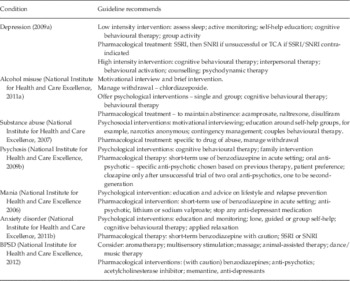
Especially for the more common problems, our findings suggest sub-optimal access to psychological interventions and over-reliance on pharmacotherapy, especially antidepressants and benzodiazepines; treatment approaches at odds with current treatment guidelines (see Table 4; National Institute for Health and Care Excellence, 2006, 2007, 2009a , 2009b , 2011a , 2011b , 2012). These findings concur with Rogers et al. whose review of referrals from primary care highlights ‘a gap between best evidence and real world practice in the care of patients with depression [and suggests that] access to psychological services should be improved and made available in primary care networks’ (Rogers et al. Reference Rogers, Heatherington, Carroll, Leonard, Cullen and Meagher2013).
Summary of NICE/Royal College of Psychiatrists Clinical Guidelines in respect of common mental disorders

SSRI, selective serotonin reuptake inhibitor; SNRI, serotonin-norepinephrine reuptake inhibitor; TCA, tricyclic antidepressants; BPSD, behavioural and psychological symptoms of dementia.
Methodological considerations
Validity of the data reported in this paper is enhanced by the practices in which it was conducted (a special interest in the topic and with advanced practice information systems) and the method of data collection (data collected by a senior medical student working with the GP principal and a study instrument developed to minimise variation between researchers, which has been used previously in studies of psychological morbidity in Irish general practice). However, these practice features mean they are unlikely to be representative; thus, the possibility of ascertainment bias cannot be discounted. The study’s retrospective nature, dependency upon prior documentation of issues within consultation notes and our interpretation of these records is likely to have underestimated true period prevalence.
While our study instrument was informed by similar instruments used in previously conducted work in primary care in Ireland, it did not identify patients with some mental disorders, most notably somatoform disorders. Finally, as our data reflects all patients who were documented as ‘active patients’, it neither reported the proportion of patients on the practice databases who were ‘inactive’ nor the prevalence of mental disorders among this population.
While our findings highlight the value of EMRs for research purposes, some important limitations should be noted. In particular, reliance on diagnostic coding alone would have failed to identify 92% of patients with a disorder. The reasons why GPs do not code are complex and include inherent limitations of coding systems, the time/distraction involved in recording structured data in the consultation and the priority given to coding by a practice or health system (de Lusignan, Reference De Lusignan2005). Meanwhile, financial incentives and clinical audit as part of target-setting and quality/competence assurance may drive its adoption in practice (de Lusignan, Reference De Lusignan2005; Collins, Reference Collins2012; de Jong et al. Reference De Jong, Visser and Wieringa-de Waard2013). de Lusignan et al. (Reference De Lusignan, Metsemakers, Houwink, Gunnarsdottir and van der Lei2006) highlight the importance of contextual issues such as these in interpreting the validity of findings based on routinely collected clinical data.
This is especially important in the case of mental disorders. In this study, EMRs did not use standardised diagnostic screening tools. Thus, it is difficult to say with certainty whether all of the recorded diagnoses would meet the respective ICD-10 or DSM-5 criteria. Many diagnoses were documented as part of a consultation that involved a number of issues, which inevitably makes the use of formal approaches to screening difficult, thereby impacting on identification. Making a psychological diagnosis in general practice tends to be a longitudinal process following a number of visits; while GPs recognise the possibility of psychiatric diagnosis early on, they are ‘cautious about applying a definitive diagnosis’, wishing first to rule out any physical co-morbidities (Lampe et al. Reference Lampe, Shadbolt, Starcevic, Boyce, Brakoulias, Hitching, Viswasam, Walter and Malhi2012). Similarly, a systematic review into the diagnostic process regarding depression in general practice found that diagnostic strategies tended to rely on knowledge of patient history, the doctor–patient relationship and eliminating the possibility of physical disease rather than rigidly sticking to psychiatric diagnostic criteria (Schumann et al. Reference Schumann, Schneider, Kantert, Lowe and Linde2012).
Implications for clinical practice, research and education
This study highlights a need for further research on the epidemiology and management of mental disorders in general practice and the ‘gap between best evidence and real world practice’ especially access to psychological interventions (Rogers et al. Reference Rogers, Heatherington, Carroll, Leonard, Cullen and Meagher2013). Larger studies involving a more representative sample of practices would make for more generalisable findings, while longitudinal research would both determine the natural history of these common problems in practice and determine the effectiveness of Ireland’s mental health service reforms and especially their intent to deliver ‘more care in the community’ (The Stationery Office, 2006; Health Forum Steering Group, 2008; Oireachtas, 2011; Health Service Executive, 2012b ). This study highlights the potential importance of more formal approaches to diagnosis and disease coding within EMRs. Developing and evaluating interventions that systematically enable both, yet which do not impact on the interaction between doctor and patient, which is key to the psychological narrative (Lampe et al. Reference Lampe, Shadbolt, Starcevic, Boyce, Brakoulias, Hitching, Viswasam, Walter and Malhi2012; Schumann et al. Reference Schumann, Schneider, Kantert, Lowe and Linde2012), is a priority.
Acknowledgements
The authors thank the GPs and practice staff for their assistance with this study and the University of Limerick Research Incentives Programme and Graduate-Entry Medical School (Strategic Research Fund) who funded this study.
Appendix 1
Study instrument used in data collection
1. Demography
1.1. Gender Male Female
1.2. Age last birthday _____________
1.3. Health cover GMS Non-GMS
2. Psychological Morbidity
2.1. Has a psychological problem been documented in the last two years? Yes / No
2.2. On how many occasions? __________
2.3. Which psychological problems have been documented in this time?
2.4. What pharmacological treatments have been prescribed in the last two years?
3. Primary / Secondary Care service utilisation
3.1. Number of consultations (including antenatal) with the practice (past year): _____
3.2. Has been referred to or attended secondary care (including emergency departments) in the last 2 years? Yes No
3.3. How was diagnosis identified?
Free text in consultation note / diagnostic code in active problem / diagnostic code in past history / referral letter / other (specify)