Introduction
All hours of the twenty-four are alike to Orientals,
and their passenger traffic is regulated accordingly. Footnote 1
In 1919, a shopkeeper from Gujranwala who had been accused of ‘waging war’ against the British imperial state, defended himself with an alibi based on railway timetables. Under section 121 of the Indian Penal Code regulating offences against the state, Jagannath was charged with fomenting agitation in Gujranwala on 12 and 13 April 1919.Footnote 2 Offering railway timetables as his alibi, Jagannath argued that it was physically impossible for him to have done so. He explained that he had left Gujranwala for Kathiawar on 12 April by the five p.m. train; producing witnesses to corroborate his presence in Dhoraji on 16 April, he argued that since it took 44 hours to reach Dhoraji from Delhi by the fastest train, it was impossible for him to have been in Gujranwala after 6 p.m. on 13 April. The court permitted him to summon witnesses to prove his alibi, but actually pronounced judgment without waiting for them. ‘Jagannath's Case’ became somewhat of an albatross around the imperial neck, particularly when Mohandas Gandhi—the Indian nationalist himself trained as a lawyer—spoke out against this ‘miscarriage of justice’, insisting that railway timetables ‘completely established’ Jagannath's alibi.Footnote 3
The use of railway timetables as a legal defence by Jagannath—‘a man of humble position and status’—points to how the introduction of railways as a popular mode of travel in the mid-nineteenth century affected everyday life in colonial India. The imperative of adapting to this dramatic technological change was certainly not specific to colonized populations. In the nineteenth century railways were viewed globally as heralding progression to the modern, both as transport technology and historical stage.Footnote 4 However, in colonial India (and colonial contexts more broadly), the imperial state perceived the intended effect of railway transport and travel rather specifically: as a speedy mechanism to literally transport temporally backward societies into a normative historical modern. According to an imperial official writing in 1846, railways were that ‘mighty engine of improvement’ which would ‘cause the slumbering spirit of India to awake from the sleep of ages, the sleep of apathy, superstition, and prejudice’.Footnote 5
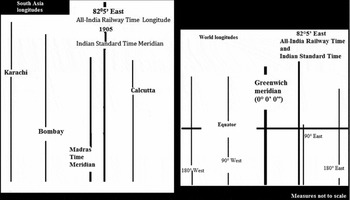
The temporal emphasis of such anticipation was heightened in the process of developing a standardized railway time for scheduling and coordinating India's railway network.Footnote 6 In 1905—a half century after the first passenger train ran in India (1853) and 14 years before Jagannath's trial (1919)—the imperial government completed the process of standardizing railway time in British India. Set five hours and thirty minutes ahead of the time of the Greenwich meridian in England (0° 0’ 0”), this all-India railway time—continuing even today as Indian Standard Time (IST)—was intended as more than a technical mechanism for coordinating the safe movement of India's railways. Instead, the imperial state expected it to provide a uniform time for India and, by linking it mathematically with Greenwich time, to make the colony temporally modern and rational.
By tracing the process and effects of temporal restructuring engendered by railways, this paper examines how railways and railway travel affected practices, sensibilities, and relationships in colonial India. It probes not only how societies grapple in everyday life with vast technological transformations, but also how colonized populations have navigated the administrative intervention of imperialist states. Given that the annual number of railway passengers in 1905 was about 250 million, remarkable numbers were affected by the ensuing changes.Footnote 7 In addition to those regularly encountering train schedules and railway timetables, the eventual institution of railway time as civil and national time in colonial India further broadened the purview of everyday negotiations of standardization.
Substantial scholarship on the relationship between railways and colonial India, particularly the seminal work of economist Daniel Thorner in the 1950s and historian Ian Kerr in the 1990s, has substantively focused on how the financing and building of railways affected capital and labour relations, industrial production, and market integration in India.Footnote 8 Though brief, the investigation of a developing colonial travelling public in work by Manu Goswami (2004) and Laura Bear (2007) is critical in two recent attempts to understand how the ‘unprecedented circulation of people’ engendered by railways affected identity and community in India.Footnote 9 Thus, chapter three of Goswami's study of the spatial production of India as a national entity argues for railways as state spaces of ‘mobile incarceration’, while Bear explores the ‘intimate historical self’ of India's premier railway ‘caste.’ Related is Ian Kerr's more recent analysis of how railways in India have been represented in textual, aural and visual media, a topic extensively explored by Marian Aguiar (2010).Footnote 10 The range of new ‘departures’ is collated in a 2007 volume edited by Kerr, entitled 27 Down.Footnote 11
This paper begins by examining how assumptions about time and time-reckoning informed both discussion and policy about standardizing railway time in colonial India, and traces the official process between 1854 and 1905 through which this temporal restructuring was instituted. It then explores how, during the colonial period, Indians grappled in practice with railway temporality, both as speedy transport and as railway time. It argues that imperial policy structured the standardization of railway time around notions of colonial difference, articulated through reified ideas of colonial (and metropolitan) time-sense. However, the ways in which such changes were actually accepted, contested, and appropriated shows remarkable parallels across binaries of colonizer and colonized. The multiplicity of responses is not surprising in itself given the constantly increasing size of the colonial travelling public and the intimate relationship between railway and civil time. However, the breadth and heterogeneity of reactions and negotiations is materially indispensable in critiquing presumptions that decreed a civilizational hierarchy of responses to temporal standardization. Consequently, these responses are crucial in reclaiming the historical modern as a time occupied contemporaneously by colonizer and colonized.
1854–1905: standardizing time in colonial India
Without coordinated times, cities, towns, and villages functioned on their own times,
marking an individuality that remained unimportant before the railroad. Footnote 12
In the nineteenth century, the question of ‘railroad time’ generated extensive discussion globally. E. P. Thompson's classic work on the relationship between work-discipline and industrial capitalism demonstrates that clock-time was already widely in use.Footnote 13 However, it was the demands of coordinating railway transport that effectively spurred the spread of standardized time.Footnote 14 The half-century between 1854 and 1905 was rife with discussions about standardizing railway time in India. This involved (i) replacing local time with that of the presidency/province served by a particular railway system; (ii) replacing presidency/province time with an all-India time; and (iii) ensuring that this all-India time was mathematically related to that of an internationally accepted base meridian at Greenwich.Footnote 15 Although generated by railway companies concerned with technical co-ordination and safety at junction points, these discussions also involved administrators at local and national levels, most notably civil servants in the public works department. They demonstrate not only a deep reliance on imperial imaginings of a reified and singular Indian temporality, even among technical men and administrators, but also—and frequently despite conflicting policy positions—the remarkable stability of such reified understandings.
Time and distance
In colonial India, these discussions about standardization were integrally premised on an idea of colonized spaces and people being temporally distant from the historical present. This distancing is effectively captured by Johannes Fabian's notion of allochronism, which he describes as a ‘conjuring trick’ that separates in historical time those who actually exist in shared time.Footnote 16 His understanding of it as ‘a persistent and systematic tendency to place the referent(s) of anthropology in a Time other than the present of the producer of anthropological discourse’ is morphologically similar to how a teleological rendering of temporality was used to understand the historical role of railways in colonial India—and to underpin the process of standardizing time here. This temporal distancing of colonized populations was argued through defining a singular Indian sense of time, characterized as pre-modern, which was then juxtaposed against a normative idea of modern, which excluded the colonized from their own present.Footnote 17 In the colony, modernity thus became a world of ‘co-existent yet non-contemporary beings’.Footnote 18
This characterization of colonial temporality was not new to the mid-nineteenth century when discussions about standardized railway time began to take place. Romila Thapar has traced how eighteenth-century Indologists, who were unable to cross-reference Biblical and Classical information with Indian texts, deemed time-sense in India as cyclical and, consequently, incapable of comprehending historical change, arguing that cyclicality prevented any event from being unique.Footnote 19 This cyclical and mythic pre-modern Indian time-sense was then juxtaposed against a reified idea of a modern metropolitan time-sense, described as linear and historical: capable of emphasizing the uniqueness of particular events, whilst making them non-recurring. Indological scholarship thus used temporal distancing devices (cyclical, repetitive) and adjectives (mythical) to distance in time societies and people who actually existed contemporaneously in the present.Footnote 20 Of immediate relevance here is not the palpable ahistoricity of such reification—which misrepresented temporality in both colony and metropoleFootnote 21—but how deeply these influenced official discussion and policy decisions about standardizing time in colonial India.
Synchronizing the colony
Almost as soon as passenger trains began running in India, official discussion about the time ‘to be observed generally on Indian railways’ was initiated by Colonel Baker, the government's consulting engineer for railways. In 1854, when railway mileage in India stood at 35 miles in Bombay presidency (with 121 miles in Bengal presidency being added in 1855), he argued that India's vastness necessitated that local mean time be kept at each station on Indian railways.Footnote 22 Presidency officials in Madras and Bombay agreed with him, However, they argued the case not by emphasizing that rail mileage remained limited and in discrete pockets at this juncture but instead by juxtaposing time-sense in India and England.Footnote 23 Colonel Pears thus stated that while in England the need for standardization derived weight from the number and influence of men of business—for whom ‘it was very important that there should be no mistake about time’—yet in India, it would ‘be very long before the mass of people could be made to understand a railway time’.Footnote 24
Dissatisfied with governmental support for local mean time, the East India Railway argued for a standardized railway time by inverting the argument about India's vastness: its traffic-manager believed that India's size made it impossible to ‘construc[t] an intelligible Time Bill, without the establishment of some universal’.Footnote 25 J. C. Batchelor went as far as to determine the time ‘by which all Railway Station clocks may be regulated from the 15th October next’.Footnote 26 The Government of India declined this request, deciding that stations on the East India Railway would follow presidency time—that of its capital, Calcutta—up to the ‘extreme limit of local Bengal supervision’, continuing with Allahabad time from there to Delhi.Footnote 27 However, this move from local to presidency time was instituted unwittingly. The Secretary of State for India in London belatedly informed the Indian administration that their decision—instituting Calcutta time as railway time on East India Railway stations in Bengal—contravened their 1854 decision supporting local mean time.Footnote 28 While admitting this error, the Government of India decided to stay with the 1864 decision: by now, the East India Railway had worked for nearly a year up to Allahabad with Calcutta time, and from Allahabad to Delhi with Allahabad time.Footnote 29 However, Cecil Stephenson, the East India Railway's deputy agent challenged the government's orders by insisting that an all-India railway time was necessary for guards and pointsmen to ensure passenger safety.Footnote 30
The Bengal government disagreed with Stephenson and argued that an all-India railway time would militate ‘against the interests of the public of the large centres of business’, such as Calcutta and Bombay, ‘entitled to the greatest consideration’.Footnote 31 The East India Railway's chairman countered this argument by alleging that a failure to standardize an all-India railway time meant that the government was neglecting passenger safety.Footnote 32 The request focused on standardization on the East India Railway, but between 1855 and 1867, railway mileage in Bengal had burgeoned and the East India Railway had also spread westwards out of the presidency.Footnote 33 However, when Bengal's Deputy Consulting Engineer chose to support the East India Railway's request and suggested that the local time of Madras (Madras time) be accepted as ‘the Railway standard in India as London time is in England’,Footnote 34 its Lieutenant-Governor disagreed: in his opinion, the institution of Madras time or that of ‘any other foreign city’ would be unacceptable to the public’.Footnote 35 Though it had already instituted Madras time as an all-India telegraph time, the government rejected it as an all-India railway time in 1867.Footnote 36
Longitudes and Time Meridians

Across the globe, spatially specific local time was the ‘only valid standard’ till about the mid-nineteenth century.Footnote 37 Any form of temporal standardization—be it railway, national, or Greenwich time—required that local time be substituted with supra-local time, capable of being divided into commensurable units. In contrast to local time, supra-local time thus broke the link between time and place, a process that Wolfgang Schivelbusch describes as a loss of temporal identity for regions whose local time was replaced.Footnote 38 Furthermore, whilst supra-local time was theoretically inter-subjective, it actually privileged a specific location whose local time was selected as the standard.Footnote 39 Thus, temporal standardization was challenged in various contexts across the globe, ‘particularly by communities whose local times differed substantially from the standards they were to adopt’.Footnote 40 Despite Greenwich time being suggested as England's standard in 1847, railroad time was not accepted ‘as anything but schedule time until much later in the [nineteenth] century’. There was also ‘considerable psychological and social resistance’ in Scotland, Ireland and the west of England to standardization by those anxious to ‘preserve the hour of their locality’.Footnote 41
Given India's breadth, challenges to temporal standardization by those whose local time varied substantially from the standard would have been expected and congruent with reactions across the globe. However, possible equivocation about this new temporal ordering in the colony was read normatively. The imperial presumption of a singular Indian time-sense engendered the conclusion that a colonized population would be unequivocally hostile to temporal standardization. This perhaps explains the responses that imperial functionaries anticipated of the colonial population. While Colonel Pears had argued in 1854 that the need for standardization in England derived weight from the number and influence of the men of business, in India it was the public of the large centres of business such as Calcutta and Bombay who were presumed to be unwilling to accept any but local time.Footnote 42 The government's invocation in 1867 of native prejudice sounded fundamentally similar to Colonel Pears’ 1854 suggestion that in India it would be ‘very long before people could be made to understand railway time’. The fact that annual passenger traffic had increased almost 2,500 per cent—from 0.5 to 13.8 million—between 1854 and 1867 did not substantially affect the argument of the colony as a site of difference.Footnote 43 It could, perhaps, explain why the same government that standardized time on the telegraph system was more hesitant to introduce it on the railways: the former being dominantly an official instrument arguably posed less threat of affecting ‘public’ opinion or ‘native prejudice’.Footnote 44 Finally, in 1870, Madras time—‘now used by the telegraph and regulated from the only government observatory’—was suggested as a standard railway time, first to be adopted on the Great Indian Peninsular Railway.Footnote 45 It was also advocated as civil time. However, when the change was made, Calcutta, Bombay and Karachi—perhaps because they remained commercially, financially, and administratively critical to a post-Rebellion imperial state obsessed with stability—were to be permitted to continue with their local time(s) for civil purposes.Footnote 46
Rationalizing the colony
After the establishment of an all-India railway time, the next step was to link this mathematically with a meridian accepted as an international base. This impetus became part of wider discussions about selecting ‘a prime meridian and a single, universal time for the whole world’.Footnote 47 The India Office in London forwarded to the Government of India suggestions made by Sanford Fleming, a Canadian railway engineer who was advocating—as had the 1884 Washington Conference—a prime meridian corresponding with the time of the Greenwich meridian in England.Footnote 48 However, this choice of zero longitude was far from uncontested. France held out against Greenwich, and even the establishment in 1911 of Paris Mean Time—described by David Landes as ‘nothing other than Greenwich Mean Time, without the word “Greenwich”’—was seen as instrumental to ‘salving’ national susceptibilities.Footnote 49 Similarly, the General Time Convention in north America hotly debated the choice of Greenwich in the selection of a national meridian for time purposes. Many emphasized that ‘there was no reason to base a time system for rail operations in America on the location of an English observatory’, with a particularly pithy riposte from the scientist Simon Newcombe: ‘See no more reason for considering Europe in the matter than for considering the inhabitants of the planet Mars’.Footnote 50
The Government of India was not immediately amenable to the idea of displacing Madras time but did not fundamentally question the choice of Greenwich as base meridian. Instead, it emphasized that there seemed ‘no advantage in exchanging our present standard of Madras time’, especially if it was to be replaced by time-zones regulated by meridians ‘which pass through no important places’. Instead, there would be ‘time enough’ to effect these changes, ‘when India's neighbours and the chief countries of Europe do so’.Footnote 51 However, the Committee of the Royal Society insisted that in view of the ‘doubt which attends all statements of time in the great majority of cases in India’, it was imperative to change railway time in India from Madras time to that of a longitude exactly five hours and thirty minutes east of Greenwich. The subtraction of five hours, twenty-one minutes and ten seconds required to translate events from Madras to Greenwich time was used to argue India's temporal irrationality, compared with countries where the calculation involved whole hours.Footnote 52 Even as the Royal Scottish Geographical Society expressed the hope that ‘all British stations will adopt the nearest hour to Greenwich time as their standard’,Footnote 53 an official in the Government of India wrote that ‘when the time for change arrives the experience of other countries will be available as a guide to the ultimate decision’.Footnote 54
Early in the twentieth century, the imperial government finally circulated to railway companies their proposal for the colony to ‘fall into line with the rest of the civilized world’.Footnote 55 Some, like the Great Indian Peninsular Railway, objected—its agent in Bombay stressing the ‘considerable inconvenience’ that would result from upsetting ‘the present standard adopted in India to which our business men of all nationalities are wedded by long usage’.Footnote 56 However, most other railway companies viewed this change as ‘desirable,’ resulting in a favourable ‘consensus of opinion’.Footnote 57 The Government of India consequently declared that it had decided to adopt on railways ‘a standard time which in India will be exactly 5½ hours in advance of Greenwich and 9 minutes in advance of Madras time’, the change to be introduced ‘at midnight between the 30th June and the 1st July 1905’.Footnote 58 This new all-India railway time—of a meridian roughly two degrees east of Madras—continues to be Indian Standard Time.
Negotiating with time
The. . .cyclical and the linear. . .penetrate one another,
but in an interminable struggle; sometimes disruption. Footnote 59
Implementing the changes instituted between 1854 and 1905—from local mean time to presidency time, the institution of Madras time as railway time, and the 1905 establishment of a standard railway time linked ‘rationally’ with Greenwich—was a gradual process. Furthermore, the adoption of railway time as civil time was an even more vexed issue. Three decades after Madras time had been decreed railway and civil time in British India—with only Bombay, Calcutta, and Karachi being allowed to continue with their local time for civil purposes—the General Manager of the Darjeeling Railway could be found complaining of the confusion caused by there being ‘railway time and telegraph office time, cutchery [court] time, bazar time and also church time’ in a small town like Darjeeling.Footnote 60 However, given the continually increasing numbers of railway passengers in India, millions had to gradually negotiate not only train schedules and railway timetables on a regular basis, but also the larger structure of temporal re-organization that underpinned railway time. This section explores the discrepant and multiple ways in which a colonized population grappled with the temporal changes engendered through railways, both as swift transport and standardized time: how it affected their everyday lives, how they adapted to it, and to return to Jagannath's alibi, how they appropriated and deployed it.
Time as narrative
The coming of the railway itself performed a temporal function by demarcating historical time. There is brief yet explicit intimation of this in Indira (1873), a novel penned by a leading figure of the Bengal intelligentsia, Bankimchandra Chattopadhya. The story opens with the narrator-protagonist Indira lamenting that she could not take up her position as wife: her wealthy father believed that his son-in-law had not earned enough money to support his daughter. To rectify this, Indira's mortified husband resolved to ‘travel to the west’. ‘There was then no railway’, states Indira, and ‘the way to the west was very difficult’.Footnote 61 Her husband travelled on foot and ‘was long on the way’ till he ‘finally reached the Punjab’. ‘He who could do this’, she concludes emphatically, ‘could also make money’.Footnote 62 This opening reference is startling in a novel in which railway travel does not really figure. Even Calcutta, linked in a functioning railway network, is approached by boat.Footnote 63 Bankim thus seems to be deploying railways for temporal orientation—born in 1838, his adult life would have been co-terminus with the spread of railways in Bengal, orienting his sense of historical time around railways.
The slowness and arduousness ascribed to the pre-railway journey confirms that this orientation is not merely descriptive: Indira contends that if her husband could travel on foot, he would not be daunted by the task of making money. Bankim seems to have both understood and endorsed the temporal acceleration generated by railways. In the monthly he edited and published in the 1870s, he wrote:
Look at the railways, and the engines, which surpassing a hundred thousand of the horses of Indra in strength, make a month's journey in a day. . . . Your father, who lives in Benaras, has this morning fallen fatally ill. . .and by night you sit at his feet and care for him.Footnote 64
Bankim is unequivocally enthusiastic about temporal shrinkage, or the dramatic compression of travel time engendered by railways.Footnote 65 He exhibits no apprehension, such as is visible, for instance, in the German poet Heinrich Heine's characterization of railway travel from Paris to Germany as ‘a terrible idea’.Footnote 66 The increased tempo of movement suffocated Heine; imagining the impending completion of railway links, he felt ‘the mountains and forests of all countries advancing on Paris’.Footnote 67
Given Meenakshi Mukerjee's understanding of Indira as part of the third strand of the nineteenth-century novel in India, one that ‘attempted to render contemporary Indian society realistically in fiction’, Bankim's enthusiasm records at least one sense of the response and possibility engendered by the speed of railways.Footnote 68 Crucial here is Partha Chatterjee's identification of Bankim as (anti-colonial) nationalist thought's moment of departure: embodying the related assertions that ‘the superiority of the West lies in the materiality of its culture, exemplified by its science, technology and love of progress’ and that ‘[t]rue modernity for the non-European nations would lie in combining the superior material qualities of Western cultures with the spiritual greatness of the East’.Footnote 69 When juxtaposed against Heine's anxieties, the reaction of this colonial elite—small but politically influential in the late nineteenth century—thus inverts the imperial structure of colonial time-lag, the ‘first in Europe and then elsewhere’ rendering of temporality as described by Dipesh Chakrabarty.Footnote 70
Multiple narratives were generated amongst the colonized when faced with the compression of time engendered by railways. In Intizar Husain's ‘Kataa Huaa Dabba’ (‘A Stranded Railroad Car’, 1954), the elderly Mirza Sahib expresses his preference for travel prior to railways. For him, the speed of railways had robbed travel of enjoyment. On a train, he stated:
You blink your eye and you've arrived at your destination. But there was a time when kingdoms fell and governments toppled by the time you reached where you were going; and the toddlers you'd left crawling on all fours—you returned to find them fathers worrying their heads over a suitable match for their marriageable daughters. Footnote 71
Whereas Indira had invoked the rigours of pre-railway travel, Mirza Sahib invoked a romantic idea of it. For him, ‘real’ journeys were those before railways, when it took ‘ages to pass a single night’ of travel. One travelled ‘hundreds and hundreds of miles, back and forth, with the end nowhere in sight and all traces of the starting point irretrievably obscured’. He thought back with excitement at the ‘fear of tigers, of snake-bites, of highwaymen and yes, of ghosts too’. One travelled ‘by the dim star-lit sky overhead and the burning torches below’.Footnote 72 The speed of railways had destroyed this rich sensory tableau: now that ‘the train is in fashion’, concluded Mirza Sahib, ‘I just don't feel like travelling anymore’.Footnote 73
Bankim had been exhilarated by the speed of railways and the possibilities created by compression of travel time; Mirza Sahib's melancholia is an eulogy for a past whose experiential depth was effaced by the speed of the new technology, a sentiment strikingly homologous to the nineteenth-century English naturalist John Ruskin's lament about ‘all travelling becoming dull in exact proportion to its rapidity’.Footnote 74 Schivelbusch's argument about the aesthetic freedom of the pre-industrial subject being ‘discovered at the very moment when pre-industrial methods of production and transportation seemed threatened by mechanization’, is certainly relevant here.Footnote 75 However, even if romanticized, Mirza Sahib's reaction demonstrates the heterogeneous responses to temporal shrinkage amongst the colonized.
While annihilating space by shrinking transport time, railways simultaneously expanded space by incorporating new—previously remote—areas into the transport network. From 35 miles open for passenger traffic in 1854, railway mileage jumped to 2,581 miles by 1864, was 19,466 miles by 1895 and stood at 32,090 miles in 1910.Footnote 76 Thus, railway travel both diminished and increased travelling time. Railways allowed one to reach a destination faster, but as rail mileage expanded, so did the time spent travelling. A potent example of the expansion of travel time, even as railways compressed distance, is found in the prodigious writings of the nationalist leader Mohandas Gandhi during many hours of train travel. Gandhi's substantial Collected Works bear witness to the extent of writing (and dictating) that he did whilst travelling, hardly surprising when, to quote him, there were times when ‘out of a month almost fifteen nights were spent on trains’.Footnote 77 In fact, stringing together the pieces written by Gandhi as he travelled exhaustively by train is tantamount to tracing a textual itinerary of nationalist politics in India.Footnote 78 Gandhi's actual use of travel time—especially when juxtaposed against his unequivocal critique of railway technology in Hind Swaraj (1909)—lends itself to the idea of consumption as a series of creative and transgressive acts that dispute and fragment the authorized text, and create in it ‘something un-known’ to the producer.Footnote 79 The political valence of such transgressive consumption is only heightened if one reads his travels against assertions like ‘A native. . .cares little for his time’.Footnote 80
Being ahead of and behind time
The temporal re-structuring engendered by railways was most visibly manifested in timetables: train schedules directly oriented everyday life towards the changes instituted. Early railway timetables were based on the 12-hour diurnal system, using ante-meridian (a.m.) and post-meridian (p.m.) notations.Footnote 81 By the time the Canadian engineer Sanford Fleming penned his 1889 memorandum suggesting that the twenty-four-hour notation be adopted on railway timetables globally, the practice seems to have been in use on railways in India and Burma.Footnote 82 In Fleming's view, counting the hours from midnight to midnight (numbered from zero to twenty-four) was necessary for:
the misprint of a single letter, a.m. for p.m. or vice versa will easily arise to cause inconvenience, loss of time, probably loss of property, or loss of life.Footnote 83
Though railways were introduced in England about two decades before they were in India, the twenty-four-hour notation for railways seems to have been in use in India first—in 1889, Fleming was urging English railway managers to adopt this system.Footnote 84 The subject had been under discussion for decades: as early as March 1861, the periodical Once a Week had commented on the imprecision of England's Bradshaw timetables and guides, asking: ‘who can say at once whether five minutes past twelve at night is a.m. or p.m.’.Footnote 85 Their support for the alternative notation was bolstered by a belief that it was ‘no great strain on the intellect’, for those who could read and write would understand that ‘a train arriving at 15.45 by the table, arrives at 3.45 p.m. by the clock’.Footnote 86 This discussion in Once a Week not only threw into question the implicit connection between specific ideas of intellect deemed, in imperial discourse, as necessary for adapting to technological progress, but also—again—disrupted an imperial logic of colonial time-lag.
However, it was not merely imperial discourse that was insensitive to historical praxis. An 1866 petition to the Viceroy by the British Indian Association requested shelter and accommodation at railway stations for native third-class passengers who could not be expected to arrive at the station only at the proper time.Footnote 87 Most of them, stated the petition, had ‘an indefinite idea of time, knowing little beyond pruhurs of three hours each’. Also, a large number came from surrounding villages and rural districts ‘where no time is kept’.Footnote 88 Obviously large segments of the Indian population were confronted by timetables that, at least till the 1870s, were in English and used the Latin alphabet.Footnote 89 Considering the demographics and politics of the British Indian Association, its internalization of imperial views about temporal sense (or lack of it) in the colony might not seem surprising. Yet, attacking the predominantly English management, the petition simultaneously complained of trains arriving ‘so very irregularly and behind the time’, thus faulting the imperial state on the very grounds on which it had sought dominance.Footnote 90
Interestingly, this internalization of imperial critiques of the colony, as well as the fledgling notion of paternalism towards a mass public that informs the 1866 petition, can be juxtaposed against a very different moment, embodied in a 1924 piece by Mohandas Gandhi entitled ‘Time Sense’.Footnote 91 Excoriating the educated for being ‘late for everything’, he argued that the masses waiting patiently for their leaders embodied forbearance. Whereas the British Indian Association had painted a picture of ‘the poor, the ignorant and the helpless’ masses, incapable of punctuality because they could not grasp the structure of temporality within which timetables existed, Gandhi—even as he stressed the need for time-discipline—dissociated punctuality from education.
However, the question of punctuality was neither stable, nor simple. Discussing the ‘common charge’ that Indians ‘have no sense of time [and] we are as a rule behind time’—an explicit reference to an allochronistic rendering of the colony—Gandhi argued:
One who is too late is admittedly behind time. But it is equally true to say that one who is four hours before time is also behind time. He has neglected a hundred things. . . . He may succeed in catching his train, but he will be behind time for many other things probably more important.Footnote 92
Re-inserting everyday life into ‘empty’ time
Even as time-sense functioned as a discursive battleground, railway passengers had to negotiate the everyday logistics of railway travel. Early demands by the travelling public were for railway timetables to be translated into pertinent local language(s). The Panjábí-i-Akhbár of Lahore had demanded in April 1871 that that the Sindh, Punjab and Delhi Railway publish Urdu and Hindi translations of railway timetables for the ‘benefit of the Native public’. Unlike many of the reforms demanded by the third-class travelling public, this was implemented quickly. In August 1871, the newspaper commended the fact that monthly timetables were now being published in English, Urdu, and Hindi.Footnote 93 The demand gained momentum with the Railway Act of 1879 requiring by law that railways ‘exhibit at each station a timetable in one or more vernacular languages’.Footnote 94 Delegates at the 1882 Railway Conference in Simla emphasized their compliance with this requirement.Footnote 95 Few could match the zeal of the Sindh, Punjab and Delhi Railway which displayed timetables in English, Urdu, and Hindi, ‘on the platforms, waiting sheds, outside verandahs, goods sheds’ and supplied them to ‘police thanas [stations], court-houses, dak bungalows [rest-houses], hotels, &c., as also to the principal traders within a radius of 30 miles of each station’.Footnote 96 However, others did provide them in waiting-sheds and at railway stations.Footnote 97 Public demands continued to stress the need for timetables in local vernaculars where this demand had not been complied with.Footnote 98
This preliminary demand was accompanied by the more vocal asking for train timings to be tailored to their convenience. As early as 1857, ‘repeated applications’ led the agent of the East India Railway to authorize the 9.20 a.m. up and 10.12. a.m. down trains to stop at C[i]nnag[h/l]ure and Bidabatty stations.Footnote 99 The demands only increased in the next few decades. The Koh-i-Núr of August 1872 complained at length about the trouble suffered by passengers owing to train timings between Delhi and Ghaziabad. Since the only up-train from Delhi started at 2.45 a.m., and left Ghaziabad for Meerut at 7.35 a.m., passengers had to begin the journey from Delhi late at night and wait at Ghaziabad for four or five hours for the Meerut train. Similarly, since the mail-train started from Lahore at 2.45 a.m. and the passenger-train, which started at 12 a.m., only reached the Phillour Pass at 8 p.m., passengers had to spend the entire night there before crossing the Pass.Footnote 100 Calcutta's Sulabha Samachar complained that trains on the Tirhut State Railway were not timed ‘to run in harmony with those on the East Indian Railway’, the Burdwan Sanjivani suggested that the 7.20 up-chord could make time to halt at Mankpur if it omitted ‘unimportant station[s]’, the Kerala Patrika asked for train timings in Malabar to be changed to ‘afford greater convenience to the public’, and the Swadeshamitran demanded that the Madras Railway Company re-schedule the 9 p.m. Olavakode train to meet the special train connecting Tirur to Calicut.Footnote 101
Train timings were also relevant to emerging time-structures of work and leisure. In certain urban areas, railways allowed specific groups to live at some distance from where they worked—to spend the weekdays in the city and to return home on the weekends. In a letter to the Englishman (Calcutta) dated 21 August 1857 ‘A Regular Passenger’ complained that Monday morning trains between Pundooah and Howrah were inconvenient for those who worked in Howrah and visited their families on weekends.Footnote 102 He stated that since Monday morning passengers usually had to ‘join their offices at nine, at least before ten’, it was desirable that the Pundooah trains start at six instead of seven as present: the changed timing would allow passengers to reach Howrah at half-past eight.Footnote 103 The Englishman itself was an elite newspaper, catering to the English community in Bengal as well as to a limited circle of bilingual Bengalis working in the context of a bureaucratic-capitalist time-discipline or chakri.Footnote 104 Nevertheless, among a limited set of people at least, the dual demands of work and family seem to have been split fairly discretely during the week, each circumscribed within its allotted days. Since the East India Railway link between Howrah and Pundooah was completed only in the second half of 1854, it is remarkable how quickly this urban–suburban organization of the week emerged, drawing on emerging bureaucratization, an urban-industrial order including clerical and mercantile firms, and the temporal shrinkage provided by the railways.Footnote 105 Demands for convenient daily and weekly train timings continued to come in, whether it was merchants and officials living at Saidapet and St Thomas’ Mount petitioning the South Indian Railway to run trains starting at 8 p.m. from these stations, or employees at merchant offices in Calcutta complaining that there were only two trains after 6 p.m. to allow them to return to Hooghly, Bandel, or Chandrenagore.Footnote 106 Station clocks and timetables were artefacts that marked the establishment of a new temporal order, albeit one that was realized gradually.Footnote 107 However, among the demands of passengers for the alteration of train timings, one sees not only the spread of bureaucratic-capitalist structures, but equally a tempering of the theoretical abstractness of these with individual and local concerns—inserting the minutiae of daily life back into the theoretically empty homogeneity of standardized time.
Emerging structures of work and leisure also engendered a debate in which a disenchanted notion of leisure collided with sacred time (of a Judaeo-Christian God). In the 1850s, East India Railway officials in Calcutta were isolated in their endeavour to generate profits through the running of excursion trains on Sundays: the Government of India and the company's directors in London insisted on limiting ‘Sabbath Trains to the absolute necessities of the public’.Footnote 108 The government conceded that the East India Railway would eventually be able to run trains on Sunday but declined to encourage Sunday excursion trains.Footnote 109 A railway official in Calcutta who petitioned for a passenger train from Howrah to Ranigung on Sunday had to assure the Company's Board that this ‘[was] not to be an Excursion train’. To enforce the ‘important principle’ of limiting Sabbath Trains, no reductions in fares could be made on Sundays; furthermore, arrivals and departures of even regular trains had to ‘afford the Employees of the Company the opportunity of attending Divine Worship’.Footnote 110
The issue was aggravated with the Christian inhabitants of Calcutta insisting that government curtail ‘this new practice’ of Sabbath trains. The potency of the complaint was heightened because Sabbath-breaking was included in the list of un-Christian behaviour supposed to have elicited God's wrath in the form of the 1857 Rebellion. Preaching on a Fast-Day in October 1857, Reverend Charles Forbes Septimus Money of the Church of St John's, Deptford in London had castigated the Government of India for patronizing ‘that Sabbath breaking’ which was ‘sure to bring. . .swift and terrible destruction’.Footnote 111 Thus, when the East India Railway's London Board discovered an announcement in the Calcutta papers advertising an excursion train ‘on the occasion of a Hindu festival for a particular Sunday’ the response was swift and stern. The railway's agent in Calcutta was admonished and excursion trains on Sunday were forbidden.Footnote 112
The discussion about excursion trains on the Sabbath actually mirrored one taking place in England, where the Lord's Day Observance Society and the Anti-Sunday Travel Union were complaining of attempts by railway companies to fill their excess capacity on Sunday with excursion trains.Footnote 113 In India, however, the issue had a different valence, given the limited purview of Judaeo-Christian temporality in the colony.Footnote 114 Forbidding Sabbath excursion trains can certainly be read as part of the homogenizing impulse of imperialism. However, the very issue on which it was premised—Sabbath—also points to the multiple, contradictory, pulls through which the local sought to grapple with a flattened, homogenized, and ‘empty’ idea of inter-subjective temporality.Footnote 115
A similar filling-in of empty time is visible in discussions about the public issue of timetables during 1912–1913. In March 1912, the General Traffic Manger of the East India Railway had suggested that public timetables be issued on the first day of March, June, September, and December (instead of on the first of January, April, July and October).Footnote 116 He believed his suggestions accorded with the seasons: March, April and May were ‘the hottest months over the larger portion of India’; June, July and August ‘comprise most of the rainy season when Time Tables have to be altered on certain sections’; August, September, October and November ‘cover the Autumn’; and December, January and February ‘comprise practically the cold weather of India’. However, his suggestion represented not simply the insertion of the dictates of local seasonality but rather of seasonality as it affected the specific needs of Europeans in India. Thus, 1 March was when ‘the exodus to Europe and Hills takes place’; the beginning of September marked ‘the exodus from the Hills’; and timetables issued on 1 December could ‘include all the Christmas concessions’. The new schedule—passed at a meeting of the Indian Railway Conference Association in 1912—thus exemplified two forms of local specificity, both cyclical and repetitive: the seasonality of colonial India and the migration patterns of an English population struggling to cope with an alien climate.Footnote 117
Conclusion
How did the colonized, as passengers and population, negotiate the temporal re-structuring introduced through railways, both as speedy transport and as standardized time? How does the demand by a Lahore paper for railway timetables in Hindi and Urdu, correspond with another for railway schedules to be altered to fit the urban-suburban week of passengers living in Pundooah and working in Howrah? Can one correlate Jagannath's deployment of railway timetables to defend himself against charges of treason with Gandhi's use of railway time for scripting much of his oppositional politics, despite his trenchant critique of the technology? What results from juxtaposing Bankim's excitement about railway speed with Mirza Sahib's lament about how this very speed had destroyed ‘real’ journeys?
Most obviously, these responses delineate the complex ways in which people in colonial India negotiated an abstract administrative and technological change in their everyday life. They appear in fragments, but it is precisely this structure that perhaps captures the polyvalence of actual responses.Footnote 118 Hence, one can read these negotiations as representing the complexity of everyday responses through a series of historical ‘focal points’.Footnote 119 Furthermore, when compared with the equally heterogeneous reactions to standardization of railway and civil time in other parts of the world—particularly the imperial metropole—these fragments of experience materially de-stabilize the imperial narrative of colonial time-lag and reclaim the historical present as a time in which the colonizer and colonized exist contemporaneously. From a normative world of ‘co-existent yet non-contemporary beings’,Footnote 120 modernity is reclaimed as an experiential historical present.
Some of these negotiations also represent—to borrow from Walter Benjamin—instances of ‘now-time’, moments in which protagonists critically evaluate the present, even as they remain implicated in it.Footnote 121 The population of colonial India could hardly escape a world in which the speed of railways decreased and increased travel time, in which an order of timetables and schedules marked the transition to standardized railway time, in which calendars were becoming alien, disenchanted, and homogenous. However, as they navigated these changes, some of their responses, albeit tenuous, seem to interrogate that which they were grappling with, providing in effect a ‘modern critique of modernity’.Footnote 122
Moments that evaluate the relationship between time, speed, and railways can be found in three well-known works of fiction: Khushwant Singh's Train to Pakistan (1956), Saadat Hasan Manto's ‘Kali Shalvar’ (‘The Black Trousers’, circa. 1940) and Intizar Husain's ‘Kataa Hua Dabba’ (‘A Stranded Railroad Car’, 1954). All were written after the temporal re-structuring that marked the period between 1854 and 1905, and by authors who were in fact born after 1905. However, the struggles of some of the characters with the changing temporality of speed and standardization offer instances that interrupt—to critique from within—that historical moment in which they are enmeshed.
Mano Majra, the frontier village in Train to Pakistan, has become emblematic of competing narratives about South Asia's past, present, and future.Footnote 123 In her reading, Marian Aguiar aptly highlights the extent to which the life of the village is emplotted through its relationship with railway trains passing through it.Footnote 124 The village is indeed ‘very conscious of trains’: it is introduced through its railway station; its denizens awake and fall asleep to the sounds of passing trains; the shopkeepers and hawkers supplying these trains provide ‘an appearance of constant activity’.Footnote 125 At first glance, having welded the natural circularity of everyday life with the linear impetus on which railways had been premised, Mano Majra seems to exist in a harmonious conjunction of time-scales, a ‘natural/technological symbiosis’ as Aguiar terms it.Footnote 126 However, Mano Majra's relationship with railways is perhaps more unstable than appears at first glance. Even though the presence of modernity through railways is indeed a ‘fait accompli’, as Aguiar suggests,Footnote 127 yet Mano Majra also distances itself from this authorized teleology by reneging on its relationship with railways. Just before he explains how railway timetables grid the life of the village, Singh states:
Not many trains stop at Mano Majra. Express trains do not stop at all. Of the many slow passenger trains. . .only two are scheduled to stop for a few minutes. The others stop only when they are held up.Footnote 128
Even while steeped in railway temporality, Mano Majra stands apart from it. Tellingly, the crowd at the railway station is not composed of bona fide passengers oriented around railway timetables but of hangers-on, wasting time in ‘endless arguments about how late the train was on a given day and when it had last been on time’.Footnote 129
Mano Majra's ambiguity becomes claustrophobia and fear in the relationship that Sultana—the protagonist of Manto's ‘Kali Shalvar’—has with railways. The night-train had delivered Sultana from the provincial cantonment town of Ambala to Delhi, a move described as ‘a reorientation of life expectations along national lines’.Footnote 130 Delhi did not bring that which Sultana desired and consequently she begged her companion Khuda Baksh to return to Ambala with her. Return, however, was foreclosed. To Sultana's entreaty—‘I'll pack and we can leave by the night train’—he responded: ‘we can't go back now’. A despondent Sultana began spending her days watching the railway yard visible from her balcony: railway engines and carriages going by ‘constantly, in one direction or the other’. The one that she empathized with, however, was ‘that lone carriage [that] had been propelled on the tracks of life and then abandoned’. Though surrounded by movement—by ‘other people. . .changing tracks’—Sultana feared she had no idea ‘[w]here she was headed for’. Fearfully, she thought: ‘And then, one day, she would lose the impetus that had moved her and she would stop somewhere, at a place of which she knew nothing’.Footnote 131
Sultana's temporal despair becomes complete disorientation in Intizar Husain's ‘Kataa Hua Dabaa’. When Shujaat Ali describes his father's first train journey to Delhi, the relationship between time, speed, and railways becomes phantasmagorical:
As the train picked up speed, the same familiar feeling assaulted him: as if the car he was riding in had come unhitched and stood in the middle of nowhere while the rest of the train whistling and clattering, had steamed far away. Sometimes he felt that the train had started running backwards, pulling time along with it.Footnote 132