

Informal party access to state resources and the state of parties in advanced democracies
The use of state resources by political parties is controversial, particularly when resources are not – as in the case of direct party funding – earmarked for partisan purposes. Be these resources linked to parliamentary representation or incumbency, comparative research has focused on informal and sometimes illegal party practices in new democracies (e.g. Helmke and Levitsky, Reference Helmke and Levitsky2006; Grzymala-Busse, Reference Grzymala-Busse2008). What is studied less is the informal utilization of state resources by political parties in consolidated democracies (e.g. Biezen, Reference Biezen2003a; Kopecký et al., Reference Kopecký, Mair and Spirova2012; Gauja, Reference Gauja2013). These practices are not necessarily illegal but occur in grey zones, in which the actual usage of resources is only vaguely specified or, if partisan use is – in principle – prohibited, not effectively monitored. While they are as old as democratic institutions themselves, public attention and, with it, disapproval have intensified considerably in recent years. Problematic party finance practices were discovered in a range of democracies putting parties’ formal and informal access to state resources into question.Footnote 1 For citizens legality is not necessarily a sufficient condition for considering practices acceptable (McAllister, Reference McAllister2000; Allen and Birch Reference Allen and Birch2012). Thus, once made public, they easily reinforce negative perceptions of parties that are already widespread (Dalton and Weldon, Reference Dalton and Weldon2005).
These practices range from the flow of money attributed to the parliamentary group into the budget of the party organization (Pierre et al., Reference Pierre, Svasand and Widfeldt2000) over the flexible usage of parliamentary allowances or staff for purposes violating a narrow conception of ‘parliamentary business’ (Ewing, Reference Ewing2007; Allen, Reference Allen2009) to the allocation of executive appointments based on merit, while also considering partisan affiliation (Kopecký et al., Reference Kopecký, Mair and Spirova2012). These informal practices exist thanks to incomplete or ambiguous formal rules and often reflect the difficulty to assure that institutionally provided resources (that ought to assure the functioning of the democratic process) cannot be used for political purposes as well (Birch, Reference Birch2011: 32). The study of informal party practices is not only important considering the hostile climate parties face. Since parties’ roots in society are weakening, the importance of resources linked to the state that parties can systematically access, either through direct control (e.g. direct state funding) or through informal influence (e.g. resources linked to parliamentary and governmental roles) intensifies (Biezen et al., Reference Biezen, Mair and Poguntke2011).
This paper studies one widespread, informal strategy of parties to access additional income, the collection of so-called ‘party taxes’. It looks at how much rent political parties can extract from their parliamentarians’ salaries and why. Many parties in advanced democracies oblige their members who enter parliament on a party ticket to regularly donate a specific share of their salary to party coffers (e.g. Tsatsos, Reference Tsatsos1992; Nassmacher, Reference Nassmacher2001, Reference Nassmacher2009; Sickinger, Reference Sickinger2009).Footnote 2 MP salaries are provided by the state to attract qualified office-holders from all corners of society (Best and Cotta, Reference Best and Cotta2000). They are not intended to constitute an additional source of party income and yet in many advanced democracies they are exactly that. Without formally violating the law, the practice – when going beyond minor transfers – can divert the latter’s purpose.
A unique data set covering whether parties collect party taxes and how much they take from parliamentary salaries in 19 advanced democracies highlights the relevance of this practice: Of the 141 parties, 89 collect party taxes from their national MPs, parties that spread across 17 of the 19 democracies we examined. In our analysis, we focus on how much rent parties can extract from their MPs’ salaries, reflecting the relative intensity of the constraint implied by the practice, which varies dramatically, both across the 89 parties that extract rent from parliamentary salaries and the 17 democracies in which parties use the practice. The Mouvement Reformateur in Belgium, for instance, taxes only 0.5%, while the Dutch Socialist Party collects 75.0% of MPs’ base salary. The average tax share is 13.3%.Footnote 3 A brief look at the German parties included in our study further indicates that party taxes’ contribution to the overall income of parties (including local, regional and national levels) is significant. In 2008, contributions ranged from 6.6% (the Christian Social Union) as the lowest share up to 20.2% (the Greens).Footnote 4 In essence, for many MPs taxing rules imply a not insignificant reduction of their private income (possibly making their job less worthwhile), while for many party organizations they provide a channel to access additional income. Despite its importance, large-N cross-national research on party finance has widely overlooked this practice (see for an exception Nassmacher, Reference Nassmacher2009).
Leaving the empirical contribution of the paper by covering a neglected party finance strategy aside, the study of this phenomenon has important conceptual and theoretical repercussions for comparative party research more generally.
On a conceptual level, leading scholars of party finance have approached these transfers from parliamentary salaries to party coffers as a form of ‘indirect state funding’ (Biezen, Reference Biezen2003a). The notion of ‘indirectness’ is important since it stresses the gap between the resource’s origin (the state), the initial recipient of the salary (the parliamentarian), and the eventual benefactor (the party organization). Its reading as ‘state funding’ stresses that this resource transfer rests on a stable relationship between the party and MPs who are located within state institutions, since otherwise any donation from public sector employees (as MPs paid by the state) to political parties could be considered as ‘indirect state funding’. Recognizing these two elements, it is helpful to approach party taxes as informal (not legally enforceable) intra-organizational rules. Unlike most research on party funding (that tends to approach parties as unitary actors eager to maximize their resource access) we thereby open up the ‘black box’ of intra-party politics and redirect attention to the intra-organizational dimension of party finance. Doing so reveals a conflict of interest between distinct party sub-units, party executive and parliamentarian, two sets of actors that – since they operate in a voluntary organization – are mutually dependent on each other.Footnote 5 While the pressure parties try to put on MPs to make their contribution is widely recognized (Tsatsos, Reference Tsatsos1992; Young and Tham, Reference Young and Tham2006), we find considerable differences between parties operating in the same system, which means we cannot account for the practice simply assuming a hierarchy between party and MP as supported by the electoral system, for instance.Footnote 6
This brings us to the theoretical contribution. This study of taxing practices pushes us to link intra-organizational relations to party finance strategies. Facing the variability of this practice across parties and countries, its study opens a window of opportunity to systematically test the validity of and contrast two of the most important approaches on the nature of political parties in advanced democracies: Duverger’s seminal book on Political Parties initially published in 1951 (Duverger, Reference Duverger1964) and Katz and Mair’s cartel party theory first presented in the 1990s (1995a; 1995b; 2009; see for further elaborations Biezen, Reference Biezen2004, Reference Biezen2012). Both works argue that finance strategies are central to the nature of parties. Yet unlike Katz and Mair, Duverger distinguished parties along their societal income with cadre parties maintained by a few rich donors and with (mostly leftist) mass parties financed by small yet numerous membership subscriptions, dependencies that shaped intra-party relations accordingly (Duverger, Reference Duverger1964: 63–64). Several decades later, Katz and Mair (Reference Katz and Mair1995b) argued that societal income sources are increasingly replaced by state resources, leading to the rise of a new party type, the cartel party. Consequently, parties are less shaped by their relations to society than by those to the state and, as a consequence, ‘begin to resemble each other’, also in terms of ‘their internal organisational form’ (Katz and Mair, Reference Katz and Mair2009: 756).Footnote 7 While Katz and Mair did not dismiss the role of party origin and ideology, they pointed to conditions that made them less important, which allows us to contrast the two perspectives.
Both visions of party organization were formulated inductively and led to a wide range of case studies exploring which party model individual parties corresponded to more closely (e.g. Katz and Mair, Reference Katz and Mair1995a; Detterbeck, Reference Detterbeck2002). Yet individual propositions derived from them have rarely been tested on a wider, cross-national scaleFootnote 8 or tested against each other, although the cartel party was explicitly introduced to overcome the ‘over-reliance’ on party models defined by their societal linkages (Katz and Mair, Reference Katz and Mair2009: 754).Footnote 9 If this is so, how can we then decide whether Duverger is really outdated, as some scholars have wondered (Janda and Colman, Reference Janda and Colman1998: 632), or whether his party typology – unlike his work on electoral and party systems – has failed (Schlesinger and Schlesinger, Reference Schlesinger and Schlesinger2006: 59)?
This study of taxing patterns addresses this fundamental issue by integrating the two perspectives. It derives one core variable from each approach that shapes the acceptability of demanding taxing rules, that is, high salary transfers from MP to party: party ideology (Duverger, Reference Duverger1964) and party access to the state (Katz and Mair, Reference Katz and Mair1995b, Reference Katz and Mair2009). Next to examining their effects in isolation, we link the two and test whether – if a central condition for ‘cartelization’ (i.e. close party-state entanglement) is given – ideological differences as stressed by Duverger are less important to account for intra-party practices such as taxing rules. Having developed these arguments theoretically, we justify the case selection, describe the data set and operationalize the explanatory variables and a set of control variables. On that basis, we run multi-level regression models to test our hypotheses. We conclude with a discussion of our findings’ broader theoretical repercussions and their implications for future research.
A theoretical approach to parties’ access to parliamentary salaries
Definition: party taxes as intra-organizational rule
We conceptualize a ‘taxing regime’ or a ‘party tax’ on parliamentary salaries as an intra-organizational rule (which might be formally specified in its statutes or only communicated informally) that expects an MP to regularly donate a fixed share of his or her public salary to the party’s coffers (e.g. national or regional headquarters). While the definition can be, in principle, extended to any type of office-holder entering a paid position through party support, this study is restricted to the taxing of elected office-holders, more particularly national MPs. With very few exceptions, if a party has adopted a taxing regime, this rule also applies to the salaries of national parliamentarians. Depending on the party analysed, party taxes can be defined as ‘compulsory’ or presented as a ‘rule of appropriateness’ but in either case are distinct from voluntary ad-hoc donations. The share taxed might vary within the same party, for example, between those elected to office on the national level or on the regional level. Similarly, there might be additional taxes for those national MPs who take over additional (e.g. ministerial) functions that lead to higher compensation. Yet the criteria of regular and specified payments exclude any one-off payments driven by individual preferences or will that may be decoupled from the nature of intra-party dynamics (e.g. unregulated donations of MPs to their constituency organizations, which are widespread, also in parties without any established taxing practice as conceptualized here).
Basic assumptions: distributive conflict and the mutual dependence between party and parliamentarian
Any attempt to theorize this practice must start out from political parties as collective actors with a focus on the relationship between the party organization and its representatives. At the heart of taxing regimes lies a distributive conflict between parliamentarians and their party. The salaries of MPs constitute a potential pool of resources. Parties, as organizational actors that face considerable financial pressures, are interested in accessing it, while MPs prefer to keep their income. While in many systems candidates need a party label to stand a realistic chance to win a seat, the dependence between party and MP is not one-sided. Parties are voluntary associations and MPs who perceive the organizational obligations imposed on them as too severe are unlikely to stick with their party. This situation of mutual dependency is crucial. Given parties’ increasing difficulties in attracting talented personnel, taxing practices have to be acceptable and cannot be hierarchically imposed as a simple reflection of a party’s financial needs or of the electoral system that grants a party more or less control over its MPs. In contrast, our approach specifies factors that shape the level of acceptability of demanding taxing rules, which provides the foundation for linking Duverger’s society-centred and Katz and Mair’s state-centred perspective on the connection between party finance and party organization.
Three hypotheses on the acceptability of demanding taxing rules: contrasting and linking society-centred and state-centred perspectives
According to Duverger, the acceptability of demanding salary transfers is, from the MP’s perspective, predominantly a product of his or her relationship with the party organization (1964: 198), shaped in turn by three closely tied mechanisms. First, the heavier the burdens a party imposes on prospective office-holders – be it in terms of parliamentary discipline or financial contributions – the more selective its recruitment strategy is likely to be. The further parties are to the left, the more they tend to recruit candidates favourable towards redistribution and the more accepting MPs can be expected to be of high salary transfers to party coffers (itself a form of intra-organizational redistribution; Duverger, Reference Duverger1964: 198–200). Second, mass parties as compared with cadre parties have more elaborate extra-parliamentary structures and are therefore considered as less deferential towards parliament and its representatives (Duverger, Reference Duverger1964: 190), echoed by existing studies showing the extra-parliamentary arm of (usually leftist) mass parties to be particularly strong in terms of resources (Gibson and Harmel, Reference Gibson and Harmel1998: 467–468). Third, this position is normatively underpinned, especially in leftist parties, since MPs are considered as delegates whose ‘status as members of the party’s “inner circle” takes precedence over their status as members of parliament’ (Duverger, Reference Duverger1964: 202). The more strongly this notion is held, the higher the appropriate salary share to be ‘returned’ to the party. Taking these arguments together suggests a positive relationship between leftism and tax share:
H1 (the ideological positioning hypothesis): The further to the left a party is positioned ideologically, the higher the salary share its MPs will contribute to party coffers.
While Duverger assigns little relevance to parties’ access to state resources (1964: 148), Katz and Mair’s state-centred perspective on parties (Reference Katz and Mair1995b) suggests that also the systemic environment affects the acceptability of taxing practices. Further developing this perspective, Biezen (Reference Biezen2004) introduced the notion of ‘parties as public utilities’ to describe the changing role of parties in contemporary democracies, including a general trend towards parties’ more extensive usage of state resources (Biezen, Reference Biezen2004: 701). Increasing MPs’ state-paid salaries has allowed politics to become a full-time occupation (Best and Cotta, Reference Best and Cotta2000), with parties acting as gate-keepers (Katz and Mair, Reference Katz and Mair1995b). Yet despite this general trend, democracies still vary considerably in the extent to which parties penetrate state institutions and access various types of resources directly and indirectly (Biezen, Reference Biezen2012; Kopecký et al., Reference Kopecký, Mair and Spirova2012).
An early concept introduced to describe democratic regimes in which this penetration is particularly intense is the ‘party state’ (not to be conflated with the concept of one-party state). In such democracies, the connections between parties and state are numerous and (illegal practices aside) considered legitimate to assure the functioning of these polities. Italy, Germany, and Austria have served as prime examples (e.g. Calise, Reference Calise1997; Hennis, Reference Hennis1998; Sickinger, Reference Sickinger2009). In such democracies, the usage of parliamentary salaries by political parties can be conceptualized as one of many ways through which parties access state resources to maintain themselves as the core actors in charge of the democratic process (reflecting Biezen’s conception of parties as public utilities, see 2004) and the collection of large party taxes are likely to be a legitimate, general practice among parties. This means that irrespective of parties’ specific dispositions they can more easily defend the expectation of regular and significant contributions from their MPs. If this is the case, we should find tax shares to be generally higher in these regimes.
H2 (the party state hypothesis): In political systems in which parties’ informal access to state resources is broad parties collect higher salary shares than in systems in which this access is limited.
While both factors can now be tested against each other, it is finally crucial to consider their interplay. This reflects the conceptual link between the cartel party model and its predecessor, Duverger’s mass party, whose development towards the cartel party model can be expected to vary with the systemic conditions it operates in (Biezen, Reference Biezen2005). If, as derived from cartel party theory, parties’ broad, informal access to state resources makes the collection of party taxes generally easier (H2), while, simultaneously, the interpenetration of parties and the state leads the former to resemble each other organizationally (Katz and Mair, Reference Katz and Mair2009: 756), the specific orientation of a party as stressed by Duverger (H1) should be less decisive for explaining taxing patterns in such contexts. In contrast, in democracies where parties and state are still relatively separate, the ideological nature of the party should have a larger effect on the level of the tax. This leads to our final hypothesis:
H3 (the ‘ideology in context’ hypothesis): In political systems in which parties’ informal access to state resources is limited, a party’s ideological disposition will have a larger effect on tax share than in systems in which this access is broad.
Case selection and data collection
We evaluate our approach using original data on the taxing practices of political parties in 19 Western democracies. Data collection targeted parties in 15 European democracies, plus the four Anglo-Saxon democracies New Zealand, Canada, Australia, and the United States. To assure the basic homogeneity of the cases covered and thereby to assure a meaningful application of the relevant concepts and measures presented below, we restricted the analysis to political systems whose democratic institutions are long-lived (established before or right after the Second World War) and that are characterized by institutionalized political parties and by party systems in which the left-right dimension constitutes a major axis of competition. While Spain or Portugal, which democratized in the 1970s, for instance, now meet the latter criteria, in-depth studies on party evolution suggest that party formation and evolution in these new Southern democracies (as in Central-Eastern Europe) followed different developmental patterns than those we find in more long-lived democracies (e.g. Morlino, Reference Morlino1998; Biezen, Reference Biezen2003b, Reference Biezen2005; Casal Bértoa, Reference Casal Bértoa2013). They are thus excluded from the analysis since these more long-lived democracies were the reference point of the classical works on party organization that the theoretical frame of this paper rests upon. Studying an intra-organizational practice, we thus opted for a relatively exclusive approach when initially specifying our sample of democracies to study.Footnote 10 We included all parties that held seats in the lower house of their national parliament between early 2008, when the data collection process started, and end of 2010, thereby covering all parties that had potential access to the salaries of national parliamentarians as an income source. Taxing practices were common in all but two countries.Footnote 11 Accordingly, the sample of countries covered in the later analysis encompasses 17 democracies.
The data collection drew on the following primary sources: party constitutions and finance regulations, over 50 face-to-face semi-structured interviews with party officials and party experts, an email survey targeting party head offices, complemented by news reports and the existing (in many cases fairly detailed) country literature.Footnote 12 The interviews were essential since as insightful as formal documents are, we found that a party tax can exist informally as an expectation that is communicated to office-holders once they enter office and only specified in internal documentation of the party executive or parliamentary party, which might be not accessible to outsiders. It may also be communicated to candidates in a pledge that he/she signs after nomination which is kept by the leadership (to be potentially used as a ‘reminder’). The triangulation of different data sources helped to assure the accuracy of data and to avoid interviewee bias (in particular with regard to those parties that did not document in their constitution that parliamentary salaries were indeed one of their sources of finance) and thereby allowed us to put together a reliable and detailed picture of taxing practices.
Operationalization of the dependent variable
Our data set includes information on whether a taxing rule exists in a party and if so, how much a party collects from its national MPs. Following our basic definition of a party tax, we identified whether a party has an organizational rule that obliges national MPs to regularly donate a specific share of their salary or not. Almost without exception, whenever a tax has been established on some office-holders’ salaries or allowances, this rule includes national MPs. Accordingly, the focus on national MPs as ‘tax payers’ gives us a reasonably precise picture of which parties have a tax and which do not. On that basis, we could operationalize our dependent variable, the level of tax in all parties with a taxing rule.
This was a critical step since tax payer and collector are not necessarily located on the same governmental level.Footnote 13 Thus, we could not simply look at what the national executive as tax collector took from national MPs. In particular, parties operating in federal systems have powerful regional party executives, so taking only the national headquarters into account would not lead to an appropriate estimate of the tax burden imposed on national MPs.Footnote 14 To assure comparability, our dependent variable Tax Share refers to the combined percentages of the average base salaryFootnote 15 paid by national parliamentarians as collected by the national and the regional organizational units in a party: in unitary systems the sole tax collector is usually the national party,Footnote 16 whereas in federal systems contributions from national MPs often go to the regional level or to both regional and national level.Footnote 17 Our operationalization thereby avoids an underestimation of a party’s capacity to draw on national MP salaries.Footnote 18
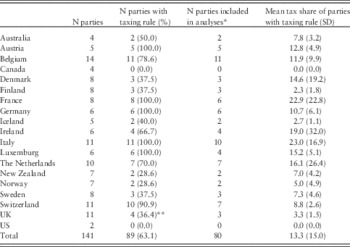
Of the initial 141 parties in our 19 democracies, 135 taxing parties are found in the 17 systems in which taxing is practiced by at least by some parties. Of these 135 parties, 89 tax parliamentary salaries of their national MPs. For most (80 of 89) of the parties that have a tax, we could gather information about both the tax share and all relevant explanatory variables, leading to the sample of 80 parties included in our analysis (for information on missing data, see Appendix A). Among these 80 parties, tax shares range from 0.5% of the base salary to 75.0%. Half of the parties (50.0%) take a share below 10%, 37.5% a share between 10–30% and 12.5% more than 30%. The average tax share is 13.3%. The number and percentage of parties that tax per country as well as the mean tax share per country (with standard deviations) are reported in Table 1. Since the distribution of the dependent variable, Tax Share, is extremely left skewed (i.e. most parties take a moderate share from their MPs and only very few parties a large share), we take the log of Tax Share as the dependent variable.Footnote 19
Taxing practices on the salaries of national MPs in advanced democracies

* Due to missing information regarding relevant variables for analysis. Details on missing parties in Table A1 can be found in the Appendix.
** Two parties with a taxing regime are not listed here. The Liberal Democrats have a taxing rule but only tax the allowances of local councillors. Sinn Fein has a taxing rule on national MPs but is listed under Ireland (it had seats in the House of Commons and the Dáil in the period covered).
Operationalization of explanatory variables
Testing the ideological positioning hypothesis requires us to specify a party’s ideological orientation; we use party positions on the left-right scale as specified by Benoit and Laver (Reference Benoit and Laver2006). Since we use this variable (Ideological Position) as a proxy for the general orientation of MPs, the left-right position averaging party ideology across the full range of issues covered in the study is the most appropriate choice of measure.Footnote 20 Expert survey data has proved to be reliable in estimating party positions and is consequently widely used in comparative studies (Lowe et al., Reference Lowe, Benoit, Mikhaylov and Laver2011). The values assigned to parties range from 0 to 20; the higher the value the further the party is located on the right. The mean policy position of the parties in our sample is 8.9 with the extreme points being 2.1 on the left and 18.9 on the right side of the scale. To enable an easy comparison between coefficients in the following model, we transform the ideological position variable to a scale from 0 to 1.
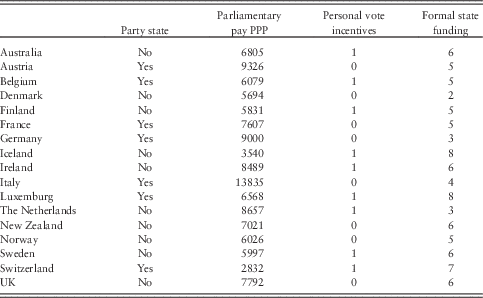
To test the party state hypothesis, we need a convincing proxy for parties’ leeway to access state resources informally, which is clearly separate from the partisan usage of parliamentary salaries. A good measure for informal party access that concerns an arena clearly distinct from the parliamentary one is provided by a series of recent studies that provide rankings of patronage across a wider range of democracies (e.g. Kopecký and Scherlis, Reference Kopecký and Scherlis2008; Kopecký et al., Reference Kopecký, Mair and Spirova2012). Party patronage is not necessarily illegal (as corruption is) but its legitimacy is often questioned, since it clashes with the idea that non-elected positions should be distributed on the basis of merit only. If patronage practices are nonetheless widespread, this implies considerable leeway for parties to access state resources, also informally.Footnote 21 Accordingly, the relative access of parties to non-elected positions in public and semi-public life (e.g. in the civil service, governing boards, public sector companies), that is, the scope of party appointment power in the state apparatus (Kopecký and Scherlis, Reference Kopecký and Scherlis2008: 356; Kopecký et al., Reference Kopecký, Mair and Spirova2012), serves as our proxy of informal party control.Footnote 22 Based on these studies, we can distinguish democracies in which the scope of control is extensive from those in which it is limited. The democracies not covered by these studiesFootnote 23 are classified along Kopecký et al.’s definition of patronage using other comparative studies that explore party access to and the actual politicization of civil service systems (e.g. Müller, Reference Müller2000; Peters, Reference Peters2004) complemented by case study material (e.g. Tsatsos, Reference Tsatsos1992; Detterbeck, Reference Detterbeck2002; for the country classification see Appendix B). We coded seven (41.2%) out of 17 countries as party states.Footnote 24
Finally, to empirically test the ‘ideology in context’ hypothesis, we introduce a variable in our model, which measures the effect of the Ideological Position variable in only those democracies with limited informal party access to state resources as measured by our Party State variable (see above and Appendix B). We expect the effect of this new variable (Ideological Position in Non-Party States) to be larger (i.e. more negative) than the effect of ideological position in the overall model.
Control variables
To control for rivalling explanations, we introduce four additional variables in our models. Each of them can be plausibly expected to affect the level of tax parties collect.
First, we include a variable capturing the size of the parliamentary group. The collection of parliamentarians’ contributions constitutes a demanding task and resistance is likely to grow with the level of tax. In particular, incoming office-holders need to be chased up by party personnel and be reminded to set up a standing order to assure regular payments. The costs to assure compliance increase with the number of office-holders who are taxed by a party. Furthermore, in smaller groups, it is more transparent who has already complied and who has not, which makes the practical implementation of a taxing rule easier as well as the effective imposition of social sanctions on those MPs who try to free-ride more likely. Finally, the fewer MPs a party has, the more it might try to extract from each individual, since smaller parties might have fewer alternative income sources. We measure the Parliamentary Group Size variable in terms of a party’s most recent absolute number of seats in the first house of parliament between early 2008 and late 2010 (the period of data collection).Footnote 25 We expect to find a negative relationship between Parliamentary Group Size and Tax Share.
Second, a systemic variable likely to affect taxing practices is level of Parliamentary Pay. An MP who earns very well can be more easily asked for a large contribution than an MP whose pay is comparatively meagre. Simultaneously, it is more lucrative for a party to make the effort to collect a certain share from MPs when salaries are high. To measure this variable, we used the average pay of rank-and-file MPs in the respective currency of a country and adjusted these figures by taking account of differences in the purchasing power between countries, hence yielding purchasing power adjusted salaries in US Dollars (Parliamentary Pay PPP).Footnote 26 We expect taxing shares to rise with increasing salaries.
Third, the extent to which political parties have access to formal state funding should systematically affect the extent to which parties bother to collect party taxes from MPs, a demanding intra-organizational task. The debate on party funding reform tends to assume that the more generous formal resource access parties have, the less pressure there is for them to exploit resources in informal ways (e.g. Nassmacher, Reference Nassmacher2009; Koss, Reference Koss2011). To measure Formal State Funding parties receive in a system, we combine two indicators developed by Bischoff (Reference Bischoff2006) in a cross-national study on barriers to new party entry in 21 democracies. Both indicators categorize democracies along the same logic captured by four-point scales. One indicator measures how easily parties can access direct state funding in a system, that is, ranging from a barrier of less than 1% of the vote being required to receive funding (1) to no funding provision at all (4). The other measures concern whether and how parties profit from free television time, that is, ranging from the provision of free television time to all parties (1) to no free television time at all (4).Footnote 27 Combined in one index, they provide information on the relative availability of direct and indirect formal state funding.Footnote 28 The higher the scores a country receives, that is, the scarcer Formal State Funding, the stronger the incentives are for parties to collect high taxes.
Finally, we control for the incentives the electoral system generates for pursuing personal vote strategies distinct from party reputation. Whenever winning a parliamentary seat depends exclusively on the party label, party control over candidates and incumbents invited by the institutional setting can be considered high. If parties widely determine a candidate’s fate at elections, while his or her personal characteristics are unimportant, parties can be expected to find it easier to impose organizational rules on the candidate than if the role of a personal vote is important and candidate characteristics can be decisive. To capture Personal Vote Incentives as generated by the electoral system, we classified the electoral systems in our countries along the degree of control party leaders exercise over access to their party’s label by controlling party endorsements and ballot rank in list systems (Carey and Shugart, Reference Carey and Shugart1995: 419f; Shugart, Reference Shugart2001) as a measure of the dependency of candidates on party leaders. We distinguish between electoral systems in which party leaders present a fixed ballot (0) and systems in which voters may change the ballot presented by party leaders or in which party leaders do not control access to ballots or rank (1). Incentives to pursue a personal vote are considered to be higher in the latter than in the former. We therefore expect a negative effect of the variable on Personal Vote Incentive on tax share.
The overall model looks like this:
 $$\eqalignno{ {\rm Tax\ Share}=\, & {\rm a}\,{\plus}\,{\rm b}_{{\rm 1}}\ {\rm Ideological\ Position}\,{\plus}\,{\rm b}_{{\rm 2}}\ {\rm Party\ State} \cr & {\plus}\,{\rm b}_{{\rm 3}}\ {\rm Ideological\ Position\ in\ Non{\hbox-}Party\ States} \cr & {\plus}\,{\rm b}_{{\rm 4}}\ {\rm Parliamentary\ Group\ Size}\,{\plus}\,{\rm b}_{{\rm 5}}\ {\rm Parliamentary\ Pay\ PPP} \cr & {\plus}\,{\rm b}_{{\rm 6}}\ {\rm Formal\ State\ Funding}\,{\plus}\,{\rm b}_{{\rm 7}}\ {\rm Personal\ Vote\ Incentives}\,{\plus}\,{\rm e} $$
We expect b1, b3, b4 and b7 to be negative (with b3 being more negative than b1) and b2, b5 and b6 to be positive.
Since the control variables are mapped on different scales, we transform them to a scale from 0 to 1 where necessary to ease comparisons between coefficients in the models below (Tables B1 and B2 in Appendix B provide details on all explanatory variables).
Results
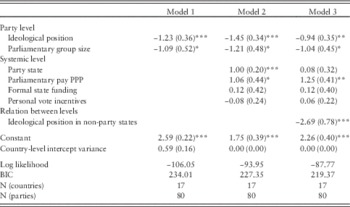
Our data include parties nested within countries. Consequently, we need a modelling strategy that allows for the fact that our units of analysis are not independent from each other and enables us to model effects on the party as well as on the system level adequately. We therefore estimate random-intercept multilevel regression models to explain the level of the tax parties collected (Tax Share) from MP salaries. By using this type of model we are controlling for unexplained variance between countries and can assess the degree of variance caused by country-specific factors via the intra-class correlation coefficient (for a discussion of multilevel models, see Steenbergen and Jones, Reference Steenbergen and Jones2002).Footnote 29 The analysis proceeds as follows: to assess the explanatory power of both levels of analysis, the party and the systemic level, we first compute models containing party-specific factors only (Model 1) and introduce systemic factors in the second step (Model 2). We then take into account the links between the two levels by looking at differences in the effect of party-specific factors depending on the systemic environment in which parties operate (Model 3). Table 2 presents the results of the multilevel models where the dependent variable is the tax share extracted from MPs by their parties.
Party- and country-level variables shaping tax share

Note: Coefficients of linear random-effect multilevel models, standard errors in brackets, levels of significance: ***P<0.001, **P<0.01, *P<0.05.
Model 1, which reports the effects of the party-specific factors only, suggests strong support for the ideological position hypothesis. In line with our expectations, Ideological Position has a significant negative effect on Tax Share, that is, the further to the left a party is positioned, the higher the share it takes from its MPs. Furthermore, Parliamentary Group Size has a significant negative effect on Tax Share, that is, the smaller it is the higher the tax share, indicating that growing group size indeed complicates the collection of high taxes. Moreover, both variables have similar effect sizes, hence parliamentary group size constitutes an important influence on tax share. Still, with an interclass-correlation coefficient of 0.15, there remains a degree of variance due to country characteristics, which should not be neglected, justifying the introduction of systemic variables in the second step (Model 2).
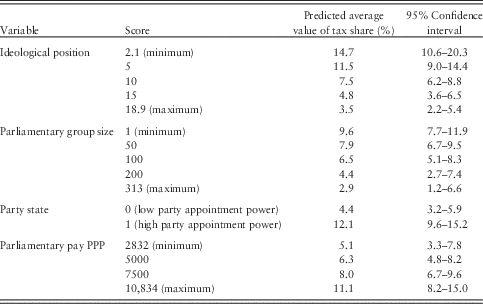
Model 2 shows that despite introducing systemic variables, the effects of ideological position and parliamentary group size remain significant. Also Party State (captured by parties’ power to appoint non-elected office-holders) has a significant positive effect on Tax Share, that is, the tax share is higher in countries with broad informal party access to state resources, which supports our party state hypothesis. The amount of salary paid to MPs (Parliamentary Pay PPP) has a significant effect in the expected direction, that is, parties tax more when salaries are high, which increases the confidence in our main effects. Moreover, the effect of parliamentary pay is as strong as the effect of party state on tax share.Footnote 30 Although comparing effect sizes is convenient in the above models since all independent variables are mapped on a scale ranging from 0 to 1, assessing the real-world meaning of these effects becomes more difficult. Table 3 therefore shows the predicted average values of tax share with the four independent variables with significant effects taking on different values (based on Model 2).
Predicted average values of tax share

In Table 3, we can see that differences in the Ideological Position of parties make a huge difference to the tax share they impose on their MPs.Footnote 31 While parties on the far left on average take about 15% of MP salaries, parties on the right take on average only a moderate 3.5%. Party State, our main systemic explanatory variable, has a large effect on the tax share imposed on national MPs, which is on average about 8 percentage points higher in systems with high party appointment power (i.e. party states) than in other systems. Compared with this, whether Parliamentary Group Size, or Parliamentary Pay PPP are at their minimum or maximum leads to a difference of only six to seven percentage points between minimum and maximum tax share.
Although Party State already affects tax share when looked at in isolation, we further expect an impact of this systemic variable on the relative effects of parties’ ideological positions on our dependent variable. Since both our main explanatory variables affect the acceptability of extracting rent from parliamentarians informally, and thus relate to the same theoretical dimension, our ‘ideology in context’ hypothesis expects the influence of Ideological Position to be lower in party states than in those states where parties’ informal access to state resources is limited. We tested this claim in Model 3 (Table 2). We introduced a variable measuring the ideological position of parties in the latter context (Ideological Position in Non-Party States). As can be seen in the last column of Table 2, this variable has a large and significant effect on Tax Share (−2.69), which clearly exceeds the effect of the ideological position on all parties (−1.45), that is, irrespective of the type of system they act in, and thus supports the ‘ideology in context’ hypothesis. Hence, whereas in party states parties with different ideological orientations are able to subtract high tax shares from their MPs, in less favorable surroundings (i.e. non-party states) the ideological position is the main explanatory factor for the level of tax shares imposed by parties.
Conclusions
This study of taxing practices in political parties explored a widely neglected, informal party finance strategy across a wide range of parties and advanced democracies: the requirement on party members who enter public office on a party ticket to regularly donate a specific share of their salary to party coffers. While the paper’s contribution to the by now extensive party finance literature is in itself significant, the study, more importantly, provided a suitable lens to contrast and link two seminal rivalling perspectives on the nature of parties in contemporary democracies: Duverger’s society-centred perspective on party organization (1964) and Katz and Mair’s state-centred cartel party theory (Reference Katz and Mair1995b). Conceptualizing taxing rules as organizational obligation (which due to the mutual dependency between party and MP cannot be simply hierarchically imposed on MPs) led us to theorize the impact of variables driving the acceptability of this informal practice.
Our analytical focus on factors shaping the acceptability of such financial obligations, in turn, allowed us to link Duverger’s work on the one hand and Katz and Mair’s on the other. Following Duverger (Reference Duverger1964), we hypothesized that leftist party ideology facilitates the collection of high salary shares. Following Katz and Mair (Reference Katz and Mair1995b), we hypothesized that in political systems, in which parties’ informal access to state resources is generally broad, the collection of high salary shares will be more acceptable than in settings in which the separation between parties and state apparatus is more pronounced. Finally, we linked the two and hypothesized the influence of a party’s ideological position on tax share to be higher in democracies in which parties’ informal access to state resources is limited than in party states where it is extensive, a claim implicit in Katz and Mair’s most recent and last explicit elaboration of their theory (Reference Katz and Mair2009). Testing these hypotheses based on a unique data set covering MP taxing levels in parties across a wide range of advanced democracies, all our main explanatory variables showed a significant impact on the level of tax in the expected direction, despite controlling for various rivalling influences.
Clearly, the odds were against Duverger, who first published his seminal book in the early 1950s. Yet even if party ideology is a more influential predictor of intra-organizational practices in democracies where informal party access to the state apparatus remains limited, party ideology remains a powerful predictor across diverse systemic contexts, which stresses our initial point: to understand informal party practices we need to consider the nature of the organization and what it can ask from its representatives. Which demands on MPs are judged acceptable reflects parties’ recruitment strategies with leftist parties targeting candidates willing to serve the organizational interest and embracing redistribution (both on the state and organizational level), accompanied by the readiness to sanction non-compliance even at considerable costs.Footnote 32 At the same time, if close linkages to the state indeed invite an assimilation of taxing practices that are, as a consequence, less shaped by their ideological and societal origins, this has important repercussions for debates around the future and viability of party government in modern democracies, where citizens perceive parties as detached from society and see little difference between them (Dalton and Wattenberg, Reference Dalton and Wattenberg2002; Dalton and Weldon, Reference Dalton and Weldon2005; Mair, Reference Mair2005). In essence, our findings imply a trade-off between societal roots and state linkage, a claim inherent in the cartel party theory (Katz and Mair, Reference Katz and Mair1995a, Reference Katz and Mair1995b) and the literature around it (e.g. Detterbeck, Reference Detterbeck2002; Biezen, Reference Biezen2012), which so far has not been tested on a broader cross-national scale.
Our findings finally indicate that various party strategies to access different types of funds and resources are interlinked. The collection of party taxes from MPs and the control over appointments in the state apparatus – our measure for the identification of party states – are two distinct strategies to access resources informally. Consequently, informal party access to the latter resource facilitates access to the former, echoing Biezen’s theoretical argument (2005) that parties as ‘public utilities’ might acquire a special status in Western democracies, a status that legitimizes the partisan usage of state resources more generally. However, coming back to the sensitivity of citizens towards informal funding strategies as mentioned in the introduction, this ‘legitimating effect’ might be predominantly at work in the political arena (i.e. affect the relationship between political actors such as parliamentarians and extra-parliamentary party elites) rather than reflect the attitudes of citizens. With trust in parties in decline, citizens have become more and more hostile to what is perceived as the problematic usage of public privileges by politicians and parties. This makes the comparative study of informal party practices and the assessment of the discrepancies between elite attitudes towards these practices and the public’s evaluations thereof an important area of future research (McAllister, Reference McAllister2000; Allen and Birch, Reference Allen and Birch2012).
Acknowledgements
This research was supported by the British Academy (SG-04570) and the Economic and Social Research Council (RES-239-25-0032). The authors also thank Daniel Stegmueller and Filippo Tronconi who helped with the research as well as the Lehrstuhl André Kaiser, University of Cologne, who discussed an earlier version of the paper during a research stay of N. Bolleyer funded by the Humboldt Foundation. Finally, they are grateful to the three EPSR referees and the editors of the journal for their helpful suggestions. All remaining mistakes are those of the authors.
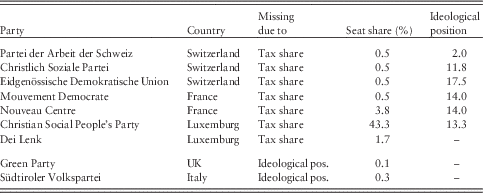
Appendix A. Missing Data
Table A1 gives an overview of parties we could not include in our analysis due to missing information. For seven parties we were unable to gather information regarding tax shares. The seat shares of these parties show that, as expected, we lose some minor parties, but also one large party. Hence, our sample is not biased in favor of large parties. Furthermore, we lose three Swiss parties which should not influence our results since there are 11 parties in total in Switzerland, meaning that Switzerland is still strongly represented in our sample. With regard to ideological position, we tend to lose parties on the right side of the ideological spectrum. Still, when running our models with leftist parties only, the basic findings remain the same. Finally, there is no difference in seat size between our initial sample and the parties we lose due to a lack of information on tax shares. For two parties we had no information on ideological positions. These parties are smaller than the average party, and constitute only 2.2% of our sample. Consequently, this should not affect our findings.
Parties with missing information

Appendix B. Descriptive Statistics
Party-level variables

Country-level variables