


Introduction
Magical ideation (MI) may be an important construct in obsessive compulsive disorder (OCD). Therefore, it may provide a unique point of access for an intervention that has not previously been explored. The prominence of MI within the disorder has been argued to differentiate OCD from other anxiety disorders (Enright & Beech, Reference Enright and Beech1993; Enright et al. Reference Enright, Claridge, Beech and Kemp-Wheeler1994; Enright, Reference Enright and Rapee1996; Einstein & Menzies, Reference Einstein and Menzies2006).
Magical thinking refers to a disposition to invoke a hidden causal structure beneath the appearance of phenomena (Woolley, Reference Woolley1997). Good examples of magical thinking are beliefs in the paranormal, such as clairvoyance, astrology, spirit influences and telepathy. A clinical example of MI in OCD is the thought one client described, ‘if I don't balance the food as I chew it within my mouth and as I swallow it in my oesophagus, it may poison me’. Another common example would be the need to repeat a phrase in order to stop a close family member (who is not with the individual) from being in a car accident. In both cases there is no causal connection between the action conducted and the feared outcome occurring. Moulding & Kyrios (Reference Moulding and Kyrios2006) propose that magical thinking is caused by an extreme discrepancy between desired levels of control over the environment and the perceived control an individual has. Furthermore, Swain (Reference Swain2006) suggests that plasticity of the brain and material rewards for accepting untestable hypotheses, such as believing in Santa Claus, may be responsible for learning to defy known laws of science.
Thought–Action Fusion (TAF) in Rachman's model of OCD is, among other things, the belief that thoughts influence the likelihood of events in the real world (Rachman, Reference Rachman1997, Reference Rachman1998). An example would be ‘If I think my dad might die in a car accident, he is more likely to die in a car accident’. Significantly, Einstein & Menzies (Reference Einstein and Menzies2004a, Reference Einstein and Menziesb, Reference Einstein and Menzies2006) demonstrated that magical thinking may be responsible for this fusion by underpinning TAF. Amir et al. (Reference Amir, Freshman, Ramsey, Neary and Brigidi2001) argued that magical thinking in OCD was a specific type of TAF.
Evidence suggests that there are different types of magical thinking. In particular, there is TAF magical thinking and non-TAF magical thinking (Berle et al. Reference Berle, Blaszczynski, Einstein and Menzies2006). While magical thinking is common in individuals with chronic schizophrenia, these individuals do not exhibit elevated TAF levels (Berle et al. Reference Berle, Blaszczynski, Einstein and Menzies2006). In a large non-clinical sample, Lee et al. (Reference Lee, Cougle and Telch2005) found that MI was correlated with the TAF – Likelihood Scale but not with the TAF – Moral (TAF-M) Scale, supporting the conceptual role of MI in OCD.
Several studies have investigated the relationship between magical thinking and OCD. In non-clinical samples, contradictory findings have been obtained. Einstein & Menzies (Reference Einstein and Menzies2004b) found large and significant relationships between the MI Scale (Eckblad & Chapman, Reference Eckblad and Chapman1983) and two measures of OCD [the Maudsley Obsessional Compulsive Inventory (MOCI; Hodgson & Rachman, Reference Hodgson and Rachman1977), and the Padua Inventory (PI; Sanavio, Reference Sanavio1988)] in a non-clinical undergraduate sample. However, two other studies using non-clinical samples failed to confirm this result (Marino et al. Reference Marino, Lunt and Negy2008).
More consistent data have been reported in studies using clinical samples. Norman et al. (Reference Norman, Davies, Malla, Cortese and Nicholson1996) examined the relative strength of the relationships between obsessive compulsive (OC) symptomatology and schizotypy, anxiety and depression in a clinical population. The schizotypy index was based on two scales of psychosis proneness. These were the MI Scale and the Perceptual Aberration (PA) Scale (Chapman et al. Reference Chapman, Chapman and Raulin1978). The correlation between schizotypy and OC symptomatology (r = 0.60) was observed to be significantly greater than the correlations between OC symptoms and either anxiety (r = 0.42) or depression (r = 0.38). The authors concluded that magical thinking may be an important feature of OCD.
Einstein & Menzies (Reference Einstein and Menzies2004a) investigated relationships between MI, TAF and superstitious beliefs in a sample of 61 OCD patients. Compared to beliefs in superstition and TAF, MI was the construct most closely associated with OC symptoms. Large and significant relationships between MI scores and measures of OCD were obtained even when alternative mediators [Lucky behaviours (LBeh), Lucky beliefs (LBel), Thought–Action Fusion – Revised (TAF-R) scales] were held constant. No other variable remained significantly related to the Obsessive–Compulsive Inventory – Short Version (OCI-SV; Foa et al. Reference Foa, Huppert, Leiberg, Langner, Kichic, Hajcak and Salkovskis2002) when MI scores were held constant.
A further study explored changes in MI for 34 patients with OCD who received standard cognitive behavioural treatment for the disorder (Einstein & Menzies, Reference Einstein and Menzies2008). Treatment did not specifically target magical styles of thinking. t tests demonstrated significant improvement on all three measures of OC symptoms over the course of treatment (OCI-SV and PI). Magical thinking also changed significantly (as indicated by t tests). Significant correlations between MI improvement and improvement on the OC symptom scales suggested an association between improvement in magical thinking and improvement in OC symptoms. Importantly, a significant negative correlation was obtained between pre-scores on MI and change scores on the OCD measures suggesting that high levels of MI were associated with high levels of treatment intractability.
The data collected from clinical populations to date indicate that MI may play a causal or a mediating role in the expression of OC symptoms; however, no studies have been designed to explicitly test this causal relationship. If MI is a mediator, symptoms of OCD should be altered when targeted in treatment. The present paper describes two cases in which MI was the sole target of a 6-week cognitive therapy package (Einstein & Menzies, Reference Einstein, Menzies and Einstein2007). It was hypothesized that: (1) a 6-week tailored cognitive package would successfully lower MI and; (2) that this would result in associated reductions in OC symptoms.
Method
Participants
The participants presented at a large hospital-based anxiety clinic seeking cognitive behavioural treatment for OCD. They participated in two clinical interviews to establish DSM-IV (APA, 1994) diagnosis. The initial interview was a 30-min telephone screen at which a preliminary diagnosis was made. To confirm this diagnosis, a 90-min face-to-face assessment interview was conducted by a clinical psychologist and a psychologist in the second year of their postgraduate clinical training. The clinical psychologists had between 3 and 6 years’ experience specializing in the management of anxiety disorders. Participants were invited to take part in the research while on a waiting list for CBT treatment at the clinic. Following the study both participants were offered treatment as usual.
The participants were selected for the study as they presented with elevated levels of MI (scores of 10 and 14 on the MI Scale) within the time period for data collection. The previous study of MI within a population of patients seeking treatment for OCD showed the mean MI score to be 6.08 (standard deviation = 4.72) (Einstein & Menzies, Reference Einstein and Menzies2004a). Thus MI scores close to 1 standard deviation above this mean were deemed acceptable for the purpose of this pilot study.
Participant 1
C.P. was a 45-year-old woman who had grown up in a Catholic family. She reported a 6-year history of OCD, centring on food/fluid contamination concerns. She could not eat from opened food packages, consume drinks prepared by others, nor eat in restaurants. She feared that she would be inadvertently poisoned or harmed through contaminated food items. She completely avoided using salt or soy sauce when out, drinking coffee at work and would only eat her own meal 1 hour after family/friends had eaten theirs to check that their food had not been poisoned. C.P. reported that her fear was much worse at night. C.P. met criteria for a comorbid diagnosis of a major depressive disorder. She reported a loss of appetite, decreased libido, poor concentration, hypersomnia (sleeping 12 hours per night), hopelessness, helplessness, worthlessness and feeling as though she was a burden on others. She had withdrawn from all social activities. She obtained a score of 42 on the Beck Depression Inventory – II (BDI-II; Beck et al. Reference Beck, Steer and Brown1996). C.P. was unable to take prescribed medication (Lovan and consequently Cipramil) due to a fear of being poisoned and sensitivity to the side-effects.
C.P. also had a history of panic disorder with agoraphobia. She had experienced panic attacks in 1995 after ingesting cocaine. At the time she had experienced heart palpitations, tingling in her hands, irritability, difficulty concentrating, headaches and insomnia. In 1995 she had received treatment for her panic disorder at an anxiety clinic in Sydney. She reported that this treatment had been successful, resulting in the cessation of her panic attacks and agoraphobic avoidance. Following treatment she no longer feared panic attacks.
C.P. reported that her father and paternal grandmother had suffered from depression and anxiety. She described her premorbid personality as extraverted and happy. She had a large social circle and enjoyed sailing and reading. At the time of the assessment she was working part time in retail.
Participant 2
R.F. was a 25-year-old male with a 14-year history of OCD. At the time of assessment he presented with a range of OC symptoms, including: intrusive thoughts about causing or failing to prevent harm to others, intrusive images about death and the supernatural, repeating rituals, neutralizing of ‘bad’ thoughts by focusing on ‘good’ thoughts and belief in lucky numbers. He had previously experienced checking compulsions and fear of contamination; however, both had been successfully treated in the past and were not a significant component of his current presentation.
Examples of rituals described by R.F. were: (1) if he heard a song on the car radio being sung by a deceased person (e.g. Elvis) he would feel compelled to change the channel and retrace his route until he felt ‘right’; (2) if he had an intrusive thought about harm coming to a loved one he would feel compelled to replace the ‘bad’ thought with a ‘good’ thought, and re-do the action he was engaged in at the time of having the ‘bad’ thought (e.g. entering through a doorway); (3) repeating actions four times (taking clothes on and off, showering, turning lights on and off, walking). In addition, R.F. avoided graveyards and refused to wear clothes if he had experienced an intrusive thought or image of death whilst previously wearing them.
At the time of assessment R.F. did not meet criteria for any other diagnoses. However, he had a history of major depressive disorder, the last episode of which had concluded 6 months prior to the current presentation. At the time of assessment he was being prescribed 100 mg/d fluvoxamine. This dose remained stable throughout the treatment and follow-up period. R.F. did not have suicidal ideation. He reported a history of nihilistic thinking but denied such thoughts currently.
R.F. had received a substantial amount of treatment prior to presenting at the clinic. He reported having tried several pharmacological interventions (sertraline, risperidone, diazepam), all of which had caused intolerable side-effects. He had also had two previous trials of Exposure and Response Prevention, which he reported to have reduced his checking and washing symptoms but which had not assisted greatly with his atypical symptoms.
With respect to family psychiatric history, R.F. reported diagnoses of schizophrenia on both the paternal and maternal sides of the family. He also described a paternal cousin with a severe unipolar depressive disorder and described symptoms of depression in his sister, although she had not been formally diagnosed.
At the time of assessment R.F. was unemployed. He had not worked for 6 months prior to the assessment. He had previously been studying but had dropped out of the course due to OCD.
R.F did not report any significant medical history. He reported a low alcohol intake and denied current use of other drugs. He reported ‘experimental’ use of cannabis, ecstasy and speed 4 years prior to presenting at the clinic.
R.F. described close relationships with all family members. He did not report any significant difficulties within the family. He described his premorbid personality as perfectionistic.
Procedure
The participants were given the PI, either the OCI (Foa et al. Reference Foa, Kozak, Salkovskis, Coles and Amir1998) or the OCI-SV (Foa et al. Reference Foa, Huppert, Leiberg, Langner, Kichic, Hajcak and Salkovskis2002), the MOCI, the MI Scale, the LBeh and LBel scales (Frost et al. Reference Frost, Krause, McMahon, Peppe, Evans, McPhee and Holden1993) and the TAF-R Scale (Shafran et al. Reference Shafran, Thordarson and Rachman1996) to complete pre- and post-intervention and at 3 months’ follow-up. Both clients were rated on the YBOCS (Goodman et al. Reference Goodman, Price, Rasmussen, Mazure, Fleischmann, Hill, Heninger and Charney1989) by an independent rater at pre-treatment, post treatment and 3 months’ follow-up.
Measures
Padua Inventory (PI; Sanavio, Reference Sanavio1988)
The PI Scale was developed as a measure of OCD proneness for use in normal samples. It consists of 60 items covering the full range of OCD symptomatology. The severity of each symptom is measured on a 0- to 4-point Likert scale. The instrument has adequate levels of internal consistency, test–retest reliability and convergent validity (Macdonald & de Silva, Reference Macdonald and de Silva1999; Feske & Chambless, Reference Feske, Chambless, Goodman, Rudorfer and Maser2000).
Obsessive Compulsive Inventory (OCI; Foa et al. Reference Foa, Kozak, Salkovskis, Coles and Amir1998)
The OCI is a 42-item self-report measure of OC symptoms. Respondents rate the frequency and distress caused by specific activities on a 5-point Likert scale. The OCI contains seven subscales: Washing, Checking, Doubting, Ordering, Hoarding, Mental neutralizing and Obsessing. The OCI demonstrates good discriminant validity between diagnostic groups and adequate convergent validity with other measures of OCD. The OCI demonstrates satisfactory test–retest reliability and high subscale internal consistency.
Obsessive Compulsive Inventory – Short Version (OCI-SV; Foa et al. Reference Foa, Huppert, Leiberg, Langner, Kichic, Hajcak and Salkovskis2002)
The OCI-SV is an 18-item self-report measure of OC symptoms. Responses are provided on a 5-point Likert scale. The scale is a shortened version of the original OCI which retains excellent psychometric properties. In addition, the frequency scale has been eliminated (Foa et al. Reference Foa, Huppert, Leiberg, Langner, Kichic, Hajcak and Salkovskis2002).
Maudsley Obsessional Compulsive Inventory (MOCI; Hodgson & Rachman, Reference Hodgson and Rachman1977)
The MOCI consists of 30 true-false items covering the range of OC symptoms. The questionnaire has adequate test–retest reliability, convergent validity (Hodgson & Rachman, Reference Hodgson and Rachman1977), and internal consistency (Norman et al. Reference Norman, Davies, Malla, Cortese and Nicholson1996). Four subscales may be derived from the MOCI, namely checking, cleaning, slowness and doubting. Despite the development of numerous alternative measures of OCD severity over the last two decades, the MOCI probably remains the most widely used instrument for assessing general OCD symptomatology.
Magical Ideation Scale (MI Scale; Eckblad & Chapman, Reference Eckblad and Chapman1983)
The MI Scale consists of 30 true–false items exploring beliefs in a number of magical influences (e.g. thought transmission, spirit influences, astrology, good-luck charms, psychic energy). Sample items include: ‘Horoscopes are right too often for it to be a coincidence’ and ‘Things sometimes seem to be in different places when I get home even though no one has been there’. The scale was originally designed as a measure of psychosis proneness. It has demonstrated construct validity as a measure of schizotypy (Chapman & Chapman, Reference Chapman, Chapman and Alpert1985; Chapman, et al. Reference Chapman, Chapman and Miller1982) and adequate internal consistency (see Norman et al. Reference Norman, Davies, Malla, Cortese and Nicholson1996).
Lucky Beliefs Questionnaire (LBelQ; Frost et al. Reference Frost, Krause, McMahon, Peppe, Evans, McPhee and Holden1993)
The LBelQ consists of 30 items, scored on a 5-point Likert scale, concerning a variety of superstitious beliefs. The measure was generated from a semi-structured interview on superstitions developed by Leonard et al. (Reference Leonard, Goldberger, Rapport, Cheslow and Swedo1990). Additional items were drawn from the Encyclopedia of Superstitions (Radford & Radford, Reference Radford and Radford1969). The LBelQ is a popular measure of superstitiousness and has particularly strong internal consistency (0.95, see Frost et al. Reference Frost, Krause, McMahon, Peppe, Evans, McPhee and Holden1993).
Lucky Behaviours Questionnaire (LBehQ; Frost et al. Reference Frost, Krause, McMahon, Peppe, Evans, McPhee and Holden1993)
The LBehQ is a companion instrument to the LBelQ. Like the LBelQ, it consists of 30 items scored on a 5-point Likert scale. Items refer to superstitious behaviours performed by respondents in response to superstitious beliefs. Subjects rate the frequency with which they engage in such behaviours. Again, internal consistency for the LBehQ is particularly strong (see Frost et al. Reference Frost, Krause, McMahon, Peppe, Evans, McPhee and Holden1993).
Thought–Action Fusion Scale – Revised (TAF-R; Shafran et al. Reference Shafran, Thordarson and Rachman1996)
The TAF-R Scale consists of 19 items divided into three scales. The TAF-M Scale assesses the belief that experiencing an intrusive thought is as morally unacceptable as acting on the thought (e.g. ‘If I wish harm on someone, it is almost as bad as doing harm’). The TAF – Likelihood for Others (TAF-LO) Scale assesses the belief that an unacceptable thought about a negative event occurring to others makes the event more probable (e.g. ‘If I think of a relative/friend falling ill this increases the risk that s/he will fall ill’). The TAF – Likelihood for Self (TAF-LS) Scale assesses the belief that having an unacceptable thought about a negative event occurring to oneself makes that event more probable (e.g. ‘If I think of myself being in a car accident, this increases the risk that I will have a car accident’). The measure has been demonstrated to possess adequate reliability in student, adult and obsessional samples (Shafran et al. Reference Shafran, Thordarson and Rachman1996).
Beck Depression Inventory – Second Edition (Beck et al. Reference Beck, Steer and Brown1996)
The BDI-II is a 21-item self-report questionnaire of depression. It is a widely used measure of the severity of depressive symptoms. The measure has been demonstrated to possess adequate internal reliability and both convergent and discriminant validity (Penley et al. Reference Penley, Wiebe and Nwosu2003).
Yale–Brown Obsessive Compulsive Scale (YBOCS; Goodman et al. Reference Goodman, Price, Rasmussen, Mazure, Fleischmann, Hill, Heninger and Charney1989)
The YBOCS is a clinician-administered and rated OC scale that assesses symptom severity. The YBOCS has five items each on the obsessions and compulsions subscales. These items measure duration/frequency, interference in social and occupational functioning, associated distress, degree of resistance and perceived control over obsessions and compulsions. The total score for the symptom severity section of the YBOCS ranges between 0 and 40 and is the sum of the subscales scores. The YBOCS has excellent inter-rater and test–retest reliability (Goodman et al. Reference Goodman, Price, Rasmussen, Mazure, Fleischmann, Hill, Heninger and Charney1989; Kim et al. Reference Kim, Dysken and Kuskowski1990). However, internal consistency findings for the measure are mixed and it has been referred to as the ‘gold-standard’ measure for assessing severity of OCD (St Clare, Reference St Clare, Menzies and de Silva2003).
Intervention
Eight procedures were undertaken. Each procedure lasted between 10 and 25 min and was accompanied by a cognitive restructuring (CR) handout. The handout questioned the participant's comprehension of the task and concluded by asking about the current state of the individual's belief in the activity. It was completed in session with participants in a Socratic manner. Each procedure was designed to reduce general magical thinking tendencies. No direct link to OCD was drawn. As can be seen below, the package of procedures provides a generic attack on MI. A different therapist provided treatment for each client (both clinical psychologists with over 6 years’ experience in the field). Participants understood that they were taking part in a research trial and that the research was designed to target magical thinking. Sessions were 50 min long.
(1) Astrology article. An article from The Skeptic magazine (Edwards, Reference Edwards1992) described how the author responded to an advertisement for free horoscopes under six pseudo-names. All ‘six’ respondents received the same horoscope marked ‘personal, private and confidential’ and were offered a free Inca crystal if they paid for a more detailed horoscope. Three weeks later, another letter was sent offering additional free gifts. The author bought the more detailed horoscope and received the ‘free’ gifts. He submitted the Inca crystal for analysis by a professor at the School of Earth Sciences, Melbourne University. The crystal was found to be costume jewellery ‘worth at most a few cents’. The article comically portrays the offer of the free horoscope as a business which intended to profit from gullible patrons. The CR handout reviewed comprehension of the article and motives behind the astrologer's offer.
(2) Horoscope analysis. This component used the horoscopes page from a current magazine. The order of the horoscopes had been rearranged and the star signs removed. The CR handout asked participants to rate each description according to how accurate each prediction had been over the previous month and to select the description that was most accurate. Participants were then handed the original magazine page and asked whether they had chosen the correct star sign. They had not identified the correct star sign. They were then asked to consider the meaning of this in terms of the general way that horoscopes are written.
(3) Explanation of the origins of fire. Four explanations of the origin of fire were briefly described. Three were drawn from different time periods and countries including Egypt, Northern Africa and Australia. The fourth was based on the scientific paradigm. The accompanying CR handout asked the participant to consider the implications of the existence of four competing explanations.
(4) Guide for Tarot card readers. This activity was based on an internet site. The site contained instructions for people wishing to learn how to interpret Tarot cards. The webpage provided many methods by which the Tarot card reader should instil confidence in the client. It also explained how to alter the meaning of the card to satisfy the client. The accompanying CR handout asked several questions about the nature of the instructions and whether interpretations could ever be proven incorrect. The final question asked how the exercise had altered participants’ beliefs in Tarot card reading.
(5) UFO sighting. This activity is based on an article from The Skeptic magazine, written by Steve Roberts (Reference Roberts1996). This article reviewed claims and evidence for a UFO sighting. It explained the possible reasons behind such a sighting. The questions on the CR handout encouraged the reader to consider what scientifically validated evidence existed for this and other UFO sightings. The final question asked how the article had changed the readers’ belief in UFOs.
(6) Agon Shu cult video. This 6-min video clip was supplied (with permission) by the Australian Broadcasting Corporation for use in this study. It reviewed the Agon Shu cult movement in Japan. The video commenced with a newspaper advertisement stating that an upcoming festival ‘promises miracles’. Excerpts from the festival were shown including a dramatic fire-lighting scene, fortune telling, good-luck charms and carnival celebrations. Many of these activities require the cult member to pay additional money for the service. The narrator described the criminal history of the leader of the movement and suggested that one of the aims of the organizers was to make money from attendees. The CR handout tested comprehension of the video clip. It questioned the attraction of such a festival to spectators and the motives behind the religious movement.
(7) The Carlos Hoax. A factsheet described the activities of a fraudulent channeler who was brought to Sydney by the television program ‘60 minutes’. Channeling is a process in which a person (the channeler) claims that a spirit entity has taken over their body and is speaking through them. The factsheet explained how the media and the public were drawn into the fraudulent claims of the channeler. It described articles for sale by the channeler. The accompanying CR handout asked the reader several comprehension questions about the article. The final question asked whether reading about the Carlos Hoax has changed participants’ beliefs in channelling and whether anyone could have disproven Carlos.
(8) Superstition analysis. The CR handout presented several superstitions followed by a series of 3–4 questions about the logic and consequences behind each superstition. For example, ‘Some people believe that owning a green car is unlucky. Do you know anyone with a green car? Do they seem to have worse luck than other people? Would you stop yourself buying a green car because of this superstition? How could the colour of a car bring about bad events in the owner's life?’
Data analyses
In order to examine the first hypothesis, a reliable change index (RC) (as described by Jacobson et al. Reference Jacobson, Follette and Revenstorf1984) was calculated for participants on each outcome measure between pre-treatment and 3 months’ follow-up. The RC defines clinically significant change according to whether each individual has returned to normal functioning. That is, whether the individual's level of functioning at 3 months’ follow-up is statistically more likely to have been drawn from a functional rather than a dysfunctional population. The RC was calculated using Type C cut-off points (see Jacobson et al. Reference Jacobson, Follette and Revenstorf1984). Type C was chosen as it is the preferred method of calculating RC when the dysfunctional and functional population distributions overlap. OCD population means and standard deviations were drawn from samples described by: (1) Hodgson & Rachman (Reference Einstein, Menzies and Einstein1977) for the MOCI; (2) Einstein & Menzies (Reference Einstein and Menzies2004a) for the MI; (3) Foa et al. (Reference Foa, Kozak, Salkovskis, Coles and Amir1998) for the OCI; (4) Sanavio (Reference Sanavio1988) for the PI; (5) Einstein & Menzies (Reference Einstein and Menzies2004a) for the LBeh and LBel scales; (6) Shafran et al. (Reference Shafran, Thordarson and Rachman1996, study 2) for the TAF-R; (7) Stewart et al. (Reference Stewart, Stack and Wilhelm2008) for the YBOCS. Normal population means and standard deviations were taken from samples described by: (1) Dent & Salkovskis (Reference Dent and Salkovskis1986) for the MOCI, (2) Einstein & Menzies (Reference Einstein and Menzies2004b) for the MI, the LBeh and LBel scales and the PI, (3) Foa et al. (Reference Foa, Kozak, Salkovskis, Coles and Amir1998) for the OCI; (4) Shafran et al. (Reference Shafran, Thordarson and Rachman1996, study 2) for the TAF-R; (5) Steketee et al. (Reference Steketee, Frost and Bogart1996, sample 2) for the YBOCS. The participants were described as unchanged/deteriorated, recovered, or improved but not recovered according to the criteria defined by Jacobson & Truax (Reference Jacobson and Truax1991). A participant was described as unchanged on a given measure if RC <±1.96. A participant was described as recovered on a given measure if: (1) RC was greater than ±1.96, and; (2) their score was statistically more likely to have been drawn from the functional (i.e. normal) population than the dysfunctional (i.e. OCD) population. A participant was described as improved but not recovered on a given measure if: (1) RC was greater than ±1.96 but; (2) their score was not statistically more likely to be from the functional than the dysfunctional population.
Results
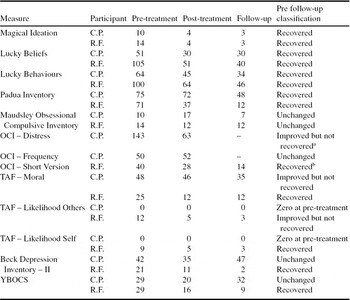
MI and superstitious beliefs and behaviours were found to be successfully altered by the intervention. This was demonstrated by the results at 3 months' follow-up (Table 1). Scores indicated that C.P. and R.F. had recovered on the MI scale, the PI, the LBel and LBeh scales. On the OCI – Distress Scale, C.P. was improved and on the OCI-SV R.F had recovered.
Questionnaire outcome data and classification of clients based on the twofold criteria of Jacobson et al. (Reference Jacobson, Follette and Revenstorf1984)

OCI, Obsessive Compulsive Inventory; TAF, Thought–Action Fusion; YBOCS, Yale–Brown Obsessive Compulsive Scale.
a OCI – Distress and OCI – Frequency calculations based on post-treatment due to missing data at follow-up.
b OCI – Short Version based on cut-offs described in Foa et al. (Reference Foa, Huppert, Leiberg, Langner, Kichic, Hajcak and Salkovskis2002).
R.F. had recovered on the TAF-M and TAF-LS scales; however, he met criteria for improved but not recovered on the TAF-LO Scale. C.P. was zero at pre-treatment for the TAF Likelihood scales; however, she also met criteria for improved but not recovered on the Moral subscale of the TAF. R.F. was recovered on the BDI-II at follow-up, whereas C.P.'s depression had further deteriorated.
On the YBOCS, at post-treatment R.F. was recovered while C.P. was improved but not recovered. At follow-up R.F. remained recovered whereas C.P. was unchanged (Table 1). Despite lower scores on the MOCI at follow up, the scores were deemed unchanged according to the twofold criteria of Jacobson et al. (Reference Jacobson, Follette and Revenstorf1984).
Discussion
Consistent with the first hypothesis, a 6-week treatment addressing magical thinking tendencies successfully altered magical and superstitious thinking styles. In relation to the second hypothesis, OC symptoms were rated as recovered on the PI and for R.F. on the OCI-SV. C.P. was rated as improved but not recovered on the OCI – Distress Scale, despite the fact that treatment did not target OC symptoms in any way. No specific OC beliefs were discussed in treatment. Exposure and response prevention, behavioural experiments and cognitive therapy targeting relevant obsessions and compulsions were not conducted with participants. The fact that a treatment purely aimed at magical thinking impacted on OC symptoms, is, at the very least, consistent with the hypothesis that magical thinking may be a causal or mediating factor in the disorder.
High MI may lead to people doing less well in therapy because they may be less willing to engage in exposure and response prevention. Magical thinking has been shown to be inversely related to psychological mindedness and ambiguity tolerance and positively related to external locus of control (Beitel et al. Reference Beitel, Ferrer and Cecero2004). Psychological mindedness has also been shown to predict a better response to psychotherapy when measured by self-ratings of psychosocial outcomes post-discharge (Conte et al. Reference Conte, Ratto and Karasu1996). Thus one reason why high MI may lead to a poorer response to existing treatment may be because individuals with high MI may be less open to a scientific-psychological world view. They may be less willing to acknowledge that their thought process may be flawed and less willing to try out behavioural treatments. In some cases of high MI, a second reason may relate to the testability of the OC fear reported. In this scenario the therapist may have difficulty constructing a behavioural experiment which will show that the feared outcome will not occur. For example, if a patient believes that touching a substance will lead to a family member contracting cancer in 10 years’ time, setting up a hierarchy and getting the patient and family members to touch the substance will not provide evidence that the participants have not died until the 10-year time-frame has elapsed.
C.P. showed less of an improvement in OC symptoms than R.F. She also reported a severe level of depression at pre- and post-treatment. It is possible that this depression further interfered with her ability to generate challenges to her OC fears without therapy input. Unfortunately the second hypothesis that a reduction in MI would lead to a decrease in OCD symptoms was only partially supported by the results. In order to demonstrate this more fully a larger trial would need to be conducted.
In fact there were several limitations to this study. These include the uncontrolled case study design, the lack of a structured diagnostic interview (apart from YBOCS) prior to treatment, and the small number of participants. Clearly further work needs to be done to investigate how the present package would complement existing procedures for the treatment of OCD. The package should be the most relevant for individuals presenting with high levels of magical thinking who have previously been shown to be poor responders to standard treatment of the disorder (Jenike et al. Reference Jenike, Baer, Minichiello, Schwartz and Carey1986; Minichiello et al. Reference Minichiello, Baer and Jenike1987; Maina et al. Reference Maina, Bellino, Bogetto and Ravizza1993; Moritz et al. Reference Moritz, Fricke, Jacobsen, Kloss, Wein, Rufer, Katenkamp, Farhumand and Hand2004). In addition it may be beneficial to apply this treatment to other disorders in which MI has been identified as present. Such disorders may include eating disorders (Lavender et al. Reference Lavender, Shubert, de Silva and Treasure2006), and body dysmorphic disorder given its high comorbidity with severe OCD (Stewart et al. Reference Stewart, Stack and Wilhelm2008).
Declaration of Interest
None.
Learning objectives
(1) To introduce readers to the literature on the presence of magical ideation in OCD and the finding that high levels of magical ideation lead to poorer response to current evidence-based treatment for OCD.
(2) To encourage therapists to assess levels of magical ideation prior to commencing cognitive behavioural treatment for OCD.
(3) To encourage clinicians to address magical ideation directly in treatment using some or all of the techniques described.
(4) To demonstrate that therapists can incorporate innovative and creative approaches to their work and remain within an evidenced-based paradigm.
(5) The article provides clinical support for the cognitive model of anxiety by showing that beliefs which generate fear are worth targeting in the course of treatment for anxiety disorders.



Comments
No Comments have been published for this article.