Introduction
This paper examines the operation of managerialism in the non-governmental sector in the state of Oaxaca, Mexico. Managerialism, which we define as formalised approaches to organisational management, constitutes a diverse set of specialised knowledges and practices that circulate throughout the state's vibrant civil society community. Its elements are typically imported to NGOs from the corporate and state sectors, often in conjunction with Northern academic programmes dedicated to business management and public administration.Footnote 1 As in other sectors, managerialism is not evenly or smoothly adopted in the NGO sector: it is negotiated and contested while nonetheless shaping organisational practices. This paper takes as its tasks the theorisation and description of the politics underlying the diffusion and operation of managerialism among NGOs in Oaxaca and a consideration of how aspects of managerialism can be challenged and reconfigured during periods of political and social upheaval, as happened in Oaxaca in 2006.
To begin with we summarise a theoretical framework for analysing how managerialism works ‘on the ground’. We orient researchers to the variability in flows of knowledge and practice as they move through international institutions and their collaborating organisations and onward, with particular attention to managerialism's impact on specific projects undertaken by NGOs. Second, we report on three empirical studies of managerialism in Oaxaca. These include an ‘extensive’ spatial analysis of the level of ‘formalisation’ among civil society organisations operating in Oaxaca, and two ‘intensive’ organisational ethnographies that trace managerialism's day-to-day unfolding within NGOs dedicated to environmental conservation and community development. These previously published findings are collected together here for the first time, giving us an opportunity to draw broader conclusions about the politics of NGOs in Oaxaca and the operation of managerialist relations within them. Third, we consider managerialism's role during and after the social unrest of 2006, when the political stakes for NGOs were raised. Many NGOs joined the key organisation leading the struggle, the Asamblea Popular de los Pueblos de Oaxaca (Popular Assembly of the Peoples of Oaxaca, APPO), while others positioned themselves differently.
Managerialism includes aspects of modern management that, in both corporate and public administrative worlds, have become associated with ‘good governance’.Footnote 2 Managerialism of this sort is of course not new in places such as Oaxaca. For centuries oaxaqueños have navigated complex bureaucratic structures and procedures emanating from various state agencies and from the pervasive footprint of the Partido Revolucionario Institucional (Institutional Revolutionary Party, PRI). In this way, then, the managerialism we are investigating is not ploughing new ground. It may be better understood as a reconfiguration of some long-standing and familiar social practices (such as paperwork and clientelistic relations) with some newer elements and language (such as transparency). There have been many studies that have discussed some of these enduring practices as aspects of bureaucratic authoritarianism, or of corporatism, for example.Footnote 3 For our purposes here, we focus on the ways in which contemporary managerialism has diffused through transnational networks, including development networks, and has been variously adopted and adapted by NGO communities in Oaxaca, a place where there is much that is familiar about managerial practices even as some elements may appear to be new.
It is also important to note that the recent uptake of managerialist practices by NGOs in Oaxaca, as elsewhere, has occurred under intensified inter-sectoral connections brought about by the neoliberal restructuring of state programmes devoted to social welfare provision, environmental protection and economic development.Footnote 4 In the wake of structural adjustment programmes and ongoing economic crises, many countries in Latin America, particularly Mexico, have seen a dramatic increase in NGO activity since the early to mid-1980s.Footnote 5 In their efforts to secure funding and other resources, these organisations have often complied with managerialist models, with their emphases on accountability, transparency, entrepreneurship and innovation. They work with ‘clients’ under participatory ‘best practices’ while attempting to ensure that their efforts contribute to capacity-building and are sustainable, and they employ consultants to help them manage their image, root out inefficiencies, develop evaluation criteria and conduct assessments. These aspects of managerial practice are now part of a wider NGO ‘development speak’, and have become components of resource-dependent relations existing among international NGOs and donor agencies, their subsidiary and partner organisations, independent clearing-house organisations, and grassroots NGOs.Footnote 6
Managerialism is complex and contradictory. On the one hand, donor organisations have an interest in ensuring that the funds they disperse are used on the projects for which they were intended and are not subject to pilfering or leakage. They also have an interest in seeing that best practices are followed: that the NGOs they support do not exploit client populations; that efforts are made to be inclusive and participatory; and that unbiased and objective programme assessments are undertaken. Donors want to know, for example, when and why negative impacts occur so they can be minimised in the future, just as they want to have a clear understanding of a project's positive impacts so that its successes can be disseminated for ‘scaling up’ to other areas or to other client populations. It is to some degree accurate to state that global civil society would not be able to meet its development, sustainability and justice objectives without the control, oversight and feedback mechanisms that managerialism sets in motion. Without such routine practices, the legitimacy of civil society at all levels and in all sectors might be threatened.Footnote 7
On the other hand, managerialism can reinforce already asymmetrical power relations.Footnote 8 In Mexico, NGO networks operate on terrain shaped by a legacy of exploitation, ethnic, gender and class exclusions, and an oftentimes paternalistic and clientelistic bureaucratic culture, all attributes potentially reinforced by the discourses and institutions of development. Sometimes managerialism can be culturally disjunctive: everything from completing personnel time sheets to filling out human subject approval forms can complicate inter-organisational relations that might already be fraught with differences over what projects are worthy of support, what constitutes ‘development’ in a post-colonial context, and so on. As such, managerialism can weigh heavily on the most well-intentioned NGO operatives, causing them to variously resent or resist incorporation into its rules, paperwork and intrusions, or to forgo collaborative relations altogether.Footnote 9 The risks of skewing goals towards means rather than ends, and of either punishing NGOs by withdrawing funds or creating conditions of ‘donor dependency’, are well known.Footnote 10 There is also the very real danger that, by processes that are at once instrumental and rationalising, managerialism will diffuse the transformative political potentials existing within the NGO sector.Footnote 11 At the very least, managerialism challenges the romantic image of the grassroots organiser more concerned with producing positive and sustainable outcomes than with implementing modern accounting practices, conducting appraisals and producing reports.
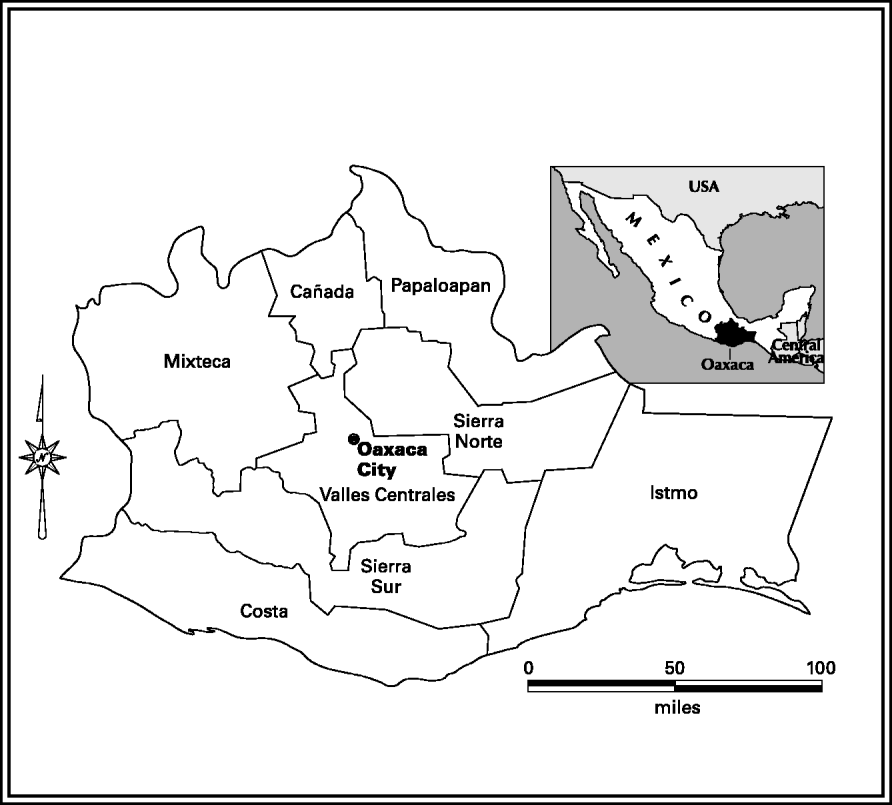
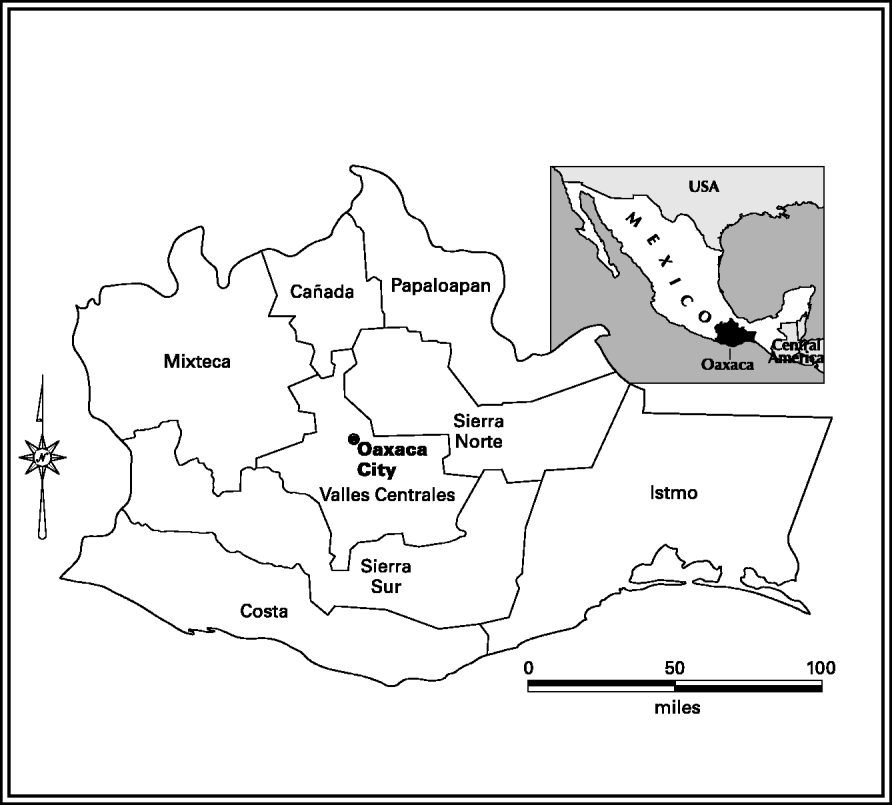
The issues just described are particularly pressing in the state of Oaxaca, which has seen an explosion of NGO activity since the mid-1980s, from wide-ranging affiliates of the largest international NGOs in the world to the smallest grassroots organisations confined to single villages.Footnote 12 Oaxaca is in southern Mexico, has a population of 3.5 million and is divided into eight regions (Figure 1). The state is the second-poorest in Mexico behind Chiapas and is highly culturally diverse, home to at least 16 major Indigenous groups.Footnote 13 With rugged terrain and uneven precipitation, it also contains regions recognised for their world-class biodiversity. NGO activity in the state of Oaxaca is unevenly mapped onto this cultural and ecological variation, with the approximately 400 organisations that operate in the state covering an enormous range of social, economic, political, cultural and environmental issues.
Map of Oaxaca's Eight Regions
The diversity and vibrancy of NGOs and wider civil society in Oaxaca is complicated by the dominance of the PRI in Mexico during the twentieth century. This control continued at the state level after the party's loss in the 2000 national election, and remained a contested legitimacy after the party retained the state's governorship in 2004. NGOs have had their work cut out for them in Oaxaca: the state has been severely impacted by the decline of the agrarian economy, by outmigration to northern Mexico and the United States, and by IMF-mandated structural adjustment policies that reduced social services. It is exemplary of those places in which NGOs have been left to ‘pick up the pieces’ in the wake of neoliberal globalisation.Footnote 14 Staffed by capable professionals facing scarce employment opportunities in Mexico's corporate and state sectors, as well as by civic-minded grassroots organisers and Indigenous activists, Oaxaca's NGOs offer rich possibilities for Northern donors and international NGOs seeking to provide assistance and support projects – but with managerialism, there are strings attached.
Conceptualising Managerialism in Motion
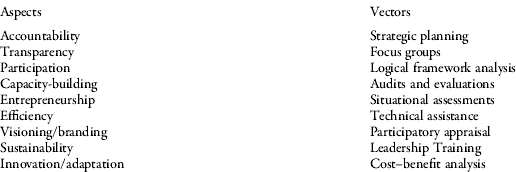
Table 1 summarises key aspects of managerialism, each of which has been the focus of a large literature in NGO management.Footnote 15 As an example, we consider briefly here one of the most studied areas of managerialism: accountability.Footnote 16 Edwards and Hulme define it as ‘the means by which individuals and organisations report to a recognised authority (or authorities) and are held responsible for their actions’.Footnote 17 NGOs must be held accountable, they argue, ‘if their claims of legitimacy are to be sustained’.Footnote 18 Upstream (or ‘patron’) accountability can require assessments of the use of funds provided by state agencies, firms and donor organisations, while downstream (or ‘end-user’) accountability refers to the assessment of projects undertaken by an NGO.Footnote 19 Internal mechanisms of accountability – self-assessments of an organisation's own rules, practices, goals and achievements – are also common.Footnote 20
Aspects and Vectors of Managerialism
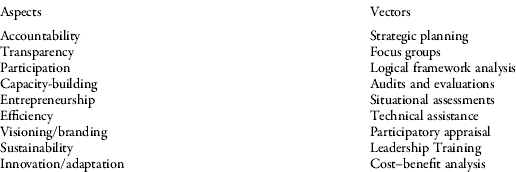
Table 1 also shows ‘vectors of managerialism’, specific methods through which different aspects of accountability and so on flow through networks and might be transferred to an NGO. The concept of managerial vectors recognises that knowledge regimes are linked to practices, and that these impinge on the work lives of NGO operatives as more time is devoted to ‘disclosures/reports, performance assessments and evaluations, processes of internal self-regulation, and social auditing’.Footnote 21 Importantly, in Oaxaca such vectors may require that NGO personnel have fluency in non-Indigenous languages (Spanish and, often, English), word-processing abilities, facility with quantitative data collection, analysis and display, and even familiarity with some social science and project evaluation techniques (such as focus groups or logical framework analysis). As we found in our study of a technical assistance programme, discussed below, this report and analysis culture may explain why all the ‘experts’ delivering technical assistance to the Indigenous rural communities we studied were educated professionals from Mexico City or other large cities.Footnote 22
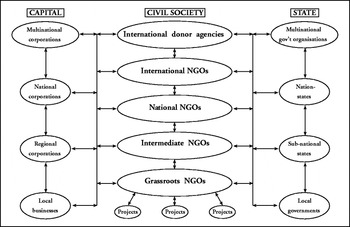
The framework for our analysis of managerialism has two components. The first involves a conceptualisation of the larger geographic and sectoral context through which managerialism travels. We put ‘managerialism in motion’ in Figure 2. The figure shows three sectors – capital, state and civil society – classified according to the scope of their operations (international, national, regional or local). Each institutional node is potentially linked to all others, directly or through other nodes, via a network of flows that consists of financial and material resources, personnel, and knowledge regimes and associated practices.Footnote 23 Together, these flows ‘capacitate’ or activate the network in ways that allow researchers to conceptualise, if not trace, the emergence and movement of particular aspects of managerialism as they circulate. Note the importance of treating these flows as bi-directional, recognising that actors in specific institutional settings can ‘push back’ in various ways against managerialism, in the process reworking elements of it. Examples could range from a failure to comply to more subtle forms of resistance, such as redefining what is meant by ‘participation’ or ‘transparency’.
A Fully Capacitated NGO Network

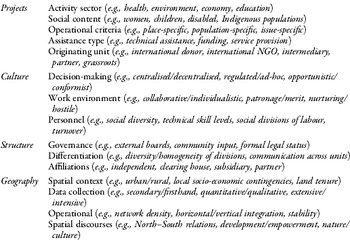
A second aspect of the framework involves conceptualising differences in organisational settings: these, research suggests, can affect how managerialism is formulated, disseminated and received. Drawing partially from the literature on management of NGOs and on organisational geography, we identified four dimensions of organisations that might impact the flows of managerialism: (1) the type of projects that organisations support or carry out; (2) aspects of organisational culture; (3) the structural dimensions of their operations; and (4) their geographic context.Footnote 24 Various components of these dimensions are shown in Table 2; they range in specificity from the aptitudes and characteristics of NGO personnel and the density of NGO networks to the type of assistance provided and the ways in which an organisation conceptualises social and economic development. Obviously, in a data-rich environment such as an NGO, it is impossible to hold constant all these variables in order to determine their independent impact on different aspects of managerialism. They are meant, instead, to be signposts for researchers undertaking ethnographies of the complex settings in which managerialism unfolds on a day-to-day basis. Such factors shape how managerialism is formulated within a particular organisation, as well as how accommodation and resistance emerge in different settings as its components are imported from the corridors of one organisation – say a national donor or local clearing-house NGO – to another – say a community NGO. Not least, given the recursive nature of the flows shown in Figure 2, these organisational dimensions can mediate upstream flows as personnel rethink managerialist directives in their ongoing and future projects. Detailed examples of these sorts of actions and interactions are drawn out in the organisational ethnographies reported later in this paper, but first we turn to a geographic portrait of Oaxacan NGOs.
Dimensions and Components Influencing Managerialism ‘On the Ground’

Source: Adapted from Roberts et al., ‘NGOs and the Globalization of Managerialism’.
NGO Formalisation in Oaxaca
An early part of our project involved compiling a census of NGOs operating in the state of Oaxaca.Footnote 25 Of the 400 or so NGOs thought to be operating in the state, we were able to secure detailed information on nearly 300. Of the variables we compiled, five were used to construct an index of the level of ‘formalisation’ for each NGO:
1. NGO type: this variable indicates whether the NGOs were (a) independently operating but place-bound (less formalised); (b) independent but demonstrably capable of working anywhere within the state (moderately formalised); or (c) a roving subsidiary of a national or international NGO (most formalised).
2. Legal status: this variable indicates whether or not the NGO had formal ‘AC’ (civil association) designation as a registered organisation. Those that did were presumed to be more formalised.
3. Central location: this variable indicates whether or not the NGO had its headquarters in Oaxaca City. Those that did were presumed to be more formalised.
4. Operational space: different from NGO type in contrasting organisational geographies to organisational structure, this variable measures the extensiveness of an NGO's operations, from community, municipality and region to multi-region, state-wide and extra-state levels. It was assumed that formalisation is positively correlated to the spatial extensiveness of the operations.
5. Year began: this variable was included under the assumption that formalisation is positively correlated with amount of time in operation.
These variables were reduced to a single index using factor analysis. Formalisation scores (or factor scores) for each NGO reveal differences in levels of formalisation, contrasting NGOs that are older, less place-bound (for example, roving subsidiaries), formally incorporated and centrally located, on the one hand, with those that are younger, more peripherally located and more spatially constrained, on the other.Footnote 26 Case-by-case qualitative evaluations of a set of familiar NGOs in the state gave the research team a high degree of confidence in referring to the index as a continuous surrogate for degree of ‘grassroots’ orientation among the 292 NGOs in our dataset. Given the complexity of organisational effects on managerialism developed in our conceptual framework (Table 2), we cannot draw direct correlations between this index and any individual NGO's accommodation of or resistance to the demands of managerialism, but it does seem safe to assume that those organisations with a higher index will have more organisational capacity in negotiating the demands of managerialism. Indeed, these NGOs are likely to owe some of their formalisation characteristics – greater geographical reach and flexibility, for example – to that capacity.
Among other things, we were interested in the regional variation in the index; accordingly, we calculated an average level of formalisation for each region in the state, based on region-specific counts of all NGO activities. Thus, a highly formalised NGO with projects in four of Oaxaca's regions would have contributed positively to each region's overall score, while a comparatively lower level of formalisation for a small place-based NGO would decrease the score for its particular region of operation. Our findings are summarised in Table 3, which provides data on three variables: the region-specific index average, the number of people per NGO active in the region, and a measure of regional poverty (for ease of comparison, the columns are aligned from the poorest to the richest region). The table shows that NGO formalisation and per capita activity levels have very little correlation with regional poverty levels. Thus, to explain the location of large grassroots sectors or highly formalised ones, as well as the overall level of NGO activity in Oaxaca, requires region-specific historical analysis.
Average Level of Formalisation and Poverty by Region

Notes: Higher values on the index indicate more formalised NGO operations in the region. Pop/NGO is the population divided by the total number of NGOs active in the region. NGOs can be active in more than one region. % Poor is the percentage of the working population earning less than Oaxaca's US$ 4 equivalent per day (data from the Instituto Nacional de Estadística, Geografía e Informátíca (National Institute of Statistics, Geography and Informatics), 2000 census).
Source: Adapted from Moore et al., ‘Mapping the Grassroots’, pp. 230 and 234.
To illustrate, consider Oaxaca's poorest region, Cañada, located in the remote northern part of the state (Figure 1). Comparatively speaking, it has a moderate level of NGO activity and, perhaps surprisingly at first, the highest regional formalisation index. Yet this score is not indicative of a high level of development among the region's NGOs, for an examination of the raw data reveals that Cañada has a weakly developed grassroots sector. Rather, it shows that, in the absence of such a sector, the region's NGOs are mostly spatially footloose, externally operated and urban-based – often with their headquarters located in Oaxaca City. By contrast, the equally poor region of Sierra Norte is found to have an extremely low level of formalisation among the NGOs located there, indicating a bias toward ‘grassroots’ activities. What is more, the per capita NGO values for Sierra Norte indicate that there are a large number of projects being undertaken by these organisations. These findings can be accounted for by reference to regional histories, economies and politics. Cañada has been and remains to some degree an outlier in the state, with a long history of top-down social relations. Sierra Norte's many small communities, on the other hand, have a history of radical organising in the protection of their cloud-forest resources; this helps explain the region's high degree of grassroots organising, as indicated both by its low formalisation index and by its low population per NGO measure (the latter may also be partly accounted for by the region's relative proximity to Oaxaca City).Footnote 27 In contrast to both these regions is the Istmo. It is relatively prosperous and has a vibrant level of grassroots (less formalised) activity (but less so, in per capita terms, than Sierra Norte). Finally, the Valles region has a large population relative to the number of projects undertaken, but a medium to high degree of formalisation among the NGOs there.
Generalisations from these regional findings may be aided by conceptualising a set of three hypothetical ‘NGO population pyramids’ of the sort used by demographers to illustrate a population's age and gender structure. At the top of each pyramid are the more formalised NGOs; the bottom shows the distribution of grassroots organisations. The familiar demographic triangular pyramid structure is comparable to that found in Sierra Norte, where there is a large grassroots sector and a limited amount of formalised activity. On the other hand, the situation in Cañada, where formalised institutions dominate, is more like an inverted triangle. A more uniform distribution, such as is found in the Mixteca, Costa, Papaloapan and Valles regions, would not be triangular but rather more rectangular in appearance. All things being equal, from a policy perspective it would seem that regions with a pyramid structure might be encouraged to build capacity by ‘scaling up’ in ways suggested by Uvin and colleagues.Footnote 28 In regions where the pyramid is inverted and where large, externally controlled and therefore highly formalised NGOs operate (such as Cañada), the problem is quite the opposite: how to build a strong grassroots sector so as to reach the widest possible constituency.Footnote 29 A more uniform distribution might permit the widest possible range of critical political engagement across levels of formalisation – an aspect that has taken on heightened significance in Oaxaca, as we discuss below.
Participation and Empowerment in the Forest
During 2004 and 2005, the research team undertook two organisational ethnographies of NGOs working in Oaxaca. The first organisation studied was Bosques Mexicanos, a forest conservation affiliate of the World Wildlife Fund (WWF); the second was the Fundación Comunitaria Oaxaca (Oaxaca Community Foundation, FCO), which acts as a clearing-house NGO. Both organisations have offices in Oaxaca City but work almost exclusively with rural Indigenous communities, both are operated and staffed mainly by educated, non-Indigenous Mexican personnel, and both deliver technical assistance. Bosques receives much of its funding from WWF-UK but also partners with major national, bilateral and multilateral organisations such as USAID and the Inter-American Development Bank (IDB). The FCO relies almost exclusively on such organisations (and US-based foundations such as the Kellogg Foundation) for its funding. We chose to investigate managerialism in motion by starting ‘in the middle’, as it were, of the networks, rather than in the headquarters of the donors or in the homes of rural residents affected by NGO activities, for example. Bosques and the FCO are deeply embedded in transnational networks, and as in nearly all cases, the donor institutions have strict rules for the management of resources and the operation of supported programmes. The aim of our studies was to trace flows of managerialism as they circulated within each NGO and to gauge their effect on projects of environmental conservation and community development respectively. Two researchers were placed within the organisations: David Walker worked with Bosques, and Margath Walker with the FCO. In this section we discuss findings from our study of Bosques’ efforts to implement a forest conservation plan in the Chimalapas forest area of Oaxaca State's Istmo region.Footnote 30 We follow this with a second section discussing the findings reported in our study of the FCO's technical assistance programme aimed at building organisational capacity and promoting entrepreneurship.Footnote 31
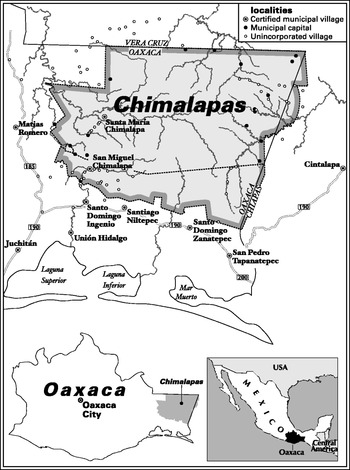
The Chimalapas forest is an area of roughly 600,000 hectares that rises from the flat plain of the southern and central Istmo region to more than 2,400 metres (Figure 3). Though threatened by in-migration, cattle ranching and illegal logging activity, the Chimalapas remains home to some of the best-preserved forest lands in Latin America. Sometimes referred to as ‘the lungs of Mexico’, the Chimalapas includes rare mountain cloud-forest ecosystems and montane mesophile forests of pine and oak.Footnote 32 The Indigenous peoples of the forest are Zoque-speakers. They comprise some 30 per cent of the area's total population of 13,000, roughly half of whom live in one of two municipios: San Miguel Chimalapa and Santa María Chimalapa. Both municipalities have relatively high degrees of legal autonomy, with traditional usos y costumbres governance fully sanctioned.Footnote 33
Map of the Istmo Region and the Chimalapas Forest Area

The politics and mechanics of ‘participation’ were an ongoing concern for Bosques’ staff during David Walker's on-site ethnography. Early on in the research he was confronted at Bosques’ Oaxaca City offices by a group of Zoque men who had travelled over nine hours by bus to press their demands for WWF funding of a forest conservation plan. The staff told the visitors that they were only authorised to provide technical assistance, and that no funds were available to support the communities’ planning efforts. The encounter brought into view tensions that have arisen as participation has migrated from its origins as a radical strategy of self-determination by marginalised peoples into a mainstream discourse.Footnote 34 In the eyes of critics the ‘mainstreaming’ of participation has involved co-optation by government and civil society organisations, converting it into a ‘new tyranny’ that is beyond redemption.Footnote 35 These issues are especially contentious when it comes to conservation efforts in Indigenous lands. In a 2004 World Watch Magazine article, Mac Chapin castigated the ‘Big Three’ environmental NGOs – Conservation International, the Nature Conservancy and the WWF – for a ‘disturbing neglect of the indigenous peoples whose land they are in the business to protect’.Footnote 36 Chapin cited a ‘string of failures’ on the part of the Big Three, including their top-down management strategies, their preference for people-free parks that ignore local people's access needs, the lack of cultural training among staff biologists, the concentration of funding that has solidified their power, and their partnering with capital and state interests that support ranching, mining, drilling and bio-prospecting on native lands.
Chapin's critique was a lightning rod within the global conservation community, including the offices of Bosques. There, discussions took place against the backdrop of more than two decades’ worth of efforts by the WWF to take into account the needs of local people and to implement participatory conservation. Even as its parent organisation was being attacked by Chapin, Bosques’ staff were operating under a 1996 declaration to ‘identify, seek out, and consult with legitimate representatives of relevant indigenous groups’, to ‘provide fora for consultation … so that information can be shared … and problems, grievances, and disputes … can be resolved’ and to ‘assist indigenous peoples’ organisations in the design, implementation, monitoring, and evaluation of conservation activities’.Footnote 37 Indeed, interviews revealed that participation was not simply a nuisance discourse but a presence, felt in part through the proactive coordination of WWF-UK, which oversaw Bosques’ work through its Forest Programme.Footnote 38 One aspect of WWF-UK's model of participation was found in its requirement that Bosques work directly with the leaders of the Chimalapas communities rather than through independent NGOs; in the past, these intermediary relations had resulted in several political missteps.Footnote 39
In June 2004, the Bosques staff biologist working on the Chimalapas organised a workshop with representatives from eight state agencies and another NGO in the Istmo town of Juchitán. The agencies – with oversight over environment, transportation, agriculture, Indigenous affairs, forestry and social development, among other areas – were there to pursue two goals: first, to coordinate governmental and NGO activities in the forest, which had been notoriously fractured, to the point that agencies often found themselves working at cross purposes; and second, to prepare themselves for an asamblea, or assembly, called for the next day by the comisariados of the two Chimalapas municipios.Footnote 40 The first goal was met only partially, since old patterns of information control seemed hard to break down. Nonetheless, the workshop participants did agree that the next day's asamblea posed a significant challenge. In the words of one government official: ‘[It] is going to be difficult to control the Chimalapas community members in the assembly. Although we are guests there, we need to come up with a strategy to not allow them to dominate the meeting’. Another Juchitán participant agreed: ‘If we give them the opportunity to speak, they will continue speaking for the whole time’.Footnote 41
These concerns, though not universally expressed, suggest that the Zoques were acknowledged as highly capable in their dealings with representatives of NGOs and state agencies. The Zoque leaders had, in the words of ‘participation-speak’, themselves become empowered – partly through earlier experiences in participatory conservation programmes that they now found themselves contesting. From these engagements, the Zoque leaders obtained knowledge of both their legal rights and the language of community development and natural resource planning. Among other sources, ‘vectors of empowerment’ in the forest included the following arrangements. First, the development of state-funded Natural Resource Committees (NRCs), which helped train Zoque leaders in modern forest management. Second, statutory decrees in 1995, 1998 and 2004 that concentrated power in and bequeathed autonomy to the two municipios while also giving them responsibility for crafting their own local legal codes. Third, a decade of working, contentiously in some cases, with some of the 80 NGOs present in the Istmo region.Footnote 42 Fourth, a powerful discursive shift in ethnic politics – a ‘politics of recognition’ such that, at least since the 1994 Zapatista rebellion in neighbouring Chiapas, ‘the emergent political actor in Oaxaca was no longer peasant but indigenous, and … ethnicity more than class … [became] crucial in the mobilisation of political identities’.Footnote 43 Empowerment enabled territorial claims to be pressed so that, as one of the region's residents explained to the government and NGO representatives, ‘If you want to come into our house, you have to come in through the front door. You cannot come in through the back window’.Footnote 44
The asamblea for which the NGO and government personnel were preparing brought over 300 people to San Miguel's community centre. As predicted, the meeting began testily, with many audience interruptions of the government representatives’ presentations. The Bosques plan, presented by the staff biologist in the increasingly warm building, covered numerous points, including the designation of conservation and sustainable logging areas, rules for financing projects, the development of non-wood resources, strategies for guarding the forests, and the logging permit process. When he had finished, the comisariado from Santa María took the microphone in the now sweltering building, and proclaimed:
Where does all of the money go that you receive from USAID, DFID and IDB? We know that many NGOs have received millions of pesos. No, compañeros, not just pesos, millions of dollars, to study the Chimalapas, to work with the communities in the Chimalapas, to develop strategies and plans for the conservation and the preservation of the Chimalapas, but where is all of that money? It did not stay in the community! They took it with them! This new inter-institutional master plan for the Chimalapas is not a development plan. If it were a development plan then it would include education, health care, transportation infrastructure and communication infrastructure, the management of livestock and crops, not just environmental preservation. Today, compañeros, we present the Plan Comunal Chimalapas para la Defensa Indigena y Biodiversidad [Chimalapas Communal Plan for the Defence of Indigenous People and Biodiversity]!Footnote 45
The comisariado then gave the microphone to his counterpart from San Miguel, who, step by step, outlined the details of a multifaceted communal plan, including its environmental, social (including health care and education), economic and infrastructural components. The staff member who had been leading the Bosques delegation and who had just presented the Bosques conservation plan, realising he had to defer to the Zoque leaders, stood up at the end and embraced them, telling them that he was enthusiastic about working together with them on their plan.
For us, the event highlights how one aspect of managerialism, participation, can meet on unequal ground the circulation of another, empowerment. And even while both to some extent have common connections to governmental (NRCs) and non-governmental (WWF-UK) nodes, like any discourse, they are eventually set free from these contexts and they circulate, morph and sometimes rebound in surprising and unanticipated ways (Figure 2). The events that day also point us toward the difference between an aspatial, non-territorial understanding of participation (as free ‘communication’ or ‘dialogue’) and one that is resolutely rooted in the material space of the forest, from which the Zoques can, through their empowerment, retain the right to extend an invitation, and not simply to ‘participate’ (or ‘have input’).Footnote 46
At the same time, we must caution against overlooking the very real social differences within the Chimalapas. The concentration of power described above has left decision-making in the hands of a relatively small number of Zoque men. If invitations are to be offered, it is important that the many women, young people, in-migrants, and non-Indigenous populations in the Chimalapas are part of their issuance. Just as these differences within the forest preclude a consensus over the ‘we’ that constitutes the Chimalapas, so too does the ‘masking of social difference in the name of a totality [that is, ‘community’] prevent closure around the politics of … participation, whether understood as a practice in need of rehabilitation or as the new tyranny’.Footnote 47 In other words, participation always requires a ‘we’ behind an invitation to dialogue, and there we will find additional questions of power, as well as empowerment.
Vectoring Neoliberalism through Technical Assistance
In this section we turn our focus to a vector of managerialism, technical assistance, examining briefly its contested history and contemporary use in a community development project in Oaxaca. The project in question was undertaken by the Fundación Comunitaria Oaxaca (Oaxaca Community Foundation, FCO) through a contract awarded by the Inter-American Development Bank (IDB). Formally titled Fortalecimiento de Procesos de Desarollo Micro-Regional en el Estado de Oaxaca (Strengthening the Processes of Small Area Development in the State of Oaxaca), the so-called demiregión programme's name performs double duty, signalling its micro orientation (demi-región) while inviting community ownership (de-mi-región – ‘of my region’). The programme had as its goals the building of capacity through aprendizaje, a process aimed at enhancing Oaxacan civil society by promoting ‘productive organisations’ – usually small, community-oriented businesses – through the transfer of business skills, marketing information and technical knowledge. (Already in the goals of the demiregión programme, then, we see the mixing of civil society and entrepreneurial objectives – a feature to which we will return later.) The programme was specifically designed to foster the participation of both women and Indigenous populations in activities as diverse as artisan and craft production, ecotourism and micro-credit provision.
At the top of the demiregión organisational chart were the FCO's permanent staff; their job was to provide direction and administrative oversight. They, in turn, relied on five fieldworkers; these were the NGO operatives whose job it was to identify community-based organisations –organizaciones de base – that were ready to receive technical assistance, and then to coordinate the field visits by experts contracted to deliver technical assistance at the village level. The idea was simple enough: find community-based, market-oriented organisations; determine, through a diagnostic evaluation, their needs; consult with the FCO's staff regarding a plan to strengthen the organisation; and acquire the services of a professional with knowledge and expertise deemed relevant. That expert would visit the community with the fieldworker and conduct a workshop; afterwards an evaluation would be undertaken, and then the process would be repeated in a new community. In this model, community organisations received only technical assistance. Project funds went to the FCO, its permanent and contingent staff, and the contracted experts, in the form of wages, travel, per diem, supplies and so on.
Although attending to local conditions was an explicit part of its remit, the demiregión programme was in practice characterised by a strategy consistent with the abstractions and standardisations that define the most calculative dimensions of managerialism. First, fieldworkers were to target communities in five regions of the state: Valles Centrales, Sierra Sur, Costa, Papaloapan (the La Chinantla area) and Sierra Norte (the Sierra Juárez area). Fieldworkers found their work difficult, and noted the distinct set of challenges facing them in each of the designated regions. Yet they were required to follow the same diagnostic evaluation procedures for all sites, enforcing a standardisation that, while useful for cross-context comparisons, did not permit them to adapt tactics to suit the circumstances of different localities. Second, the identified local organisations were required to be engaged in market-oriented, productive activities. Here too assessments of appropriateness were made by standardised questionnaire. In many cases, however, fieldworkers encountered more informal community economies, organised in many cases around familial lines and often not legally constituted, lacking a product, or owing allegiance to a particular political party.Footnote 48 Often a group would seem to have evaporated upon the second or third visit – this reflected the extremely informal and insubstantial nature of many of the organisations, some apparently existing only in so far as members anticipated some benefits from the organisation's qualification for technical assistance. As a result, fieldworkers expressed frustration about trying to muster enough people for the workshops.
It is worthwhile here to reflect briefly on how this project extends the history of technical assistance with the larger domain of development.Footnote 49 Technical assistance emerged in the post-war period as a set of ‘hard’ programmes, expert-delivered knowledge and technologies, often in the areas of infrastructure and agriculture (such as dams, bridges, irrigation systems, new farming practices, and pest- and drought-resistant seeds, often delivered via extension agents), in Mexico and elsewhere. It grew throughout the 1960s under programmes by USAID and the United Nations Development Programme, expanding from engineering projects into health and education by the end of the 1970s. Under structural adjustment programmes, technical assistance took on the task of training bureaucrats in the management of national economies and with this turned to its ‘soft’ form, with its greater emphasis on the ‘provision of expert services for institutional and human development’.Footnote 50 This shift from material-environmental transformations to human capital development is mirrored in the demiregión programme. And while it is true that the FCO hired Mexican fieldworkers and professionals rather than expatriates, neo-colonialist models, which can ‘perpetuate expatriate attitudes and organisational cultures’, may still be at work.Footnote 51 This is especially so in a programme that seems to align so closely with the ideology of neoliberalism.Footnote 52
We understand neoliberalism as marking political-economic shifts that emerged around the world in the 1980s and that seek to realign the relations between people and one another, and between people and markets.Footnote 53 Some markers of neoliberalism include: the liberalisation of the mobility of goods (trade) and capital (but not people); the deregulation of the financial sector (but with state guarantees of bail-outs in times of crisis); a minimal role for the state in economic life (beyond securing property rights, upholding contract law and maintaining security); and, most importantly for the programme under review, the expansion of market mechanisms into previously non-marketised sectors (such as education, water and childcare) and areas (such as Indigenous communities). Concomitant with all of these is the transformation of subjectivities, such that individuals rework themselves to be more in line with economic logics in all aspects of their lives.Footnote 54
We have already described some of the ways in which the FCO's demiregión programme expressed managerialism: in, for example, the one-size-fits-all approach to the differences among and within rural communities; its accountability-ensuring reliance on common diagnostic and evaluative tools; and its emphasis on entrepreneurship, efficiency, capacity-building, sustainability and innovation. Equally important, however, is how well these elements of managerialism – and the programme's deliverables – meshed with the subject-transforming potential of neoliberalism. Indeed, it would not be unreasonable to suggest that ‘soft’ technical assistance seems to fit more comfortably into NGOs and other non-profit vehicles of civil society than it does into the state and capital sectors, for it is there that entrepreneurship and marketisation can do their work without the overt clientelism of the state or the singular profit orientation of capital.
Central to all aspects of the demiregión programme was the cultivation of entrepreneurs with better-developed managerial skills. Such technical assistance was pedagogical to its core, aimed at creating new entrepreneurial subjects by teaching its enrolees how to keep track of time and money, present a professional attitude, and maintain the borders between family, community and business. Curiously, in many instances, those targeted for assistance – especially Indigenous women – were expected to be both bearers of some collective identity (most commonly framed as members of comunidades) and individualised market-oriented subjects. In the former case, the staff's use of the historically inflected comunidades played a dual role: it helped to ingratiate fieldworkers and technical assistance professionals alike with the rural villagers they addressed, and it enlisted the villagers’ sense of responsibility as members of a community whose traditional usos y costumbres law all but ensured an ethic of self-sacrifice. This could only help to serve the FCO's overarching objective: the construction of organizaciones, a term (equally at use in its offices) that suggests a move toward the rationalities of development, productivity and marketisation. All of this discursive work, in which we see what Thomas Lemke notes to be a ‘consistent expansion of the economic form to apply to the social sphere, thus eliding any difference between the economy and the social’, ironically took place in a political economy of financial flows that, though they were activated in the name of villages and their rural poor, never resulted in any actual money or tangible resources being transferred to any of those designated as beneficiaries.Footnote 55 Instead, the programme delivered only intangibles (skills and knowledges), not payments or material goods, as it worked to create entrepreneurial subjects.Footnote 56
Politicising NGOs after 2006
Although the NGOs we put under the ethnographic lens were in their own ways conduits for some of the most problematic aspects of managerialism, they were also goal-seeking institutions, intent on making change while pursuing internal and sometimes individualised agendas. In all cases their operatives demonstrated a deep understanding of donors, and of their knowledge regimes, their organisational cultures and the larger contexts within which they worked. One such larger context informing the daily practices of the NGO staff is the formal political sector. In their discussion of the politics of civil society development organisations, Jude Howell and Jenny Pearce point to the complexity of NGOs and their relations to the state (as well as to donors and markets).Footnote 57 They show how state power relations are both reproduced and challenged within civil society, how outcomes are not predetermined but contingent, and how these produce conditions not only for failure, but also for change. Assuming that Howell and Pearce are correct, we should then always remain open to the possibility that new forms of civic action can emerge under the dynamic circumstances within which dispersed and indeterminate forms of power circulate.
This is precisely what happened on the streets of Oaxaca in the summer of 2006, when the city was rocked by the authorities’ failed attempt to crack down on striking teachers in its centre.Footnote 58 The uprising that ensued lasted for six months, intensifying and heightening existing patterns of state-led violence against Indigenous communities, women and poor people, and it both revealed and deepened the fissures within Oaxacan society.Footnote 59 The events also had a transformative impact on the state's NGO sector. Many NGO staff found themselves thrown into active oppositional politics, embracing a new role that for some resembled the noisy activism of their youth. In a meeting called on the afternoon of 14 June at a local women's NGO, a large number of representatives from local civil society organisations (organismo civil is their preferred self-designation) met and discussed what action they should take. At the meeting, many organisations’ representatives expressed a common feeling of being under attack, and a consensus emerged that the only redress was to seek the immediate resignation of then-governor Ulises Ruiz. In deciding upon this course, these organismo civil operatives became founding members of APPO, which saw itself as a legitimate expression of popular will after a dubiously elected government had been further delegitimised through its violent response to the striking teachers.Footnote 60
The formation and subsequent actions of APPO initiated a qualitative change in NGO–government relations in Oaxaca. While many of the state's NGO operatives had never hidden their dislike for the state government or the PRI, many NGOs had become accustomed to cooperating with both on a variety of issues. For example, a number of organisations had funding for projects involving democratisation, the content of which tended to be related to empowerment as ‘citizenship training’, in which people were taught how to act appropriately within a given power structure; or organisations would enrol people in workshops stressing leadership, transparency and political reform. These programmes never directly challenged existing power structures, however, and in some cases were quite compatible with them.Footnote 61 Certainly before the violent summer of 2006 there had been nothing like APPO, with its commitment to collective political action and demands for the resignation of the state's governor. Some NGO operatives became leaders within APPO, adopting a direct-action approach to political change, including the occupation of government buildings, the disruption of traffic and the takeover of whole neighbourhoods. Many bravely risked their organisations’ viability and their own and their families’ safety as they were threatened, jailed and physically assaulted.Footnote 62 In other cases support was more tacit as sympathetic organismo civil elements employed traditional strategies to organise and publicise APPO's actions, as well as run meetings and stage events, both in physical locales and in cyberspace.Footnote 63 Many found that they could leverage their networks to circulate information and alert national and international audiences to their versions of the struggle. Inspired by the Zapatista uprising some 12 years earlier, the production and circulation of information in support of APPO became important work for some organisations, giving rise to a number of websites and documentaries designed to give APPO's point of view on events.Footnote 64 These political commitments sometimes came at the cost of donor relations, and many NGOs involved in the struggle incurred a considerable financial burden as mainstream projects were put on hold and energies were directed toward the unfunded political work within APPO.
The events of 14 June thus reshaped the very nature and meaning of politics for many Oaxacan NGOs.Footnote 65 Largely present and active in the uprising were many grassroots NGOs; when operatives from international NGOs became involved, they often did so under the proviso that they were not representing their organisation. Many of the smaller local NGOs signed on to APPO as organisations, joining in a diverse mobilisation that included union members, ‘common’ people, students and radical activists.Footnote 66 In doing so they broke out of the managerial mould so often assigned to NGOs by their networked position as nodes of neoliberalism. The 14 June events also ushered in a new spirit of cooperation among organisations that had typically competed for scarce donor resources. Since then a new political axis of NGO alliances has developed, marked by the distinction between those that participated in the movement and those that did not. With the exception of human rights organisations at all levels, then, more than a fair share of the most sympathetic and active NGOs in APPO were of the less formalised, more grassroots variety. This confirms our suspicion that greater levels of formalisation would correspond to both more entrenched managerialist practices and higher barriers to political action.Footnote 67
A further blow to managerialism's apolitical tendencies can be found in the Espacio Civil, a loose agglomeration of NGOs which held separate meetings about tactics and strategies but whose deliberations fed directly into APPO's General Assembly.Footnote 68 Espacio Civil members convened frequently to formulate strategy, create a common voice and discuss the potential contributions that civil society organisations could make to the movement. As such, the Espacio Civil is not a formal organisation but a network of NGOs that has endured. The NGO members understand themselves to be part of a larger movement to which they can contribute expertise, especially in legal, technical and organisational domains. When APPO was finally able to negotiate with the Mexican federal government, two Espacio Civil members became part of the negotiating team of 22. APPO itself came to exemplify the power of horizontal political action, absent of pyramidal or hierarchical organisational structures.Footnote 69 Although the movement's activities were severely curtailed by a brutal federal police crackdown on 25 November 2006, the links forged between the different civil society organisations held firm. Espacio Civil members continued to collaborate on different initiatives by, for example, creating a web radio station called Banda Civil and conducting state-wide election-watch campaigns. Some NGOs turned more vigorously to human rights activities, working in association with others in order to leverage international pressure against continued repression.Footnote 70 Other organisations turned to more formal politics, aiding in the creation of a coalition of opposition parties whose gubernatorial candidate was victorious in the elections of 2010. These organisations’ efforts were rewarded with the inclusion of various persons active in civil society in the new cabinet. For example, civil society representatives were chosen to head up institutes focusing on issues of concern to women and to Indigenous people.
Conclusion
This paper reports on a set of studies aimed at producing better theorisations and empirical understandings of the role of managerialism across Oaxaca's diverse NGO community. Our project has been both multi-method and multi-sited. At the theoretical level, we conceptualised a multi-sectoral (capital, civil society, state) collection of networks through which the discursive practices of managerialism flow into the daily work of NGOs. There are, we surmised, both aspects (akin to ‘discourses’) and vectors (akin to ‘practices’ and ‘technologies’) of managerialism (Table 1). The theoretical framework is attuned to both the geographic and sectoral origins and dispersions of these knowledge regimes (Figure 2), and to their embedded position within NGOs with different cultures, organisational capacities and so on (Table 2). Empirically speaking, the complexities of these flows prohibit a complete mapping of managerialism in motion. This is because managerialism is tricky: it emerges morphed by state, civil society and capital interactions; it is contingently attached to allied discursive practices surrounding neoliberal entrepreneurship, good governance, engaged citizenship and sustainable development; and it flows multilaterally, emerging from Northern standards of modernisation but landing upon, and encountering resistance from, an entrenched terrain of oftentimes corrupt, bureaucratic, clientelistic and paternalistic relations long associated with Oaxaca and the Mexican state.
Our first empirical study was extensive in design. It drew upon two censuses of Oaxacan NGOs to produce a dataset whose variables unevenly, but by parts, enabled us to forge an index of formalisation that provides a snapshot regionalisation of NGO activity in the state. From the 292 observations we analysed, there emerged a picture of formalisation that is varied and yet discernable: the poorest, most remote and least politically active region (Cañada) has – perhaps contrary to expectations – the most formalised NGO activity, owing largely to the absence of grassroots organisations relative to the presence of outpost NGOs with strong primate-city and international connections. On the other hand, formalisation appears to be low – indicating the existence of a strong grassroots sector – in a similarly poor region (Sierra Norte), characterised by a history of political activity and a location not far from Oaxaca City. To be sure, we cannot map our constructed index of formalisation onto a one-to-one relation with managerialism, for the latter has no quantifiable metric. However, in broad strokes we might do well to assume that managerialism travels more readily in those circuits where the index of formalisation is high (Table 3). Thus, its dictates, rather than being correlated to maps of poverty and wealth, are tied to complexly figured contexts of local history, economy and culture that have shaped the regionally varying structure of NGO activity in Oaxaca.
We then turned to managerialism ‘in motion’ or ‘on the ground’ – the latter might well have served as the section heading for our two in-depth case studies, one of the WWF's Bosques forest conservation plan in the Chimalapas and one of the FCO's neoliberalising technical assistance programme targeting community organisations in rural villages. In Bosques we found a strong presence of participatory discourses, but they were largely just that; in practice, the ends of saving the forest trumped the means. Participation, however, was not a discourse lost on the Indigenous forest peoples of the Istmo: they used their prior experience in state-sponsored resource management planning and their history of political organising through usos y costumbres to confront the Bosques NGO with their own discourse, that of empowerment. In the case of the FCO, we found a steady stream of neoliberal subject-making, all supported through a regime of practices and technologies known as ‘technical assistance’. We found that the FCO's territorial strategies, community definition procedures, and project design and appraisal methods followed the classic ‘cut-and-paste’ model of managerialism, but the encounters we witnessed on the part of local groups seldom translated into enthusiastic adoption of new practices.
In brief, our research has shown that there can be no easy assumptions made about the effects of managerialism in the NGO sector. As a set of knowledges and practices, its abstractions always meet the terrain of locally specific conditions and contextualised politics. By adopting elements of managerialism, many NGOs in Oaxaca have been able to secure a long-term footing in the formalised arena of civil society. They have been able to access national and international networks and their associated resource flows, and many have accomplished ambitious goals of social development and environmental sustainability. And yet, in 2006 the managerialist, ‘business as usual’ mode of operation of many NGOs was called into question in acute ways. The fact that so many organisations joined APPO, and in doing so have been able to qualitatively change the nature and meaning of politics in Oaxaca, is a testament to the vigour of civil society organisations, including but not limited to the NGO sector. The events of 2006 and since have brought into sharp relief the potentials and limits of various organisational forms and strategies. Managerialism was part of that complex mix, neither determining nor irrelevant to the role that NGOs have played and will continue to play in bringing about social and political change in Oaxaca.