Numerous investigations in child language suggest a strong association between lexical and grammatical abilities in the early stages of language (e.g., Bates & Goodman, Reference Bates and Goodman1997, Reference Bates, Goodman and MacWhinney1999; Dale, Dionne, Eley, & Plomin, Reference Dale, Dionne, Eley and Plomin2000; Dionne, Dale, Boivin, & Plomin, Reference Dionne, Dale, Boivin and Plomin2003; Marchman & Bates, Reference Marchman and Bates1994). The strong association between lexicon and grammar is thought to indicate continuity, interdependence, and “inseparability” of these two language domains (Bates & Goodman, Reference Bates and Goodman1997). Moreover, hypotheses such as the lexical bootstrapping hypothesis, the continuity hypothesis, and the critical mass hypothesis propose that the acquisition of lexical knowledge is prior and a prerequisite for the development of grammar (for a review, see Bartsch, Reference Bartsch2006; Marchman & Thal, Reference Marchman, Thal, Tomasello and Slobin2005). Across different languages, children do not begin to combine words until their vocabularies reach several hundred words (see Bates & Goodman, Reference Bates, Goodman and MacWhinney1999). Children typically master a critical mass of words before producing a variety of syntactic constructions; for example, the size of verb vocabulary strongly predicted the number of verb overregularization errors in young English-speaking children (Marchman & Bates, Reference Marchman and Bates1994). The interdependence between the lexicon and the grammar supports the assumption of a single or domain-general mechanism behind language development (Marchman & Thal, Reference Marchman, Thal, Tomasello and Slobin2005; Tomasello, Reference Tomasello2003). These domain interdependence hypotheses clash against other theoretical frameworks, such as the declarative/procedural model or dual-system theory of language acquisition (Pinker & Ullman, Reference Pinker and Ullman2002; Ullman, Reference Ullman2001; Ullman, Izvorski, Love, Yee, Swinney, & Hickok, Reference Ullman, Izvorski, Love, Yee, Swinney and Hickok2005). In these frameworks, the lexicon and the grammar constitute two separate language subsystems organized in distinct cognitive and neural modules. The lexicon is learned as part of declarative memory, in rote or associative memory, and is subserved by domain specific cognitive components. In contrast, the grammar (or the rules or constraints that combine lexical forms into phrases and sentences) depends on procedural memory, which is subserved by different cognitive components (Ullman, Reference Ullman2001, Reference Ullman2004). Support for these ideas comes from studies of children's use of regular and irregular morphology in English, Spanish, and German. They found that children tend to overapply “rules”; for example, children may use the English regular past tense morpheme “-ed” with irregular verbs. In contrast, overgeneralization of irregular language forms to regular forms (e.g., vowel stem changes observed in English irregular past tense or Spanish irregular verbs used with regular verbs) is rare, suggesting that irregular verbs are stored in declarative memory and that the rules for regular verbs are part of procedural memory (Clahsen, Reference Clahsen, Featherston and Sternefeld2007; Clahsen, Aveledo, & Roca, Reference Clahsen, Aveledo and Roca2002; Ullman, Reference Ullman2001).
Empirical support for the interdependence of the lexicon and the grammar is based on studies of young children with typical and atypical development, as well as of children who speak typologically different languages. For example, researchers examined the relationship between English vocabulary size and grammatical skills (measured by length of utterance, use of functional words, and mean number of words of the three longest utterances) using the MacArthur Communicative Development Inventory (Fenson et al., Reference Fenson, Dale, Reznick, Thal, Bates and Hartung1993). Parental reports from more than 1800 monolingual English-speaking children between 8 and 30 months of age were examined and a strong relationship between vocabulary size and use of selected regular and irregular bound morphemes (e.g., plural -s; r = .85, p < .001) was found (Fenson et al., Reference Fenson, Dale, Reznick, Bates, Thal and Pethick1994). Similar findings were observed in special populations of English-speaking young children, such as early and late talkers and children with Down syndrome, Williams syndrome, and focal brain lesions (Bates et al., Reference Bates, Thal, Trauner, Fenson, Aram and Eisele1997; McGregor, Sheng, & Smith, Reference McGregor, Sheng and Smith2005; Moyle, Ellis Weismer, Evans, & Lindstrom, Reference Moyle, Weismer, Evans and Lindstrom2007; Singer-Harris, Bellugi, Bates, Rossen, & Jones, Reference Singer-Harris, Bellugi, Bates, Rossen and Jones1997).
The link between lexical and grammatical development has also been found in monolingual speakers of other languages such as Italian, Hebrew, Icelandic, and Spanish (Caselli, Casadio, & Bates, Reference Caselli, Casadio and Bates1999; Caselli et al., Reference Caselli, Bates, Casadio, Fenson, Fenson and Sanderl1995; Devescovi et al., Reference Devescovi, Caselli, Marchione, Pasqualetti, Reilly and Bates2005; Jackson-Maldonado, Thal, Marchman, Bates, & Gutierrez-Clellen, Reference Jackson-Maldonado, Thal, Marchman and Bates1993; Maital, Dromi, Sagi, & Bornstein, Reference Maital, Dromi, Sagi and Bornstein2000; Thordardottir, Weismer, & Evans, Reference Thordardottir, Weismer and Evans2002). However, limited research is available for children exposed to more than one language, in particular, Latino children who are learning both Spanish and English languages. These children constitute an increasing percentage of the children in the United States, with great variability in proficiency and use of the languages (United States Census Bureau, 2000). The linguistic performance of these children may reveal relationships between lexical and grammatical domains within languages as well as cross-language interactions. In fact, several researchers have noted that bilingual children provide an excellent opportunity to measure associations between lexical and grammatical domains within and across languages while holding other child-related factors constant (Marchman, Martínez-Sussmann, & Dale, Reference Marchman, Martínez-Sussmann and Dale2004; Pearson, Fernandez, Lewedeg, & Oller, Reference Pearson, Fernandez, Lewedeg and Oller1997).
In particular, the language performance of bilingual children allows us to examine whether grammatical attainment in one language is associated to lexical abilities within the same language and/or across languages. During development, the grammar emerges gradually. Children who speak either English or Spanish have been shown to initially use morphosyntactical forms with constrained lexical items and to later generalize grammatical rules to other words (Gathercole, Sebastian, & Soto, Reference Gathercole, Sebastian and Soto2002; Tomasello, Reference Tomasello2000, Reference Tomasello, Tomasello and Bates2001). Within this framework, the role of experience with a variety of lexical items is fundamental for the development of the grammar (Bates & Goodman, Reference Bates, Goodman and MacWhinney1999; Tomasello, Reference Tomasello2003). Under this perspective, grammatical attainment in a given language is expected to be more strongly associated with lexical knowledge in that specific language, than to vocabulary level in the other language. This prediction is also consistent with a perspective that underscores the role of general cognitive abilities, such as perceptual and structural bootstrapping (i.e., cognitive processes that are not domain specific), on language development (Marchman & Bates, Reference Marchman and Bates1994; Plunkett & Marchman, Reference Plunkett and Marchman1993). Perceptual and structural bootstrapping refers to the child's cognitive abilities to discover perceptual cues and pattern distributions in the language input, which in turn, facilitate the child's learning of the language(s) (Naigles, Reference Naigles1990; Naigles & Hoff-Ginsberg, Reference Naigles and Hoff-Ginsberg1998; Shi, Werker, & Morgan, Reference Shi, Werker and Morgan1999; Werker & Yeung, Reference Werker and Yeung2005). Because these abilities support the learning of both the lexicon and the grammar, one may expect associations between these two language domains. However, a child who is exposed to two languages must also be able to detect different cues and distributions of phonemes, words, and word order, for example, for each language. The impact of these cross-linguistic differences in cues and distributions may vary depending on the amount and quality of exposure to the two languages. Thus, the strength of the association between lexical and grammatical domains may be affected by the degree of similarity/difference between the morphosyntactic characteristics of the two languages as well as sociolinguistic factors affecting the acquisition of the two languages in bilingual children. Bilingual children may also be able to extract abstract concepts about word combinations from one language and apply them to the other (Conboy & Thal, Reference Conboy and Thal2006). Yet, additional factors such as typological similarities and differences across the two languages, the context of language(s) exposure, the social status of the languages, language dominance, and age of acquisition may also affect the extent to which attainments in one language relate to attainments in the other, and as a result, the associations between lexical and grammatical domains may not be apparent across the two languages.
A study of Spanish–English bilingual toddlers living in the United States looked at the relationship between vocabulary and grammar variables within Spanish and English and across languages using parental report (Marchman et al., Reference Marchman, Martínez-Sussmann and Dale2004). One or both parents completed the MacArthur Communicative Development Inventory (Fenson et al., Reference Fenson, Dale, Reznick, Thal, Bates and Hartung1993) and its Spanish equivalent (Inventario del Desarrollo de Habilidades Comunicativas: Palabras y Enunciados; Jackson-Maldonado et al., Reference Jackson-Maldonado, Thal, Marchman, Newton, Fenson and Conboy2003) based on their ability to read and write in that language and their familiarity with their child's language use. Significant correlations between vocabulary size and grammatical complexity (use of selected bound and unbound morphemes) were found within each language (English r = .74, Spanish r = .79). However, cross-language multiple correlation coefficients were weak and nonsignificant (English vocabulary and Spanish grammatical complexity R = .28, Spanish vocabulary and English grammatical complexity R = .18; Marchman et al., Reference Marchman, Martínez-Sussmann and Dale2004). Spontaneous English and Spanish language samples of a subset of these children (n = 22) revealed similar findings. Strong and significant within-language correlations were found between lexical (number of different words [NDW]) and grammatical measures (mean length of utterance in words [MLUW]; Spanish r = .89; English r = .71). In contrast, cross-language multiple correlation coefficients between vocabulary and grammar were weaker (Spanish NDW and English MLU R = .55, p < .05; English NDW and Spanish MLU R = .34, ns; Marchman et al., Reference Marchman, Martínez-Sussmann and Dale2004).
In another study, 64 bilingual toddlers from Spanish-English background in the United States were followed up from 19 to 31 months of age (Conboy & Thal, Reference Conboy and Thal2006). Overall, there was no significant difference in vocabulary across languages. English and Spanish vocabularies were moderately correlated (r = .43, p < .0001). Vocabulary was classified into social terms, nouns, predicates, and closed class words. Verbs were included in the predicate category along adjectives, quantifiers, and adverbs, and predicates were correlated across languages (r = .34, p < .01). Longitudinal growth curve analyses were used to analyze growth in the grammatical measures (e.g., sentence complexity score and MLU of the three longest utterances) as a function of age and vocabulary size. Changes in these measures were related to age and to changes in same-language vocabulary size but not to changes in vocabulary size in the other language. For example, the slope of English MLU growth was predicted by English vocabulary change, t (29) = 3. 60, p < .001, and the slope of Spanish MLU growth was predicted by Spanish vocabulary change, t (29) = 5.38, p < .0001. In contrast, neither Spanish vocabulary change was significantly related to English MLU growth, t (28) = 0.36, p > .50, nor English vocabulary change to Spanish MLU growth, t (28) = −1.67, p > .10 (Conboy & Thal, Reference Conboy and Thal2006). The only exception to this trend was that the number of English words at the end of the study positively predicted Spanish MLU at the same time, above and beyond the effect of Spanish vocabulary at that age. This effect was only found in the English vocabulary to Spanish grammar direction and not in the opposite direction (Spanish lexicon to English grammar; Conboy & Thal, Reference Conboy and Thal2006). The authors proposed that differences in word order cue reliability favoring English over Spanish may explain the positive effect of English vocabulary on Spanish MLU. However, the characteristics of their data (which did not distinguish correct versus incorrect utterances) did not allow for a conclusive interpretation.
The reviewed studies support the interdependence of the lexicon and the grammar in a given language. However, within young bilinguals, lexical attainments in one language do not appear to be related to grammatical attainments in the other. The available research examining this question with bilingual learners is difficult to evaluate because of differences in the methodological procedures used (e.g., cross-sectional vs. longitudinal designs; spontaneous language samples vs. parent report). In addition, these studies focused on simultaneous bilingual toddlers, and their findings cannot be generalized to older bilingual children and/or to children whose exposure to a second language began at a later age, such as preschool. Clearly, research is needed to examine these questions directly.
WHAT IS THE RELATIONSHIP BETWEEN THE LEXICON AND THE GRAMMAR IN OLDER BILINGUAL CHILDREN?
Research examining the interdependence of the lexicon and the grammar in older bilingual children, in particular, children who are learning English as a second language, is also limited and inconclusive, because of the measures used across studies. Most of the available studies are based on measures derived from standardized tests. This is problematic because the majority of these tests have limited validity and comparability across English and Spanish (Gutiérrez-Clellen & Simon-Cereijido, Reference Gutiérrez-Clellen and Simon-Cereijido2007; Peña, Iglesias, & Lidz, Reference Peña, Iglesias and Lidz2001). Moreover, many of these measures can result in culturally based performance differences (Peña & Quinn, Reference Peña and Quinn1997; Quinn, Goldstein, & Peña, Reference Quinn, Goldstein and Peña1996). For example, a large study of 704 Spanish-English bilingual children attending kindergarten, second grade, and fifth grade in Miami, Florida, used the Test de Vocabulario en Imágenes (TVIP; Dunn, Padilla, Lugo, & Dunn, Reference Dunn, Padilla, Lugo and Dunn1986), which is a translation of the English Peabody Picture Vocabulary Test (PPVT; Cobo-Lewis, Eilers, Pearson, & Umbel, Reference Cobo-Lewis, Eilers, Pearson, Umbel, Oller and Eilers2002; Dunn & Dunn, Reference Dunn and Dunn1981). They also administered subtests of the Woodcock–Muñoz Language Battery (Woodcock & Muñoz-Sandoval, Reference Woodcock and Muñoz-Sandoval1995), which is not normed with bilingual children in the United States, but rather with monolingual populations from Spanish-speaking countries. This study found high correlations between reading and writing subtests across languages but no significant correlation between oral measures in English and Spanish. Principal components analysis of unresidualized standard scores showed that Spanish and English measures of literacy (e.g., word attack, letter-word, passage comprehension, proofing, and dictation) loaded highly on Factor 1 (Factor 1 loadings range from .61 to .82); that is, literacy measures were interdependent across English and Spanish. In contrast, English oral language measures (e.g., picture vocabulary, verbal analogies, oral vocabulary, and PPVT) loaded highly on Factor 2, whereas Spanish oral language measures loaded on Factor 3. Thus, oral language measures were related within language and not across languages. Spanish proficiency was not associated to English proficiency or vice versa (Cobo-Lewis et al., Reference Cobo-Lewis, Eilers, Pearson, Umbel, Oller and Eilers2002).
Similar results were found in a study of 92 Spanish-speaking English language learners ages 6 to 8 (Gottardo, Reference Gottardo2002). Vocabulary, measured by the PPVT and the TVIP, was correlated to an experimental measure of grammar targeting plurals, noun–verb agreement, verb tense, and adjectives in English and Spanish, within language (PPVT and English grammar: r = .67, p = .001; TVIP and Spanish grammar: r = .47, p = .001) but not across the languages (PPVT and Spanish grammar: r = .22, ns; TVIP and English grammar: r = .01, ns; Gottardo, Reference Gottardo2002).
In contrast, a longitudinal study of 49 Spanish-speaking preschoolers learning English found that Spanish language abilities at Time 1 or prior to intervention significantly predicted English morphosyntax at Time 2 or 9 months after intervention (Castilla & Restrepo, Reference Castilla and Restrepo2004). In this study, elicited measures of Spanish morphosyntax (e.g., the cloze task and sentence repetition task of the Spanish Morphosyntax Test of the Bilingual English Spanish Assessment [BESA]; Peña, Gutiérrez-Clellen, Iglesias, Goldstein, & Bedore, n.d.) and Spanish semantics (e.g., Semantics Test of the BESA; Peña et al., n.d.) predicted later performance in elicited English morphosyntax tasks (e.g., cloze task and sentence repetition task of the English Morphosyntax Test of the BESA; Peña et al., n.d.). Significant correlations among different domain variables within and across languages were found. For example, English morphosyntax cloze task scores were significantly correlated with the Spanish cloze task (r = .74, p < .001), with the Spanish sentence repetition task (r = .69, p < .001), and with the Spanish Semantic Test (r = .50, p < .001).
In addition, the English sentence repetition task was significantly correlated with the Spanish cloze task (r = .45, p < .001), Spanish sentence repetition task (r = .69, p < .001), and Spanish Semantics Test (r = .59, p < .001; Castilla & Restrepo, Reference Castilla and Restrepo2004). Of note, correlations within the same domain (e.g., the morphosyntax tasks) tended to be stronger than across domain (e.g., morphosyntax and semantics). It is also important to note that this study did not use a direct vocabulary measure in these analyses. Although performance on the Semantics Test required specific vocabulary knowledge, the task involved processes such as categorization and semantic associations. Once again, the contradictory findings of these studies may be related to methodological differences in design (e.g., cross-sectional vs. longitudinal studies) and in the language measures selected (e.g., standardized vs. experimental measures, lexical diversity vs. vocabulary knowledge measures). The current study investigates cross-domain and cross-linguistic interactions using spontaneous measures of lexical diversity and grammatical complexity. The following section addresses the advantages of this approach.
In addition, available research with bilingual children has focused on children with typical language development (TLD). These studies have not included bilingual children with different language abilities, such as children with language delays. This is a question of interest because previous research suggests differences across lexical and syntactic abilities, depending on the languages investigated. For example, utterance length from spontaneous language samples and receptive vocabulary, measured by the raw scores of the PPVT-R (Dunn & Dunn, Reference Dunn and Dunn1981), were not significantly correlated (r = .08) for English-speaking preschoolers with specific language impairment (SLI), in contrast to the significant correlations reported for the younger language-matched control group with typical language (Rice, Redmond, & Hoffman, Reference Rice, Redmond and Hoffman2006). Based on this evidence and on persistent morphological deficits in English-speaking children with SLI, grammatical growth has been posited to be dissociated from lexical growth for this population (for a review, see Rice, Reference Rice, Levy and Schaeffer2003). However, studies of late talkers and children with SLI who speak other languages, such as German, Italian, Icelandic, and Spanish, have found lower frequencies of morphological deficits than their English peers (Leonard & Bortolini, Reference Leonard and Bortolini1998; Lindner & Johnston, Reference Lindner and Johnston1992; Simon-Cereijido & Gutierrez-Clellen, Reference Simon-Cereijido and Gutierrez-Clellen2007; Thordardottir et al., Reference Thordardottir, Weismer and Evans2002). Thus, associations between the lexicon and the grammar for children with limited language ability may vary across languages.
USE OF SPONTANEOUS MEASURES OF LEXICAL DIVERSITY AND GRAMMATICAL COMPLEXITY
An alternative approach to examine cross-language relationships for oral language measures in older children is to assess their spontaneous language samples. One advantage is that this methodology does not rely on tests developed for monolingual speakers as is the case with current standardized measures. In addition, to study bilingual children in the two languages, it is important to use measures that are comparable across the languages. Narratives can help measure lexical diversity and grammatical complexity in both languages. During narration, children need to use sentences of different length and complexity as well as an appropriate and relevant lexicon. Then, these utterances can be analyzed to obtain estimates of lexical and grammatical complexity in every language. Narratives allow us to study cross-linguistic differences across the languages of monolingual speakers (e.g., in samples produced by English-only and Spanish-only speakers) and within bilingual speakers (e.g., in English and Spanish samples produced by the same bilingual speakers).
The best methodology to study lexical diversity in Spanish is not established yet. In contrast to English, Spanish is highly inflected for verbs, articles, and adjectives, and thus rules for counting word roots differ from one language to the other. Lexical diversity measures such as type–token ratio or the measure of lexical diversity D (a purportedly stable measure that is independent of sample size; Malvern & Richards, Reference Malvern and Richards2002) may prove to be comparable across the two languages; however, there is no evidence to support its use with Spanish and English samples from bilingual individuals at this time. Alternatively, the NDW used in the children's narratives can be directly compared across the two languages. Studies in English demonstrate that the NDW significantly correlates with age (Miller, Reference Miller1987). The NDW has been shown to discriminate between children with typical versus impaired language development as well (Klee, Reference Klee1992; Watkins, Kelly, Harbers, & Hollis, Reference Watkins, Kelly, Harbers and Hollis1995). Because the NDW is dependent on sample size, it is important to calculate the NDW in a set number of utterances. A computerized language sample software, such as the Systematic Analysis of Language Transcripts (SALT; Miller & Iglesias, Reference Miller and Iglesias2006), allows us to calculate the NDW in the first 50 utterances of the sample. For this study, the NDW in the first 50 utterances of both English and Spanish samples was calculated using the conventions of the bilingual (English–Spanish) version of the SALT program.
To assess grammatical complexity, SALT provides two measures of MLU: one measured in morphemes, and one in words (MLUW). MLU is considered a general measure of syntactic complexity and correlates significantly with age in English (Miller, Reference Miller1987; Miller & Chapman, Reference Miller and Chapman1981) and Spanish (Echeverría, Reference Echeverría1979; Gutiérrez-Clellen & Hoffstetter, Reference Gutiérrez-Clellen and Hoffstetter1994). Based on previously published research guidelines for bilingual children (Gutiérrez-Clellen, Restrepo, Bedore, Peña, & Anderson, Reference Gutiérrez-Clellen, Restrepo, Bedore, Peña and Anderson2000), MLUW is deemed to be the most reliable measure in both English and Spanish for this population.
In addition, linguistic complexity can be estimated by examining the use of verbs with complex argument structure. In a previous study, use of ditransitive predicates (DITRs) and MLUW assisted in the identification of language impairment (LI) in Spanish-speaking children. A semantic–syntactic complexity model using MLUW, theme argument use, and proportion of ditransitive verbs classified children with LI as well as a model focused on morphological accuracy (Simon-Cereijido & Gutierrez-Clellen, Reference Simon-Cereijido and Gutierrez-Clellen2007). English-speaking children with LI also exhibit limited use of verbs with three arguments in spontaneous language (Thordardottir & Weismer, Reference Thordardottir and Weismer2002) and complex argument structure may pose greater grammatical challenges to children with SLI in terms of argument and auxiliary omissions (Grela & Leonard, Reference Grela and Leonard2000). Use of DITRs may be a meaningful measure for both English and Spanish. Bilingual children may apply what they know about transitivity in one language to the other language. For example, second-language learners do not have parsing difficulties in the second-language comprehension when the verb argument structures in the two languages match (Dussias & Cramer, Reference Dussias and Cramer2006; Juffs, Reference Juffs1998; Zyzik, Reference Zyzik2006).
Verb argument structure use may be related to the child's overall lexicon or to the child's verb lexicon diversity. Within constructivist models and domain interdependence hypotheses (Bates & Goodman, Reference Bates, Goodman and MacWhinney1999; Tomasello, Reference Tomasello2003), experience with a variety of lexical items is critical for the development of verb argument structure. As verb vocabulary grows, argument structure is predicted to become more complex. The number of different verbs (NDV) may be an important measure of lexical diversity, which may relate to the number of DITRs in the two languages.
The purpose of this study was to examine within- and across-language relationships between lexical and grammatical domains by focusing on measures of lexical diversity and grammatical complexity in Spanish and English in preschool and school-aged Latino children with different language abilities. We hypothesized that if there is interdependence between the lexical and grammatical domains, (a) strong correlations will be observed between these two domains in English and in Spanish, and (b) correlations between domains within each language will be stronger than correlations between domains across languages.
METHOD
Participants
Because the goal was to examine the lexical and grammatical performance of children with different levels of proficiency, the sample included both children with TLD and children with language delays. There were 196 Latino children with different levels of English and Spanish proficiencies and different language abilities (126 children with TLD, 70 children with language delay). The mean age of the full sample was 67 months or 5 years, 7 months (SD = 11.45 months, range = 47–85 months). The children were sampled from schools in districts serving predominantly low-income families in the Southwest region of the United States. School lunch program status was used as a metric for income level. Each school independently determined lunch program qualification status, which was determined by family income and the number of occupants in the household. Sixty-nine percent of the children were eligible for reduced or free lunch and 37% of the children's mothers had less than 12 years of schooling. The majority of the children were of Mexican American descent.
The children with language delay were identified based on (a) evidence of parent concern and/or teacher concern, (b) clinical judgment based on observations of trained bilingual speech-language pathologists (e.g., reported evidence of limited responsiveness in conversational samples, modifiability, etc.), and (c) below cutoff scores on the Spanish Morphosyntax Test and/or the English Morphosyntax Tests of the BESA (Peña et al., n.d.) as determined by previous research with these measures (Gutiérrez-Clellen, Restrepo, & Simon-Cereijido, Reference Gutiérrez-Clellen, Restrepo and Simon-Cereijido2006). For children who completed the two morphosyntax tests, the best score was selected to measure language proficiency. The children with TLD met criteria based on the same measures as the children with language delay. The children with TLD had higher BESA morphosyntax scores (M = 0.78, SD = 0.16) than the children with language delay (M = 0.47, SD = 0.20). Both groups were recruited from the same classrooms and schools. None of the children had hearing impairments, mental retardation, emotional disturbance, motor difficulties, or neurological deficits, according to parent report and school records.
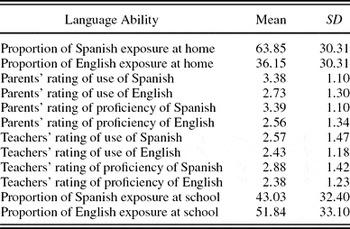
Procedures for establishing English and Spanish exposure and use. English and Spanish exposure and use were determined using parent and teacher reports based on previous research with these measures (Gutiérrez-Clellen & Kreiter, Reference Gutiérrez-Clellen and Kreiter2003). Parents were asked to rate the spoken English and Spanish proficiency and use of their child using a 5-point rating scale for each measure (0 = no use or proficiency, 4 = use all the time and nativelike proficiency). They also reported the number of hours the child interacted with each member of the household and the language spoken during those interactions. The children's teachers were also given a questionnaire to rate the participants' use and proficiency of English and Spanish using the same 5-point scale. In addition, they provided an estimate of the percentage of time that the child was exposed to English and Spanish as a measure of language exposure at school. Table 1 describes the English and Spanish exposure, proficiency, and use of the children based on the questionnaire data.
Mean and standard deviation of measures of Spanish and English exposure for use and proficiency for all participants (N = 196)

Testing procedures
Each participant produced at least one narrative language sample in Spanish, English, or both, depending on the child's language ability or willingness to speak the target language. Some children were reluctant to speak Spanish, and some did not have sufficient English proficiency to complete the task in that language. From the pool of 196 children, 136 (69.4%) produced Spanish narratives and 104 (53.1%) produced English narratives. A similar number of children with language delay produced narratives in each language (39 in Spanish, 40 in English). Twenty-two percent (44 of 196) of the participants produced narratives in the two languages. In this subset of children, there were 35 children with TLD and 9 with language delay.
Narrative samples were elicited with wordless frog stories and transcribed using the SALT—English and Spanish (SALT-RV9) computer program (Miller & Iglesias, Reference Miller and Iglesias2006). For Spanish, children were asked to tell the stories Frog on His Own (Mayer, Reference Mayer1973) and Frog Goes to Dinner (Mayer, Reference Mayer1974). For English, narratives were elicited using Frog, Where Are You? (Mayer, Reference Mayer1969) and One Frog Too Many (Mayer, Reference Mayer1975). All the samples were collected in the schools. Trained and supervised bilingual research assistants, both graduate and undergraduate students, collected the language samples. Each language was tested on a different day. The order of elicitation for each child varied depending on the examiner and the child's availability. The samples were obtained using a story retell and a spontaneous narration format. For the retelling task, evaluators read the script corresponding to the story and the language of elicitation. There was one sentence per picture on average. Specific prompts for encouragement such as “anything else?”, “what else?” were provided to ensure uniformity. For the spontaneous narration, children were allowed to look at the pictures of the book first, and then encouraged to tell the story to the evaluator. The two languages were tested using the same procedures.
Analysis procedures
The narrative samples were recorded for later transcription and transcribed by trained bilingual research assistants at the university laboratory using the conventions of SALT for English and Spanish samples (Miller & Iglesias, Reference Miller and Iglesias2006). The samples were segmented in T-units (Hunt, Reference Hunt1965). A T-unit is a single main clause and any dependent constituents. In English, concatenatives (wanna, gonna) were not expanded. In Spanish, word roots were assigned using the root identification command of the bilingual version of SALT. Only spontaneous utterances were included and Spanish–English mixed utterances, and utterances with unintelligible words were excluded from the analysis. Children's narratives were 58 utterances in length on average with a standard deviation of 20 utterances.
The analysis was based on two measures of lexical diversity (NDW and NDV) and two measures of grammatical complexity (MLUW and use of DITRs). The NDW and the MLUW were generated by the SALT program. The NDV was obtained as follows. First, a list of verbs was extracted using the SALT Explore command. Then, the number of different verbs used by each individual was calculated manually. Neither the copula verbs “be,” “ser,” “estar,” the auxiliaries, or the English modals were included in the total count of different verbs. English verbs used as nouns were also excluded. In Spanish infinitival phrases such as “va a X” (“is going to X”), the auxiliary “go” was not counted (coded as auxir) and the X was counted as a verb. Verbs were counted when used as main verbs and when used as modifiers. This is frequent in Spanish, for example, “va corriendo/*(he) goes running.”
The number of DITRs was calculated by counting the number of predicates that had a direct and an indirect object (e.g., “he gave him a present,” “le dio un regalo”). These utterances were coded by hand and a count of the number of DITRs in each sample was generated by SALT.
About one-half of the transcripts were independently transcribed by a second transcriber to achieve at least 90% item-by-item agreement for transcription accuracy, segmentation, and coding.
As noted, the English and Spanish measures were derived from different stories. To directly compare the measures across languages, the individual measures (NDW, NDV, MLUW, and DITR in each language) were normalized using the following equation: (xi/maxx) × 100 (e.g., individual scores were divided by the maximum observed score and multiplied by 100) prior to the statistical analyses. In the full sample, the English and Spanish normalized scores were compared by inspecting means and calculating effect sizes (Cohen, Reference Cohen1988).
Pearson correlations were used to explore relationships between language domains (i.e., between NDW and MLUW, NDW, and DITR, NDV and MLUW, and NDV and DITR) within languages. Because of the reduced sample size of the subset of children who produced narratives in both languages, across language correlations were conducted only between the more traditional measures of NDW and MLUW.
RESULTS
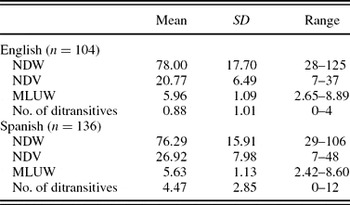
Table 2 presents the means and standard deviations of the lexical and grammatical measures based on the raw data in each language for all participating children (i.e., children with typical language and children with language delay). Examination of the raw and normalized data shows similarities and differences across languages. Overall, the means for the normalized MLUW and NDV appeared to be similar across languages (English MLUW = 67.05 [14.16] and NDV = 56.13 [17.56]; Spanish MLUW = 65.44 [13.16] and NDV = 56.10 [16.64]). Effect sizes for these measures were small (MLUW, d = .25; NDV, d = .08). MLUW raw scores across languages were comparable (see Table 2). Even though the normalized scores of verb diversity were comparable across languages, it was noted that the Spanish count of different verbs was somewhat larger than the English count (see Table 2). Overall lexical diversity (NDW) and use of DITRs was higher in Spanish. The means of the normalized scores of NDW were 71.97 (15.01) for Spanish and 62.40 (14.16) for English. The effect size for this lexical measure across languages was large (d = .75). In addition, based on the normalized data, the mean number of DITRs for Spanish was also higher (M = 37.25, SD = 23.76) than the English mean (M = 21.87, SD = 25.28). The effect size for number of DITRs across languages was moderate (d = .44). The mean of the raw count of DITRs in Spanish was noticeably higher than the English count (see Table 2). The reported effect sizes are based on the normalized data.
Mean, standard deviation, and range of NDW, NDV, and MLUW, and number of ditransitive predicates based on the raw scores for the full sample (N = 196)

Note: NDW, number of different words; NDV, number of different verbs; MLUW, mean length of utterance in words.
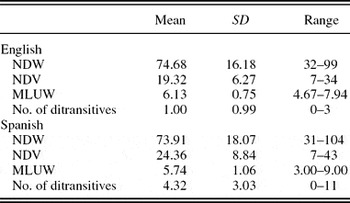
Table 3 describes the means and standard deviations of the measures' raw scores for the subset of bilingual children who provided samples in the two languages. Mean scores parallel the full sample results on Table 3.
Mean and standard deviation of NDW, NDV, and MLUW, and number of ditransitive predicates based on the raw scores of the children who provided narratives in both English and Spanish (N = 44)

Note: NDW, number of different words; NDV, number of different verbs; MLUW, mean length of utterance in words.
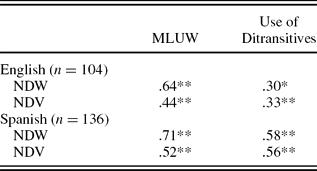
Table 4 lists the correlations between lexical and grammatical measures within each language. In both English and Spanish, there were strong and significant correlations between NDW and MLUW (in English, r = .64, p < .001; in Spanish, r = .71, p < .001). The NDV also correlated significantly with MLUW in both languages (in English, r = .44, p < .001; in Spanish, r = .52, p < .000). Both NDW and NDV were more strongly correlated with the use of DITRs in Spanish (NDW and DITR: r = .58, p < .001; NDV and DITR: r = .56, p < .001) than in English (NDW and DITR: r = .30, p < .01; NDV and DITR: r = .33, p < .001).
Within language correlations between lexical measures (NDW and NDV) and grammatical measures (MLUW and use of ditransitive predicates) for the full sample
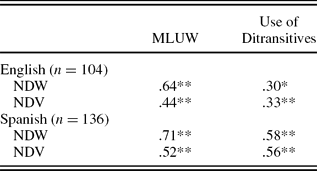
Note: NDW, number of different words; NDV, number of different verbs; MLUW, mean length of utterance in words.
*p < .01. **p < .001.
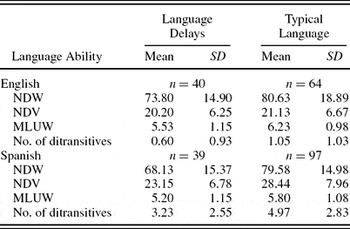
Similar trends were observed in the small subset of children with language delays (39 children with Spanish language samples, 40 children with English language samples). The means and standard deviations of the lexical and grammatical measures for this subgroup and for the children with TLD are included in Table 5. Children with language delays had lower means than the typical group for NDW, NDV, MLUW, and use of DITRs in Spanish. In English, the atypical group had lower means than the typical group for all the measures with the exception of verb diversity. In addition, NDW was also significantly correlated with MLUW in Spanish (r = .68, p < .001) and in English (r = .59, p < .001).
Mean and standard deviation of NDW, NDV, MLUW, and number of ditransitive predicates based on the raw scores of the full sample by language ability

Note: NDW, number of different words; NDV, number of different verbs; MLUW, mean length of utterance in words.
Cross-language correlations across domains for the subset of bilingual children were not significant for any of the measures (Spanish NDW and English MLUW: r = .18, ns; English NDW and Spanish MLUW: r = .15, ns). Of the 44 children who provided narratives in the two languages, 32 participants had greater Spanish proficiency (relative to English proficiency). For these Spanish-dominant bilinguals, the within-language correlation across domains (Spanish NDW and MLUW: r = .65, p < .001) was comparable to the correlation found for the children who were able to produce a narrative in Spanish but not in English (Spanish NDW and MLUW: r = .76, p < .001). However, there were no significant correlations between their Spanish NDW and their English MLUW (r = .27, ns) or between their English NDW and their Spanish MLUW (r = .27, ns).
DISCUSSION
The purpose of this study was to examine relationships between lexical diversity and grammatical complexity in Spanish and English in preschool and school-aged children with different language abilities. Similarly to previous research findings reported for young bilingual children, lexical diversity and grammatical complexity were correlated within English and Spanish languages. These results provide support for the domain interdependence hypothesis.
There were stronger associations between lexical and grammatical measures in the Spanish samples than in English. This was more noticeable for use of DITRs. It is possible that this disparity is related to differences in the number of DITRs obtained in each language. The number of DITRs used in Spanish was greater than in English. This difference was observed for the children with TLD (Spanish mean = 4.97 [2.83]; English mean = 1.05 [1.03]) and for the children with language delay (Spanish mean = 3.23 [2.55]; English mean = 0.60 [0.93]). The Spanish samples of the 44 children with narratives in the two languages had more DITRs (mean = 4.32) than the English samples (mean = 1.00) as well.
This difference may also be related to characteristics of the two languages. There are certain constructions in Spanish that require use of direct object and indirect objects such as inalienable possession constructions (le corté el pelo/I cut his hair) that are not ditransitive in English. In particular, there were 9 Spanish verbs used in ditransitive contexts among the 30 most frequently used verbs in the Spanish narratives. They are “agarrar/grab, decir/say, dar/give, llevar/bring, tomar/take, poner/put, picar/sting, sacar/take, tirar/throw.” Three of these verbs (i.e., grab, put, sting) are not used in ditransitive contexts in English. For example, the Spanish sentences “le agarró la pata a la rana,” “le puso una velita al pastel,” and “la abeja le picó la lengua” have a direct and an indirect object. The English translations only include a direct object: “[he] grabbed the frog's leg,” “[he] put a little candle on the cake,” and “the bee stung his tongue.” Future studies examining the use of ditransitives in specific contexts amenable to parallel English/Spanish constructions (e.g., events expressed with verbs of communication and object exchanges such as “to tell/contar” and “to give/dar”) will be needed to examine these cross-linguistic differences further.
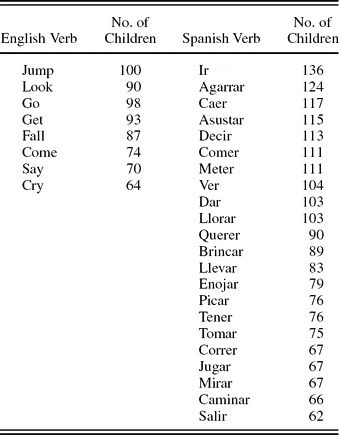
There were also differences in the number of different verb types used in the Spanish and English samples. The Spanish samples showed greater verb diversity than the English samples. For example, in the Spanish narratives there were 209 different verb types and 22 of those verbs were used by more than 60 children (see Table 6). In contrast, the English samples had a count of 156 different verb types but only 8 of those verbs were used by more than 60 children. Once again, typological differences between the two languages may help explain these findings. Spanish is a manner verb language (Slobin & Bocaz, Reference Slobin and Bocaz1988; Talmy, Reference Talmy1991) and does not use verb particles to indicate path. Thus, when Spanish speakers mark path and manner, they rely on the use of two different lexical verbs (sube corriendo/[he] goes up running). In contrast, English is considered to be a path verb (Slobin, Reference Slobin, Shibatani and Thompson1996; Talmy, Reference Talmy1991). To communicate path and manner, English speakers use one lexical verb in conjunction with a verb particle (he runs up). Our methodology to calculate NDV did not account for verb particle combinations, and this could explain the smaller number of verb types in English.
English and Spanish verbs used by more than 60 children in the full sample

However, the lower number of English verbs is surprising in comparison to previous cross-linguistic research conducted by Slobin (Reference Slobin, Shibatani and Thompson1996). In fact, the frog story used by Slobin and colleagues is one of our English elicitation stories. In Slobin's studies, monolingual English speaking children used a greater number of verb types (n = 47) than monolingual Spanish speaking children, who used 27 types of verbs. In fact, if English verbs were combined with the verb particles (e.g., counting “fall down” and “fall in” as two different types of verbs), the number of verb types in Slobin's studies increased to 123. This research suggested that English speakers use a larger variety of verbs than Spanish speakers. In contrast, in our samples, the opposite was found. Latino children produced a smaller variety of English verbs than of Spanish verbs. Limited English proficiency cannot fully account for the reduced English verb diversity. Among the 104 children who produced English narratives, only 31% (32 of 104) had greater proficiency in Spanish than in English. Therefore, the majority or 69% of the children was dominant in English. The English verb diversity rates found in the present study may be related to the sociolinguistic characteristics of the participants. In contrast to Slobin's middle class sample, the participants of the present study had a greater representation of children from lower socioeducational background. This is a variable repeatedly associated to low vocabulary (Hart & Risley, Reference Hart and Risley1995; Jewkes, Reference Jewkes2005; Qi, Kaiser, Milan, & Hancock, Reference Qi, Kaiser, Milan and Hancock2006; Restrepo et al., Reference Restrepo, Schwanenflugel, Blake, Neuharth-Pritchett, Cramer and Ruston2006). In addition, educational research has repeatedly shown that Latino children from low socio-economic status backgrounds in the United States tend to start school with language skills, including vocabulary, below age expectations (St. Pierre et al., Reference St. Pierre, Ricciuti, Tao, Creps, Kumagawa and Ross2001, Reference St. Pierre, Ricciuti, Tao, Creps, Swartz and Lee2003; Zill et al. Reference Zill, Resnick, McKey, Clark, Pai-Sarmant and Connell2001, Reference Zill, Resnick, Kim, O'Donnell, Sorongon and McKey2003). Limited access to quality day care and preschools and insufficient professional training of the educational staff caring for this population also impact the development of lexical skills in these children (Herzenberg, Price, & Bradley, Reference Herzenberg, Price and Bradley2005; National Task Force on Early Childhood Education for Hispanics, 2007). Thus, these differences should be interpreted with caution, in particular, for second-language learners in the United States who may systematically represent a particular socioeducational level (Werker & Byers-Heinlein, Reference Werker and Byers-Heinlein2008).
The children with language delay exhibited similar lexical–grammatical associations as their peers with TLD within the same language. However, the strength of the correlations between semantic and grammatical domains appeared to vary depending on the languages that were being compared. These patterns were observed in the full sample and the subset of children with language delay. The correlations between Spanish NDW and Spanish MLUW were stronger than the corresponding English correlations for the full sample (Spanish r = .71, English r = .64) and for the subset of children with language delays (Spanish r = .68, English r = .59). These cross-linguistic differences in the strength of the association (Spanish r = .89, English r = .71) were also found in the spontaneous language of bilingual toddlers by Marchman et al. (Reference Marchman, Martínez-Sussmann and Dale2004). It is unclear whether this is related to differences in the characteristics of the Spanish and English samples and/or to language elicitation differences across studies. In contrast, Gottardo (Reference Gottardo2002) reported stronger lexical–grammatical associations in English (r = .67) than in Spanish (r = .47) when using elicited tasks of vocabulary and grammar. In contrast to Rice et al. (Reference Rice, Redmond and Hoffman2006), our study revealed a significant positive correlation between English MLUW and lexical skills in the children with limited language ability. Participants' demographic disparities (e.g., participants' ethnicity, parental education, socioeconomic status) and methodological differences (e.g., spontaneous vocabulary vs. standardized vocabulary measures) may partly explain the different results. This underscores the need to carefully explore the effects of socioeconomic, educational, and sociolinguistic factors, in addition to methodological considerations, in studies of children with language delays.
In addition, we examined cross-language relationships in the language of the 44 bilingual children who provided narrative samples in each language. As observed in previous studies with bilingual children in the United States, there were no significant correlations between Spanish and English measures. To ascertain the possible influence of dominance in this subset of bilingual children, we also examined the cross-language lexical–grammatical correlations in the 34 children who were Spanish dominant because of their greater Spanish than English proficiency. In contrast to Conboy and Thal (Reference Conboy and Thal2006), the correlations in both directions (Spanish lexicon to English grammar and English lexicon to Spanish grammar) were not significant. However, the lack of evidence of a lexical–grammatical relationship across the two languages does not constitute evidence that the two languages are learned independently. In fact, Spanish and English lexical and grammatical domains may be associated by other measures that were not controlled in the present study both within and across languages.
There are several limitations of the current study affecting our ability to fully explore cross-language associations between lexical and grammatical measures. First, the sample size of children with narratives in both languages precluded multivariate analyses exploring the effect of factors such as relative language exposure and proficiency on lexical and grammatical attainments in the languages. Second, the cross-sectional design of the current study does not allow for a direct evaluation of the interactions between these domains as children acquire a second language. Cross-linguistic associations in second language learners were found in longitudinal studies (e.g., Castilla & Restrepo, Reference Castilla and Restrepo2004) rather than in cross-sectional studies (e.g., Gottardo, Reference Gottardo2002). Research using longitudinal methods is needed to examine these associations in a direct manner.
Language learning may also be more evident when change over time, rather than static proficiency, is measured. That is, rates of growth, instead of static scores or gains in scores, should be considered. For example, children who exhibit a fast rate of growth in Spanish vocabulary (regardless of the absolute starting and ending lexical level) may also exhibit accelerated growth in English grammar, in contrast to children whose rate of growth is slow. Of note, a longitudinal study of bilingual Spanish- and English-speaking preschoolers has shown that rates of growth in one language predict later performance on the other language (Hammer, Lawrence, & Miccio, Reference Hammer, Lawrence and Miccio2007). In particular, growth in Spanish receptive language abilities during preschool predicted early Spanish and English reading abilities in kindergarten. The same prediction was observed for growth in English receptive language (Hammer et al., Reference Hammer, Lawrence and Miccio2007). It is also possible that certain grammatical constructions may be relatively easier or more difficult based on the typological overlap between the two languages, and that the level of complexity of grammatical measures may moderate the strength of lexical and grammatical associations at different points in development. In addition, differences in proficiency may affect language learning across domains differently as children learn a second language. For example, lexical abilities in the first language may mediate the acquisition of grammatical skills in a second language only during the initial stages of second-language learning, but not after children are capable of speaking the two languages fluently, such as with the bilingual participants in the present study. Future longitudinal studies will be needed to address these questions.
Future research should also use both spontaneous and elicited tasks. The specific lexical and grammatical measures should be carefully considered in terms of what they intend to measure and in terms of equivalency across the pair of languages of interest. Lexical abilities may be determined based on vocabulary size, vocabulary use, lexical diversity, or semantic knowledge. Grammatical knowledge may be operationalized by measures as diverse as length and complexity of utterances or use of a specific grammatical inflection or constructions (e.g., use of irregular verbs or use of DITRs). Once a given measure is selected, the measure should be comparable across English and Spanish. Furthermore, research is critically needed focusing on children learning a second language at a later age. As it was discussed earlier, sequential bilinguals may initially rely more on their first language when learning a second language. Age of acquisition and the context of language(s) exposure are also important variables to consider in future studies.
CONCLUSION
In conclusion, strong associations between lexical and grammatical measures reported in previous research were also observed in this sample of children with various levels of English and Spanish exposure and ability. The findings of the study support the domain interdependence hypothesis within a language.
From a clinical perspective, the lack of cross language correlations within bilingual speakers underscores the importance of looking at each of the two languages of the bilingual child, in particular, for measures of oral language. As previous studies have suggested (Cobo-Lewis et al., Reference Cobo-Lewis, Eilers, Pearson, Umbel, Oller and Eilers2002; Marchman et al., Reference Marchman, Martínez-Sussmann and Dale2004), proficiency in one language is not necessarily associated with concurrent proficiency in the other language. It is important that bilingual children demonstrate different levels of abilities in each language, and thus examination of each language is fundamental to gauge their linguistic knowledge and ability.
ACKNOWLEDGMENTS
This research was supported by NIH/NIGMS SDSU MBRS Program 5 R25 GM58906-06, NIDCD [NO.1-DC-8-2100], the Bamford-Lahey Children's Foundation, and the MANA de San Diego Foundation. We thank Meghan Filipp, Danielle Ruiz, and Jacqueline Kreiter Kotas for valuable assistance with reliability.