The tripletail or blackfish (Lobotes surinamensis Bloch, 1790) has a worldwide distribution in marine and brackish tropical and subtropical waters (e.g. Carvalho-Filho, Reference Carvalho-Filho1999; Froese & Pauly, Reference Froese and Pauly2008). In the south-western Atlantic it is recorded along the coast from Pará in northern Brazil to Argentina (Menezes & Figueiredo, Reference Menezes and Figueiredo1980; Carvalho-Filho, Reference Carvalho-Filho1999). However, records of the tripletail from oceanic islands in the South Atlantic are lacking (Lubbock, Reference Lubbock1980; Edwards, Reference Edwards1990; Andrew et al., Reference Andrew, Hecht, Heemstra and Lutjeharms1995; Gasparini & Floeter, Reference Gasparini and Floeter2001; Soto, Reference Soto2001). Here we record L. surinamensis for the first time from an oceanic island in the South Atlantic (Fernando de Noronha Island, north-eastern Brazil), based on underwater sightings and photographs of two individuals.
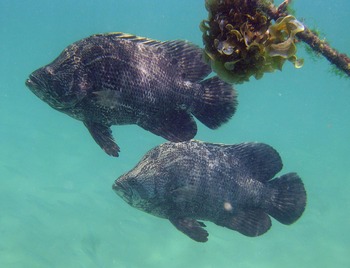
Two Lobotes surinamensis individuals estimated to have about 35 cm in total length (TL) were observed on 20 October 2008 under a buoy at about 2 m depth over a sandy bottom at the Baía do Sueste, Fernando de Noronha Archipelago (03°50′S 32°15′W), off north-eastern Brazil. The two individuals were photographed, and several digital photographs are on file at ZUEC (Museu de Zoologia da Universidade Estadual de Campinas). The tripletails displayed their usual unwary behaviour (Carvalho-Filho, Reference Carvalho-Filho1999) and allowed our close approach. The diagnostic long and well developed soft dorsal and anal fins, which originated the common name tripletail are clearly seen (Figure 1), and allow no identification mistakes even if a specimen was not secured.
A couple of tripletails or blackfish (Lobotes surinamensis) about 35 cm in total length close to a buoy rope at the Baía do Sueste, Fernando de Noronha Island, off north-eastern Brazil. Photograph: Cristina Sazima.

Lobotes surinamensis is infrequently recorded at oceanic islands in the North Atlantic, including the Azores and Madeira Islands (Tortonese, Reference Tortonese, Quero, Hureau, Karrer, Post and Saldanha1990; Santos et al., Reference Santos, Porteiro and Barreiros1997). Our report extends to the South Atlantic the oceanic island occurrence of this species, and adds to the marine fish fauna reported for Fernando de Noronha Archipelago (Soto, Reference Soto2001).
Both tripletail individuals probably were approaching the size of first spawning, as sizes of smallest sexually mature male and female are 29 and 44 cm TL respectively (Brown-Peterson & Franks, Reference Brown-Peterson and Franks2001). As the tripletail spawns offshore (Ditty & Shaw, Reference Ditty and Shaw1994), it is probable that this fish is able to reproduce around an oceanic island such as Fernando de Noronha (see Krajewski & Bonaldo, Reference Krajewski and Bonaldo2005, for Lutjanus jocu).
The behaviour of staying close to floating objects is usual for L. surinamensis, both juveniles and adults (Menezes & Figueiredo, Reference Menezes and Figueiredo1980; Carvalho-Filho, Reference Carvalho-Filho1999; Riera et al., Reference Riera, Grau, Grau, Pastor, Quetglas and Pou1999). As several small fish congregate under floating objects (e.g. Gooding & Magnuson, Reference Gooding and Magnuson1967; Riera et al., Reference Riera, Grau, Grau, Pastor, Quetglas and Pou1999), one function of this behaviour in the carnivorous tripletail would be to have access to prey fish, as recorded by one of us (A.C.F.) while snorkelling among seaweeds in the open sea off Bahia, north-eastern Brazil.
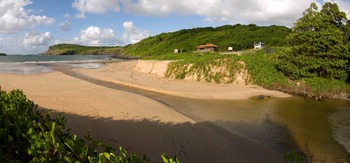
Fernando de Noronha Island has the only oceanic mangrove in the South Atlantic, situated on the Baía do Sueste, the site of our tripletail record. Despite this small mangrove connecting with the sea only after heavy rains accumulate water enough to force a passage through the dunes (Figure 2), the occurrence of the two tripletails may be related to this habitat, as juveniles and adults favour mangroves and estuaries, besides being found in the open sea (e.g. Carvalho-Filho, Reference Carvalho-Filho1999; Froese & Pauly, Reference Froese and Pauly2008).
Water passage from the mangrove to the sea at the Baía do Sueste, Fernando de Noronha Island, off north-eastern Brazil. Photograph: Zaira Matheus.

ACKNOWLEDGEMENTS
We thank José Martins Silva Jr (Centro Golfinho Rotador) for unfailing logistic support; Zaira Matheus for allowing use of the mangrove photograph; the ICMBio for permission to study fish in the National Marine Park of Fernando de Noronha; the CNPq and FAPESP for essential financial support.