


Introduction
The spatial distribution and characteristics of a snowpack depend not only on altitude but also on the landscape structure, creating stratigraphic complexes of a snowpack reminiscent of sedimentary rock formations. The processes of formation, accumulation and metamorphism of a snowpack create a snowpack with a certain structure and mechanical/strength-stress properties. Crystal-morphological analysis (Reference Kazakov and GensiorovskiyKolomytz, 1977, 1984) and landscape-indicative properties of a snowpack (Reference Kazakov and GensiorovskiyKolomytz, 1976) show that the pack can be defined as a geological material or a lithologic complex. Such a lithologic description allows detailed study of variations in stratification, structure and texture of snowpacks with landscape.
Stratigraphic Complex of a Snowpack
The stratigraphic complex as a lithologic system
A stratigraphic complex is a lithologic system that forms in a certain landscape and passes through stages of sedimentation and diagenesis under similar conditions. The complex therefore exhibits a spectrum of stratigraphic columns with similar properties where they have been formed during compatible winters. The process of formation and metamorphosis of a stratigraphic complex determines the structural and physical–mechanical characteristics of the snowpack. Similar stratigraphic complexes of snowpacks will be formed in different locations, but with similar landscapes.
Calculation of recrystallization parameters of the snow layer
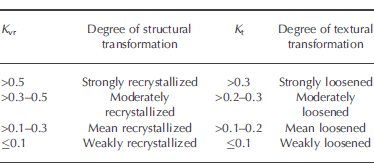
The following coefficients (of the recrystallization K p, of the secondary stratification K vr and of the snowpack texture K t) quantitatively describe how the snowpack is related to the process of structural and textural transformation: K p=H 1/H, Kvr =H 2/H 1, Kt =H v/H, where H is the total thickness of the snowpack, H 1 is the total thickness of secondary idiomorphic snow, H 2 is the total thickness of layers that consist of crystals of skeletal shape class and H v is the total thickness of the layers with fibrous structure. The combination of these coefficients defines the state of the snowpack in the stratigraphic complex (Table 1).
Degree of transformation of snowpack structure and texture. Characteristics of the snowpack stratigraphic complexes
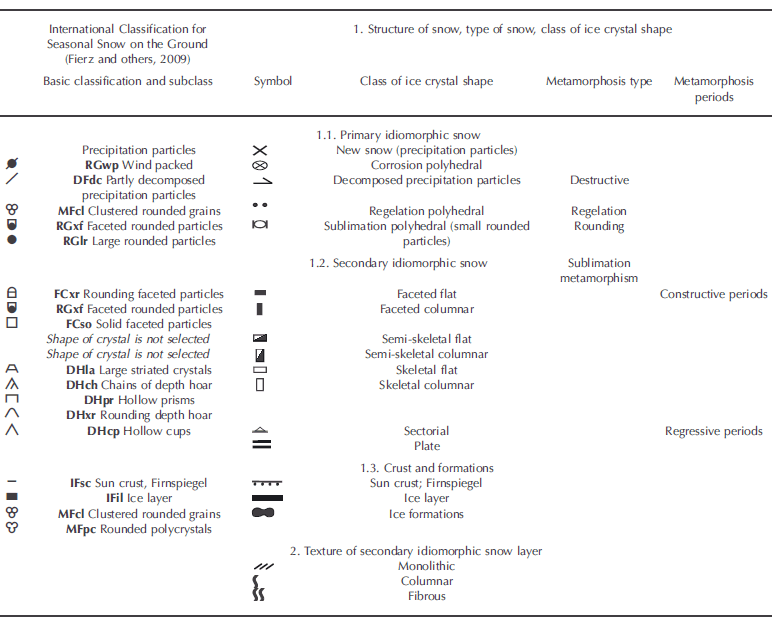
During the selection of a snowpack stratigraphic complex the description of snow structure was executed by E. Kolomytz’s morphogenetic classification (Reference Kazakov and GensiorovskiyKolomytz, 1976, 1984; Table 2).
The structure of snow
Hierarchy Of Taxonomic Levels of a Snowpack Stratigraphic Complex
A unified taxonomic classification scale of stratigraphic snowpack complexes can be created using landscape-indicative properties. As a stratigraphic snowpack system is part of a subsystem of the landscape-zone systems, it can be described in compliance with general principles for describing complex systems.
The taxonomic scale of snowpack stratigraphic complexes is based on schematic principles in taxonomy (Reference Chereshkin, Kononov and TischenkoChereshkin and others, 1999), the theory of classification and systematization of complex areas in compliance with the following principles:
1. A classification principle requiring the classification of values of system parameters. The taxonomical scale of the snow-cover stratigraphic complex is developed according to this principle, based on the principles of construction of landscape classifications.
2. A multilevel description principle stating that, for a systematic description, an object should be described as an element of a whole system, as a holistic phenomenon, as a complex structure the constitution of which should be described in detail.
According to that classification the following principles were developed for a snowpack as a multilevel system.
The processes in stratigraphical complexes are defined by geological, geomorphological, hydrometeorological and snow conditions. This helps to separate taxons, territories with similar geological, geomorphological, hydrometeorological and snow conditions. Therefore, the main issue is to choose criteria in order to distinguish areas with similar characteristic parameters of the processes.
The taxonomic scale of snowpack stratigraphic complexes consists of five taxonomic levels (Table 3):
The classification of a snowpack stratigraphic complex
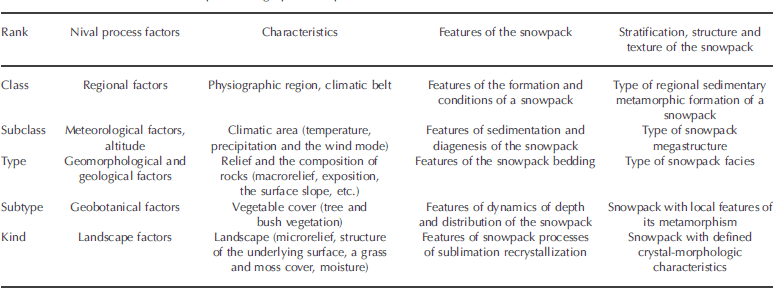
1. Class. Regional factors define the territory in terms of a physiographic area and a climatic zone. A number of factors define the state and conditions of the snow cover; they also allow separation of the types of regional sedimentary metamorphic formations of snowpacks.
2. Subclass. Meteorological factors and the altitude allow the definition of climatic zone regions with similar temperature, precipitation and wind characteristics, which create similar sedimentation and diagenesis snowpack conditions.
3. Type. Geomorphic and geological factors – the macrorelief, the exposition, the surface slope, etc. – allow territories in the same climatic area with different snow bedding structures to be defined.
4. Subtype. Geobotanical factors – tree and bush vegetation – define the dynamics of the height and the snowpack distribution and local metamorphic features.
5. Kind. Landscape factors – the microrelief, the structure of the underlying surface, grass and moss cover, the moisture, etc. – influence the processes of the snowpack sublimation recrystallization and cause a snowpack with certain crystal-morphological properties to be formed.
Methodological Principles for Creating Stratigraphic Complex Maps and Determining Snowpack Characteristics in Unstudied Areas
Principles that describe snowpack stratigraphic complexes as multilevel systems are based on the assumption that processes in stratigraphic complexes of snowpacks are determined by geological, geomorphological, hydrometeorological and landscape conditions.
According to that principle, a taxonomic scale of stratigraphic complexes of snowpacks was created, based on principles of creating landscape classifications. Taxons are areas with similar geological, geomorphological, hydrometeorological and nival conditions.
Methodological principles for creating maps with stratigraphic complexes of snowpack are based on the following principles:
1. The nature and the rate of the snowpack metamorphosis depend on landscape conditions.
Landscape-indicative properties of the snowpack allow the history of the snowpack formation and development in unstudied areas to be recreated based on the landscape and climate description. They also allow prediction of the period of time when the layers of skeletal-class ice crystals and layers of snow with fibrous/filamentary structure were formed.
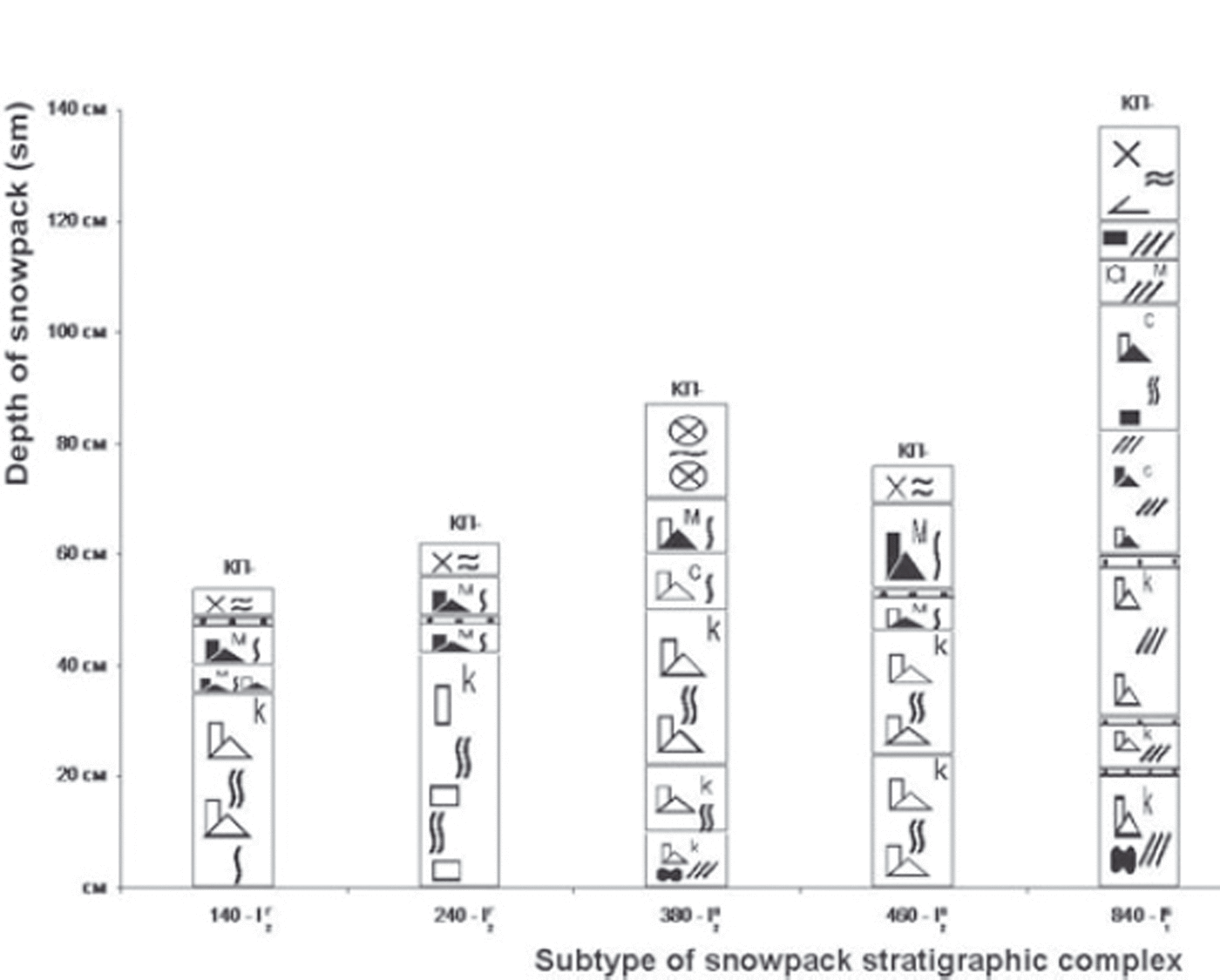
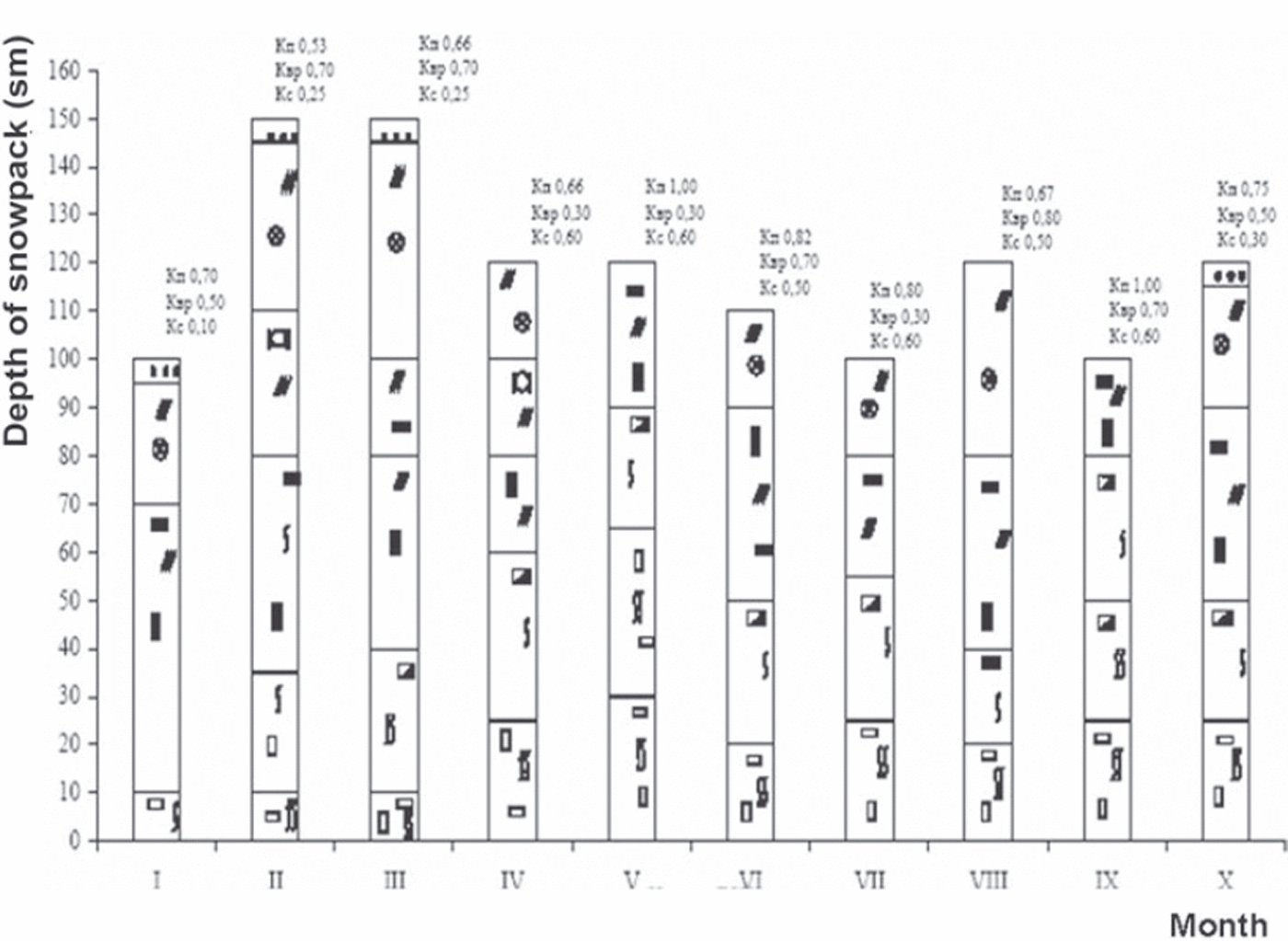
The spectrum of types of snowpack stratigraphical columns is determined by polymorphic landscape structure (Reference Kazakov and GensiorovskiyKolomytz, 1976; Drevilo, 1999, Reference Drevilo2000; Reference DreviloDrevilo and others, 2000), the extent of the landscape hydromorphosis and the set of meteorological conditions in wintertime within the considered area (Fig. 1).
The spectrum of stratigraphic columns of a snowpack in different landscapes (Makarov river basin, southern Sakhalin, 14 March 1986).
2. The conception of the snowpack development as a determined process allows separation of taxons and types of snowpack stratigraphical complexes in insufficiently known areas.
Characteristics of snowpack stratigraphic complexes in the study areas help to calculate values describing the snowpack in unstudied areas of a similar type, by creating the hierarchical row of taxonomical categories of the snowpack stratigraphic complex.
Stratigraphic complex maps of small and medium size can be plotted as zoning on subtypes or types of stratigraphic complexes (Fig. 2).
Map of snow-cover stratigraphic complexes on Sakhalin island (Drevilo, 2000). Scale 1:1000000.

Stratigraphic complex maps of large size can be plotted as zoning on kinds of snowpack stratigraphic complexes (Figs 3 and 4).
Map of the stratigraphic complex of snow cover on Rogatka river basin, southern Sakhalin. Natural scale 1:25000. IX: index of stratigraphic complex of a snow cover with hierarchical level ‘Kind’ (Reference Drevilo, Zhiruev, Okopniy, Gensiorovskiy and KazakovGensiorovskiy, 2007).

A typical snowpack stratigraphic profile in the Rogatka river, southern Sakhalin, during the period of maximum snow accumulation. IX is an index of the stratigraphic complex with a hierarchical level ‘Kind’.
Methods of Study of a Snowpack Structure and Texture
Structure (the shape and the size of ice crystals) and texture (the relative location and orientation of the crystal optical axes) are the main directive parameters in the snowpack system, and their changes during the metamorphosis stage cause changes in the physical characteristics of the snowpack.
In order to select a stratigraphic complex of snowpacks and an unbiased characterization of its texture and structure, the structure of the snow layers must be described quantitatively. Usually, the characterization of the structure and the texture in a stratigraphic study is made visually and will represent an expert report. Statistical information about the proportion and the percentage of ice crystals of different shape and size in a snow layer is needed in order to describe the snowpack structure.
For this purpose we use macrophotography of ice crystals (Fig. 5) of all snow layers. Subsequently, we process the photographs in laboratories, distinguish crystal shape classes and define the class of the prevalent crystal shape using the Kolomytz morphogenetic classification (Reference Kazakov and GensiorovskiyKolomytz, 1976, 1984; Table 2). We also define the percentage, the average and the maximum crystal size.
The structure of snow. Photograph for testing the size and class of ice crystal shape.

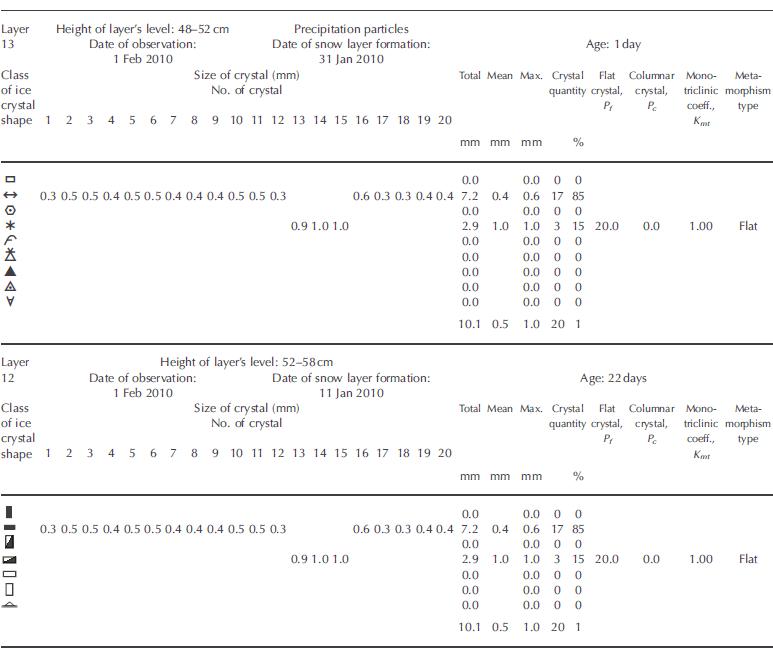
These parameters are defined using a sample of at least 20 crystals (Table 4). The photographs of ice crystals of all snow layers will allow other researchers to use the results of this study.
The snow structure of layers 13 and 12. Test of the size and shape of ice crystals based on the analysis of a snow layer sample
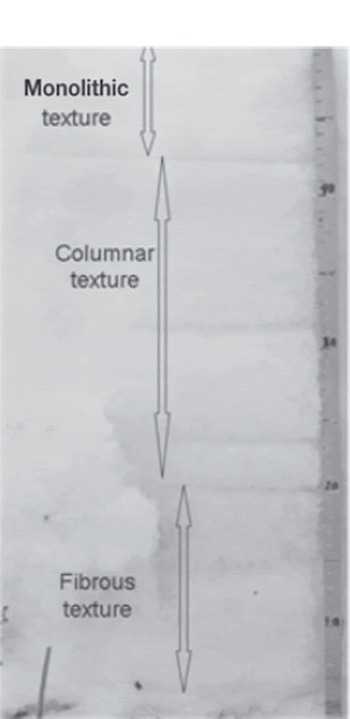
The texture of a snow layer is usually defined visually. There are three different types of structure that help to estimate the extent of the ordering of ice crystal clusters in a snow layer: monolithic, columnar and fibrous (Fig. 6). The density and the hardness should also be defined in order to describe the stratigraphic complex of a snowpack in addition to the structure and the texture of a snow layer. Basic identification and quantifiable parameters of a snowpack are presented in the stratigraphic column (Table 5).
Types of snow texture.
The stratigraphic column of a snowpack. Pit No. 1, foot of Susunayskiy Ridge, 1 February 2010, 15:10–16:35. Dates are day/month/year
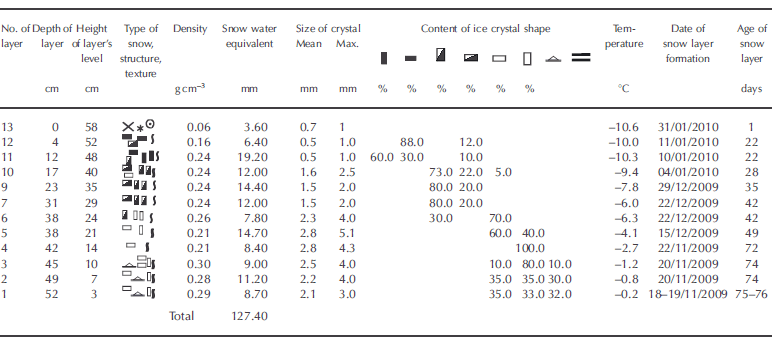
Notes: Mean height on snow-depth gauge 55 cm. Mean density 0.22. Snow water equivalent on snow-depth gauge 279.84mm:. Aspect of slope: W. Altitude 100m. Slope angle 3˚. Air temperature –8.5˚C. Air moisture 89%. Cloudiness (lump-sum/bottom) 3/0. Weather: fair. Wind 0ms–1. Condition of ground: frozen. Observers: N.A. Kazakov and I.A. Kononov. Underlying surface: grass. Vegetation: alder–birch forest. Crown density 25%. Process data: N.A. Kazakov. Coeff. of snow recrystallization 0.90. Coeff. of snow secondary stratification 0.46. Coeff. of snow texture 0.45. Verified: J.V. Gensiorovskiy.
Discussion
Analysis of the results of the stratigraphic study (Sakhalin island, Kuril Islands, East Siberia, Khibiny Mountains on the Kola Peninsula, Moscow suburbs, Yamal Peninsula, Western Caucasus (Reference FierzKazakov and Gensiorovskiy, 2007), Northern Caucasus–Elbrus in the high-altitude zone 5000–5200m, 1979–2011) showed that areas with similar geomorphological, geobotanical, geological and meteorological conditions have similar stratigraphic snowpack columns. For example, similar characteristics are shown by a spectrum of stratigraphic columns of snow cover in the Khibiny Mountains (600–700ma.s.l.), middle Sakhalin (East Sakhalin Mountains; 1400–1500ma.s.l.) and southern Sakhalin (Susunajsky Ridge; 950–1000ma.s.l.).
Conclusions
Landscape heterogeneity (polymorphism) is the main influence on snow distribution and structure. The process of the formation and development of a stratigraphic complex of a snowpack is determined as follows: a snowpack with certain structural and physical–mechanical characteristics is formed as a result of sedimentation and diagenesis processes. Similar snowpack stratigraphic complexes formed in different locations usually cover similar landscapes.
Acknowledgements
This research was made possible by the assistance of our colleagues and friends D.A. Bobrova, E.N. Kazakova, I.A. Kononov, V.I. Lobkina, V.I. Okopnyj and S.V. Rybal’chenko.



