Management Implications
Tithonia diversifolia (Mexican sunflower) is an invasive plant, native to the New World, and an exemplary conflict species. It is known to have spread to every continent except Antarctica. It is prized as a colorful ornamental and for soil conditioning. However, it is also reviled as an environmental weed that is difficult and expensive to control. We built a CLIMEX model of T. diversifolia to estimate the areas at threat of invasion and identified those areas that are only suitable for ephemeral populations. In the latter areas, it may be possible to allow T. diversifolia to be propagated as a garden ornamental, with little risk of it establishing and becoming an environmental nuisance. Where the climate is modeled as suitable for establishment, it may be prudent to attempt to restrict the intentional propagation of T. diversifolia, lest garden escapees become environmental weeds. We applied a climate change scenario to the ecoclimatic niche model to assess the sensitivity of the range boundary to expected near-term climatic changes. Tithonia diversifolia’s range is only moderately sensitive to climatic warming along the poleward boundaries, and invasive plant management policies should be able to respond in a timely manner to emerging trends in range extension. It may be prudent to include a buffer of approximately 500 km on the modeled range boundary, considering this area at emerging risk of invasion. Biological controls are being investigated in South Africa. Invasive plant managers may wish to follow the developments in South Africa, and if the agents appear to be effective, consider host specificity testing to assess their suitability for deployment elsewhere.
Introduction
Invasive plants, insects, and vertebrates can cause significant social and economic damage to native ecosystems, agricultural production, and human health (Lowe et al. Reference Lowe, Browne, Boudjelas and De Poorter2000; Vilà et al. Reference Vilà, Espinar, Hejda, Hulme, Jarošík, Maron, Pergl, Schaffner, Sun and Pyšek2011). As climate is a major factor governing the niche of invasive species (Andrewartha and Birch Reference Andrewartha and Birch1984; Woodward Reference Woodward1987), the assessment of climate suitability is critical for understanding their potential distribution. This knowledge can underpin efforts to restrict the spread of invasive species into sensitive regions and can inform policies to manage their impacts. Moreover, as anthropogenic climate change continues, the potential range of invasive plants will be affected, with shifts in future distribution into higher latitudes and altitudes compared with the potential range under current climates (Sutherst et al. Reference Sutherst, Baker, Coakley, Harrington, Kriticos and Scherm2007).
Mexican sunflower [Tithonia diversifolia (Hemsl.) A. Gray; Asteraceae] is a herbaceous perennial shrub, native to Mexico and Central America (Acevedo-Rodríguez and Strong Reference Acevedo-Rodríguez and Strong2012; Tongma et al. Reference Tongma, Kobayashi and Usui1998). It has become naturalized in tropical areas of Asia and Africa (Chukwuka et al. Reference Chukwuka, Ogunyemi and Fawole2007) where it was introduced as an ornamental plant and to improve soil fertility. However, once established, it has quickly spread to become a weed of significant importance (Tongma et al. Reference Tongma, Kobayashi and Usui1998). Tithonia diversifolia has invaded the Caribbean, much of South America, Africa, and Southeast Asia, including northeastern Australia, where it is regarded as an environmental weed by the governments of New South Wales and Queensland (NSW Department of Primary Industries n.d.; State of Queensland 2020). It outcompetes native vegetation, forming dense thickets and disrupting ecosystems. Tithonia diversifolia is difficult to contain, because its seeds are spread effectively by wind, animals, waterways, and contaminated agricultural produce; therefore, controlling reproduction is a critical factor in controlling the invasiveness of this species (Muoghalu Reference Muoghalu2008; Muoghalu and Chuba Reference Muoghalu and Chuba2005). Whether through the use of suitable herbicides or complete removal, the local eradication of this weed is time-consuming and labor-intensive (Chukwuka et al. Reference Chukwuka, Ogunyemi and Fawole2007).
Tithonia diversifolia is a ruderal sensu Grime (Reference Grime1974). As with most Asteraceae, T. diversifolia appears well adapted to wind dispersal. The seeds are small and topped with a ring of hairs (pappus) that provide wind drag to assist with keeping seeds aloft (Sheldon and Burrows Reference Sheldon and Burrows1973; Yang et al. Reference Yang, Tang, Guan and Sun2012). The cost of this dispersal ability is the limited amount of resources available to the seed to fuel competitive growth in existing vegetation, and hence disturbance of the natural vegetation is usually required for T. diversifolia to establish (Grime Reference Grime1974; Muoghalu and Chuba Reference Muoghalu and Chuba2005). Tithonia diversifolia is thus commonly found in areas such as cleared arable land, plantations, roadsides, and unkempt lawns (Chukwuka et al. Reference Chukwuka, Ogunyemi and Fawole2007; Muoghalu Reference Muoghalu2008). Its ability to reproduce vegetatively as well as sexually may allow it to be present as semi-persistent populations in areas that are climatically unsuitable for seed production due to an insufficient annual heat sum. Such populations may only persist through one generation.
By modeling the potential distribution of T. diversifolia, we can anticipate which areas are susceptible to invasion and, subsequently, what natural or other assets are under threat of invasion to assess the benefits and costs of implementing monitoring, control, or eradication policies (Kriticos et al. Reference Kriticos, Leriche, Palmer, Cook, Brockerhoff, Stephens and Watt2013). Range changes have the capacity to undermine strategies to manage invasive species, and foresight into emerging issues can reveal possibilities for proactive or preventative actions. To understand the current and emerging risks posed by invasive plant species, it is therefore necessary to model the current suitability of climates as well as the potential distribution under future climate scenarios. By using this model to compare the current distribution of pests to their potential range, biosecurity agencies can implement management strategies such as containment, control through pesticides or herbicides, eradication, the introduction of biological control agents, or slow-the-spread policies. Knowing the potential distribution of invasive species allows governments and stakeholders to allocate resources judiciously to control or eradicate them.
Bioclimatic models are frequently used to project the potential range of invasive species for risk assessment and to estimate range shifts under future climate change scenarios (Guisan and Zimmermann Reference Guisan and Zimmermann2000; Kriticos and Randall Reference Kriticos and Randall2001). Defining the climate limitations of the species using the model involves the use of data on the known range of the species, its physiological tolerances and biotic interactions, and its dispersal potential (Elith and Leathwick Reference Elith and Leathwick2009; Soberon and Nakamura Reference Soberon and Nakamura2009). The completed model can then be projected to other regions or times to identify areas at risk of invasion (Sutherst Reference Sutherst2014).
Correlative bioclimatic models link available distribution records of the species in question with the spatial environmental data, essentially pattern matching known suitable climates to similar regions worldwide (Sutherst Reference Sutherst2014). These models are generally easy to run but are erratic and unreliable for estimating the potential distribution of invasive species, which involves an application of the model to novel environmental situations (Sutherst and Bourne Reference Sutherst and Bourne2009; Webber et al. Reference Webber, Yates, Le Maitre, Scott, Kriticos, Ota, McNeill, Le Roux and Midgley2011).
Process-based niche models such as CLIMEX (Kriticos et al. Reference Kriticos, Maywald, Yonow, Zurcher, Herrmann and Sutherst2015; Sutherst and Maywald Reference Sutherst and Maywald1985) focus on the population response of a species to temperature and soil moisture factors, rather than on the climatic patterns it is associated with. This process orientation allows the model to estimate the potential distribution of the focal organism in terms of the response of the species to primary climatic variables at temporal scales that are relevant to species growth and survival (daily to weekly). Conversely, correlative species distribution models analyze climatic similarities between known suitable locations using abstract Bioclim variables of coarse temporal resolution (e.g., mean annual temperature, mean annual precipitation, radiation during the wettest quarter; Kriticos et al. Reference Kriticos, Jarošik and Ota2014). The growth and stress functions in CLIMEX are formulated to conform with the law of tolerance (van der Ploeg et al. Reference van der Ploeg, Böhm and Kirkham1999), which allows it to largely avoid the so-called novel climates problem that arises with correlative species distribution models, in which models inaccurately represent a species’ potential distribution in a new region or under climate change scenarios that the models are forced to extrapolate (Sutherst and Bourne Reference Sutherst and Bourne2009; Webber et al. Reference Webber, Yates, Le Maitre, Scott, Kriticos, Ota, McNeill, Le Roux and Midgley2011).
The potential distribution of T. diversifolia has been modeled recently for Africa with an elaborate procedure using MaxEnt (Obiakara and Fourcade Reference Obiakara and Fourcade2018). Bioclimatic models such as MaxEnt that employ a “background” to infer unsuitable habitat naturally suffer from confusion if they attempt to combine native range distribution data, wherein the climatic range is well represented with distribution records, while at the same time including an invaded range, where the invasion is incomplete. Combining native and invaded range data sets into one analysis provides the model with evidence of suitability where there are presence records in the native range, as well as apparent evidence of unsuitability due to a lack of presence records in the same or similar climates in the invaded range where there has been no opportunity for the organism to invade. Obiakara and Fourcade (Reference Obiakara and Fourcade2018) deals with this problem inadvertently. When transferred to Africa, the model built on native range data in Central America did not capture the distribution points in Africa well: it “…failed to account for the presence of T. diversifolia in the whole of South Africa and many parts of West Africa…” (Obiakara and Fourcade Reference Obiakara and Fourcade2018:9). Consequently, they built two models, one for the Americas and one for Africa, and combined them for Africa, taking the maximum value at each climate station. The resulting model for Africa included complex modeling artifacts, especially in the putative range margins. Obiakara and Fourcade (Reference Obiakara and Fourcade2018) cites a lack of data in Asia for not projecting the model elsewhere. Perplexingly, despite the acknowledged inadvisability of applying MaxEnt to novel climate data, it was applied to two climate change scenarios in Obiakara and Fourcade (Reference Obiakara and Fourcade2018). The implausible results reinforce the inadvisability of this method.
Here we describe the fitting of a CLIMEX model to estimate the potential global distribution of T. diversifolia in order to identify areas at risk of invasion, taking into account irrigation patterns. The model distinguishes between those areas that are suitable for establishment from those where the plant could be cultivated with little risk of establishment.
Methods
Current Distribution
Distribution data points (latitude and longitude coordinates) for T. diversifolia were sourced from the Global Biodiversity Information Facility (GBIF 2021). The tab-separated value (CSV) file downloaded from GBIF was converted into a shapefile using Quantum GIS (www.qgis.org). The shapefile was then imported into CLIMEX for model fitting and mapping. Points with coordinates of (0,0) or lacking coordinates were disregarded, leaving 4,369 suitably complete records. The popularity of T. diversifolia on gardening websites based in the United States suggest that its distribution there as represented in GBIF is substantially underrepresented. Likewise, the reported distribution in the Democratic Republic of the Congo appears suspiciously underreported.
According to Acevedo-Rodríguez and Strong (Reference Acevedo-Rodríguez and Strong2012), T. diversifolia is native to Mexico and Central America (Belize, Costa Rica, El Salvador, Guatemala, Honduras, Nicaragua, Panama) and, along with its congenerics [Tithonia rotundifolia (Mill.) S.F. Blake (clavel de muerto) and Tithonia tubaeformis (Jacq.) Cass. syn. T. tubiformis (Jacq.) Cass.)], is invasive throughout the Caribbean.
Climate Data Sets
The CliMond CM30 World (1995H V2) data set was used to estimate current global potential distributions. This data set is a 30-yr mean, centered on 1995, representing historical climate. The CM30 ACCESS 1.0 data set was used to represent a future climate scenario for the years 2040 to 2059 forced with the Representative Carbon Pathway (RCP) 8.5 greenhouse gas emissions scenario (Kriticos et al. Reference Kriticos, Webber, Leriche, Ota, Bathols, Macadam and Scott2012; van Vuuren et al. Reference van Vuuren, Edmonds, Kainuma, Riahi, Thomson, Hibbard, Hurtt, Kram, Krey, Lamarque, Masui, Meinshausen, Nakicenovic, Smith and Rose2011). These data sets consist of monthly means of minimum and maximum temperature, precipitation total, and relative humidity at 0900 and 1500 hours.
Irrigation
The Global Map of Irrigated Areas (GMIA; Siebert et al. Reference Siebert, Henrich, Frenken and Burke2013) was used to define those areas where irrigation is practiced. We resampled the 5’ (approximately 10 by 10 km) gridded data up to 30’ (approximately 50 by 50 km) to match our climate data. The methods by which the irrigation areas are defined creates some misleading artifacts, with sizable administrative areas reporting very small irrigation areas. To moderate these effects, we filtered out irrigation areas that were smaller than 10 ha in each 30’ grid cell, creating a binary grid indicating the presence of irrigation. This threshold was selected by trial and error to remove the important anomalies while preserving the important features in the GMIA data set.
Niche Modeling
CLIMEX (Kriticos et al. Reference Kriticos, Maywald, Yonow, Zurcher, Herrmann and Sutherst2015; Sutherst and Maywald Reference Sutherst and Maywald1985) is a process-oriented climate-based software package designed for niche modeling, enabling users to project the potential climatic distribution of poikilothermal organisms from current distribution records (Kriticos et al. Reference Kriticos, Kean, Phillips, Senay, Acosta and Haye2017). The uniqueness of this program among climate-based modeling software is the combined inductive–deductive method used to fit models. The modeler can use distribution data to infer parameters for stress functions, guided by available knowledge of the species biology and constrained by enforced ecological relationships between parameters. Users are encouraged (Kriticos et al. Reference Kriticos, Maywald, Yonow, Zurcher, Herrmann and Sutherst2015) to use the method of multiple competing hypotheses (Chamberlin Reference Chamberlin1965) to deal with the almost inevitable conflicts that arise between evidence drawn from the different knowledge domains. The resulting parameters describe a set of growth and stress functions, which are used to estimate the species’ growth and persistence potential at any location based on climatic data.
The CLIMEX Compare Locations model calculates the Ecoclimatic Index (EI), an overall index of general climate suitability for the organism in question, scaled between 0 (unsuitable, no persistence potential) and 100 (climatically perfect year-round, only practically achieved in rare cases in equatorial regions with highly stable climates). The EI is calculated from the annual Growth Index (GIA), which correlates to the population growth potential according to climate averages throughout the year, and the stress indices, which are associated with population reductions. These include heat stress, cold stress, dry stress, wet stress, or a combination of interacting temperature and moisture stresses such as cold-dry or hot-wet stress. In addition, other special constraints can be imposed, such as the need to experience a minimum annual heat sum for reproduction or to successfully complete an obligate diapause. If any special constraints are not met at a location, then the EI is set to 0.
The CLIMEX genetic algorithm is a machine learning algorithm for fitting of stress parameters (and therefore the approximate potential distribution) based on the known distribution data. It was run on the T. diversifolia distribution data set to create a starting set of parameters. Parameters were then hand-fitted, attempting to match the modeled climate suitability patterns to the known distribution patterns for T. diversifolia. Each individual manual iterative parameter adjustment represents a hypothesis on the tolerance of the organism to a particular moisture or temperature mechanism, which becomes suspect should it not accord with qualified distribution data or allow an excessively large number of false positives. Furthermore, each parameter value must be biologically plausible: it should accord with knowledge of the biology of the species or highly similar organisms and not contradict other growth or stress parameter values. Outlying points were interrogated using satellite imaging in Google Earth to assess, for example, whether anthropogenic irrigation was apparent, potentially rendering microhabitats suitable for growth, or whether the nearest climate station was at a higher altitude than the likely location of the record. The model-fitting process aims for perfect model sensitivity (the concordance between distribution data and the potential range), with all qualified distribution points shown as suitable with an EI value of ≥1. Qualified distribution points are those that are not excused from consideration because they were considered erroneous or not applicable (e.g., the observed plant was growing in a protected environment, or the geocoded location was poorly aligned with the climate grid).
Ideally, a CLIMEX model is fitted to the native distribution of a species and then verified using invaded range data in one continent. At this stage, the model may be adjusted to address any apparent niche expansion due, for example, to enemy release (Keane and Crawley Reference Keane and Crawley2002). Finally, the model can be validated using data from one or more additional continents. These geographically independent data sets can provide a strong form of validation, though niche vacancy due to invasion history may limit their ability to test the veracity of the model. In the case of this model, we built the initial model using American data, verified it using African distribution data, and validated it using Australasian distribution data. As described in the following sections, some parameters were adjusted during verification to fit outlying records in Africa.
Whereas many correlative species distribution models are sensitive to the abundance of distribution records within the species climatic envelope, CLIMEX models are sensitive to the distribution points at the range margins. Consequently, outlying records are closely scrutinized to try to understand whether they have been accurately geocoded, whether their presence is dependent on non-climatic factors such as irrigation, and whether they are likely well represented by adjacent climate stations (e.g., are at similar altitude).
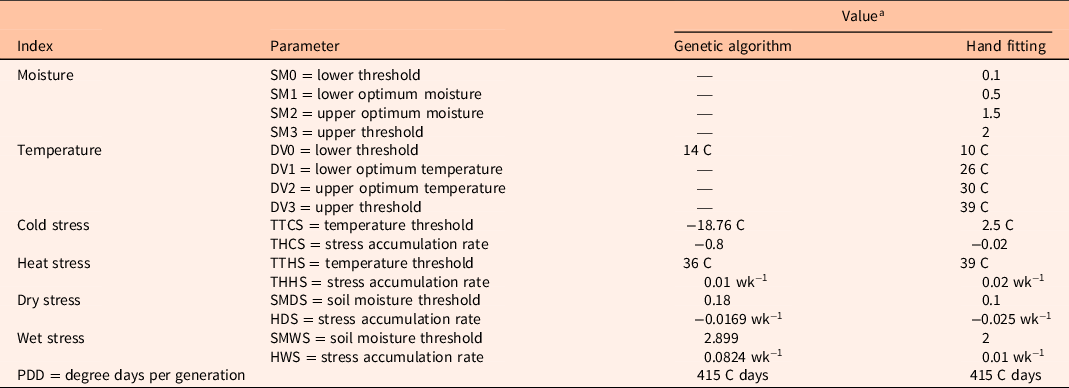
The fitted model parameters are summarized in Table 1, and the rationale for their selection is detailed in the following sections.
Parameters for the CLIMEX model of Tithonia diversifolia.

a Values without units are a dimensionless index of a 100-mm single-bucket soil moisture model (Kriticos et al. Reference Kriticos, Maywald, Yonow, Zurcher, Herrmann and Sutherst2015).
Soil Moisture
The lower soil moisture limit for growth SM0 was set to 0.1 to approximate permanent wilting point. The lower (SM1) and upper (SM2) limits for optimal growth were adjusted until suitability in Kenya and eastern Ethiopia conformed with expert knowledge of the species’ ecology in eastern Africa (A Witt, CABI, personal communication). The upper limit for growth (SM3) was set to the same value as the threshold for wet stress (2.0).
Temperature
The minimum temperature for development (DV0) was decreased due to locations not being warm enough, then decreased further to increase suitability in Kenya. The maximum temperature threshold for development (DV3) was increased to model outlying points in Benin as marginally suitable. The minimum and maximum limits for optimal growth were set to moderately warm values that conformed with expert opinion on the relative suitability of different locations in eastern Africa (A Witt, CABI, personal communication) and are biologically plausible for a tropical plant.
Cold Stress
Many gardening websites (e.g., https://floridata.com/plant/1098) mention the frost susceptibility of T. diversifolia, noting that it dies back to ground level under light frosts. Accordingly, the threshold temperature for cold stress (TTCS) was set to 2.5 C, as this monthly minimum temperature value includes approximately one frost event per week. The stress accumulation rate (THCS) was fitted to enable a distribution record near Durango, Mexico, to be marginally suitable. The gap between TTCS and DV0 suggests that, between these temperatures, T. diversifolia does not grow, but it does not suffer cold stress. It is likely that in reality, when temperatures fall in this range, T. diversifolia may suffer an energetic flux imbalance, which would usually be simulated in CLIMEX using a degree-day cold stress mechanism. In the case of T. diversifolia, we found no evidence that this cold stress mechanism was required to explain its distribution.
Heat Stress
The threshold temperature at which heat stress commences (TTHS) and the stress accumulation rate (THHS) were fit to an outlying record in northern Benin, which also allowed Namibian locations to fall within the potential distribution range. Values for both parameters were then relaxed (TTHS increased to 29 C, and THHS reduced to 0.02 wk−1) to reduce heat stress at Kenyan and Ethiopian locations to conform with expert knowledge of the species’ ecology in eastern Africa (A Witt, CABI, personal communication). Consequently, the modeled suitability improved slightly in Benin and Namibia, with the EI value increasing from 1 to 6. Notably, in Benin and Namibia, dry stress has a greater impact on limiting the climate suitability of T. diversifolia than does heat stress.
Dry Stress
The threshold for dry stress (SMDS) was set to 0.1, in accordance with the lower limit for growth (SM0). Dry stress was increased as the limiting factor, compared with the value fitted using the genetic algorithm, as T. diversifolia is generally a perennial plant, albeit with a moderate drought tolerance (Orwa et al. Reference Orwa, Mutua, Kindt, Jamnadass and Anthony2009). The dry stress accumulation rate (HDS) was increased to accord with the apparent range boundary along the edge of the southern Sahara Desert and Namibia.
Wet Stress
The fitted wet stress is a lethal limiting factor in areas such as a portion of the Colombian coast and inland Papua New Guinea, where T. diversifolia has not been recorded. The threshold soil moisture level (SMWS) and the stress accumulation rate (HWS) were both rounded, as the genetic algorithm gives overly precise values.
Minimum Annual Heat Sum for Reproduction (PDD)
The PDD limits the distribution in high-altitude areas (>2,800 m above sea level) of northwestern South America. Experimenting with a higher PDD value excluded known suitable locations. The minimum heat sum (450 C d above 10 C) accords with T. diversifolia being capable of rapid physiological development.
Assessing the Goodness of Fit
Four factors are considered when determining the goodness of fit of a CLIMEX model: sensitivity, specificity, biological reasonability of parameters, and parsimony (Kriticos et al. Reference Kriticos, Maywald, Yonow, Zurcher, Herrmann and Sutherst2015). Sensitivity measures the proportion of true positives, which are location values modeled as suitable. Specificity demands that the area of suitability should not be excessive; hence the number of false positives should be as low as possible. Assessing specificity is problematical when modeling invasive species, as a lack of distribution records in introduced ranges may or may not indicate unsuitability of an area. In modeling parlance, true negatives (and by extension false negatives) are practically and conceptually difficult to define. Underreporting may occur due to geographic difficulty of obtaining data (as is the case in much of South America and central Africa) or caused by governmental and administrative issues. It is also possible that the area is climatically suitable, but the species has not yet overcome dispersal barriers. To address this issue, the criterion of biological plausibility of parameters was introduced to the assessment of the goodness of fit of CLIMEX models (Kriticos et al. Reference Kriticos, Maywald, Yonow, Zurcher, Herrmann and Sutherst2015). Biological plausibility demands that the parameters and stress mechanisms are reasonable, which necessitates a correspondence with knowledge on behavior and tolerances of the organism in question or biologically or ecologically similar organisms. Unfortunately, the scientific literature on T. diversifolia is generally limited to its impacts on agriculture and lacks detail on the responses of the organism to moisture and temperature mechanisms. The final assessment criterion of CLIMEX models is parsimony. When accommodating the previous factors, the model should be accurate while using as few stress mechanisms or parameters as possible.
Irrigation and Climate Change Scenarios
To understand the influence of irrigation on the potential distribution of T. diversifolia, we applied the model parameters fitted using a natural rainfall scenario to a top-up irrigation scenario (2.5 mm d−1). In this irrigation scenario, in any week when rainfall was less than 17.5 mm, the deficit was made up from irrigation. The net effect is to mimic crop management, staving off some dry stress. We then used the GMIA (Siebert et al. Reference Siebert, Henrich, Frenken and Burke2013) to create a composite risk map, using the irrigated scenario where irrigation is practiced. The method is described in detail in Yonow et al. (Reference Yonow, Ramirez-Villegas, Abadie, Darnell, Ota and Kriticos2019).
An issue with the modeling of pest distribution under future climate scenarios is that uncertainties as to the level of future emissions of greenhouse gases (the major driving factor of climate change) translate to substantial and irreducible uncertainties as to the future climate trajectory. While species distribution may be estimated for individual climate scenarios, it is impossible to judge which scenario is the most probable. Therefore, an “extreme” emission scenario is applied (RCP 8.5 as per IPCC [2014] and van Vuuren et al. [Reference van Vuuren, Edmonds, Kainuma, Riahi, Thomson, Hibbard, Hurtt, Kram, Krey, Lamarque, Masui, Meinshausen, Nakicenovic, Smith and Rose2011]). Considering the current rate of observed emissions and temperature rise (Rahmstorf et al. Reference Rahmstorf, Cazenave, Church, Hansen, Keeling, Parker and Somerville2007), it is perhaps best described as “business as usual” for late this century in order to “stress test” the distribution. This stress-testing method allows for assessment of the direction and relative strength of the change of the potential distribution of T. diversifolia as a means of drawing policy attention to the emerging patterns of invasion threat from this species, and hence to support the development of future-proof strategies for managing this invasive plant. The composite irrigation scenario method was also applied to the future climate scenario.
Results and Discussion
Modeled Climate Suitability under Historical Climate
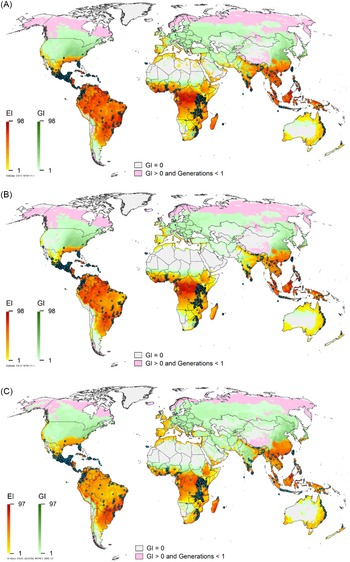
The modeled potential distribution accords well with the known global distribution (Figure 1A). While the current distribution is predominantly tropical, outlying records in cold locations (e.g., Cape Town in South Africa and the Himalayan Mountains in northern India) underscore the potential for range expansion into cooler areas. The model has near-perfect sensitivity, with only a few outlying records in mountainous areas in the Andes unable to be fit because the spatial resolution of the gridded climate data was too coarse to align properly with the distribution records. Regions shown in pink, with GI > 0 and Generations < 1, roughly align with the circumpolar boreal forest, where cold stress is the major limiting factor. Under these conditions, T. diversifolia could perhaps reproduce clonally, but the annual heat sum is likely insufficient for sexual reproduction. In green areas of low climate suitability, such as much of the United States and central Europe, T. diversifolia may be able to produce viable seed despite an EI < 0 but will not be able to establish and propagate as easily. In these areas, cold stress is likely to cause dieback, and persistence may only be possible in favorably warm microhabitats.
Climate suitability for Tithonia diversifolia modeled using CLIMEX: (A) under historical climate (centered on 1995), using a spatially explicit composite of natural rainfall and top-up irrigation scenarios; (B) under historical climate (centered on 1995), using a natural rainfall scenario; and (C) under a future climate scenario (ACCESS 1.0 model, RCP 8.5 centered on 2050), using a spatially explicit composite of natural rainfall and top-up irrigation scenarios. The EI is the ecoclimatic index, representing the relative climate suitability for population establishment. The GI is the annual growth index, indicating the potential for population growth. Green areas on the map are locations where there is potential for ephemeral populations of T. diversifolia to develop. Pink areas can support some growth but experience an insufficient heat sum to support the completion of a generation.

The effect of irrigation on the climate suitability patterns for T. diversifolia is most apparent in the southwestern United States and northern Mexico, the Sahara Desert and South Africa, and southern and eastern Australia (compare Figure 1A with irrigation and Figure 1B without irrigation).
Modeled Climate Suitability under Future Climate Change Scenario
As may be expected when using a change scenario for a relatively short time horizon, the changes in modeled climate suitability patterns for T. diversifolia are subtle (compare Figure 1A, historical, with Figure 1C, future scenario). The most notable effects are a poleward expansion of the zones suitable for persistence (EI > 0) in the Northern Hemisphere (southeastern and northwestern United States, western Canada, northwestern Europe, China, and Japan). In the Southern Hemisphere, the potential for range expansion is mostly in South America, though the potential is also marked in New Zealand. The more prominent effect in the Southern Hemisphere is for an increase in climate suitability within areas that are already suitable for persistence.
The widespread distribution of T. diversifolia globally provides an excellent basis for bioclimatic modeling, allowing the model to be fit in the Americas and Africa, with the remaining data reserved for model validation. As these continents have the largest documented distributions, they are ideal for setting parameters to accord with known occurrences of T. diversifolia. Fine-tuning the model then fits known global locations (except for regions with anthropogenic environmental changes or where T. diversifolia was incorrectly reported).
Globally, the greatest potential for invasive spread under current climate is in South America (Argentina, Uruguay, and southern Brazil), Europe, northern and southern Africa, China, southern Australia, and Oceania, notably in Indonesia, the Philippines, and the Pacific Islands (Figure 1A).
In Africa, there is strong concordance between the model and the known distribution. While there are very few recorded sightings in countries such as the Democratic Republic of the Congo, the Congo Republic, and the Central African Republic, these countries are part of the tropical Congo basin, where thick rain forest and political unrest likely contribute to underreporting of T. diversifolia (and many other species) (Figure 1A).
Most of the modeled climate change impacts on T. diversifolia are increasing climate suitability within the present potential distribution at higher latitudes. Conversely, tropical areas will experience more supra-optimal temperatures and a less favorable soil moisture regime in the modeled future climate scenario, indicating that the overall climate suitability may decrease for T. diversifolia (compare Figure 1A and Figure 1C). In this comparison, there appear to be few jurisdictions that are likely to become climatically suitable for T. diversifolia persistence in the near future (Canada, Belgium, Netherlands). The large number of records of T. diversifolia recorded in Taiwan and the cultural and trade connections with the southern Japanese islands make it likely that T. diversifolia is already present in at least some of these islands, and these could constitute a stepping-stone threat to the southern areas of the main island of Japan, which is likely to become climatically suitable for establishment of T. diversifolia (Figure 1C).
The relatively small difference between the climate suitability under historical climate (Figure 1A) and the future climate scenario examined here (Figure 1C) suggest that biosecurity agencies can take the modeled historical climate suitability results and consider areas within about 500 km on the poleward limits as an emerging risk area for establishment of T. diversifolia and try to manage this zone accordingly. Because of the irreducible uncertainties regarding the rate and extent of climate changes, an adaptive management framework may be appropriate within this buffer zone.
The results of the CLIMEX modeling compare favorably against those of Obiakara and Fourcade (Reference Obiakara and Fourcade2018). In Africa, the MaxEnt projections from the native range produced some very odd modeling artifacts, most apparent along the southern belt of the Sahara Desert (Figure 3b of Obiakara and Fourcade Reference Obiakara and Fourcade2018). These modeling artifacts do not represent topoclimatic patterns, but rather represent noisy geometric patterns from combining Bioclim variables. Because MaxEnt lacks any enforcement of the law of tolerance (Shelford Reference Shelford1918, Reference Shelford1963), the three African model results in Obiakara and Fourcade (Reference Obiakara and Fourcade2018) underrepresent the suitability of central and southern Africa due to a lack of records. The MaxEnt model also appears to underrepresent the suitability of the peri-coastal regions of northern Africa, which experiences a Mediterranean climate (Köppen Reference Köppen1936). This result is likely due to a lack of training records in the southwest of South Africa and southern California. The reduced suitability of the east African highlands from Uganda down to Zimbabwe in the MaxEnt model in Obiakara and Fourcade (Reference Obiakara and Fourcade2018) is at odds with the large number of distribution records we found there and with our modeled suitability (Figure 1A).
As with most invasive plants, preventing or slowing the spread of T. diversifolia is likely to be the most cost-effective strategy for jurisdictions that are at risk but do not presently have any infestations. This is likely to be most effective in protecting island nations. In continental situations, control will be more complicated because of the potential for natural spread across jurisdictional borders and the demand for the plant as a garden ornamental.
Where border biosecurity fails, or is unlikely to be effective, classical biological control may be an attractive strategy. South African trials of insect natural enemies of T. diversifolia have been undertaken, but as yet, no suitable candidates have been found (Simelane et al. Reference Simelane, Mawela and Fourie2011). While a defoliating Chlosyne butterfly (Lepidoptera: Nymphalidae) showed promise as a control agent, the damaging larvae were highly vulnerable to parasitization by wasp species in the field. Host-specificity tests have therefore not been undertaken, as this candidate is unlikely to be suitable. An unidentified Mexican moth candidate showed some promise but was rejected due to insufficient host specificity, as it also attacked sunflower cultivars (Helianthus annuus L.). Simelane et al. (Reference Simelane, Mawela and Fourie2011) noted a chrysomelid beetle Platyphora ligata (Stål) that was recorded on T. diversifolia in both Mexico and Costa Rica and the fact that a number of pathogens have been recorded on T. diversifolia in the native range. Some native range isolates of Puccinia enceliae (Dietel & Holw.) were tested on South African Tithonia spp. but were found to be incompatible; hence, careful genetic matching of host and pathogen is likely to be important for any successful control program.
Aside from the well-known benefits of biological control in terms of cost-effectiveness and safety and the reduced need for chemical herbicide applications, the system is also likely to be largely buffered from negative effects of climate change. As conditions change for T. diversifolia, they are likely to change in the same direction for potential biocontrol agents. Coevolution of these agents and T. diversifolia to meet the same climate signals could be revealed with some modeling and experimentation conducted as part of a renewed host-specificity testing program. As described in Kriticos et al. (Reference Kriticos, Ireland, Morin, Kumaran, Rafter, Ota and Raghu2021), ecophysiological studies can be cost-effectively integrated into classical biological control programs, and these studies can support modeling to inform the control program. Extending the methods to include the candidate agents would support an exploration of the likely effects of climate change on the synchrony and sympatry of the agents and their plant host.
Government agencies may struggle to balance conflicts of interest with species such as T. diversifolia that are perceived by different social sectors to have positive or negative traits (Virtue et al. Reference Virtue, Bennett and Randall2004). In Australia, the Queensland and New South Wales governments have tried to walk both sides of the street. In these states, while a general biosecurity duty applies to the management of this weed, there is no specific legislation preventing its spread as a garden ornamental-turned-escapee (NSW Department of Primary Industries n.d.; State of Queensland 2020). In the absence of government regulation preventing its sale or cultivation, gardeners are likely to provide a source of seed to fuel the invasion of nearby native reserves (Groves et al. Reference Groves, Boden and Lonsdale2005). Preventing the sale or propagation of T. diversifolia outside of shires that are presently invaded would likely decrease the cost, time, and effort necessary to eradicate this weed, as it has been shown to propagate widely when planted as an ornamental (Chukwuka et al. Reference Chukwuka, Ogunyemi and Fawole2007). Climatic changes appear set to increase the suitability of the southern regions of Australia, increasing their weed risk substantially. Managing the risks in southern NSW could at least buy Victoria more time before it must deal with the spread of this invasive plant.
In New Zealand, we have records of T. diversifolia from Auckland. Despite the invasion threat throughout much of the North Island, we could find no evidence of any form of regulatory response to manage the invasion threats. A Google search revealed many sources in New Zealand promoting the benefits of T. diversifolia as a garden ornamental and as a source of food for migratory monarch butterflies, but little acknowledgment of the threat it poses to disturbed natural ecosystems.
The green areas on our maps offer the potential for propagating T. diversifolia in areas where there is minimal risk of establishing self-sustaining invasive populations. In those areas modeled as suitable for establishment, classical biological control may be the next best option for dealing with the conflict, allowing gardeners to enjoy the benefits while reducing the invasive threats to native ecosystems.
Acknowledgments
The aid and knowledge of Arne Witt (CABI) was essential to the fine-tuning of this model. We are grateful to Noboru Ota (CSIRO) for preparing the maps in this paper. No conflicts of interest have been declared. This research received no specific grant from any funding agency or the commercial or not-for-profit sectors.