Introduction
Disasters, whether natural or man-made, pose unexpected and complicated challenges for healthcare systems, necessitating collaboration at all levels of the healthcare profession as well as coordinated and trained responses from frontline healthcare providers. The rising rate of disasters underscores the importance of disaster preparedness in healthcare facilities, especially hospitals, the primary responders to such incidents.Reference Thobaity1, Reference Kim2 In India, a country that is continuously susceptible to various disasters such as floods, earthquakes, cyclones, and emergent outbreaks of new epidemic diseases, the preparedness of the healthcare sector to disasters has become critical to reduce morbidity and mortality in case of a disaster.Reference Gupta, Mehra and Shamdasani3, 4 In this context, the COVID-19 pandemic has served as a wake-up call, emphasizing the need for all healthcare workers to be adequately trained and prepared for disaster situations.
Kerala State, a province in India, is an example of augmented disaster vulnerability, as it is prone to floods, landslides, and cyclonic storms, which were at their worst in 2018, when catastrophic floods affected health facility infrastructure.5 According to the Disaster Management Act of 2005, all healthcare institutions in India are obliged to develop a disaster preparedness plan that focuses on establishing institution-level capacity, staff training, and coordination of response activities.Reference Talati, Bhatia and Kumar6 However, even with these regulatory frameworks, there are considerable gaps in disaster preparedness capacities, especially regarding the activities and competencies of different healthcare professionals during disaster management.
Nurses are the most significant group in the healthcare workforce across the globe and essential frontline workers in incidents of disasters, including critical care, triage, emergency management, and psychosocial support for the victims.Reference Veenema, Deruggiero and Losinski7, Reference Lin, Tzeng and Chiang8 The recent data is in line with this, showing that nurses tend to have limited disaster preparedness knowledge and expertise, and research conducted in disaster-prone countries has found that nursing professionals have low-to-moderate levels of disaster preparedness.Reference Labrague and Hammad9, Reference Küçük, Sari and Demirbağ10 The COVID-19 pandemic highlighted significant gaps in nursing disaster preparedness, including deficiencies in education and training, insufficient personal protective equipment, and a lack of support systems within organizations.Reference Flaubert, Menestrel, Williams and Wakefield11
Disaster management should be characterized by the involvement of all stakeholders and diverse viewpoints to ensure preparedness planning and disaster response coordination.Reference Elkady, Hernantes and Labaka12 The perceptions of stakeholders influence institutional policies, resource allocation, priorities in training, and delineation of roles in the disaster management systems. The role of nurse educators in disaster management is perceived differently by different parties, such as clinical nurses, physician leaders, emergency management personnel, nurse educators themselves, and so forth, so it is critical to understand how each party views the role of nurse educators to create specific interventions, expectations of the role, and resource optimization to alleviate post-traumatic stress.Reference Mustikasari, Fadhillah and Pratiwi13 Research has shown that nurse educators can significantly contribute to the implementation of strategies that allow hospitals to manage crises efficiently.Reference Flaubert, Menestrel, Williams and Wakefield11, Reference Alkhalaileh14
Although the importance of disaster preparedness education has been acknowledged and the existing knowledge gaps in nurse disaster preparedness have been identified, there remains a lack of qualitative studies examining stakeholders’ opinions on the role of nurse educators in Hospital Disaster Management (HDM). Most research used quantitative designs to evaluate levels of disaster preparedness and knowledge gaps, as well as training requirements, but has not studied in depth the contextual, organizational, and relational consequences for nurse educators’ disaster management roles.Reference Lin, Tzeng and Chiang8, Reference Zhang, Zhang and Zhang15 Investigating complex phenomena, the embodiment of nuanced ideas, situational elements, and diverse views that are difficult to identify using quantitative methods, is made easier by qualitative approaches.Reference Dahlberg and Dahlberg16
Hence, this qualitative research aims to fill these crucial gaps by presenting stakeholders’ views on the role of nurse educators in HDM and the competencies they need to contribute positively as both educators and first-line care providers. Through the application of the qualitative approach to the study of tertiary care hospitals and nursing colleges in Kerala, the research aims to produce contextually significant, practice-relevant information that has the potential to inform curriculum development, professional development programs, institutional policies, and disaster preparedness planning. The results can be used in the broader discussions of disaster nursing education, the readiness of the health care workforce, and the maximization of nurse educators’ roles in enhancing the institution’s and community’s disaster resilience.
Aim and Objectives
This study aimed to explore the perception of stakeholders in hospitals, such as doctors, clinical nurses, nurse administrators, and nurse educators, about the involvement of nurse educators in HDM, and to identify how they could be better supported to perform better through competency development. The study was conducted with the following research questions.
-
1. How do stakeholders perceive the involvement of nurse educators in HDM?
-
2. What core competencies are considered essential for a nurse educator to contribute effectively to HDM?
-
3. What training areas should be taught to enhance the competencies of nurse educators so that they can function as frontline care providers during a disaster?
Methods
A qualitative, hermeneutic phenomenological approach was used to interpret participants’ experiences of HDM and to understand how and why they perceive their roles, challenges, and competencies. The participants were those directly or indirectly involved in HDM, including doctors in medicine, surgery, emergency medicine, and community medicine; clinical nurses; medical superintendents; nurse educators; nurse supervisors; and nurse administrators. They were identified by contacting the administrators of tertiary care hospitals and nursing colleges in Kerala. The information-rich prospective participants were approached through face-to-face or telephonic contact. The eligibility criteria were being a permanent employee of the hospital or nursing college with at least 5 years of experience in their respective work areas, and being willing to participate in the study. A quota sampling technique was used to select participants. Within the quota, maximum variation sampling was also employed based on years of experience and the extent of the hospital’s involvement in disaster-related activities. The researchers prepared the interview guides based on the literature review and expert opinion, which were pilot-tested through two interviews. Also, conducted 15 in-depth interviews (IDIs) and 4 focus group discussions (FGDs). The final sample of 38 could achieve data redundancy.
Data Collection
The data were collected by using an IDI guide and an FGD guide, moderated by an experienced qualitative researcher, with 15 IDIs and 4 FGDs conducted from October to December 2023. Prior appointment for IDI and FGD was obtained from the participants. The purpose of the study was explained to the participants in advance, and the interview was scheduled at their convenience with written informed consent. Direct and video conferencing were used for data collection with a mix of Malayalam and English, averaging 1 to 1.30 hours. The interviews were video recorded, and a topic guide was developed, which was piloted during the first 2 interviews. The researchers remained neutral during data collection and established rapport with the participants. After the interview, the transcripts were shared with the participants for feedback before analysis.
Study Rigor
To ensure the rigor of the study, methods focusing on credibility, dependability, transferability, reflexivity, and conformity were employed.Reference Lincoln, Guba and Pilotta17 The interview guides were aligned with national and international disaster management guidelines, and interviews were conducted with academic nurses and staff of hospitals to determine the validity of the data. The research ensured reliability by engaging in extended periods with the participants, building trust, and making sure the data reflected the participants’ true perspectives. The research ensured data reliability through member checks, in which members reviewed the findings, making the data more dependable. The research ensured the researchers remained unbiased, adopted reflexivity, and ensured data consistency by keeping a research diary that contained the researchers’ ideas and reflections. The variability in findings and codes was ensured by independent examination of the findings. Detailed descriptions of the research context and methods were provided, enabling readers to evaluate the applicability of the findings to other settings.
Data Analysis
The audio recordings were transcribed from Malayalam to English and analyzed using thematic analysis. Researchers first became acquainted with the data by reading the transcripts, which led to the identification of preliminary codes that were consistent with the study objectives. During the indexing phase, these codes were applied to relevant data segments. In the charting phase, the data were presented in a matrix, in which meaning units were summarized into categories, which were then analyzed to yield overall themes, yielding conclusions about participants’ experiences.
Ethical Considerations
The Institutional Ethics Committee of the Government Nursing College, Thiruvananthapuram, Kerala, India, approved the study (CNT/IEC/51/1/2022, dated 31/12/2022) prior to the initiation of data collection. The administrators of the involved institutions granted permission, and the study participants provided written informed consent. Anonymity and confidentiality of the information were ensured by assigning code numbers to the transcripts.
Results
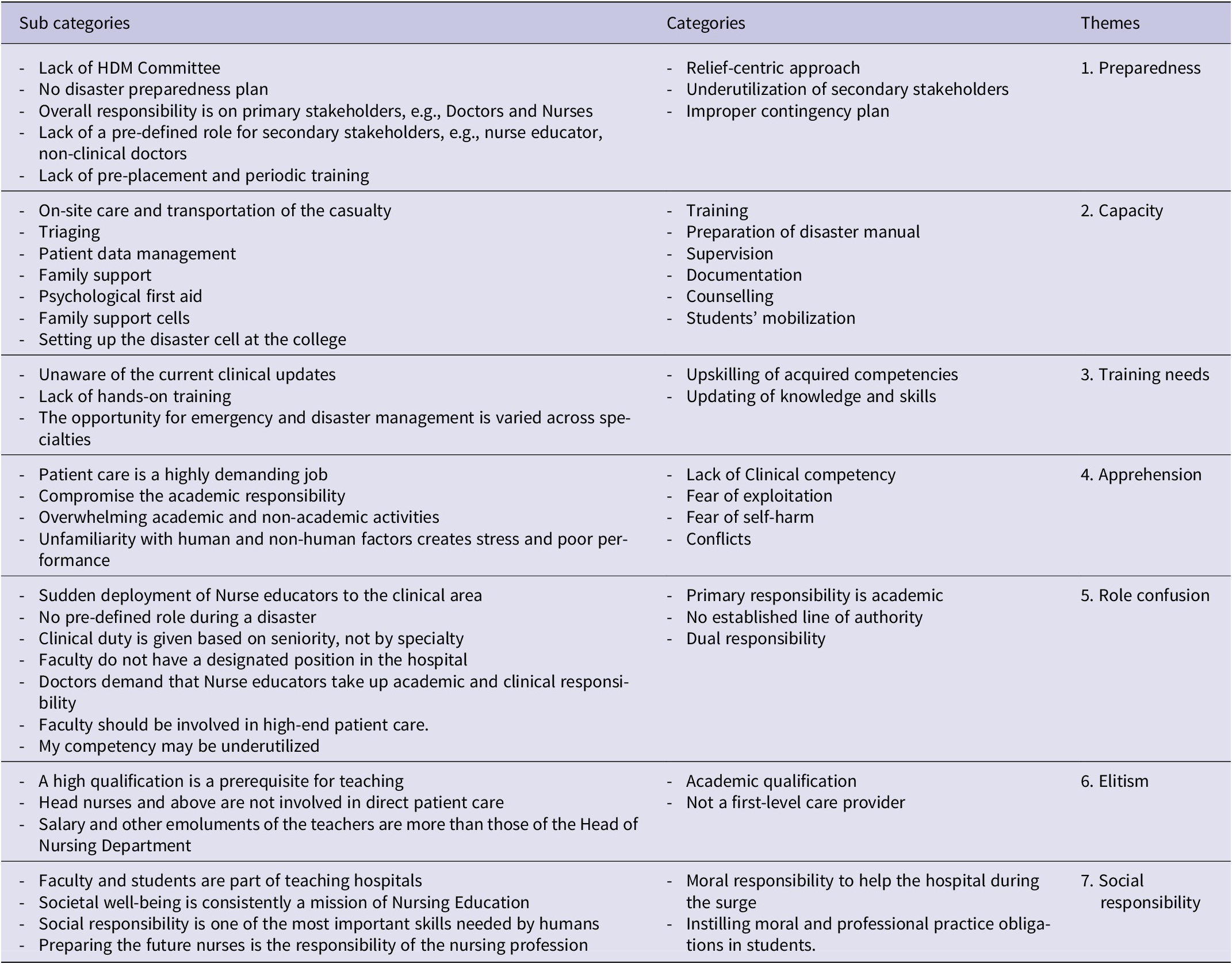
There were 38 participants, comprising 8 doctors (including specialists in psychiatry, community medicine, epidemiology, and surgery), 5 nurse administrators, 3 clinical nurses, 1 nurse supervisor, and 21 nurse educators, who were the stakeholders in HDM. The age range was 33 to 66 years, with an age range of 40 to 50 years. Females mainly held roles as nurse educators and administrators, while males were often surgeons and epidemiologists. Their qualifications included BSN, MSN, MSc, PhD, MD, MS, and MPhil, reflecting a strong emphasis on advanced education. Experience ranged from 5 to 43 years. The subcategories, categories, and themes are listed in Table 1 below.
Subcategories, categories, and themes of qualitative analysis
THEME 1: PREPAREDNESS
A prominent theme emerged across the 3 categories under theme 1: a relief-centric approach, underutilization of secondary stakeholders, and an improper contingency plan. The participants expressed uncertainty about the existence of a hospital management committee, the absence of mock drills, the lack of a concept of a disaster ward, and the lack of emergency equipment. The participants believed that the disaster management committee exists, but it has not been formed, and recalled a lack of training and preparation in their nursing education. They mentioned a lack of organized response protocols during disasters. They expressed concerns about the hospital’s ability to manage emergencies and about a lack of knowledge of evacuation routes during emergencies.
Category 1.1—Relief-centric approach
There is no disaster management plan for the hospital or the disaster management committee. HDM takes a relief-centric approach after a disaster. There is no pre-disaster and post-disaster plan. The relief-centric approach results in chaos in surge management.
-
• “It seems there is no hospital management committee. Despite many discussions, nothing has been established. If a committee exists, we are unaware of it. The hospital has never held a mock drill, and if it had, our students would likely have informed us.” (IDI—Nurse Educator)
-
• “I don’t remember any emergency drills at our institution, and I doubt our layout is suitable for emergencies. Given the number of patients and staff, we were unsure where to go in the event of a fire or other crisis.” (IDI—Nursing officer)
-
• “I studied at a government college and learned about disaster management as a chapter in community health nursing. However, even after working in a medical college, I’ve never seen an organized response to a disaster. When major accidents happen, the public and media often disrupt operations, and I have not witnessed any disaster protocols being implemented.” (IDI—Nurse educator)
-
• “During mass casualty events, patient numbers can surge from 10 to 100 within an hour, prompting us to call for extra manpower and to utilize any available space for admissions. When our college was flooded, many people went home, while others were in a state of confusion. I could only conduct a few health education camps and provide social services, as nursing colleges typically do. This happened again during the next flood.” (FGD—Nurse educator).
Category 1.2—Underutilization of secondary stakeholders
Doctors, nurses, and hospital support staff are primarily responsible for disaster management. Non-clinical doctors and faculty from nursing and paramedicine are not part of HDM.
-
• “In a disaster situation, only doctors make decisions, while nursing staff and others are left to implement those decisions.” (IDI—Faculty, Surgery)
-
• “If a disaster management committee is formed with clear roles, we can effectively manage bystanders and the media. A system to inform the faculty team should also be planned.” (IDI—Faculty, Psychiatry)
Category 1.3—Improper contingency plan
Many hospitals have not implemented their contingency plans for personnel, materials, and facilities. Additionally, nursing colleges and faculty are often excluded from these plans. Most participants reported being unfamiliar with the hospital’s contingency plan.
-
• “Although our institution is an apex-level center, we lack a disaster management system and can respond only reactively. There is no pre-planning for space, capacity, workforce, or materials. While a ward for infectious diseases was initially created for disaster purposes, it has since become a fever ICU and has been repurposed for other departmental needs. No further planning has been done, leaving us unprepared for future disasters.” (IDI—Faculty, Surgery)
THEME 2: CAPACITY
The study focused on assessing the capacities required by nurse educators for effective disaster management. “Capacity” refers to the roles the nurse educator can take on during disaster management. The categories leading to their development are Training, Disaster Manual Preparation, Supervision, Documentation, Counseling, and Student Mobilization.
Category 2.1—Training
As nurse educators primarily serve as teachers, they can be used to train students and conduct pre-periodic training for faculty across various areas of HDM.
-
• “A mass casualty incident is usually related to traumatic injuries. Training for Advanced Trauma Life Support has been ongoing, and staff have received training in Basic Life Support, Advanced Cardiovascular Life Support, and Paediatric Advanced Life Support over the past few years. All nursing staff are equipped with essential skills, and training can also cover various disaster scenarios.” (FGD-3)
Category 2.2—Preparation of Disaster Manual
The nurse educator is the most appropriate stakeholder to prepare the hospital disaster manual, working with representatives from different departments. The participants expressed the need for a disaster manual and for its dissemination to various hospital staff.
-
• “We can initiate training and are proficient in preparing manuals. Disaster manuals can be developed and distributed to staff across various categories in nursing schools, colleges, and hospitals.” (FGD-4)
Category 2.3—Supervision
Effective utilization of students during the surge is an effective contingency plan for a hospital. Participants stated that during a disaster, students need close supervision to reduce errors and increase efficiency.
-
• “During a disaster, people often rush to help, but detailed records of treated patients are not maintained. This can make it challenging to verify information later at the reception. Students can be mobilized to assist with triage, depending on the hospital’s needs, under the supervision of a nurse educator.” (IDI—Nursing Officer)
Category 2.4—Documentation
The faculty can take on the role of documenting events during disasters and preparing reports.
-
• “Documentation requires a dedicated team. There will be many unidentified patients. Collect as much information as possible from their companions and secure their belongings. Report incidents to the police, as theft often occurs during disasters. If patients are unconscious and can’t provide their names, use ‘Unknown 1’ and use this identifier on their outpatient card, investigations, patient band, and/or deceased bodies to ensure proper tracking. The nursing college faculty can coordinate with the documentation process.” (IDI—Nursing Administrator)
Category 2.5—Counseling
During a disaster, patients, families, and the public often experience stress, anxiety, and a lack of awareness. Primary care providers cannot be engaged in raising awareness and addressing psychosocial issues for a large group of patients. Nurse educators can step in to provide counseling.
-
• “Psychiatric nursing expertise is distinct from other nursing specialties, but with proper training, these professionals can make a significant impact. Psychological first aid is an essential component of crisis intervention; long-term support is equally essential. There is a significant shortage of workforce, with only 1-2 psychologists generally available in a medical college. In such cases, faculty can provide support, and students can contribute meaningfully.” (IDI—Psychiatrist)
Category 2.6—Students’ mobilization
Faculty members are essential in mobilizing students and effectively assigning tasks based on their preparation levels. This also allows students to clarify any doubts about disaster management.
-
• “If the hospital has a disaster team with nurse educator representatives, we receive training that enables us to train our co-faculty and students. As team members, we are responsible for mobilizing both faculty and students, with student participation being mandatory.” (FGD-2)
THEME 3: TRAINING NEEDS
The faculty’s training needs emerged as a key theme in the study. Nearly all nurse educators who participated reported a need for upskilling and updating their knowledge and skills, particularly in HDM. Participants from all categories shared this common view regarding the need for training.
Category 3.1—Upskilling of acquired competencies
Many participants noted a decline in their clinical skills over the years due to a focus on teaching. Clinical teaching and supervision often become fragmented. The minimum requirement for college teaching is a postgraduate degree. As faculty move into non-clinical roles, their competencies in areas such as basic life support and triage may weaken.
-
• “We receive extensive training, but it lacks continuity. For instance, the goal of our ATLS and PALS training was to create a code blue team, but that never materialized. Although initial efforts can be sparked by passion, maintaining them remains a significant challenge and our greatest weakness.” (IDI—Nurse educator)
Category 3.2—Updating of knowledge and skills
Nurse educators expressed their desire to update their knowledge and skills. The COVID-19 scenario prompted most faculty to realize they could not avoid clinical responsibility during a surge.
-
• “As a psychiatrist, I want to emphasize that one in four people who are not critically ill struggle with mental health issues. Proper training and support are essential to effectively address their needs.” (IDI—Psychiatrist)
-
• “We need training to understand our roles during a disaster so we can work together effectively. Let’s form a team and clearly define our capabilities and limitations.” (IDI—Nurse educator)
THEME 4: APPREHENSION
Apprehension emerged as a key theme related to a lack of clinical competency, fear of exploitation, fear of self-harm, and conflicts. The nurse educator mainly expressed this sentiment, but participants from other categories also voiced similar concerns.
Category 4.1—Lack of Clinical Competency
Clinical competency is vital for effective performance in emergencies and disasters. However, many faculty members worry about their skills in these situations. While doctors and nursing officers acknowledge that nurse educators can excel, they often doubt the faculty’s expertise.
-
• “When a casualty arrives, emergency assessment and lifesaving measures must take priority. I currently lack confidence in handling these situations without proper training, and these skills can diminish if not practiced regularly. Continuous training and refresher courses are essential. During my internship ten years ago, I observed that many educators were disconnected from clinical settings. This raises a critical issue: how can staff nurses or students respect a group that isn’t up to date on practices? If we critique others, we must also recognize our own shortcomings. Faculty members need to remain informed about ward developments while students are present. Teaching outdated material from 10 or 20 years ago erodes respect. We must be willing to set aside our elitism and learn from nurses.” (IDI—Nurse educator)
Category 4.2—Fear of exploitation
The nurse educator expressed concerns about being exploited by being assigned additional responsibilities at the hospital. They highlighted that they already face staff shortages and have other academic duties.
-
• “Teachers fear that being in charge of a ward would transfer vast responsibilities in patient care to us that we are not prepared for and do not have the authority to execute. This may cause confusion and further stress in our identity. Above all, the severe shortage of faculty at the hospital and college impedes our ability to fulfil clinical responsibilities.” (IDI—Nurse educator)
Category 4.3—Fear of self-harm
While teaching is generally considered a low-risk profession, involvement in hospital activities during a disaster raises concerns about exposure to diseases and physical strain.
-
• “During a disaster, nurse educators tend to ensure their own safety by choosing less-risky tasks, such as working in the information cell or health education programs. They usually do not agree to provide direct patient care due to fears of exposure to infections or physical strain.” (FDG-4)
Category 4.4—Conflicts
Participants reported that conflicts are likely to arise because there are no pre-defined roles for each stakeholder during a disaster. Doctors typically take control of all aspects of care, including nursing care.
-
• “Will the service side accept us? Our students seem hesitant to accept us. There’s a fear of losing out on promotion opportunities, which has created conflict among nurse educators.” (IDI—Nurse educator)
-
• “Many nurses do not fully accept the role of nurse educators, believing there is limited work for them. Those with experience in nursing education understand the heavy workload involved. To initiate change, proper training and certification for faculty are essential. There is a significant gap between nursing education and clinical practice, which leads to student indifference when they become staff nurses. In addition, the nursing colleges often fail to showcase their faculty’s abilities.” (IDI—Nurse educator)
THEME 5: ROLE CONFUSION
The theme of role confusion overlaps with the theme “Conflicts,” but has distinct subcategories. These subcategories highlight the gaps and reasons for the sub-optimal involvement of nurse educators in HDM.
Category 5.1—Primary responsibility is academic
All participants, including doctors, nurses, and nurse educators, agreed that the nurse educator’s primary responsibility is academic, with patient care as a secondary role within clinical supervision. It was also noted that clinical assignments should be based on seniority rather than specialty.
-
• “If we refer to our job description—if there is one—our primary responsibility is teaching. Medical faculty, however, have dual roles that include both teaching and patient care, which is why they participate in 24-hour clinics. This distinction makes a significant difference.” (IDI—Nurse educator)
Category 5.2—No established line of authority
The absence of pre-defined roles creates confusion regarding the line of authority in both giving and receiving instructions. Currently, nurse educators do not hold an official position in hospital settings, contributing to this ambiguity.
-
• “The disconnect between teaching and service leads to issues in command structures. When issuing a directive, it is important to clarify the authority behind it. Establishing a formal role for nurse educators in the hospital can enhance clarity and legitimacy.” (IDI—Nurse educator)
Category 5.3—Dual responsibility
Faculty and nursing administrators agree that the current system fails to support the dual roles of academic and clinical duties. However, in disasters with limited personnel, the expertise of nurse educators can be used effectively.
-
• “I am in favour of an integrated position with dual obligations to guarantee our active involvement in disaster situations.”
“I have two points to share. First, many institutions lack clear roles, making it hard to contribute effectively. We could concentrate our efforts and have a significant influence if the roles are clearly defined.” (IDI—Nurse educator)
THEME 6: ELITISM
The nurse educator often pointed out the elitism displayed by medical faculty, but they also acknowledged a similar superiority within their own ranks toward service-side nurses.
Category 6.1—Academic qualification
In the medical field, clinical and academic roles at teaching hospitals typically share the same qualifications. In contrast, nurse educator positions require advanced credentials, fostering hierarchical attitudes.
-
• “In hospitals, some accept us, and those who do not. While we often point out others’ faults, nurse educators must also reflect on their own behaviour. Often, we exhibit an elitist attitude similar to that of medical faculty, with hierarchical dominance.” (IDI—Nurse educator)
Category 6.2—Not a first-level care provider
Nurses often pursue advanced qualifications to transition into teaching roles, which are seen as more prestigious. The physical demands of clinical nursing, including shift work, contribute to this preference. Senior positions, such as head nurses, usually involve limited direct patient care.
-
• “As teachers, we are not expected to provide direct patient care, whether during emergencies or in routine situations.” (FGD—4)
THEME 7: SOCIAL RESPONSIBILITY
All participants agreed that supporting the parent hospital during a disaster is a shared social responsibility.
Category 7.1—Moral responsibility to help the hospital during the surge
Faculty and students in teaching hospitals are expected to contribute to societal well-being. Participants stressed the need to integrate social responsibility into nursing curricula for better disaster preparedness.
-
• “The pandemic taught us how much we need social responsibility. Disaster training, such as for disease outbreaks and floods, should be part of our curriculum, with an emphasis on mass-casualty management. If these initiatives are made priority concerns, their implementation will be easier and smoother.” (IDI—Nurse educator)
Category 7.2—Instilling moral and professional practice obligations to students.
Participants highlighted the importance of a balance in nursing education, ensuring students gain practical experience while meeting academic requirements. Regular disaster training should be part of the curriculum to equip students for emergency response without compromising their studies.
-
• “The nursing profession aims to prepare future nurses, but we cannot send students unprepared into disaster scenarios. They need clinical exposure while also meeting university requirements. Annual disaster training tailored to their academic level is essential to build their confidence and competence.” (IDI—Nursing administrator)
Discussion
The qualitative study explored how different hospital stakeholders perceive the role of nurse educators in HDM and identified the competencies and training needed to improve their involvement during disasters. The results show that organizational gaps, problems with professional identity, and systemic obstacles work together to limit nurse educators’ ability to participate effectively in disaster preparedness and response. While previous research has emphasized the importance of nursing workforce readiness in disaster contexts, this study uniquely foregrounds the perspectives surrounding nurse educators—a group often overlooked in disaster management discourse despite their strategic position within teaching hospitals.
Preparedness Gaps and Structural Limitations
The study established a pervasive lack of institutional preparedness that is manifested by the lack of operational disaster committees, weak contingency planning, and a relief-oriented approach to disaster response.Reference Vu, Obaitor and Grobusch18, Reference Tesfaye, Prior and McIntyre19 The claim that disaster readiness in many healthcare institutions is still mostly reactive rather than proactive is supported by the lack of mock drills, ambiguous evacuation procedures, and limited faculty and staff understanding of disaster plans. The exclusion of secondary stakeholders, such as nurse educators and non-clinical faculty members, from the disaster committee will impede the opportunity to expand capacity, contrary to global recommendations that highlight the importance of participation in disaster preparedness for increased resilience in the institution.Reference Singh, Sapkota and Achour20, Reference Li, Hockenberry and Chen21
Expanding the Capacity of Nurse Educators
The results indicate that nurse educators have tremendous untapped potential to help HDM in areas such as training, documentation, supervision, psychosocial support, and student mobilization. These competencies fit into the international competency frameworks, such as those suggested by the International Council of Nurses, which emphasize the role of the educator in preparedness training, communication, and coordination.22 The research also supports the need to involve students in disaster response within a framework of proper guidance. This aligns with the literature promoting experiential disaster training to build future workforce preparedness.Reference Brinjee, Thobaity and Almalki23, Reference Cho and Kwon24
Training Needs and Competency Gaps
Another common theme among the stakeholder groups was the need for ongoing upskilling of nurse educators, especially in clinical skills such as triage, basic and advanced life support, and emergency care. This is consistent with studies suggesting that nurse educators have low-to-moderate disaster preparedness and require systematic, ongoing training.Reference Labrague and Hammad9, Reference Luo, Yan and Tang25, Reference Rohini, Kamalasanan and Venkateswaran26 Their preparation for frontline roles in disasters is also complicated by the fact that their academic roles have eroded their clinical skills, indicating the need for flexible workforce mobilization and cross-training to meet the immediate capacity requirements.27
Apprehension, Role Confusion, and Professional Identity
The fear of perceived clinical incompetence, exploitation, and personal safety among nurse educators proved a major barrier to their participation in HDM. These are not the only issues, and such anxieties have been reported among nurses worldwide, especially when roles in disaster situations are ambiguous or training is lacking.Reference Thobaity1 Another significant finding was role confusion, similar to research emphasizing the necessity of a clear delineation of roles and of combined academic-clinical models to maximize workforce use during crises.Reference Veenema, Griffin and Gable28
Elitism and Hierarchical Dynamics
Elitism, both as an attitude of perceived medical faculty superiority and as a hierarchical attitude in nursing, adds another sociocultural aspect to the discussion. All these dynamics may undermine cooperation, erode trust, and slow the inclusion of nurse educators in disaster teams. Hierarchical conflicts at the same level have been observed in the literature on disaster response, where professional silos and status disparities hamper coordinated response.Reference Abdeen, Fernando and Kulatunga29
Social Responsibility and Professional Obligation
Nevertheless, due to the difficulties, the participants were highly socially responsible, which is why they underscore the moral duty of faculty and students to teach in hospitals during disaster response. This aligns with the general values of nursing, which are service, community, and ethical responsibility in times of crisis.Reference Shahriari, Mohammadi and Abbaszadeh30, Reference Gebreheat and Teame31 Hence, by incorporating social responsibility in curricula and institutional policies, disaster preparedness and the culture of shared responsibility could be reinforced.
Implications
The study has significant implications for nursing education, hospital administration, and the health system’s disaster preparedness. To begin with, the lack of preparedness and role clarity underscores the need for hospitals, especially teaching hospitals, to integrate nurse educators into disaster management to reduce confusion during disasters. Secondly, the research emphasizes the need for periodic competency-building faculty development programs and interventions for nurse educators, such as periodic academic–clinical refreshers, simulations, and interdisciplinary workshops, to sustain competence and confidence, and provisions for training future nurses in disaster readiness. Third, the findings recommend integration of disaster preparedness as a fundamental part of the nursing curriculum. When properly trained, nurse educators can help produce a disaster-ready workforce by integrating experiential learning, psychosocial support training, and ethical decision-making into students’ learning experience. Lastly, the research points to the need to promote a culture of collective responsibility, greater interprofessional respect, and cooperation within the professional ranks to improve teamwork quality and institutional resilience in crisis.
Limitations
There are a few limitations to consider when interpreting the results. The study was conducted in tertiary care nursing colleges in a province in India, which may limit the generalizability of the findings to other regions with dissimilar organizational designs, resource adequacy, or disaster patterns. Even though the sampling was conducted using maximum variation, the views of stakeholders regarding private hospitals, rural hospitals, or non-teaching institutions were not represented. Also, the research relied on self-reported perceptions, which can be influenced by recollection bias, social desirability, or participants’ past experiences. Lastly, no direct observation of disaster drills or the actual response to a disaster was incorporated into the study, which would have provided more information on the roles and interprofessional interactions.
Conclusion
This qualitative research provides a subtle insight into how various hospital stakeholders understand the role of a nurse educator in HDM. The results indicate significant gaps in disaster preparedness, role clarity, and competency maintenance, as well as a potential for nurse educators to play an important role in disaster planning, training, psychosocial support, documentation, and surge capacity.
Healthcare institutions can tap into this untapped workforce by eliminating structural obstacles, enhancing competency-building programs, and incorporating nurse educators in the formal disaster management frameworks to increase disaster resilience. As disasters become more frequent and sophisticated, the optimization of the role of nurse educators is a strategic requirement and a professional and societal need. The findings can be used in policy formulation, curriculum development, and institutional readiness to establish a more resilient and responsive healthcare system.
Author contribution
-
1. Athirarani M Rohini: Conceptualization, methodology, formal analysis, investigation, data curation, and writing—draft
-
2. Ajayan Kamalasanan: Formal analysis, writing, reviewing, and editing
-
3. Viswanathan K Venkateswaran: Resources, validation, software
-
4. Latha Mandal: Supervision, Funding acquisition, project administration
-
5. Rosenara B Thajudheen: Validation, visualization
-
6. Rajamohanan K. Pillai: Conceptualization, methodology, visualization
Funding statement
The Nursing Research Society of India funded this study as part of a Fellowship in Nursing Research.
Competing interests
The authors declare no conflicts of interest.
AI tools
The authors acknowledge using the AI tool Grammarly to edit the text to a limited extent.
Sources of support
The Nursing Research Society of India funded this study as part of a Fellowship in Nursing Research.