Introduction
There is a growing interest in the potential of qualitative longitudinal research within the social sciences in general (Thomson et al., Reference Thomson, Henderson and Holland2003b; Elliott et al., Reference Elliott, Holland, Thomson, Bickman, Brannen and Alasuutari2007 forthcoming), and in social policy research in particular (Molloy et al., Reference Molloy, Woodfield and Bacon2002). The psychological underpinnings of personal behaviour and the context that gives this behaviour meaning have become the focus of current policy attention. Halpern and colleagues talk in terms of an ‘ecological approach’ to the promotion of personal responsibility and behaviour change where attention is given both to the individual and those around them, such as parents and peers, in order to ‘make gradual changes to social norms’ (Halpern et al., Reference Halpern, Bates, Beales and Heathfield2004: 4). Reviewing research on the thinking and behaviour of young adults, Jones (Reference Jones2005) points to the importance of an iterative and dynamic relationship between what in policy terms are understood as ‘anti-social behaviours’ and the environments in which they develop. Paradoxically, the same behaviour may be understood as a product of social exclusion and as an attempt on the part of the individual to be socially included (Thomson et al., Reference Thomson, Henderson and Holland2003a). This is a perspective that demands a subtle and situated understanding of how and why individuals and communities operate as they do (Wilkinson, Reference Wilkinson2005; MacDonald et al., Reference MacDonald, Shildrick, Webster and Simpson2005).
The dominant contemporary model for qualitative longitudinal research centres on the prospective repeat interview study, although other established traditions of longitudinal qualitative study include long-term ethnography and follow-ups or re-studies of classic research projects (see Holland et al., Reference Holland, Thomson and Henderson2004 for an overview). The resurgence of interest in qualitative longitudinal methodologies is undoubtedly associated with an interest in processes (rather than simply outcomes), with understanding change and with a focus on the individual (although the unit of analysis for qualitative longitudinal research need not be the individual). One of the most compelling attractions of this kind of work is that it enables us to explore apparent discordance between what people say and what they do in such a way to escape some of the traditional constraints of qualitative research.
Interview-based research is an imperfect way of studying behaviour. The existence of two accounts does not in itself resolve the problem that interviews are constituted through stories that are told about life, rather than the life as it is lived. Yet the generation of multiple accounts over time does provide a rich source of understanding of the complexities of the storied life (Bruner, Reference Bruner1987; Bertaux, Reference Bertaux and Bertaux1981). Given that social policies increasingly seek to influence behaviour, the ‘long view’ offered by qualitative longitudinal research offers the possibility of developing more complex and thus realistic understandings of how and why individuals and communities live as they do as well as the intended and unintended consequences of policies themselves.
Lessons from a qualitative longitudinal study
The Inventing Adulthoods data set documents the lives of approximately 100 young people over a period of ten years. The data was collected through three consecutive studies funded by the ESRC, spanning the period 1996–2006. The young people who volunteered to be involved in the study were drawn originally from mixed ability form groups in schools in five contrasting locations within the UK. The main methods employed in the study have been repeat biographical interviews (up to six over the course of the study), memory books (Thomson and Holland, Reference Thomson and Holland2005) and focus groups. Data were transcribed and stored and coded on NuDist. Young people were aged between 11–17 years at the beginning of the study and 21–29 years at the last round of data collection.Footnote 1
The Inventing Adulthoods data set is rich, detailed and multi-dimensional. There are many ways in which the data can be organised, and different dimensions through which analysis can take place. The data set was gathered through a series of ‘waves’ of fieldwork. Our initial impulse was to organise and analyse the data by ‘wave’, enabling us to compare accounts gathered at a similar moment of time: cross cut data. As the study developed and waves of data accumulated, we became increasingly aware of the need to conduct diachronic analysis – following individuals, themes and groups over time longitudinally. Our main tool for conducting the diachronic analysis became the ‘case profile’ – a document in which we drew together the analyses that researchers wrote about an individual after their interview was completed. These cumulative case profiles not only provided a condensed account of changes in the individual's circumstances and appearance, but also summarised the ways in which their narratives developed and how the interviewer responded to them.
Over the course of this ten-year study we have recognised the centrality of the researcher to the data and the value of recording hopes, fears and feelings as a systematic part of the data generation process. We have also become aware of the significance of ‘perspective’ in framing a longitudinal data set – the lack of analytic closure and the significance of the position in time and space from where the interpretation of a particular case is made (McLeod, Reference McLeod2003). We have written about our experience of learning to conduct qualitative longitudinal research in temporal terms, identifying examples of foresight, insight and hindsight, and the challenge of combining synchronic (cross cutting) and diachronic (longitudinal) analyses (Thomson and Holland, Reference Thomson and Holland2003).
Longitudinal data sets have been likened to wine, deepening in flavour and character over time. As this process develops, the challenge increasingly becomes one of realising the potential of the data set. The way that we have interrogated the Inventing Adulthoods data set has changed. Initially we drew primarily on cross cut data, employing individual cases as illustrations of wider patterns. Increasingly we have developed an approach in which we seek to juxtapose case studies productively, for example exploring the divergent educational pathways of three able young women growing up in a disadvantaged estate (Henderson et al., 2007; Thomson et al., Reference Thomson, Henderson and Holland2003a). Working in this way with the whole data set has enabled us to explore the significance of the socio-economic context of young people's lives as well as more individual, cultural and agentic capacities (Henderson et al., Reference Henderson, Holland, McGrellis, Sharpe and Thomson2007a). Also this approach enables us to circumvent some of the problems associated with attrition, as we employ cases comparatively to generate insight rather than to make generalisations.
Yet working with the big picture has also been a frustrating experience, where we were only just touching the surface of a rich, complex and deep data set. I have had the opportunity to look at individual cases in much greater detail, moving away from the idea of an illustrative case study towards the idea of an exploratory case history. Where the aim of the former is to summarise events and actions, the aim of the latter is to interrogate how and why events and actions took place as they did. In the rest of this paper I will outline the components of a qualitative longitudinal case history, the strategies that I developed for analysis and some of the practical and ethical problems associated with working this way.
The qualitative longitudinal case history
Scale and warrant take a new form in a qualitative data set which can be simultaneously small (in terms of numbers of cases), and large (in terms of the intensity of the data held for each individual) (Yates, Reference Yates2003). McLeod (Reference McLeod2003) has written about how in qualitative longitudinal studies we accumulate individual archives, from which ‘histories’ can be constructed (see also Kuhn, Reference Kuhn2002; Bertaux and Delacroix, Reference Bertaux, Delacroix, Chamberlayne, Bornat and Wengraf2000). Seen in this way, the individual becomes an object of enquiry in their own right and not simply illustrative material to flesh out findings established elsewhere. The form in which data is collected, and the number of and intervals between waves of fieldwork, can be understood as constituting the intensity and density of data, which in turn becomes critical in establishing the kinds of insights that are possible from the data set.
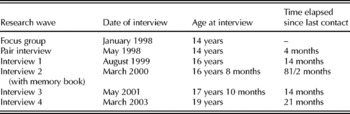
The purpose of my research was to explore the process of identity change over time, with a particular interest in the ways that young people forge gender identities. The qualitative archives that I worked with were drawn from the Inventing Adulthoods data set, a series of in depth interviews undertaken with four young people over a period of ten years. Each of these interviews lasted between one and three hours, with archives including up to 15 hours of transcribed interview material plus additional sources including data from focus groups in which the young person took part, transcripts, diaries, researcher field notes and case profiles. I selected just four cases for in depth analysis, chosen both because of what they represented in relation to the wider data set, and on the basis of the quality of the data itself (Thomson, Reference Thomson2004). An example of the archive for one of my cases (Karin) is shown in
Table 1.

From archive to history
The process of moving from a longitudinal archive to a case history involves a massive condensation of data, but also a structured analysis. My particular approach sought to find a way of combining cross sectional and longitudinal analyses.
Initially I immersed myself in the individual archive, analysing each interview in its own right, identifying themes inductively, in order to explore connections between interviews over time. In order to craft a case history I condensed and conceptualised the raw interview data through a model appropriate to my particular purposes. Although our interviews invited young people to narrate their lives in the round, I used a model to divide their accounts into biographical fields. The exact categories employed for each case arose from the initial analysis of the data set but tended to reflect the domains of the domestic; paid work; leisure, and education. For each of these biographical domains I forged a longitudinal account. This entailed drawing together all the data relevant to each field across the different interviews and sketching a narrative of change and continuity over time, an approach that is similar to Saldana's idea (2003) of the ‘through lines’ that can structure a longitudinal analysis. Combining and relating these biographical parts back into a narrative whole constituted the written histories. Returning to the example of Karin, the case history was constructed using the following ‘through lines’:
• Education: hanging in and hanging out.
• Play: style, sexuality and ‘trying men on’.
• Family life: the baby, sister and the mother.
The aim of the case history is to provide a compelling account of the individual, of how and why events unfolded as they did and of the transformation of the individual over time. As Bertaux and Delacroix (Reference Bertaux, Delacroix, Chamberlayne, Bornat and Wengraf2000) explain, the purpose of this kind of life history is not so much to predict how a life will develop, but to explain why a life was lived as it was, accounting for the number of ‘unlived lives’ that did not transpire. Theory is one of the main tools that the analyst employs in this task and will dictate the character of the ‘through lines’ that become the focus for the analysis.
Case histories in conversation
The next stage of my approach was to place case histories in conversation with each other. I have avoided using the terminology of comparison due to the impossibility of comparing like with like when working with biographical material. Contrast can be a very powerful analytic tool, and the basis on which individuals are selected for the purposes of contrast are a critical aspect of research design. Here I highlight how I interrogated the data in complementary ways, one privileging the individual accounts and the other privileging the social and the spatial context. Both approaches employed contrast as a key analytic strategy. To demonstrate my approach I draw on two of the four case histories, Karin (referred to above) and Sherleen. Both were working class young women who were followed through their final years of compulsory education. Sherleen was an only child and African Caribbean, growing up in the English inner city. Karin was the youngest of three, Catholic and white growing up in a Northern Irish city.
Privileging the individual and the temporal
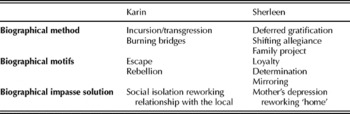
Table 2reproduced below shows a conversation between case histories that pays particular attention to the narrative features of the accounts. Here I ask questions of both the case histories including how actions and motives are framed (biographical methods), what were the recurrent motifs and turns of phrases (biographical motifs), and whether there were key events and turning points identified within the history (biographical impasses and solutions).

Sherleen's case history drew attention to the centrality of her relationship with her mother, a single parent who encouraged her daughter to invest in education, yet then struggled with the emotional losses that would be associated with social mobility. A focus on biographical methods and motifs made it possible to see how both Sherleen and her mother sought to find ways in which educational success could be reworked as a whole family project. Yet over time a crisis or biographical impasse emerged in the coincidence of Sherleen's loss of educational motivation and her mother's fall into depression. Sherleen's ultimate decision to stop living with her mother and to remake her home with her grandparents while also determining to ‘stay local’ for her university education can be seen as a biographical solution to the conflicting pressures of social mobility and a reliance on family support.
Karin's family also aspired to social mobility for their children, the first generation to make it into higher education. Yet her biographical method differed enormously from that practised by Sherleen. In her accounts she presented herself as rebelling against the norms and values of her local community, transgressing class, gender and sectarian boundaries. Through her appearance, leisure activities and sexual and social relationships she systematically ‘burned her bridges’, actively setting herself against the local conventions of acceptable behaviour. Where Sherleen invested in family and study, Karin invested her energy in a mixed faith peer group, alternative leisure, youth culture and risk taking. The outcome of this biographical method was occasional social isolation, and on a couple of occasions Karin retreated into the domestic in order to nurse her wounds. Unlike Sherleen she did not invest heavily in education, but she always did ‘just enough’ so that she did not fail educationally, understanding it as her passport out of a town she despised.
This way of reading and juxtaposing case histories privileges the individual story and its narrative features. It provides a way of further condensing data, and of placing the cases into productive conversation. Both young women were the first generation in their family to contemplate higher education and for both this kind of social and geographical mobility created biographical problems. What these were and how they responded to them differed significantly. A focus on the distinctive biographical methods, motifs, impasses and solutions that emerged from the stories of two young women provides one way of exploring these differences.
Privileging the social and the spatial
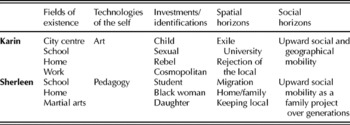
The second way in which I juxtaposed the cases enabled me to interrogate the data set from a different direction, asking a different set of questions of the case history. In
Table 3I detail the social and spatial context for these two young women's case histories. My particular interests led me to explore the data through established theoretical concepts including the categories of ‘fields of existence’ and ‘technologies of the self’ derived from the work of Pierre Bourdieu and Michel Foucault as well as more grounded understandings of ‘investments/identifications’ and ‘spatial and social horizons’. These are all analytic categories that lead our attention from the individual to the social, providing a complementary perspective to the focus on individual biography outlined above.

The fields that most characterise Sherleen's account are education and the home. With the exception of her involvement in martial arts (where she is a black belt and a teacher), she avoids socialising with peers and commercial settings – understanding such activities as jeopardising her study. Sherleen is comfortable with an educational mode of interaction, whether that be as a sensible student or a generous teacher and she employs pedagogy as a technique of the self in many areas of her life. All experiences are potential learning opportunities and she consciously extracts useful information and resources as a matter of course. Sherleen works incredibly hard and the motivation for this labour is tied up with identifications as a black woman who will have to achieve against the odds, and a good daughter/granddaughter who has a duty to those who have made sacrifices for her. Her spatial and social horizons are shaped by these investments – she has no intention of moving away from her immediate neighbourhood and recognises her emotional reliance on her family, passing up several opportunities for personal advancement that involved leaving her neighbourhood and home town.
An additional field of existence, the city centre, distinguishes Karin's account, and it is here that she explores creative and sometimes risky forms of self-expression. Through hanging out, skateboarding and graffiti she adopts an artistic technology of the self, investing in an identity that is rebellious and sexual yet also childlike – eschewing adult responsibilities. Central to Karin's identifications is a rejection of the local and an adoption of a cosmopolitan identity. This is in part a reaction to the local sectarianism that constrains physical mobility and social mixing, but is also supported by the confidence derived from having older siblings at university in England. The vociferousness of Karin's rebellion can be explained in part by the strong pull that the traditional working class culture of her community holds for her as the last of her siblings to be in the home and remaining in the country. Like Sherleen she is aware of the hopes and the thwarted ambitions of her parents and this is difficult to live with. Yet circumstance and resources enable a very different reaction.
Together, these matrices represent two directions in which a qualitative longitudinal data set can be interrogated. The analyses that arise from these different approaches are distinct yet complementary. The overall aim of my approach was to employ longitudinal data in order to construct a story of a life, which was greater than the sum of its parts (the individual interview transcripts) making it possible to gain insight into underlying biographical and social processes at play. These case histories were forged through a combination of synchronic and diachronic analysis and the application of a conceptual model. By bringing a number of these case histories into conversation I sought to find ways of identifying analytic patterns at a higher level of abstraction/generality. By again employing the two directions of analysis I have attempted to recognise and respond to the dynamic and multifaceted character of the data.
Although my theoretical interests may appear to be distant from the substance of much policy research, I suggest that the structure of this analysis – the creation of case histories and the subsequent conversation between them – has relevance for those engaged in qualitative longitudinal policy research. It was only by looking at data from both of these analytic directions that it became possible to make sense of the structured yet unique destiny of the individual, and the significance of the interplay of resources and resourcefulness over time. It is not simply a chronological description of change but an exploration of how the individual is involved in creating that change, in a specific temporal and social context. It gets away from a simple before-and-after or cause-and-effect model of behavioural change and points towards a more dynamic interplay of timing, resources, and resourcefulness.
In search of a four dimensional analysis
Qualitative longitudinal data overwhelms the kind of two dimensional strategies of data analysis that have tended to be employed in qualitative data analysis, whether that be the kind of framework analysis developed by Lewis and colleagues (Ritchie and Lewis, Reference Ritchie and Lewis2003) or approaches to coding and sorting interview transcripts associated with computer assisted data analysis packages. Accounts of the analysis of qualitative longitudinal data have sought to transcend the limits of two-dimensional analysis in different ways. For example, Saldana (Reference Saldana2003) encourages the use of music and narrative metaphor in the search for an analytic ‘through line’. Lewis (this issue) argues that recursivity can bring a third dimension into a framework approach. In work with Janet Holland, I have talked in terms of finding ways of synthesising and articulating cross-sectional and longitudinal approaches (Thomson and Holland, Reference Thomson and Holland2003). My experience of working with qualitative longitudinal data has convinced me that longitudinality and cross sectionality are two aspects of the character of the data that seek expression at each stage of analysis of qualitative longitudinal data.
The case history approach has much strength. Most significantly, it enables a focus on the processual – on ‘how’ something happens over time. It is not simply a documentary method as it involves a massive condensation of primary data. The analyst must actively create a history from the archive. The temporal character of the data set means that specificity, concrete events, juxtapositions and coincidences, lie at the heart of the analytic story that is forged. So the case history is simultaneously abstracted from the mass of detail that constitutes the archive, and concretely tied to the particularities of the case. It is not possible to generalise interpretations from the case history, yet depth can also provide a foundation for insight. Although a case history is constructed to demonstrate ‘how’ a process takes place over time, the culmination of this project is also the starting point for understanding ‘why’ questions. By placing case histories into conversation with each other, it may also be possible to identify patterns and to engage in theoretical development.
Yet the qualitative longitudinal case history also presents us with some real ethical challenges, demanding that we recognise that insight and the satisfaction of curiosity may exist in some tension with the invasion of privacy.
The practical and ethical challenges arising from case histories
The significant costs associated with quantitative longitudinal research have always been offset by the potential that such data sets hold for secondary analysis. The emergence of qualitative longitudinal research as a paradigm has been characterised by a recognition that archiving and secondary analysis are an integral part of the project (Holland et al., Reference Holland, Thomson and Henderson2004; Henderson et al., Reference Henderson, Holland and Thomson2007b). The challenges associated with secondary analysis of qualitative data have begun to be debated with opinion dividing on a range of issues including the difficulties involved in recreating context, the role of the original researcher and the protection of participants. As Henderson and colleagues (2007b) point out, both the problems and possibilities of secondary analysis are amplified with a qualitative longitudinal data set.
Qualitative researchers have tended to take their responsibility to protect the privacy of participants very seriously, offering confidentiality as a matter of course and ensuring that where possible data is anonymised. The growing demand by research councils for academic researchers to archive data has added considerably to the costs of qualitative research. The possibility that participants may opt to forgo confidentiality is one of the most challenging aspects of the growing popularity of visual methods and sociologists are having to review their own ethical investments in the light of different approaches in other disciplines (Kemper and Royce, Reference Kemper and Peterson Royce2002; Pink, Reference Pink2001).
At the earliest stage of the Inventing Adulthoods study we were unaware that we were engaging in a longitudinal project, and we had no intentions to archive the data set. As the study evolved we became aware that in order to realise the full potential of the data set we would need to share it with other analysts. With the support of the ESRC we are in the process of archiving the data set, and building a community of secondary analysts. As such we have to contend with the ethical problems that arise from this kind of data set.
The accumulation of interview accounts from a prospective qualitative longitudinal study such as ours can give rise to an extraordinary perspective on the individual. As noted at the beginning of this paper, multiple interviews with the same individual enable us to get beneath the surface of accounts. The whole is more than the sum of its parts, and as (often-contradictory) accounts accumulate over time, it becomes possible to gain far-reaching insight into an individual's psyche. In the Inventing Adulthoods study we felt a need to share this perspective, and after the third round of interviews offered all participants a copy of their tapes. If these young people were to give us informed consent (renegotiated at each round) we felt that it was crucial that they understood what the data enabled us to ‘see’. In practice we could only demonstrate a willingness to share the perspective that the data allowed us, as not all young people took up our offer, and not all of those who did listened to their tapes.
As we have begun to work more with depth and individual cases, the problem of privacy has become more of a challenge. Some qualitative longitudinal researchers make a positive decision not to use individual case studies in published work (Wierenga, Reference Wierenga2002), however we have been determined to find a way of doing so that was respectful to all concerned. Our commitment to archiving and secondary analysis made this more urgent.
The case history approach described here resulted in extremely detailed accounts of individual lives. Although these accounts were anonymised, with key identifying details changed, they were nevertheless recognisable to those whose lives were documented and interpreted. Although all participants had given consent for their transcripts to be used in published material, I wanted to consult the individuals concerned before deciding whether to publish these case histories. The following extract is drawn from an interview with Karin, conducted after she has read her case history, and it suggests that both sharing and withholding interpretations of data may be problematic.
Karin: It was kind of cringe-worthy reading it. But at the same time I know everything I told you, you are just kind of passing it back now. You didn't just pick things out of nowhere, so nothing shocked me.
Int: Do you feel that it is an accurate feedback?
Karin: Yeah. There were some things ‘Ah, I knew that already’ and then there were other things ‘Oh really? I'll have to think about that’. But yeah.
Int: So what kinds of things surprised you?
Karin: I was surprised by the whole, ahm [laughs] that I should ‘try and transgress conventional modes of femininity’. I didn't know I did that! But then, when I think about it, aye, I did. But I wouldn't have noticed that myself . . . You didn't come up with anything shocking. I told you something, you thought about it and then told it back to me in your ways.
Int: Its quite an unusual thing, for anybody involved in research to actually receive that back again.
Karin: Yeah. I think that it would have been much easier for me not to have got this. See if you are ever doing this again, don't bother. I don't think that anybody needs to [laughs].
Int: You think it would have been better not to have it?
Karin: I might be more wary about talking to you. Cos I never know what you're going to think about me now.
We have always recognised that an involvement in a longitudinal study is an ‘intervention’ into a person's life and as such have sought to ensure that this intervention was as benevolent as possible (Thomson and Holland, Reference Thomson, Plumridge and Holland2003). Reading a sociological account of the life that you are living is perhaps more than we might ask of a study participant. As we move forward with the project of writing up, archiving and sharing the data set we are having to balance our desire to realise the potential of the data with a concern with the well-being of the research participants. Although a commitment to consultation and participation is an important aspect of this process, it does not in itself solve all the ethical issues involved.
Conclusion
In this paper I have reflected on my experience of developing ‘case histories’ from a qualitative longitudinal data set. This data set was not the product of social policy research, but rather policy relevant sociological enquiry. However, some of the insights gained from this work have relevance for social policy research. In particular, the analytic practice of reading data in two directions – following the individual biography over time, and reading it in relation to wider social categories and other cases – makes it possible to gain a purchase on the dynamic interplay of the personal and the ecological that policy researchers are increasingly interested in.
The investment involved in creating a qualitative longitudinal data set means that they will be of great interest as a source for secondary analysis. The approach described here can be understood as an exercise in secondary analysis of a data set that I was centrally involved in collecting and analysing. My approach was designed to realise the potential of this particular qualitative longitudinal data set and as such explored a small number of cases in depth. One of the great strengths of repeat interview data is that it allows us to get beneath the surface of accounts. The way in which a longitudinal archive is transformed into an analytic account, or case history, is not simply an exercise in data condensation, but also involves systematic analysis and theoretical interpretation. I have described two stages in the development of a case history approach to qualitative longitudinal data. The first involves the use of cross sectional and narrative approaches in the forging of case histories. The second involves bringing case histories together in ‘conversation’, again employing two complementary analytic strategies that privilege both the individual/longitudinal dimension and the social/cross sectional dimension of the data set.
The perspective enabled by the case history approach raises important practical and ethical challenges that are not easily resolved. It is an approach that gives rise to thick descriptions of individual lives rather than typologies of pathways or ‘characters’. Yet these condensed accounts also capture the essence of the interplay between agency and ecology, the particular and the general. As these issues move to the centre of social policy research, the qualitative longitudinal case history has much to offer.