Human Immunodeficiency Virus (HIV) infection and Acquired Immunodeficiency Syndrome (AIDS) are two current, major health problems. Since the mid 1990’s, the epidemiological pattern of HIV infection has changed substantially, its transmission mechanism shifting from primarily parenteral to primarily sexual (Centro Nacional de Epidemiología, 2011). According to epidemiological data on HIV/AIDS prevention in Spain from the Director General of Public Health, Quality, and Innovation (Centro Nacional de Epidemiología, 2014), of the 3,210 new HIV diagnoses reported in 2013, 82% were sexually transmitted: 51% in men who have sex with men, 31% in heterosexual sex.
This changing epidemiological pattern has facilitated the implementation – by the designated authorities – of various preventive strategies that aim to attenuate the spread of the epidemic via sex. Nevertheless, to get effective results, there is a clear need to identify and better understand the variables that cause or perpetuate sexual risk behaviors (Espada, Quiles, & Méndez, Reference Espada Sánchez, Quiles Sebastián and Méndez Carrillo2003). Based on that premise, several theoretical models have been developed to explain sexual risk behaviors. For instance, within the framework of Social Cognitive Theory, Bandura (Reference Bandura, DiClemente and Peterson1994) proposed the Self-efficacy Model to explain sexual behaviors that risk HIV infection. Bandura (Reference Bandura1986) defined self-efficacy as “people’s judgments of their capabilities to organize and execute courses of action required to attain designated types of performances” (p. 391). He posits that behavior is mediated by a process of cognitive appraisal in which people combine past experiences, attitudes, knowledge, physiological states, and social influences to form an estimate of the abilities they need to execute a given behavior. Thus, whether or not someone uses a condom depends not just on the conviction that it prevents HIV infection (outcome expectations), but also on self-perceived ability to use one in the moment of sex (self-efficacy expectations).
To date, many studies have concluded there is a relationship between perceived self-efficacy and various HIV-prevention behaviors and attitudes. In a study of college students, Ballester, Gil-Llario, Ruiz-Palomino, and Giménez-García (Reference Ballester, Gil-Llario, Ruiz-Palomino and Giménez-García2013) found that people with high self-efficacy scores reported more condom use in vaginal intercourse and in sex under the influence of alcohol or other drugs, a lower probability of having sex when no condom is available, greater trust in condoms as a reliable HIV prevention method, and lower perceived probability of contracting HIV. The data in other, similar studies have been consistent with those findings (Davis et al., Reference Davis, Masters, Eakins, Danube, George, Norris and Heiman2014; Mashegoane, Moalusi, Ngoepe, & Peltzer, Reference Mashegoane, Moalusi, Ngoepe and Peltzer2004; Morokoff et al., Reference Morokoff, Quina, Harlow, Whitmire, Grimley, Gibson and Burkholder1997).
Growing interest in the relationship between perceived self-efficacy and sexual risk behaviors implicated in HIV transmission, has prompted the development and validation of several instruments designed to measure that variable. One example, developed and validated in a Spanish population, is Ballester et al.’s (Reference Ballester, Gil-Llario, Ruiz-Palomino and Giménez-García2013) Escala de Autoeficacia para el Uso del Preservativo [Condom Use Self-Efficacy Scale]. The original instrument was part of the Cuestionario de Prevención del Sida (CPS) [AIDS Prevention Questionnaire (APQ)] by Ballester, Gil, and Giménez (Reference Ballester, Gil and Giménez2007). It includes seven prompts to evaluate different skills related to condom use at different points in sexual relations: condom acquisition, before starting to have sex, condom negotiation with the sex partner, putting it on, maximum sexual arousal, and situations where alcohol or other drugs have been consumed.
On a different note, increased sexual freedom in Spanish society, along with greater normalization of the LGB (lesbian, gay, bisexual) community, have brought to light the growing practice of sexual behaviors other than vaginal and anal intercourse. For example, cunnilingus is performed by 72.9% of heterosexuals (Ballester, Gil, Giménes, & Ruiz, Reference Ballester, Gil, Giménez and Ruiz2009), and 72% of homosexual women (Bailey, Farquhar, Owen, & Mangtani, Reference Bailey, Farquhar, Owen and Mangtani2004) and anilingus is performed by 87.7% of homosexual and bisexual men (Folch et al., Reference Folch, Ferrer, Casabona, Fernández-Dávila, Soriano and Díez2013). Both require the use of adequate alternative prevention methods, like latex barriers (Richters, Prestage, Schneider, & Clayton, Reference Richters, Prestage, Schneider and Clayton2010), which are latex rectangles that cover the vulva or anus during oral sex to prevent direct contact with bodily fluids. Considering that the instruments available were developed to assess self-efficacy in condom use (Baele, Dusseldorp, & Maes, Reference Baele, Dusseldorp and Maes2001; Brafford & Beck, Reference Brafford and Beck1991; Hernández & López, Reference Hernández Cortina and López Rebolledo2011), an effort should be made to develop and validate assessment instruments to tap self-efficacy in latex barrier use.
With that in mind, and given that the brevity and simplicity of the Condom use Self-Efficacy Scale, the present study’s objective is to adapt it so it can be applied in the latex barrier context to the Spanish population at large. We will then examine its factorial structure through exploratory factor analysis and subsequent confirmatory factor analysis. Next, we will analyze its psychometric properties separately in men and women, as Ballester et al. (Reference Ballester, Gil-Llario, Ruiz-Palomino and Giménez-García2013) and Burns and Dillon (Reference Burns and Dillon2005) advised. Reliability analysis will look at the seven items’ internal consistency, and construct validity analysis will determine whether the instrument has any relation to other variables it is theoretically related to, such as: attitudes toward condoms, and high-risk sexual behaviors. We expect that self-efficacy scores will be positively related to condom use, perceived self-efficacy in condom and latex barrier use for HIV prevention, and ability to refuse sex in which HIV-prevention methods are not utilized (Ballester et al., Reference Ballester, Gil-Llario, Ruiz-Palomino and Giménez-García2013; Mashegoane et al., Reference Mashegoane, Moalusi, Ngoepe and Peltzer2004).
Method
Participants
The sample was recruited through a combination of convenience sampling and quota sampling, making an effort to balance participants’ gender, age, and geographical area of Spain. The following inclusion criteria applied: having had some kind of sex with another person, good mastery of the Spanish language, and agreeing to participate in the study.
A total of 480 people participated, 36.90% of them men and 63.10% women, from various geographical areas in Spain: Andalusia (6.30%), Aragón (2.10%), Asturias (2.70%), Balearic Islands (2.50%), Canary Islands (2.50%), Cantabria (0.40%), Castilla-La Mancha (3.10%), Castilla y León (4.60%), Catalunya (15%), Extremadura (14.80%), Galicia (4.40%), Madrid (17.90%), Murcia (0.20%), Navarra (6.90%), Basque Country (0.40%), La Rioja (0.20%), and Comunidad Valenciana (16%). They ranged in age from 17 to 57 years old (M = 26.25; SD = 7.72), of which 53 were age 17 to 19, 313 were 20 to 39, 75 were 30 to 39, 30 were 40 to 49, and 9 were over 50 years old.
Regarding sexual orientation, 342 participants identified as heterosexual (73.70% of them women, 26.30% men), 93 homosexual (17.20% of them women, 82.80% men), and 45 bisexual (77.80% of them women, 22.20% men).
In terms of sexual activities, 86% of heterosexual or bisexual male participants reportedly perform cunnilingus, along with 86.27% of homosexual and bisexual female participants. Meanwhile, 27% of heterosexual and bisexual men in our sample reportedly give rim jobs, along with 77.01% of homosexual and bisexual men, 16.33% of heterosexual and bisexual women, and 33.33% of homosexual and bisexual women.
As for level of education, 42.30% had secondary schooling, 56.90% went to college, and just 0.80% had only primary schooling. 96.70% of participants surveyed were Spanish, 3.30% immigrants.
Instruments
Latex Barrier use Self-Efficacy Scale (LBSS) [Escala de Autoeficacia para el uso de la Barrera de Látex (EABL)]
This instrument was created by adapting items on the Condom use Self-Efficacy Scale ad hoc for the latex barrier context. It is made up of 7 items that tap different abilities related to latex barrier use in different scenarios leading up to sex: acquisition or purchase, the moments before starting to have sex, negotiation with the sex partner, actually using the latex barrier, times when alcohol or other drugs have been consumed, and moment of maximum sexual arousal. Participants’ responses are given on a Likert-type scale with five options indicating their level of agreement/disagreement with each statement: 1 = strongly disagree, 2 = disagree somewhat, 3 = neutral, 4 = agree somewhat, 5 = strongly agree. Items 1, 2, 5, and 7 are worded positively, while 3, 4, and 6 are worded negatively. Higher scores reflect higher perceived self-efficacy in latex barrier usage.
AIDS Prevention Questionnaire (APQ; Ballester et al., Reference Ballester, Gil and Giménez2007) [Cuestionario de Prevención del Sida (CPS)]
This instrument is made up of 65 questions with different formats: 29 dichotomous, 23 Likert scale, 8 multiple choice, and 5 open ended. It evaluates components that the specialized scientific literature has shown are important in HIV prevention: attitudes, self-efficacy, perceived risk, knowledge, behaviors, and intended behavior. The scale’s psychometric properties are acceptable, considering we obtained a Cronbach’s alpha of .70 and a test-retest correlation of .83.
Condom use Self-Efficacy Scale (CSS; Ballester et al., Reference Ballester, Gil-Llario, Ruiz-Palomino and Giménez-García2013) [Escala de Autoeficacia para el uso del Preservativo, EAP]
This instrument was originally a subscale of the AIDS Prevention Questionnaire (Ballester et al., Reference Ballester, Gil and Giménez2007), but its psychometric properties were tested independently, and the information it provides is of great interest to the present research, so we decided to administer it separately. It includes 7 prompts (for example, “me siento/sentiría cómodo/a o seguro/a a la hora de comprar condones [I feel/would feel comfortable and safe buying condoms]” and “si tengo que sugerir a una pareja que usemos condón, tengo/tendría miedo de que me rechace [if I have to suggest using a condom to a partner, I fear they would reject me]”). Responses are given on a Likert-type scale from 0 (strongly disagree) to 5 (strongly agree); bear and mind that items 3, 4, and 6 are worded the opposite way as the other items. Validation studies in different samples of Spanish university students have shown its reliability, measured using Cronbach’s alpha, to be between .62 and .64. The instrument exhibits a one-dimensional structure. Higher scores are indicative of higher self-efficacy in condom use.
Sexual Assertiveness Scale (SAS; Morokoff et al., Reference Morokoff, Quina, Harlow, Whitmire, Grimley, Gibson and Burkholder1997)
We used the version adapted and validated in a Spanish population by Sierra, Vallejo-Medina, and Santos-Iglesias (Reference Sierra, Vallejo-Medina and Santos-Iglesias2011). The instrument’s18 items (for instance, “I have sex without using a condom or latex barrier if my partner wants” and “I refuse to have sex if my partner refuses to use a condom or latex barrier”) evaluate people’s ability to respond in sexually assertive ways in three scenarios: initiating sex (Initiation), refusing unwanted sexual activities (Refusal), and insistence on contraceptive use to prevent pregnancy and sexually transmitted infection (Pregnancy-STD Prevention, P-STD). Items are scored on a Likert-type scale ranging from 0 (never) to 4 (always). The Spanish adaptation’s internal consistency, assessed using omega coefficients, was over .76 for all three dimensions.
Procedure
First, we proceeded to adapt the questionnaire’s terminology, the objective now being to evaluate self-efficacy in latex barrier use rather than condom use. In the process, we paid close attention to gender in the questions so the items’ wording would include men and women alike. We reduced the response scale to five points to avoid response dispersion, and confirmed that the change improved reliability over the original instrument. Next, we sent the instrument to two professionals in the field of Health and Sexuality Psychology to judge item comprehension. Anytime the experts found the wording of an item unclear, they were asked to suggest an alternate wording. The resulting final instrument was administered to a small group from the general population to again establish that its seven items were comprehensible. It appears in Appendix 1.
To gather the sample, we first contacted 25 associations and entities (youth centers, student organizations, LGBT groups, universities, organizations that fight against HIV/AIDS, etc.) to ask for their collaboration and give them information about the present research. The 20 organizations willing to collaborate posted, via social media or at their website, a message with generic information about the study and a link directing respondents to the online questionnaires. Each time a participant accessed the survey online, s/he was given information about the research objectives, and then provided informed consent. At all times, we communicated that their responses would be anonymous and confidential. Participation was voluntary, and participants received no form of compensation. The sample was formed between the months of June and September of 2014.
Data Analysis
To explore and later verify the instrument’s factorial structure, participants were randomly divided into two subsamples: we conducted Exploratory Factor Analysis (EFA) in the first one, comprised of 180 individuals (61.67% female, 38.33% male) ranging in age from 17 to 52 years old (M = 26.03; SD = 7.71); and Confirmatory Factor Analysis (CFA) was carried out in the second, consisting of 300 participants (64% women, 36% men) ranging in age from 17 to 57 years (M = 26.38; SD = 7.73).
To determine the instrument’s psychometric properties, we did the following analyses:
-
1) Statistical analysis of items (mean, standard deviation, skewness, and kurtosis), item-total and item-factor correlations, and Cronbach’s alpha if the item were eliminated.
-
2) Kaiser-Meyer-Olkin test and Bartlett’s test of sphericity. EFA in Subsample 1 by means of unweighted least squares factor extraction (the sample shows non-normal distribution) and direct oblimin rotation (factors are assumed to be related). Factor extraction through parallel analysis.
-
3) Unweighted least squares analysis by gender to see if this yields different factors than in the total sample.
-
4) Internal consistency evaluated in terms of Cronbach’s alpha coefficient.
-
5) CFA in Subsample 2 using structural equation modeling. We decided to employ Satorra-Bentler (χ2 S-B) scaled chi-square difference testing, assuming non-normal distribution. The following goodness of fit indexes were used: the Satorra-Bentler ratio of chi-square to degrees of freedom (χ2 S-B/df), Normed Fit Index (NFI), Non-normed Fit Index (NNFI), Comparative Fit Index (CFI), and Root Mean Square Error of Approximation (RMSEA). The model was considered to fit the data well if χ2S-B /df was less than or equal to two (Ullman, Reference Ullman, Tabachnick and Fidell2001); NFI, NNFI, and CFI were over .95 (Hu & Bentler, Reference Hu and Bentler1999); and RMSEA was less than or equal to .06 (Kline, Reference Kline1988).
-
6) One-way Analysis of Variance (ANOVA) to calculate potential significant differences between men and women.
-
7) Convergent validity in terms of the Pearson correlation coefficient between the LBSS and other, theoretically related constructs: self-efficacy in condom usage, insistence on using HIV-prevention methods, and considering condoms and latex barriers reliable.
All analyses were executed in the programs: IBM SPSS Statistics 20, Factor 9.30.1, and EQS 6.1.
Results
Item Analysis and Exploratory Factor Analysis
To explore and later verify the instrument’s factorial structure, participants were randomly divided into two subsamples. No significant differences were found between subsamples as a function of sex (χ2 = .263; p >.05), age (t 458 = 1.75; p >.05), sexual orientation (χ2 = .044; p >.05), or level of education (χ2 = 6.799; p >.05).
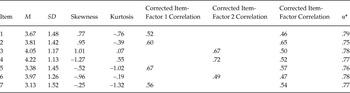
First, we analyzed the seven items’ metric properties. As shown in Table 1, item 4 had the highest mean (M = 4.22; SD = 1.13), and item 7 had the lowest (M = 3.13; SD = 1.52). Note that the means obtained on all items fell near the questionnaire’s theoretical mean (M = 2.5). Corrected item-total correlations surpassed the established minimum (.30), ranging from .46 to .65. On the negative attitudes subscale, correlations ranged from .49 to .72, and on the positive attitudes subscale, correlations ranged from .52 to .67.
Descriptive Statistics for the Two-factor Solution (n = 180)

* Cronbach’s alpha if the item were eliminated
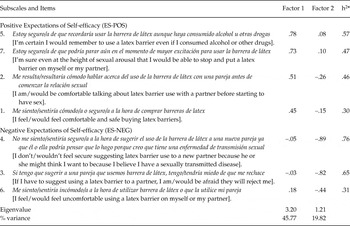
Next, to determine the instrument’s factorial structure, EFA was conducted in Subsample 1 (n = 180). Results on the Kaiser-Meyer-Olkin test (KMO = .71) and Bartlett’s test of spheriticity (χ2 21 = 486.89, p < .001) were satisfactory, indicating it was appropriate to proceed with factor analysis. Thus, EFA was done using unweighted least squares factor extraction and oblique direct oblimin rotation, which according to parallel analysis yielded two factors, together explaining 65.59% of total variance (see Table 2). The total questionnaire’s internal consistency (α) was .80. The factorial structure was configured as follows. The first factor, which we will call Positive Expectations of Self-efficacy (ES-POS), accounted for 45.77% of total variance and included four items (1, 2, 5, and 7) that measure different positive expectations of self-efficacy that would facilitate latex barrier use. Factor loadings onto this factor ranged from .45 (item 1) to .78 (item 5). Internal consistency, calculated using Cronbach’s alpha coefficient, was .78. Meanwhile, the second factor, which we shall call Negative Expectations of Self-efficacy (ES-NEG), accounted for 19.82% of total variance and included three items (3, 4, and 6) that measure different negative expectations of self-efficacy that would interfere with, or reduce the probability of, latex barrier use. Items’ factor loadings on this factor ranged from .44 (item 6) to .89 (item 4). This subscale had a Cronbach’s alpha of .78. We must point out that it is possible the factors yielded through EFA were the result of methodological artifact, considering that the negatively worded items, scored in the reverse, all loaded onto the same factor.
Configuration Matrix

* Communalities
Third, we performed unweighted least squares analysis by gender to see if different factors would emerge in keeping with the statistically significant differences in normative data for men versus women (see Table 4). However, the differences were almost nonexistent; we found two components with the same composition as before, together explaining 60.88% of variance in men’s scores and 64.68% of variance in women’s scores.
Confirmatory Factor Analysis
Next, we conducted CFA in Subsample 2 (n = 320). Coefficients of skewness and kurtosis revealed that the sample was non-normally distributed, so we utilized the Satorra-Bentler (χ2 S-B) chi-square statistic and other robust statistics rather than the chi-square statistic (χ2) from maximum likelihood estimation. The model was considered to fit the data well if χ2 S-B /df was less than or equal to two (Ullman, Reference Ullman, Tabachnick and Fidell2001); NFI, NNFI, and CFI were over .95 (Hu & Bentler, Reference Hu and Bentler1999); and RMSEA was less than or equal to .06 (Kline, Reference Kline1988).
Based on our review of the theory and data collected in EFA, we proceeded to compare two different models:
Model 1
One-dimensional model that considers self-efficacy a single entity.
Model 2
Two-factor model that considers self-efficacy a conjunction of positive and negative attitudes. This was the model obtained previously in EFA.
Table 3 presents goodness of fit indexes for the models we compared. The one-dimensional model was rejected because its goodness of fit indices reflected inadequate fit to the data. Conversely, all the two-factor model’s goodness of fit indices were optimal: χ2 S-B/df (1.56), NFI (.96), NNFI (.98), CFI (.99), and RMSEA (.04). A path diagram of the model shows standardized weights ranging from .39 (item 7) to .85 (item 4), and a correlation between factors of .60. Note that the error in items 5 and 7 covaried, as suggested by the values of modification indexes obtained, as both items refer to specific situations that hinder latex barrier use (item 5: “Estoy seguro/a de que recordaría usar la barrera de látex aunque haya consumido alcohol u otras drogas [I’m certain I would remember to use a latex barrier even if I consumed alcohol or other drugs]”; item 7: “Estoy seguro/a de que podría parar aún en el momento de mayor excitación para ponerme la barrera de látex o ponérsela a mi pareja [I’m sure even at the height of sexual arousal that I would be able to stop and put a latex barrier on myself or my partner]”).
Goodness of Fit Indexes for the Models Compared

Note: χ2S-B = Satorra-Bentler χ2; χ2/df = relative χ2; NFI = Normed Fit Index; NNFI = Non-normed Fit Index; CFI = Comparative Fit Index; RMSEA = Root Mean Square Error of Approximation.
* Covariance of the error in items 5 and 7
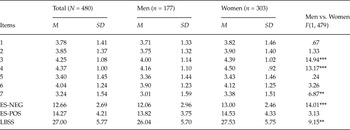
Means, Standard Deviations, and ANOVAs by Gender (N = 480)

*** p < .01; **p < .01
Normative Data
In the total sample, the two items with the highest mean scores were 4 (M = 4.37; SD = 1.00) and 3 (M = 4.25; SD = 1.08), while items 7 (M = 3.24; SD = 1.54) and 5 (M = 3.40; SD = 1.45) had the lowest mean scores. ANOVA as a function of gender in the total sample, on each item and subscale, revealed statistically significant differences on items 3, F(1, 479) = 14.94; p < .001; 4 F(1, 479) = 13.17; p < .001; 7 F(1, 479) = 6.87; p < .01; and ES-NEG F(1, 479) = 14.01; p < .001, with women consistently scoring higher than men. In terms of total self-efficacy level, we found that women reported higher perceived self-efficacy in latex barrier use (M = 27.53; SD = 5.75) than men (M = 26.04; SD = 5.70); F(1, 479) = 9.15, p < .01.
Convergent Validity
We went on to calculate convergent validity between perceived latex barrier self-efficacy, and perceived condom self-efficacy, ability to refuse sex unless HIV-prevention methods are utilized, and perceived reliability of condoms/latex barriers as methods to prevent sexual transmission of HIV. Correlations were calculated separately for men and women in light of research findings of a strong influence of gender (Ballester et al., Reference Ballester, Gil-Llario, Ruiz-Palomino and Giménez-García2013; Burns & Dillon, Reference Burns and Dillon2005).
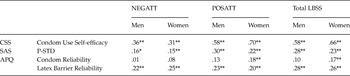
According to Table 5, all the correlations computed with the CSS, the P-STD subscale of the Sexual Assertiveness Scale, and the APQ item about latex barrier reliability were significant, regardless of gender. On the item about condom reliability, only in women were significant correlations found, and only with ES-POS (r = .18, p < .01) and Total LBSS (r = .17, p < .01); in men, no statistically significant correlation was observed between this item and another measure.
Correlation between LBSS Total and Subscale Scores, and Other Variables

Note: CSS = Condom use Self-Efficacy Scale; SAS = Sexual Assertiveness Scale; P-STD = Pregnancy-STD Prevention, APQ = AIDS Prevention Questionnaire; NEGATT = Negative Attitudes subscale of the LBSS; POSATT = Positive Attitudes subscale of the LBSS. *p < .05; **p < .01
Discussion
This study’s objective was to adapt an instrument to assess self-efficacy in latex barrier use, and analyze its psychometric properties. Having access to valid, reliable instruments of that kind is of the utmost importance; to collect data about abilities linked to latex barrier use could service the design and implementation of effective prevention interventions (Espada et al., Reference Espada Sánchez, Quiles Sebastián and Méndez Carrillo2003).
Our results were generally favorable. The items’ psychometric properties were adequate, and we obtained good corrected item-total and item-factor correlations, all above .45. EFA grouped the seven items into two factors that together explained 65.59% of total variance. The first factor, which we called ES-POS, captures some positive expectations of self-efficacy that favor latex barrier use. The second factor, called ES-NEG, reflects various negative expectations of self-efficacy that tend to diminish the likelihood of latex barrier use. This structure was replicated through CFA, with the two-factor model obtaining better goodness of fit indexes than the one-dimensional model.
The LBSS’s internal consistency, evaluated using Cronbach’s alpha coefficient, was adequate for the total scale (α = .80) and the two factors (α = .78) alike. Thus, we can compare that value to other scales that evaluate self-efficacy for preventive methods, like Brafford and Beck’s (Reference Brafford and Beck1991) Condom Self-Efficacy Scale (α = .91), the Specific Condom Use Self-efficacy Scales by Baele et al. (Reference Baele, Dusseldorp and Maes2001) (α = .65–.84), and the Escala de Autoeficacia para el uso del Preservativo [Condom Use Self-efficacy Scale] by Ballester et al. (Reference Ballester, Gil-Llario, Ruiz-Palomino and Giménez-García2013) (α = .62–.64).
In terms of validity evidence, analyses confirmed most of our hypotheses. As expected, the CSS correlated positively with latex barrier use self-efficacy in men (r = .58, p < .01) as well as women (r = .66, p < .01). That finding is consistent with others in the specialized scientific literature in supporting the conclusion that self-efficacy influences condom use (Ballester et al., Reference Ballester, Gil-Llario, Ruiz-Palomino and Giménez-García2013; Mashegoane et al., Reference Mashegoane, Moalusi, Ngoepe and Peltzer2004). At the same time, we found a moderate correlation between self-efficacy and perceived reliability of the latex barrier, independent of gender, and between self-efficacy and perceived reliability of condoms in women only (r = .17, p < .01). In that vein, Ballester et al. (Reference Ballester, Gil-Llario, Ruiz-Palomino and Giménez-García2013) found that trusting condoms as an effective method of HIV prevention correlated positively with self-efficacy. Finally, regarding sexual assertiveness, we found a positive correlation between the P-STD subscale of the Sexual Assertiveness Scale, and self-efficacy in men (r = .28, p < .01) as well as women (r = .23, p < .01). That is consistent with the findings of Ballester et al. (Reference Ballester, Gil-Llario, Ruiz-Palomino and Giménez-García2013) and Morokoff et al. (Reference Morokoff, Quina, Harlow, Whitmire, Grimley, Gibson and Burkholder1997), who reported a positive correlation between self-efficacy and refusal to have sex without a condom or latex barrier.
Last, comparisons as a function of gender supported additional aspects of the scientific literature. For example, our results indicate that women generally perceive themselves as more capable of resolving situations related to latex barrier use at different moments leading up to sex, which is consistent with research findings on condom use in college students by Ballester et al. (Reference Ballester, Gil-Llario, Ruiz-Palomino and Giménez-García2013), and Burns and Dillon (Reference Burns and Dillon2005). Nevertheless, a study conducted by Muñoz-Silva, Sánchez-García, Martins, and Nunes (Reference Muñoz-Silva, Sánchez-García, Martins and Nunes2009) in Spanish and Portuguese college students yielded contradictory results. Men in that study perceived more self-efficacy in condom usage than women. That discordant result could be due to differences in the preventive method in question – latex barriers in this case, condoms in all the other studies. Analyzing the situations proposed in our study to the minutest detail, we observed that men perceived lower self-efficacy than women on the items that describe possible rejection if they suggest using a latex barrier, and in situations requiring behavioral and emotional self-control abilities, as in the moment of maximum arousal.
In conclusion, this instrument’s main advantages are: a) robustness of the resulting factors, each of which explained at least 19% of total variance, and all items’ factor loadings exceeding .44; b) good internal consistency for the total questionnaire (α = .80) and the two factors (α = .78); c) brevity and simplicity, features that make it easier to administer and interpret. With all that in mind, we believe the LBSS may be an appropriate instrument to evaluate self-efficacy in latex barrier use. However, in the future, it would be advantageous to conduct new studies in older samples. It will also be important to adapt and validate the instrument in clinical populations and populations with high-risk sexual behavior, and to modify it so it can be applied in cases where non-latex barriers are used.